International Journal of Scientific Research in Computer Science, Engineering and Information Technology © 2017 IJSRCSEIT | Volume 2 | Issue 1 | ISSN : 2456-3307
A Dynamic Image Compression Using Improved LZW Encoding
Algorithm
M. Sangeetha, P. Betty
M.E Research Scholar, Department of Computer Science and Engineering, Kumaraguru College of technology, Coimbatore, India
ABSTRACT
Lossless image compression techniques seek the smallest possible image storage size for a specific level of image quality; in addition, dictionary-based encoding methods were initially implemented to reduce the one-dimensional correlation in text. The objective is to present a comparative measures of present techniques of image processing in accounts using compression techniques that are in use in Bio-metric images. Number of test has been performed to evaluate the presentation of projecting compression technique on the bio-metric data the performance reveals that LZW Compression algorithm having better accuracy of other predictive methods like Run-Length Encoding, Huffman Encoding, Delta Encoding, JPEG (Transform Compression) and MPEG algorithms are not performing well.
Keywords : RLE, LZW, JPEG, Compression, Delta Encoding.
I.
INTRODUCTION
Digital images are usually encoded by lossy compression methods due to their large memory or bandwidth requirements. The lossy compression methods achieve high compression ratio at the cost of image quality degradation. However, there are many cases where the loss of information or artifacts due to compression needs to be avoided, such as medical, prepress, scientific and artistic images. As cameras and display systems are going high quality and as the cost of memory is lowered, we may also wish to keep our precious and artistic photos free from compression artifacts. Hence efficient lossless compression will become more and more important, although the lossy compressed images are usually satisfactory in many cases.
Image compression is defined as the process of reducing the amount of data needed to represent a digital represent of a digital image. To remove the redundant data after storing and transmission of compression images using digital images. The main objectives of compression is to reducing the number of bits required to store and transmitting of digital images and without any loss of information can be measured.
an sub images. First, we have to consider for even row sub images Xe is encoded by using prediction of pixel image and other way of odd row sub images Xo is encoded for prediction and these two sub image using context adaptive coding to be implement.
The basic framework of image compression is discussed; although further details regarding image transforms/representations and coding. A digital image represents a two-dimensional array of samples, where each sample is called a pixel. Precision is determined by how many levels of intensity can be represented, and this is expressed as the number of bits per pixel (bpp). The value of bpp reflects different components of the color systems used. For example, in grayscale images the values represent brightness or luminance resolution and range from 1, 2, 4,8,12 or 16 bpp. For RGB color images, the values represent the intensity of each color space, and resolution is usually 24 bpp. An ideal image compression would remove redundant and irrelevant information before the coding process. Redundancy in images can be classified as statistical redundancy or psycho visual redundancy. Statistical redundancy can be classified into three types:
Spatial, due to the correlation between neighboring pixels in an image;
Spectral, from correlation between color planes or spectral bands;
Temporal, in terms of correlation between neighboring frames in a sequence of images.
The rest of this paper is organized as follows. In Section 2 review the related work. The proposed models and descriptions are described in Section 3. Finally conclude the paper in Section 4.
II.
METHODS AND MATERIAL
1. Related Work
In [4] Authors Discussed A Encoding Information Using Fewer Bits Than An Un-Coded Representation Is Also Making A Use Of Specific Encoding Schemes. Compression Is A Technology For Reducing The Quantity Of Data Used To Represent Any Content Without Excessively Reducing The Quality Of The Picture. It Also Reduces The Number Of Bits Required To Store And/Or Transmit Digital Media. Compression
Is A Technique That Makes Storing Easier For Large Amount Of Data.
In [5] Authors Considered The Image Compression Is Been Used From A Long Time And Many Algorithms Have Been Devised. In This Paper We Have Converted An Image Into An Array Using Delphi Image Control Tool. Image Control Can Be Used To Display A Graphical Image - Icon (Ico), Bitmap (Bmp), Metafile (Wmf), Gif, Jpeg, Etc, Then An Algorithm Is Created In Delphi To Implement Huffman Coding Method That Removes Redundant Codes From The Image And Compresses A Bmp Image File (Especially Grayscale Image) And It Is Successfully Reconstructed. This Reconstructed Image Is An Exact Representation Of The Original Because It Is Lossless Compression Technique.
In [6] Authors Described The Jpeg-2000 Is An Emerging Standard For Still Image Compression. This Paper Provides A Brief History Of The Jpeg-2000 Standardization Process, An Overview Of The Standard, And Some Description Of The Capabilities Provided By The Standard. Part I Of The Jpeg-2000 Standard Specifies The Minimum Compliant Decoder, While Part Ii Describes Optional, Value-Added Extensions. Although The Standard Specifies Only The Decoder And Bit-Stream Syntax, In This Paper We Describe Jpeg-2000 From The Point Of View Of Encoding. We Take This Approach, As We Believe It Is More Amenable To A Compact Description More Easily Understood By Most Readers.
In [7] Authors Proposed The Structure Of Part I Of The Jpfg 2000 Standard Is Presented And Performance Comparisons With Established Standards Are Reported. This Article Is Intended To Serve As A Tutorial For The Jpeg 2000 Standard. The Main Application Areas And Their Requirements Are Given. The Architecture Of The Standard Follows With The Description Of The Tiling, Multi-Component Transformations, Wavelet Transforms, Quantization And Entropy Coding. Some Of The Most Significant Features Of The Standard Are Presented, Such As Region-Of-Interest Coding, Scalability, Visual Weighting, Error Resilience And File Format Aspects.
Performance Than Our Previously Reported Extension Of Ezw That Surpassed The Performance Of The Original Ezw. The Image Coding Results, Calculated From Actual File Sizes And Images Reconstructed By The Decoding Algorithm, Are Either Comparable To Or Surpass Previous Results Obtained Through Much More Sophisticated And Computationally Complex Methods. In Addition, The New Coding And Decoding Procedures Are Extremely Fast, And They Can Be Made Even Faster, With Only Small Loss In Performance, By Omitting Entropy Coding Of The Bit Stream By The Arithmetic Code.
Compression Techniques
The Research Methodology Considers The Image Compression Problem In The Occurrence Of Noise. To Introduce A Tractable Compression Algorithms, Which Is A Natural Extension Of Run-Length Encoding, Huffman Encoding, Delta Encoding, Lzw Compression, Jpeg (Transform Compression) And Mpeg Algorithm Thorough Theory About Its Performance. The Research Propose A Lzw Compression Method To Represent Data Compression Near A Union Of Subspaces, And Confirm That In This Model, The Algorithm Is Effective As Long As There Are Sufficiently Many Samples From Each Subspace And That The Subspaces Are Not Too Close To Each Other.
A.
Run-Length EncodingRun-Length Encoding (Rle) Is A Very Simple Form Of Lossless Data Compression In Which Runs Of Data (That Is, Sequences In Which The Same Data Value Occurs In Many Consecutive Data Elements) Are Stored As A Single Data Value And Count, Rather Than As The Original Run.
This Encoding Method Is Frequently Applied To Graphics-Type Images (Or Pixels In A Scan Line) — Simple Compression Algorithm In Its Own Right.
Rle Approach Is Given Below:
Sequences Of Image Elements X1, X2, …, Xn (Row
By Row)
Mapped To Pairs (C1, L1), (C1, L2), …, (C1, Ln)
Where Ci Represent Image Intensity Or Colour And Li The Length Of The Ith Run Of Pixels.
(Not Dissimilar To Zero Length Suppression Above)
The Patches Have Been Employed Firstly To Produce Separate Streams Of Dc Coefficients (Direct Current. It'll Define The Basic Shade For The Whole Block. The Dc May Also Refer As Constant Component). Ac Coefficients (Alternating Components. The Remaining Coefficients Are Called The Ac Coefficients) And Their Indexes. The Correlation Among Dc Coefficients Is Exploited By Using Differential Pulse Code Modulation (Dpcm). Similarly Indexes Of The Ac Coefficients Are Also De-Correlated By Dpcm.
The Run Length Code For A Grayscale Image Is Represented By A Sequence {Vi, Ri} Where Vi Is The
Intensity Of Pixel And Ri Refers To The Number Of
Consecutive Pixels With The Intensity Vi As Shown In
Figure 1.
65 65 65 71 71 71 71 82 82 82
{65,3} {71,4} {82,3}
Figure 1: Run Length Encoding
B.
Huffman EncodingHuffman Code Procedure Is Based On The Two Observations. (I). More Frequently Occurred Symbols Will Have Shorter Code Words Than Symbol That Occur Less Frequently. (Ii). The Two Symbols That Occur Least Frequently Will Have The Same Length. The Huffman Code Is Designed By Merging The Lowest Probable Symbols And This Process Is Repeated Until Only Two Probabilities Of Two Compound Symbols Are Left And Thus A Code Tree Is Generated And Huffman Codes Are Obtained From Labeling Of The Code Tree.
Individual Symbols Of The String In A Left To Right Manner.
C.
Delta EncodingDelta Encoding Represents Streams Of Compressed Pixels As The Difference Between The Current Pixel And The Previous Pixel. The First Pixel In The Delta Encoded File Is The Same As The First Pixel In The Original Image. All The Following Pixels In The Encoded File Are Equal To The Difference (Delta) Between The Corresponding Value In The Input Image, And The Previous Value In The Input Image. In Other Words, Delta Encoding Has Increased The Probability That Each Pixel Value Will Be Near Zero, And Decreased The Probability That It Will Be Far From Zero. This Uneven Probability Is Just The Thing That Huffman Encoding Needs To Operate. If The Original Signal Is Not Changing, Or Is Changing In A Straight Line, Delta Encoding Will Result In Runs Of Samples Having The Same Value.
D.
Lzw CompressionLzw Is An Adaptive Technique. As The Compression Algorithm Runs, A Changing Dictionary Of (Some Of) The Strings That Have Appeared In The Text So Far Is Maintained. Because The Dictionary Is Pre-Loaded With The 256 Different Codes That May Appear In A Byte, It Is Guaranteed That The Entire Input Source May Be Converted Into A Series Of Dictionary Indexes. If "A" And "B" Are Two Strings That Are Held In The Dictionary, The Character Sequence "Ab" Is Converted Into The Index Of "A" Followed By The Index Of "B". "A" Greedy String Matching Algorithm Is Used For Scanning The Input, So If The First Character Of "B" Is "X", Then "Ax" Cannot Be An Element Of The Dictionary. The Adaptive Nature Of The Algorithm Is Due To That Fact That "A" "X" Is Automatically Added To The Dictionary If "A" Is Matched But "A" "X" Is Not Matched.
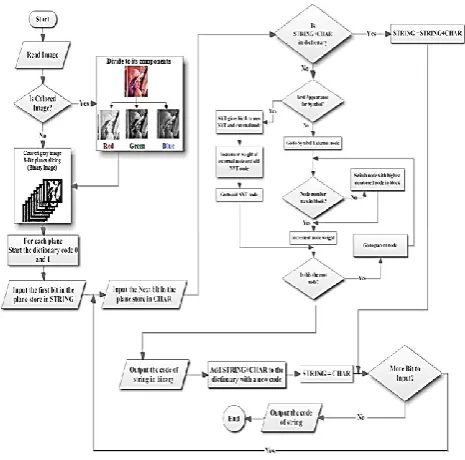
Lzw Compression In The Following Ways Described In Fig. 2. First, Slice The Gray-Scale Images Into Eight Binary (Monochrome) Images By Using Bit-Plane Slicing. The Colored Images Are Typically Represented By The Tristimulus Red, Green, And Blue Signals Each Of Which Is Gray Scale Image Will Be Sliced Into Eight Binary (Monochrome) Images By Using Bit-Plane Slicing. The Separation Of The Input Image Can
Be Done Through Color Separation Or Through Semantic Separation. The Generated Binary Images Contain Redundant Bits, Which Will Increase The Compression Ratio. Because The Number Of Color Decrease To Two Colors Black (The Value Is 0) And White (The Value Is 1).
Figure 2: Lzw Compression Flow
E.
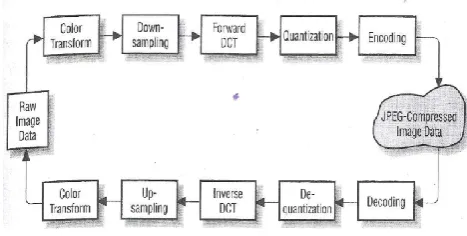
JPEG (Transform Compression)The Jpeg Image Compression Technique Consists Of 5 Functional Stages. The Overflow Jpeg Compression Diagram Is Illustrated In Figure 3.
An Rgb To Ycc Color Space Conversion,
A Spatial Sub-Sampling Of The Chrominance Channels In Ycc Space,
The Transformation Of A Blocked Representation Of The Ycc Spatial Image Data To A Frequency Domain Representation Using The Discrete Cosine Transform,
A Quantization Of The Blocked Frequency Domain Data According To A User-Defined Quality Factor, And Finally
The Coding Of The Frequency Domain Data, For Storage, Using Huffman Coding
Figure 3: JPEG Compression and Decompression
F.
Mpeg EncodingThe Mpeg Standard Is Intended For Compressing Full-Motion Video. It Uses Inter-Frame Compression, Achieving Compression Ratios Of Up To 200:1 By Storing Only The Differences Between Successive Frames. Mpeg Specifications Also Include An Algorithm For Compressing Audio Data. Mp3 Is Probably The Most Widely Popular Among The Many Audio Compression Formats Specified By The Mpeg Standards.
Mpeg Codes Frames In A Sequence Using Three Different Algorithms (See Figure Below). A Dct Based Algorithm Similar To Jpeg First Codes Intra-Frames (I). To Exploit Temporal Redundancy Between Frames, Mpeg Codes The Remaining Frames Using Two Prediction Techniques. One Codes Predicted Frames (P) With Forward Predictive Coding, Where The Actual Frame Is Coded With Reference To A Past Frame. The Other Codes Interpolated, Or Bi-Directional, Frames (B)
With Bi-Directionally Predicted, Interpolated Coding, Also Called Motion-Compensated Interpolation. Bi-Directional Prediction Uses A Past And A Future Frame To Code Current Frames, Providing The Highest Amount of Compression.
G.
Zero-Trees Of Wavelet CoefficientsEmbedded Zerotrees Of Wavelet Transforms (Ezw) Is A Lossy Image Compression Algorithm. At Low Bit Rates, I.E. High Compression Ratios, Most Of The Coefficients Produced By A Subband Transform (Such As The Wavelet Transform) Will Be Zero, Or Very Close To Zero. This Occurs Because "Real World" Images Tend To Contain Mostly Low Frequency Information (Highly Correlated). However Where High Frequency Information Does Occur (Such As Edges In The Image) This Is Particularly Important In Terms Of Human Perception Of The Image Quality, And Thus Must Be Represented Accurately In Any High Quality Coding Scheme.
By Considering The Transformed Coefficients As A Tree (Or Trees) With The Lowest Frequency Coefficients At The Root Node And With The Children Of Each Tree Node Being The Spatially Related Coefficients In The Next Higher Frequency Subband, There Is A High Probability That One Or More Subtrees Will Consist Entirely Of Coefficients Which Are Zero Or Nearly Zero, Such Subtrees Are Called Zerotrees. Due To This, We Use The Terms Node And Coefficient Interchangeably, And When We Refer To The Children Of A Coefficient, We Mean The Child Coefficients Of The Node In The Tree Where That Coefficient Is Located. We Use Children To Refer To Directly Connected Nodes Lower In The Tree And Descendants To Refer To All Nodes Which Are Below A Particular Node In The Tree, Even If Not Directly Connected.
The Dominant Pass Encodes The Significance Of The Coefficients Which Have Not Yet Been Found Significant In Earlier Iterations, By Scanning The Trees And Emitting One of The Four Symbols. The Children Of A Coefficient Are Only Scanned If The Coefficient Was Found To Be Significant, Or If The Coefficient Was An Isolated Zero. The Subordinate Pass Emits One Bit (The Most Significant Bit Of Each Coefficient Not So Far Emitted) For Each Coefficient Which Has Been Found Significant In The Previous Significance Passes. The Subordinate Pass Is Therefore Similar To Bit-Plane Coding.
III.
RESULTS AND DISCUSSION
Comparison Analysis
This paper aims to collect and consider papers that deal with different image compression techniques. Our objective is not to undertake a logical review, but quite to provide a broad state-of-the-art view on these related fields. Many different approaches have been projected to assist compression, which has mentioned in a body of literature that is spread over a wide variety of fields and periodical locations. The majority of comparison study has been available in the image processing domain, and particularly in the lossless compression literature.
Table 1: Summary Table for Comparison of Clustering Deviations for Black Box Regression Techniques
Title Algorithm Advantages Drawbacks Results
IV.CONCLUSION
In this paper compared six lossless data compression algorithm Run-Length Encoding, Huffman Encoding, Delta Encoding, LZW Compression, JPEG (Transform Compression) and MPEG algorithm which consists of variant images types and extension(grey level and RGB images. The result of analytical technique on the image compression reveals that LZW compression algorithm is best performance as of image compression techniques but other predictive methods like Run-Length Encoding, Huffman Encoding, Delta Encoding, JPEG (Transform Compression) and MPEG algorithm are not performing well.
The further work enhanced and expanded for the compression algorithm of high-dimensional image data using LZW and improved LZW algorithms.
V.
REFERENCES
[1] W.B .Pennebaker and J.L.Mitchell, JPEG still Image Data Compression standard. we York,NY,USA: Van Nostrand Reinhold,1993.. [2] Information Technology-Lossless and
Near-Lossless Compression of Continuous-Tone Still Images (JPEG-LS), ISO/IEC Standard 14495-1, 1999.
[3] M. Weinberger, G. Seroussi, and G. Sapiro, ―The LOCO-I lossless image compression algorithm: Principles and standardization into JPEG-LS IEEE Trans. Image Process., vol. 9, no. 8, pp. 1309–1324, Aug. 2000.
[4] Mamta Sharma ,‖ Compression Using Huffman Coding‖, IJCSNS International Journal of Computer Science and Network Security, VOL.10 No.5, May 2010.
[5] Mridul Kumar Mathur,Seema Loonker,Dr.Dheeraj saxena,―Lossless Huffman coding technique for image compression and reconstruction using Binary trees.‖IJCTA ,Jan-Feb 2012.
[6] M. W. Marcellin, M. J. Gormish, A. Bilgin, and M. P. Boliek, ―An overview of JPEG-2000,‖ in Proc. IEEE Data Compress. Conf., Mar. 2000, pp. 523–541.
[7] A. Skodras, C. Christopoulos, and T. Ebrahimi, ―The JPEG 2000 still image compression
standard,‖ IEEE Signal Process. Mag., vol. 11, no. 5, pp. 36–58, Sep. 2001.
[8] A. Said and W. A. Pearlman, ―A new, fast, and efficient image codec based on set partitioning in hierarchical trees,‖ IEEE Trans. Circuits Syst. Video Technol., vol. 6, no. 3, pp. 243–250, Jun. 1996.
[9] Anitha. S, "LOSSLESS IMAGE COMPRESSION AND DECOMPRESSION USING HUFFMAN CODING", International Research Journal of Engineering and Technology (IRJET), Volume: 02 Issue: 01, Apr-2015. [10] Samir Kumar Bandyopadhyay, Tuhin Utsab Paul,
Avishek Raychoudhury, "Image Compression using Approximate Matching and Run Length", (IJACSA) International Journal of Advanced Computer Science and Applications, Vol. 2, No. 6, 2011.
[11] J. M. Shapiro, ―Embedded Image Coding Using Zero-Trees of Wavelet Coefficients‖, IEEE Transactions on Signal Processing, vol. 41, pp. 3445–3462, December 1993.
[12] Civarella and Moffat. Lossless image compression using pixel reordering. Proceedings of twenty seventh Australian Computer Science conference, pp 125-132,2004.
[13] A. Said and W. A. Pearlman, ―A New, Fast and Efficient Image Codec Based on Set Partitioning in Hierarchical Trees‖, IEEE Transactions on Circuits and Systems for Video Technology, vol. 6, no. 3, pp. 243–250, June 1996.