R E S E A R C H
Open Access
A new method to study ILC problem for
time-delay linear systems
Zijian Luo
1, Michal Feˇckan
2and JinRong Wang
1**Correspondence: [email protected] 1Department of Mathematics, Guizhou University, Guiyang, Guizhou 550025, P.R. China Full list of author information is available at the end of the article
Abstract
In this paper, we apply a new method, a delayed matrix exponential, to study P-type and D-type learning laws for time-delay controlled systems to track the varying reference accurately by using a few iterations in a finite time interval. We present open-loop P- and D-type asymptotic convergence results in the sense of
λ
-norm by virtue of spectral radius of matrix. Finally, four examples are given to illustrate our theoretical results.MSC: 34A37; 93C15; 93C40
Keywords: time-delay system; delayed exponential matrix; iterative learning control
1 Introduction
In the past decades, delay differential equations have been widely used in the fields of eco-nomics, physics, and engineering control. Existence, stability, and periodic solutions are studied extensively and there are many interesting and important results; see, for example, [–].
Since Uchiyama [] and Arimoto [] put forward the iterative learning control (ILC for short), a wide variety of iterative learning control problems and related issues are proposed and studied in recent decades. For example, ILC for varying reference trajectories [, ], ILC for fractional differential systems [, ], ILC for impulsive differential systems [, ], research on the robustness of ILC [, ], and so on.
It is a common phenomenon that time delays exist in many practical engineering issues. However, the prevalence of the phenomenon to the delay caused a lot of practical engi-neering problems. So the study of the control problem of time-delay system is paid more attention. Some effective methods for studying the iterative learning control for time-delay systems are provided by Sun [–].
After reviewing the previous works dealing with ILC problems for delay systems, we observe the following facts:
(i) A delay systemx˙(t) =Ax(t) +Bx(t–τ),t> is considered mostly as an integral system, whereA,Bare suitable matrices.
(ii) A uniform transition matrix associated withA,Bis not derived directly and the structure of solutionx(t)is not well characterized on every subintervals
[,τ], . . . , [nτ, (n+ )τ],n∈N.
(iii) An extended Gronwall inequality is used to derive convergence results instead of applying direct methods.
It is remarkable that Khusainov and Shuklin in [] initially introduced a delayed expo-nential matrix method to study the following linear differential equation with one delay term:
⎧ ⎨ ⎩
˙
x(t) =Ax(t) +Bx(t–τ), t≥,τ ≥,
x(t) =ϕ(t), –τ≤t≤, ()
whereAandBare matrices andϕis an arbitrary continuously differentiable vector func-tions. A representation of a solution of system () withAB=BAis given by using a so-called delay exponential matrix, which is defined as follows:
eBtτ =
⎧ ⎪ ⎪ ⎨ ⎪ ⎪ ⎩
, t< –τ,
E, –τ ≤t< ,
E+Bt+B(t–τ)+· · ·+Bk(t–(kk!–)τ)k, (k– )τ ≤t<kτ,k= , , . . . ,
()
forτ> , whereandEare then-dimensional zero and identity matrices, respectively. For more recent contributions on oscillating systems with pure delay, relative control-lability of system with pure delay, asymptotic stability of nonlinear multidelay differential equations, one can refer to [–] and the references therein.
Inspired by the references mentioned above, in this work, we discuss ILC for time-delay systems. More precisely, we study the following linear controlled systems with pure delay:
⎧ ⎪ ⎪ ⎨ ⎪ ⎪ ⎩
˙
xk(t) =Axk(t) +Bxk(t–τ) +uk(t), t∈[,T],
xk(t) =ϕ(t), –τ≤t≤,τ > ,
yk(t) =Cxk(t) +Duk(t),
()
whereTdenotes pre-fixed iteration domain length withT=Nτ andN∈N. Letϕ∈C τ := C([–τ, ],Rn),AandBbe twon×nmatrices such thatAB=BAandC,Dbe twom×n
matrices,kdenotes thekth learning iteration, the variablesxk,uk∈Rnandyk∈Rmdenote
state, input, and output, respectively. By [], Corollary ., we derive that the statexk(·)
has the form
xk(t) =eA(t+τ)eBτtϕ(–τ) +
–τ
eA(t–τ–s)eB(t–τ–s)
τ e
Aτϕ(s) –Aϕ(s)ds
+
t
eA(t–τ–s)eB(t–τ–s)
τ eA
τ
uk(s)ds, ()
whereeBtτ is defined in () andB=e–AτB. By introducingeBt
τ for (), we state some possible advantages of our approach as follows.
(i) The structure of solutionx(t)is characterized on every subintervals.
Letydbe a desired trajectory and setek=yd–yk, which denotes output error andδuk=
uk+–uk.
For the system (), we consider the open-loop P-type ILC updating law
uk+(t) =uk(t) +Poek(t). ()
For the system () withD=, we consider the open-loop D-type ILC updating law
uk+(t) =uk(t) +Doe˙k(t), ()
wherePoandDo∈Rn×mare learning gain matrices.
The main objective of this paper is to use delayed exponential matrix to generate the control inputuksuch that the time-delay system outputykis tracking the iteratively
vary-ing reference trajectoriesydas accurately as possible whenk→ ∞uniformly on [,T] in
the sense of theλ-norm by adopting P-type ILC and D-type ILC.
Here we point out that our method is different from the method given in the previous reference, however, we obtain the same convergence results. Our method relies on a direct formula solution, so it is constructive.
The rest of this paper is organized as follows. In Section , we give some notations, concepts, and lemmas. In Sections and , we give convergence results of P-type ILC and D-type for system (). Examples are given in Section to demonstrate the applicability of our main results.
2 Preliminaries
LetJ⊂Rbe a finite interval andL(Rn) be the space of bounded linear operators inRn.
Denote byC(J,Rn) the Banach space of vector-value continuous functions fromJ→Rn
endowed with the∞-norm x =maxt∈J|x(t)|for a norm | · |onRn. We also consider
on C(J,Rn) a λ-norm x
λ=supt∈J{e–λt|x(t)|}, λ> . We introduce a space C(J,Rn) = {x∈C(J,Rn) :x˙ ∈C(J,Rn)}. For a matrix A:Rn→Rn, we consider its matrix norm
A =max|x|=|Ax|generated by| · |.
Lemma .(see [], .., Chapter ) Let A∈L(Rn).For a given> ,there is a norm
| · |onRnsuch that
A ≤ρ(A) +,
whereρ(A)denotes the spectral radius of the matrix A.
Next, we give an alternative formula to compute the solution of linear system with pure delay, which is a direct corollary of [], Corollary ..
Lemma . Let f :J→Rnbe a continuous function.The solution x∈C(J,Rn)of
⎧ ⎨ ⎩
˙
x(t) =Ax(t) +Bx(t–τ) +f(t), t> ,τ≥,
has the form
Proof According to the formula () in [], we know the solution of system () has the form
Next, we submit the formula of delayed matrix exponential () to () to prove the result. We divide our proof into two steps.
Step . We prove that
Step . We check that
3 Convergence analysis of P-type
In this section, we give the first convergence result of P-type.
Theorem . Let yd(t),t∈[,T]be a desired trajectory for system().Ifρ(E–DPo) < ,
Proof Without loss of generality, we consider (j– )τ ≤t<jτ,j= , , . . . ,N. Linking ()
According to () and Lemma ., we have
ek+(t) = (E–DPo)ek(t) –C
For anyλ> A , we apply integration by parts via mathematical induction to derive
= –
and, taking theλ-norm, we arrive at
ek+ λ≤
Remark . We use a delayed matrix exponential method to obtain convergence of the
uniform convergence only under conditionρ(E–DPo) < in the end of the above proof.
Moreover, fixing∈(,–ρ(E–DPo)
), the smallest suitableλ> A is given by the equation
C Po
which is rather awkward to solve. On the other hand, () has a unique solution for any > . Moreover, it may have anyλ> A as a solution by varying C Po .
4 Convergence analysis of D-type
In this section, we discuss the ILC convergence of D-type.
Theorem . Let yd(t),t∈[,T],be a desired trajectory for system()with D=.Ifρ(E–
Similar to the proof of Theorem ., one can apply Lemma . to derive that
+ CA
In analogy to the computation in ()-(), inequality () becomes
e˙k+(t)e–λt≤ρ(E–CDo) +e˙k(t)e–λt+ (W+W) Do ˙ek λ, ()
we needCto be surjective.
5 Simulation examples
In this section, four numerical examples are presented to demonstrate the validity of the designed method. In order to simulate the tracking errors of trajectories, we adopt for sim-plicityL-norm in our simulations. ThisL-norm can be used, since by the fact that e
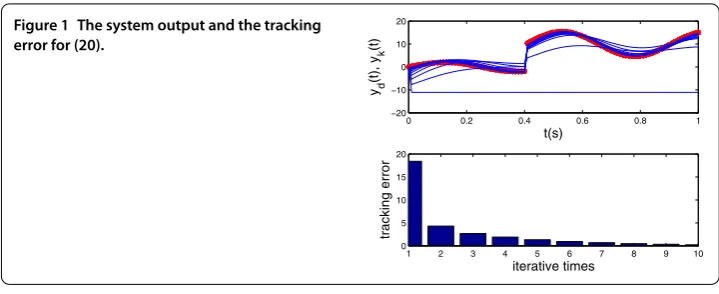
Figure 1 The system output and the tracking error for (20).
Table 1 The tracking error of each iteration for (20)
k 1 2 3 4 5 6 7 8 9 10
Error 18.41 4.31 2.68 1.91 1.33 0.95 0.68 0.48 0.34 0.24
eλT e
k λfor a suitableλ> A , we obtain ek → ask→ ∞,i.e.,limk→∞supt∈J|ek(t)|=
, which yieldsek→ inL(J,Rn).
Example . Consider
⎧ ⎪ ⎪ ⎨ ⎪ ⎪ ⎩
˙
xk(t) =xk(t) +xk(t– .) +uk(t), x(t)∈R,t≥,
xk(t) =t, –.≤t≤,
yk(t) =xk(t) + .uk(t),
()
and P-type ILC
uk+(t) =uk(t) +ek(t).
The original reference trajectory is
yd(t) =
⎧ ⎨ ⎩
sin(πt), t∈[, .],
sin(πt) + cos(πt) + , t∈[., ].
Set t∈[, ],τ = .,ϕ(t) =t. Forn=m= , A= ,B= ,C= , andD= .. It is not difficult to find thatB=e–AτB=e–.and
et.=
⎧ ⎨ ⎩
+e–.t, t∈[, .],
+e–.t+e– (t–.)
! , t∈[., ].
Next, we setPo= . Obviously,ρ( –DPo) = . < . Thus, all conditions of Theorem .
are satisfied, soyk(t) uniformly converges toyd(t), fort∈[, ].
The upper figure of Figure shows the outputykof equation () of the th iterations
and the reference trajectoryyd. The lower figure of Figure shows theL-norm of the
Figure 2 The system output and the tracking error for (21).
Table 2 The tracking error of each iteration for (21)
k 1 2 3 4 5 6 7 8 9 10
Error 18.41 10.80 7.16 4.99 3.60 2.65 1.98 1.49 1.34 0.86
k 11 12 13 14 15 16 17 18 19 20
Error 0.66 0.51 0.39 0.30 0.23 0.18 0.14 0.11 0.08 0.06
Example . Consider
⎧ ⎪ ⎪ ⎨ ⎪ ⎪ ⎩
˙
xk(t) =xk(t) +xk(t– .) +uk(t), x(t)∈R,t≥,
xk(t) =t, –.≤t≤,
yk(t) =xk(t),
()
and D-type ILC
uk+(t) =uk(t) + .˙ek(t).
The original reference trajectory is the same as for Example .. Set t∈[, ],τ = ., ϕ(t) =t. Forn=m= ,A= ,B= ,C= andD= . It is not difficult to find thatBand et.are the same as for Example .. Next, we setDo= .. Obviously,ρ( –CDo) = . < .
Thus, all conditions of Theorem . are satisfied.
The upper figure of Figure shows the equation () outputykof the th iterations and
the reference trajectoryyd. The lower figure of Figure shows theL-norm of the tracking
error (see also Table ) in each iteration.
Example . Consider
⎧ ⎪ ⎪ ⎨ ⎪ ⎪ ⎩
˙
xk(t) =xk(t) +xk(t– .) +uk(t), xk(t),uk(t)∈R,t≥,
xk(t) = (et,et)T, –.≤t≤,
yk(t) = (, )xk(t) + (, )uk(t),
()
and P-type ILC
uk+(t) =uk(t) +
. –.
Figure 3 The system output and the tracking error for (22).
Table 3 The tracking error of each iteration for (22)
k 1 2 3 4 5 6 7 8 9 10
Error 10.09 5.41 3.14 1.62 0.76 0.33 0.14 0.06 0.02 0.01
The original reference trajectory is
yd(t) =
⎧ ⎨ ⎩
sin(πt), t∈[, .],
sin(πt) + sin(πt) + , t∈[., ].
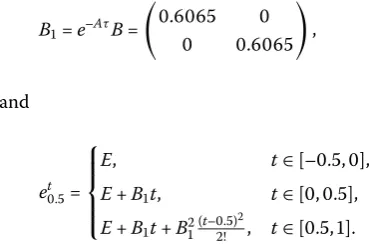
Sett∈[, ],τ= .,ϕ(t) = (et,et)T. Next,n= ,m= ,A=B=E,Eis the identity matrix,
C= (, ) andD= (, ). It is not difficult to find that
B=e–AτB=
. .
,
and
et.=
⎧ ⎪ ⎪ ⎨ ⎪ ⎪ ⎩
E, t∈[–., ],
E+Bt, t∈[, .],
E+Bt+B (t–.)
! , t∈[., ].
Next, we setPo= (., –.)T. Obviously,ρ(E–DPo) = . < . Thus, all conditions of
Theorem . are satisfied. Thenyk(t) uniformly converges toyd(t), fort∈[, ].
The upper figure of Figure shows the equation () outputykof the th iterations and
the reference trajectoryyd. The lower figure of Figure shows theL-norm of the tracking
error (see also Table ) in each iteration.
Example . For system
⎧ ⎪ ⎪ ⎨ ⎪ ⎪ ⎩
˙
xk(t) =xk(t) +xk(t– .) +uk(t), xk(t),uk(t)∈R,t≥,
xk(t) = (t,t)T, –.≤t≤,
yk(t) = (, )xk(t),
Figure 4 The system output and the tracking error for (23).
Table 4 The tracking error of each iteration for (23)
k 1 2 3 4 5 6 7 8 9 10
Error 10.09 6.17 5.18 4.62 4.02 3.40 2.81 2.30 1.87 1.50
k 11 12 13 14 15 16 17 18 19 20
Error 1.21 0.96 0.77 0.61 0.49 0.39 0.31 0.24 0.19 0.15
we take the D-type ILC
uk+(t) =uk(t) +
–.
˙ ek(t).
The original reference trajectory is the same as for Example .. Obviously, all conditions of Theorem . are satisfied. Thenyk(t) uniformly converges toyd(t), fort∈[, ].
The upper figure of Figure shows the outputykof equation () of the th iterations
and the reference trajectory yd. The lower figure of Figure shows theL-norm of the
tracking error (see also Table ) in each iteration.
Competing interests
The authors declare that they have no competing interests.
Authors’ contributions
The authors have made equal contributions. All authors have read and approved the final manuscript.
Author details
1Department of Mathematics, Guizhou University, Guiyang, Guizhou 550025, P.R. China.2Department of Mathematical Analysis and Numerical Mathematics, Faculty of Mathematics, Physics and Informatics, Comenius University in Bratislava, Mlynská dolina, Bratislava, 842 48, Slovakia.
Acknowledgements
The authors are grateful to the referees and Associate Professor Dr. Qian Chen for their careful reading of the manuscript and valuable comments. The authors also thank the editor for help. The first and third authors acknowledge National Natural Science Foundation of China (11661016; 11201091), Training Object of High Level and Innovative Talents of Guizhou Province ((2016)4006), United Foundation of Guizhou Province ([2015]7640) and Outstanding Scientific and Technological Innovation Talent Award of Education Department of Guizhou Province ([2014]240). The second author acknowledges the Slovak Grant Agency VEGA No. 1/0078/17 and the Slovak Research and Development Agency under the contract No. APVV-14-0378.
Received: 4 August 2016 Accepted: 6 January 2017
References
1. Balachandran, B, Kalmár-Nagy, T, Gilsinn, DE: Delay Differential Equations. Springer, Berlin (2009)
2. He, J: Variational iteration method for delay differential equations. Commun. Nonlinear Sci. Numer. Simul.2, 235-236 (1997)
4. Wen, Y, Zhou, XF, Zhang, Z, Liu, S: Lyapunov method for nonlinear fractional differential systems with delay. Nonlinear Dyn.82, 1015-1025 (2015)
5. Abbas, S, Benchohra, M, Rivero, M, Trujillo, JJ: Existence and stability results for nonlinear fractional order Riemann-Liouville Volterra-Stieltjes quadratic integral equations. Appl. Math. Comput.247, 319-328 (2014) 6. Zhang, GL, Song, MH, Liu, MZ: Exponential stability of the exact solutions and the numerical solutions for a class of
linear impulsive delay differential equations. J. Comput. Appl. Math.285, 32-44 (2015)
7. Uchiyama, M: Formulation of high-speed motion pattern of a mechanical arm by trial. Trans. Soc. Instrum. Control Eng.14, 706-712 (1978)
8. Arimoto, S, Kawamura, S: Bettering operation of robots by learning. J. Robot. Syst.1, 123-140 (1984)
9. Xu, JX, Xu, J: On iterative learning for different tracking tasks in the presence of time-varying uncertainties. IEEE Trans. Syst. Man Cybern. B34, 589-597 (2004)
10. Ahn, HS, Moore, KL, Chen, YQ: Iterative Learning Control: Robustness and Monotonic Convergence in the Iteration Domain. Communications and Control Engineering Series. Springer, Berlin (2007)
11. Luo, Y, Chen, YQ: Fractional order controller for a class of fractional order systems. Automatica45, 2446-2450 (2009) 12. Li, Y, Chen, YQ, Ahn, HS: On thePDα-type iterative learning control for the fractional-order nonlinear systems. In: Proc.
Amer. Control Conference, pp. 4320-4325 (2011)
13. Bien, ZZ, Xu, JX (eds.): Iterative Learning Control: Analysis, Design, Integration and Applications. Springer, Media (2012)
14. Li, ZG, Chang, YW, Soh, YC: Analysis and design of impulsive control systems. IEEE Trans. Autom. Control46, 894-897 (2001)
15. Sun, MX: Robust convergence analysis of iterative learning control systems. Control Theory Appl.15, 320-326 (1998) 16. Lee, HS, Bien, Z: Design issues on robustness and convergence of iterative learning controller. Intell. Autom. Soft
Comput.8, 95-106 (2002)
17. Sun, MX, Chen, YQ, Huang, BJ: High order iterative learning control system for nonlinear time-delay systems. Acta Autom. Sin.20, 360-365 (1994)
18. Sun, MX: Iterative learning control algorithms for uncertain time-delay systems (I). J. Xi’an Instit. Technol.17, 259-266 (1997)
19. Sun, MX: Iterative learning control algorithms for uncertain time-delay systems (II). J. Xi’an Instit. Technol.18, 1-8 (1998)
20. Khusainov, DY, Shuklin, GV: Linear autonomous time-delay system with permutation matrices solving. Stud. Univ. Žilina Math. Ser.17, 101-108 (2003)
21. Khusainov, DY, Shuklin, GV: Relative controllability in systems with pure delay. Int. J. Appl. Math.2, 210-221 (2005) 22. Medved’, M, Pospišil, M, Škripokvá, L: Stability and the nonexistence of blowing-up solutions of nonlinear delay
systems with linear parts defined by permutable matrices. Nonlinear Anal. TMA74, 3903-3911 (2011) 23. Medved’, M, Pospišil, M: Sufficient conditions for the asymptotic stability of nonlinear multidelay differential
equations with linear parts defined by pairwise permutable matrices. Nonlinear Anal. TMA75, 3348-3363 (2012) 24. Diblik, J, Feˇckan, M, Pospišil, M: Representation of a solution of the Cauchy problem for an oscillating system with two
delays and permutable matrices. Ukr. Math. J.65, 58-69 (2013)
25. Boichuk, A, Diblik, J, Khusainov, D, R˚užiˇcková, M: Fredholm’s boundary-value problems for differential systems with a single delay. Nonlinear Anal. TMA72, 2251-2258 (2010)
26. Boichuk, A, Diblik, J, Khusainov, D, R˚užiˇcková, M: Boundary value problems for delay differential systems. Adv. Differ. Equ.2010, Article ID 593834 (2010)
27. Boichuk, A, Diblik, J, Khusainov, D, R˚užiˇcková, M: Boundary-value problems for weakly nonlinear delay differential systems. Abstr. Appl. Anal.2011, Article ID 631412 (2011)