R E S E A R C H
Open Access
Equilibria of channel selection games in
parallel multiple access channels
Samir M Perlaza
1*, Samson Lasaulce
2and Mérouane Debbah
3Abstract
In this article, the parallel multiple access channel is studied under the assumption that transmitters maximize their individual spectral efficiency by selfishly tuning their power allocation policy. Two particular scenarios are studied: (a) transmitters are allowed to use all the available channels; and (b) transmitters are constrained to use a single channel. Both scenarios are modeled by one-shot games and the corresponding sets of Nash equilibria (NE) are fully
characterized under the assumption that the receiver treads the multiple access interference as noise. In both cases, the set of NE is non-empty. In the case in which transmitters use a single channel, an upper bound of the cardinality of the NE set is provided in terms of the number of transmitters and number of channels. In particular, it is shown that in fully loaded networks, the sum spectral efficiency at the NE in scenario (a) is at most equal to the sum spectral efficiency at the NE in scenario (b). A formal proof of this observation, known in general as a Braess paradox, is provided in the case of two transmitters and two channels. In general scenarios, we conjecture that the same effect holds as long as the network is kept fully loaded, as shown by numerical examples. Moreover, the price of anarchy and the price of stability in both games are also studied. Interestingly, under certain conditions on the channel gains, Pareto optimality can be achieved at some NE if and only if the number of channels equals or exceeds the number of transmitters. Finally, simulations are presented to verify the theoretical results.
1 Introduction
Multiple access channels (MAC) correspond to a com-munication scenario where several transmitters commu-nicate with a single receiver through a common channel [1]. In parallel MAC, each transmitter can exploit a com-mon set of orthogonal channels to communicate with the receiver. Often, channel orthogonality is assumed in the frequency domain, and thus, channels can be under-stood as different non-overlapping frequency bands. This model allows one to study communication scenarios such as 802.11-based wireless local area networks [2,3], dis-tributed soft or hard handovers in cellular systems [4], or throughput-maximizing power control in multi-carrier code division multiple access (MC-CDMA) systems [5].
In this article, we analyze the parallel MAC assuming that transmitters selfishly maximize their individual spec-tral efficiency (ISE) by autonomously selecting a single
*Correspondence: [email protected]
1Department of Electrical Engineering, Princeton University, Equad, 19 Olden Street, Princeton, NJ 08544, USA
Full list of author information is available at the end of the article
channel to perform their transmission. Here, the chan-nel selection (CS) policy is not imposed by the receiver to the transmitters, which justifies the terms decentral-ized parallel MAC. The motivation for studying this sce-nario and, in particular, the limitation of using a single channel for transmitting stems from the fact that this is often a practical constraint in some wireless networks, for instance, Wi-Fi networks. Moreover, the choice of enforcing radio devices to use only a subset of all the available channels has been proved to be beneficial in the case of rate-efficient centralized parallel MAC when using successive interference cancellation [4]. In the case of energy-efficient decentralized parallel MAC, it has been shown that using a single channel is a dominant strat-egy [5]. Within this framework, we study this scenario, to which we refer to as CS problem, using a one-shot game model. The players (the transmitters) have discrete action sets (the channels) and their utility function (performance metric) corresponds to their ISE. Our interest focuses on the analysis of the set of Nash equilibria (NE) [6] of this game. The relevance of the NE relies, in part, on the fact that it describes a network state where the channel used by each transmitter is individually optimal with respect to
the channels adopted by all the other transmitters in the network. Another reason is that an NE can be reached in a fully decentralized fashion when radio devices interact during certain time following particular behavioral rules [7,8].
We distinguish the CS game described above from the power allocation (PA) game. In the PA game, transmit-ters can simultaneously use all the available channels, and thus, the set of actions is a convex and closed set [9]. Indeed, the PA problem in decentralized parallel MAC has been well investigated in the wireless literature [9-13]. In these works, the main contribution consists in conducting a complete analysis of the set of NE of the corresponding one-shot games. Nonetheless, very few is known about the set of equilibria in decentralized parallel MAC, with CS policies. As we shall see, by dropping the convexity of the set of actions, fundamental differences arise. For instance, the uniqueness of the NE no longer holds.
Although the parallel MAC is, in terms of signal model, a special case of the input multiple-output (MIMO) interference channel (IC), the NE analysis of the MIMO-IC [14-18] does not directly apply to the case of parallel MAC. First, [10,11] address the case of fast fading links and shows substantial differences between both models especially in terms of the uniqueness of the NE. Second, even if identical channel variation models are considered in the MIMO-IC and parallel MAC, the sufficient condition for the uniqueness of the NE derived in [14,19] for static or block fading IC can be shown to hold with probability zero in parallel MAC [9]. In par-ticular, the sufficient condition for the uniqueness of the NE provided in [14] is not necessary in general [20]. The (more explicit) sufficient conditions for uniqueness given by Scutari et al. [19] are generally not verified in parallel MAC. More precisely, from [19] it is implied that there exists a unique pure NE with high probability when for each point-to-point communication the signal dominates the interference. This condition is clearly not verified in parallel MAC. For instance, in a 2-user parallel MAC, if one user’s signal is dominated by the interference, the con-verse holds for the other user. Finally, we highlight that in the parallel MAC, when single-user decoding (SUD) is assumed at the receiver, both the compact PA and CS games have a special structure, namely, they are potential games [21] or more specifically, best-response potential games [22]. This structure is not observed in the case of the MIMO-IC model. In Section 3, we discuss the implications and advantages derived from this fact.
Within this context, the main contributions of this arti-cle are described hereunder.
• The set of NE of the decentralized parallel MAC is fully described in the case of CS policies and SUD at the receiver. This set is shown to be non-empty and
an upper bound of its cardinality is provided as a function of the number of transmitters and available channels.
• In the 2-transmitter 2-channel case, it is formally proved that for any realization of the channel gains, there always exists at least one NE in the CS game that produces a higher or equal network spectral efficiency (NSE) than the unique NE in the PA game. In wireless communications, this kind of observations is often associated with a Braess-type paradox [23] as in [20,24,25], where similar observations have been made in other scenarios. For an arbitrary number of transmitters and channels, we only provide numerical results that support the aforementioned claim. • The set of NE of the decentralized parallel MAC is
also studied in the asymptotic regime, that is for a large number of transmitters in the case of CS policies. In this context, we provide closed-form expressions of the fraction of players which transmit over each channel as a function of the ratio between the channel bandwidth and the total available bandwidth (sum of all channel bandwidths).
• Finally, we study the efficiency of the set of equilibria in terms of the price of anarchy (PoA) and the price of stability (PoS). We provide closed-form conditions over which no loss of performance is observed at the equilibrium in both the PA and the CS games.
The content of this article can briefly be summarized as follows. In Section 2, the system and game models are described. In Section 3, we revisit the existing results regarding the PA problem and we provide new results on the CS problem in terms of existence and uniqueness of the NE. In Section 4, the contribution aforementioned are fully detailed. In Section 5, we present simulation results in order to verify our theoretical results. Finally, the article is concluded by Section 6.
2 Models
2.1 System model
Let us define the setsK= { 1,. . .,K}andS = { 1,. . .,S}. Consider a parallel MAC withKtransmitters andS
chan-nels (namely non-overlapping bands). Denote by y =
(y1,. . .,yS)T the S-dimensional vector representing the
received signal, which can be written in the baseband at the symbol rate as follows
y=
K
k=1
Hkxk+w. (1)
Here,∀k ∈ K,Hk is the channel transfer matrix from
transmitter k to the receiver, xk is the vector of
the noise observed at the receiver. We will exclusively deal with the scenario where the matrices Hk are
S-dimensional diagonal matrices (parallel MAC), i.e.,Hk =
diaghk,1,. . .,hk,S
. In our analysis, block fading chan-nels are assumed. Hence, for each channel use, the entries hk,s, for all (k,s) ∈ K × S, are time-invariant
realiza-tions of a complex circularly symmetric Gaussian random variable with zero mean and unit variance. Here, we assume that each transmitter is able to perfectly estimate its own channel realizations (coherent communications), i.e., the channelshk,1. . .hk,Sfor transmitterk. The vector
of transmitted symbolsxk,∀k ∈ K is anS-dimensional
complex circularly symmetric Gaussian random variable with zero mean and covariance matrixPk =E
xkxHk
= diagpk,1,. . .,pk,S
. Assuming the transmit symbols to be Gaussian and independent is optimal in terms of spectral efficiency, as shown in [26,27]. For all(k,s) ∈ K ×S, pk,srepresents the transmit power allocated by transmit-terkover channelsand transmitters are power-limited, that is
∀k∈K,
S
s=1
pk,spk,max, (2)
where pk,max is the maximum transmit power of trans-mitter k. A PA vector for transmitter k is any vector pk = pk,1,. . .,pk,S
with non-negative entries satisfy-ing (2). The noise vector w is an S-dimensional zero mean Gaussian random variable with independent, equal variance real and imaginary parts. Here, EwwH = diagσ12,. . .,σS2, where σs2 represents the noise power over channels. We, respectively, denote the noise spec-tral density and the bandwidth of channel s by N0 and Bs, thus,σs2 = N0Bs. The total bandwidth is denoted by
B=Ss=1Bs.
2.2 Game models
The PA and CS problems described in Section 1 can, respectively, be modeled by the following two non-cooperative static games in strategic form (withi∈ {a,b}):
G(i)=
K,Pk(i)
k∈K,(uk)k∈K
. (3)
In both games, the set of transmittersK is the set of players. An action of a given transmitterk ∈ Kis a par-ticular PA scheme, i.e., anS-dimensional PA vectorpk =
pk,1,. . .,pk,S
∈P(i)
k , whereP (i)
k is the set of all possible
PA vectors which transmitterkcan use either in the game G(a)(i=a) or in the gameG(b)(i= b). An action profile
of the gamei∈ {a,b}is a super vector
p=p1,. . .,pK∈P(i),
whereP(i)is a set obtained from the Cartesian product of all the action sets, i.e.,P(i)=P(i)
1 × · · · ×P (i) K , where
P(a)
k =
pk,1,. . .,pk,S
∈RS:∀s∈S,p k,s0,
s∈S
pk,spk,max , and
P(b)
k =
pk,maxes:∀s∈S, es=
es,1,. . .,es,S
, ∀r∈S\s,es,r=0, andes,s=1
.
In the sequel, we respectively refer to the gamesG(a)and G(b)as the PA game and CS game. Moreover, we drop the
super-indices(a)or(b)when interchangeably referring to
the gameG(a)orG(b).
Let us denote byp−kany vector in the set
P(i)
−k
=P(i)
1 × · · · ×P (i) k−1×P
(i)
k+1× · · · ×P (i)
K (4)
with (i,k) ∈ {a,b} ×K. For a given k ∈ K, the vector denoted byp−krepresents the strategies adopted by all the players other than playerk. With a slight abuse of notation, we can write any vectorp∈ P(i)aspk,p−k, in order to emphasize thekth component of the super vectorp. The utility for playerkin the gameG(i)is its spectral efficiency
uk : P(i)→R+, and
uk(pk,p−k)=
s∈S Bs
B log2
1+γk,s[bps/Hz], (5)
where γk,s is the signal-to-interference plus noise ratio (SINR) seen by playerkover its channels, i.e.,
γk,s= pk,sgk,s σ2
s +
j∈K\{k}pj,sgj,s
, (6)
andgk,s hk,s2. Note that from (6), it is implied that SUD is used at the receiver. The choice of SUD is basi-cally due to scalability (in terms of signaling cost) and fairness for the decoding scheme. Clearly, optimality is not sought here, nonetheless, these constraints are inherit to the decentralized nature of the network.
As a solution concept for bothG(a)andG(b), we focus on
the notion of NE [6], which we define, using our notation, as follows
Definition 1(Pure NE). In the non-cooperative games in strategic formG(i), with i∈ {a,b}, an action profilep ∈ P(i) is a pure NE if it satisfies, for all k ∈ K and for all pk ∈Pk(i), that
uk(pk,p−k)uk(pk,p−k). (7)
since no player has a particular interest in deviating from the actual state.
In the following, we provide some fundamental results which we use in the further analysis of the gamesG(a)and G(b).
3 Auxiliary results
In this section, we introduce some existing results on the existence and uniqueness of the NE in the gamesG(a)and G(b). For doing so, we use the fact that both gamesG(a)and G(b)have been shown to be potential games (PG) [21,28]
in [4,29], respectively. We conclude this section by intro-ducing a new result which allows us to establish an upper bound on the number of NE that the game G(b) might
possess.
3.1 General results
The analysis presented in the following strongly relies on the fact that both gamesG(a)andG(b)are potential games.
Thus, for the sake of completeness, we define exact PGs using our notation.
Definition 2(Exact PG). Any game in strategic form defined by the triplet
G=K,(Pk)k∈K,(uk)k∈K
is an exact potential game if there exists a functionφ (p) for allp ∈ P = P1× · · · ×PK such that for all players
k∈Kand for allpk∈Pk, it holds that
uk(pk,p−k)−uk(pk,p−k)=φ (pk,p−k)−φ (pk,p−k).
Note that the utility function of playerkcan be written as follows,
uk
pk,p−k=φ (p)−υkp−k, (8)
where
φ (p) =
s∈S Bs
B log2
σs2+
K
k=1 pk,sgk,s
and (9)
υkp−k =
s∈S Bs
B log2
⎛
⎝σs2+
j∈K\{k}
pj,sgj,s ⎞ ⎠. (10)
Interestingly, the first termφ (p)does not depend on the index ofkand the termυkp−kdoes not depend on the actions of playerk. Thus, the results initially mentioned by the authors of [4,29] follow immediately from (8) and Definition 2.
Lemma 1. The strategic form gamesG(i), with i∈ {a,b},
are exact potential games with potential function φ (p) : P(i)→R
+defined in (9).
The relevance of PG relies on the fact that it is a class of games for which the existence of at least one pure NE is always guaranteed [21]. In addition, many known learn-ing procedures, such as, best response dynamics, fictitious play, and some reinforcement learning dynamics converge in PG. As a consequence, any of these dynamics can be used to implement algorithms to achieve an equilibrium in a fully decentralized fashion. Nonetheless, we leave the design of decentralized techniques for achieving NE out of the scope of this article and we focus on the analysis of the equilibria. We refer the interested readers to [7,8,13,14,30] for more details. In the following, we use Lemma 1 to ana-lyze the set of NE of both our PA gameG(a)and our CS
gameG(b).
3.2 Known results concerning the PA gameG(a)
In the following, we comment on the existence and uniqueness of the NE inG(a).
3.2.1 Existence of an NE
Regarding the existence of pure NE, the following lemma is an immediate consequence of our Lemma 1 and Lemma 4.3 in [21].
Lemma 2(Existence of a pure NE). The gameG(a)has
always at least one NE in pure strategies.
Regarding the existence of a mixed NE (i.e., a proba-bility distribution on the possible actions which verifies Definition 1), it follows from [31], that the existence of at least one NE in mixed strategies always exists. This is basi-cally because the action spaces Pk(a) are compact spaces and the utility functions are continuous with respect to the action profile. However, in compact strategy spaces, mixed strategies are generally less attractive due to the dif-ficulty of its implementation in wireless communications systems [8].
3.2.2 Uniqueness of the pure NE
In the game G(a), the uniqueness of the NE has been
shown to hold with probability one [9].
Theorem 1 (NE uniqueness in parallel MAC).The gameG(a)has almost surely a unique pure NE.
3.2.3 Determination of the NE
From Definition 2, it follows that the unique NE in pure strategies, denoted by p†, is the unique solution of the following optimization problem:
arg max
p∈P(a)φ (p). (11)
The components of the PA vectorp†in (11) are for all (k,s)∈K×S,
p†k,s =
Bs
Bβ1k − σs2+
j∈K\{k}p†j,sgj,s gk,s
+
, (12)
whereβkis a Lagrangian multiplier chosen to saturate the power constraints (2). Note that this result shows the con-nections between the notion of NE and the well-known water-filling PA policy [13]. For a further discussion on this connection, the reader is referred to [7,8].
3.3 New results concerning the CS gameG(b)
In the game G(b), it can be checked that given a vector p−k ∈P−(bk), it follows that∀k ∈Kand∀pk ∈
0,pk,max
, the potential function satisfies that φpkes,p−k
φpk,maxes,p−k
, wherees =
es,1,. . .,es,S
∈ RS,∀r ∈ S\s,es,r=0, andes,s=1. Thus, the problem of transmit
power control disappears and there is no lost of generality by choosing the action sets asPk(b). Technically, the main difference betweenG(a)andG(b)is that the latter is a finite
game (|K×S|<+∞). In the following, we investigate the consequences of this fact on the existence and multiplicity of the NE.
3.3.1 Existence of a pure NE
Regarding the existence of at least one NE in pure strate-gies, we have that from our Lemma 1 and Corollary 2.2 of [21], the following lemma holds.
Lemma 3(Existence of a pure NE). The gameG(b)has
always at least one NE in pure strategies.
Regarding the existence of an equilibrium in mixed strategies, we have that given that the actions sets are dis-crete and finite, then the existence of at least one NE in mixed strategies is ensured [6].
3.3.2 Multiplicity of the pure NE
In the following, we show that multiple NE might exists in the gameG(b).
Proposition 1. LetKˆ ∈ Nbe the highest even number which is less or equal to K. Then, the gameG(b)has L pure
NE strategy profiles, where,
1L1+(S−1)
i∈{2,4,...,Kˆ}
K i
. (13)
The proof of Proposition 1 is given in Appendix. This proof relies on the fact that whenever a player deviates from a given action profilep, it achieves a different util-ity. That is, given a set of channelsgij
∀(i,j)∈K×S, it holds thatuk(p) = uk(p), wherep is obtained by letting only one transmitter to deviate fromp. This holds from the fact that the channel realizations are drawn from a continuous distribution and thus, Pruk(p)=uk(p)|p=p
= 0. Thus, under this condition, ifp is an NE, thenpis not and vice versa. Following this procedure, a set of action profiles can be eliminated and only some actions profiles which are NE candidates are left over. In this way, a bound on the maximum number of equilibria can be provided independently of the exact channel realizations and only relying on the parameters K and S. Indeed, this is one of the main properties of the bound provided by Propo-sition 1 since, a calculation of the exact number of NE becomes cumbersome when the number of transmitters K and channelsS grows to infinity. As we shall see, the bound in Proposition 1 holds with strict equality in the case of K = 2 transmitters and S = 2 channels, that is, 1 L 2. For an arbitrary number of transmitters K > 2 and channelsS > 2, the bound is not tight. This is basically because some of the action profiles obtained using the elimination processes described before might mutually be exclusive of the set of NE. For instance, in the game G(b) with K = 3 and S = 2, the set of PA
vectors pmax(e1,e1,e1), pmax(e1,e2,e2), pmax(e2,e2,e1), andpmax(e2,e1,e2)might all be NE candidates. Nonethe-less, ifpmax(e1,e1,e1)is an equilibrium for a given vector of channels gij∀(i,j)∈K×S, then the other three action
sets are not NE for the same set of channels and vice versa. Thus, only three out of the four candidates can be NE simultaneously. The exact number of NE can be determined following the method described in the fol-lowing section, but it requires the complete knowledge of the channel gains. Proposition 1 aims at providing an estimation based only on the parametersKandS.
3.3.3 Determination of the NE
In order to fully identify the action profiles correspond-ing to an NE, we use the graphGdescribed in the proof of Proposition 1 in Appendix. Basically, we convert the non-directed graph G into an oriented graph Gˆ whose adjacency matrix is the non-symmetric square matrixAˆ whose entries are∀(i,j)∈I2andi=j,
ˆ aij=
1 if i∈Vjandφ
p(j)> φp(i)
0 otherwise,
(14)
andaˆi,i = 0 for alli ∈ I. The setVjcontains the indices
also called the neighborhood of action profilep(j). More specifically, in the oriented graphG, there exists an edgeˆ or arrow starting in vertexviand ending in vertexvj, i.e.,
ˆ
aij=1, if and only ifφ (p(j)) > φ (p(i))andφ (p(i))is in the
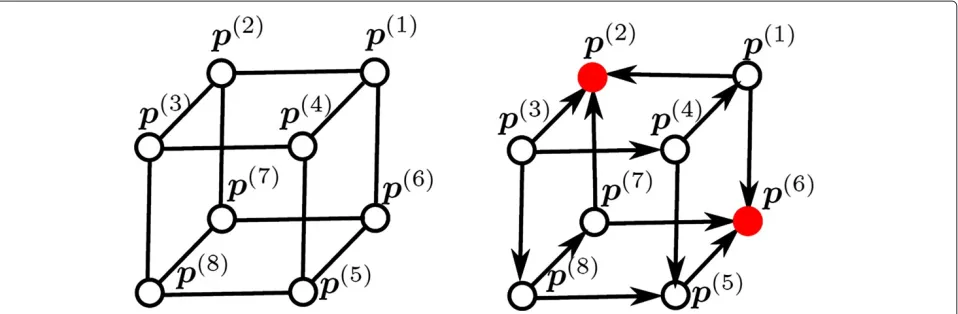
neighborhood ofφ (p(j)). Note that the first condition for adjacency inGˆ represents the assumption of rational play-ers. That is, a player changes its strategy if the new strategy brings a higher utility, i.e., it increases the potential func-tion. The second condition enforces the fact that only one player can deviate at a time from the initial action profile p(i). In Figure 1, we show an example of the non-directed Ggraph and how it is transformed into an oriented graph
ˆ
Gfor the case whereK=3 andS=2.
From the definition of the matrixAˆ, we have that a nec-essary and sufficient condition for a vertexvito represent
an NE action profile is to have a null out-degree in the oriented graphG, i.e., there are no outgoing edges fromˆ the node vi (sink vertex). Finally, one can conclude that
determining the set of NE in the game G(b) boils down
to identifying all the sink vertices in the oriented graph ˆ
G. Note that this method can be used only to determine the whole set of NE. It does not pretend to be an algo-rithm which can be directly implemented in decentralized wireless networks, since it requires complete information at each transmitter. Methods for achieving equilibria in wireless networks are described in [7,8,13,14,30].
4 Equilibrium performance analysis and special cases
In this section, we study in detail two special cases of relevant interest to understand previous conclusions and provide more insights into decentralized PA problem in terms of design. First, the gamesG(a) andG(b) are
stud-ied assuming that there exist onlyK =2 transmitters and S= 2 available channels. In particular, we analyze the set of NE action profiles of both games and compare the NSE,
U(i) : P(i) → R, obtained by playing both games. Here, for alli∈ {1, 2},
U(i)(p1,. . .,pK)=
K
k=1
uk(p1,. . .,pK)[bps/Hz]. (15)
From this analysis, we conclude that limiting the trans-mitters to use a single channel brings a better result in terms of NSE (15). Second, we consider the case of a large number of transmitters. This study leads to two important conclusions: (i) the fraction of players using a given chan-nel depends mainly on the bandwidth of each chanchan-nel and not on the exact channel realization nor the number of players and channels; (ii) in the asymptotic regime (K → ∞) both games exhibit the same performance. Before we start, let us introduce the notion of best response corre-spondence, since it plays a central role in the following analysis.
Definition 3 (Best-response correspondence). In a non-cooperative game described by the 3-tuple
K,(Pk)∀k∈K,(uk)∀k∈K, the relation BRk : P−k → Pk
such that
BRk
p−k=arg max qk∈Pk
uk
qk,p−k, (16)
is defined as the best-response correspondence of player k∈ K, given the actionsp−kadopted by all the other players.
4.1 The 2-transmitter 2-channel case
Consider the gamesG(a)andG(b)withK = 2 andS =2.
Assume also that∀k ∈ K, pk,max = pmax and∀s ∈ S, σs2=σ2andBs= BS. Denote by SNR= pσmax2 the average
signal-to-noise ratio (SNR) of each active communication.
4.1.1 The PA game
Then, following Definition 1, one can write the following set of inclusions, represents a system of equations. By solving the result-ing system of equations (17) for a given realization of the channelsgij
∀(i,j)∈K×S, one can determine the NE of the gameG(a). We present such a solution in the following
proposition. with probability one, p† is the unique NE and it can be written as follows:
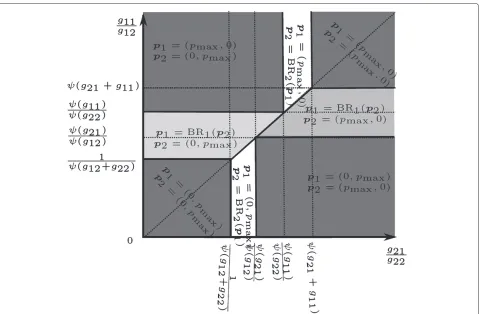
The proof of Proposition 2 is given in Appendix. In Figure 2, we plot the different types of NE of the game G(a)as a function of the channel ratios gg1112 and gg2122. Note
that under the knowledge of all channels, the set of all pos-sible pure NE can be obtained by simply placing the point
in Figure 2. The uniqueness of the NE is not ensured under certain conditions. In fact, infinitely many NE can be observed, however, the conditions for this to happen are zero probability events, as we shall see in the following lemma.
Lemma 4. Letα = g11 g21 =
g12
g22 and assume that the set of
channelsgij∀(i,j)∈K×S satisfies the following conditions
The proof of Lemma 4 is the first part of the proof of Proposition 2. In the following section, we perform the same analysis presented above for the gameG(b).
4.1.2 The CS game
WhenK = 2 andS = 2, the gameG(b) has four
possi-ble outcomes, i.e.,P(b) = 4. We detail such outcomes
and its respective potential in Table 1. Following Defini-tion 1, each of those outcomes can be an NE depending on the channel realizationsgij
can be written as follows:
Figure 2Nash equilibrium action profiles as a function of the channel ratiosg11 g12and
g21
g22for the two-player-two-channel gameG(a).The
functionψ:R+→R+is defined as follows:ψ(x)=1+SNRx. The best response function BRk(p−k), for allk∈K, is defined by (12). Here, it has been arbitrarly assumed thatψ (g21)
ψ (g12) <
ψ (g11)
ψ (g22).
• Equilibrium 4: wheng∈B4=
g∈R4+: g11
g12 1+
SNRg12andgg2122 1+SNR1 g12
, then,p∗1=(0,pmax)and p∗2=(pmax, 0).
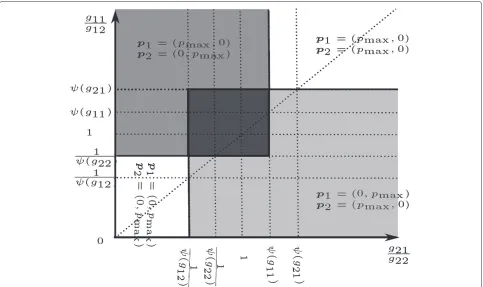
The proof follows immediately from Definition 1 and Table 1. In Figure 3, we plot the different types of NE action profiles as a function of the channel ratios g11 g12
Table 1 Potential functionφof the gameG(a), withK=2
andS=2
Tx1\Tx2 p2=(pmax, 0) p2=(0,pmax)
p1=(pmax, 0) 1 2log2
σ2+pmax(g11+g21)
+1 2log2
σ2
1 2log2
σ2+pmaxg11
+1 2log2
σ2+p maxg22
p1=(0,pmax) 1 2log2
σ2+p maxg12
+1 2log2
σ2+pmaxg21 1 2log2
σ2+p
max(g12+g22)
+1 2log2
σ2
Player 1 chooses rows and player 2 chooses columns.
and g21
g22. Note that under the knowledge of all
chan-nels, the set of all possible pure NE can be obtained by simply placing the point
g11 g12,
g21 g22
in Figure 3. Note how the action profiles p∗ = (pmax, 0, 0,pmax) and p+=(0,pmax,pmax, 0) are both NE, when the channel realizations satisfy that g ∈ B5 = B1 ∩ B4, i.e.,
B5=
g∈R4+: 1
1+SNRg22
g11
g12
1+SNRg21and
1 1+SNRg12
g21
g22
1+SNRg11
.
(18)
This confirms the fact that several NE might exist in the gameG(b)depending on the exact channel realization, as
Figure 3Nash equilibrium action profiles as a function of the channel ratiosg11 g12and
g21
g22for the two-player-two-channel gameG(b),
respectively.The functionψ:R+→R+is defined as follows:ψ(x)=1+SNRx. The best response function BRk(p−k), for allk∈K, is defined by (12). Here, it has been arbitrarly assumed thatψ(g11) < ψ(g21).
In the sequel, the performance achieved by the trans-mitters at the equilibrium in both games are compared.
4.2 A Braess-type paradox
As suggested in [23], a Braess-type paradox refers to a counter-intuitive observation consisting in a reduction of the individual utility at the equilibria, when the players are granted with a larger set of actions. That is, by letting the players to choose from a larger set of options, their indi-vidual benefit reduces. Recently, the Braess-type paradox has been also associated with the reduction of the sum-utility instead of the individual utilities, as in [20,25,34] in the wireless communications arena.
In our particular case, the set of actions for player k in the game G(b) is a subset of its set of actions in the
game G(a), i.e., ∀k ∈ K, Pk(b) ⊆ Pk(a). Interestingly,
as observed in [23], reducing the set of actions of each player leads, in this particular game, to a better global performance. This effect has been reported in the paral-lel interference channel in [24,25] under the consideration of particular channel conditions and later, more gener-ally in [20]. However, a formal proof of the existence of this paradox is not provided in the aforementioned references. This observation has also been reported in
the parallel MAC for the case of successive interference cancellation (SIC) in [35]. Nonetheless, the channel in [35] was not fully decentralized, as it required a central controller to dictate the channel policy to all the transmit-ters. In the following, we study this observation in more detail.
Let us denote byp(k†,n)the unique NE action profile of gameG(a), when the vectorg =
g11,g12,g21,g22
∈ An,
for alln∈ {1. . ., 8}. Let us also denote byp(∗,n)one of the NE action profiles of gameG(b)when
g11,g12,g21,g22
∈ Bn, for alln ∈ {1,. . .4}. The setsAnandBn are defined
in Propositions 2 and 3. Then, for a finite SNR level, one can observe that ∀n ∈ {1,. . ., 4}, An∩Bn = An
and∀g = g11,g12,g21,g22
∈ An, the following
equal-ity always holdsp(k†,n) = p(k∗,n), which implies the same network performance. However, when the NE of both games are different, one cannot easily compare the util-ities achieved by each player since they depend on the exact channel realizations. Fortunately, the analysis largely simplifies by considering either a low SNR regime or a high SNR regime and more general conclusions can be stated. The performance comparison between gamesG(a)
and G(b) for the low SNR regime is presented in the
Proposition 4. In the low SNR regime, both gamesG(a)
andG(b), with K = 2 and S = 2, possess a unique NE,
denoted byp∗. Here, for all k∈Kand s∈S,
p∗k,s = pmax1{s=arg max∈Sgk, } (19)
p∗k,−s = pmax−pk,s. (20)
The proof of Proposition 4 is given in Appendix. From, Proposition 4, it can be stated that at the low SINR regime, players achieve the NE by simply choosing the channel with the highest channel gain independently of the other player’s action. The performance comparison between gamesG(a)andG(b)for the high SNR regime is presented
in the following proposition.
Proposition 5. In the high SNR regime, with K =2and S =2, the gameG(a)has a unique pure NE denoted byp†
and the gameG(b)has two pure NE denoted byp(∗,1)and p(∗,4), respectively. Then, at least for one n ∈ {1, 4}, there exists an SNR value0 < SNR0 < ∞, such that∀SNR SNR0,
2
k=1 uk
p(∗,n)− 2
k=1
uk(p†)δ, (21)
andδ0.
The proof of Proposition 5 is given in Appendix. From the proof of Proposition 5, it can be stated that in none of the games, players transmit simultaneously on the same channels. Now, from Propositions 4 and 5, it can be con-cluded that at low SNR both gamesG(a)andG(b) induce
the same NSE. On the contrary, the game G(b) always
induces a higher or equal NSE than the gameG(a)in the
high SNR regime. This counter-intuitive result implies a Braess-type paradox, as suggested in the beginning of this section.
4.3 The case of large systems
In this section, we deal with the gamesG(b) for the case
of large networks, i.e., networks with a large number of transmitters. Within this scenario, the dominant parame-ter to analyze these games is the fraction of transmitparame-ters using a particular channel. As we shall see, contrary to the case of small number of transmitters and channels analyzed in the previous section, in the case of large networks, each player becomes indifferent to the action adopted by each of the other players. Here, each player is rather concerned with the fractions of players simultane-ously playing the same action, i.e., using the same channel. Hence, one of the interesting issues to be solved is the
determination of the repartition of the users between the different channels at the NE.
As a first step towards identifying the fractions of transmitters per channel at the NE, we first re-write the potential (9) as a function of the vector x(p) = (x1(p),. . .,xS(p)), wherexs(p), withs ∈ S, denotes the
fraction of players transmitting over channelsgiven the action profilep∈P(b). Hence,
∀s∈S, xs(p) = |KsK(p)| S
i=1xi(p) = 1,
(22)
whereKs(p)⊆Kis the set of players using channelsgiven
the action profilep ∈P(b), i.e.,Ks(p) = {k ∈K : pk,s =
0}. Letbs = BsB denote the fraction of bandwidth
associ-ated with channels, such thatSs=1bs=1. Then, one can
write the potential as follows
φ (p) =
S
s=1 bslog2
⎛
⎝N0Bs+pmax
k∈Ks(p)
gk,s ⎞ ⎠
= Slog2(K)+
S
s=1 bslog2
No Bs
K +xs(p)pmax
× ⎛ ⎝ 1
|Ks(p)|
k∈Ks(p)
gk,s ⎞ ⎠ ⎞
⎠. (23)
Note that the termSlog2(K)in (23) does not depend on the actions of the players. Thus, in the following, we drop it for the sake of simplicity. We assume that the number of playersKand the available bandwidthBgrows to infinite at a constant rateμ > 0, while the fractions bs, for all
s ∈ S are kept invariant. That is, the average bandwidth per transmitters is asymptotically constant,
lim
K,B→∞
B
K =μ. (24)
Thus, under the assumption of large number of trans-mitters and for any action profilep∈P(b), it follows that,
∀s∈S, 1 |Ks(p)|
k∈Ks(p)
gk,s
K−→→∞ ∞
0
λF.gs(λ)=s,
whereFgsis the cumulative probability function associated
with the channel gains over dimension s. Hence, for all action profilep∈ P(b)adopted by the players, maximiz-ing the functionφ (p)in the asymptotic regime reduces to maximize the functionφ (˜ x(p)),
˜
φ (x(p))=
S
s=1
bslog2(μNo bs+xs(p)pmaxs).
That is, solving the OP,
maxx=(x
1,...,xS)∈RS+ S
s=1bslog2(μN0bs+xspmaxs),
s.t. Si=1xi=1 and∀i∈S, xi0,
The optimization problem above has a unique solution
whereβkis Lagrangian multiplier to satisfy the
optimiza-tion constraints. Interestingly, in the case when all the channels are described with the same statistics, that is, ∀s∈S,Fgs(λ)=Fg(λ), (∀s∈S,s=) it holds that,
∀s∈S, xs=
Bs
B. (26)
The above provides a very simple relation between the repartition of the users among the available channels in the asymptotic regime. Indeed, it can be implied that the number of transmitters using a given channel s is pro-portional to the bandwidth allocated to the corresponding channel. In particular, note that this result generalizes the work in [36].
To conclude on the usefulness of the large system anal-ysis, let us consider the upper bound on the number of NE which is given by Proposition 1. Let us normalize the upper bound on the number of pure NELin (13) by the total number of pure (CS) strategy profiles, and let us write,
L SK < S1K
1+(S−1)2K. (27)
Now, for a sufficiently large number K, the following approximation holds,
1
SK
1+(S−1)2K ≈ (S−1)2SK. (28)
Although the number of pure NE in the CS game might be conjectured to be large, it is in fact relatively small in the asymptotic regime. Indeed, (28) indicates that when the number of users is large, the fraction of pure NE goes to zero whenever the number of channels is greater or equal to 3. This result shows the difficulty of using methodologies such as the one proposed in Section 3.3.3 to study the set of NE or the difficulty of achieving equi-libria using decentralized learning algorithms as proposed in [7,8].
4.4 PoA and PoS
The PoA [37] and the PoSa [38] are both measures of the efficiency of the set of equilibria of a game. Basically, the PoA measures the loss of global performance due to decentralization by comparing the maximum sum utility achieved under the global control of a central author-ity with the minimum sum utilauthor-ity achieved at the Nash equilibrium. The PoS measures also the loss of global performance due to decentralization by comparing the maximum sum utility achieved under the global control of an authority with the maximum sum utility achieved at
the Nash equilibrium. For the PA gameG(a) and the CS
mization problem in the numerator of (29) and (30), we have that the following holds from the information theo-retical upper bound of the sum of individual rates of the MAC [1]:
Here, (a) holds with strict equality, for any given PA vector p, when the receiver implements (perfect) SIC. Moreover, (b) holds with strict equality when (perfect) SIC is used at the receiver andp‡is the PA vector at the NE with the highest NSE. That is,
p(‡,i) ∈ arg max
p∈P(i)φ (p)=arg max p∈PNE(i)
φ (p), (35)
where the equality in (35) holds since the maximizers of the functionφare the set of NE as shown in Section 3.
Regarding the optimization problem in the denominator of (29) and (30), we use the following notation
and we write (29) and (30) as follows,
we write (29) and (30) as follows,
PoAG(i)
Here, strict equality holds for all k ∈ K, only when transmitters do not share the same channels with other transmitters. In the following, we use this reasoning to study the PoA and the PoS of both gamesG(a)andG(b).
4.4.1 PoA and PoS inG(a)
As shown in Theorem 1, the set of NE of the gameG(a)is
unitary. Thus, we have that,
p(‡,a)=p(,a)=p(⊥,a), (43)
Following Proposition 2, it becomes clear that strict equality in (42) is observed at the equilibrium of the game G(a), if and only if, transmitters use different channels to
communicate with the receiver. In the case in whichK=2 andS = 2, according to Proposition 2, such condition is fulfilled wheng=g11,g12,g21,g22
satisfies eitherg∈A1 or g ∈ A4. This observation leads us to the following lemma.
Lemma 5(PoA and PoS ofG(a)). Let K =2, S=2and g = g11,g12,g21,g22
satisfy at least one of the following conditions:
Corollary 1(PoA in the low SNR regime). Let K =2, S= 2andg =g11,g12,g21,g22
satisfy at least one of the following conditions:
with >0arbitrarily small.
Corollary 2(PoA in the high SNR regime). Let K=2, we state the following result:
Proposition 6(PoA of theG(a)). Letp∗ ∈ P(a)be the equilibrium of the game G(a) and consider the following
condition:
If ∃(k,s)∈K×S :p∗k,s>0, then∀j∈K\ {k},p∗j,s=0. (57)
Then, if the condition above holds, we have that:
PoAG(a)
=PoSG(a)
=1, (58)
otherwise, we have that:
PoAG(a)
Note that from Proposition 6, it can be concluded that in the case in which K > S, the PoA is strictly bigger than one, since the condition (57) does not hold. Thus, as long asK > S there always exists a loss in performance due to the decentralization of the network. Nonethe-less, depending on the channel realizations, in the case
in which K S, global optimal performance can be
achieved at the equilibrium.
4.4.2 PoA and PoS inG(b)
As shown in Theorem 1, the set of NE of the gameG(a)is
not necessarily unitary. Thus, we have that if the equilib-rium of the gameG(a)is not unique, thenp(,a) =p(⊥,a)
and the following holds:
PoAG(b)
with strict inequality for any channel realization in (61). This is basically because two different NE action pro-files generate the same sum utility with probability zero, when the channel gains are generated following a con-tinuous distribution. Thus, the numerator is monotoni-cally increasing while the denominator is monotonimonotoni-cally decreasing in (40). On the contrary, in the case of the PoS (62), equality can be observed whenever p(‡,b) = p(,b)and (33) holds with equality, which is the case when
there exists an equilibrium where every transmitter uses a different channel from all the other transmitters.
Following the same arguments as in the case of the game G(a), we state that a unitary PoA (PoA = 1) is observed
only when the set of NE is unitary and transmitters do not share the same channels to transmit. This condition according with Proposition 3 is observed in the gameG(b),
withK =2 andS = 2, wheng= g11,g12,g21,g22
Otherwise,
PoAG(b)
>1, (68)
with strict inequality.
In the case of the PoS, we highlight that strict equality holds in (42) when transmitters use different channels to communicate with the receiver at the equilibrium. This condition is satisfied in the game G(b), withK = 2 and
S = 2, wheng= g11,g12,g21,g22
satisfies eitherg∈ B1 org∈B4. Thus, we write the following lemma.
Lemma 7(PoS of the gameG(b)). Let K =2, S=2and g = g11,g12,g21,g22
satisfy at least one of the following conditions:
g∈
g∈R4+:g11 g12
1 1+SNRg22
, g21 g22
1+SNRg11
, or
(69)
g∈
g∈R4+:g11 g12
1+SNRg21,
g21
g22
1 1+SNRg12
.
(70)
Then,
PoSG(b)
=1. (71)
Otherwise,
PoSG(b)
>1, (72)
with strict inequality.
From Lemmas 6 and 7, the following corollaries
fol-low by taking the limits SNR → 0 and SNR → ∞,
respectively.
Corollary 3(PoA and PoS in the low SNR regime). Let K=2, S=2andg=g11,g12,g21,g22
satisfy at least one of the following conditions:
g11g12 and g21g22or (73) g11g12 and g21g22. (74)
Then, in the low SNR regime(SNR→0),
PoAG(b)
=PoSG(b)
=1, (75)
otherwise,
1< PoAG(b)
=PoSG(b)
< 1+, (76)
with >0arbitrarily small.
Corollary 4(PoA and PoS in the high SNR regime). Let K = 2, S = 2. Then, in the high SNR regime (SNR→ ∞), we have that
PoAG(b)
→ ∞ (77)
PoSG(b)
→1. (78)
In Corollary 4, (77) follows from the fact that at high SNR, the gameG(b), withK = 2 andS = 2, always
pos-sesses two equilibria in pure strategies (Lemma 8). Thus, at the high SNR regime, the numerator of (29) arbitrar-ily increases while its denominator arbitrararbitrar-ily decreases. Similarly, at the high SNR regime both equilibria consist in action profiles where transmitters use different chan-nels to communicate with the receiver. Thus, (42) holds with strict equality for the case of the NE with the highest NSEp, which justifies (78). In a more general case, for instanceK >2 andS>2, we state the following result:
Proposition 7(PoA of theG(b)). Letp∗ ∈ P(b) be an
equilibrium of the game G(b) and consider the following
conditions:
(i)p∗ isunique (79)
(ii)If∃(k,s)∈K×S:p∗k,s>0, then∀j∈K\{k},p∗j,s=0. (80)
Then, if both conditions simultaneously hold, we have that:
PoAG(b)
=1, (81)
otherwise, we have that:
PoAG(b)
> 1 and (82)
lim SNR→∞PoA
G(b)
= ∞. (83)
Proposition 8(PoS of theG(b)). Letp∗ ∈ P(b)be the equilibrium with the highest NSE of the game G(b) and
consider the following condition:
(i)If∃(k,s) ∈ K×S:p∗k,s>0,
then∀j ∈ K\ {k},p∗j,s=0. (84)
Then, if the condition above holds, we have that:
PoSG(b)
=1, (85)
otherwise, we have that:
PoSG(b)
> 1 and (86)
lim SNR→∞PoS
G(b)
→ ∞. (87)
not hold. Thus, as in the previous case, as long asK > S there always exists a loss in performance due to the decen-tralization of the network. Nonetheless, depending on the channel realizations, in the case in whichK S, global optimal performance can be achieved at the equilibrium.
5 Numerical examples
In the previous sections, a mathematical argument has been provided to show that at the low and high SNR regimes, using a CS policy yields a higher or equal NSE than using a water-filling PA policy. A formal proof has been provided for the case ofK = 2 transmitters and S = 2 channels. Moreover, we highlight that a CS pol-icy is evidently simpler than a PA polpol-icy in terms of implementation. Unfortunately, providing a formal proof for an arbitrary number of transmitters K and chan-nels S at a finite SNR becomes a hard task since it will require to calculate all the types of NE depending on the exact channel realizations. Hence, for the case of arbitrary parameters K, S, and SNR, we provide only numerical examples to give an insight of the general behavior. First, we evaluate the impact of the SNR for a network with a fixed number of transmitters and chan-nels. Second, we evaluate the impact of the network load, i.e., the number of transmitters per channel for a given fixed SNR.
5.1 Impact of the SNRpmaxσ 2
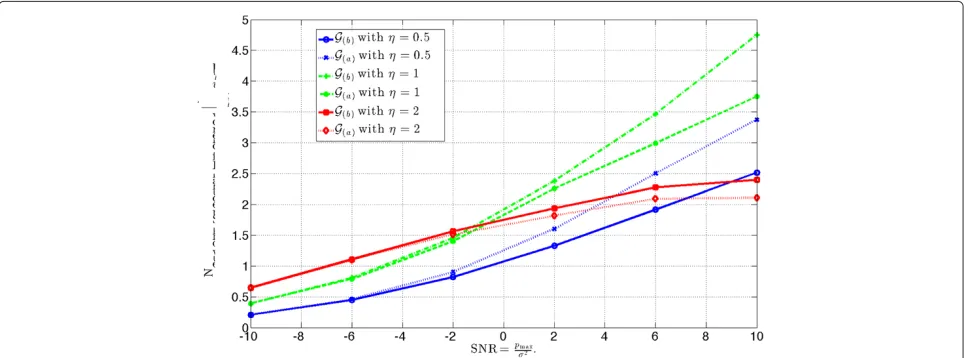
In Figure 4, we plot the NSE as a function of the aver-age SNR of the transmitters. Here, it is shown that in fully loaded and over-loaded networks, i.e.,η= KS 1, the gain in NSE obtained by using a discrete action set (gameG(a))
increases with the SNR. Conversely, for weakly loaded net-works η < 1, limiting the transmitters to use a single
channel appears to be suboptimal as the SNR increases. This is basically because using only one channel, necessar-ily implies letting some interference-free channels unused. Interestingly, at low SNR, the NSE observed in both games is the same, independently of the load of the system. In both cases, high SNR and low SNR regimes, the observed results are in line with Propositions 4 and 5.
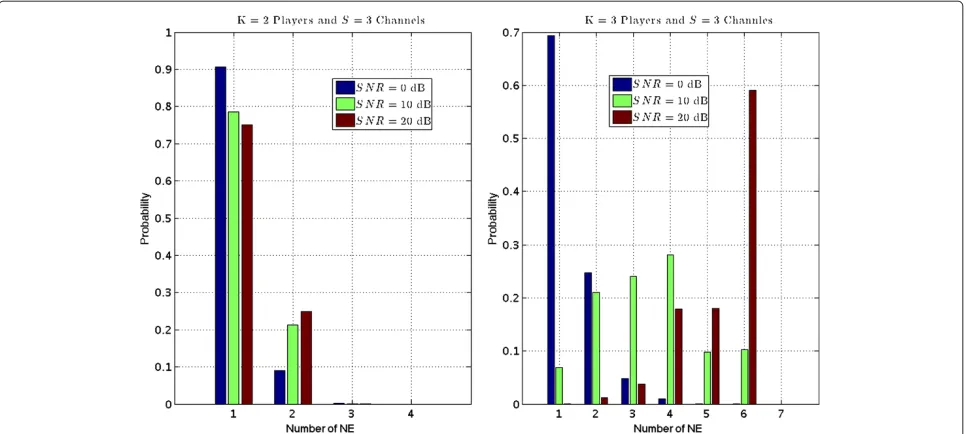
In Figure 5, we plot the probability of observing a spe-cific number of NE in the gameG(b) for different values
of SNR. This probability is calculated as the empirical fre-quency of the number of NE observed in 106realizations of the game G(a) and G(b). At each game realization, a
new channel matrix realizationH is considered. In the first case (Figure 5a), we consider S = 2 and K = 3,
whereas in the second case (Figure 5b), K = 3 and
S=3. Note that from Proposition 1, the maximum num-ber of NE is 4 and 7, respectively. However, only 3 and 6 NE are, respectively, observed in the simulations. This observation joints the discussion on the tightness of the bound presented in Section 3.3.2. Note that Proposition 1 relies only on the number of transmitters and available channels. A tighter bound can be obtained if the actual channel realizations are considered. However, this might be significantly tedious for networks with large number of transmitters.Moreover, note also that low SNR levels are associated with a unique NE (with high probability), whereas, high SNR levels are associated with multiple NE (with high probability). Note that this observation, at least for the case ofK = 2 andS = 2, is inline with Propositions 4 and 5.
5.2 Impact of the number of transmitters (K)
In Figure 6, we plot the NSE as a function of the number of transmitters per channel, i.e., the system loadη = KS.
Figure 4NSE as a function of theSNR=pmax
Figure 5Probability of observing a specific number of NE in the gameG(b)calculated using Monte-Carlo simulations.
Therein, one can observe that for weakly loaded systems η < 1, playing G(a) always leads to higher NSE than
playing G(b). This is natural since restricting the
trans-mitters to use only one channel implies not using other channels which are interference-free, as S > K. On the contrary, for fully loaded and over-loaded systems, the NSE of the game G(a) is at least equal or better than
that of the gameG(b). Indeed, the fact that for high
sys-tem loadsη > 2, the NSE obtained by playing the game G(a) and G(b) become identical stems from the fact that
under this condition the system becomes dominated by the interference.
In Figure 7, we plot the PoA (29) of both games G(a) and G(b) as a function of the number of
trans-mitters for several SNR values. First, we highlight the fact that as shown in our theoretical analysis, optimal performance (PoA(G(b))=1) is achieved
in the case of low density networks η1 using
CS. Note also that in the case of the PA game PoA(G(a)) >1 independently of the network load,
which implies that there always exists a loss of per-formance when the network is decentralized and the transmitters are allowed to use several channels simultaneously.
Figure 6NSE as a function of the system loadη= KS for differentSNR= pmax
Figure 7PoA calculated using Monte Carlo simulations and using Equation (29) for a network withK=10players,Bs
B =1S, for alls∈S
andSNR=10 log10pmax N0B
∈ {0, 15}dB.
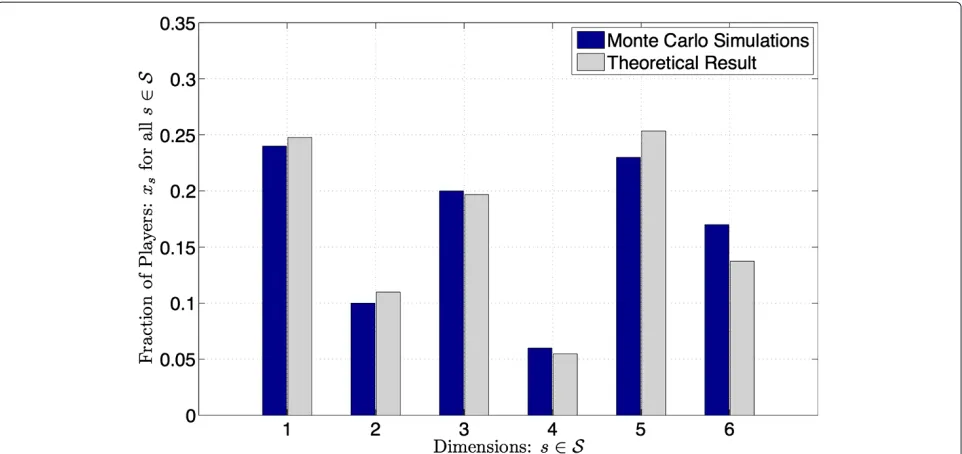
Finally, in Figure 8, we show the fractionsxs of
trans-mitters using channels, withs ∈ S, obtained by Monte Carlo simulations and using (26) for a large network with an asymptotic ratio of players per channel equivalent to η = 10. Therein, it becomes clear that (26) is a precise estimation of the outcome of the gamesG(a) andG(b) in
the regime of large number of players.
6 Conclusions
In this article, it is shown to what extent the equilibrium analysis of the decentralized parallel MAC differs from
those conducted for other channels like Gaussian MIMO interference channels and fast fading MIMO MAC. In particular, the special structure of parallel MAC and the assumption of SUD at the receiver leads to the potential game property. The CS game was merely introduced in the literature but not investigated in details as it is in this arti-cle. In particular, a graph-theoretic interpretation is used to characterize the number of NE. In the case where the number of transmitters is large, the fraction between pure NE and the total number of action profiles is relatively small, which makes both the analysis and the achievability
Figure 8Fraction of players transmitting over channels, withs∈S, calculated using Monte Carlo simulations and using Equation (26) for a network withS=6channels,K=60players, withb=(bs)∀s∈S=(0.25, 0.11, 0.20, 0.05, 0.25, 0.14), and
SNR=10 log10pmax N0B
of the NE a challenging task. Now, from a design point of view, we provide theoretical results and numerical examples to show that a fully loaded network, when trans-mitters use only one channel, can be more efficient than its counterpart when all the channels can be exploited by the transmitters. Although all of these results are encour-aging about the relevance of game-theoretic analyses of PA problems, important practical issues have deliberately been ignored. For example, the impact of channel estima-tion is not assessed at all. Also, it is important to conduct a detailed analysis on the signaling cost involved by all the PA algorithms arising from this game formulations to learn NE.
Appendix
Proof of Proposition 1
In this appendix, we provide a proof of Proposition 1, which establishes an upper bound for the number of NE of the gameG(b). Here, we exploit some basic tools from
graph theory. Let us index the elements of the action set P(b) in any given order using the index n ∈ I =
1,. . .,SK. Denote byp(n)thenth element of the action
setP(b). We write each vectorp(n)withn ∈I, asp(n) =
p(1n),. . .,p(Kn)
, where for allj∈K,pj(n) ∈Pj(b). Consider
that each action profilep(n)is associated with a vertexvn
in a given non-directed graphG. Each vertexvnis adjacent
to theK(S−1)vertices associated with the action profiles resulting when only one player deviates from the action profilep(n), i.e., if two verticesvnandvm, with(n,m)∈I2
andn = m, are adjacent, then there exists one and only onek∈K, such that
∀j∈K\ {k}, p(jn)=pj(m), and p(kn)=p(km).
More precisely, the graphGcan be defined by the pair G=(V,A), where the setV = v1,. . .,vSK
(nodes) rep-resents theSK possible actions profiles of the game and
A(edges) is a symmetric matrix (adjacency matrix ofG) with dimensionsSK ×SK and entries defined as follows ∀(n,m)∈I2andn=m,
an,m=am,n=
1 ifn∈Vm
0 otherwise, (88)
andan,n = 0 for alln ∈ I, where the setVnis the set of
indices of the adjacent vertices of vertexvn. In the
follow-ing, we use the concept of distance between two vertices of the graphG. We define this concept using our notation:
Definition 4 (Shortest Path). The distance (shortest path) between vertices vn and vm, with (n,m) ∈ I2
in a given non-directed graph G = (V,A), denoted by dn,m(G)∈Nis:
dn,m(G)=dm,n(G)= K
k=1
1 p(kn)=p(km)
. (89)
Here, for any pair of action profilesp(n) andp(m), with (n,m) ∈I2andn =m, we have thatφ (p(n)) = φ (p(m)) with probability one. This is because channel gains are random variables drawn from continuous probability dis-tributions and thus, Prφ (p(n))=φ (p(m))|n=m = 0. Hence, following Definition 1, one can state that if the action profilep(n), withn∈I, is an NE of the gameG(b),
then, it follows that
∀m∈V(n), φ (p(n)) > φ (p(m)), (90)
and thus, with probability one, none on the action profiles inV(n)are NE. By iteratively following this procedure over
the remaining set of action profilesI \ {n∪V(n)}, some
action profiles can be eliminated and only those that are potentially NE are left over.
Thus, given that the action profile p(n) is an NE, the action profilep(m), withn=m, can be an NE candidate, if it is (at least) at distance two ofp(n)and any other NE can-didate, i.e.,dn,m(G) = dm,n(G) ∈ {2, 4,. . .,Kˆ}. An action
profile at distance ∈ {2, 4,. . .,Kˆ}fromp(n), is a vector where players have simultaneously deviated fromp(n). Hence, for each -tuple of players, there always existsS−1 action profiles at distance from p(n) and at distance 2
from each other. Thus, considering the initial NE action profilep(n), there might exist at most
L1+
i∈{2,4,...,Kˆ}
K i
(S−1) (91)
NE candidates. This establishes an upper bound forL and completes the proof.
Proof of Proposition 2
In this appendix, we provide a proof for the Proposition 2. The proof is separated in two steps. First, we show that a PA vectorp=p1,p2∈P(a)of the form
p1=(p11,pmax−p11) andp2=(pmax−p22,p22),
is not an NE of the gameG(a), whenp11 ∈ 0,pmaxand p22 ∈
0,pmax
. Second, we show that ifpis an NE, then, pis unique and satisfies that,p∈P†, where
P† = P(a)\ {
p=(p11,pmax−p11,pmax−p22,p22) ∈R4
+:p11∈0,pmax andp22∈0,pmax}.