MP-05.01
Impact of Side of Allograft Placement and Location of Arterial Anastomosis on Delayed Renal Function after Pediatric Renal Transplantation
Figueroa, Victor H.; Lorenzo, Armando; Kim, Wooheon T.; Romao, Rodrigo L.P.; Pippi Salle, Joao L.; Koyle, Martin; Taylor, Katherine
The Hospital for Sick Children, Toronto, ON, Canada
Introduction and Objectives: It has been suggested that renal allograft
vascular reconstruction is easier to perform in the right iliac fossa rather than the left because of a more superficial orientation and relatively simpler exposure of the iliac vessels. Our goal was to compare the impact of side and location of the arterial reconstruction on early graft function.
Methods: Medical records of 95 children who underwent renal
transplan-tation between 2006-2011 were retrospectively reviewed. Demographics, warm ischemia time, side and location of vascular anastomosis, nadir and time to reach nadir creatinine were captured.
Results: Mean age at the time of transplantation was 10.5 years (17
months-17years). Out of 95 transplants (63 males-32 females), 54 (56.8%) were cadaveric and 41 (43.2%) were living-related. In 73 cases (76.8%), the graft was placed on the right side vs. 22 (23.2%) on the left. On the right side, the kidney was anastomosed to the external iliac artery (EIA), com-mon iliac artery (CIA) and Aorta (Ao) in 16.5% (n=12), 69.8% (n=51) and 13.7% (n=10) respectively; with a similar distribution on the left side: 22.8% (n=5) to EIA, 68.2% (n=15) to CIA and 9% (n=2) to Ao. Mean ischemia time was 10 minutes longer on the left side compared to the right (47.5 vs. 38.3 minutes, p=0.003). However, this was not associated with statistically significant differences on time to reach nadir creatinine (p=0.32) and mean nadir creatinine (p=0.11). When patients were grouped by location of the anastomosis, there was no difference in warm ischemia time, mean time to nadir creatinine and mean of creatinine nadir (p>0.05).
Conclusions: We found a significant increase in the warm ischemia time
when the kidney was transplanted on the left side. Although these findings suggest a more challenging vascular anastomosis on this side, longer warm ischemia time was not associated with delayed renal function. Overall, location of arterial anastomosis did not have any impact on renal function outcomes.
MP-05.02
Minimally Invasive Open Technique for Management of Upper Pole Ectopic Ureter in Children with Duplicated Systems Sheikh, Adeel1; Zaidi, Adil2; DeMaria, Jorge2; Braga, Luis1
1McMaster Institute of Urology, Hamilton, ON, Canada; 2St. George’s
University, Great River, NY, United States
Introduction and Objectives: Duplex systems with upper pole ectopic
ureters may be associated with an increased incidence of urinary tract infections, urinary incontinence, hydroureteronephrosis, and vesicoure-teric reflux (VUR). Surgical management options are aimed at reducing these complications. Distal ureteroureterostomy (U-U) is one such modal-ity which is minimally invasive yet relatively under-utilized. We report our prospective analysis with this technique.
Methods: Since 2009, we have prospectively followed all children who
underwent distal ureterouretostomy (U-U) for upper pole ectopic ureters associated with a duplex collecting system and no VUR. Age at surgery, operative time, postoperative complications, length of surgical incision and hospital stay, as well as time to resolution of hydroureteronephrosis were
analyzed. One surgeon stented all anastamoses whereas the other did not based on their routine practice without any selection bias. All cases were performed through a small transverse inguinal incision.
Results: U-U was performed on 17 patients with a median age at surgery of
13 months (1-60). Median followup was 12 months (6-27). Mean operative time was 87 min (70-115). One patient required readmission after discharge for febrile urinary tract infection with stent migration outside of the urethra. Another child returned to hospital for severe stent colic. Mean postopera-tive hospital stay was 18 hours. One patient spent 4 days in hospital for a presumed viral infection. All patients showed complete resolution of their hydroureteronephrosis. Time to resolution of hydroureteronephrosis was 5 months (3-9). No complications were observed in children who had stentless U-U.
Conclusions: Distal U-U via a small inguinal incision is an effective
mini-mally invasive option for management of ectopic upper pole ureters without lower pole VUR. It can be performed on an outpatient basis in most patients. Nonstented patients fared well with no complications.
MP-05.03
Observation versus Immediate Intervention in Ureteropelvic Junction Obstruction: Does It Matter?
Stearns, Gillian1; Reeder, Jay1; Barrieras, Diego2; Houle, Anne-Marie2;
Franc-Guimond, Julie2; Riddell, Jonathan1
1SUNY Upstate, Syracuse, NY, United States; 2CHU Sainte-Justine, Montreal,
QC, Canada
Introduction and Objectives: Ureteropelvic junction syndrome is a
com-mon cause of antenatal hydronephrosis. Controversy exists over the indica-tions for pyeloplasty, as well as its timing and renal functional outcome. The objective of this study is to assess whether a period of observation with selective intervention adversely affects ultimate renal function as compared to early pyeloplasty.
Methods: Retrospective review of patients diagnosed with unilateral severe
high-grade antenatal hydronephrosis (SFU 3 or 4) between 1998 and 2008 was performed. Children were categorized into those who received pyelo-plasty based on the initial evaluation (early) versus those that underwent a period of observation with later pyeloplasty due to functional deterioration (delayed). All patients received an initial postnatal MAG-3 renal scan post-natally, and at least one more postoperatively. The main outcome variable is percent renal function of the affected kidney. Statistical analysis used T-test to assess for differences between groups, and bivariate analysis to determine if surgical timing had an effect on ultimate renal function.
Results: One hundred fifty three patients were identified with unilateral
severe antenatal hydronephrosis. Of these, 77 children underwent pyelo-plasty [45 immediate, 32 delayed]. Mean age at surgery was 5.9 weeks (+\-8weeks) in the early group and 50 weeks (+\-55.8 weeks) in the delayed group. Mean initial renal function was similar between groups [early 44.3 +\-1.4%, delayed 44.9+\-1.7%, p=0.56]. Postoperative mean renal func-tion was also similar [early 42.2 +\-1.6%, delayed 44.9+\-1.9%, p=0.28]. On linear regression analysis, the timing of surgery did not have a significant effect on ultimate renal function.
Conclusions: In cases of unilateral severe hydronephrosis, immediate
pyeloplasty does not appear to confer any significant benefit in terms of renal functional preservation over a strategy of observation and selected intervention for functional decline.
MP-05.04
A Prospective Study Using a New Bulking Agent for the Treatment of Pediatric Vesicoureteral Reflux: Bulkamid®
Cloutier, Jonathan1; Blais, Anne-Sophie2; Moore, Katherine2; Bolduc,
Stéphane2
1Division of Urology CHUL, CHUQ, Quebec, QC, Canada; 2Division of
Urology, CHUL-CHUQ, Université Laval, Quebec, QC, Canada
Introduction and Objectives: Vesicoureteral reflux (VUR) is a prevalent
disease in the pediatric population and the use of endoscopic treatment has become the first line of therapy, especially for low grade reflux. Commercially available products offer short term good success rate but their price are becoming an issue. Our objective was to evaluate the suc-cess of endoscopic treatment for VUR in children using hydrogel agent (Bulkamid®), which is actually approved for periurethral injection. It has been documented to maintain its volume a long time after the injection.
Methods: We performed a single centre, single surgeon prospective
off-label study using Bulkamid®; an hydrogel agent consisting of 97,5% water and 2.5% cross-linked synthetic polymer presented in a 1.0 ml syringe, to treat VUR. All patients underwent endoscopic subureteral double HIT technique injection. Every patient had a 3-month postoperative ultrasound and voiding cystourethrogram (VCUG) to confirm the absence of de novo hydronephrosis and correction of VUR (grade 0).
Results: A total of 34 patients underwent Bulkamid® injection between
March and November 2011. Median age at surgery was 43 months (range 10 mo to 21 yo). Eight males and 26 females were included for a total of 58 refluxing ureters. Bilateral reflux was identified in 22 patients. Nine patients had duplex systems and 2 of them had reflux in both renal moieties. Reflux grade was I in 7, II in 18, III in 17, IV in 11 and V in 5 ureters. Mean volume injected was 1.07 ml. Success rate for grade 1 to 3 was 79% and overall, it was 76%.
Conclusions: Our short-term data demonstrated an interesting success
rate principally for low grade reflux with the off-label use of this newly approved product. It was easily injected and the technique did not require any modification. Another
inter-esting aspect of this product is his lower cost compared to other available bulking agents.
MP-05.05
Does Routine Ultrasounds Change Management in the Follow-up of Patients with Vesicoureteral Reflux? Wildgoose, Petra1; Weber, Bryce2; Lorenzo,
Armando3; Bagli, Darius3; Farhat, Walid3;
Harvey, Elizabeth3; Pippi Salle, Joao L.3 1McMaster Medical School, Hamilton,
ON, Canada; 2Alberta Children’s Hospital,
Calgary, AB, Canada; 3Hospital for Sick
Children, Toronto, ON, Canada
Introduction and Objectives: Little data
exists regarding whether U/S findings alter management plans beyond history and physical examination in VUR patients. We sought to evaluate the impact of follow-up U/S on the change in clinical management.
Methods: A prospective analysis of
con-secutive children with a diagnosis of VUR, seen in clinic with a routine follow-up U/S, within 4 months (Nov 2010-Feb 2011). Variables collected included: demographic data, VUR history, dys-functional voiding symptoms, along with concurrent U/S findings. Change in man-agement at the time of visit was defined as a new prescription, nurse counselling for voiding dysfunction, surgery, or fur-ther investigations (i.e. DMSA). On U/S,
change was considered to be a change in grade of hydronephrosis or new renal scarring.
Results: The study included 114 consecutive patients. The mean age was
4.5 yrs old, mean age at diagnosis was 1.7 years, with the average child followed for a mean of 2.8 years. A change in management with stable U/S findings occurred in 14 patients, in which the change included order-ing a DMSA in 9 (64%), nurse counsellorder-ing for dysfunctional voidorder-ing in 3 (21%), and surgery in 2 patients (14%) patients. Overall a change on U/S was seen in 4 patients (3 with worsening hydro and one with suspected new scars). One of these received a change in management in the form of a repeat DMSA to look for worsening renal scarring. Further, when all the collected variables where analyzed for influencing change of man-agement, only a history of urinary tract infection since the last follow-up visit was significant (p<0.001).
Conclusions: The only variable showing a significant effect on change in
management was a history of UTI since last visit, reflective that clinical decisions were based on recent history rather than U/S findings. In an era of restricted resources coupled with the limitations of U/S to evalu-ate renal scarring, the value of follow-up U/S for children with VUR may need to be revisited.
MP-05.06
Methodological Quality Assessment of Randomized Controlled Trials in Hypospadias Literature
Braga, Luis1; Lorenzo, Armando2; Vizcarra, Rachel1; Pemberton, Julia1;
DeMaria, Jorge1; Byrne, Roisin3
1McMaster University, Hamilton, ON, Canada; 2University of Toronto,
Toronto, ON, Canada; 3University of Calgary, Calgary, AB, Canada
Introduction and Objectives: To assess the overall quality of published
randomized trials in hypospadias literature and to determine factors asso-ciated with better reporting quality.
Methods: Two independent investigators searched MEDLINE for all
English-written hypospadias RCTs published between 1990-2011. Title,
authors, institutions, year and journal of publication of the included trials were concealed prior to article assessment. The quality of each study was assessed by reporting a quality percentage score based on items from the revised CONSORT statement. Studies were rated as either high (OQP >70%), moderate (OQP 40-70%) or low reporting quality (OQP ≤40%). Year of publication (before or after 2006), blinding of outcome assessor, statistical significance and sample size (n>50) were evaluated separately by using a 4-point key Methodologic Index Score (MIS; range, 0-4).
Results: We retrieved 23 relevant RCTs that included 1652 patients with
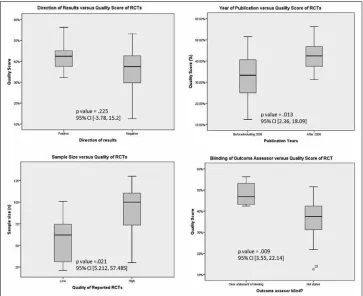
an overall quality percentage (OQP) range of 13-56% (median=39%). Over 80% of studies failed to adequately report randomization strategy, allocation concealment, blinding, baseline characteristics and sample size calculations. Blinding of outcome assessor and p value significance were reported only in 5 (22%) and 7 (30%) of the trials, respectively. Median MIS was 2 (range:0-4). Univariate analyses showed that publication after 2006 (p<0.01), RCT sample size >50 (p=0.03), p value significance level (p<0.01) and blinding of outcome assessor (p<0.01) were significantly associated with better quality of RCTs. On multivariate linear regression, only blinding of outcome assessor and sample size >50 remained as an independent and significant predictors of improved MIS (Fig. 1).
Conclusions: Although the overall quality of reporting of hypospadias
RCTs has improved over time, description of key methodologic issues remains poor. This may lead to biased interpretation of hypospadias trial results.
MP-05.07
Is There a Role for Prophylactic Antibiotics after Stented Hypospadias Repair?
Kanaroglou, Niki; Alotay, Abdulhakim; Romao, Rodrigo L.P.; Koyle, Martin; Lorenzo, Armando; Bagli, Darius; Farhat, Walid
Hospital for Sick Children, Toronto, ON, Canada
Introduction and Objectives: Evidence supporting post operative
pro-phylactic oral antibiotics (POA) in routine stented hypospadias repair is lacking. In light of emerging resistance patterns, drug side effects, parental anxiety, and rising health care costs, we seek to clarify to role of POA in preventing post operative infections in this population.
Methods: After ethics board review, we studied the records of all
consecu-tive patients undergoing stented primary or redo hypospadias repair by a single surgeon from Jan 1 - Aug 31, 2011. All patients received single dose antibiotics on induction. Prior to April 1st, all patients received POA while stented. We compared this group to the non-POA group (surgery after April 1st). Primary outcomes included urinary tract infection (UTI) defined by positive urine culture, and skin infection. These events were captured using a province-wide database from our institution’s Infection Control Board for surgical site infections. Secondary outcomes included rates of fistula, dehiscence and meatal stenosis.
Results: During this period, 60 patients underwent hypospadias repair,
53 of which were stented. Mean age at surgery was 20.7 months, and mean follow-up was 8.2 months. 48 (90%) had a tubularized incised plate repair, and the remaining cases were done by glanular approximation (1) or staged approach (4). 17 (32%) received POA, and 36 (68%) had no POA. 1 patient in the POA group had post operative UTI. No UTIs occurred in the non-POA group (p=0.3). 1 patient from each group was treated for skin infection by their pediatrician (p=0.53). 2 patients in the POA group had fistula (10%), and 4 (6%) non-POA patients had fistula or stenosis (2 pts each), (p=0.9).
Conclusions: In our cohort, there was no clear difference in UTI, skin
infection, or complication rates between the two groups. These results sug-gest that POA may be unnecessary in routine stented hypospadias repair. Further prospective study is needed to clarify these risks and benefits.
MP-05.08
The Effect of Androgen Stimulation on Postoperative Complication Rates after Penoscrotal Hypospadias Repair: a Systematic Review and Meta-analysis
Cole, Eric1; Wright, Ian1; Lorenzo, Armando2; Pemberton, Julia1; Vizcarra,
Rachel1; Farrokhyar, Forough1; Braga, Luis1
1McMaster University, Hamilton, ON, Canada; 2University of Toronto,
Toronto, ON, Canada
Introduction and Objectives: We conducted a systematic review and
meta-analysis to summarize the effect of preoperative androgen therapy (AT) on postoperative complication rates after proximal hypospadias repair.
Methods: Electronic databases and grey literature were comprehensively
searched between 1990 and 2010. Eligibility criteria were applied. Title, abstract, and full text screening was carried out by 2 independant authors and discrepancies were resolved by consensus. Heterogeneity between studies was tested using Cochran’s Chi2 test and quantified by calculat-ing I2. Quality appraisal of included studies classified studies as high, moderate or low scientific quality. Meta-analysis was performed when appropriate. A fixed effects model was used in the absence of heterogene-ity and a random effects model was used when heterogeneheterogene-ity was present using Review Manager 5.1.
Results: Our search yielded 640 citations, of which 5 met inclusion
cri-teria and were included in the final analysis. The 5 studies assessed post-operative complications based on prepost-operative AT: one was a randomized control trial (RCT) of patients with distal/midshaft hypospadias and 4 were observational studies of proximal hypospadias. In a pooled analysis of patients (n=301) with proximal hypospadias, the use of preoperative AT was associated with increased risk of postoperative complications [OR=1.63, 95%CI 0.94-2.83] with I2 of 0%. The RCT (n=75) showed
a decreased risk of postoperative complications in patients with distal/ midshaft hypospadias treated with AT [OR=0.28 (0.07, 1.15)].
Conclusions: It appears that stimulation with androgens prior to
hypo-spadias repair leads to increased complication rates in patients with proximal defects. These findings should be interpreted with caution due to limitation inherent to meta-analysis of small observational studies. A well-designed, prospective study is needed to verify these findings and to further examine the relationship between AT and hypospadias repair outcomes.
MP-05.09
Clitoroplasty and Vaginoplasty in Adolescents and Adults with Disorders of Sex Development (DSD): Lessons Learned Pippi Salle, Joao L.1; Romao, Rodrigo L.P.1; Allen, Lisa1; DeMaria, Jorge2;
Braga, Luis2; Jednak, Roman3; Dave, Sumit4; Lorenzo, Armando1; Farhat,
Walid1; Koyle, Martin1; Bagli, Darius1
1The Hospital for Sick Children, University of Toronto, Toronto, ON,
Canada; 2McMaster University, Hamilton, ON, Canada; 3McGill
University, Montreal, QC, Canada; 4University of Western Ontario,
London, ON, Canada
Introduction and Objectives: Optimal timing for feminizing
genitoplasty(FG) in patients with DSD is controversial. Early FG has recently been challenged for ethical issues. In addition, outcome data on post-pubertal surgery for DSD is scarce. Herein we report the experience with 19 patients who underwent FG in adolescence or early adulthood.
Methods: Retrospective, multicentric review of teenage and adult DSD
patients who underwent surgical repair in the last 12 years. Age, diagnosis, surgical details and complications were obtained. Some patients self-reported on sexual activity, opinion on timing of surgery and postoperative clitoral sensitivity.
Results: Diagnosis was congenital adrenal hyperplasia in 15 patients
were technically more demanding than when done in childhood. 10/19 patients (4 early, 6 late CL) with available information reported good clito-ral sensitivity and ability to reach orgasm. Five patients strongly regretted not having earlier intervention in childhood and 5 developed significant loss of libido after orchiectomies. There were no major surgical compli-cations. Most patients who underwent vaginoplasty had postoperative dilations and none developed severe stenosis. Ten patients are known to be sexually active and satisfied.
Conclusions: Post-pubertal FG is feasible although technically more
dif-ficult. Based on our data, both early and late CL can maintain clitoral sensitivity and ability to achieve orgasm. Although some patients in this series regret not having earlier repair, the question about ideal timing for FG remains unanswered.
MP-05.10
Correlation of Ultrasound (US) with Laparoscopy (LAP) in Kuwaiti Patients (pts) with Unilateral Non-palpable Testicles (NPT): Impact of Weight (WT) and Contralateral Testicular Size Elsawy, Mohamed1; El-Hout, Yaser2; Gupta, Vipul1; Farhat, Walid2; Alsaid,
Abdulnasser1
1Ibn Sina Hospital, Sulaibikhat, Kuwait; 2Hospital for Sick Children,
Toronto, ON, Canada
Introduction and Objectives: LAP is the gold standard in managing NPT.
The value of preoperative US is debatable with possible value in obese pts and in measuring contralateral descended testicular size, where hypertro-phy may be predictive of absent testicle. Herein, we examine the current predictive accuracy of US compared to LAP considering body wt and contralateral testicular size.
Methods: This is a single centre prospective study of a cohort of Kuwaiti
pts managed for unilateral NPT over 1 year. All underwent preop US for ipsilateral localization and contralateral size. Pts with testicles rendered palpable under anesthesia were excluded. Wt was recorded and a sub-analysis for obese pts (wt >95th percentile on wt-for-age curve) was done. Contralateral size was compared to size of an age matched control group and correlated to LAP outcome.
Results: Analysis was completed on 67 pts. On US, 26 testicles were
localized and 41 were not visualized. On LAP, 30 testicles were localized and 37 confirmed absent; hence, 4/30 testicles were missed by US. Three of 4 missed testicles by US were in obese pts (p< 0.05). Nine obese pts were identified in the cohort; hence US had a sensitivity of 66% for obese pts. Contralateral hypertrophy significantly correlated with absent testicle on LAP with a (mean± SD) testicular length of 11.8 ± 1.7 mm vs. 17.0 ± 1.9 mm and a (mean ± SD) testicular volume of 0.33± 0.12 mL vs. 0.76± 0.27 mL, in the localized testis vs. the absent testis groups, respectively (p<0.05). Of note, control group measurements were 12.6 ± 2.0 mm for length and 0.30 ± 0.13 mL for volume. Overall, no testis was found by LAP for a contralateral cut-off length of 16 mm.
Conclusions: Though US cannot replace the diagnostic certainty of LAP,
it localizes NPT in the majority of pts. Its accuracy declines in obese pts, limiting its value. Contralateral size may be a useful predictor of LAP outcome. Whenever available preoperatively, the results of an US may aid in counselling pts with NPT.
MP-05.11
Attempt at Fertility Preservation in Two Children with Paratesticular Rhadomyosarcoma
Spelliscy, Courtney; Kiddoo, Darcie University of Alberta, Edmonton, AB, Canada
Introduction and Objectives: Rhadomyoscarcoma is one of the most
common forms of childhood tumor. They occur less than 4% of the time in the paratesticular region. Ultrasound is the modality of choice in dif-ferentiating between intratesticular and extratesticular lesions. Complexity arises when the ultrasound misdiagnoses the tumor as epididymitis or orchitis. Tumors may expand and require radiation which can impact fertility. We report two cases of children who required scrotal radiation due to positive margins and underwent testicular fixation in the inguinal region prior to radiation.
Methods: Information was collected on two patients with similar
presen-tations of paratesticular rhabdomyosarcoma who underwent testicular fixation prior to radiation.
Results: Patient A presented with an embryonal paratesticular
rhabdomyo-sarcoma. The child required radiation therapy for positive margins and underwent surgery prior to radiation to move the right testicle into the groin to avoid the radiation field. Following chemotherapy and radiation the testicle appeared viable and was returned to the scrotum. Patient B presented with a paratesticular rhabdomyosarcoma with intraabdomi-nal lymphadenopathy. Chemotherapy was initiated for Stage IV disease. Sperm banking was discussed and he was referred for radiation. This patient was unable to provide a semen sample and prior to the initiation of radiation, his testicle was moved in the same fashion in an attempt to preserve fertility.
Conclusions: Clinical outcomes for pediatric patients with testicular
tumors can be very good with early detection and multimodal therapy. While chemotherapy may damage germ cells, radiation will exacerbate it. As survival improves it becomes important to consider fertility pres-ervation. We report two cases of surgery to fix the remaining testicle in the inguinal region to avoid the radiation field. This is a feasible choice however the long term fertility results are yet to be determined.
MP-05.12
Urodynamic Improvements after Medical Treatment of Partial Bladder Outlet Obstruction in an Animal Model
Maciejewski, Conrad1; Tredget, Edward2; Metcalfe, Peter1
1University of Alberta, Division of Urology, Edmonton, AB, Canada; 2University of Alberta, Division of Plastic Surgery, Edmonton, AB, Canada
Introduction and Objectives: Anticholinergic medication remains the
standard for symptomatic treatment for partial bladder outlet obstruction (pBOO), however it is unclear if it prevents deterioration to end-stage bladder. In-vitro work has demonstrated the involvement of novel signal-ing pathways in bladder fibrosis, includsignal-ing the mTOR / MAPK pathway, which is suppressed by rapamycin. We aimed to assess the long-term urodynamic effects of oxybutinin and compare it to rapamycin in an animal model.
Methods: Following approval from the University of Alberta Animal
Care & Use Committee, female Sprague-Dawley rats underwent surgical induction of pBOO. Three experimental groups were used: control, daily oral oxybutynin (3mg/kg) and daily oral rapamycin (2mg/kg). Rats were maintained and monitored up to 12 weeks, where urodynamics were performed and organs harvested.
Results: Oxybutynin treatment resulted in a 10-fold increase in bladder
capacity versus controls (3.36 ± 0.53 cc vs. 0.36 ± 0.08 cc, p<0.01). Similar changes were seen in maximum detrusor pressure with oxybutynin treated rats compared to controls (46.5 ± 7.8 cm H2O vs. 17.3 cm H2O ±
4.04, p<0.01). No significant differences in bladder capacity or pressure were seen with rapamycin. Bladder weights were significantly different between control and oxybutinin treated rats (326 ± 30.5 mg vs. 875 ± 318 mg, p=0.04), as well as with rapamycin treated rats (227 ± 70 mg,
p=0.08). Bladder wall thickness was also significantly different between control and oxybutynin treated rats (0.51 ± 0.02 mm vs. 0.71 ± 0.05 mm, p=0.01), and rapamycin treated animals (0.39 ± 0.01 mm, p=0.01).
Conclusions: Daily treatment with oxybutinin results in an increase in
bladder capacity but pressures and thickness remain elevated. Rapamycin treatment results in significantly lighter and thinner bladders. Further work will determine if this data is related to deterioration to fibrotic changes and progression to the end-stage bladder.
MP-05.13
Outcomes Following Fecal Continence Procedures in Patients with Neurogenic Bowel Dysfunction
Kiddoo, Darcie; Metcalfe, Peter; Hoy, Nathan University of Alberta, Edmonton, AB, Canada
Introduction and Objectives: Fecal incontinence in children and adults
surgical intervention may be considered. Both the Malone antegrade con-tinence enema (MACE) and the cecostomy button have recently become very popular. This study aims to review our results and compare the outcomes between the two procedures.
Methods: A retrospective chart review of all patients who underwent
either a MACE or cecostomy followed through either the pediatric or adult spina bifida clinics was performed. Regression analysis was used to determine whether there was a difference in continence and failure rates between the two groups, controlling for gender and age at proce-dure. Continence was defined as the ability to wear underwear with no accidents when well.
Results: Forty-four patients were identified who had either procedure for
fecal continence. Twenty-one patients underwent MACE and 23 patients underwent cecostomy. The rate of fecal continence achievement was 85.7% for MACE and 95.7% for cecostomy. For cecostomy, 8.7% switched the initial procedure, compared to 14.3% with MACE. Complication rates were 52.2% for cecostomy vs. 61.9% with MACE. Common complica-tions for MACE were pain (28.6%) and difficulty (23.8%) with catheter-izing; for cecostomy, it was difficulty flushing (21.7%).
Conclusions: There is no significant difference (p>0.05) between MACE and cecostomy button with respect to achieving fecal continence. Both groups do well and few patients stop using their chosen method to attain continence. Both methods present unique challenges, including difficulty catheterizing with the MACE and difficulty in flushing via the cecostomy tube. At this point there is no clear preferred method, suggesting that patients and their families need to understand the differences and make a personal choice.
MP-05.14
Onabotulinumtoxin A Endoscopic Detrusor Injection for the Treatment of Neurogenic Bladder in Children: Effect of Dose Adjustment, Multiple Injections and Avoidance of Reconstructive Procedures
Figueroa, Victor H.; Romao, Rodrigo L.P.; Pippi Salle, Joao L.; Kanaroglou, Niki; Koyle, Martin; Bagli, Darius; Lorenzo, Armando
The Hospital for Sick Children, Toronto, ON, Canada
Introduction and Objectives: Treatment for neurogenic bladder (NGB)
has been expanded with the introduction of intra-detrusor onabotulinum-toxin A injections. Herein we review our experience with this procedure for cases in which maximal anti-cholinergic therapy failed or was not tolerated.
Methods: We prospectively enrolled 17 patients who underwent
onabotu-linumtoxin A injections over a 4-year period. Demographic information, number of injections, and dose of onabotulinumtoxin A employed were captured. Children were monitored with baseline and post-injection renal ultrasound, urodynamics, and assessed for side effects, satisfaction and symptom improvement.
Results: A total of 43 sessions were performed with injections repeated
every ~6 months. Mean patient age was 10.7 years (3-17). Following the first injection, mean bladder capacity adjusted for age and compliance improved by 27% (p=0.039) and 45.2% (p=0.041). After subsequent injections, with a higher mean dose of 21.1 units these values increased to 35.7% (p=0.043) and 55.1% (p=0.091) respectively. Clinical improve-ment of ≥50% was seen in 10 children (76.9%). However, 3 patients in whom the dose of onabotulinumtoxin A was reduced to 200 units all complained of recurrent symptoms. Fourteen children (82.3%) avoided surgical reconstruction as a second line of treatment. No complications or upper tract deterioration were found associated to this procedure.
Conclusions: Intra-detrusor onabotulinumtoxin A injection is a promising