R E S E A R C H
Open Access
A hybrid MAC protocol for optimal
channel allocation in large-scale wireless
powered communication networks
Sungryung Cho
1†, Kyungrak Lee
2,3†, BooJoong Kang
4and Inwhee Joe
3*Abstract
This paper proposes a large-scale wireless powered communication network (WPCN), which consists of a hybrid access point (H-AP) and numerous nodes. The H-AP broadcasts energy to all nodes, and the nodes harvest the energy and then use the harvested energy to transmit information. For the large-scale WPCN, we also propose a novel hybrid multiple access protocol, termedhybrid multiple access-based dual harvest-then-transmit. The proposed protocol utilizes both time division multiple access (TDMA) and carrier-sense multiple access (CSMA), in order to deal with various traffic patterns and transmission reliability of different applications in large-scale networks. We consider a dual wireless energy transfer (WET) at the H-AP. The main WET is performed in TDMA and the other WET is performed atspace holes in CSMA, to increase the channel utilization and harvested energy. For the considerations, we study the
sum-throughput maximization in the large-scale WPCN based onhybrid multiple access-based dual harvest-then-transmit. Simulation results show that the proposed protocol outperforms the conventional protocol in large-scale WPCN.
Keywords: Wireless powered communication networks (WPCN), Hybrid multiple access, Channel allocation, Sum-throughput optimization
1 Introduction
Recently, there has been a great interest in a large-scale wireless network, such as internet of things (IoT) and a low-power wide-area network (LPWAN) due to the eas-iness of maintenance and the economic advantages for deployment compared to wired networks [1–3]. In these networks, one of major research issues is how to sup-ply stable operating power for numerous end-nodes, to improve network lifetime. To solve this problem, energy harvesting has received a great deal of attention as a replacement of traditional energy sources (e.g., batter-ies) in wireless networks. Especially, ambient radio sig-nals have been regarded as a promising energy source for the energy harvesting, since the radio signals enable both wireless energy transfer (WET) and wireless infor-mation transfer (WIT). For this reason, wireless pow-ered communication networks (WPCN) have been largely
*Correspondence: [email protected] †Equal contributors
3Department of Computer Science and Engineering, Hanyang, Wangsimni-ro,
222, 04763 Seoul, Korea
Full list of author information is available at the end of the article
investigated, in which a radio signal is used for the WET [4–6].
A typical WPCN consists of a hybrid-access point (H-AP) and multiple nodes, where the H-AP performs the WET in downlink (DL) and the nodes carry out the WIT in uplink (UL) by using the harvested energy [7–10]. There have been many efforts to improve the performance of WPCN in terms of throughput, energy efficiency, resource allocation, etc. [11–18].
However, most existing WPCN models cannot be directly employed to large-scale wireless networks, since nodes, in a typical WPCN, are designed to transmit infor-mation in every block. In addition, the existing WPCN models assume that all nodes can fully transmit their information in a single block, where each node transmits in rapid succession, using its own time slot. However, in large-scale networks, there would be different traffic pat-terns or specialized requirements such as transmission reliability. Furthermore, the number of transmitting nodes can be larger than the number of available slots in a sin-gle block. In that case, some nodes will fail to acquire their slots then the nodes cannot perform the WIT.
Another scale issue in a WPCN is related to state infor-mation (SI) messages between the H-AP and nodes, which are used to share status information, such as channel information, harvesting efficiency and traffic generation [18, 19]. In a large-scale WPCN, the number of SI mes-sages would be big enough to degrade the network perfor-mance significantly because of traffic overhead caused by numerous SI messages.
In this paper, we propose a novel protocol for a large-scale WPCN, named hybrid multiple access-based dual harvest-then-transmit (H-DHT). The H-DHT has a hybrid multiple access structure which employs both time division multiple access (TDMA) and carrier-sense multiple access (CSMA), in order to manage different traffic patterns and requirements of nodes. We assume that there are two primary traffic patterns in the large-scale WPCN: periodic and non-periodic traffic. Note that transmission reliability is guaranteed for the periodic traf-fic, but not for the non-periodic traffic. The periodic traffic can be allocated in the TDMA period (TP) for the reliable information transmission, i.e., the time slots in the TP are assigned to each node for their periodic traffic. Especially, we consider that the H-AP can also perform the DL WIT in the TP when the H-AP has information to transmit (not supported in [11–15]). On the other hand, the non-periodic traffic, which is unconstrained from the trans-mission reliability, is allocated in the CSMA period (CP).
We also propose a novel WET method, named the
dual-WET, which improves the channel utilization and increases the amount of harvested energy at nodes. The H-AP performs the main-WET during the TP and the additional WET, termed sub-WET, during the CP. As a typical CSMA is a contention-based channel access pro-tocol, channels are not always occupied and there can exist wasted time, called space holes, in wireless chan-nels depending on the system of interest. However, in the H-DHT, nodes can harvest additional energy by perform-ing the sub-WET in space holes. As a result, the chan-nel utilization can be improved without any throughput reduction.
Furthermore, we describe the procedure of the SI trans-mission between the H-AP and nodes, where numerous SI messages could degrade the network performance in large-scale networks [20]. In the proposed model, some nodes, which generate periodic traffic and require the transmission reliability, only report their states to the H-AP, in order to obtain time slots in the TP. The other nodes, that generate non-periodic traffic which is uncon-strained from the transmission reliability, participate in the CP without any SI transmission. By the rate of trans-mission reliability, the ratio between TDMA and CSMA durations (RTC) can be calculated, which is motivated by the guaranteed time slots (GTS) allocation scheme in IEEE 802.15.4 network [20].
We also consider the minimum slot time (MST) in the DL and UL WIT. The H-AP can estimate the number of slots for the DL and UL WIT to allocate time slots to nodes in the TP, by using the MST. It is worth noting that the number of received SIs cannot exceed the maximum number of slots in the TP. If the number of received SIs is larger than the maximum number of slots in the TP, the H-AP will discard excessive SIs and inform the excess to corresponding nodes.
The main contributions of this paper are summarized as follows:
• For large-scale WPCN, we propose a protocol termed hybrid multiple access-based dual
harvest-then-transmit protocol, which guarantees the transmission reliability by TDMA and the other transmission is performed by CSMA. In addition, the H-AP can also perform the DL WIT.
• In the proposed protocol, all nodes perform the dual -WET, where the main-WET happens in the TDMA period and thesub -WET happens in the CSMA period atspace holes. For that reason, the channel utilization can be improved and the amount of harvested energy at nodes can also be increased.
• We propose the procedure of the SI transmission for large-scale WPCN, in order to reduce the network overhead caused by SI messages. Nodes, that
generate periodic traffic and require the transmission reliability, transmit the SI to the H-AP for the slot allocation in the TDMA period.
• We consider the minimum slot time for the DL and UL WIT. Based on the minimum slot time, the H-AP can estimate the maximum number of nodes for the UL WIT.
• With the proposed protocol, we present a system model for large-scale WPCN, where the
sum-throughput of nodes is maximized by the convex optimization technique. By comparing other multiple access-based protocols, we investigate whether the hybrid multiple access is suitable for large-scale WPCN or not.
The rest of this paper is organized as follows. Section 2 introduces related works and Section 3 describes the large-scale WPCN model and the proposed H-DHT pro-tocol. Section 4 presents the problem formulation for the H-DHT. Section 5 provides simulation results and discus-sion. Finally, Section 6 concludes the paper and discusses future work.
2 Related works
nodes transmit in rapid succession, one after the other. To improve the amount of harvested energy at nodes, in [12] and [13], full-duplex WPCN models are researched, where the H-AP broadcasts wireless energy and receives infor-mation from nodes simultaneously. However, the nodes can only perform UL WITs sequentially based on the TDMA protocol.
To apply different multiple access protocols, in [14], the authors propose an orthogonal frequency division mul-tiplexing (OFDM)-based system for WPCN. Based on OFDM, the H-AP performs the DL WET in optimized sub-channels, but the nodes still carry out the UL WIT in sequence over time. In [15], the space-division multiple access (SDMA) protocol is used for the DL WET and UL WIT. However, the UL WIT in [14, 15] is performed as the TDMA-based harvest-then-transmit protocol [11]. In [16] and [17], the wireless powered cognitive radio networks are proposed for the secondary nodes to transmit infor-mation sequentially to the H-AP when the primary nodes are inactive. Nonetheless, it is assumed that the H-AP and nodes are aware of network information.
For the network information reception in WPCN, in [18], the authors propose a frame structure that utilizes state information (SI) of all nodes. Based on the SI, the H-AP calculates the duration of WET and WIT in a block time. But the all or a part of the nodes still transmit infor-mation in rapid succession, based on TDMA. [19] pro-poses a multiple-input-multiple-output system for WPCN based on the time-division-duplexing (TDD) protocol. In addition, throughput maximization and rate fairness schemes are also investigated.
In addition, there are many researches for green com-munication focusing on energy efficiency. In [21], device-to-device communication is studied, where devices can harvest energy from environmental energy sources, power beacons, which radiate power to devices, and ambi-ent radio signals. In [22], cloud radio access networks (CRANs) are studied for the high energy efficiency ben-efit. In [23], green transmission technologies are intro-duced, focusing on how to utilize the degrees of freedom in different resource domains, as well as how to bal-ance the tradeoff between energy and spectrum efficiency. Also, in [24], the energy-efficient power allocation and wireless backhaul bandwidth allocation are studied in het-erogeneous small cell networks. In [25], user association and power allocation in mmWave-based UDNs are stud-ied regarding to load balance constraints, energy harvest-ing by base stations, user quality of service requirements, energy efficiency, and cross-tier interference limits.
Optimal resource allocation is another issue, briskly researched for green communications. In [26] and [27], resource allocation, power control, and sensing time opti-mization problem in a cognitive small cell network are investigated. In [28], a resource allocation scheme for
orthogonal frequency division multiple access-based cog-nitive femtocells is proposed. In [29], resource allocation for energy efficiency optimization in heterogeneous net-works is studied.
3 System model
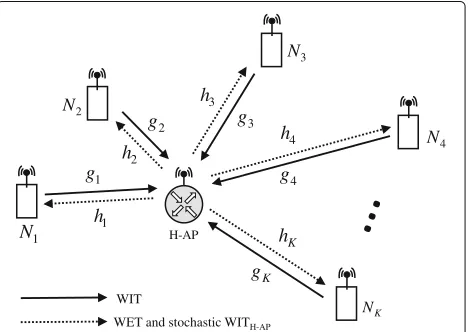
In this section, we describe a large-scale WPCN and propose the H-DHT protocol. As illustrated in Fig. 1, a large-scale WPCN consists of a single H-AP and node
i, ∀i ∈ {1, 2,· · ·,N}, where N is a positive integer and big as we consider a large-scale network. We assume that the H-AP equips one antenna for the DL WET/WIT and receiving information from nodes, one at a time. Nodes are also assumed to have a single antenna for harvesting energy and receiving information from the H-AP, and the UL WIT, which cannot be performed at the same time. It is worth noting that the H-AP and nodes operate over the same frequency band. The DL channel power gain from the H-AP to nodei,∀i∈ {1, 2,· · ·,N}, and the UL channel power gain from nodei,∀i ∈ {1, 2,· · ·,N}, to the H-AP are denoted byhiandgi, respectively. We assume that all channels follow quasi-static flat-fading, where hi and gi remain constant during each block time, denoted by T, but possibly can vary in different blocks depending on the system of interest. Furthermore, we assume that the H-AP knows perfectly bothhiandgi,∀i∈ {1, 2,· · ·,N}.
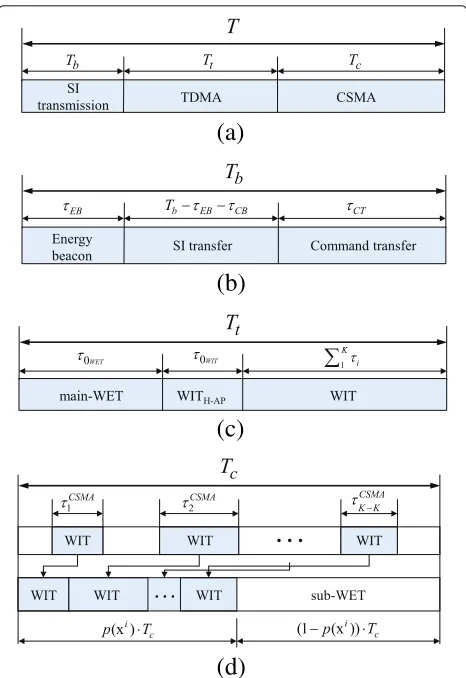
The proposed network adopts the H-DHT protocol as shown in Fig. 2a, which consists of SI transmission, TDMA, and CSMA period in a block. Therefore, we have
T =Tb+Tt+Tc, (1)
whereTb,Tt, andTcare the SI transmission period (SIP), TP, and CP, respectively. For convenience, we normalize a
WIT
WET and stochastic WITH-AP 2
h
1 h
3 h
4 h
K
h 1
g
2
g g3
4 g
K
g 1
N
2 N
4 N
K
N
H-AP
3 N
(a)
(b)
(c)
(d)
Fig. 2The hybrid multiple access-based dual harvest-then-transmit protocol.aThe proposed protocol, named H-DHT, which consists of SI transmission, TDMA, and CSMA period in a block time, denoted by T. For details,bdescribes the SI transmission period, denoted byTb, which consists of the energy beacon, SI transfer, and command transfer period. Futhermore,cshows the TDMA period, where main-WET is performed by the H-AT and nodes harvest energy during
τ0WET. Then, the H-AP transmit information to nodes duringτ0WIT, if any, and nodes transmit information to the H-AP duringτi.dshows the CSMA period, wheresub-WET is performed and nodes transmit information during the rest of time
block time asT =1 in the sequel; consequently, both the term of energy and power can be used interchangeably.
3.1 State information transmission period in the H-DHT protocol
The SIP consists of the energy beacon period, SI trans-mission period, and command transfer period as shown in Fig. 2b. During the energy beacon period, the H-AP broadcasts energy to all nodes in the proposed network and the nodes harvest the broadcasted energy for their SI transmission. It is worth noting that the broadcasted energy in the energy beacon period is sufficient for SI transmission.
During the SI transmission period, only nodes that gen-erate periodic traffic report their SI to the H-AP in order to request transmission reliability. Thus, we reduce a sig-nificant network overhead caused by numerous SI mes-sages from all nodes in the large-scale network. It is worth noting that although the near-far problem [11] exists dur-ing the energy beacon and SI transfer periods, the excess energy can be neglected since the overall energy involved is very low. The node that transmitted their SI can be allo-cated in the TP for the UL WIT, but the other nodes, which are unconstrained from the transmission reliability, participate in the CP for the UL WIT.
During command transfer period, based on the received SI, the H-AP decides the RTC in a block time and calcu-lates the optimal time of nodes in the TP, considering the MST. Then, the H-AP transforms the decision informa-tion into a command and broadcasts the command to all the nodes in the large-scale WPCN.
Then, the SIP is obtained as
Tb=τEB+τSI+τCT, (2)
whereτEB,τSI, andτCTare the time of the energy beacon period, SI transfer period, and command transfer period, respectively.τSIdepends on the number of SIs from nodes. SinceτEBandτCT are a fixed time and very moment, so we assume thatτEB, andτCTare zero for the convenience in the sequel, as [18, 19].
3.2 The ratio between TDMA and CSMA
In the proposed model, we consider periodic and non-periodic traffic from nodes in the large-scale WPCN. In addition, we consider that some nodei,∀i∈ {1, 2,· · ·,N}, might not generate any information in a block time, i.e., a part of the nodes can perform the UL WIT. Thus,
K denotes the number of nodes, which generate trans-mitting information in a block time, and is obtained as
K=N·Pd, (3)
wherePdis the average probability of generating informa-tion at the nodei,∀i∈ {1, 2,· · ·,N}.
For the periodic traffic of nodes, we consider that trans-mission reliability is required. Some nodes that generate the periodic traffic among node i, ∀i ∈ {1, 2,· · ·,K}, transmits SI messages to the H-AP. Thus,Kˆ denotes the number of nodes that require transmission reliability in the a block time and is obtained as
ˆ
K=K·Ps (4)
wherePsis the average probability of generating SI at the node i, ∀i ∈ {1, 2,· · ·,K}. By Ps, the H-AP calculates the RTC since Ps means the rate of transmission relia-bility. Thus, we assume that the RTC is proportional to
3.3 TDMA period in the H-DHT protocol
In the TP, the H-AP performs themain-WET and the DL WIT. The nodei,∀i∈ {1, 2,· · ·,Kˆ}, performs the UL WIT by using the harvested energy from the dual-WET: the
main-WET in the TP andsub-WET in the CP. It is worth noting that the DL WIT is performed in the TP, when the H-AP is necessary to transmit information.τ0denotes the
time assigned to the H-AP in the TP and is expressed as
τ0=τ0WIT +τ0WET, (5)
where 0≤τ0WIT ≤τ0and 0≤τ0WET ≤τ0denote the time of the DL WIT and themain-WET at the H-AP, respec-tively. If there is no transmitting information at the H-AP, τ0WIT can be zero.τi,∀i ∈ {1, 2,· · ·,Kˆ}, denotes the allo-cated time to nodei,∀i∈ {1, 2,· · ·,Kˆ}, for the UL WIT in each block time as shown in Fig. 2c. Thus, the TP can be expressed as
ˆ K
i=0
τi≤Tt. (6)
For the reality, we assume thatτi is constrained to be larger than the required minimum slot time, denotedτmst, whereτi converges to zero when the harvested energy is sufficiently large. It is worth noting thatτmstcan be cal-culated by the maximum data rate and the frame length, depending on the system of interest. The constraint ofτi is expressed as
τmst≤τi, ∀i∈ {1, 2,· · ·,N}. (7) In the TP, the nodei,∀i∈ {1, 2,· · ·,N}, performs energy harvesting during τ0WET. Then, the harvested energy at nodes in the TP is expressed as
ETDMAi =ξihiPAτ0WET, ∀i∈ {1, 2,· · ·,N}, (8)
wherePAdenotes the transmit power at the H-AP, which is sufficiently stable to broadcast energy by wireless and large enough to ignore the receiver noise. 0 ≤ ξi ≤ 1 denotes the energy harvesting efficiency for nodei,∀i ∈
{1, 2,· · ·,N}.
Also, in the CP, the node i, ∀i ∈ {1, 2,· · ·,N}, har-vests the additional energy from the sub-WET at space holes, where the H-DHT performs dual-WET. ECSMAi , ∀i ∈ {1, 2,· · ·,N}, denotes the harvested energy from the sub-WET, which is studied in the following subsec-tion. Consequently, the total harvested energy from the
dual-WET is denoted byEiand is expressed as
Ei=ETDMAi +ECSMAi , ∀i∈ {1, 2,· · ·,N}, (9)
where we assume that the nodei,∀i ∈ {1, 2,· · ·,N}, in the large-scale WPCN, replenishes their energy from the
dual-WET
For the throughput maximization,Eiat each node must be consumed for its transmission duringτi. We denote
xi as the complex baseband signal transmitted by node
i, ∀i ∈ {1, 2,· · ·,K}. In addition, we assume Gaussian inputs, i.e.,xi ∼ CN(0,Pi), wherePidenotes the average transmit power at nodei. Then,Piduring the UL WIT at nodeican be expressed as
Pi= ηi
Ei τi
, ∀i∈ {1, 2,· · ·,K}, (10)
where 0 ≤ ηi ≤ 1 denotes the portion of the total harvested energy used for the UL WIT at node i, ∀i ∈
{1, 2,· · ·,K}, in steady state. For the purpose of exposi-tion, we assumeηi = 1,∀i ∈ {1, 2,· · ·,K}, in the sequel, i.e., all the energy harvested at each nodeiis used for its UL WIT. For the DL WIT,PAdenotes the transmit power at the H-AP and is expressed as
PA=ηA
Pmax τ0WIT
(11)
where 0 ≤ ηA ≤ 1 denotes the utilization rate of the transmission power at the H-AP and Pmax denotes the maximum transmission power available at the H-AP. It is worth noting that since τ0WIT converges zero if Pmax is unlimited, we assume thatPi ≤ PA ≤ Pmaxfor the real-ity, wherePiis the largest atξihiηi=1. For the purpose of exposition, we assumePAτ0WET =ηAPMAXin the sequel.
3.4 CSMA period in the H-DHT protocol
In the CP, the H-AP performs thesub-WET and the node
i,∀i ∈ {1, 2,· · ·,K − ˆK}, performs the UL WIT.τi,∀i ∈ {1, 2,· · ·,Kˆ}, denotes the UL WIT time of nodei,∀i ∈
{1, 2,· · ·,K− ˆK}in the CP as shown in Fig. 2d. Thus, the CP can be expressed as
K− ˆK
i=1
τi≤Tc. (12)
The channel utilization of the contention-based proto-col, as CSMA, is degraded byspace holes. However, in the H-DHT, we consider that space holes in the CP can be utilized by thesub-WET to harvest additional energy and increase the sum-throughput. The harvested energy from thesub-WET can be expressed as
ECSMAi =ξihiPAτ0CSMA,∀i∈ {1, 2,· · ·,N}, (13)
whereτ0CSMA denotes the total harvesting time in the CP. It is worth noting thatECSMAi is used for the UL WIT in the following block as Eq. (9) and can be zero when there is nospace holesin the CP.
noting that if there is a collision, all of the information transmitted is assumed to be lost.
To describe the CP, we define two sets for the non-collision and non-collision transmission in Markovian model as Fig. 3 [30].A andBdenote non-collision and collision states, respectively. status at nodei.xji = 1 represents an active transmission at nodeiand 0 represents waiting or performing energy harvesting by the sub-WET at node i. The link status is expressed as
xji=
1 if nodeiin statejtransmits data,
0 otherwise. (16)
In addition, we assume that the waiting time of nodei, ∀i ∈ {1, 2,· · ·,K− ˆK}, is exponentially distributed and λ−1 denotes the mean of the exponential distribution.
The probability density function of the waiting timetiis given by frames per unit time [31].
Due to the sensing delay, δTs, experienced by the node i, ∀i ∈ {1, 2,· · ·,K − ˆK}, the probability, that
Fig. 3Markov chain model for the CP. To describe the CSMA period, Markovian model is used to express two sets for the non-collision and collision transmission states
nodeiperforms the UL WIT withinδTswhile starting the UL WIT from another node, is expressed as
pi1−exp(−λiδTs), (18)
by the memoryless property of the exponential random variable, i.e., CDF [31]. Thus, the rate of transition,Gj ∈
A, to one of the non-collision states in the Markov chain is defined as states is given by
Gj=
4 Problem formulation for the H-DHT protocol In this section, we study the sum-throughput maximiza-tion in the large-scale WPCN based on the H-DHT. Specifically, we aim to maximize the sum-throughput of the DL and UL WIT in the TP, and the UL WIT in the CP, respectively. In the following, we formulate the optimization problem for the TP and the CP.
4.1 TDMA period in the H-DHT protocol
In the TP, the H-AP and nodei, ∀i ∈ {1, 2,· · ·,Kˆ}, can perform the DL and UL WIT, respectively.RTDMA
sum denotes the sum-throughput of the H-AP and nodes allocated in the TP and can be expressed as
RTDMAsum =ρ0R0+
where ρ0 denotes the presence of the DL WIT at the
H-AP. If there is information transmission at the H-AP, ρ0 is 1, or if not ρ0 is 0. R0 and Ri denote the throughput of the DL WIT and UL WIT, respectively.R0
is obtained by
. In addition,Riis obtained by
where γi = gihσiηiξ2iPA and Pi from Eq. (10). denotes the signal-to-noise ratio gap from the additive white Gaussian noise channel capacity as a modulation and cod-ing scheme (MCS) use.σ2represents the noise power at
the H-AP. For convenience, we assumeξihiPA = 1 from Eqs. (8) and (13) in the sequel of this paper without loss of generality.
Consequently, from Eqs. (22) and (23),RTDMAsum can be expressed as
To maximize the sum-throughput in the TP,RTDMAsum , the optimal time allocation is investigated in the large-scale WPCN. The throughput maximization is then expressed as the following problem:
(P1) : max
where Eqs. (26) and (27) correspond to the original con-straints from Eqs. (7) and (6), respectively. To solve (P1), we first present the following two lemmas.
Lemma 3.1The optimal time allocation of (P1) must satisfy the constraint, Eq. (27), with equality, i.e., Kˆ
i=0τi∗=Tt.
ProofPlease refer to Appendix A.
Lemma 3.2The objective function of (P1), Eq.(25), is a concave function of the allocated time for the H-AP and node i,∀i∈ {1, 2,· · ·,Kˆ}, i.e.,τ =τ0,· · ·,τKˆ
T
.
ProofPlease refer to Appendix B.
Proposition 3.1The optimal time allocation of (P1) is
τ0∗=
ProofPlease refer to Appendix C.
4.2 CSMA period in the H-DHT protocol
In the CP, the H-AP performs the sub-WET and node
i, ∀i ∈ {1, 2,· · ·,K − ˆK}, performs the UL WIT. In Section 2, we describe the system model of the CP as continuous Markov chain model [33]. Now, we optimize the sum-throughput of nodes in the CP by maximizing the probability of being in the non-collision transmission states. For maximizing the probability, the stationary dis-tribution of the continuous Markov chain, denoted by
pxi, is defined as
pxi exp(ri)
jexp(rj)
, (32)
where ri satisfies the detailed balance equation [34]. Eqs. 19 and (20) expressri, which is obtained as
ri=
idenotes the mean transmission length of the information. It is worth noting that for the purpose of exposition, we assume λ = 1. Hence, we can inter-change the throughput of nodes in the CP andRi from Eq. (23),∀i∈ {1, 2,· · ·,K− ˆK}.
all the non-collision transmission states, which can be expressed by
F(R)
i∈A
lnpxi (34)
= K− ˆK
i=1
ln
τiln
1+γiτ0WET+τ τ0CSMA i
−(K− ˆK−1) K− ˆK
i=1
(λiδTs)−
i∈A
A, (35)
whereAlnjexp(rj). Then,i∈AAis defined as
i∈A
A=
i∈A
ln i∈A
exp(ri)+
i∈B
exp(ri)
+exp(1)
. (36)
Then, the throughput maximization is then obtained by the following problem:
(P2) : max
τ F(τi) (37)
s.t.τmst≤τi (38)
K− ˆK
i=1
τi≤Tc (39)
where Eqs. (38) and (39) correspond to the original con-straints from Eqs. (7) and (12), respectively. To solve (P2), we first present the following lemma.
Lemma 3.3The objective function of (P2) is a concave function of the allocated time for the H-AP and node i,∀i∈
{1, 2,· · ·,K− ˆK}.
ProofPlease refer to Appendix D.
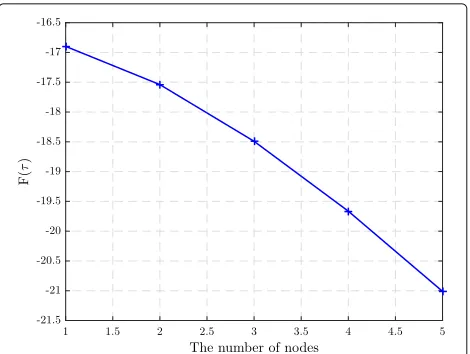
Figure 4 further shows the objective function of (P2) by increasing nodes in the CP, i.e., Eq. (37) is a concave function over the number of nodes in the CP.
Proposition 3.1The optimal time allocation of (P2) is
τi∗= γiC
q∗−1, (40)
τ0∗CSMA=Tc− K− ˆK
i=1
τi∗ (41)
whereq∗1+γiC
τ∗
i , andqis calculated by the well-known Lambert W-function [32] as Proposition 3.1.
ProofPlease refer to Appendix F.
Fig. 4F(τi)according to the number of nodes. Figure 4 shows that the objective function of (P2) is a concave function, to apply the convex optimization technique
5 Simulation results and discussion
In this section, we present some simulation results to evaluate the performance of the proposed H-DHT proto-cols in the large-scale WPCN. Theharvest-then-transmit
(HTT) protocol in [11] and the adaptive harvest-then-cooperate protocol (AHC) in [18] are used for the com-parison. In the evaluation, the energy harvesting efficiency is assumed to be equal to one for all nodes, i.e.,ξi = 1, ∀i ∈ {1, 2,· · ·,N}. The noise power at the receiver, σ2, is assumed to be one, and the energy transmit power of the H-AP for the DL WET,PA, is assumed to be 10 dB. We also assumei.i.d.Rayleigh fading for all channels in the network and the channel power gains of these chan-nels are exponentially distributed, where the mean of the channel power gains is one, i.e.,gi = 1 andhi = 1,∀i ∈ {1, 2,· · ·,N}, respectively. Although we propose the H-DHT protocol for large-scale WPCN, in which there can be thousands of nodes like IoT or LPWAN networks, we assume that there are a hundred nodes for convenience. Also, we assume sensing delay to check channel state is 0.001 ms, and the network overhead caused by a single SI message is 0.5% in a block time.
Fig. 5Ratio of SI transfer period to block time according to the number of nodes. Figure 5 shows the effect of the number of nodes to the ratio of the SI transmission period to a block time in the HTT, the AHC, and the proposed H-DHT according to the average probability of generating SI message, Ps, respectively. In the proposed H-DHT protocol, the ratio of SI period to block time increases slightly as the number of nodes increases
messages, the increase of the ratio of the SI transmission period to the block time stops when the ratio reaches the maximum value. On the other hand, both the HTT and AHC protocols assume that all nodes in the WPCN trans-mit SI messages to the H-AP, since we can see that the ratio of the SI message transmission period to the block time increases continuously according to the increase of the number of nodes.
Figure 6a shows the total harvested energy for UL WIT according to the ratio of TDMA period to block time. In the HTT and AHC protocols, a block time is entirely used for TDMA-based WET and WIT. Therefore, the total har-vested energy does not change. However, in the proposed H-DHT protocol, nodes harvest energy twice when the H-AP performs amain-WET in the TP and asub-WET in the CP within a block time. Especially, we assume that the H-AP performssub-WET when the wireless channel is in idle state in the CP. In general, the channel utilization rate of CSMA protocol for the wireless ad hoc network is very low compared to TDMA protocol [36]. There-fore, in Fig. 6a, we can see that the total harvested energy decreases according to the increase of the ratio of TDMA period to a block time. In addition, Fig. 6b shows that the harvested energy during the CP decreases according to the increase of the ratio of TDMA period to a block time because thesub-WET period decreases.
Figure 7 shows the sum-throughput according to the number of nodes in the HTT, AHC, and the proposed H-DHT. As we can see in the Fig. 7, the throughput of both the HTT and AHC protocols decreases when the num-ber of nodes increases, because of the network overhead
(a)
(b)
Fig. 6Total harvested energy according to the ratio of TDMA period to block time.ashows the total harvested energy for UL WIT according to the ratio of TDMA period to block time. We can see that the total harvested energy decreases according to the increase of the ratio of TDMA period to a block time. In addition,bshows that the harvested energy during CSMA period decreases according to the increase of the ratio of TDMA period to a block time because the sub-WET period decreases
caused by SI transmission. However, the sum-throughput of the H-DHT protocol increases according to the num-ber of nodes, because the H-DHT protocol permit only the nodes, which require reliable data transmission, to send SI message to the H-AP. Therefore, the network overhead caused by SI message transmission is relatively low compared to the HTT and AHC protocols. Also, the result shows that the sum-throughput increases when the Ps increases, because high Ps indicates that channel utilization rate increases.
Fig. 7Sum-throughput according to the number of nodes. Figure 7 shows the sum-throughput according to the number of nodes in the HTT, AHC, and the proposed H-DHT. As we can see in the Fig. 7, the throughput of both HTT and AHC protocols decreases when the number of nodes increases, because of the network overhead caused by SI transmission. However, the sum-throughput of the H-DHT protocol increases according to the number of nodes, because the H-DHT protocol permit only the nodes, which require reliable data transmission, to send SI message to the H-AP
protocol, HTT and AHC, in terms of channel allocation. In the H-DHT protocol, only the nodes which want to obtain a time slot of TP generate SI message. Therefore, in Fig. 5, we can see that the network overhead caused by SI is decreased in the H-DHT compared to the con-ventional protocols, HTT and AHC. As a result, channel resource for WIT/WET is increased. Figure 6, also, shows that the proposed H-DHT protocol outperforms the con-ventional protocols, HTT and AHC in terms of channel allocation. The H-DHT protocol performs sub-WET at
space holes in the CT, so there is no wasted time. As a result, in Fig. 6a, we can see that the nodes in the proposed H-DHT protocol harvest more energy compared to nodes in the HTT and AHC, in most cases according to ratio of TDMA period to block time.
6 Conclusions
This paper proposes a novel protocol for a large-scale WPCN, namely hybrid multiple access-based dual harvest-then-transmit (H-DHT). The proposed H-DHT protocol has a hybrid multiple access structure which employs both TDMA and CSMA, in order to man-age different traffic patterns and requirements depend-ing on applications. Thus, the H-DHT protocol provides transmission reliability for transmitting information of nodes by TDMA. Furthermore, we propose a novel wire-less energy transfer method, named dual-WET, which improves the channel utilization and increases the amount
of harvested energy at nodes. Specifically, from dual -WET, the nodes can perform energy harvesting atspace holesin CSMA. In addition, we describe the novel proce-dure of SI message transmission between the H-AP and nodes to reduce network overhead caused by numerous SI messages. For the consideration, simulation results reveal that the H-DHT outperforms the existing WPCN proto-cols in a large-scale network, in terms of sum-throughput, SI transmission overhead, and an amount of harvested energy at nodes.
There are some research issues remained to improve the proposed system model for future work. Full-duplex WPCN models can be consider to the TP in order to improve harvested energy from main-WET, where the self-interference is fully prevented. Additionally, we will expend the QoS in terms of receiving information as considering the energy efficiency.
Appendix
Appendix A: Proof of Lemma 3.1
This can be proved by contradiction. Suppose τ =
τ
0,· · ·,τKˆ
T
is an optimal solution of (P1), and it
satis-fies thatKi=ˆ0τi < Tt. It follows thatτ0 <Tt−Ki=ˆ1τi. The objective function given in Eq. (25) is a monotonic increasing function with respect toτ0. Thus, the value of
Eq. (25) under the vector
τ
0,· · ·,τKˆ
T
is larger than that under τ. This contradicts with our presumption. Thus, the optimalτ∗must satisfyKi=ˆ 0τi∗=Tt.
This completes the proof of Lemma 3.1.
Appendix B: Proof of Lemma 3.2
According to [37], a function is concave if its Hessian is negative semidefinite. Thus, to showRTMDAsum (τ)is a con-cave function ofτ, we denote the Hessian ofRTDMAsum (τ)by
Hiand demonstrate thatHiis a negative semidefinite. For any given real vectorν=[ν0,· · ·,νK]T, it follows that
νTH
iν≤0, (42)
where the inequality follows from the fact thatτmst ≤τi. Thus,Hiis negative semidefinite. Therefore,RTDMAsum (τ)is a concave function ofτ =τ0,· · ·,τKˆ
T . This completes the proof of Lemma 3.2.
Appendix C: Proof of Proposition 3.1
Lsum(τ,λ)=RTDMAsum (τ)−λ
⎛ ⎝
ˆ K
i=0
τi−Tt
⎞
where λ ≥ 0 denotes the Lagrange multiplier with the constraint in Eq. (27). The dual function of (P1) is thus given by
G(λ)=min
τ∈DLsum(τ,λ), (44)
whereDis the feasible set ofτ specified by Eqs. (26) and (27). Thus, strong duality holds for this problem thanks to the Slater’s condition.
Since (P1) is a convex optimization problem for which the strong duality holds, the Karush-Kuhn-Tucker (KKT) conditions are both necessary and sufficient for the global optimality of (P1), which are given by
ˆ
whereτi∗andλ∗denote the optimal primal and dual solu-tions of (P1), respectively. It can be easily be verified that
Kˆ
i=0τi∗ = Ttmust hold for (P1) and thus from Eq. (27) without loss of generality, we assumeλ > 0. It is worth noting that for convenience, we normalizeTt as 1 in the sequel.
It can be easily shown that X(α) is a monotonically increasing function ofα ≥ 0 sincedXdα(α) ≥ 0 forα ≥ 0.
0. Therefore, the optimal time allocation is given by
τ0∗=
1−z∗+F·C
1−z∗ . (55)
From Lemma 3.1,τiis obtained as
τi∗= γi·C
1−z∗, (56)
where z is calculated by the well-known Lambert W-function [32] as
0WIT is obtained as τ0∗WIT =maxτ τ
This thus proves Proposition 3.1.
Appendix D: Proof of Lemma 3.3
We may note that the proof of Lemma 3.3 is essentially equal to Lemma 3.2.
Appendix F: Proof of Proposition 3.2
Lsum(τ,λ)=F(τ)−λ
where λ ≥ 0 denotes the Lagrange multiplier with the constraint in Eq. (39). The dual function of (P2) is thus given by
G(λ)=min
τ∈DLsum(τ,λ) (61)
Since (P2) is a convex optimization problem for which the strong duality holds, the Karush-Kuhn-Tucker (KKT) conditions are both necessary and sufficient for the global optimality of (P2), which are given by
K− ˆK solutions of (P2), respectively. It is worth noting that for convenience, we normalizeTcas 1 in the sequel. Then, from Eq. (64), it follows that
1
consider the case of λ∗ > 0, which corresponds to
K− ˆKτ∗ We can modify (65) as
qlnq
τi . Therefore, optimal time of the nodei is obtained as
τi∗= γiC
q∗−1 (67)
whereq∗is calculated by the Lambert W-function [32] as Proposition 3.1.
This completes the proof of Proposition 3.2.
Acknowledgements
The SC, KL, and BK would like to acknowledge the encouragements and suggestions provided by Prof. Inwhee Joe during this research.
Funding Not applicable.
Availability of data and materials
The datasets of this paper are included within its additional files.
Authors’ contributions
SC and KL propose and analyze the H-DHT protocol based in large-scale WPCN. BK modified the English expressions. IJ organizes the whole paper as well as the proofreading. All authors read and approved the final manuscript.
Ethics approval and consent to participate Not applicable.
Consent for publication Not applicable.
Competing interests
The authors declare that they have no competing interests.
Publisher’s Note
Springer Nature remains neutral with regard to jurisdictional claims in published maps and institutional affiliations.
Author details
1Department of Computer and Software, Hanyang, Wangsimni-ro, 222, 04763
Seoul, Korea.2Unmanned Vehicle Systems Research Group, Electronics and Telecommunications Research Institute, Gajeong-ro, 34129 Daejeon, Korea. 3Department of Computer Science and Engineering, Hanyang, Wangsimni-ro,
222, 04763 Seoul, Korea.4Centre for Secure Information Technology, Queen’s University Belfast, Queens Rd, BT3 9DT Belfast, UK.
Received: 16 June 2017 Accepted: 18 December 2017
References
1. K Wang, Y Wang, Y Sun, S Guo, J Wu, Green industrial internet of things architecture: an energy-efficient perspective. IEEE Commun. Mag.54(12), 48–54 (2016)
2. Standardization of NB-IOT Completed. http://www.3gpp.org/news-events/3gpp-news/1785-nb_iot_complete. Accessed 28 December 2017 3. N Sornin, M Luis, T Eirich, T Kramp, O Hersent,LoRa Alliance. LoRaWAN
Specification. (LoRa Alliance, San Ramon, 2015). https://www.rs-online. com/designspark/rel-assets/ds-assets/uploads/knowledge-items/ application-notes-for-the-internet-of-things/LoRaWAN%20Specification %201R0.pdf
4. O Ozel, K Tutuncuoglu, J Yang, S Ulukus, A Yener, Transmission with energy harvesting nodes in fading wireless channels: optimal policies. IEEE J. Sel. Areas Commun.29, 1732–1743 (2011)
5. CK Ho, R Zhang, Optimal energy allocation for wireless communications with energy harvesting constraints. IEEE Trans. Sig. Process.60, 4808–4818 (2012)
6. S Bi, CK Ho, R Z, Wireless powered communication: opportunities and challenges. IEEE Commun. Mag.53(2015)
7. X Zhou, R Zhang, CK Ho, Wireless information and power transfer: architecture design and rate-energy tradeoff. IEEE Trans. Commun.61, 4757–4763 (2013)
8. L Liu, R Zhang, KC Chua, Wireless information and power transfer: a dynamic power splitting approach. IEEE Trans. Commun.61, 3990–4001 (2013)
9. R Zhang, CK Ho, Mimo broadcasting for simultaneous wireless information and power transfer. IEEE Trans. Wirel. Commun.12, 1989–2001 (2013) 10. K Huang, E Larsson, Simultaneous information and power transfer for broadband wireless systems. IEEE Trans. Signal Process.61, 5972–5986 (2013)
11. H Ju, R Zhang, Throughput maximization in wireless powered
communication networks. IEEE Trans. Wirel. Commun.13, 418–428 (2014) 12. H Ju, R Zhang, Optimal resource allocation in full-duplex wireless-powered
communication network. IEEE Trans. Commun.62, 3528–3540 (2014) 13. X Kang, CK Ho, S Sun, Full-duplex wireless-powered communication network
with energy casuality. IEEE Trans. Wirel. Commun.14, 5539–5551 (2015) 14. X Zhou, R Zhang, CK Ho, Wireless information and power transfer in
multiuser ofdm systems. IEEE Trans. Wirel. Commun.13, 2282–2294 (2014) 15. Y Cheng, P Fu, Y Chang, B Li, X Yuan, Joint power and time allocation in
full-duplex wireless powered communication networks. Mob. Inf. Syst. 2016, 1–15 (2016)
16. SH Lee, R Zhang, KB Huang, Opportunistic wireless energy harvesting in cognitive radio networks. IEEE Trans. Wirel. Commun.12, 4788–4799 (2013)
17. SH Lee, R Zhang, Cognitive wireless powered network: spectrum sharing models and throughput maximization. IEEE Trans. Cogn. Commun. Netw. 1, 335–346 (2015)
19. Q Yao, A Huang, H Shan, T Quek, W Wang, Adaptive
harvest-then-cooperate: delay-aware wireless powered communication networks. 2016 IEEE 17th Int. Workshop Sig. Process. Adv. Wirel. Commun (SPAWC).15, 1–5 (2016)
20. E Karapistoli, FN Pavlidou, I Gragopoulos, I Tsetsinas, An overview of the IEEE 802.15.4a standard. IEEE Commun. Mag.48, 47–53 (2010)
21. L Jiang, H Tian, Z Xing, K Wang, K Zhang, S Maharjan, S Gjessing, Y Zhang, Social-aware energy harvesting device-to-device communications in 5g networks. IEEE Wirel. Commun.23(4), 20–27 (2016)
22. D Zeng, J Zhang, S Guo, L Gu, K Wang, Take renewable energy into cran toward green wireless access networks. IEEE Netw.31(4), 62–68 (2017) 23. Y Wu, Y Chen, J Tang, D So, Z Xu, I C, P Ferrand, J Gorce, C Tang, P Li, K
Feng, L Wang, K Borner, L Thiele, Green transmission technologies for balancing the energy efficiency and spectrum efficiency trade-off. IEEE Commun. Mag.52(11), 112–120 (2014)
24. H Zhang, H Liu, J Cheng, VCM Leung, Downlink energy efficiency of power allocation and wireless backhaul bandwidth allocation in heterogeneous small cell networks. IEEE Trans. Commun.PP(99), 1-1 (2017). https://doi.org/10.1109/TCOMM.2017.2763623. http://ieeexplore. ieee.org/document/8070320/citations
25. H Zhang, S Huang, C Jiang, K Long, V Leung, H Poor, Energy efficient user association and power allocation in millimeter-wave-based ultra dense networks with energy harvesting base stations. IEEE J. Sel. Areas Commun.35(9), 1936–1947 (2017)
26. H Zhang, C Jiang, N Beaulieu, X Chu, X Wang, T Quek, Resource allocation for cognitive small cell networks: a cooperative bargaining game theoretic approach. IEEE Trans. Wirel. Commun.14(6), 3481–3493 (2015) 27. H Zhang, Y Nie, J Cheng, V Leung, A Nallanathan, Sensing time
optimization and power control for energy efficient cognitive small cell with imperfect hybrid spectrum sensing. IEEE Trans. Wirel. Commun. 16(2), 730–743 (2017)
28. H Zhang, C Jiang, X Mao, H Chen, Interference-limited resource optimization in cognitive femtocells with fairness and imperfect spectrum sensing. IEEE Trans. Veh. Technol.65(3), 1761–1771 (2016) 29. J Tang, D So, E Alsusa, K Hamdi, A Shojaeifard, Resource allocation for
energy efficiency optimization in heterogeneous networks. IEEE J Sel. Areas Commun.33(10), 2104–2117 (2015)
30. S Subramanian, EL Pasiliao, JM Shea, MM Carvalho, WE Dixon, inIEEE MILITARY COMMUNICATIONS CONFERENCE, 2012. Throughput maximization in csma networks with collisions, (2012), pp. 1–6. https://doi.org/10.1109/MILCOM.2012.6415717. http://ieeexplore.ieee. org/document/6415717/citations
31. DF Schmidt, E Makalic, Universal models for the exponential distribution. IEEE Trans. Inf. Theory.55, 3087–3090 (2009)
32. LambertW-Function. http://mathworld.wolfram.com/LambertW-Function.html . Accessed 28 Dec 2017
33. L Jiang, J Walrand, A distributed CSMA algorithm for throughput and utility maximization in wireless networks. IEEE/ACM Trans. Networking. 18, 960–972 (2010)
34. KP Kelly,Reversibility and Stochastic Networks. (Wiley, Chichester, 1979) 35. SM Stigler,Statistics on the Table: The History of Statistical Concepts and
Methods. (Harvard University Press, Cambridge, 1999)
36. T-J Lee, HR Lee, MY Chung, Mac throughput limit analysis of slotted csma/ca in ieee 802.15.4 wpan. IEEE Commun. Lett.10, 561–563 (2006) 37. SP Boyd,Convex Optimization. (Cambridge University Press, Cambridge,