At small phase angles, the whole coma aperture-averaged linear polarization of comets nearly coincides with that of C-type asteroids. However, the experimental study of light scattering by independent dust particles and regoliths, consisting of exactly the same particles, shows that their negative polarization branches are substantially different. Therefore, the similarity in the linear polarization of comets and C-type asteroids has to be interpreted in terms of a random coincidence rather than evidence for common properties of dust particles. Imaging polarimetry of comets shows two features with a distinctive behavior of the linear polarization: jets and circumnucleus haloes. Dust particles in jets produce only positive polarization through all the phase angles; whereas, dust particles in the halo reveal a significant negative polarization branch withPmin = −6%. By comparison with the experimental
study of light scattering, such a difference in the negative polarization could indicate common properties of dust in the circumnucleus haloes and C-type asteroids. The high negative polarization can be confidently attributed to weakly absorbing particles. The real part of the refractive index Re(m)is 1.5–1.6, and the imaginary part is limited to Im(m)≤0.02. The morphology of dust particles in the circumnucleus haloes can be rather fluffy with a material density of about 0.8 g/cm3. The power-law index for the size distribution is estimated to be about
a=1.5–2.
Key words:Comets, asteroids, negative polarization, discrete dipole approximation.
1.
Introduction
The most common polarimetry of comets uses measure-ments of the degree of linear polarization averaged over the whole coma. Although it obviously leads to a loss of spatial information, aperture-averaged polarimetry is much simpler to perform than imaging polarimetry and can be carried out by observatories with relatively-small telescopes and with-out access to an expensive highly-sensitive charge-coupled device (CCD). For example, the linear polarizations for 13 comets reported by Chernovaet al.(1993) were obtained using a 1-m telescope.
One principal result of the whole coma aperture-averaged polarimetry of comets concerns the negative polarization branch (NPB) at small phase anglesα (α≤20–22◦). Note that, in the case of randomly-oriented scatterers, the degree of linear polarization is given by: P=(I⊥−I)/(I⊥+I)
(where,I⊥andIare the intensities of electromagnetic radi-ation vibrating perpendicular to, and in, the scattering plane respectively). Thus, negative polarization simply implies
I >I⊥near the backscattering regime. The average shape of the NPB is quite symmetric, so the minimum of the neg-ative polarization Pmin, typically≈ −1.7%, is observed at αmin ≈ 10–11◦ (e.g., Chernova et al., 1993;
Levasseur-Copyright cThe Society of Geomagnetism and Earth, Planetary and Space Sci-ences (SGEPSS); The Seismological Society of Japan; The Volcanological Society of Japan; The Geodetic Society of Japan; The Japanese Society for Planetary Sci-ences; TERRAPUB.
doi:10.5047/eps.2011.03.005
Regourd et al., 1996). It is important to emphasize that all aperture-averaged polarimetric observations of cometary comae show a NPB at small phase angles; to our knowl-edge, there are no publications in peer-review journals, re-porting an absence of the NPB.
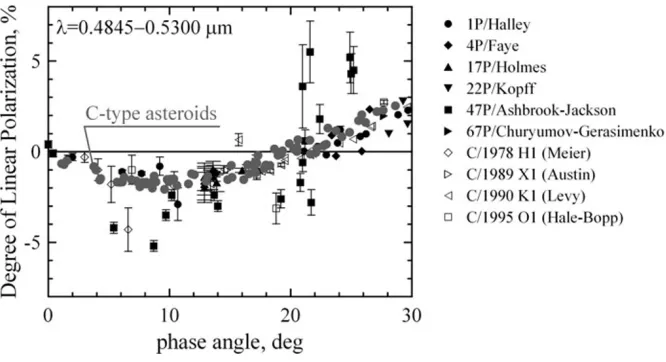
At small phase angles, a synthetic phase curve of the lin-ear polarization of various comets nlin-early coincides with that found for C-type asteroids. For instance, Fig. 1 presents typical synthetic dependences of the degree of linear po-larization P on the phase angleα near backscattering for 10 various comets and 13 C-type asteroids. The observa-tions of the comets have been carried out in the contin-uum part of the spectrum at λ = 0.4845–0.53μm, ex-cept for the emission line of C2gas around 0.514μm. The
data for comets are adapted from Chernovaet al.(1993), Ganesh et al. (1998), Joshi et al. (2010), Hadamcik and Levasseur-Regourd (2003a), Kikuchiet al.(1987), Kiselev and Chernova (1981), and Rosenbushet al.(1994, 2009a). Most polarimetric data for asteroids have been obtained at
λ=0.518μm, adapted from Zellner and Gradie (1976). The resemblance between the NPB of the minor plan-ets and complan-ets was first stressed by Kiselev and Chernova (1981) and later confirmed in, e.g., Chernovaet al.(1993) and Levasseur-Regourd et al. (1996). This finding was interpreted in terms of the similar properties of cometary grains and particles forming the regolith in C-type aster-oids (e.g., Chernovaet al., 1993), which also seems to be consistent with the similar morphology of interplanetary
Fig. 1. Synthetic dependences of the degree of linear polarization on phase angle for comets and C-type asteroids. The data for comets are adapted from Chernovaet al.(1993), Ganeshet al.(1998), Joshiet al.(2010), Hadamcik and Levasseur-Regourd (2003a), Kikuchiet al.(1987), Kiselev and Chernova (1981), Rosenbushet al.(1994, 2009a); whereas, data for C-type asteroids are from Zellner and Gradie (1976).
dust particles originating from asteroids and comets (e.g., Brownlee, 1985). Later, the conclusion of a common mor-phology for cometary and asteroidal dust particles led to the conclusion of the same driving mechanism for the negative polarization found in asteroids and comets (e.g., Petrovaet al., 2000; Joshiet al., 2003).
Though the resemblance of asteroidal and cometary IDPs is clear, it is also quite obvious that IDPs collected in the Earth’s stratosphere are representative neither of dust in a cometary comae nor regolith particles in C-type aster-oids. The coincidence of the negative polarization in as-teroids and comets must imply an insensitivity of the neg-ative polarization branch to the physical properties of the target. However, such a “finding” does contradict numer-ous theoretical studies of light scattering by irregularly-shaped particles, which show that the angular profile of the degree of linear polarization is strongly dependent on the particle properties (e.g., Lumme and Rahola, 1994; Yanamandra-Fisher and Hanner, 1999; Petrovaet al., 2000; Kimura, 2001; Kimura et al., 2003; Zubkoet al., 2003, 2004, 2005, 2006, 2007, 2008, 2009; Lasue and Levasseur-Regourd, 2006; Vilaplana et al., 2006; Muinonen et al., 2007; Lindqvistet al., 2009; Nousiainen, 2009). Labora-tory measurements also confirm a strong dependence of the NPB on the properties of dust particles (e.g., Gustafson and Kolokolova, 1999; Mu˜nozet al., 2000, 2006; Voltenet al., 2001; Hadamciket al., 2009; Renardet al., 2010). Thus, there is a contradiction between the similarities of the NPBs of comets and asteroids, and the high sensitivity of the neg-ative polarization to properties of dust particles.
2.
Negative Polarization Produced by
Single-scattering and by Scattering from Dust
De-posited on a Surface
An obvious distinction between the coma and regolith is the number density of particles. The fluffiest regolith re-mains a substantially more compact medium than the dens-est cometary coma. In terms of light scattering, it implies a difference in the contribution from multiple scattering. In-deed, in the case of regoliths, the multiple scattering
be-tween constituent particles plays an important role and has to be taken into account; whereas, in the case of the coma, it can be simply ignored. Note that a rigorous computa-tion of the multiple scattering in a dense medium consist-ing of micron-sized particles is a difficult problem. How-ever, the contribution of multiple scattering could be de-rived from the comparative experimental study of light scat-tering by independent dust particles and regoliths made of those particles. Shkuratovet al.(2004) present the results of such a study of ten samples of terrestrial dust. Within that work, the same sample particles have been investigated with the nephelometer of the University of Amsterdam (The Netherlands) and the photometer/polarimeter of Kharkov National University (Ukraine). In the former case, scat-tering from individual sample particles has been studied; whereas, in the latter case, the same particles have been de-posited on a surface. By a comparison of the two results, the true contribution of multiple scattering within regoliths can be estimated.
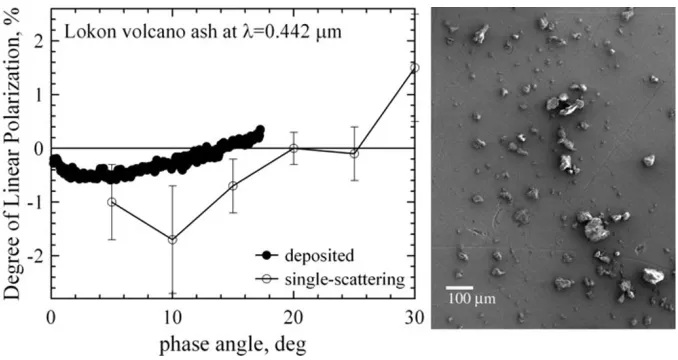
Figure 2 presents the phase curves of the degree of linear polarization for Lokon volcano ash measured in blue light (adapted from Shkuratov et al. (2004)). An SEM image of Lokon volcano ash particles is given in the right panel of Fig. 2 (adapted from Shkuratovet al.(2006)). The de-posited sample is characterized by a fluffy structure and a rather small geometric albedo, A = 8%. Note that such a low albedo is quite close to the average albedo of C-type asteroids (e.g., Zellner and Gradie, 1976). Figure 2 shows that the NPB for scattering from independent grains (open symbols) is noticeably deeper than that for the de-posited particles (filled symbols): Pmin ≈ −1.7% versus
Pmin ≈ −0.5%. Thus, the multiple scattering between
par-ticles forming a regolith substantially depolarizes the scat-tered radiation at small phase angles. It has to be stressed that this finding holds true for all the samples investigated in Shkuratovet al.(2004). However, in the case of bright samples, the depolarization effect is much higher; the de-crease of amplitude of the NPB can be as much as an order of magnitude.
Fig. 2. Dependences of the degree of linear polarization on phase angle for a Lokon volcano ash sample. Open symbols are results for single-scattering particles; filled ones—for the regolith consisting of exactly the same particles. The SEM image on the right-hand panel shows the morphology of Lokon volcano ash particles. Measurement data are adapted from Shkuratovet al.(2004); whereas the SEM image is from Shkuratovet al.(2006).
of multiple scattering is consistent with the polarimetry of asteroids. For instance, E-type asteroids (A ≈ 50%) pro-duce an NPB with Pmin ≈ −0.3%; whereas, in the case of
S-type asteroids (A≈20%),Pmin≈ −0.7% (e.g., Belskaya
et al., 2003). However, C-type asteroids (A≈7%) produce the NPB with Pmin ≈ −1.8% (e.g., Zellner and Gradie,
1976). Notice also that, in general, the multiple scatter-ing between particles in a regolith may produce the nega-tive polarization at small phase angles. The comprehensive explanation for the origin of this effect was given indepen-dently by Shkuratov (1985) and Muinonen (1989). Some-times, the effect is referred to as the polarization opposition effect (POE) in order to distinguish it from the NPB, though a different origin for the NPB and POE is not obvious (e.g., Shkuratovet al., 2002; Zubkoet al., 2008). Nevertheless, in practice, the POE is attributed to those cases when the min-imum of polarization is located atα≤ 3◦(e.g., Shkuratov
et al., 2002). For instance, it is believed that the POE is responsible for the secondary minimum in phase curves of linear polarization observed atα=0.8–1.8◦for E-type as-teroids (Rosenbushet al., 2009b).
As was shown in Fig. 2, there is a noticeable difference in the degree of linear polarization produced by the inde-pendently scattering particles and regoliths consisting of such particles. Therefore, the coincidence in the NPB of comets and C-type asteroids cannot be interpreted in terms of common properties of their dust particles. Moreover, the similarity in the polarization curves of comets and asteroids must testify to a large difference between cometary and as-teroidal dust. On the other hand, this conclusion is inconsis-tent with the well-established similarity between IDPs orig-inating in comets and asteroids (e.g., Brownlee, 1985); so, the resemblance in the negative polarization of comets and asteroids needs to be re-examined.
3.
The Resemblance of the NPBs of Comets and
C-type Asteroids Revisited
An obvious restriction of the aperture-averaged po-larimetry of comets is that this completely ignores varia-tions of the linear polarization through the coma. However,
such variations have been known for sometime (e.g. Elvius, 1958). The variations of the linear polarization through a cometary coma were reported also by Martel (1960), Clarke (1971), Dollfus and Suchail (1987), Renard et al.
(1996), Jockerset al.(1997), Tangaet al.(1997), Furushoet al.(1999), Hadamcik and Levasseur-Regourd (2003a), and many others. Note also that the variations of linear polariza-tion in the inner coma (i.e., at distances from the nucleus of less than approximately 7000 km) have been detected by the optical probe experiment (OPE) on board the Giotto space probe for comet 1P/Halley (Levasseur-Regourdet al., 1999) and 26P/Grigg-Skjellerup (McBrideet al., 1997). The ex-tended picture of the linear polarization variations in comae could be obtained from the imaging polarimetry of comets. The most comprehensive imaging polarimetry of comets was reported by Hadamcik and Levasseur-Regourd (2003b), who present data for nine different comets. Their results have been confirmed by other observers. For in-stance, the bright comet C/1995 O1 (Hale-Bopp) attracted the attention of many observers across the world, and at least three other groups carried out imaging polarimetry of this comet, all giving similar results (i.e., Jockers et al., 1997; Tanga et al., 1997; Furusho et al., 1999). Also integrating imaging data over the whole coma compares well with aperture-averaged polarimetry (Hadamcik and Levasseur-Regourd, 2003b).
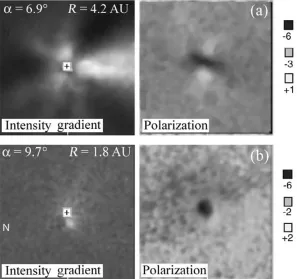
Fig. 3. Intensity gradient and polarimetric images of comets C/1995 O1 (Hale-Bopp) (top) and 81P/Wild (bottom) obtained atλ=0.67μm (adapted from Hadamcik and Levasseur-Regourd (2003b)).
linear polarization in jets/arcs remains positive at all phase angles, including even small phase angles.
Figure 3 shows the intensity gradient (on the left) and polarimetric images for two different comets adapted from Hadamcik and Levasseur-Regourd (2003b). The upper row presents the data for comet C/1995 O1 (Hale-Bopp) and the bottom row for comet 81P/Wild. The images are 38000 and 9000 km for the upper and bottom frames, respectively. The phase angleαand heliocentric distance R for the ob-servation dates are given in the photometric images. In both polarimetric images, one can clearly see the circumnucleus haloes. Note also that the positive polarization, which is no-ticeably higher than the background, can be confidently as-sociated with the jets apparent in photometric images. Nev-ertheless, one bright detail in the intensity gradient of comet C/1995 O1 (Hale-Bopp) is invisible in the polarimetric im-age.
Obviously, the average polarization in the whole coma is determined by contributions from halo, jets, and the rest of the coma. For instance, in the image correspond-ing to comet C/1995 O1 (Hale-Bopp), the highest val-ues for positive and negative polarization are (2±0.5)% and (−5±1)%, respectively; whereas, the polarization in-tegrated over the whole coma is (−0.4±0.4)% (Hadamcik and Levasseur-Regourd, 2003b). Thus, in the aperture-averaged polarimetry of comets, a significant negative po-larization in the circumnucleus halo could be disguised by high positive polarization in jets. It needs to be emphasized that a high jet-activity may completely hide a circumnuclear halo (Hadamcik and Levasseur-Regourd, 2003b). However, high jet-activity generally correlates with a small heliocen-tric distance of a comet; as a consequence, ground-based
observation of haloes at large phase angles is a difficult problem.
It needs to be stressed that some reports on unusually high negative polarization in the very inner part of the coma can also be found for aperture-averaged polarimetric ob-servations of comets. For example, Jockers and Kiselev (2002) found an unusually high negative polarization in comet C/2000 WM1 (LINEAR) at small phase angles. It is possible to outline two necessary conditions for aperture-averaged observations of circumnucleus haloes. The first implies that the circumnucleus halo is not hidden by jet-activity from the observer. However, weak jet-jet-activity typ-ically could be observed at a relatively large heliocentric distance Rof the comet. The second condition requires a small geocentric distanceof the comet. It increases the apparent brightness of the comet and, therefore, makes pos-sible an observation with small-sized apertures. Moreover, a small geocentric distance increases spatial resolution.
Jockers and Kiselev (2002) measured the linear polariza-tion in comet C/2000 WM1 (LINEAR) and found P ≈
−2.4% at the phase angleα = 13◦. However, due to the small geocentric distance of the comet=0.468 A.U., the projected area in their measurements was only about 3750
Fig. 4. Synthetic dependences of the degree of linear polarization on phase angle for the circumnucleus haloes (filled symbols) and jets (open symbols). Data are adapted from Hadamcik and Levasseur-Regourd (2003b).
Levasseur-Regourd (2003b).
Figure 4 presents synthetic dependences of the degree of linear polarization on phase angle for circumnucleus haloes and jets (data points adapted from Hadamcik and Levasseur-Regourd, 2003b). In Fig. 4, the minimum of po-larization Pmin and phase angle of polarization minimum αminin the NPB of circumnucleus haloes can be estimated as approximately−6% and 15◦, respectively. Taking into account the depolarizing effect of multiple scattering in the regolith, which was discussed in Section 2, a significant difference of the NPBs in circumnucleus haloes (shown in Fig. 4) and C-type asteroids (in Fig. 1) could indicate some similarity in the properties of their dust. On the other hand, the absence of the NPB in cometary jets suggests a substan-tial difference in the properties of dust forming the jets and regolith in C-type asteroids.
4.
Interpretation of Imaging Polarimetry of
Comets
Unfortunately, there has been little effort to date to in-terpret the imaging polarimetry of comets. For instance, Hadamcik and Levasseur-Regourd (2003b) attributed the high negative polarization in circumnucleus haloes to “more compact particles with different ices.” The first quantitative analysis of synthetic phase curves of the linear polarization measured in circumnucleus haloes was done by Zubkoet al. (2009). There, the impact of absorption on light scat-tering, by irregularly-shaped particles with sizes compara-ble with wavelength, were studied. While the real part of the refractive indexm was fixed, Re(m) =1.5, the imag-inary part was varied from 0 to 1.3. It was found that an increase of material absorption quickly reduces the ampli-tude of the negative polarization, so the effect disappears at Im(m) > 0.1; whereas, high negative polarization with
Pmin = −6% implies an absence of highly-absorbing
ma-terials with Im(m)≤0.02 in circumnucleus haloes. How-ever, in Zubkoet al.(2009), only single-sized particles were considered; whereas, a more realistic simulation must in-clude a size distribution of dust particles and this is adopted in this section for the analysis of the NPB in circumnucleus
haloes.
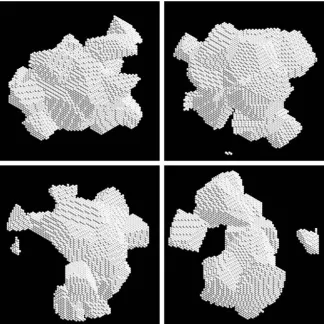
As in Zubkoet al.(2009), we use the so-called agglom-erated debris particles model for the shape of cometary dust particles. The generation algorithm for these model par-ticles has been previously described (e.g. in Zubkoet al., 2006, 2009). On average, agglomerated debris particles are equi-dimensional with a rather-low packing density of ma-terialρ=0.236. Constituent grains, as well as being over-all agglomerates, have a truly irregular morphology. Note that the agglomerate structure and irregular morphology are widely thought to be features of cometary dust. Example images of agglomerated debris particles are shown in Fig. 5. As can be seen, some constituent grains do not necessar-ily touch other parts of the agglomerated debris particles, though they are located very close to each other. How-ever, as was shown in Zubkoet al. (2008), in the case of irregularly-shaped particles, the absence of the direct con-tact between constituent grains does not affect significantly the light-scattering properties; this is especially the case for the NPB. More images of agglomerated debris particles can be found in Zubkoet al.(2006, 2009).
Light scattering by agglomerated debris particles is sim-ulated with the discrete dipole approximation (DDA, e.g., Draine and Flatau, 1994; Zubkoet al., 2010; and references therein). We use our own programming realization of the DDA, which reveals quite a good accuracy of computation (Penttil¨aet al., 2007). In this paper, we present results for three refractive indicesm=1.6+0.0005i, 1.6+0.02i, and 1.6+0.1i; differing only in the imaginary part.
Light scattering by particles comparable with wavelength is determined by the ratio of particle radiusr to the wave-lengthλof the incident radiation, which is referred to as the
Fig. 5. Images of four samples of agglomerated debris particles.
density ρ as follows: xeq = ρ1/3x. Through this study,
the size parameter x is varied from 1 to 26 (in the case of m = 1.6+0.0005i), 28 (m = 1.6+0.02i), and 32 (m =1.6+0.1i). The difference in the upper range limit ofx is caused by limitations in the DDA convergence. At wavelengthλ = 0.67μm, the range ofx corresponds to particle radii from 0.1μm to 2.8, 3, and 3.4μm, respec-tively.
Light-scattering properties of agglomerated debris par-ticles are averaged over sample shapes and orientations at each set of m and x; using a minimum of 500 sample particle shapes. Light scattering by each sample particle has been computed for one random orientation of the inci-dent electromagnetic wave and averaged over 100 scattering planes evenly distributed around the propagation direction of the incident light. We continue averaging over particle shape, while fluctuations of the standard deviation of the degree of linear polarization over the entire range of phase angleαexceed 1%; therefore, the actual number of sample particles considered very often exceeds 500. More details on the averaging over scattering planes and control of the averaging quality can be found in Zubkoet al.(2008).
Light-scattering properties of agglomerated debris parti-cles are also averaged over particle size with power-law size distributionr−a; whereas, the power indexais varied from 1 to 4 with a step of 0.1. Note that the studied range of
a is consistent with the results of in situmeasurement of comet 1P/Halley with VeGa-1 and 2 spacecrafts (Mazetset al., 1986). For instance, as was found in the case of comet
1P/Halley, the power indexavaried from 1.5 to 3.4 over the mass range of cometary dust particles from 10−19to larger
than 10−12kg. Interestingly, the lower range limit ofa
cor-responds to the most lightweight particles.
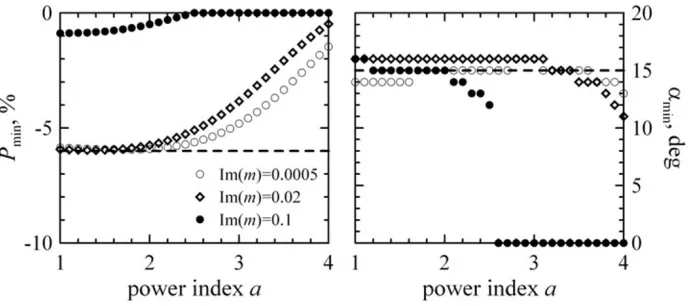
Figure 6 presents the results of numerical simulation of light scattering by agglomerated debris particles. The left panel shows the minimum of the negative polarizationPmin
and the right panel—the phase angle of the minimum of polarization αmin; both are functions of the power index
a. Open symbols correspond to weakly-absorbing particles with Im(m)=0.0005 and 0.02; whereas, the filled ones— to highly-absorbing particles with Im(m) = 0.1. The dashed line in each panel shows the corresponding char-acteristic for the circumnucleus haloes. As can be seen in the left panel, only weakly-absorbing particles may produce the necessary amplitude of the NPB. Moreover, this occurs only in the range ofa from 1 to 2. Thus, the present ex-tended analysis confirms the previous findings in Zubkoet al.(2009) for single-sized particles at Re(m)=1.5. Parti-cles with refractive indices Re(m)=1.5–1.6 and Im(m)=
size distribution of agglomerated debris particles. Open symbols correspond to weakly-absorbing materials withm=1.6+0.0005iand 1.6+0.02i; whereas, filled symbols present the case of high absorptionm=1.6+0.1i.
ice tholin (Khareet al., 1993). Nevertheless, one can con-clude that the organic material based on that of the Green-berg model (e.g., Jenniskens, 1993) cannot exist in consid-erable quantities in the circumnucleus haloes; neither can hydrogenated carbon (e.g., Duley, 1984).
As one can see in Fig. 6, weakly-absorbing agglomerated debris particles fit the amplitude of the NPB in the circum-nucleus haloes in the power index rangea = 1–2. Under the assumption of material densityρmat=3 g/cm3, the mass
of agglomerated debris particles studied in Fig. 6 could be estimated between 10−17 kg and 10−14 kg. However, in
this range of mass, in situ measurements reveal the index in power-law size distribution to be a = 1.5–2.5 (Mazets
et al., 1986). Thus, the range ofathat provides a good fit of Pminin the circumnucleus haloes and, simultaneously, is
consistent within situstudies of cometary dust, isa =1.5– 2. It needs to be emphasized that, in the given range ofa, the computedαminalso fits quite well with that observed in the circumnucleus haloes. Thus, both principal character-istics of the NPB in our simulation are consistent with the observations. It is interesting to note that our estimation of the power indexafor dust particles in circumnucleus haloes significantly differs from the indirect estimations of average power index for the whole coma (e.g., Jockers, 1997). On the other hand, the dust in circumnucleus haloes is not the most abundant constituent of the coma.
Finally, we can consider the question of the density of dust particles in circumnucleus haloes. As previously noted, Hadamcik and Levasseur-Regourd (2003b) assumed a com-pact structure of dust particles in the haloes. While agglom-erated debris particles fit the principal parameters charac-terizing the NPB, their material density is not too high. In-deed, assuming the material density of the solid silicates to be 3.5 g/cm3 and the packing density of material to be
0.236, the material density in agglomerated debris particles is about 0.83 g/cm3. However, according to the laboratory
study of craters in aluminum foil of the Stardust collec-tor, the material density of cometary dust is between 0.3 to 3 g/cm3(H¨orzet al., 2006). Therefore, agglomerated
de-bris particles have to be classified as being fluffy particles rather than compact.
5.
Summary
The discussion presented in this paper can be summa-rized as follows. Though the aperture-averaged linear po-larization of comets does nearly coincide with that of C-type asteroids at small phase angles, it is seen as a random coincidence. The similarity cannot be considered as evi-dence for common properties of dust particles in comets and asteroids. According to laboratory measurements, light scattering by independent dust particles is substantially dif-ferent from that by regoliths consisting of exactly the same particles. In particular, the negative polarization of indepen-dent particles is at least a few times higher than that of the regolith.
Aperture-averaged linear polarization in comets cannot be attributed to a single type of dust particle. There are at least two types of cometary dust particles with sub-stantially different polarimetric properties: dust particles forming cometary jets and those forming the circumnucleus halo. Dust particles in jets produce only positive polariza-tion through all phase angles; whereas, those in the halo reveal a significant negative polarization branch at phase angles α ≤ 30◦. In the latter case, the amplitude of the NPB can be as high as 6%. However, this value is more than three times the amplitude of the NPB in C-type aster-oids (|Pmin| ≈ 1.8%). Taking into account findings in the experimental study of light scattering by independent and deposited particles, one can assume common properties of dust particles in the cometary circumnucleus haloes and re-goliths of C-type asteroids.
Small Particles, 530 pp., Wiley, New York, 1983.
Brownlee, D. E., Cosmic dust—collection and research,Ann. Rev. Earth Planet. Sci.,13, 147–173, 1985.
Chernova, G. P., N. N. Kiselev, and K. Jockers, Polarimetric characteristics of dust particles as observed in 13 comets—Comparisons with asteroids,
Icarus,103, 144–158, 1993.
Clarke, D., Polarization measurements of the head of comet Beunett (1969i),Astron. Astrophys.,14, 90–94, 1971.
Dollfus, A. and J.-L. Suchail, Polarimetry of grains in the coma of P/Halley. I—Observations,Astron. Astrophys.,187, 669–688, 1987. Dorschner, J., B. Begemann, T. Henning, C. Jaeger, and H. Mutschke,
Steps toward interstellar silicate mineralogy. II. Study of Mg-Fe-silicate glasses of variable composition, Astron. Astrophys., 300, 503–520, 1995.
Draine, B. T. and P. J. Flatau, The discrete dipole approximation for scat-tering calculations,J. Opt. Soc. Am. A,11, 1491–1499, 1994. Duley, W. W., Refractive indices for amorphous carbon,Astrophys. J.,287,
694–696, 1984.
Elvius, A., Preliminary results of polarization measurements in comets,
Arkiv f¨or Astronomii,2, 195–197, 1958.
Furusho, R., B. Suzuki, N. Yamamoto, H. Kawakita, T. Sasaki, Y. Shimizu, and T. Kurakami, Imaging polarimetry and color of the inner coma of comet Hale-Bopp (C/1995 O1),Publ. Astron. Soc. Jpn.,51, 363–373, 1999.
Ganesh, S., U. C. Joshi, K. S. Baliyan, and M. R. Deshpande, Polarimetric observations of the comet Hale-Bopp,Astron. Astrophys. Suppl. Ser., 129, 489–493, 1998.
Gustafson, B. A. S. and L. Kolokolova, A systematic study of light scatter-ing by aggregate particles usscatter-ing the microwave analog technique: An-gular and wavelength dependence of intensity and polarization,J. Geo-phys. Res.,104, 31711–31720, 1999.
Hadamcik, E. and A. C. Levasseur-Regourd, Dust evolution of comet C/1995 O1 (Hale-Bopp) by imaging polarimetric observations,Astron. Astrophys.,403, 757–768, 2003a.
Hadamcik, E. and A. C. Levasseur-Regourd, Imaging polarimetry of cometary dust: different comets and phase angles,J. Quant. Spectr. Rad. Trans.,79–80, 661–678, 2003b.
Hadamcik, E., J.-B. Renard, A. C. Levasseur-Regourd, J. Lasue, G. Al-couffe, and M. Francis, Light scattering by agglomerates: Intercon-necting size and absorption effects (PROGRA2experiment),J. Quant. Spectr. Rad. Trans.,110, 1755–1770, 2009.
H¨orz, F., R. Bastien, J. Borg, J. P. Bradley, J. C. Bridges, D. E. Brown-lee, M. J. Burchell, M. Chi, M. J. Cintala, Z. R. Dai, Z. Djouadi, G. Dominguez, and 32 colleagues, Impact features on Stardust: Implica-tions for comet 81P/Wild 2 dust,Science,314, 1716–1719, 2006. Jenniskens, P., Optical constants of organic refractory residue,Astron.
Astrophys.,274, 653–661, 1993.
Jessberger, E. K., Rocky cometary particulates: their elemental isotopic and mineralogical ingredients,Space Sci. Rev.,90, 91–97, 1999. Jockers, K., Observations of scattered light from cometary dust and their
interpretation,Earth Moon Planets,79, 221–245, 1997.
Jockers, K. and N. Kiselev, Wavelength dependence of polarization of comet C/2000 WM1 (LINEAR) in the negative and positive polarization branches, inProceedings of Asteroids, Comets, Meteors—ACM 2002, edited by B. Warmbein, 567–570, (Berlin, Germany, 29 July–2 August, 2002), 2002.
Jockers, K., V. K. Rosenbush, T. Bonev, and T. Credner, Images of polar-ization and colour in the inner coma of comet Hale-Bopp,Earth Moon
proximation,J. Quant. Spectr. Rad. Trans.,70, 581–594, 2001. Kimura, H., L. Kolokolova, and I. Mann, Optical properties of cometary
dust. Constraints from numerical studies on light scattering by aggregate particles,Astron. Astrophys.,407, L5–L8, 2003.
Kiselev, N. N. and G. P. Chernova, Phase functions of polarization and brightness and the nature of cometary atmosphere particles,Icarus,48, 473–481, 1981.
Lasue, J. and A. C. Levasseur-Regourd, Porous irregular aggregates of sub-micron sized grains to reproduce cometary dust light scattering observations,J. Quant. Spectr. Rad. Trans.,100, 220–236, 2006. Levasseur-Regourd, A. C., E. Hadamcik, and J. B. Renard, Evidence for
two classes of comets from their polarimetric properties at large phase angles,Astron. Astrophys.,313, 327–333, 1996.
Levasseur-Regourd, A. C., N. McBride, E. Hadamcik, and M. Fulle, Sim-ilarities between in situ measurements of local dust light scattering and dust flux impact data within the coma of 1P/Halley,Astron. Astrophys., 348, 636–641, 1999.
Lindqvist, H., K. Muinonen, and T. Nousiainen, Light scattering by coated Gaussian and aggregate particles,J. Quant. Spectr. Rad. Trans.,110, 1398–1410, 2009.
Lisse, C. M., Y. R. Fern´andez, M. F. A’Hearn, T. Kostiuk, T. A. Livengood, H. U. K¨aufl, W. F. Hoffmann, A. Dayal, M. E. Ressler, M. S. Hanner, G. G. Fazio, J. L. Hora, S. B. Peschke, E. Gr¨un, and L. K. Deutsch, Infrared observations of dust emission from comet Hale-Bopp,Earth Moon Planets,78, 251–257, 1997.
Lumme, K. and J. Rahola, Light scattering by porous dust particles in the discrete-dipole approximation,Astrophys. J.,425, 653–667, 1994. Martel, M. T., Variations de la polarisation observ´ee du 18 au 29 aoˆut
dans la com`ete 1957d pour des r´egions situ´ees `a moins de 4’ du noyau,
Annales d’Astrophysique,23, 480–497, 1960.
Mazets, E. P., R. L. Aptekar, S. V. Golenetskii, Yu. A. Guryan, A. V. Dyachkov, V. N. Ilyinskii, V. N. Panov, G. G. Petrov, A. V. Savvin, R. Z. Sagdeev, I. A. Sokolov, N. G. Khavenson, V. D. Shapiro, and V. I. Shevchenko, Comet Halley dust environment from SP-2 detector measurements,Nature,321, 276–278, 1986.
McBride, N., S. F. Green, A. C. Levasseur-Regourd, B. Goidet-Devel, and J.-B. Renard, The inner dust coma of comet 26P/Grigg-Skjellerup: multiple jets and nucleus fragments?,Mon. Not. R. Astron. Soc.,289, 535–553, 1997.
Muinonen, K., Electromagnetic scattering by two interacting dipoles, in
Proc. 1989 URSI Electromagnetic Theory Sympos., 428–430, Stock-holm, Sweden, 1989.
Muinonen, K., E. Zubko, J. Tyynel¨a, Yu. G. Shkuratov, and G. Videen, Light scattering by Gaussian random particles with discrete-dipole ap-proximation,J. Quant. Spectr. Rad. Trans.,106, 360–377, 2007. Mu˜noz, O., H. Volten, J. F. de Haan, W. Vassen, and J. W. Hovenier,
Ex-perimental determination of scattering matrices of olivine and Allende meteorite particles,Astron. Astrophys.,360, 777–788, 2000.
Mu˜noz, O., H. Volten, J. W. Hovenier, M. Min, Yu. G. Shkuratov, J. P. Jalava, W. J. van der Zande, and L. B. F. M. Waters, Experimental and computational study of light scattering by irregular particles with extreme refractive indices: hematite and rutile,Astron. Astrophys.,446, 525–535, 2006.
Nousiainen, T., Optical modeling of mineral dust particles: A review,J. Quant. Spectr. Rad. Trans.,110, 1261–1279, 2009.
M. Shakhovskoy, F. P. Velichko, S. V. Kolesnikov, and N. V. Karpov, Polarization and brightness opposition effects for the E-type Asteroid 44 Nysa,Icarus,201, 655–665, 2009b.
Shkuratov, Yu. G., On the origin of the opposition effect and negative po-larization for cosmic bodies with solid surface,Astronomicheskii Circu-lar,1400, 3–6, 1985 (in Russian).
Shkuratov, Yu., A. Ovcharenko, E. Zubko, O. Miloslavskaya, K. Muinonen, J. Piironen, R. Nelson, W. Smythe, V. Rosenbush, and P. Helfenstein, The opposition effect and negative polarization of struc-tural analogs for planetary regoliths,Icarus,159, 396–416, 2002. Shkuratov, Yu., A. Ovcharenko, E. Zubko, H. Volten, O. Munoz, and G.
Videen, The negative polarization of light scattered from particulate surfaces and of independently scattering particles,J. Quant. Spectr. Rad. Trans.,88, 267–284, 2004.
Shkuratov, Yu., S. Bondarenko, A. Ovcharenko, C. Pieters, T. Hiroi, H. Volten, O. Munoz, and G. Videen, Comparative studies of the re-flectance and degree of linear polarization of particulate surfaces and independently scattering particles,J. Quant. Spectr. Rad. Trans.,100, 340–358, 2006.
Tanga, P., A. Cellino, and M. Di Martino, Imaging polarimetry of comet Hale-Bopp (C/1995 O1) around perihelion,Earth Moon Planets,78, 359–364, 1997.
Vilaplana, R., F. Moreno, and A. Molina, Study of the sensitivity of size-averaged scattering matrix elements of nonspherical particles to changes
Zubko, E., D. Petrov, Yu. Shkuratov, and G. Videen, Discrete dipole ap-proximation simulations of scattering by particles with hierarchical structure,Appl. Opt.,44, 6479–6485, 2005.
Zubko, E., Yu. Shkuratov, N. Kiselev, and G. Videen, DDA simulations of light scattering by small irregular particles with various structure,J. Quant. Spectr. Rad. Trans.,101, 416–434, 2006.
Zubko, E., K. Muinonen, Yu. G. Shkuratov, G. Videen, and T. Nousiainen, Scattering of light by roughened Gaussian random particles,J. Quant. Spectr. Rad. Trans.,106, 604–615, 2007.
Zubko, E., Yu. Shkuratov, M. Mishchenko, and G. Videen, Light scattering in a finite multi-particle system,J. Quant. Spectr. Rad. Trans.,109, 2195–2206, 2008.
Zubko, E., H. Kimura, Yu. Shkuratov, K. Muinonen, T. Yamamoto, H. Okamoto, and G. Videen, Effect of absorption on light scattering by agglomerated debris particles,J. Quant. Spectr. Rad. Trans.,110, 1741– 1749, 2009.
Zubko, E., D. Petrov, Ye. Grynko, Yu. Shkuratov, H. Okamoto, K. Muinonen, T. Nousiainen, H. Kimura, T. Yamamoto, and G. Videen, Validity criteria of the discrete dipole approximation,Appl. Opt.,49, 1267–1279, 2010.