R E S E A R C H
Open Access
A secure billing protocol over
attribute-based encryption in vehicular cloud
computing
Lewis Nkenyereye, Youngho Park and Kyung Hyune Rhee
*Abstract
The integration of cloud computing into vehicular ad hoc networks (VANETs) has allowed the possibility of offering multiple services to the vehicle owners ranging from safety to entertainment services. The ubiquitousness of cloud computing involves a multitude of service providers; thus, an efficient and secure access control mechanism is required. However, rigorous security features need to be addressed for such commercial-based services to be fully adopted. In this paper, we present a secure billing protocol over attribute-based encryption in vehicular cloud computing. We achieve the identity privacy of the vehicles and their requested services through pseudonym techniques. Certificateless signature scheme is used to assure the authentication of legitimate vehicles which can enjoy the provided services. We use attribute-based encryption to guarantee access control based on the purchased services. We make use of hash chain technique to provide authorization through electronic voucher (credits) which a vehicle has to possess in order to purchase a service. Unlike existing protocols in VANETS, the proposed protocol is not built on expensive bilinear pairing operations. We provide the efficiency of the proposed protocol through
performance analysis and simulation.
Keywords: Access control, Attribute-based encryption, Certificateless signature scheme, Vehicular cloud computing
1 Introduction
Combining cloud computing (CC) with vehicular ad hoc networks (VANETs) to form vehicular cloud computing (VCC) appeals the existing cloud service providers (CSPs) such as Amazon EC2, S3, Microsoft Azure to also extend their services to vehicle users. Taking advantage of the vehicle’s on-board unit (OBU), the vehicle users would have additional computing resources to enjoy various services from safety to infotainment-related services. In conventional cloud computing, CSPs usually offer a pay-per-use billing system in their pricing model which means that a user will only be charged for exactly the amount of services provided. A vehicle user can acquire the services on the move using the OBU’s visual and computational capabilities. As pointed out by Li et al., a key success of commercial applications over vehicular environment will
*Correspondence: [email protected]
Department of IT Convergence and Application Engineering, Pukyong National University, 45 Yongso-ro, Nam-gu, Busan, Republic of Korea
inevitably be featured by entity authentication and billing while simultaneously embracing the vehicle mobility [1].
Basic security requirements in VCC have been addressed such as entity authentication, authorization, and privacy [2, 3]. Existing literature has more focused on access control mechanisms which allow a CPS to provide multiple services within a single package [4–6]. To enforce access control in different services, attribute-based encryption (ABE) has widely been adopted to offer a number of services embedded within a single package [4, 5]. Even though ABE ensures that a service is accessed by a legitimate user, bad-intentioned vehicle user might over use the services as long as the access structure per-mits it. Thus, secure billing feature is required in order the vehicle users to strictly access what they consent to pay for. Secure billing systems which provide evidence to the vehicle user when it comes to payment need to be considered for a full adoption of the commercial services in VCC.
Among the relevant works with secure billing feature in VANETs, Yeh et al. proposed a local and proxy-based authentication and billing protocol in order to reduce the communication overhead. Their protocol pro-posed an incentive-aware multi-hop forwarding tech-nique for vehicles in the VANETs [7]. The protocol did not consider secure access control which is indis-pensable for CSPs within the VCC architecture. In another work, Yeh et al. proposed a portable authentica-tion/authorization/accounting (AAA) framework for pur-chasing services from the road entities (RSUs). They used signature-based and key policy attribute-based encryp-tion (KP-ABE) in their billing mechanism to achieve local-ized fine-grained access control [4]. However, in their protocol, the system master secret key must be distributed to every vehicle temper proof device. Therefore, in case the temper proof device is compromised, the system secu-rity features are affected [8]. Moreover, these protocols are built based on expensive pairing operations which will hinder the whole system efficiency since the CSPs would also provide voluminous files such as mp3 files or movies. In this paper, we present a secure billing protocol over attribute-based encryption in vehicular cloud computing. The identity privacy of the vehicles and their requested services is achieved through pseudonym techniques. We make use of certificateless signature scheme to assure the authentication of legitimate vehicles which can enjoy the provided services [9]. ABE is adopted to guaran-tee rigorous access control based on the provided access structure [10]. Hash chain technique is to used to guaran-tee the authorization property through electronic voucher which a vehicle has to possess before enjoying any giving service [11].
1.1 Motivation and contribution
The vehicles on the move need also to enjoy a variety of services provided by the CSPs as individuals do through the smart phones. Additionally, the vehicles on the move are predicted to easily and efficiently enjoy the CSP’s ser-vices due to the technological features such as visual, computing, and networking in-built capabilities. How-ever, the CSP owners have to make sure that the vehicle users pay for the provided services along with additional security properties which need to be met before the adop-tion of the commercial services in VCC. We describe our contributions as follows:
• We first present an application model for a secure billing protocol over attribute-based encryption in vehicular cloud computing which allows the vehicle users to enjoy a variety of service on the move. We define the security requirements to be met by the proposed protocol.
• We present a secure billing protocol over attribute-based encryption in vehicular cloud computing based on the techniques of attribute-based encryption, secret sharing scheme, certificateless signature scheme, and hash chain technique. • We apply electronic voucher (credits) feature in the
system to restrict the vehicles from over using the acquired access structure in order to enjoy the embedded services. Thus, a vehicle is not prompt to enjoy a given service in a limited time. The electronic coin boosts the confidence of the CSPs over
non-repudiation of payment.
• We provide analysis of the proposed protocol in terms of security objectives. We further evaluate the performance of the proposed protocol through computational delay, transmission overhead, and simulation.
The remainder of the paper is organized as follows. We first present the related work and the preliminaries in Section 2 and Section 3, respectively. We present the sys-tem architecture of the proposed protocol in Section 4 and the design of our protocol in Section 5. We discuss the security analysis and performance of the proposed protocol in Section 6 and finally conclude in Section 7.
2 Related work
In this section, we present the related work which is subdi-vided into two sub-sections. We first present the evolution of vehicle communication architectures from the conven-tional VANET framework to vehicular cloud computing extensions along with related security mechanisms. Then, we present the existing work on billing schemes within the CC environment and VCC.
2.1 VANET architecture
VANET result as an extension of mobile ad hoc netwoks (MANETs) [12]. In VANETs, the main entities represent the vehicles, RSUs, and an over-viewer third party called Trusted Authority (TA) in charge of registration, certifica-tion, and revocation of all the entities within the VANET architecture [13]. Conventional VANETs avail two major communication means through the dedicated short-range communication (DSRC) as V2V and V2I communications [14]. A considerable number of applications were pre-dicted to be achieved through the VANET architecture; however, the computational cost of the value-added appli-cations in VANETs require huge computation capabilities which led to the mixture of VANETs and cloud computing [15].
types of architectures which originated from the combina-tion of VANETs and cloud computing [18].VANETs using cloudis defined as vehicles equipped with smart devices and communicating with the cloud the same way as our mobile phones connect to different servers located in the cloud.Vehicular cloudrefers to the full utilization of vehi-cle devices as computers to form mobile servers. In this architecture, one could use the vehicle OBU’s to make his/her personal cloud.Hybrid vehicle cloudis a combina-tion of the above architectures also referred as VCC. The feasibility of VCC was adopted by several researchers [19, 20], though security issues within the cloud computing are still an attractive on-going research whereby different secure protocols have been proposed [21]. In this work, we construct our protocol based onVANETs using cloud architecture.
2.2 Secure billing schemes
A billing transaction refers to the saving of the the move-ment logs in order to verify the billing operations. Billing transactions are part of electronic payment schemes. Time-based billing and content-based billing are the main billing approaches in cloud computing and depend on the type of required services. However, several CSPs seem to embrace content-based billing rather than time-based billing [22]. A considerable number of electronic payment schemes have been suggested in the literature. Among them are micro-payment-based schemes such as MiniPay and Netpay [23]. These e-payment systems allow the users of cloud-based applications to securely and efficiently per-form payments. These schemes are built using one-way hash functions that generate chains of hash values. The cloud users will first release several hashes with the hash chain in order to perform billing transactions. On the basis of the micro-payment-based scheme, Pay-as-you-Browse [24] and XPay [22] fused the micro-payment con-cept into cloud-hosted services. Though those schemes have less billing latency, they do not support additional security features required for billing transactions in cloud-based services.
Within the vehicular environment, secure billing feature is core prerequisite for a full adoption of commercial-based services by the CSPs in VCC. Several billing mech-anisms have been proposed for VANET applications [4, 7, 25, 26]. In [7], Yeh et al. proposed a local and proxy-based authentication and billing scheme to reduce the commu-nication overhead. The protocol proposed an incentive-aware multi-hop forwarding for the vehicles within the VANET architecture. They adopted batch verification technique in their scheme to fulfill the security require-ments and signature-based communications. However, the protocol does not satisfy access control property, thus cannot allow multiple services in a single package. In [4], Yeh et al. proposed a portable AAA framework which
allow the vehicle users to enjoy CSP’s services from the RSUs. They used signature-based and KP-ABE in the billing protocol to attain localized fine-grained access con-trol and also employed E-coin to provide service autho-rization. However, the proposed protocol is built based on expensive pairing operations which might not be efficient due to voluminous sizes of various files.
3 Preliminaries
In this section, we present the basic properties of lightweight attribute-based encryption (lABE) based on Elliptic Curve Integrated Encryption Scheme (ECIES) and certificateless signature scheme which form the basic cryptographic primitives of the proposed protocol.
3.1 Lightweight ABE scheme
The lABE scheme of [10] based on elliptic curve cryptog-raphy consists of Setup, Encryption, Key-Generation, and Decryption algorithms.
3.1.1 lABE.Setup
Suppose that the attribute space of the system is defined as the universe of attributesU= {1, 2,. . .,n}. LetGbe an additive group with a prime orderqandP ∈G, whereG consists of points on an elliptic curve andPis a generator ofG. lABE.Setup() algorithm generates lABE parameters as follows:
1. Choose a randoms∈Z∗qas the attribute master secret key and computes the corresponding public keyPK=s·P.
2. For each attributei∈U, choose an attribute secret ti∈Z∗qand compute the attribute public key lABE.Encrypt(m, ω, labe.params) outputs the cipertext CMas follows:
1. For the access tree, assign index to each node other than root.
2. For each node, a polynomialqnode(x)overZ∗qis
defined in top-down manner where each polynomial is of degreednode−1anddnodeis the threshold value
of the node.
• for the root, setqroot(0)=s.
• for other nodes including leafs, set qnode(0)=qparent(index(node))where
index(node)is the index value of the node.
3. Letn be the number of leaves in, for each leaf node leafl(1≤l≤n), a secret share of the decryption key is computed asDleafl =qleafl(0)·t
−1
i wherei is the
attribute associated toleaflandtiis the random
number fori chosen in lABE.Setup. 4. ReturnD= {Dleafl |leafl∈}
3.1.4 lABE.Decrypt
The decryption algorithm lABE.Decrypt(CM, D, labe.params) decrypts the cipertext CM, if and only if the attributes set ωsatisfies the access tree, by using NodeKey(CM, D, node) for a node in the access tree recursively. In the lABE scheme [10], secret sharing based on Lagrange interpolation [Shamir] is used to reconstruct the decryption key.
1. For each leaf node to which an attributei is associated, NodeKey(CM, D,leafl) is defined as
follows:
• if the associated attributei toleaflis not
included inω, then NodeKey(CM, D,leafl) =⊥.
2. For a non-leaf nodeu, it calls NodeKey(CM, D, z) for all childrenz of the node u.
• Letωube an arbitrarydusized set of children
nodes such that NodeKey(CM, D, z)= ⊥. If no such set exist NodeKey(CM, D, u) returns⊥.
be the Lagrange coefficient where ωu= {index(z)|z∈ωu},
3. Calculate the decryption keyK = NodeKey(CM, D, root) =qroot(0)·k·P=s·k·P.
4. Return the decrypted messagem=DecK(C).
3.2 Certificateless signature scheme
The certificateless signature (CLS) scheme of [9] consists of the following algorithms.
• CLS.Setup() algorithm generates a master key and public system parameters as follows:
– Choose an additive groupG with a prime orderq and a generatorP∈Gdefined on an elliptic curve.
– Select master secret keys∈Zq∗and computes the master public keyPpub=s·P.
– Choose two cryptographic hash functions H1:{0, 1}∗×G2→Zq∗and
H2:{0, 1}∗×G3→Zq∗.
– Set public system parameters cls.params= {G,q,P,Ppub,H1,H2}. – Returns,cls.params
• CLS.SetSecret(id ) outputs a secret value for the given identityid as follows:
– Select randomlyxid∈Z∗qas a secret value and
computePid =xid·P.
– ReturnS1= xid,Pid
• CLS.PartialKey(x, id,Pid) generates a partial private
and public key for theid as follows:
– Choose a randomrid∈Z∗qand compute
• CLS.Sign(m,skid) generates the signature for a
messagem as follows:
– Choose a randoml∈Zq∗such that gcd(l+h,q) = 1, whereh=H2(m,R,Pid,Rid)andR=l·P.
– Computer=(l+h)−1(xid+sid)(modq).
– Return the signatureσ= r,R.
• CLS.Verify(m, id,pkid,σ) verifies the signatureσfor
the messagem under the id as follows:
– Computeh1=H1(id,Rid,Pid)and
h2=H2(m,R,id,Pid,Rid).
– Check ifr·(R+h2·P)=? Pid+Rid+(h1·Ppub).
4 Proposed protocol
In this section, we first present the system architecture of the proposed protocol. Secondly, we present the secu-rity requirements of the proposed protocol, and lastly, we outline the main phases of the proposed protocol.
4.1 Architecture
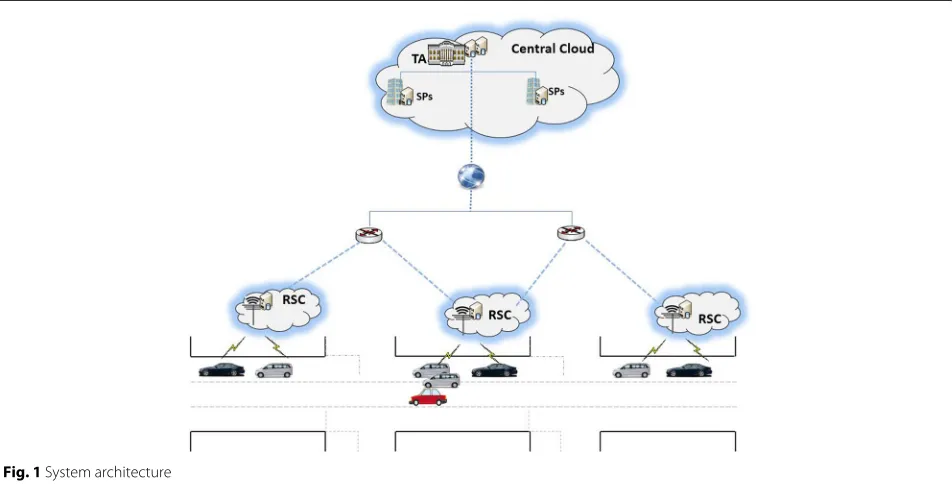
We describe the communication entities within our pro-tocol which are made of Trusted Authority (TA), Service Providers (SPs), Road Side Cloud (RSC), and vehicles which communicate through the OBU as shown in Fig. 1:
• TA: It is in charge of the registration of all entities (RSC, SPs, and vehicles) inside our system and issues cryptographic materials during the system
initialization.
• RSC: RSCs are databases located along the roads and accessible by the vehicles. The RSCs store the service
files (SFs) provided by the SPs. In that case, the vehicles can acquire the files through the RSCs. The vehicles get the electronic voucher from SPs through the RSCs. Due to the advancements of technology, we assume that RSCs are connected to an electricity power generator with enough computational capability.
• SPs: It is a server located in the cloud belonging to a cloud-based commercial service providers (CSPs). SPs offer a range of services, and one service package can incorporate several services such as mp3 audio, a map, or a short video clip. SPs send their service files to RSCs so that the vehicles can easily download them. However, in order to convince the vehicles of the services they need to be charged for, TA provides an electronic voucher with a given value which a vehicle has to satisfy in order to get the services. Moreover, the electronic voucher logs are sent to TA in non-rushing hours for accountability and
non-repudiation of payment.
• Vehicles: Vehicles are equipped with OBUs which allow them to communicate with RSCs in order to require files from the SPs.
4.2 Security objectives
Our protocol should satisfy the following security require-ments:
• Authentication and authorization: Each vehicle should be authenticated before it can receive a service file from SPs through the RSCs. Additionally, only
legitimate subscribers should get access to use SP’s services.
• Identity privacy preservation: The real identity of a vehicle should be kept secret from other vehicles, RSC, and SPs.
• Fine-grained access control: Through fine-grained access control based on ABE, a vehicle should strictly be able to open a service corresponding to its access structure.
• Double-spending resistance: A vehicle should not over use its purchased electronic voucher to open additional files.
• Non-repudiation of payment: A vehicle should not deny the electronic voucher which it has used to open a given file. This would help in case of disputes over billing issues.
• Traceability: TA should be able to reveal the real identity of SPs and vehicles.
The proposed protocol consists of the following sub-protocols:
• System Setup: TA sets up its master secret key and its corresponding public key. Each vehicle provides its real identity, and TA generates the corresponding pseudo identity from which a partial private key is computed. SPs and RSCs also provide their real identities, and TA computes their partial private keys. Each SP generates the service files along with their access structures. SPs send securely the attribute master key of each file to TA. SPs also send the service files to RSC along with the corresponding secret keys which will be used for E-voucher generation through hash chain technique. • E-voucher Generation: Periodically, a vehicle
registers for SP’s services. During the registration, the vehicle specifies the service files it wishes to acquire. Then, TA generates an electronic voucher (EV) which contains the secret shares corresponding to the access structure which the vehicle registered for. E-voucher will work as a transaction evidence for the purchased services.
• Service Purchase: RSCs periodically advertise the SP’s services.vican request of any service among the
advertised services. Depending on the E-voucher balance, RSCjfirst computes a new value of EV based
on the requested services and sends the services tovi
along with the secret shares corresponding to the access structure of the requested service.
5 Proposed description
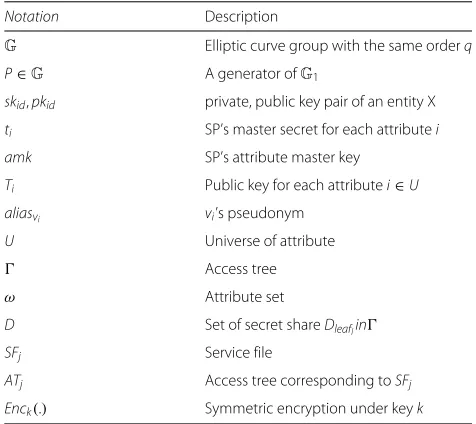
In this section, we design a secure billing protocol over attribute-based encryption in vehicular cloud computing. Table 1 shows the notations used in describing the pro-posed protocol.
Table 1Notations and descriptions
Notation Description
G Elliptic curve group with the same orderq
P∈G A generator ofG1
skid,pkid private, public key pair of an entity X
ti SP’s master secret for each attributei
amk SP’s attribute master key
Ti Public key for each attributei∈U
ATj Access tree corresponding toSFj
Enck(.) Symmetric encryption under keyk
5.1 System setup
In setup phase, TA generates global system parameters and any other entities register to the TA as follows:
1. TA chooses an elliptic curve groupGof orderq and a generatorP∈G.
2. To generate master secretskTAand public keypkTA,
TA runs CLS.Setup() and setsskTA,cls.params
← CLS.Setup(), then publishescls.params.
3. For registering each vehiclevi, TA assigns a
pseudonymaliasvito eachvi.
4. EachRSCjandSPkregisters to the TA and generate
CLS private keys as follows:
• RSCjandSPkgenerateS1,RSCj ← CLS.SetSecret(RSCj) andS1,SPk ←
CLS.SetSecret(SPk), and requests partial private
key to the TA, respectively.
• TA issuesS2,RSCj ←CLS.PartialKey(skTA,RSCj, PRSCj) andS2,SPk ←CLS.PartiaKey(skTA,SPk, PSPk) to each entity securely.
• RSCjandSPkset
In addition, each service providerSP prepares service files served under a given access structure as follows:
lABE.Setup(), and publisheslabe.paramsto the system.
2. Letl be the number of service files. SP decides access treeATjand prepares encrypted service fileSFj
(1≤j≤l) under a given attribute setωjasSFj← andαto the TA securely.
5.2 E-voucher generation
Periodically, the vehicles request an electronic voucher (EV) which permits to enjoy the services offered by any SPs through the RSCs. To acquire an EV from TA, vi
performs the following:
1. vicomposes an electronic voucher request message
EVR= {aliasi,K,ts}wherets is the time stamp and
K is a secret key to be used later.
2. visendsC1=EncPKTA{EVR,pkvi,δi}to the TA, whereδis the signature for theEVR set asδi=
CLS.Sign(EVR,skvi).
3. Upon receiving the messageC1, TA first decryptsC1 using its private key, then verifies the signature as CLS.Verify(EVR,aliasi,pkvi,δ). If it holds, TA generates E-voucher (EV ) as follows:
• Letd be the maximum credits forvito purchase
service files. Computehkd=hashd(α)where
hashd()represents thed -th hash chain, i.e.,
hkd=hash(hashd−1(α))=
hash(hash(. . . (hash(α)) . . .)).
• Generate
EV =aliasi,exp,d,MAChkd(aliasi|exp|d)
whereexp is the expiration date.
4. TA sendsC1=EncK(EV)tovi. Then,vican recover
EV by decrypting theC1under the shared secret key K.
5.3 Service purchase
A vehicle after getting theEVcan enjoy file services from any chosenRSCj.RSCjadvertises periodically the services
along with their denomination valuedˆ.
1. From service file lists advertised,vichooses a list for
SFjand composes a service request message
mf = {SFj,EV,aliasi,pkvi,K,ts}whereK is a secret key to be shared withRSCj, and setsδj←
CLS.Sign(mf,skvi).visendsC2=EncPKRSCj(mf,δi)to RSCj.
2. RSCjdecrypts theC2and verifies the signatureδias
CLS.Verify(mf,aliasi,pkvi,δi). If it holds and the balanced≥ ˆd,
• Computehk =hashd(α)and check if
MAChk(aliasi|exp|d)=? MAChkd(aliasi|exp|d). • Generate a new E-voucher
EV =aliasi,exp,d,MAChkd(aliasi|exp|d)
In this section, we evaluate the performance of the pro-posed protocol based on the security analysis, the com-putation delay, the transmission cost, the communication overhead, and simulation.
6.1 Security
According to the aforementioned security objectives, we analyze and discuss the security of the proposed protocol.
• Authentication: The authentication of eachvi
requesting a service file is guaranteed by the certificateless signature scheme on message EVR= {aliasi,K,ts}with
C1=EncPKTA{EVR,pkvi,δi}. No adversary can forge a valid signature due to the hardness of DL problem. Otherwise, the verifier could check the validity of the message EVR by running CLS.Verify(m, id,pkid,σ)
to check ifr·(R+h2·P)=? Pid+Rid+(h1 ·Ppub). Thus, the proposed protocol provides message authentication.
• Authorization: Any vehicle has to be acquire a electronic voucher before it can use SP’s service.vi
sendsC1=EncPKTA{EVR,pkvi,δi}to the TA to request electronic voucher. After a successful verification, TA sendsC1=EncK(EV)where
EV=aliasi,exp,d,MAChkd(aliasi|exp|d)
asvi’s EV
which allows thevito access SP’s services.
• Identity privacy preservation: An attacker cannot obtain a real identity of a vehicle throughout our proposed protocol. During the registration phase of the vehicle by TA, each vehicleviis given a
pseudo-identity aliasvi. Even though the attacker captures the EVR request message EVR= {aliasi,K,ts}, the only
plain identity ofviavailable is its pseudo-identity
aliasvi. In the remaining protocol’s operations, the only available information ofviis its pseudo-identity
aliasvi. We conclude that the proposed protocol guarantees identity privacy preservation. • Fine-grained access control: In our protocol, the
first encrypted under a shared symmetric keyK. Moreover, unless a vehicle possesses the required secret sharesDleafl =qleafl(0)·t
−1
i from ATj, the
vehicle cannot reconstruct the root nodeR to be able to get the secretqroot(0)·k·P=s·k·P. During the decryption phase based on the root or child node, unlessvipossesses the required secret shares, the
decryption process output⊥. Thus, even the vehicles which share a number of attributes cannot collude together to recover the secret which allow the decryption of the service file.
• Double-spending resistance: A vehicle cannot over use its access structure to enjoy beyond what its electronic voucher can allow. BeforeRSCjsends a
service file tovi, a new value of E-voucher
EV =aliasi,exp,d,MAChkd(aliasi|exp|d)
where d =d− ˆdandhkd =hashd(α)is generated. Thus, we confirm that the proposed protocol is resistant to double spending of E-voucher.
• Non-repudiation for payment: A vehicle cannot deny of using the services because a log message is attached to ensure that the vehicle transactions are saved. Moreover, though the RSC does not control the electronic spending ofvi, it keeps records of the
number of turns E-voucher has been regenerated. • Traceability: Even though it is hard for an attacker to
know the real identity of a vehicle, TA has the capability of revealing the vehicle’s real identity in case of disputes. TA makes a search to find which real identity corresponds to any given or reported aliasvi. We conclude that the proposed protocol satisfies the traceability property.
6.2 Computational delay
In this section, we evaluate the performance of our pro-tocol in terms of computational delay. Note that we ignore the time complexity involved in setup because it is assumed to be done offline and occasionally. We mainly consider the operations that dominate the speed of sig-nature generation and sigsig-nature verification such as one point multiplication, one pairing operation over an ellip-tic curve, asymmetric encryption, asymmetric decryp-tion, symmetric encrypdecryp-tion, signature generadecryp-tion, and signature verification. We neglect all other small opera-tions such as addiopera-tions. We consider the implementation parameters in [27, 28] with embedding degree 6, with {G,q}represented by 161 and 160 bits, respectively. The implementation was executed on a 3.5-GHz, core i-5, 16GB RAMdesktop computer. The obtained results are shown in Table 2.
As described in Section 3.2,visends a request for SP’s
file by computingh = H2(m,R,Pid,Rid),R = l·P, and
r = (l+h)−1(x
id +sid)(modq) which equals to 2Tmul.
Table 2Measurement of cryptographic operations
Notation Operations Time (ms)
Tpair Bilinear pairing 2.82
Tmul Point scalar multiplication 0.78
Tas−enc Asymmetric encryption 1.17
Tas−dec Asymmetric decryption 0.61
Ts−enc Symmetric encryption 0.51
Ts−dec Symmetric decryption 0.55
Th Execution time of a general hash function 0.0001
RCSjcomputesWi=k·Piandqleafl(0)·t
−1
i , which equals
to (I + 1)Tmul where I is the number of attributes for the requested files. During the service purchase phase in Section 5.3, to recover the main secret based on the secret shares,vicomputesqleafl(0)·k·Pwhich equals todTmul where dis the number of nodes in the access structure. The E-voucher verification and regeneration is similar for bothviand RSCj which equals toTh. If we set the
num-ber of attributes (I = 5) and the number of leaf node
(d=5), then the computational cost equals to 9.36 ms for the proposed protocol and 40.2 ms for PBS [4]. The overall computational cost is illustrated in Table 3.
6.3 Number of transmission RSCs
Taking into consideration the computational delay onvi
and RSCj, we investigated the number of transmission
RSCs that are needed to send a file (based on the size) which will influence the predictive handoff protocols to be adopted [29]. We consider the following settings to simulate a practical scenario [30]:
• The average velocity of a vehicle (denotedv) ranges from 10 to 40 m/s (36–144 km/hr).
• The valid coverage range of an RSC (denotedCRSU) is 300 to 600 m.
• The data rateαof a service channel can be up to 54 Mbps,
• The vehicle density (denotedde) of an RSC on two-lane two-way streets varies from 50 to 150 vehicles.
• The service files size (denoteds) is assumed to weight from 0.5 to 20 Mbytes. The files may contain maps, mp3, mp4, or videos.
Table 3Computational cost [4] of and proposed protocol
Scheme phase PBS: [4] Proposed
Access control onvi (d+2)Tpair+3Tmul (1+d)Tmul
Access control on RSCj (1+I)Tmul (1+I)Tmul
Billing onvi Tpair+3Tmul Th
Billing on RSCj Tpair+7Tmul 3Th
Letηbe the probability that each vehicle issues a service request, and letXbe a random variable representing the number of requesting vehicles among a total ofde vehi-cles. As a result,Xfollows a binomial distributionB(de,η), and we have:
and an expectation value of
E(X)=
The RSC verifying the service requests will estimate how many RSCs are needed (denoted NRSC) to
trans-mit the requested file. We measure how much time (denoted TReq) is required for a service file as TReq =
s×1024×1024×8×E(X) α×54×1024×1024 =
s×de×η×8
α×54 .
We then computeNRSC = (Tvi+TRSCCRSC)×v×TReq where Tvi andTRSCrepresent the computational overhead ofvi and RSCj, respectively, as shown in Table 3.
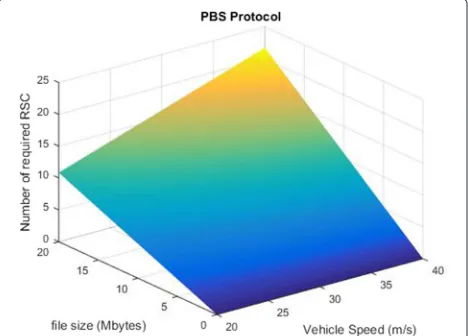
We further compare our protocol with existing scheme [4] which considers privacy, access control, and billing fea-tures. As noted in [4], PBS protocol requires 10 RSCs to complete forwarding a service of 20 Mbytes. However, in the same circumstances, the proposed protocol requires only 2 RSCs as shown in Figs. 2 and 3, respectively.
6.4 Communication overhead
In this section, we analyze the communication overhead of the proposed scheme. The sizes of the elements are 64× 2 = 128 bytes for pairing based operations and 20× 2 = 40 bytes for ECC-based elements [31]. The sizes of the general hash function’s output and time stamp are 20 and 4 bytes, respectively. Compared to [4], the proposed protocol offers lower communication overhead
Fig. 2Required number of RSCs for PBS [4]
Fig. 3Required number of RSCs for proposed protocol
since PBS [4] is build based on expensive pairing opera-tions. The total message size is 70 bytes for the proposed protocol in which we consider that the access structure contains 5 nodes (I= 5).
6.5 Simulation
Additionally, we evaluate the performance of the pro-posed protocol through simulation. We used VANET-SIM simulator for vehicle mobility coupled with ns-3 simulator for network simulation [32]. We further set our scenario based on the IEEE 802.11p VANET platform range which is 2.56 Mbps in highly populated street such as high-ways that use DSRC, to a maximum transmission range of 6 Mbps. We consider a city scenario with a map down-loaded from OpenStreepMap database [33] with a random speed for the vehicles ranging from 10 to 40 m/s (36– 144 km/hr). The details of the simulation are shown in Table 4. The average overall delay (denotedAvD) is defined
as:
whereNReqV is the number of vehicles requesting for SP’s
services andNRSCis the number of roadside clouds.TvSendi is the time at whichvisends a request to RSCjandTvReci v is the time at whichvireceives a response from RSCj. The
average loss ratio denoted asAvLossis defined as follows:
AvLoss=
whereNSvReci vis the number of service files received byvi
Table 4Simulation settings
Tools/parameter Value/specification
Mobility generation tool VANETSIM 2.02
Network simulation tool ns-3
Trans range 6 MBps
Number -of -vehicle 100
Simulation time 200 min
Wireless protocol 802.11a
Departure interval 200 min
RSU radius 600 m
Mobility model shortest path
Message size for [4] 109 bytes
Message size for proposed 70 bytes
RSCj andNSSendRSCj is the number of service files sent by
RSCjtovi.
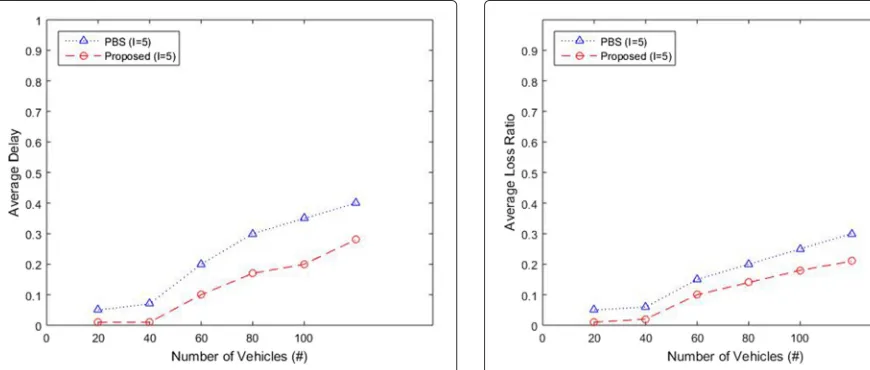
We investigate the effect of the number of vehicles on the average delay. As described in [4], we consider 100 vehicles with a probability of launching a SP’s service request equals to 0.5(η=0.5). The number of attributes of each access structure ATjis set to 5 (I=5). The
aver-age delay based on the vehicle’s density is around 0.39 for 100 vehicles for PBS [4] whereas it is 0.21 for the proposed protocol as depicted in Fig. 4. This occurs due to the time whichvihas to wait before it receives an SP’s service which
depends on the verification and regeneration of E-voucher as shown in Table 3. In Fig. 5, the proposed protocol per-forms better when we investigate the average delay based on the speed of vehicles. For a normal speed ranging from 10 to 35 m/s, the average delay is 0.35 for the PBS [4] and 0.11 for the proposed protocol.
When we study the impact of vehicle’s density on the average loss ratio, the proposed protocol performs better
Fig. 4Impact of vehicle density on average delay
Fig. 5Impact of vehicle speed on average delay
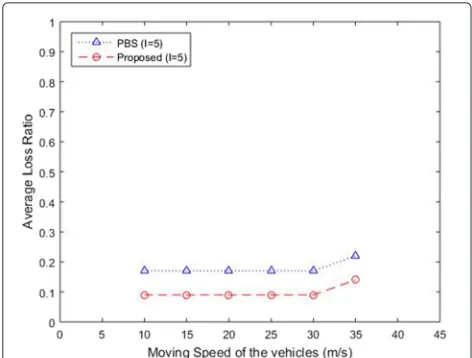
with 0.18 for 100 vehicles compared to PBS [4] with 0.25 for the same settings as shown in Fig. 6. We further inves-tigate the impact of vehicle’s moving speed on the average loss ratio. As shown in Fig. 7, the loss ratio is 0.19 for vehicles moving from 10 to 30 m/s in PBS protocol [4] whereas it is 0.09 for the proposed protocol in the same conditions.
7 Conclusions
In this paper, we proposed a secure billing protocol over attribute-based encryption in vehicular cloud computing. We used pseudonym techniques to achieve the iden-tity privacy of the vehicles and their requested services. Certificateless signature scheme is applied to assure the authentication of legitimate vehicles which can enjoy the provided services. We adopted ABE to guarantee rigorous access control based on the purchased access structure.
Fig. 7Impact of vehicle speed on average loss ratio
We used hash chain technique to provide authorization property through electronic voucher which a vehicle has to possess before enjoying any giving service. Security analysis and experimental results based on transmission overhead, average delay, and average loss ratio are pro-vided. Compared to relevant existing work under the same scenario, the proposed protocol achieves efficient billing features with less computational overhead for vehicular cloud computing.
In the future, we will continue to investigate on revo-cation technique based on the updating of the access structure rather than the vehicle’s identity-based revoca-tion.
Acknowledgements
This work was supported by the National Research Foundation of Korea(NRF) grant funded by the Korea government(MSIP) (No.
NRF-2014R1A2A1A11052981).
Competing interests
The authors declare that they have no competing interests.
Received: 1 April 2016 Accepted: 9 August 2016
References
1. C-T Li, M-S Hwang, Y-P Chu, A secure and efficient communication scheme with authenticated key establishment and privacy preserving for vehicular ad hoc networks. Comput. Commun.31(12), 2803–2814 (2008) 2. M Whaiduzzaman, M Sookhak, A Gani, R Buyya, A survey on vehicular
cloud computing. J. Netw. Comput. Appl.40, 325–344 (2014)
3. G Yan, D Wen, S Olariu, MC Weigle, Security challenges in vehicular cloud computing. Intell. Transportation Syst. IEEE Trans.14(1), 284–294 (2013) 4. L-Y Yeh, J-L Huang, Pbs: a portable billing scheme with fine-grained
access control for service-oriented vehicular networks. Mobile Comput. IEEE Trans.13(11), 2606–2619 (2014)
5. L-Y Yeh, Y-C Chen, J-L Huang, Abacs: an attribute-based access control system for emergency services over vehicular ad hoc networks. Selected Areas Commun. IEEE J.29(3), 630–643 (2011)
6. L Nkenyereye, BA Tama, Y Park, KH Rhee, A fine-grained privacy preserving protocol over attribute based access control for vanets. J. Wireless Mobile Netw. Ubiquitous Comput. Dependable Appl.6(2), 98–112 (2015)
7. L-Y Yeh, Y-C Lin, A proxy-based authentication and billing scheme with incentive-aware multihop forwarding for vehicular networks. Intell. Transportation Syst. IEEE Trans.15(4), 1607–1621 (2014)
8. W Cho, Y Park, C Sur, KH Rhee, An improved privacy-preserving navigation protocol in vanets. J. Wireless Mobile Netw. Ubiquitous Comput. Dependable Appl.4(4), 80–92 (2013)
9. D He, J Chen, R Zhang, An efficient and provably-secure certificateless signature scheme without bilinear pairings. Int. J. Commun. Syst.25(11), 1432–1442 (2012)
10. X Yao, Z Chen, Y Tian, A lightweight attribute-based encryption scheme for the internet of things. Future Gen. Comput. Syst.49, 104–112 (2015) 11. Y Liu, L Hu, H Liu, Using an efficient hash chain and delaying function to improve an e-lottery scheme. Int. J. Comput. Math.84(7), 967–970 (2007) 12. M Altayeb, I Mahgoub, A survey of vehicular ad hoc networks routing
protocols. Int. J. Innov. Appl. Stud.3(3), 829–846 (2013)
13. SA Mohammad, A Rasheed, A Qayyum, inCommunication Technologies for Vehicles. VANET architectures and protocol stacks: a survey (Springer, 2011), pp. 95–105. http://link.springer.com/chapter/10.1007%2F978-3-642-19786-4_9
14. JB Kenney, Dedicated short-range communications (dsrc) standards in the united states. Proc. IEEE.99(7), 1162–1182 (2011)
15. R Yu, Y Zhang, S Gjessing, W Xia, K Yang, Toward cloud-based vehicular networks with efficient resource management. Netw. IEEE.27(5), 48–55 (2013)
16. S Olariu, I Khalil, M Abuelela, Taking VANET to the clouds. Int. J. Pervasive Comput. Commun.7(1), 7–21 (2011)
17. M Eltoweissy, S Olariu, M Younis, inAd Hoc Networks. Towards autonomous vehicular clouds (Springer, 2010), pp. 1–16. http://link. springer.com/chapter/10.1007/978-3-642-17994-5_1
18. R Hussain, Cooperation-aware vanet clouds: providing secure cloud services to vehicular ad hoc networks. J. Inform. Process. Syst.10(1), 103–118 (2014) 19. E Lee, E-K Lee, M Gerla, SY Oh, Vehicular cloud networking: architecture
and design principles. Commun. Mag. IEEE.52(2), 148–155 (2014) 20. S Olariu, T Hristov, G Yan, inMobile ad hoc networking: cutting edge
directions. 2nd ed.The next paradigm shift: from vehicular networks to vehicular clouds (John Wiley & Sons, Inc., Hoboken, NJ, USA, 2013) 21. JK Lee, YS Jeong, JH Park, s-itsf: a service based intelligent transportation
system framework for smart accident management. Human-centric Comput. Inform. Sci.5(1), 1–9 (2015)
22. Y Chen, R Sion, B Carbunar, inProceedings of the 8th ACM Workshop on Privacy in the Electronic Society. Xpay: practical anonymous payments for tor routing and other networked services (ACM, 2009), pp. 41–50. http:// dl.acm.org/citation.cfm?id=1655195
23. A Herzberg, H Yochai, Minipay: charging per click on the web. Comput. Netw. ISDN Syst.29(8), 939–951 (1997)
24. GO Karame, A Francillon, S ˇCapkun, inProceedings of the 20th International Conference on World Wide Web. Pay as you browse: microcomputations as micropayments in web-based services (ACM, 2011), pp. 307–316. http:// dl.acm.org/citation.cfm?id=1963451
25. H Zhu, X Lin, R Lu, P-H Ho, X Shen, Slab: A secure localized authentication and billing scheme for wireless mesh networks. Wireless Commun. IEEE Trans.7(10), 3858–3868 (2008)
26. H-Y Lee, Y-B Lin, et al., Credit pre-reservation mechanism for umts prepaid service. IEEE Trans. Wireless Commun.9(6), 1867–1873 (2010)
27. R Lu, X Lin, H Zhu, P-H Ho, X Shen, A novel anonymous mutual authentication protocol with provable link-layer location privacy. Vehic. Technol. IEEE Trans.58(3), 1454–1466 (2009)
28. A Miyaji, M Nakabayashi, S Takano, New explicit conditions of elliptic curve traces for fr-reduction. IEICE Trans. Fundamentals Electron. Commun. Comput. Sci.84(5), 1234–1243 (2001)
29. L Zhang, N Seta, H Miyajima, H Hayashi, inWireless Communications and Networking Conference, 2007. WCNC 2007. IEEE. Fast authentication based on heuristic movement prediction for seamless handover in wireless access environment (IEEE, 2007), pp. 2889–2893. http://ieeexplore.ieee. org/xpl/login.jsp?tp=&arnumber=4224780&url=http%3A%2F
%2Fieeexplore.ieee.org%2Fxpls%2Fabs_all.jsp%3Farnumber%3D4224780 30. Y Qian, K Lu, N Moayeri, inGlobal Telecommunications Conference, 2008.
31. D He, S Zeadally, B Xu, X Huang, An efficient identity-based conditional privacy-preserving authentication scheme for vehicular ad hoc networks. Inform. Forensics Secur. IEEE Trans.10(12), 2681–2691 (2015)
32. A Festag, P Papadimitratos, T Tielert, Design and performance of secure geocast for vehicular communication. Vehic. Technol. IEEE Trans.59(5), 2456–2471 (2010)
33. M Haklay, P Weber, Openstreetmap: user-generated street maps. Pervasive Comput. IEEE.7(4), 12–18 (2008)
Submit your manuscript to a
journal and benefi t from:
7 Convenient online submission 7 Rigorous peer review
7 Immediate publication on acceptance 7 Open access: articles freely available online 7 High visibility within the fi eld
7 Retaining the copyright to your article