Cite as: Can Urol Assoc J 2018;12(1):E25-30. http://dx.doi.org/10.5489/cuaj.4515
Published online December 1, 2017
Abstract
Introduction: Inflammation of the prostate can be a cause of ele-vated prostate-specific antigen (PSA) in men referred for suspected prostate cancer. This systematic review assesses the evidence for antibiotic therapy in patients with type IV (asymptomatic) prostatitis with regard to reduction of PSA levels and discrimination between prostate cancer and inflammation.
Methods: MEDLINE, EMBASE, and the Cochrane registry were searched for papers reporting on cohorts of men with elevated PSA and type IV prostatitis that were treated with antibiotics. Results: The search yielded 160 papers, of which 11 met the inclu-sion criteria: two randomized trials and nine cohort studies. In total, the studies reported on 1011 patients with type IV prostatitis, of whom 926 were treated with antibiotics. PSA normalization was seen after antibiotic treatment in 33.2% of patients (95% confi-dence interval [CI] 24.9‒42.8). Meta-analysis of the randomized trials did not demonstrate a higher likelihood of PSA normalization in the antibiotics arm as compared to the control arm (odds ratio [OR] 1.27; 95% CI 0.58–2.76; p=0.553). Four studies performed prostate biopsies in all patients. Although three of these studies demonstrated lower prevalence of prostate cancer in patients in whom PSA had normalized, meta-analysis failed to show a statistic-ally significant difference (OR 0.39; 95% CI 0.06–2.49; p=0.319). Conclusions: The available evidence does not support antibiotic therapy for differentiation between benign and malignant cause of elevated PSA in men with type IV prostatitis.
Introduction
Inflammation of the prostate can be a cause of elevated prostate specific antigen (PSA) in men referred for suspected prostate cancer. In the presence of symptoms of acute bacterial pros-tatitis or recurrent urinary tract infections, antibiotic therapy is clearly indicated. There is, however, a group of patients with inflammation of the prostate without symptoms or urinary tract
infections: NIH type IV prostatitis.1 The European Association of Urology (EAU) guidelines for urological infections present antibiotics as an effective method to lower PSA in men with type IV prostatitis,2 citing a single paper.3 It remains unclear whether other studies support this practice.
Several randomized trials have allocated all asymptomat-ic men with an elevated PSA to a course of antimasymptomat-icrobial therapy. These trials were summarized by Yang et al,4 who demonstrated that there was no difference in the propor-tion of patients with responsive PSA. Furthermore, patients with responsive PSA in the antibiotics group were not less likely to have prostate cancer than those with spontaneously decreased PSA in the control group.
The abovementioned studies, by design, included a large number of men without prostatitis. Therefore, a posi-tive effect of antibiotics in men with type IV prostatitis may have been obscured. A number of investigators have assessed the effect of antibiotics specifically in patients with leucocytosis in expressed prostate secretion (EPS), post-prostate massage voided urine (VB3), or histologically proven asymptomatic prostatitis.
The aim of this study was to systematically review the evidence for antibiotic therapy in patients with type IV pros-tatitis with regard to reduction of PSA levels and discrimina-tion between prostate cancer and inflammadiscrimina-tion only.
Methods
Search strategy
A systematic literature search was conducted of the Medline, EMBASE, and Cochrane Clinical Trials database up to April 20, 2016. Results were limited to English language papers.
Medline and EMBASE were searched using the following query:
- Prostatitis OR prostate inflammation
- AND prostate-specific antigen OR PSA
- AND antibiotic OR antibiotics OR anti-microbial
Karel T. Buddingh, MD
1; Marlies G.F. Maatje, MD
2; Hein Putter, MD
1; René F. Kropman, MD
2; Rob C.M. Pelger, MD
11Department of Urology, Leiden University Medical Centre, Leiden; 2Department of Urology, HagaZiekenhuis, The Hague; Netherlands
Subsequently, the reference lists of the included papers were searched for any further relevant articles.
As part of the publication bias analysis, the International Clinical Trials Registry Platform (ICTRP) was searched for any relevant trials.
Inclusion criteria
Articles were identified that reported on a cohort of men with NIH type IV prostatitis (confirmed either by laboratory results or histopathology results) that was treated with any form of antibiotics. Papers were included if they reported followup PSA levels and/or outcome of prostate biopsy after treatment with antibiotics.
Outcome parameters
Outcome parameters included:
- Decrease in PSA in patients who were or were not treated with antibiotics
- Outcome of prostate biopsy in patients who had or had not exhibited a decline in PSA level
Data extraction and statistical analysis
Data were extracted from the selected studies by two of the authors independently (KTB and MM). When necessary, dif-ferences in interpretation were resolved by a third author (RP).
Statistical analysis was performed in R.5 Meta-analysis was performed. Calculation of effect sizes with 95% confidence intervals (CI) was accomplished by using inverse variance weighting. Between-study heterogeneity was assessed with the χ2 test for heterogeneity. Data with significant hetero-geneity (<5%) were pooled using a random-effects model; data without significant heterogeneity were pooled using a fixed effects model.6 Forest plots were generated for graphi-cal presentation of the outcomes. Funnel plots to assess for study bias were not deemed useful, as the number of studies in each analysis was too small.7
Quality of studies was assessed using the NHLBI tool for Quality Assessment of Observational Cohort and Cross-sectional Studies and Quality Assessment of Controlled Intervention Studies where applicable.8
Results
Search
The primary search yielded 160 papers. After examining titles and abstracts, 130 papers could be excluded (for inclusion flowchart, see Supplementary Fig. 1). Full texts of the remain-ing 30 papers were examined. A further 19 were excluded
for not meeting the inclusion criteria (17 papers) or because only abstracts of the studies were published (two papers). Examination of the reference lists of the 11 included papers3,9-18 did not yield further studies that met the inclusion criteria.
The search of the International Clinical Trials Registry Platform did not reveal any studies that met the inclusion criteria.
Study characteristics
Study characteristics are shown in Table 1. Two studies were randomized, controlled trials that assessed the effect of anti-biotics vs. placebo or no treatment in men with type IV pros-tatitis.16,18 The rest were prospective or retrospective cohort studies without a control group. Most studies diagnosed type IV prostatitis by white blood cell (WBC) count in EPS or VB3; one investigated patients with histologically proven type IV prostatitis upon biopsy.9 Fluoroquinolones were given in all but one study;15 duration of treatment ranged between 2‒8 weeks. In total, the studies reported on 1011 patients with type IV prostatitis, of whom 926 were treated with antibiotics.
Quality of studies
Quality of studies was assessed using aforementioned NHLBI tools. Most cohort studies were rated “good quality;”9-15 two were rated “fair quality;”3,17 The two randomized, controlled trials were rated as “good quality”16 and “fair quality.” 18
Decrease in PSA
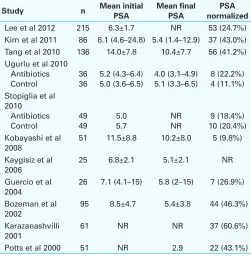
Initial and final PSA levels were reported in seven studies (Table 2). In the antibiotics group, the mean PSA decreased in all studies, with mean decrease ranging from 1.2‒3.6 ng/ mL. The only study to report on PSA levels in the control group found a decrease in PSA from 5.2 to 4.0 ng/mL in the antibiotics group (levofloxacin 500 mg once daily for four weeks) and no decrease in the control group (p<0.001).18
The proportion of patients with normalization of PSA lev-els was reported by all but one study. The pooled average percentage of patients with normalized PSA after antibiotic treatment was 33.2% (95% CI 24.9‒42.8%).
A pooled analysis of the two randomized trials16,18 yielded an odds ratio (OR) for normalization of PSA of 1.27 (95% CI 0.58–2.76; p=0.553) (Fig. 1A).
Result of prostate biopsies
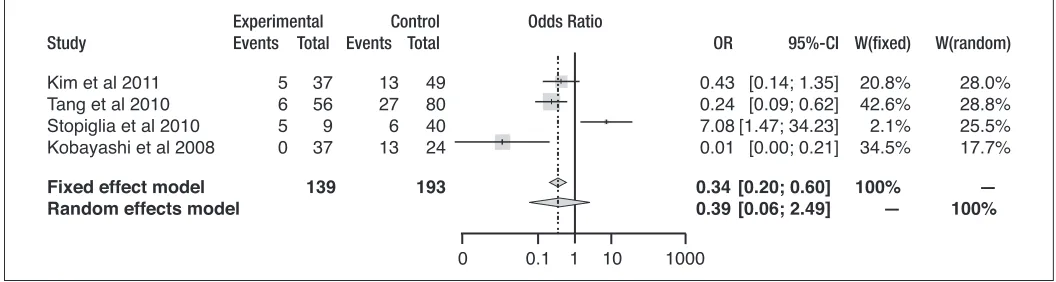
effect did not reach statistical significance (OR 0.39; 95% CI 0.06–2.49; p=0.319) (Fig. 1B).
Discussion
This is the first systematic review to assess the effect of anti-biotics specifically in men with type IV prostatitis. In all the included studies, men treated with antibiotics exhibited a decrease in PSA; however, lack of control groups in most stud-ies makes it impossible to conclude that this decrease in PSA can be attributed to antibiotics. Meta-analysis of the available randomized trials did not demonstrate superiority of antibiotic treatment above no treatment for normalization of PSA.
Previous meta-analysis focused on antibiotic treatment of all men with elevated PSA.4 No significant difference could be demonstrated between the antibiotic group and the control group in terms of normalization of PSA. The current systemat-ic review addresses the same question in men with biochemi-cally or histologibiochemi-cally proven inflammation of the prostate.
This review focuses solely on men with asymptomatic (type IV) prostatitis; however, none of the included studies administered a standardized questionnaire (such as the NIH-Chronic Prostatitis Symptom Index) to rule out a type III pros-tatitis. In most papers, clinical assessment, including digital rectal exam, was used to qualify patients as asymptomatic. As such, the patient group may have been confounded by men with unrecognized type III chronic prostatitis.
As most studies in this systematic review did not include a control group, it is possible that factors other than antibi-Table 1. Study characteristics
Study n Type of study Inclusion criteria Method for diagnosing
inflammation Antibiotic regimen Lee et al 2012 215 Prospective cohort
study
PSA 4–10 Normal DRE
WBC>10 in EPS or VB3 Levofloxacine 100 mg 3x/ day for 8 weeks Kim et al 2011 86 Prospective cohort
study
PSA 4–10 Normal DRE
WBC>10 in EPS Ciprofloxacin 500 mg/day for 4 weeks Tang et al 2010 136 Retrospective
cohort study
PSA 4–50 Normal DRE
WBC>10 in EPS Levofloxacine 500 mg 1x/ day for 2 weeks Ugurlu et al 2010 72 Randomized
controlled trial
PSA 2.5–10 Normal DRE
WBC>10 in EPS Levofloxacin 500 mg 1x/ day for 4 weeks Stopiglia et al 2010 98 Randomized
controlled trial
PSA 2.5–10 Normal DRE
WBC>20 in EPS OR>10 in VB3
Ciprofloxacin 500 mg 2x/ day for 4 weeks Kobayashi et al 2008 51 Retrospective
cohort study
PSA >4 rising and falling Normal DRE
WBC>10 in VB3 Levoflocacin 300 mg 1x/ day
Kaygisiz et al 2006 25 Prospective cohort study
PSA 4–10 Normal DRE
WBC>10 in EPS Ofloxacin 400mg 1x/day for 3 weeks Guercio et al 2004 26 Retrospective
cohort study
PSA>4 Inflammation upon first biopsy
Levofloxacin 500 mg 1x/ day for 3 weeks Bozeman et al 2002 95 Retrospective
cohort study
PSA 4–25 Normal DRE
WBC>10 in EPS Quinolone, trimethoprim-sulfamethoxazole or doxycycline for 4 weeks Karazanashvili et al
2001
61 Retrospective cohort study
PSA 4–10 Normal DRE
WBC>10 in EPS Ofloxacin 400 mg 2x/day for 2 weeks
Potts 2000 51 Retrospective
cohort study
PSA>4 WBC>10 in EPS or>20 in VB3
Trimethoprim sulfa-methoxazole for 4 weeks EPS: expressed prostatic secretion; DRE: digital rectal exam; PSA: prostate-specific antigen; VB3: voided bladder urine; WBC: white blood cell count.
Table 2. Reduction in PSA in antibiotics group and control group
Study n Mean initial
PSA Tang et al 2010 136 14.0±7.8 10.4±7.7 56 (41.2%) Ugurlu et al 2010
Antibiotics Stopiglia et al
2010 Kobayashi et al
2008
51 11.5±8.8 10.2±8.0 5 (9.8%)
Kaygisiz et al 2006
25 6.8±2.1 5.1±2.1 NR
Guercio et al 2004
26 7.1 (4.1–15) 5.8 (2–15) 7 (26.9%)
Bozeman et al 2002
95 8.5±4.7 5.4±3.8 44 (46.3%)
Karazanashvilli 2001
61 NR NR 37 (60.6%)
Potts et al 2000 51 NR 2.9 22 (43.1%)
otic therapy may have played a role in the decrease in PSA. One such factor could be natural fluctuation.19 Theoretically, men who are referred for evaluation when their PSA is at a high point in their natural fluctuation will show regression to the mean in time.
In order for antibiotics to have an effect on prostate inflam-mation, bacterial micro-organisms have to play an active role in the inflammation. Most studies in this systematic review do not report routine cultures of EPS or VB3 urine. Karazanashvili et al report 15% positive culture rate.10 Kaygisiz et al found 20% positive cultures.11 Potts et al report 36% positive cul-tures.15 It could be hypothesized that any effect of antibiotics would be limited to the subgroup of patients with positive cultures; however, Potts et al found that positive culture was not a predictor of response to antibiotics.15
Different types of histological prostatic inflammation have been described, and a consensus classification was pub-lished in 2001.20 The system grades inflammation by ana-tomical location (glandular, periglandular, or stromal), extent (focal, multifocal, or diffuse), and grade (mild, moderate, or severe). It remains to be seen whether the proposed clas-sification corresponds with outcome in terms of symptoms or PSA. Correlation between positive EPS and histological prostatitis is reported to be fair to poor.11,13 Whether data of EPS-proven prostatic inflammation and biopsy-proven
prostatitis should be combined may, therefore, be subject to debate. Inflammation upon first biopsy reduces the odds of prostate cancer in repeat biopsies,21 presumably reflecting an elevated PSA as a result of inflammation. Only one of the included studies included men based upon biopsy results; therefore, the outcome of this review mainly reflects findings in men with EPS-proven prostatitis.
Any systematic review is limited by the quality of the available studies. The most important limitation is that most studies were retrospective and did not include a control group (i.e., men with type IV prostatitis that were treated with placebo or no treatment). Two of the papers found in the initial search were excluded, as they were published as conference abstracts only. The quality of abstracts cannot be assessed in the same way as that of full publications. Many abstracts do not progress to full publications; in the studies that are published, there may be substantial abstract-to-publication discordance in data.22
Publication bias, if present in this review, is likely to favour studies that show a positive effect of antibiotics on PSA. This could be the reason why most cohort studies report substantially higher rates of PSA normalization than the ran-domized trials. A search of the International Clinical Trials Registry Platform revealed no non-published studies that met the inclusion criteria and thus no further evidence of
Experimental Control Odds Ratio
Study Events Total Events Total OR 95%-CI W(fixed) W(random)
Kim et al 2011 5 37 13 49 0.43 [0.14; 1.35] 20.8% 28.0%
Tang et al 2010 6 56 27 80 0.24 [0.09; 0.62] 42.6% 28.8%
Stopiglia et al 2010 5 9 6 40 7.08 [1.47; 34.23] 2.1% 25.5%
Kobayashi et al 2008 0 37 13 24 0.01 [0.00; 0.21] 34.5% 17.7%
Fixed effect model 139 193 0.34 [0.20; 0.60] 100% — Random effects model 0.39 [0.06; 2.49] — 100%
0 0.1 1 10 1000
Fig. 1B. Meta-analysis of four cohort studies. Odds ratio (OR) of finding prostate cancer in patients in whom prostate-specific antigen (PSA) normalized after antibiotic treatment vs. those with persistent elevated PSA. Left favours lower risk in patients with normalized PSA. Right favours higher risk in patients with normalized PSA. CI: confidence interval.
Experimental Control Odds Ratio
Study Events Total Events Total OR 95%-CI W(fixed) W(random)
Ugurlu et al 2010 8 36 4 36 2.29 [0.62; 8.41] 27.6% 40.2%
Stopiglia et al 2010 9 49 10 49 0.88 [0.32; 2.39] 72.4% 59.8%
Fixed effect model 85 85 1.27 [0.58; 2.76] 100% — Random effects model 1.29 [0.51; 3.24] — 100%
0.2 0.5 1 2 5
publication bias. A formal assessment by means of funnel plot was deemed inappropriate because of too few studies.7
Any beneficial effect of antibiotics, or lack thereof, should be weighed against the possible side effects of prolonged therapy with quinolones. Although they are generally well-tolerated, side effects range from frequent and mild, such as diarrhoea and vomiting, to rare but severe, such as tendon ruptures and arrhythmia.23 Furthermore, resistance to oral antibiotics, especially fluoroquinolones is an important fac-tor leading to post-prostate biopsy sepsis.24
The EAU guidelines on urological infections2 recommend the use of antibiotics in patients with evidence of prostatic inflammation, referring to the paper by Bozeman et al.3 It is apparent from this review that this may be an oversimplifica-tion of the clinical problem and that this recommendaoversimplifica-tion may need to be nuanced.
Conclusion
This systematic review demonstrates that patients with type IV prostatitis treated with antibiotics exhibit a decrease in PSA. Due to a paucity of controlled studies, however, there is no evidence that the reduction of PSA is causally related to the antibiotic regimen. More importantly, meta-analysis of the two available randomized trials did not reveal any dif-ference in in PSA levels treated with or without antibiotics. Therefore, the available evidence does not support antibiotic therapy for differentiation between patients with and without prostate cancer. Physicians should be aware of the limited evidence when considering antibiotic therapy in patients with type IV prostatitis.
Competing interests: The authors report no competing personal or financial interests.
This paper has been peer-reviewed.
References
1. Nickel JC. Prostatitis. Can Urol Assoc J 2011;5:306-15. https://doi.org/10.5489/cuaj.11211 2. Grabe M, Bartoletti R, Bjerklund Johansen TE, et al. EAU guidelines on urological infections 2015.
Available at https://uroweb.org/wp-content/uploads/19-Urological-infections_LR2.pdf. Accessed December 5, 2017.
3. Bozeman CB, Carver BS, Eastham JA, et al. Treatment of chronic prostatitis lowers serum prostate-specific antigen. J Urol 2002;167:1723-6. https://doi.org/10.1016/S0022-5347(05)65186-5 4. Yang L, Zhu Y, Tang Z, et al. Antibiotics may not decrease prostate-specific antigen levels or prevent
unnecessary prostate biopsy in patients with moderately increased prostate-specific antigen levels: A meta-analysis. Urol Oncol 2015;33: 201e217-24. https://doi.org/10.1016/j.urolonc.2015.02.001 5. The R Project. A language and environment for statistical computing (2010). Available at
http://www.R-project.org. Accessed December 5, 2017.
6. Riley RD, Higgins JP, Deeks JJ. Interpretation of random effects meta-analyses. BMJ 2011;342:d549. https://doi.org/10.1136/bmj.d549
7. Song F, Khan KS, Dinnes J, et al. Asymmetric funnel plots and publication bias in meta-analyses of diagnostic accuracy. Int J Epidemiol 2002;31:88-95. https://doi.org/10.1093/ije/31.1.88
8. National Heart, Lung, and Blood Institute. Tools for quality assessment. Available at www.nhlbi.nih.gov. Accessed October 1, 2016.
9. Guercio S, Terrone C, Tarabuzzi R, et al. PSA decrease after levofloxacin therapy in patients with histological prostatitis. Arch Ital Urol Androl 2004;76:154-8.
10. Karazanashvili G, Managadze L. Prostate-specific antigen (PSA) value change after antibacterial therapy of prostate inflammation, as a diagnostic method for prostate cancer screening in cases of PSA value within 4‒10 ng/ml and non-suspicious results of digital rectal examination. Eur Urol 20001; 39:538-43. https://doi.org/10.1159/000052500
11. Kaygisiz O, U‒urlu O, Ko‒an M, et al. Effects of antibacterial therapy on PSA change in the presence and absence of prostatic inflammation in patients with PSA levels between 4 and 10 ng/ml. Prostate Cancer Prostatic Dis 2006;9:235-8. https://doi.org/10.1038/sj.pcan.4500885
12. Kim YJ, Kim S-O, Ryu KH, et al. Prostate cancer can be detected even in patients with decreased PSA less than 2.5 ng/ml after treatment of chronic prostatitis. Kor J Urol 2011;52:457-60. https://doi.org/10.4111/kju.2011.52.7.457
13. Kobayashi M, Nukui A, Morita T. Serum PSA and percent free PSA value changes after antibiotic treatment: A diagnostic method in prostate cancer suspects with asymptomatic prostatitis. Urol Int 2008;80:186-92. https://doi.org/10.1159/000112612
14. Lee AG, Choi YH, Cho SY, et al. A prospective study of reducing unnecessary prostate biopsy in patients with high serum prostate-specific antigen with consideration of prostatic inflammation. Kor J Urol 2012;53:50-53. https://doi.org/10.4111/kju.2012.2012;53:50-53.1.50
15. Potts JM. Prospective identification of National Institutes of Health category IV prostatitis in men with elevated prostate-specific antigen. J Urol 2000;164:1550-3. https://doi.org/10.1016/S0022-5347(05)67026-7
16. Stopiglia RM, Ferreira U, Silva MM Jr, et al. Prostate-specific antigen decrease and prostate cancer diagnosis: Antibiotic vs. placebo prospective, randomized clinical trial. J Urol 2010;183:940-4. https://doi.org/10.1016/j.juro.2009.11.044
17. Tang P, Xie KJ, Wang B, et al. Antibacterial therapy improves the effectiveness of prostate cancer detection using prostate-specific antigen in patients with asymptomatic prostatitis. Int Urology Nephrol 2010;42:13-8. https://doi.org/10.1007/s11255-009-9598-x
18. Ugurlu O, Yaris M, Oztekin CV,et al. Impacts of antibiotic and anti-inflammatory therapies on serum prostate-specific antigen levels in the presence of prostatic inflammation: A prospective, randomized controlled trial. Urol Int 2010; 84:185-90. https://doi.org/10.1159/000277596
19. Komatsu K, Wehner N, Prestigiacomo AF, et al. Physiologic (intraindividual) variation of serum prostate-specific antigen in 814 men from a screening population. Urology 1996;47:343-6. https://doi.org/10.1016/S0090-4295(99)80450-6
20. Nickel JC, True LD, Krieger JN, et al. Consensus development of a histopathological classification system for chronic prostatic inflammation. BJU Int 2001;87:797-805. https://doi.org/10.1046/j.1464-410x.2001.02193.x
21. Moreira DM, Nickel JC, Gerber L, et al. Baseline prostate inflammation is associated with a reduced risk of prostate cancer in men undergoing repeat prostate biopsy: Results from the REDUCE study. Cancer
2014;120:190-6. https://doi.org/10.1002/cncr.28349
22. Scherer RW, Langenberg P, von Elm E. Full publication of results initially presented in abstracts. Cochrane Database Syst Rev 2007; MR000005. https://doi.org/10.1002/14651858.MR000005.pub3 23. Owens RC Jr, Ambrose PG. Antimicrobial safety: Focus on fluoroquinolones. Clin Infect Dis
2005;41:S144-57. https://doi.org/10.1086/428055
24. van der Wielen GJ, van Rossum-Arguedas Flores OE, Bellaar Spruyt JA, et al. [Antibiotic treatment of infectious complications and urosepsis after transrectal prostate biopsy or gold marker implantation].
Tijdschrift voor Urologie 2014;6:134-8. https://doi.org/10.1007/s13629-014-0069-5
Initial search
160 abstracts
30 full texts
Review of 11 reference lists
11 papers included
Excluded - 44 double results
- 37 concerning (preventing) post-biopsy prostatitis - 25 symptomatic prostatitis - 20 reviews/comments/
surveys - 6 case reports - 6 no treatment with
antibiotics - 3 other reasons
- 17 did not meet inclusion criteria
- 2 were published as abstracts only
Supplementary Fig. 1. Search flow chart.
Supplementary Table 1. Outcome of prostate biopsy in patients with and without normalization of PSA
Study protocolBiopsy
Prostate cancer detection in patients with
normalized PSA
Prostate cancer in patients with
persistent elevated PSA Kim et al 2011 All patients 5/37 (13.5%) 13/49 (26.5%) Tang et al 2010 All patients 6/56 (10.7%) 27/80 (33.8%) Stopiglia et al 2010
Antibiotics
Control All patients
5/9 (55.6%) 3/10 (30%)
6/40 (15%) 14/39 (35.9%) Karazanashvilli et