MP-05.01
2015 Prize Essay Winner: Basic Science
Optimization of the current self-assembled urinary bladder model: Organ-specific stroma and smooth muscle inclusion
Orabi, Hazem1; Rousseau, Alexandre1; Bolduc, Stephane1 1Urology Department, Laval University, Quebec, QC, Canada
Introduction and Objectives: Urinary bladder is subjected to many
con-genital and acquired diseases requiring replacement. Bioengineered tissue is required for vesical reconstruction and in vitro modeling of patholo-gies. Self-assembly method of matrix formation using autologous cells can obviate the need for using non-native tissues or exogenous materials. We have previously developed a urinary bladder model composed of dermal fibroblasts and urothelial cells. We thought that stromal cells from vesical lamina propria would give rise to ECM with many characteristics similar to that of native urinary tissues. In this study, we aimed at creating ex-vivo, a urinary bladder tissue model obtained from the different cell types of urinary bladder.
Methods: Urothelial (UCs), bladder stromal (BSCs) and smooth muscle
cells (SMCs) were isolated from bladder biopsies using surgical and enzy-matic methods. Different cells were expanded and their phenotype was confirmed. BSCs were stimulated under influence of ascorbic acid to form collagen sheets in a 4 weeks period. Following this, SMCs and UCs were sequentially seeded. Bladder equivalents were collected and subjected to histological and functional studies. They were assessed by immunohisto-chemical and histoimmunohisto-chemical staining for cell identification, proliferation and morphology and for tissue architecture. Permeability and biomechanical tests were performed.
Results: BScs were able to form collagen sheets that could be handled
easily. UCs constituted a well-organized, differentiated epithelial layer as evidenced by positive staining for pancytokeratins. Markers for imperme-ability including uroplakins and E-cadherin were detected. A well-formed basement membrane was identified with laminin and collagen IV. SMCs markers were positive for smooth muscle actin, calponin and smoothelin. Permeability test for the reconstructed bladder equivalents were similar to those of native tissues.
Conclusions: Urinary tract specific stromal cells can give rise to
extracel-lular matrices with better physiological and mechanical characteristics than non-specific stromal cells. Our urinary equivalent is suitable as urethral graft either for onlay or tubular urethral replacement or as bladder model for disease modeling and pharmacotherapeutic testing.
MP-05.02
Laparoscopic IVC injury management training: Predicting techni-cal & non-technitechni-cal skills
Lee, Jason Y.1; Blankstein, Udi2; Hoang, Richard2; Ordon, Michael H.1;
Pace, Kenneth T.1
1Urology, St. Michael’s Hospital, University of Toronto, Toronto, ON,
Canada; 2Medicine, University of Toronto, Toronto, ON, Canada
Introduction: Major vascular injuries during laparoscopic surgery, though
rare, can lead to significant morbidity. Simulation-based team training (SBTT) provides an opportunity to experience rare OR crisis scenarios in a safe environment. We developed a unique SBTT lap IVC injury scenario and conducted an observational study to determine predictors of surgeon performance.
Methods: Urology residents from our institution were recruited to
par-ticipate in a SBTT lap nephrectomy exercise. Residents completed both a
demographic & multidimensional personality questionnaire (Big Five Index – BFI) and were instructed to play the role of staff urologist. A vasovagal response to pneumoperitoneum and an IVC injury event were scripted into the scenario, unbeknownst to trainees. Resident performance in managing these events was video-recorded. All scenarios ended upon either success-ful repair of IVC injury, decision to convert to open repair, or max blood loss (2.5L). Technical & non-technical skills (NOTSS) were assessed by expert lap surgeons using validated tools. The Chi-square, Mann-Whitney U, ANOVA, and Pearson & Spearman correlations were utilized as indicated for statistical analysis.
Results: Fifteen urology residents participated (10 Jr & 5 Sr). Mean EBL
was 1.98L and 5 residents were unable to complete the exercise safely. Sr residents had more lap nephrectomy experience (p<0.01) but were similar to Jr residents in prior SBTT experience and on baseline BFI personal-ity scores. Sr residents outperformed Jrs on both technical (15.1 vs. 9.9, p<0.01) and NOTSS performance (13.8 vs. 10.1, p=0.03). Technical score correlated with NOTTS score (p<0.01) while pass/fail rating correlated with technical performance (p<0.01), NOTSS score (p=0.02), and EBL (p<0.01). Only the conscientiousness dimension of the BFI correlated with techni-cal score (p=0.03) and pass/fail rating (p=0.04). Of the 4 NOTSS domains assessed, level of training correlated with situation awareness, decision-making & leadership scores but not with communication scores (p=0.09).
Conclusions: Resident level of training and lap experience correlated with
technical & non-technical performance during a simulated laparoscopic IVC injury scenario. Level of training alone does not seem to predict com-munication & teamwork skills.
MP-05.03
Optimal timing of expert feedback in a simulated flexible ure-teroscopy course
Lantz, Andrea G.1; Blankstein, Udi 3; Andrews, J. Matthew1; Honey, R. John
D.2; Ordon, Michael H.2; Pace, Kenneth T.2; Lee, Jason Y.2
1Urology, Dalhousie University, Halifax, NS, Canada; 2Urology, St.
Michael’s Hospital, University of Toronto, Toronto, ON, Canada; 3Medicine,
University of Toronto, Toronto, ON, Canada
Introduction and Objectives: A simulation-based training (SBT) curriculum
for flexible ureteroscopy (fURS) was developed for junior urology residents. The benefits of expert feedback during SBT are well understood, but the optimal timing is not known. The objective of this study was to determine if early expert feedback was any better than late feedback, in order to determine the optimal implementation of a fURS training program.
Methods: The SBT curriculum was designed for PGY1-3 urology residents at
the University of Toronto and Dalhousie University. This course included a didactic lecture focused on fundamental ureteroscopy principles and basic fURS techniques, a hands-on demonstration of fURS, and 3 independent practice sessions using the Cook® URS model. Participants were random-ized into two groups: early feedback (EF) and late feedback (LF). The EF group received expert feedback regarding their performance of a standard-ized fURS task before independent practice sessions, while the LF group engaged in independent practice prior to receiving feedback. Baseline pre- and post-course assessments of fURS skills were conducted using the same standardized fURS task. All performances were videorecorded then graded by 2 blinded experts using a validated assessment device.
Results: 15 residents participated in the study. The groups had similar
base-line fURS experience and pre-course fURS task performance. There was a significant difference in mean pre- and post-course task completion times
Poster Session 5: Education, Technology and Basic Science
overall (15.2 min vs. 9.1 min, p<0.001); however, there was no differ-ence in improvement between the 2 groups (p=0.884). Mean perfor-mance scores improved in both groups overall (18.2 vs. 24.2, p<0.001). The EF group had a statistically significant improvement in performance scores compared to the LF group (p=0.05). More residents achieved a “pass” rating in the EF group vs. the LF group (p=0.003). Most (73%) of residents reported they would prefer early feedback.
Conclusions: This study showed the SBT curriculum for fURS is effective
for short-term learning of technical skills amongst junior level urology residents. Early feedback resulted in marginally better overall scores and was preferred by residents.
MP-05.04
First Canadian experience with robotic single incision pyelo-plasty: A comparison with multi-incision technique
Law, Jeff1; Rowe, Neal E.1; Nastis, Sophia1; Luke, Patrick P.1 1Surgery, London Health Sciences Centre, London, ON, Canada
We wanted to compare the outcomes of single incision robotic laparo-scopic pyeloplasty vs. multi-incision pyeloplasty with the da Vinci robotic system. We reviewed all consecutive robotic pyeloplasties from Jan 2011-Nov 2014. A total of 27 procedurew were performed (13 single: 14 multi). Total duration of followup with 308 and 353 days in single and multiport groups (p = NS) and patient demographics were similar between groups. Mean operating time was similar (223 vs. 199 min (p =NS) as was hospital stay (75.9 hr vs. 93.2 hr (p - NS) between single and multi-port groups. Two patients in vthe multi-port arm had persistent obstruction vs. one in the single arm on nuclear renogram post-operatively, however only one patient in either arm required re-intervention. One complication occurred in each group and one addtional port was placed in 4 single port operations to faciliate the operation. We report the first Canadian experience of single port robotic pyeloplasty and the first North American experience with the Single Site device (IntuitiveTM). Overall, our single
port procedure is associated with similar operative times, success rates, times of hospitalization adn complications compared with multi-port sur-gery. Verifying these results with a larger cohort is required prior to wide adoption of this technique.
MP-05.05
Missing the mark: Current practices in teaching the male uro-genital examination to Canadian undergraduate medical students McAlpine, Kristen1; Steele, Stephen S.1,2
1School of Medicine, Queen’s University, Kingston, ON, Canada; 2Department of Urology, Queen’s University, Kingston, ON, Canada
Introduction and Objectives: The urogenital physical examination is
an important aspect of patient encounters in various clinical settings. Exposure to the urogenital examination is typically encountered by medical students during their preclinical undergraduate curriculum. Introductory clinical skills sessions are intended to be well supported to alleviate students’ anxiety when learning this sensitive physical exam. The techniques and resources each Canadian medical school uses to guide their undergraduate students through the urogenital examination has not been previously reported.
Methods: This study surveyed clinical skills program coordinators at all
English-speaking Canadian medical schools regarding their urogenital examination curriculum with an online questionnaire.
Results: A response rate of 100% was achieved providing information
on resources available to students, the faculty involved in clinical skills sessions as well as the manner in which students were evaluated in their undergraduate program. Surprisingly, over 1/3 of the English-speaking Canadian medical schools do not provide a structured setting where a urogenital examination is performed on a patient and not one formally readdresses the urogenital physical examination after the preclinical curriculum. Perhaps even more disconcerting, no formal evaluation is instituted at almost 50% of English-speaking Canadian medical schools.
Conclusions: To ensure medical students are confident and accurate in
performing a urogenital examination, it is essential that they be provided the proper resources, teaching and training. It is crucial as we progress
towards a competency based curriculum, that increased focus be placed on patient encounters in early and late clinical training years. Without this commitment by medical schools, we are doing a disservice not only to the medical students but to our patient population as well.
MP-05.06
Mapping a competency-based urology curriculum: Agreement (and discrepancies) in the Canadian national opinion
Rourke, Keith F.1; MacNeily, Andrew2
1Division of Urology, Department of Surgery, University of Alberta,
Edmonton, AB, Canada; 2Department of Urological Sciences, University
of British Columbia, Vancouver, BC, Canada
Introduction and Objectives: Urology residency training in Canada is
evolving from a time-based model to a competency-based curriculum. To develop this curriculum we need to define core surgical competencies for newly minted urologists. We aim to better define core surgical urology competencies and assess discrepancies in opinion nationally.
Methods: A online survey based on the current RCPSC objectives of
training in urology was designed and validated in July 2014. The survey consisted of questions on practice demographics, resident involvement, fellowship training, and 76 common urologic procedures. Between August-October 2014 all 536 practicing members of the CUA were asked to rate each procedure using a 5-point Likert scale based on the statement, “After completion of residency training in Canada a urologist should be proficient in”. A core procedure was defined as one for which there was
≥75% agreement. Descriptive statistics and non-parametric testing were used to summarize the findings.
Results: A total of 128 urologists completed the survey (25.8% response
rate) with representation across Canada. Respondents included 40.6% community and 59.4% academic urologists. The survey identified 8 pro-cedures with 100% agreement and a total of 30 “core” propro-cedures with
≥75% agreement. When comparing community and academic urolo-gists there was significant disagreement on 27 procedures including 11 “core” procedures most notably radical cystectomy (88.5% agreement vs. 67.1%; p=0.002), open pyeloplasty (84.6% vs. 65.8%; p=0.04), sim-ple prostatectomy (78.9% vs. 69.7%; p=0.027), perineal urethrostomy (80.8% vs. 67.1%; p=0.016), open radical prostatectomy (96.1% vs. 80.3%; p=0.007), and Boari flap (90.4% vs. 76.3%; p=0.004). In general community-based urologists tended to rate procedures as core more often than their academic counterparts. Regional, population, and fellowship related “core” discrepancies were also found for female urethral slings, TRUS biopsy, laparoscopic pyeloplasty, ESWL, radical urethrectomy, adrenalectomy, penile plication, PNL, testes biopsy, and endopyelotomy.
Conclusion: This national survey has provided consensus on 30
proce-dures that should comprise a core surgical curriculum in urology, how-ever, there are some key differences of opinion that must be considered.
MP-05.07
The importance of graphic literacy in patient-centered commu-nication
Nayak, Jasmir G.1; Hartzler, Andrea2; Izard, Jason P.3; Dalkin, Bruce L.1;
Gore, John L.1
1Urology, University of Washington, Seattle, WA, United States; 2Group
Health Research Institute, University of Washington, Seattle, WA, United States; 3Urology, Queen’s University, Kingston, ON, Canada
Objective: The use of graphics within clinical practice is an emerging
approach to facilitate efficient patient-centered communication. We sought to examine literacy level and comprehension of graphs designed to promote patient-provider communication following prostate cancer (PCa) treatment.
Methods: We assessed literacy using validated tools including: Rapid
their comprehension of QOL graphs, and relationships between patient literacy and QOL graph comprehension. Comparative statistics assessed for differences within and between groups. Statistical significance was designated as p<0.05.
Results: The mean age was 69, with 89% Caucasian, 79%
married/part-nered, and 74% completing college. College education was associated with significantly higher literacy scores (Mean REALM 99% vs. 91%, p=0.03; mean SNS 78% vs. 67%, p=0.005; mean GLS 83% vs. 73%, p=0.04) and with significantly higher comprehension among all graph for-mats (table: 93% vs. 72%, p=0.004; bar: 94% vs 70%, p=0.002; line: 91% vs. 77%, p=0.02). Compared with patients, providers trended toward higher graphic literacy (80% vs. 87%, p=0.07) and comprehension, but this varied by graph format (table: 89% vs. 99%, p=0.07; bar: 88% vs. 98%, p=0.05; line: 88% vs. 98%, p=0.009). There was no difference in numeracy scores between patients and providers (p=0.23). Patients’ graph comprehension was positively associated with their health literacy (r=0.16-0.46), numeracy (r=0.25-0.28), and graphic literacy (r=0.26-0.39).
Conclusions: Education level is significantly associated with graphic
lit-eracy and comprehension, yet comprehension varies among graph for-mats. These findings emphasize the importance of matching the literacy requirements of emerging graphic displays with the capabilities of patients and providers ensuring that all stakeholders can engage effectively in patient-centered.
MP-05.08
Mitochondria targeting hydrogen sulphide protects renal epi-thelial cells from hypoxia re-oxygenation injury
Aboalsamh, Ghaleb A.1,2; Lobb, Ian3; Saha, Manujendra3; Whiteman,
Matthew4; Luke, Patrick P.1; Sener, Alp1,3
1Urology, University of Western Ontario, London, ON, Canada; 2Surgery,
King Abdulaziz Medical City, Jeddah, Saudi Arabia; 3Microbiology,
University of Western Ontario, London, ON, Canada; 4Experimental
Therapeutics, University of Exeter Medical School, Exeter, United Kingdom
Introduction: Kidneys procured from donors after circulatory death (DCD)
often results in delayed graft function (DGF) in over 30% of recipients. DGF has been shown to increase morbidity and worsen short and long term graft survivals. Hydrogen sulphide (H2S), has been shown to have many physiological effects including a significant protective effect on renal transplantation induced IRI, at least in animal models. Although several H2S donor molecules are in existence, many have significant systemic effects, thus potentially precluding them from clinic use. Given the importance of mitochondria in the control of cell death, our objective was to determine if a newly derived mitochondrial targeting H2S donor molecule (AP39) would be more efficacious in protecting porcine kidney tubular epithelial cells (LCC-PK1) against IRI compared to the commonly used H2S donor (GYY 4137). We hypothesized that AP39 would be more efficacious than GYY4137.
Methods: LCC-PK1 were exposed to warm ischemic stress (Glucose and
nutrient deficient media, 37°C, in a hypoxia chamber at 1% O2 saturation) for 24 hours, without any treatment (control), with AP39 or GYY4137, followed by 24hr of re-oxygenation (21% O2 in a glucose and nutrient rich media at 37°C). Cells were subsequently assessed for cell viability, apoptosis, necrosis, reactive oxygen species (ROS) production and for the expression of mitochondrial derived pro-apoptotic and anti-apoptotic genes.
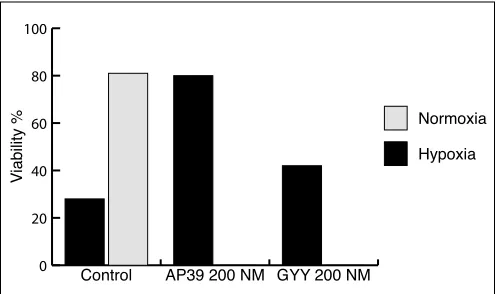
Results: After warm hypoxia re-oxygenation, both AP39 and
GYY4137 showed better cell viability when compared to control (Fig. 1). However, AP39 was significantly superior (P<0.002). AP39 limited cell death after hypoxia to levels similar to normoxic samples with a significant reduction in cell apoptosis (Fig. 2). A two-fold greater decline in ROS in favor for 200nM AP39. AP39 increased the anti-apoptotic protein Bcl-2 and reduced the pro-apoptotic protein BID but did not reduce Bax (Fig. 3).
Conclusion: This is the first in vitro study testing the effects of
mitochon-drial targeting H2S donor molecules on renal epithelial cells in warm IRI. AP39 appears to have a more potent protective effect against hypoxia compared to GYY4137, and this benefit appears to be attributable to reduction in apoptosis. Further studies using animal models are needed to validate these novel findings.
0 20 40 60 80 100
Normoxia Hypoxia
GYY 200 NM AP39 200 NM
Control
Viability
%
Fig. 1. MP-05.08. Cell Viability After Hypoxia re-Oxygenation Compared to Normoxia
0 10 20 30 40 50
Normoxia Hypoxia
GYY 200 NM AP39 200 NM
Control
Apoptosis %
Fig. 2. MP-05.08. Cell Apoptosis After Hypoxia re-Oxygenation Compared to Normoxia
0 10 20 30 40 50 60 70 80
Normoxia Hypoxia
GYY 200 NM AP39 200 NM
Control
ROS %
MP-05.09
Prospective assessment of robotic single incision donor nephrec-tomy vs. laparoscopic multi-port donor nephrecnephrec-tomy
Aboalsamh, Ghaleb A.1; May, Mounirah 1; Archambault, Jason1; Sener,
Alp1; Luke, Patrick P.1
1Urology, University of Western Ontario, London, ON, Canada
Introduction: Our study aims to compare robotic single port and standard
laparoscopic donor nephrectomy in terms of safety/efficacy and patient satisfaction in regards to pain and body image.
Methods: Twenty patients were enrolled in a prospective assessment of
robotic single incision laparoscopic donor nephrectomy (n=8) with stan-dard multiple incision laparoscopic donor nephrectomy (n=12) utilizing a standard 3 port plus pfannestiel extraction technique.
Results: Demographics were similar between the robotic and standard
laparoscopic donor groups in regards to age and body mass index. Operative time was comparable between the two groups at 247 min for the robotic and 233 min for the laparoscopic technique. There was no difference in renal warm ischemic time and length of hospital stay. Post-operative pain scores on post-operative days 1 and 7 were 4.4 and 1.8/10.0 in the robotic group versus 5.5 and 2.5/10.0 in the standard laparoscopic groups. Body image scores on day 3 and after 1month post-operatively were in favor for the robotic group as (23/28 and 23/28) vs. laparoscopic group (20/28 and 20/ 28). Only one patient in the laparo-scopic group developed wound hematoma postoperatively with no other significant complications in either group.
Conclusion: Single incision robotic donor nephrectomy is safe and
com-parable to standard laparoscopic donor nephrectomy with regards to donor outcomes. Ongoing study with larger sampler size will determine whether robotic single site donor nephrectomy is associated with reduced postoperative pain scores and better body image score vs. standard tech-nique.
MP-05.10
Assessment of percutaneous renal access skills during urology objective structured clinical examinations
Noureldin, Yasser1,2; Elkoushy, Mohamed1; Andonian, Sero1
1Urology, McGill University Health Centre, Montreal, QC, Canada; 2Urology, Benha University Hospital, Benha University, Benha, Egypt
Objectives: The first objective was to assess percutaneous renal
access (PCA) skills of urology Post-Graduate Trainees (PGTs) during Objective Structured Clinical Examination (OSCEs). The second objec-tive was to determine whether previous experience with Percutaneous Nephrolithotomy (PCNL) improved performance.
Methods: After obtaining ethics approval, PGTs from two urology
pro-grams in Quebec between Post-Graduate Years (PGY-3 to PGY-5) were recruited. Each trainee was asked to answer a short questionnaire regard-ing previous experience in endourologic procedures. After a 3-minute orientation on the PERC Mentor™ simulator, each trainee was asked to perform task 4, where they had to correctly access all of the renal calyces and pop the balloons in a normal left kidney model. Data from the questionnaire and the performance report generated by the simulator were collected and analyzed.
Results: Thirteen PGTs participated in this study. PGTs had performed a
median of 200 (50-1000) cystoscopies, 50 (10-125) TURBTs, 30 (0-100) TURPs, 5 (0-50) laser prostatectomies, and 50 (2-125) ureteroscopies prior to this OSCE. PGTs with previous PCNL experience (8/13) had performed a mean of 18.6±6.3 PCNLs. When compared with PGTs without previ-ous PCNL experience, PGTs with previprevi-ous PCNL experience performed significantly better in terms of shorter fluoroscopy time (FT) (10±1.5 vs. 5.1±0.7 min; p=0.04), fewer attempts required for successful puncture of the pelvi-calyceal system (PCS) (21±2.3 vs. 13±1.8; p=0.02), and had significantly lower complications in terms of fewer infundibular injury (7.4±1.5 vs. 2±0.4; p=0.004) and fewer PCS perforations (11±1.7 vs. 4.5±1.2; p=0.01).
Conclusion: It is feasible to use the PERC Mentor™ simulator during
OSCEs to assess PCA skills of urology PGTs. PGTs who had previous PCNL experience performed significantly better with fewer complications.
MP-05.11
Analysis of motion in laparoscopy: The deconstruction of an intracorporeal suturing task
Farcas, Monica A.1; O’Neill Trudeau, Maeve 2; Nasr, Ahmed 3; Gerstle, J.
Ted 2,4; Carrillo, Brian4; Azzie, Georges2,4
1Department of Urology, University of Toronto, Toronto, ON, Canada; 2Department of Surgery, University of Toronto, Toronto, ON, Canada; 3Division of Pediatric Surgery, Children’s Hospital of Eastern Ontario,
Ottawa, ON, Canada; 4Center for Image Guided Innovation and
Therapeutic Intervention, Hospital for Sick Children, Toronto, ON, Canada
Introduction and Objectives: Simulation plays an important role in
sur-gical education. This study describes a laparoscopic box trainer with motion sensor capabilities used to study a deconstructed intra-corporeal suturing task.
Methods: A traditional box trainer was fitted with a custom-built motion
tracking system. Participants were stratified into novice, intermediate and expert groups. They performed a defined intra-corporeal suturing task. Real-time motion data was collected in four degrees of freedom (DOFs) (roll, surge, pitch, yaw). The task was then deconstructed into segments: 1) loading needle, piercing penrose, and suture pull-through; 2) double throw knot; 3) first single throw knot; and 4) second single throw knot. Two motion analysis parameters (MAPs) were studied for each DOF: 1) number of extreme velocity events and 2) number of extreme acceleration events. One-way ANOVA analysis was used to compare MAPs between expertise groups. Post-hoc analysis was performed using two sample t-tests.
Results: Sixty-four participants were tested (14 novices, 19 intermediates
and 31 experts). The largest difference in MAPs between novices/inter-mediates vs. experts was seen in the ‘double throw knot’ task. Analysis of MAPs in the first deconstructed segment (orienting and passing needle and suture) revealed differences between novices and experts in ROLL and PITCH DOFs only. For the ‘first single throw knot’ similar MAP trends were noted across all DOFs, with significant differences between novices vs. experts and intermediates vs. experts, but not intermediates vs. novices. For the ‘second single throw knot’, a difference in MAPs across all four DOFs was preserved only for novices vs. experts.
Conclusions: Analysis of motion for deconstructed segments of a defined
suturing task in a laparoscopic simulator allowed identification of the most challenging components. Such information may allow educators to better assess and teach the psychomotor skills necessary to carry out a given task.
MP-05.12
Social media expansion at American Urological Association meetings
Loeb, Stacy1; Matta, Rano2; Azevedo, Nuno1; Tong, Steven3; Doiron, R.
Christopher3; Leveridge, Michael J.3
1Urology, New York University, New York, NY, United States; 2Surgery,
University of Toronto, Toronto, ON, Canada; 3Urology, Queen’s University,
Kingston, ON, Canada
Objectives: Numerous studies have reported on the expanding use of
social media at urology conferences. The goal of our study was to directly compare twitter activity between the 2012, 2013 and 2014 American Urological Association (AUA) annual meetings.
Methods: The AUA endorses meeting-specific “hashtags”, text strings
included in tweets that allow collation into a thread of related messages, each year. We used the unique hashtags for the past three AUA meetings (#uro12, #aua13, and #aua14) to examine trends over time in twitter activ-ity during each meeting, including the overall volume of tweets as well as the number and type of contributors. Qualitative classification using an established framework allowed characterization of tweet type and quality.
Results: The volume of tweets during AUA meetings has steadily increased
others; p≺0.001). Further, the top overall contributor has switched from a biotechnology analyst to a urology organization.
Conclusions: Social media use continues to increase at the AUA annual
meeting. Urologists now comprise the most important group contributing to conference messaging. Social media has clearly come to represent an important new avenue for meeting-related discussion and dissemination.
UP-05.01
International Urology Journal Club on Twitter: A growing edu-cational forum
Leveridge, Michael J.1; Thangasamy, Isaac2; Davies, Benjamin 3; Finelli,
Antonio4; Stork, Brian5; Loeb, Stacy6; Woo, Henry7
1Urology, Queen’s University, Kingston, ON, Canada; 2Urology,
Queensland Health, Brisbane, Australia; 3Urology, University of Pittsburgh,
Pittsburgh, PA, United States; 4Surgery, University of Toronto, Toronto, ON,
Canada; 5West Shore Urology, Muskegon, MI, United States; 6Urology,
New York University, New York, NY, United States; 7Surgery, University
of Sydney, Sydney, Australia
Introduction and Objectives: In 2012, we pioneered the first ever
inter-national Twitter-based journal club (#urojc) to discuss urology articles on a monthly basis with diverse global participation. Since that time, this model of an international Twitter based journal club has been adopted by several other medical specialties including general surgery, respira-tory medicine and nephrology. The objective of this study is to exam-ine the development of the urology journal club into an innovative and thriving forum for exchange of ideas, information and opinions since its conception two years ago.
Methods: Monthly twitter analyses such as number of users, tweets and
potential tweet views (impressions) for the journal club were obtained via a third-party service using the pre-defined Twitter hashtag #urojc. Qualitative analysis was also performed of each individual tweet to assess for relevance to the discussion. Comparisons were made between data from the first and second year of operation of the journal club, includ-ing the number and geographic location of participants, as well as the quantity and quality of tweets.
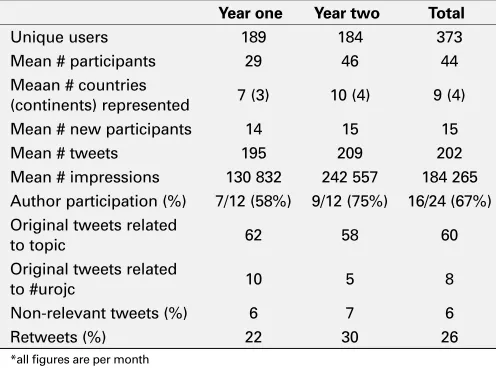
Results: See Table 1 for summary statistics. The total number of unique
users of #urojc almost doubled from year one to year two. The mean number of total participants increased by seven per month, and mean number of total countries represented increased by three per month. While the number of tweets per month also increased from year one to year two, the proportion of content-relevant tweets remained stably high at approximately 60%. Meanwhile, there was a greater degree of partici-pation from authors of the study being discussed over time.
Conclusions: It is clear that the International Urology Journal Club
con-tinues to draw robust participation from a global audience, and serves as a benchmark for Twitter-based journal clubs in other specialties. The majority of tweets are relevant to the content of the article, providing a novel forum to discuss new research findings with a global audience.
UP-05.02
Milestones in Canadian urology Gajewski, Jerzy1
1Urology, Dalhousie University, Halifax, NS, Canada
Introduction: Canadian urology has rich and telling history. There are
several publications on this topic, however most relates to a particular time frame or geographic location. The goal of this abstract is to present complete timeline of the history of Canadian Urology with emphasis on important issues and events.
Methods: We review all available archives documents from 1929 until
2015. The data were extracted from accessible publications, meeting minutes, letters and other documents. The following items were recorded: meeting place, presidents, officers & executives, chair of the committees, society publications, awards and other important events and data. The data are presented in the form of visual timeline with particularly signifi-cant events and documents highlighted in the graphics.
Results: The first meeting of the Section of Urology within Canadian
Medical Association was in 1929. Canadian Urological Association (CUA) was funded in December of 1945. Since then we had 69 Annual Meetings of CUA with the 70th to be held in Ottawa in June 2015. The meetings initially had no particular schedule but later started to alternate between east, west and central Canada. There were 70 presidents and the number of executives and officers increased with the proliferation in the activities of the association. The membership increased to over 1100. CUA incorporated in 1998. CUA awarded honorary membership to 16 individuals. CUA life achievement award established in 1980 was pre-sented to 26 CUA members. Canadian Urological Association Scholarship Foundation (CUASF) was incorporated in 1997 and provided thousands of dollars of scholarships for numerous early career urologists in Canada. CUA endorsed Canadian Journal of Urology as an official journal of the association in 1994. In 2007 CUA create its own journal Canadian Urological Association Journal. CUA produced almost 60 Patients Information Pamphlets serving both patients and members. In the recent years CUA established cooperation with other international urological societies.
Conclusions: The CUA grows up steadily from 1945 and matured to a
very effective and organized society serving and representing Canadian Urologist and becoming the “The Voice of Urology in Canada”.
UP-05.03
A resident run clinic in a urology training program: Concept and patient’s perspectives
Mason, Ross1; Whelan, Thomas F.1
1Department of Urology, Dalhousie University, St. John, NB, Canada
Introduction and Objectives: The quality of patient care provided by
surgical residents is important, as is the quality of the education received by the resident. Herein we report on the concept of a resident run Urology clinic as well as on the patient’s perspectives and satisfaction.
Methods: In Saint John, New Brunswick, a Urology resident run clinic
exists at which a patient is first evaluated by a resident physician (with the patients knowledge) and any follow-up visits or procedures are coor-dinated with the resident present so as to ensure continuity of care. At the end of this longitudinal experience, patients are administered a question-naire to determine their level of satisfaction with the care they received by the resident physician. The questionnaire is a 10-point Likert scale including questions on 4 areas of care; physician’s attitude, profession-alism, explanation received, and adequacy of the amount of time spent with the physician.
Results: 61 patients were identified who were cared for in the resident run
clinic between 2010-2014. Patient satisfaction was high in all categories with mean scores of 9.6, 9.7, 9.3, and 9.1 in the areas of physician’s
atti-Table 1. UP-05.01. Summary statistice comparing first and second year*
Year one Year two Total
Unique users 189 184 373
Mean # participants 29 46 44
Meaan # countries
(continents) represented 7 (3) 10 (4) 9 (4) Mean # new participants 14 15 15
Mean # tweets 195 209 202
Mean # impressions 130 832 242 557 184 265 Author participation (%) 7/12 (58%) 9/12 (75%) 16/24 (67%) Original tweets related
to topic 62 58 60
Original tweets related
to #urojc 10 5 8
Non-relevant tweets (%) 6 7 6
Retweets (%) 22 30 26
tude, professionalism, explanation received, and adequacy of the amount of time spent with the physician, respectively. Several patients provided written comments on the questionnaires, with most expressing satisfaction with the care they received.
Conclusions: Patients describe a high level of satisfaction with the care
they receive in a resident run Urology clinic. This clinic incorporates most of the CanMEDS objectives and provides a longitudinal learning experience which is generally absent from surgical residencies, As we search for novel ways to provide education to future Urologists, this type of clinic may serve to teach physician independence while still providing excellent patient care.
UP-05.04
OAB patients know little about their condition
Carlson, Kevin1,2; Civitarese, Andrea2; Yanko, Daniel3; Desantis, Darren1,2;
Crump, Trafford2; Baverstock, Richard 1,2
1Surgery, University of Calgary, Calgary, AB, Canada; 2vesia [Alberta
Bladder Centre], Calgary, AB, Canada; 3Fraser Health, Surrey, BC, Canada
Introduction: As overactive bladder (OAB) is an age-related condition, its
incidence is expected to rise as the elderly population in Canada grows, far outpacing the availability of urologists in the country. Identifying opportunities for intervening prior to initial consult may help reduce the expected clinical burden OAB represents. The purpose of this study is to test whether patients with relatively more severe OAB symptoms are more knowledgeable about their condition than those with relatively milder symptoms.
Methods: An evidence-based questionnaire, designed to test patients’
understanding of OAB, was developed for use in a multidisciplinary secondary care urology clinic. The instrument is comprised of 20 ques-tions relating to three underlying factors: 1) risk and symptoms, 2) treat-ment options, and 3) potential side effects of these treattreat-ment options. The questionnaire was based on similar instruments designed, used, and published in oncology. Data in this study was collected from patients enrolling in a registry whose first visit to the clinic was between June and December 2014.
Results: Of 94 patients included in the registry, 82 (87%) completed the
knowledge questionnaire. These patients had an average symptom score on the OAB-V8 of 18.9 and 11.1 on the IPSS. The mean knowledge score was 8.3 (out of 20). There were no statistically significant differences in knowledge of OAB and patients’ self-reported symptom severity.
Conclusions: In general, this study’s sample had little knowledge of OAB.
Common questions about behavioral modifications (e.g., consumption of caffeinated beverages) were answered incorrectly. Knowledge scores were unrelated to self-reported OAB symptoms, suggesting that even patients with severe impairments had little understanding of their condi-tion. These results could represent an opportunity to design an educational intervention aimed at patients with OAB who are referred to a urologist and awaiting their initial assessment.
UP-05.05
The value of a core clinical rotation in urology for medical stu-dents
Patel, Premal1; Nayak, Jasmir G.2; McGregor, Thomas B.1
1Section of Urology, University of Manitoba, Winnipeg, MB, Canada; 2Department of Urology, University of Washington Medical Center,
Seattle, WA, United States
Introduction and Objectives: Since September 2013, third year medical
students at the University of Manitoba are required to complete a one-week urology rotation during their core surgical block. Our study aimed to assess the utility and value of this change in the core curriculum.
Methods: Students were asked to fill out an online survey prior to and at
completion of their one-week mandatory urology rotation. This survey was voluntary and confidential. Paired t-test and fishers exact test were used for data analysis.
Results: Sixty-three students completed the pre-rotation survey and 53
students completed the post rotation survey. After completing their rota-tion, students gained a better understanding of various uropathology (p
< 0.0001) and appreciated that urology compromises a significant com-ponent of a general medical practice (p = 0.0230). In terms of practical skills, following a urology rotation students gained a better understanding on how to insert a foley catheter (p=0.0059), had attempted foley catheter insertion (p=0.0028) and felt comfortable independently inserting a foley catheter (p=0.0001). Additionally, students were more likely to feel com-fortable performing a digital rectal examination for prostate cancer screen-ing (p=0.0085), as well as investigatscreen-ing hematuria (p=0.0001) and renal colic (p=0.0001). Importantly, students gained a greater understanding on when to properly utilize the consult services of urology (p=0.0001). At the end of the rotation, 87% and 89% of students felt the rotation to be beneficial and were glad the rotation was mandatory, respectively. However, there was no difference in the rate of students who would consider urology as a future career (22.7% vs. 38%, p=0.7424) before and after the rotation, respectively.
Conclusion: The introduction of a mandatory urology rotation for
under-graduate medical students improved the fundamental urological knowl-edge and skill set of rotating students.
UP-05.06
Risk factors associated with the presence of microscopic hema-turia in men
Courtemanche, Karim1; Chan, Peter1; Kassouf, Wassim1 1Division of Urology, McGill University, Montreal, QC, Canada
Introduction and Objectives: Microscopic hematuria is a common
inci-dental finding on routine dipstick urinalysis. Long-term follow-up has shown that up to 5% may develop urinary tract malignancy. Although there are no clear recommendations to perform routine urinalysis, some studies have shown that up to 50% of general practitioners continue to perform annual routine urinalysis regardless of age or risk factors. The aim of our study was to identify the prevalence of microscopic hematuria as well as risk factors in the general population presenting to an annual Men’s Health Clinic held by volunteers in a public venue.
Methods: We conducted a retrospective analysis of prospectively
col-lected data at an annual Men’s Health clinic from 2008 to 2013. Patient reported health questionnaires, basic physical exam including digital rectal exam, basic bloodwork and urine dipstick data was examined. Data was analyzed using SPSS chi-square, Fisher exact, Student T-test and regression analysis as appropriate.
Results: 875 patient visits were examined. Of these, 775 had urinalysis
done. Patients who had declared a previous history of hematuria were excluded from analysis. 721 patients were therefore included in the final analysis. 64 (8.9%) patients had positive hematuria on dipstick. Average age in both groups was 55 years. Diabetes was positively correlated to microscopic hematuria with odds-ratio of 2.27 (1.1-4.6). There was no significant correlation identified with age, body-mass index, smoking, pros-tate specific antigen (PSA) or International Prospros-tate Symptom Score (IPSS).
Conclusions: Microscopic hematuria on dipstick urinalysis is a prevalent
condition in the general male population. The only risk factor associated to microscopic hematuria identified in this study was diabetes. Traditional risk factors for hematuria and malignancy such as smoking, age and lower urinary tract symptoms showed no association.
UP-05.07
Patient-driven use of smartphone camera in an office urology practice
Abara, Emmanuel1; Noushi, Nioushah1; Abara, Erinma1
1Richmond Hill Urology Practice and Prostate Institute, Richmond Hill,
ON, Canada
Introduction: With advances in digital and information technology,
smart phones are fast overtaking the LCD cell and the wired ones. These hand-held devices are equipped to capture images at high resolution and transmit them accurately and instantly by multimedia messaging service (MMS). This is influencing the way we live, work and play - and thus our health care.
Materials and Methods: Between January 5 and December 22, 2014,
phone camera images to supplement their clinical history and progress. We excluded instances when digital photos were taken at the time of surgical procedure or follow - up with appropriate informed consent.
Results: There were 4 cases: i. 60 year old man with penile lesion
pro-vided pre-op and several post-op photos; ii. 56 year old man with post papaverine priapism and penile bruising - photos for self monitoring and communication with the urologist; iii. 45 year old man with a history of penile chordee in the absence of a palpable Peyronie’s plaque; and iv. 60 year old man had a smart phone uptake of his CT scan report for his records and to share with Family doctor.
Comments: Use of smart phone camera has been reported in
differ-ent clinical scenarios. Patidiffer-ent-driven initiatives can be complimdiffer-entary to appropriate physician assessment. Use of this device by urology patients are occurring but not frequently reported. Its usefulness in aiding diagno-sis, treatment, counseling and surveillance needs further study especially regarding protecting patients’ privacy rights and confidentiality.
UP-05.08
Satellite rural ambulatory urology clinics in northeastern Ontario: 25 years later
Abara, Emmanuel1,2,3
1Department of Surgery, Kirkland Lake and District Hospital, Kirkland
Lake, ON, Canada; 2Division of Clinical Sciences, Northern Ontario
School of Medicine, Sudbury, Thunder Bay, ON, Canada; 3Richmond
Hill Urology Practice and Prostate Institute, Richmond Hill, ON, Canada
Introduction and Objectives: Along Highway 11, north of North Bay
are several rural communities that are served by small hospitals located 40 to 340 kilometers away from Timmins. Until 1989, most urological services were provided at the Timmins and District Hospital. It is not uncommon to have an elderly gentleman with urosepsis and acute urinary retention transferred by air ambulance from one of these communities. In 1990, satellite urology clinics were established to improve access and quality of care and hopefully save health care costs. This is an obser-vational study to understand what was done and where we are today.
Methods: Geographic and demographic data were gathered with a focus
on Timiskaming and Cochrane Districts. Needs assessment was completed through interviews with key stakeholders. Approval for the project was given by the Underserviced Area Program (UAP) of the Ministry of Health. Hospital privileges were approved. Primary health care providers andthe communities were notified of start dates. The various hospitals provided clerical and support staff. Evaluation processes were established to pro-vide feedback from all stakeholders for program enhancement.
Results: There are now 7 clinics. The scope of services offered has
been consolidated and expanded with introduction of risk, low-resource out-patient procedures. Delegated urological procedures, com-munity engagement and patient education initiatives have grown. Inter-professional development and collaboration have been beneficial resulting into some clinical research. With the new medical school, these rural hospitals have become hubs for clinical training.
Conclusions: Satellite urology clinics appear to be beneficial to the
patients, the health care professionals and the rural communities. It improves timely access, quality of care and may be cost-saving. The urolo-gist in the community can be a catalyst for inter-professional development and team building. Opportunities for research and learners abound.
UP-05.09
Building capacity in Rwandan Urology: An avenue of collabora-tion for the Canadian Urologists
El-Sherbini, Mohamed 1; Abara, Emmanuel2; Kanaroglou, Niki4; Wehbi,
Elias5; Rwamasirabo, Emile3; Duke, Linea1; Sourial, Michael 1; Ntakiyiruta,
Georges3
1Surgery and Pediatric Surgery, McGill University, Montreal, QC, Canada; 2Richmond Hill Urology Practice and Prostate Institute, Richmond Hill,
ON, Canada; 3National University of Rwanda, Kigali, Rwanda; 4Palm
Beach Pediatric Urology, Boynton Beach, FL, United States; 5Urology,
University of California, Irvine, Children’s Hospital of Orange County and UCI Medical Center, Irvine, CA, United States
Introduction and Objectives: In 2013, a call for volunteers was made
through the Pediatric Urologists of Canada (PUC) to visit Rwanda, a country with 11 million people served by 3 urologists. The volunteers were expected to work collaboratively with the local Faculty and Learners. By October 2014, two teams of 4 Urologists and two Residents have participated. We report the outcome.
Methods: For 2 weeks in Kigali, participants functioned as
collabora-tive educators and faculty. We worked at the three teaching hospitals - the CHUCK, King Fazal and the Military. The program included: 1.Out-patient Screening Clinic-adult and pediatric; 2. Operative (OR) surgeries including pediatric anomalies, oncology, voiding dysfunction and adult urology - BPH, urethral stricture, bladder and prostate cancer; 3. ”One-to-one” Case-based Learning; 4. Workshop in Office Urodynamics, 5. Academic day of didactic lectures on pediatric and adult urology; and 6. Community Engagement. The host provided accomodation, meals and local transportation. Participants were responsible for their air fares and travel arrangements.
Results: Health care services, as elsewhere, are unique with the existence
of public and private hospitals and other arrangements in between. With only 3 urologists, the wait times were unusually long. Despite the limita-tions, no one was denied care because of lack of funds. Anesthesia Nurse practitioners were a unique complement in the OR workforce. Invitation from Kigali was based on local needs rather than Western models and expectation. Local accountability and initiative were noticeable. We acted as mentors, moderators and educators following a curriculum developed in Rwanda. Residents got to learn, educate and work in a welcoming and different environment.
Conclusions: With the short exposure to a small segment of the Rwandan
healthcare model, we feel that there is room for improvement and devel-opment in urology and retention of well- trained home-bred workforce. The SIU, CUA, academic institutions and urologists in Canada have a great opportunity of making significant contribution to Rwanda and other LIMCs through supporting avenues of collaboration such as this.
UP-05.10
New three dimensional fully autologous tissue-engineered vagi-nal model using the self-assembly technique
Orabi, Hazem1,2; Rousseau, Alexandre1; Morissette, Amélie1; Bouchard,
Frederick2; Fortin, Marie-Claude 1; Bolduc, Stephane1,2
1Urology Department, Laval University, Quebec, QC, Canada; 2Centre de
recherche en organogénèse expérimentale de l’Université Laval / LOEX, Laval University, Quebec, QC, Canada
Introduction and Objectives: Many diseases necessitate the substitution
of vaginal tissues including congenital anomalies, malignancy and trau-matic lesions. Current replacement therapies are associated with many complications. Recent tissue-engineered vaginas using xenografts were implanted in patients with congenital vaginal abnormality. However, the use of non-autologous tissues for vaginal bioengineering may be associ-ated with infection, immunologic reactions and fibrosis on long-term. The use of autologous cells and tissues avoids these disadvantages. In this study, we aimed to create neo-vaginas with the self-assembly technique using autologous epithelial cells and stromal cells without the use of exogenous materials.
Methods: Epithelial and stromal cells were isolated from vaginal, labial
and skin biopsies using enzymatic methods. Stromal cells from the 3 different tissues were stimulated separately to form collagen sheets with culture medium containing ascorbic acid. Three collagen sheets were stacked together to form vaginal equivalents (VEq). Vaginal epithelial cells were seeded on top of the VEq made from dermal and vaginal stromal cells, while labial epithelial cells were seeded on top of the VEq made from labila stromal cells. The equivalents were evaluated using histologi-cal, functional and mechanical assessments.
Results: Stromal cells formed collagen sheets that could be handled
Continuous basement membrane underlying epithelial cells was evident by Laminin V and collagen IV. The epithelium, basement membrane and stroma characteristics were comparable to native vaginal tissues.
Conclusions: Using the self-assembly, in vitro vaginal tissues were
cre-ated with many functional and biological similarities with native vaginal tissue without any foreign material. It is appropriate for vaginal substitu-tion. Additionally, this model can be used for infectious studies, vaginal applicants and drug testing.
UP-05.11
Robotic surgery in Kuwait: The first experience
Aldousari, Saad1,2,3; Almarzouq, Ahmad3; Al-Yousef, Rawan J.2; Abul,
Fawzi1,2; Hussein, Sundus A.3,4; Thalib, Lukman5; Natarajan, Sridharan1;
Arun, Narayanaswamy1
1Urology, Sabah Al-Ahmad Urology Center, Kuwait City, Kuwait; 2Urology,
Kuwait University, Kuwait City, Kuwait; 3Urology, Mubarak Alkabeer
Hospital, Kuwait City, Kuwait; 4Pathology, Kuwait Cancer Control Center,
Kuwait City, Kuwait; 5Community Medicine, Kuwait University, Kuwait
City, Kuwait
Introduction and Objectives: Advances in urology have focused on
mini-mizing the invasiveness of surgical procedures without compromising outcomes such that a significant paradigm shift has occurred in urologi-cal procedures ultimately leading to introduction of robotic surgery. We hereby present our initial experience and outcomes in Kuwait with the da Vinci Si robot.
Methods: After IRB approval data was recorded for all patients who
under-went robotic surgery using the da Vinci Si at Sabah Alahmad Urology Center in Kuwait. Parameters recorded included demographic data, diag-nosis, basic laboratory and imaging results, total operative time including docking and console time, estimated blood loss, need for transfusion, and duration of hospitalization. Complications were graded using the Clavien classification system. Major complications were defined as ≥
Clavien 3.
Results: A total of 23 cases were done robotically in Kuwait From February
2014 to January 2015. The first case was right robotic partial nephrec-tomy. Cases included 7 radical prostatectomies for prostate cancer, 6 radical nephrectomies and 3 partial nephrectomies for renal tumors, 3 pyeloplasties for ureteropelvic junction obstruction, 2 radical adrenalecto-mies for adrenal tumors, and 2 pyelolithotoadrenalecto-mies that failed ureteroscopic management.
All cases were done transperitoneally. There was no conversion to open and none of the patients recieved a blood transfusion. There was no major complications. There was 3 Clavien grade II complications recorded in 2 patients (8.7%). Two patients developed postoperative pneumonia treated with intravenous antibiotics. Both patients were post partial nephrectomy and both were heavy smokers. One patient had wound infection managed as an outpatient with incision and drainage and normal saline packing. There was considerably less docking and total operative time going from first to last case. Madian hospital stay was 3 days.
Conclusion: In the presence of a certified uro-oncologist with robotic
training, our results show good patient and operative outcomes in a diverse group of robotic procedures. Establishing a robotic unit requires proper planning and selection of patients and continuous supervision and training of all members of the unit to ensure quality of care.
UP-05.12
Impact of a novel on-screen overlay frame of reference system for orientation during intraoperative laparoscopic surgery Kim, Soojin1; Hoogenes, Jen1; Elias, Rami1; Kim, Kevin1; Shayegan,
Bobby1; Piercey, Kevin R.1; Kapoor, Anil1; Sonnadara, Ranil1; Matsumoto,
Edward D.1
1Department of Surgery, Division of Urology, McMaster University,
Hamilton, ON, Canada
Introduction and Objectives: During laparoscopy, the surgical field is
projected onto the endoscopic screen in the operating room (OR) and is used as the focal point during the procedure, requiring various types of communication to direct the learner. Directional terminology can get
confusing when the spatial orientation of the on-screen target differs from each individuals’ vantage point. We explored how teaching occurs in the laparoscopic setting both with and without a tool designed to improve OR teaching.
Methods: We have shown that using a combination of standardized
ver-bal commands and transparent monitor overlays significantly improved teaching with laparoscopic simulators. We videotaped 19 laparoscopic teaching cases to serve as a baseline comparator group. We then intro-duced an alphanumeric grid screen overlay into the OR. We have since videotaped 22 laparoscopic teaching cases for analysis. Videotapes were transcribed verbatim and qualitatively analyzed. Follow-up interviews were conducted with participants.
Results: Analysis of the baseline cases revealed that teaching involved
the instructor pointing to the screen, the patient, and the instrument(s); holding the instrument to guide learners’ movements; and displaying the type of hand or arm movement required. Directional terms such as “right angle”, “up”, “down”, “medial”, etc. were frequently used. Learners were often told to visualize the movement before it was completed. The alphanumeric grid was utilized more frequently during the teaching of junior residents and those residents new to a given procedure, and all participants found it to be useful for practice. The preciseness of the grid format allows the learner to move directly the focal point, essentially eliminating the need for pointing and gesturing.
Conclusions: The alphanumeric grid overlay is a helpful tool for
lapa-roscopic teaching, especially when used during the teaching of junior residents and those new to a procedure. We will continue to evaluate the alphanumeric grid in practice and evaluate additional overlays: a clock with x:y triangulation and one with a dartboard-type design. Results of these additional observations will be presented, along with photographs and videotapes of the system in use in the OR.
UP-05.13
Functional integrity of bladder detrusor strips in organ culture Velasquez Flores, Monica1; Cammisotto, Philippe1; Campeau, Lysanne1 1Lady Davis Institute for Medical Research, McGill University, Montreal,
QC, Canada
Aim: The pathophysiology of overactive bladder syndrome remains to be
clarified. It is most likely a multifactorial condition with many contribut-ing elements to the development of voidcontribut-ing dysfunction. Establishcontribut-ing a reproducible and consistent experimental in vitro method to study fac-tors impacting bladder contractility could clarify our understanding of voiding dysfunction.
Methods: Detrusor strips were isolated from female rats of a hypertensive
strain (SS2BN) and mounted on agarose culture dishes under minimal tension. These strips were maintained in DMEM/F12 culture media and were subjected to daily stimulation with KCl. The contractile responses of these strips were assessed by measuring their reactions to KCl and carbachol at days 0 (i.e. noncultured), 3, 5, and 6.
Results: The contractile response to KCl significantly decreased from day
0 (572.8±99.21 g/g tissue) to day 3 (225.5±79.13 g/g tissue), but then remained stable at days 5 (218.8±77.17 g/g tissue) and 6 (205.6±50.06 g/g tissue). The EC50 of the carbachol showed no statistically significant difference between days 0, 3, 5, and 6. On the other hand, there was a statistically significance between the Emax values, but only between day 0 (866.2±64.10 g/g tissue) and 6 (429.9±34.48 g/g tissue).
Conclusions: The organ culture method applied to rat detrusor strips is
UP-05.14
The succinate receptor GPR91 as a mediator of bladder relax-ation
Velasquez Flores, Monica1; Cammisotto, Philippe1; Campeau, Lysanne1 1Lady Davis Institute for Medical Research, McGill University, Montreal,
QC, Canada
Aim: Metabolic syndrome is strongly associated with overactive
blad-der syndrome (OAB) in both men and women, affecting a large popu-lation in Western societies. Metabolic syndrome and OAB are linked through common risk factors such as atherosclerosis, ischemia and a pro-inflammatory state. Increased succinate production is detected in the presence of hyperglycemia and hypoxemia, as with diabetes mellitus and metabolic syndrome, and was recently identified as a major metabolic switch controlling metabolic functions in the body through its receptor GPR91 (SUCNR1). Our goal is to determine the role of succinate and its receptor as a key mediator in bladder contract-relaxation.
Methods: Smooth muscle cells (SMC) and urothelial cells were
iso-lated from rat bladder and grown in petri dishes until passage 2 and 5. After confluency, cells were exposed to oxygen 21% (normoxia) or 1% (hypoxia) for 24 hours then assessed for microscopy, immunohistochemis-try and immunoblotting analysis. After confluency, cells were exposed to oxygen 21% (normoxia) or 1% (hypoxia) for 24 hours, and then treated for microscopy and immunoblotting analysis. Bladder strips were also used for in vitro assessment of contractile responses to carbachol and electrical field stimulation (EFS).
Results: GPR91 was detected by immunoblotting and light microscopy
in SMC and urothelial cell cultures. Exposure of cultured cells to hypoxia (1% oxygen) for 24 hours dramatically decreased GPR91 in both cell types. Muscle strips incubated in organ baths with Krebs-Ringer buffer displayed a potent contraction in response to KCl (60 mM) or carbachol (3 nM to 100 μM).
Increasing concentrations of succinate gradually inhibited the tension elicited by a moderate concentration of carbachol (1 μM). Maleic acid, a less potent activator of GPR91, had similar effects than succinate. (On the other hand, malonate, an inhibitor of the conversion of succinate to fumarate, or dimethyl-succinate, a metabolizable permeable analog of succinate, citrate, oxalo-acetate and fumarate, intermediates of the Krebs Cycle, all mimicked the effect of succinate. Conversely, glucose, fructose glyceraldehyde, glycerol and pyruvate, intermediate of glycolysis, displayed no effects.)
Conclusion: The succinate receptor GPR91 is expressed in smooth muscle
and urothelial cells of the bladder and is highly sensitive to hypoxia. This may caused by a downregulation from increased levels of succinate produced in hypoxia state. Succinate may control bladder relaxation stimulated by carbachol by binding its receptor GPR91 and by acting at the level of the Krebs cycle.
UP-05.15
Hypoxia-induced metabolic stress in bladder smooth muscle cells
Velasquez Flores, Monica1; Cammisotto, Philippe1; Campeau, Lysanne1 1Lady Davis Institute for Medical Research, McGill University, Montreal,
QC, Canada
Objectives: Lower urinary tract symptoms are associated with the
meta-bolic syndrome. The different components of MetS contribute to end-organ dysfunction such as the bladder, possibly through endothelial dys-function or decreased blood flow. Hypoxia is known to develop in tissues of obese animal models and disrupt dramatically cell metabolism and functions. The aim of our study is to determine if hypoxia causes changes at a cellular level that may be responsible for voiding dysfunction.
Methods: Smooth muscle cells (SMC) were isolated from rat bladders
using a collagenase IV method and grown in petri dishes until passage between 2 and 5. After confluency, cells were exposed to oxygen 21% (normoxia) or 1% (hypoxia) for 24 hours then assessed for microscopy, immunohistochemistry and immunoblotting analysis.
Results: SMC were characterized by immunohistochemistry for myosin
and smooth muscle actin-alpha before and after hypoxia. MTT Cell pro-liferation Assay yielded similar results between normoxic and hypoxic cells. Hypoxia led to an increase in lactic acid release in the media of SMC. Cells showed an increase in GLUT-1 expression as revealed by immunohistochemistry and immunoblotting. Increase in HIF-1 alpha was also observed, demonstrating together with increases in GLUT-1 and lac-tic acid release that the SMC were in hypoxic state. The inducible nitric oxide-synthesizing enzyme iNOS was increased by hypoxia.
Regulators of cytoskeleton RhoA and ROCK-1 were not affected by hypoxia. On the other hand, the activated proteins Akt-473P and c-Jun amino-terminal kinases (JNKs) JNK-P, involved in insulin signaling and cell survival, were decreased with stable expression of non-phosphorylated Akt and JNK.
Conclusions: While short exposure to hypoxia does not affect SMC