Cite as: Can Urol Assoc J 2015;9(3-4):e104-8. http://dx.doi.org/10.5489/cuaj.2482 Published online March 11, 2015.
Abstract
Introduction: The first objective was to assess percutaneous renal access (PCA) skills of urology postgraduate trainees (PGTs) during the Objective Structured Clinical Examinations (OSCEs). The sec-ond objective was to determine whether previous experience with percutaneous nephrolithotomy (PCNL) improved performance. Methods: After obtaining ethics approval, we recruited PGTs from two urology programs in Quebec between postgraduate years (PGY-3 to PGY-5). Each trainee was asked to answer a short questionnaire regarding previous experience in endourologic pro-cedures. After a 3-minute orientation on the PERC Mentor simulator (Simbionix, Cleveland, OH), each trainee was asked to perform task 4, where they had to correctly access all of the renal calyces and pop the balloons in a normal left kidney model. We collected and analyzed data from the questionnaire and the performance report generated by the simulator.
Results: In total, 13 PGTs participated in this study. PGTs had performed a median of 200 (range: 50–1000) cystoscopies, 50 (range: 10–125) TURBTs, 30 (range: 0–100) TURPs, 5 (range: 0–50) laser prostatectomies, and 50 (range: 2–125) ureteroscopies prior to this OSCE. PGTs with previous PCNL experience (8/13) had performed a mean of 18.6 ± 6.3 PCNLs. PGTs with previous PCNL experience performed significantly better in terms of shorter fluo-roscopy time (10 ± 1.5 vs. 5.1 ± 0.7 min; p = 0.04), fewer attempts required for successful puncture of the pelvi-calyceal system (PCS) (21 ± 2.3 vs. 13 ± 1.8; p = 0.02), and had significantly lower complications in terms of fewer infundibular injury (7.4 ± 1.5 vs. 2 ± 0.4; p = 0.004) and fewer PCS perforations (11 ± 1.7 vs. 4.5 ± 1.2; p = 0.01).
Conclusion: It is feasible to use the PERC Mentor simulator during OSCEs to assess PCA skills of urology PGTs. PGTs who had previ-ous PCNL experience performed significantly better with fewer complications.
Introduction
Obtaining percutaneous renal access (PCA) is considered a critical step in performing percutaneous nephrolithotomy (PCNL). Urologists increasingly want to be proficient in PCA to become independent from interventional radiologists and flexible regarding the time and the location of obtaining the
PCA.1 Furthermore, in a retrospective single centre study
comparing complications of urologist-directed versus inter-ventional radiologist-directed PCA for patients undergoing PCNL, there were significantly lower complications and higher stone-free rates whenever the PCA was performed
by the urologist.2 However, the learning curve of PCNL is
quite long. It is reported that 36 to 45 cases are needed to achieve competency and 105 to 115 cases to achieve
pro-ficiency.3,4 In addition, restrictions on training hours have
limited exposure of postgraduate trainees (PGTs) to opera-tive cases. The fact that PCA is usually performed once per PCNL further limits the experience of PGTs from each PCNL case. Furthermore, increased public concerns for improving patient safety have mandated the use of simulators outside of the operating room. Simulators provide the additional advantage of unlimited deliberate practice of critical steps outside the operating room in a risk-free and stress-free envi-ronment. The objective feedback generated by the simulator allows us to assess the technical deficiencies and to provide
a learning opportunity.5,6
The PERC Mentor simulator (Simbionix, Cleveland, OH)
has been validated as a training module for PCA skills.5,7
The advantages of the PERC Mentor is that it provides tactile rib sensation, real-time virtual fluoroscopy, and organ
dis-placement with respiration – making PCA realistic.1 Knudsen
and colleagues showed that the group randomized to two 30-minute training sessions on the PERC Mentor resulted
in significantly improved PCA skills.7 Skills in basic
lapa-roscopy and photoselective vaporization of the prostate (PVP) of urology PGTs have been recently assessed during
Yasser A. Noureldin, MD, MSc, PhD;
*†Mohamed A. Elkoushy, MD, MSc, PhD;
*§Sero Andonian, MD, MSc, FRCSC, FACS
**Department of Surgery, Division of Urology, McGill University Health Center, Montreal QC; †Department of Urology, Benha University Hospital, Benha University, Benha, Egypt; §Department of Urology,
Suez Canal University, Ismailia, Egypt
Objective Structured Clinical Examinations (OSCEs) using the Basic Laparoscopic Urologic Surgery (BLUS)
curricu-lum and GreenLight (AMS Inc.) simulator.8,9 However, there
are no studies examining the feasibility of incorporating the PERC Mentor simulator into urology OSCEs to assess basic PCA skills of urology PGTs. Therefore, the first aim of this study was to incorporate the PERC Mentor simulator into urology OSCEs and to assess the PCA skills of urology PGTs. The second aim was to determine whether previous experi-ence with PCNL improved performance on the simulator during OSCEs. We hypothesize that PGTs with previous PCNL experience would perform significantly better and with fewer complications than those without previous PCNL experience.
Methods
Study design
After obtaining institutional review board approval (No. A03-E24-14B) and informed consents, PGTs from two Quebec urology training programs from postgraduate years (PGY-3 to PGY-5) were recruited to participate in this study during the semi-annual urology OSCE on April 7, 2014. The OSCE consisted of 15 stations of 20 minutes each, one of which was used to assess the PCA skills of the participating PGTs using the PERC Mentor simulator. Each trainee was asked to complete a questionnaire regarding their PGY level and previous experience in endourologic procedures (cystos-copy, transurethral resection of bladder tumour [TURBT], transurethral resection of the prostate [TURP], laser prosta-tectomy, ureteroscopy [URS] and percutaneous nephroli-thotomy [PCNL]). None of the participating PGTs had previ-ous knowledge about this simulator. Therefore, a 3-minute orientation session about the simulator was offered before proceeding to performing task 4, in which participants had to correctly access and pop the 7 balloons in the renal calyces in a normal left kidney model. The same orientation session was given by one researcher (YAN) to all participants. This included orientation on how to control the fluoroscopy unit and respirations and how to perform retrograde pyelogra-phy. In addition, participants were oriented to the simulated patient position. However, participants were not allowed to practice prior to starting task 4.
The PERC Mentor Simulator
The PERC Mentor Simulator is a virtual reality simulator designed for training urologists and PGTs in PCA. It simu-lates a patient in prone position with a virtual C-arm and mock angiographic instruments. It offers tactile feedback where the surgeon can feel the ribs with hands and, if not
careful, can hit the ribs when puncturing with the simu-lator needle. Organ displacement with breathing can be monitored with the option to hold breathing for 10 seconds. The puncture needle is available in two lengths (15 cm for non-obese patients and 21 cm for obese patients). For this study, the 15-cm needle was used with the normal non-obese left kidney model. The participant has the choice to manage the virtual C-arm freely using the arrows on the screen; he/she can change the angle of the C-arm, move it caudally or cranially, use real-time or single shot fluoros-copy. Furthermore, the surgeon can do retrograde pyelogra-phy through a virtual ureteral catheter. After each exercise, the simulator calculates operative time, fluoroscopy time, number of pelvi-calyceal system (PCS) punctures and PCS perforations, and determines infundibular, splenic, pleural, and colonic injuries. The PERC Mentor provides an objective assessment of PCA skills.
Statistical analysis
Data from the questionnaires and the performance reports generated by the simulator were collected and analyzed. Data were analyzed using the Statistical Package of Social Sciences for Windows (SPSS, Chicago, IL) version 20. Descriptive data were presented in terms of number, per-centages, medians or means and standard error of mean. Categorical variables were compared using Fisher’s exact test, while continuous variables were compared by Mann-Whitney U-test. Two tailed p value <0.05 was considered significant. Multivariate general linear model was performed for correction of any possible confounders.
Results
In total, 13 PGTs participated in this study, 12 (92.3%) from McGill University and 1 (7.7%) from Sherbrooke University, with a male to female ratio of 11 (84.6%) to 2 (15.4%). There were no PGTs who refused to participate in the study. There were 5 (38.5%), 3 (23.1%), and 5 (38.5%) PGTs from PGY-3, PGY-4, and PGY-5, respectively. There were 7 (53.8%) PGTs with video-gaming experience and 3 (23.1%) PGTs with music-playing experience. PGTs had performed a median of 200 (range: 50–1000) cystoscopies, 50 (range: 10–125) TURBTs, 30 (range: 0–100) TURPs, 5 (range: 0–50) laser prostatectomies, and 50 (range: 2–125) ureteroscopies before this OSCE.
As expected, the more senior PGTs performed signifi-cantly more cystoscopies, TURBTs, TURPs, laser prostatec-tomies, and PCNLs (Table 1).
All participants were able to finish the task within the allotted 20-minute station. Table 2 describes the operative data for all PGTs.
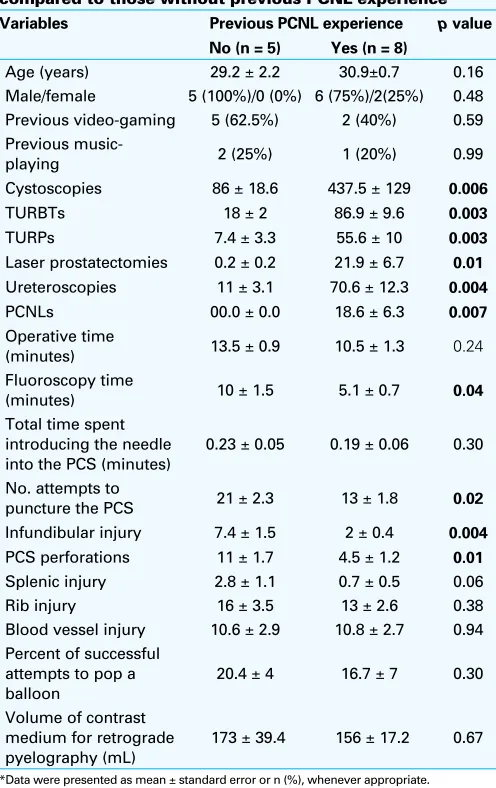
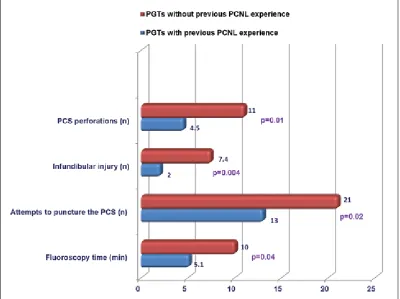
prior to this OSCE. When compared with PGTs without PCNL experience, PGTs with previous PCNL experience performed significantly better in terms of shorter fluoroscopy time (10 ± 1 vs. 5.1 ± 0.7 minutes; p = 0.04), fewer attempts to puncture PCS (21 ± 2.3 vs.13 ± 1.8; p = 0.02), fewer infundibular injury (7.4 ± 1.5 vs. 2 ± 0.4; p = 0.004), and fewer PCS perforations (11 ± 1.7 vs. 4.5 ± 1.2; p = 0.01) (Table 3, Fig. 1).
Moreover, these variables retained significance on mul-tivariate analysis. However, there were no statistically sig-nificant differences between the PGTs with and without experience in terms of age (p = 0.16), gender (p = 0.48), splenic injury (p = 0.06), rib collision (p = 0.38), blood vessel injury (p = 0.94), mean amount of contrast media used for retrograde pyelography (p = 0.67), and the percentage of successful attempts to pop the balloon (p = 0.30). In addi-tion, both groups showed comparable experience in terms of previous video-gaming and music-playing experience (p = 0.59; p = 0.99), respectively (Table 3).
Discussion
A recent Cochrane review has shown that trainees who exercise on virtual reality simulators perform better in the operating room with shorter operative time and fewer
complications.10 Recently, the PERC Mentor simulator was
introduced and validated for PCA training.7 In addition to
training, virtual reality simulators have another important function – they objectively assess trainees and provide a performance report at the end of each performed task. These performance reports have dual benefits. In addition to pro-viding feedback for deliberate practice, they could be used by program directors to monitor the progress of trainees’ skills. Although the PERC Mentor simulator had been
pre-Table 1. Number of procedures performed per postgraduate year
PGY-3 PGY-4 PGY-5 p value
Cystoscopies 86 ± 18.6 166.7 ± 33.3 600 ± 170.3 0.01
TURBTs 18 ± 2 56.7 ± 6.7 105 ± 5 0.001
PGY: postgraduate year; PCNL: percutaneous nephrolithotomy; TURBT: transurethral resection of the bladder tumour; TURP: transurethral resection of the prostate.
Table 2. Operative data for all PGTs
Median value Range
Operative time 11.5 minutes 6.2–16.3
Fluoroscopy time 6.5 minutes 2.4–12.4
Time spent introducing the
needle to the PCS 0.15 minute 0.0–0.5
Attempts for puncturing the PCS 16 4–26
No. rib collisions 15 2–26
No. splenic injuries 0.0 0–6
No. infundibular injuries 3 0–13
No. blood vessel injuries 11 2–20
No. PCS perforations 6 1–15
Amount of contrast medium
used for retrograde pyelography 165 mL 55–255 Percent of successful attempts to
pop the balloons 15.4% 0–46.7
There were no pleural or colonic injuries. PCS: pelvi-calyceal system; PGTs: postgraduate trainees.
Table 3. Baseline demographic characteristics and performance of PGTs with previous PCNL experience compared to those without previous PCNL experience Variables Previous PCNL experience p value
No (n = 5) Yes (n = 8)
Age (years) 29.2 ± 2.2 30.9±0.7 0.16
Male/female 5 (100%)/0 (0%) 6 (75%)/2(25%) 0.48 Previous video-gaming 5 (62.5%) 2 (40%) 0.59 Previous
music-playing 2 (25%) 1 (20%) 0.99
Cystoscopies 86 ± 18.6 437.5 ± 129 0.006
TURBTs 18 ± 2 86.9 ± 9.6 0.003
TURPs 7.4 ± 3.3 55.6 ± 10 0.003
Laser prostatectomies 0.2 ± 0.2 21.9 ± 6.7 0.01
Ureteroscopies 11 ± 3.1 70.6 ± 12.3 0.004
PCNLs 00.0 ± 0.0 18.6 ± 6.3 0.007
Infundibular injury 7.4 ± 1.5 2 ± 0.4 0.004
PCS perforations 11 ± 1.7 4.5 ± 1.2 0.01
Splenic injury 2.8 ± 1.1 0.7 ± 0.5 0.06
Rib injury 16 ± 3.5 13 ± 2.6 0.38
Blood vessel injury 10.6 ± 2.9 10.8 ± 2.7 0.94 Percent of successful
viously used to train PCA, it has not been previously used to assess PCA skills of urology PGTs during OSCEs. In the present study, the PERC Mentor simulator was successfully incorporated into the semi-annual urology OSCE to assess PCA skills. PGTs were eager to participate in this study and they had not practiced on this simulator prior to this study. Therefore, there was 100% participation of PGTs who were there for the OSCE. In addition, the task was feasible even for junior PGTs without previous PCNL experience. The
results obtained from the PERC Mentorsimulator were not
shared with the program director, nor did the results affect the promotion of PGTs. This study is in line with two pre-vious studies performed at the same centre to assess basic endourologic skills of urology PGTs and to assess cognitive
skills at the other OSCE stations.8,9
In the present study, when compared with PGTs without PCNL experience, PGTs with previous PCNL experience
performed significantly better on the PERC Mentorduring
OSCEs. Specifically, PGTs with previous PCNL experience had significantly shorter fluoroscopy time (10 ± 1.5 vs. 5.1 ± 0.7 minutes; p = 0.04), fewer attempts required for suc-cessful puncture of the PCS (21 ± 2.3 vs. 13 ± 1.8; p = 0.02), and had significantly lower complications in terms of fewer infundibular injury (7.4 ± 1.5 vs. 2 ± 0.4; p = 0.004), and
fewer PCS perforations (11 ± 1.7 vs. 4.5 ± 1.2; p = 0.01) (Table 3, Fig. 1). Although Knudsen and colleagues did not specifically assess PCA skills of PGTs, these findings are similar to that study. In the present study, PGTs with previ-ous PCNL experience had significantly shorter fluoroscopy time. In the Knudsen study, the group who practiced on the PERC Mentor simulator were able to significantly reduce their fluoroscopy time after two 30-minute practice sessions
(5.4 vs. 2.6 minutes; p < 0.001).7 The median fluoroscopy
time in the present study was 6.5 minutes (range: 2.4–12.4), with mean fluoroscopy time of 10 minutes and 5.1 minutes for PGTs without previous PCNL experience and for those with previous PCNL experience, respectively. The reason why fluoroscopy time was higher in the present study is that participants had to obtain PCA into 7 calyces contain-ing balloons rather than only one access in the study of
Knudsen study.7 Although practice and previous PCNL
expe-rience have been associated with shorter fluoroscopy time, in the study by Ritter and colleagues, experienced surgeons were not able to significantly reduce their fluoroscopy time during PCNL after receiving feedback (7.3 vs. 6.2 minutes;
p = 0.1).11 Perhaps, fluoroscopy time had already reached
a plateau in these experienced surgeons that it could not be further reduced within a short 6-month period. It is important Fig. 1. Demonstrates the difference in performance on the PERC Mentor (Simbionix, Cleveland, OH) simulator between
to note that in the present study PGTs with previous PCNL experience had only performed a mean of 18.6 PCNLs prior to the OSCE. It has been reported that 36 to 45 PCNLs are needed to achieve competency and 105 to 115 PCNLs
are required to achieve proficiency.3,4 Although PGTs with
PCNL experience had performed about half the number required to achieve competency, they already demonstrated significantly better outcomes in terms of shorter fluoroscopy time and fewer complications. Furthermore, these results are similar to those found in the Noureldin and colleagues’ study, in which PGTs with previous PVP experience showed significantly better performance on the GreenLight simulator
during OSCEs.9
In addition, playing video games and musical instruments had no significant effect on PERC Mentor performance dur-ing OSCE. This is consistent with the finddur-ings of Kennedy and colleagues, who studied the effect of video-gaming on the psychomotor, visuo-spatial and perceptual abilities in surgical trainees and concluded that video-gaming positively correlated only with psychomotor but not visuospatial and
perceptual abilities – both important in urological practice.12
Furthermore, van Dongen and colleagues assessed whether the Playstation generation will be better endoscopic sur-geons; they found no advantage of video-gaming during
childhood.13 Similarly, playing video games and musical
instruments did not significantly affect PVP skills during
OSCEs.9
Despite being a prospective study, this study is not devoid of limitations. Although PGTs from two Québec urology train-ing programs were recruited with 100% participation rate, the sample size was small. Another limitation is that PGTs did not have an opportunity to practice on the PERC Mentor simulator, since this simulator was brand new. Therefore, effects of practicing on the simulator could not be assessed. However, this allowed baseline assessment of all PGTs with-out any confounding factor of practice. Nonetheless, this is the first study to incorporate PERC Mentor simulator at urology OSCEs to assess PCA skills of PGTs.
Conclusion
It is feasible to use the PERC Mentor simulator during OSCEs to assess PCA skills of urology PGTs. PGTs who had previ-ous PCNL experience performed significantly better with fewer complications.
Acknowledgements: This work was partially sponsored by Fonds de la Recherche Santé du Québec (FRSQ) Chercheur Boursier grant to Sero Andonian. The PERC Mentor simulator was purchased with funds from the Royal Victoria Hospital and the Montreal General Hospital foundations.
Competing interests: Authors declare no competing financial or personal interests.
This paper has been peer-reviewed.
References
1. Stern J, Zeltser IS, Pearle MS. Percutaneous renal access simulators. J Endourol 2007;21:270-3. http:// dx.doi.org/10.1089/end.2007.9981
2. Watterson JD, Soon S, Jana K. Access related complications during percutaneous nephrolithotomy: Urology versus radiology at a single academic institution. J Urol 2006;176:142-5. http://dx.doi.org/10.1016/ S0022-5347(06)00489-7
3. Ziaee SAM, Sichani MM, Kashi AH, et al. Evaluation of the learning curve for percutaneous nephrolithotomy. Urol J 2010;7:226-31.
4. Jang WS, Choi KH, Yang SC, et al. The learning curve for flank percutaneous nephrolithotomy for kidney calculi: A single surgeon’s experience. Korean J Urol 2011;52:284-8.
5. Matsumoto ED, Hamstra SJ, Radomski SB, et al. A novel approach to endourological training: Training at the Surgical Skills Center. J Urol 2001;166:1261-6. http://dx.doi.org/10.1016/S0022-5347(05)65749-7 6. Mishra S, Jagtap J, Sabnis RB, et al. Training in percutaneous nephrolithotomy. Curr Opin Urol
2013;23:147-51. http://dx.doi.org/10.1097/MOU.0b013e32835d4e37
7. Knudsen BE, Matsumoto ED, Chew BH, et al. A randomized, controlled, prospective study validating the acquisition of percutaneous renal collecting system access skills using a computer based hybrid virtual reality surgical simulator: Phase I. J Urol 2006;176:2173-8. http://dx.doi.org/10.1016/j.juro.2006.07.011 8. Elkoushy MA, Luz MA, Delisle J, et al. Determinants of performance on the transfer task of the Basic Laparoscopic Urologic Surgery (BLUS) curriculum administered at Objective Structured Clinical Examinations. J Endurol 2013;27:1148-53. http://dx.doi.org/10.1089/end.2013.0065
9. Noureldin Y, Elkoushy MA, Fahmy N, et al. Assessment of photoselective vaporization of prostate skills during Urology Objective Structured Clinical Examinations. Can Urol Assoc J 2015;9(1-2):e61-6. http:// dx.doi.org/10.5489/cuaj.2273
10. Gurusamy KS, Aggarwal R, Palanivelu L, et al. Virtual reality training for surgical trainees in laparoscopic surgery. Cochrane Database Syst Rev 2009;1:CD006575.
11. Ritter M, Siegel F, Krombach P, et al. Influence of surgeon’s experience on fluoroscopy time during endou-rological interventions. World J Urol 2012;31:183-7. http://dx.doi.org/10.1007/s00345-012-0923-0 12. Kennedy AM, Boyle EM, Traynor O, et al. Video gaming enhances psychomotor skills but not visuospatial and perceptual abilities in surgical trainees. J Surg Educ 2011;68:414-20. http://dx.doi.org/10.1016/j. jsurg.2011.03.009
13. Van Dongen KW, Verleisdonk EJ, Schijven MP, et al. Will the Playstation generation become better endo-scopic surgeons? Surg Endosc 2011;25:2275-80. http://dx.doi.org/10.1007/s00464-010-1548-2