R E S E A R C H
Open Access
Iterative learning control for a class of
discrete-time singular systems
Panpan Gu, Senping Tian
*and Qian Liu
*Correspondence:
School of Automation Science and Engineering, South China University of Technology, Guangzhou, 510640, China
Abstract
This paper is concerned with the iterative learning control problem for a class of discrete-time singular systems. According to the characteristics of the systems, a closed-loop PD-type learning algorithm is proposed and the convergence condition of the algorithm is established. It is shown that the algorithm can guarantee the system output converges to the desired trajectory on the whole time interval. Moreover, the presented algorithm is also suitable for discrete-time singular systems with state delay. Finally, the validity of the presented algorithm is verified by two numerical examples.
Keywords: iterative learning control; discrete-time singular systems; state delay; convergence analysis
1 Introduction
Iterative learning control (ILC) is an effective control strategy to achieve perfect trajectory tracking for repetitive systems in a finite time interval (see [1, 2]). The basic idea of ILC is to improve the current tracking performance by fully utilizing the past control experience. Since the complete iterative learning algorithm was initially proposed by Arimotoet al.[3], it has attracted extensive attention in the field of control theory and many efforts have been made devoted to the progress of ILC in recent years (see [4–8] and the references therein). Singular systems have essential differences than the normal systems in many aspects, due to the fact that singular systems can preserve the structure of physical systems and impulsive elements. In many practical engineering problems, the systems have singular system models, such as circuit systems, large-scale systems, constrained mechanical sys-tems and robotic syssys-tems (see [9, 10]). Hitherto, many significant results based on the theory of normal systems have been successfully extended to singular systems and the related research has been published (see [9–13] and the references therein). Meanwhile, there is some work which has been reported on the ILC for singular systems, but most of it has focused mainly on the continue-time singular systems (see [14–17]). For instance, reference [14] analyzed the convergence of D-type and PD-type closed-loop learning al-gorithms for linear singular systems in the sense of the Frobenius norm. Based on the Weierstrass canonical form of singular systems, reference [15] proposed a P-type ILC al-gorithm for the fast subsystems with impulse. In [16], the ILC technique was applied to a class of singular systems with state delay, then the convergence of the algorithm and the possibility of the state tracking were analyzed. Based on the nonsingular transformation
method, a PD-type algorithm was designed in [17] to study the state tracking problem for a class of singular systems. Very recently, reference [18] applied the ILC strategy to a class of discrete singular systems, then the convergence analysis of the algorithm was given in detail by usingλ-norm.
On the other hand, it should be pointed out that most of the singular systems studied in the above-mentioned works are based on the assumption that the matrixA22is
nonsingu-lar (see [16–18]), which implies that the systems are impulse-free (for continue-time sin-gular systems) or causal (for discrete-time sinsin-gular systems). However, in many practical singular system models, the matrixA22may be singular. Motivated by the aforementioned
discussions, the ILC problem for a class of discrete-time singular systems will be further considered in this paper. According to the characteristics of the systems, a closed-loop PD-type learning algorithm is proposed and the convergence condition of the algorithm is established. It is worth pointing out that the algorithm presented in this paper has the ability to eliminate the non-causality of discrete-time singular systems. Under the action of the algorithm, the uniform convergence of the output tracking error is guaranteed with the aid ofλ-norm. Furthermore, the result is extended to discrete-time singular systems with state delay. In the end, two numerical examples are given to support the theoretical analysis.
Throughout this paper,Idenotes the identity matrix with appropriate dimensions. For a given vector or matrixX,Xdenotes its Euclidean norm. For a discrete system,t∈[0,T] denotes the integer sequencet= 0, 1, 2, . . . ,T. For a function h: [0,T]→Rn and a real number 0 <λ< 1,hλdenotes theλ-norm defined byhλ=supt∈[0,T]{λth(t)}. 2 Problem description
Consider the following discrete-time singular system:
⎧ ⎨ ⎩
Exk(t+ 1) =Axk(t) +Buk(t),
yk(t) =Cxk(t), (1)
wherekdenotes the iteration index,t∈[0,T] denotes the time index,E∈Rn×nis a singular matrix andrank(E) =q<n.xk(t)∈Rn,uk(t)∈Rm,yk(t)∈Rr represent the state, control input and output of the system, respectively.A,BandCare real matrices with appropriate dimensions.
Definition 1([9]) The system (1) is said to be regular if there exists a constant complex s0such thatdet(s0E–A)= 0.
Before giving our ILC law, basic assumptions for the system (1) are first given as follows.
Assumption 1 For the given desired output trajectoryyd(t), there exists a desired control inputud(t) such that
⎧ ⎨ ⎩
Exd(t+ 1) =Axd(t) +Bud(t),
yd(t) =Cxd(t),
Assumption 2 The initial resetting condition holds for all iterations,i.e.,
xk(0) =xd(0), k= 0, 1, 2, . . . ,
wherexd(0) is the initial value of the desired state.
Assumption 3([9]) The system (1) is regular, controllable and observable.
Given a desired output trajectoryyd(t), the target of this paper is to design an appropriate learning algorithm and generate the control sequenceuk(t), such that the system output yk(t) can track the desired trajectoryyd(t) as the iteration number increases.
3 Convergence analysis of the algorithm
In this paper, we adopt the following closed-loop PD-type learning algorithm:
uk+1(t) =uk(t) +ek+1(t+ 1) +K ek+1(t), (2)
where,K∈Rm×r are the learning gain matrices, andek(t) =yd(t) –yk(t) is the output tracking error at thekth iteration.
Theorem 1 Consider the system(1)satisfying Assumptions1-3.If there exists the gain
matrix∈Rm×rsuch that the matrix E+BC is nonsingular and
ρ=I–CB˜< 1, (3)
whereB˜= (E+BC)–1B.Then the system output yk(t)can converge to the desired trajectory
yd(t)on the time interval[0,T+ 1]by using the algorithm(2),i.e.,limk→∞yk(t) =yd(t),t∈
[0,T+ 1].
Proof Denotexk(t) =xd(t) –xk(t),uk(t) =ud(t) –uk(t). From (1), (2) and Assumption 1, we have
Exk(t+ 1) =Axk(t) +Buk(t) (4)
and
uk(t) =uk–1(t) –ek(t+ 1) –K ek(t)
=uk–1(t) –Cxk(t+ 1) –KCxk(t). (5)
Substituting (5) into (4) results in
Exk(t+ 1) = (A–BKC)xk(t) +Buk–1(t) –BCxk(t+ 1),
that is,
Since the matrixE+BCis nonsingular, further we can get
xk(t+ 1) =Axk(t) +˜ Buk˜ –1(t), (6)
where
˜
A= (E+BC)–1(A–BKC), B˜= (E+BC)–1B. Taking the Euclidean norm on both sides of (6) gives
xk(t+ 1)≤ ˜Axk(t)+ ˜Buk–1(t)
Multiplying both sides of the above inequality byλt(0 <λ< 1) yields
λtxk(t)≤
Applying the definition of theλ-norm to the above expression results in
xkλ≤λc3uk–1λ, (8)
It follows from (5) and (6) that
uk(t) =uk–1(t) –Cxk(t+ 1) –KCxk(t)
Taking the Euclidean norm on both sides of the above equation and combining with (3) yields
uk(t)≤ρuk–1(t)+c4xk(t),
wherec4=KC+CA˜. Combining with (8), we can derive
ukλ≤ρuk–1λ+c4x1kλ
≤ρuk–1λ+λc3c4uk–1λ
=ρˆuk–1λ, (9)
whereρˆ=ρ+λc3c4. Since 0≤ρ< 1 by (3), it is possible to chooseλsufficiently small so
thatρˆ< 1. Therefore, (9) is a contraction inukλ, and we have
lim
k→∞ukλ= 0. (10)
It follows from (8) and (10) that
lim
k→∞xkλ= 0.
Since 0 <λ< 1, we haveλT≤λt≤1 fort∈[0,T]. Furthermore, we have
λT sup t∈[0,T]
xk(t)≤ sup
t∈[0,T]
λtxk(t)=xkλ,
therefore
sup t∈[0,T]
xk(t)≤λ–Txkλ.
It is obvious thatlimk→∞supt∈[0,T]xk(t)= 0, that is,
lim
k→∞xk(t)= 0, t∈[0,T].
Recalling (7), we can obtain
lim k→∞
xk(t)= 0, t∈[0,T+ 1].
Therefore, we have
lim
k→∞yk(t) =yd(t), t∈[0,T+ 1].
4 Extension to systems with state delay
In this section, we further extend the result of Theorem 1 to a discrete-time singular sys-tem with state delay, which is described by
⎧ ⎨ ⎩
Exk(t+ 1) =Axk(t) +Dxk(t–τ) +Buk(t),
yk(t) =Cxk(t),
(11)
whereτis a known positive integer time delay. Fort∈[–τ, 0],xk(t) =ϕk(t) andϕk(t) is the initial function of the system.
Basic assumptions for the system (11) are given for further analysis.
Assumption 4 For the given desired output trajectoryyd(t), there exists a desired control inputud(t) such that
⎧ ⎨ ⎩
Exd(t+ 1) =Axd(t) +Dxd(t–τ) +Bud(t),
yd(t) =Cxd(t),
wherexd(t) is the desired state.
Assumption 5 The initial resetting condition holds for all iterations,i.e.,
ϕk(t) =ϕd(t), t∈[–τ, 0],k= 0, 1, 2, . . . ,
whereϕd(t) is the desired initial function.
Assumption 6 The system (11) is regular, controllable and observable.
Theorem 2 Consider the system(11)satisfying Assumptions4-6.If there exists the gain matrix∈Rm×rsuch that the matrix E+BC is nonsingular and the convergence condi-tion(3)holds,then the system output yk(t)can converge to the desired trajectory yd(t)on the time interval[0,T+ 1]by using the algorithm(2),i.e.,limk→∞yk(t) =yd(t),t∈[0,T+ 1].
Proof Repeating the similar procedure as that (4) to (6), we can get
xk(t+ 1) =Ax˜ k(t) +Dx˜ k(t–τ) +Bu˜ k–1(t), (12)
whereD˜ = (E+BC)–1D. Taking the Euclidean norm on both sides of (12) results in
xk(t+ 1)≤ ˜Axk(t)+ ˜Dxk(t–τ)+ ˜Buk–1(t)
=c1xk(t)+c5xk(t–τ)+c2uk–1(t), (13)
wherec5= ˜D. From Assumption 5, we know
Noting thatxk(0)= 0 by (14), fort≥1, we can derive
Multiplying both sides of the above inequality byλt(0 <λc
1< 1) and combining with (14)
gives
Applying the definition of theλ-norm the above expression becomes
xkλ≤1 – (λc1)
Letting the aboveλbe such that
λτ+1c5
1 – (λc1)T
1 –λc1
< 1
holds, further we have
It follows from (5) and (12) that
uk(t) =uk–1(t) –Cxk(t+ 1) –KCxk(t)
= (I–CB)uk˜ –1(t) – (KC+CA)xk˜ (t) +CDxk˜ (t–τ).
Taking the Euclidean norm on both sides of the above expression and combining with (3) yield
uk(t)≤ρuk–1(t)+c4xk(t)+c7xk(t–τ),
wherec7=CD˜. Combining with (14) and (16), we can derive
ukλ≤ρuk–1λ+c4xkλ+c7 sup
t∈[0,T]
λtxk(t–τ)
=ρuk–1λ+c4xkλ+c7λτ sup
t∈[–τ,T–τ]
λtxk(t)
=ρuk–1λ+c4xkλ+c7λτ sup
t∈[0,T–τ]
λtxk(t)
≤ρuk–1λ+
c4+c7λτ
xkλ
≤ρuk–1λ+λc6
c4+c7λτ
uk–1λ
=ρ˜uk–1λ, (17)
whereρ˜=ρ+λc4c6+λτ+1c6c7. Since 0≤ρ< 1 by (3), it is possible to chooseλsufficiently
small so thatρ˜< 1. Therefore, (17) is a contraction inukλ, then we have
lim
k→∞ukλ= 0. (18)
Similarly, it follows from (16) and (18) that
lim k→∞
xk(t)= 0, t∈[0,T].
Recalling (13), we can obtain
lim
k→∞xk(t)= 0, t∈[0,T+ 1].
Therefore, we have
lim
k→∞yk(t) =yd(t), t∈[0,T+ 1].
This completes the proof.
5 Numerical examples
In this section, two numerical examples are constructed to demonstrate the validity of the presented closed-loop PD-type learning algorithm.
Example 1 Consider the following discrete-time singular system:
⎧
According to the algorithm (2), take the gain matrices
=
furthermore, we can compute that
˜ the given desired output trajectory as
yd(t) =
Set the initial state and the initial input
xk(t) = [0 0 0]T, u0(t) = [0 0]T.
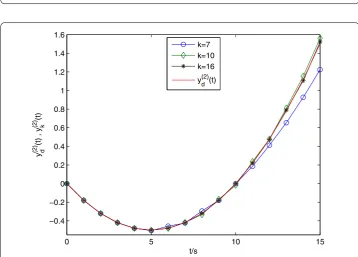
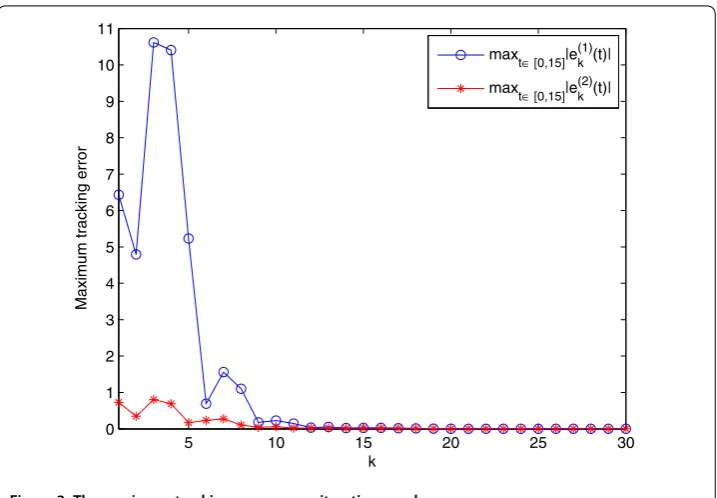
Figures 1 and 2 give the tracking situations of the system outputsy(1)k (t) andy(2)k (t) to the desired trajectories at the 7th, 10th and 16th iterations, respectively. From Figure 3, we know that the maximum tracking errorse(1)k (t) ande(2)k (t) tend to zero as the iteration number increases by using the closed-loop PD-type learning algorithm (2).
Example 2 Consider the following discrete-time singular system with state delay:
⎧ ⎨ ⎩
Exk(t+ 1) =Axk(t) +Dxk(t–τ) +Buk(t),
Figure 1 The tracking performance of the system outputy(1)k (t) to the desired trajectoryyd(1)(t) at different iterations by using the learning algorithm (2).
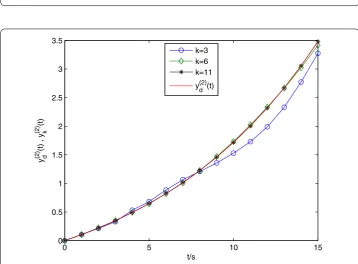
Figure 2 The tracking performance of the system outputy(2)k (t) to the desired trajectoryyd(2)(t) at different iterations by using the learning algorithm (2).
wheret∈[0, 14], the time delayτ= 1, and
E=
1 0 0 0
, A=
1 0.1 0.5 0
, D=
0 0.1 0.1 0.2
, B=C=
1 0 0 1
Figure 3 The maximum tracking error versus iteration number.
By Lemma 1 in [19], we know that the system (19) is noncausal. According to the algo-rithm (2), take the gain matrices
= given desired output trajectory as
yd(t) =
Set the initial state and the initial input
xk(t) =
Figure 4 The tracking performance of the system outputy(1)k (t) to the desired trajectoryyd(1)(t) at different iterations by using the learning algorithm (2).
Figure 5 The tracking performance of the system outputy(2)k (t) to desired trajectoryyd(2)(t) at different iterations by using the learning algorithm (2).
6 Conclusion
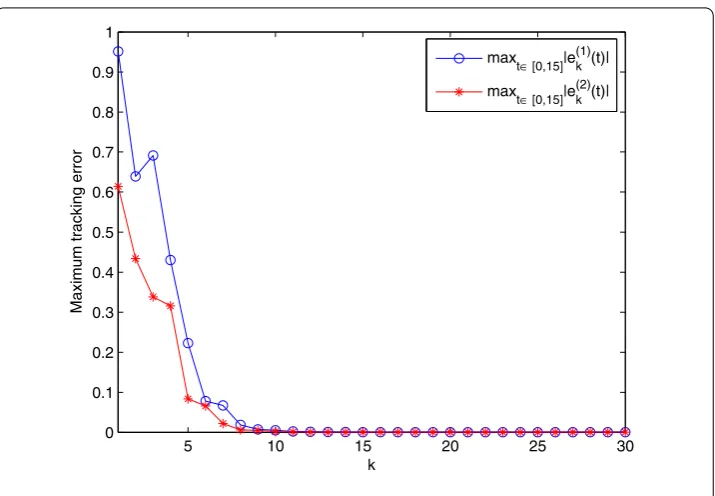
Figure 6 The maximum tracking error versus iteration number.
time interval. The corresponding result is further extended to discrete-time singular sys-tems with state delay. In the end, two numerical examples are constructed to illustrate the effectiveness of the presented algorithm.
Acknowledgements
The authors would like to express their gratitude to the anonymous reviewers for their valuable suggestions that have improved the quality of this paper. This work was supported by the National Natural Science Foundation of China (Nos. 61374104, 61773170) and the Natural Science Foundation of Guangdong Province of China (No. 2016A030313505).
Competing interests
The authors declare that they have no competing interests.
Authors’ contributions
All the authors contributed equally to this work. All authors read and approved the final manuscript.
Publisher’s Note
Springer Nature remains neutral with regard to jurisdictional claims in published maps and institutional affiliations.
Received: 3 October 2017 Accepted: 29 December 2017
References
1. Bien, Z, Xu, JX: Iterative Learning Control: Analysis, Design, Integration and Applications. Kluwer Academic Publishers, Dordrecht (1998)
2. Xu, JX, Tan, Y: Linear and Nonlinear Iterative Learning Control. Springer, Berlin (2003)
3. Arimoto, S, Kawamura, S, Miyazaki, F: Bettering operation of robots by learning. J. Robot. Syst.1(2), 123-140 (1984) 4. Sun, M, Wang, D: Initial shift issues on discrete-time iterative learning control with system relative degree. IEEE Trans.
Autom. Control48(1), 144-148 (2003)
5. Moore, KL, Chen, Y, Bahl, V: Monotonically convergent iterative learning control for linear discrete-time systems. Automatica41(9), 1529-1537 (2005)
6. Hou, Z, Xu, JX, Zhong, H: Freeway traffic control using iterative learning control-based ramp metering and speed signaling. IEEE Trans. Veh. Technol.56(2), 466-477 (2007)
7. Zhu, Q: Iterative learning control design for linear discrete-time systems with multiple high-order internal models. Automatica62, 65-76 (2015)
8. Meng, D, Moore, KL: Robust iterative learning control for nonrepetitive uncertain systems. IEEE Trans. Autom. Control
62(2), 907-913 (2017)
9. Dai, L: Singular Control Systems. Springer, New York (1989)
11. Xu, S, Lam, J, Zou, Y, Li, J: Robust admissibility of time-varying singular systems with commensurate time delays. Automatica45(11), 2714-2717 (2009)
12. Wu, L, Shi, P, Gao, H: State estimation and sliding mode control of Markovian jump singular systems. IEEE Trans. Autom. Control55(5), 1213-1219 (2010)
13. Zheng, G, Bejarano, FJ: Observer design for linear singular time-delay systems. Automatica80(6), 1-9 (2017) 14. Piao, FX, Zhang, QL: Iterative learning control for linear singular systems. Control Decis.22(3), 349-356 (2007) 15. Piao, FX, Zhang, QL, Wang, ZF: Iterative learning control for a class of singular systems. Acta Autom. Sin.33(6),
658-659 (2007)
16. Xie, SL, Xie, ZD, Liu, YQ: Iterative learning control algorithm for state tracking of singular systems with delay. Syst. Eng. Electron.21(5), 10-16 (1999)
17. Tian, SP, Zhou, XJ: State tracking algorithm for a class of singular ILC systems. J. Syst. Sci. Math. Sci.32(6), 731-738 (2012)
18. Tian, S, Liu, Q, Dai, X, Zhang, J: A PD-type iterative learning control algorithm for singular discrete systems. Adv. Differ. Equ.2016, Article ID 321 (2016)