P60
When Active Surveillance Fails: An Analysis of Manitoba Prostate Centre Surveillance Patients Who Undergo Treatment
Kamaljot Kaler, Darrel Drachenberg
University of Manitoba, Winnipeg, MB, Canada
Background: PSA screening has resulted in a significant increase in the diagnosis of low risk prostate adenocarcinoma. Treating these cancers would cause significant morbidity with radical treatment. Active surveil-lance (AS) is an alternative to radical treatment for these cancers and to monitor them with the intent to treat radically once the cancer progresses.
Methods: In this retrospective study, patients treated at the Manitoba Prostate Cancer with an active diagnosis of Prostate Adenocarcinoma with Gleason ≤3+4, multiple biopsies, ≤t2b (with one exception), and PSA <20 (two exceptions) were analyzed for changes in PSA, PSA doubling time, PSA density, Prostate volume changes, triggers for biopsy, triggers for treat-ment, types of treattreat-ment, changes in Gleason grading, pathological changes such as cores involved, percent minimum and maximum. Further biopsy intervals were assessed, follow-up time, and surgical pathology if available. Consent was obtained.
Results: Manitoba Prostate Centre has 194 patients on Active Surveillance; 64 of whom received treatment. Of the treated patients the median age was 65 with an average follow up of 5.3 years, and average of 2.6 biopsies each. Median interval to first biopsy was 9.5 months, and 12 between all biopsies. Majority of patients had Gleason 3+3 when started on active surveillance. 68.8% had a final Gleason of ≥3+4. 64.6% of initial biopsies were triggered by PSA, and 81.3% of treatment was triggered by biopsy results, i.e. Gleason progression or volume changes.
Conclusions: The Manitoba Prostate Centre treatment data of Active surveil-lance is consistent with what is found in the literature. The data collected represents a significant cohort of patients relative to available literature.
P61
NaF PET/CT Scan Is More Accurate To Detect Bone Metastases in Advanced Prostate Cancer
Ilija Aleksic,1 Christopher M. Pieczonka,2 Vladimir Mouraviev,2 Peter
Iannotta,2 Herbert I. James III,2 David M. Albala1
1SUNY, Syracuse, NY, USA; 2Associated Medical Professionals of NY,
Syracuse, NY, USA
Background: The current standard for imaging CRPC is aimed to detect metastatic disease in bones as early as possible. Clinicians have identified bone metastasis predominantly through bone scintigraphy for the past few years. Recent studies have shown the NaF PET/CT Scans are significantly more sensitive and accurate in detecting bone lesions. This study conducted retrospective analysis to compare the competence of these two methods for identifying bone metastasis.
Methods: Out of the 614 patients with advanced prostate cancer being treated with androgen deprivation therapy (ADT) in this particular bone clinic database, 34 patients received a NaF PET Scan. Of the 34 our study included all male patients ranging from 52-89 years of age (median 75.5 years).
Results: Of these patients, 3 (8.8%) were determined to have metastasis with bone scintigraphy alone while 17 (50%) were determined to have metastasis with NaF Scan (p<0.005). Five patients had equivocal findings on Bone Scintigraphy. NaF Scan determined three of these as having no metastasis and two as having metastasis. NaF scan itself reported three patients as
having equivocal findings for metastatic disease, requiring clinical correla-tion. In addition, in two cases we noticed the lysis of bone deposits from some bones after treatment with Sipuleucin-T.
Conclusions: NaF PET/CT scan are feasible option for CRPC for detecting bone metastases, decreasing the dose, cost and imaging time. With cover-age of this procedure by Medicare patients have more sensitive and specific tool to early diagnose and monitor a treatment of CRPC.
P62
Use of Rectal Swab Culture Before Prostate Biopsy yields posi-tive results that can prevent Significant Risk Of Complication by administration of targeted antibiotics
Herbert I. James III, Christopher M. Pieczonka, Vladimir Mouraviev, Yi Yang, David M. Albala
Associated Medical Professionals of NY, Syracuse, NY, USA
Background: Trans-rectal ultrasound of prostate needle biopsy is the main-stay for diagnosing prostate cancer. Flouroquinolone antibiotics have typi-cally been used to prevent infections prior to biopsy. In the community we have seen a rise in resistance to flouroquinolone leaving patients dealing with urosepsis. By swabbing for flouroquinolone resistant organisms, physi-cians are able to tailor their choice of antimicrobial agent used for infection prevention following biopsy.
Method: Specimens were collected from the cohort of 701 patients using a BBL culture swab. The samples were labeled according to established protocol and transferred to the lab. Cultures were plated out against anti-biotic disks to see if resistances developed against the flouroquinolones. Results were reported to the ordering physician - in cases in which resis-tances developed, further testing was done to determine sensitivities. In all cases, patients were placed on other appropriate antibiotics for infection prevention.
Results: From January through April 2013, 701 rectal swab samples were obtained from patients. Of these patients, 72 cultures (10.3%) were noted to be positive for flouroquinolone-resistant flora. Below is the table by month regarding total positive cultures.
Conclusion: In our community, the incidence of flouroquinolone-resistance in patients undergoing transrectal ultrasound guided prostate biopsy was over 10%. In these cases, antibiotic coverage was changed based on the sensitivities of the rectal swab culture results. In no cases, did these patients develop serious infections or complication after biopsy. This rectal swab program is easy and safely instituted in the community setting.
Moderated Poster Session V: Oncology 2
Friday, November 1, 2013
3:30 PM - 5:00 PM
Table 1. P62
2013 Total positive Total tested positivePercent
January 15 196 7.6%
February 17 160 10.6%
March 21 162 13.0%
April 19 183 10.4%
P63
Five-year Outcomes after Prostate Brachytherapy with Cesium 131
Anne G. Dudley, Ryan P. Smith, Sushil Beriwal, Ronald M. Benoit University of Pittsburgh Medical Center, Pittsburgh, PA, USA
Background: Cesium 131 is the newest isotope utilized for prostate brachytherapy. The current study reports oncologic outcomes achieved with this isotope.
Methods: All patients who underwent prostate brachytherapy with Cesium 131 and had at least 24 months of follow up were included in this study. Patients with a Gleason score 3+4 or less and a PSA of 10 ng/mL were treated with external beam radiation and brachytherapy, and patients with a Gleason score ≥8 or a PSA >20 ng/mL were treated with external beam radiation, brachytherapy, and androgen deprivation therapy; although exceptions to these guidelines occurred. Patients were followed with PSA testing q 3 months for the first year, q 6 months until year 5, and then annually. The Phoenix definition was used to determine whether patients were biochemically free of disease (BFD).
Results: A total of 408 patients have undergone prostate brachytherapy with Cesium 131 at our institution. Two hundred thirty two patients have at least 24 months of follow up (mean follow-up 39.8 months, range 24-72 months) and are included in this analysis. For the total cohort, 97.4% of patients remain disease free. Biochemically disease free rates are 98.9%, 96.4%, and 96.4% for men with low risk, intermediate risk, and high risk disease, respectively. Biochemically disease-free rates are 98.2%, 93.5%, and 95.8% for men who underwent prostate brachytherapy as monotherapy, who underwent combination therapy, and who underwent trimodal therapy, respectively. Mean PSA five years after the procedure was <0.1 ng/mL, and 71.4% of patients followed for five years had an undetectable PSA, while 91.4% of patients had a PSA of ≤0.1 ng/mL.
Conclusions: Prostate brachytherapy with Cesium 131 appears to offer excellent cancer control for all risk categories at 5 years. We will continue to analyze outcomes to ensure that oncologic outcomes remain favorable as our cohort matures.
P64
The Effect of Steroids and Alpha-Blockade on the Severity and Duration of Urinary Morbidity after Prostate Brachytherapy Anne G. Dudley, Ryan P. Smith, Sushil Beriwal, Ronald M. Benoit University of Pittsburgh Medical Center, Pittsburgh, PA, USA
Background: Prostate brachytherapy is commonly associated with bother-some lower urinary tract symptoms after the procedure. The present study attempts to determine whether the severity and duration of these symp-toms can be improved by the use of corticosteroids and alpha blockade in the perioperative period.
Methods: Patients who were undergoing prostate brachytherapy as mono-therapy were included in the study, and patients receiving androgen deprivation therapy were excluded. Patients received prednisone 5 mg q day for seven days, beginning one day prior to the procedure. Patients also received flomax 0.4 mg q day beginning one day prior to the procedure and continuing for at least 3 months after the procedure. All patients were asked to complete an AUA Symptom Index and EPIC urinary sum-mary preoperatively and at 2 weeks, 3 months, and 6 months after the procedure. Patients were also asked by written instrument whether or not they had resumed their baseline voiding pattern. Outcomes in the patients who received prednisone and Flomax (treated cohort) were compared to consecutive patients who also underwent prostate brachytherapy as monotherapy but did not receive steroids or alpha-blockers in the peri-operative period (untreated cohort).
Results: Twenty eight consecutive patients who comprised the treated cohort were compared to 28 consecutive patients who comprised the untreated cohort. By 2 weeks, 3 months, and 6 months after the proce-dure; 10.7%, 46.4%, and 75.0% of patients had resumed their baseline voiding pattern in the untreated cohort. In the treated cohort; 28.6%, 71.4%, and 78.8% of patients had resumed their baseline voiding pat-tern by 2 weeks, 3 months, and 6 months after the procedure. AUA symptom scores in the untreated cohort were 6.3, 20.8, 11.9, and 10.3 pre-operatively and at 2 weeks, 3 months, and 6 months after the
proce-dure. AUA symptom scores in the treated cohort were 7.4, 18.2, 10.0, and 7.9 pre-operatively and at 2 weeks, 3 months, and 6 months after the procedure.
Conclusions: In the present study, the use of corticosteroids and alpha-blockade in the perioperative period in men undergoing prostate brachy-therapy as monobrachy-therapy decreased the duration and severity of the both-ersome lower urinary tract symptoms which commonly accompany this procedure.
P65
The History of BCG and Bladder Cancer: Ethical Considerations Anees Fazili, Jennifer Gordetsky, Ronald Rabinowitz
University of Rochester, Rochester, NY, USA
Background: In 1976, Morales et al first applied intravesical BCG, usher-ing in a new chapter in the treatment of bladder cancer. A review of the history of BCG use prior to that study raises some ethical questions about the design of this groundbreaking clinical trial.
Methods: We performed a review of the literature regarding the use of BCG as an anti-neoplastic agent, with a focus on its application to bladder cancer.
Results: In the 1950s BCG was shown to have anti-neoplastic qualities in mice. Experimentation on using BCG for human neoplasia began in the 1960s with work on acute lymphoblastic leukemia. By 1970, intra-lesional BCG injections had been reported for the treatment of melanoma. BCG’s anti-neoplastic properties came to the attention of urologists in the early 1970s when a trans-urethral, intra-tumoural BCG injection was reported to eradicate metastatic melanoma to the bladder. Two animal studies were then initiated, examining the effect of intravesical BCG, with the aim to better understand the safety and tolerability of this route of delivery. The clinical study by Morales et al utilizing intravesical BCG to treat human bladder cancer was begun before the authors had access to the results of these animal studies. This occurred in the days before the creation of Institutional Review Boards. Hence, despite being scientifi-cally sound and grounded in immunologic principles, there was a lack of appropriate pre-clinical and Phase 1 study data to support this study. Thus, study subjects could not have been appropriately counseled and informed regarding the risks and benefits of BCG therapy prior to study involvement.
Conclusions: The initial clinical study of intravesical BCG for bladder cancer used human subjects at a time when other research groups were still undertaking the necessary preliminary animal experiments. The subsequent creation of Institutional Review Boards in 1978 and more stringent FDA approval processes would make it impossible to perform a similar trial without prior rigorous animal studies today.
P66
Lower Urinary Tract Symptoms after Prostate Brachytherapy with Cesium 131
Anne G. Dudley, Ryan P. Smith, Sushil Beriwal, Ronald M. Benoit University of Pittsburgh Medical Center, Pittsburgh, PA, USA
Background: Cesium 131 is the newest isotope utilized for prostate brachytherapy, and is thought to be associated with a shorter duration of the bothersome lower urinary tract symptoms associated with the pro-cedure. The present study updates our experience with Cesium 131.
Methods: All patients who underwent prostate brachytherapy with Cesium 131 and had at least 12 months of follow up were included in this study. Patients completed an AUA symptom score and EPIC urinary survey pre-operatively; and at 2 weeks, 3 months, 6 months, 9 months, and 12 months after the procedure. Patients were also asked by written instrument at each post-operative interval whether they had resumed their baseline voiding pattern. Patients were considered back to baseline if their AUA symptom index was within 3 points of their pre-operative score, if their EPIC urinary summary was within 12 points of their pre-operative score, or if they answered yes to a written question inquiring whether they had resumed their baseline voiding pattern.
after the procedure; 23.2%, 62.3%, and 76.9% of patients had resumed their baseline voiding pattern. AUA symptom scores were 7.3, 18.6, 11.1, and 9.2 preoperatively and at 2 weeks, 3 months, and 6 months, respec-tively. EPIC urinary summary scores were 87.5, 58.4, 77.7, and 81.7 pre-operatively and at 2 weeks, 3 months, and 6 months, respectively.
Conclusions: Prostate brachytherapy with Cesium 131 appears to offer a shorter duration of the bothersome lower urinary tract symptoms which commonly occur after the procedure when compared to the other isotopes utilized for this procedure.
P67
Surgeon Factors Affecting Treatment Decisions in The Management Of Small Renal Cancers
Alexandra Millman,1 Kenneth Pace,1 Michael Ordon,1 Jason Y. Lee2 1St Michael’s Hospital, University of Toronto, Toronto, ON, Canada, 2St.
Michael’ Hospital, University of Toronto, Toronto, ON, Canada
Background: The incidental detection of small renal masses (SRMs) has become much more common due to the increasing use of diagnostic imaging modalities. Management of SRMs can include a variety of options, ranging from surveillance to radical nephrectomy. However, there is incomplete evidence on the best treatment protocol for such tumours, and in lieu of strong evidence-based guidelines, surgeons may be more subject to subconscious biases when making treatment recom-mendations to their patients. The objective is to examine current practices in the management of SRMs and, in particular, to determine if there are any surgeon-specific factors (e.g., age, practice type, etc) that may influ-ence treatment choices.
Methods: An online survey study was conducted among Canadian
urologists currently registered with the Canadian Urological Association (n=632). The questionnaire was distributed, via email-blast, and involved the collection of demographic information, clinical practice details, and recommended treatments for 6 index cases involving theoretical patients of various ages (51-80years) with SRMs (<4 cm), medical comorbidities, and renal function (eGFR 57-96 mL/min/1.73 m2). Data was analyzed
using SPSS software using Pearson and Spearman correlation for continu-ous and categorical data, respectively.
Results: A total of 110 urologists responded (17% response rate) to the survey, although the email blast also included pediatric and retired urolo-gists. While 51% of respondents were <45 years of age, 18% were >64 years old. Roughly half of participants (45%) were practicing in an aca-demic setting and most participated in regularly scheduled “tumour” rounds (75%). Only 6% of respondents reported a personal history of cancer. Older age correlated with a non-academic practice (p<0.001), a personal history of cancer (p<0.001), and more aggressive management (surgical) for the 2 index cases involving elderly patients (~80 years). A personal history of cancer also correlated with an increased likelihood of performing surgery on the same 2 elderly, index patients (p<0.04). Academic urologists were less likely to offer aggressive treatment (surgery) for these same elderly patients and when surgery was offered for any of the 6 index patients, they were more likely to utilize MIS techniques (p<0.005). For all 4 index cases where surgery could be considered the gold standard treatment, >50% of respondents reported, for each case, that they would utilize a MIS technique.
Conclusions: There are various factors that influence the management options offered to patients with SRMs. The surgeon’s age, personal history of cancer, and other surgeon-specific variables may significantly influence treatments offered across Canada.
P68
Histologic Distribution of Metastatic RCC Shows a Difference Between N+ And M+ Disease: An Analysis of the SEER Database Michael Daugherty, Gennady Bratslavsky
SUNY Upstate Medical University, Syracuse, NY, USA
Background: Metastatic RCC occurs in approximately a third of all cases of patients diagnosed. The extent of metastasis and prognosis of the patient is dependent on Fuhrman grade and also histologic type. Some histo-logic types are more indolent and possess less metastatic potential. It is
hypothesized that these differences in metastatic potential will manifest in different rates of nodal and distant metastasis for the various histologies.
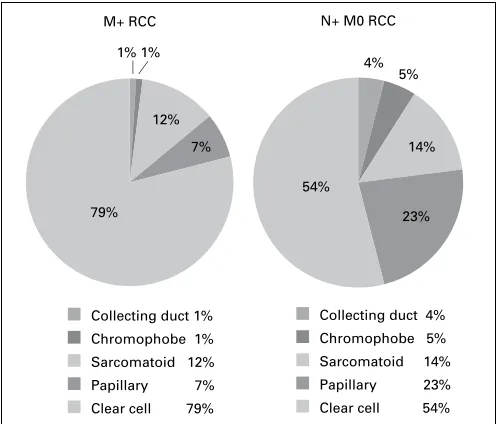
Methods: SEER-18 registries database was queried for all patients diag-nosed with metastatic RCC between the years 2004 and 2010. Histologies selected were Clear Cell, Papillary, Chromophobe, Sarcomatoid and Collecting Duct. Patients were separated into two cohorts: those that had M+ disease (regardless of nodal status) and those that had N+ disease with an M0 status. There were 4135 and 645 patients with M+ and N+ disease, respectively. Histologic distribution between the cohorts was compared using a Chi-square analysis.
Results: There were significant differences seen between the two cohorts in histologic distribution (p<0.0001, Fig. 1). There was a larger percentage of patients with papillary tumours in the N+ group (p<0.0001). In addi-tion, there was a smaller percentage of patients with clear cell tumours in the N+ group (p<0.0001). However, there was no difference seen when comparing sarcomatoid tumours in both groups (p=0.161).
Conclusion: The difference in histologic tumour rates is driven predomi-nantly by the greater than three-fold increase in the number of papillary tumours in the N+ M0 cohort. This can be explained by either the early spread of papillary tumours to lymph nodes, preferential environment for papillary metastases within the lymph nodes, or the limited ability of papillary tumours to metastasize distantly. Further molecular studies are needed to analyze the predilection for preferential metastatic sites observed in different histologic RCC subtypes.
P69
The Metastatic Potential of Chromophobe RCC is Dependent on Tumour Size: Results from the SEER Database
Michael Daugherty, Gennady Bratslavsky.
SUNY Upstate Medical University, Syracuse, NY, USA
Background: Chromophobe RCC tends to be an indolent tumour with a lower propensity of metastasis. As a result, these tumours are often over treated especially when a radical nephrectomy is performed to remove the mass. We hypothesize that there is a difference in tumour size between localized and metastatic tumours and that larger tumours experience a higher rate of metastasis.
Methods: SEER 18-registries database was queried for all patients age ≥20 years treated surgically for chromophobe RCC between 2000 and 2009. Tumours with unknown extension, grade, nodal status and size were excluded from analysis. In addition, patients with unknown race, sex and age were also excluded. Patients were divided into two cohorts based on metastatic status. There were a total of 1,740 patients with localized
Collecting duct 1% Chromophobe 1% Sarcomatoid 12% Papillary 7% Clear cell 79%
Collecting duct 4% Chromophobe 5% Sarcomatoid 14% Papillary 23% Clear cell 54%
M+ RCC N+ M0 RCC
1% 1%
12%
4% 5%
14%
54% 7%
79% 23%
tumours and 59 patients with metastatic tumours. Patient demographics and tumour characteristics were compared using chi-square analysis. Tumour size was compared between the two groups using an unpaired t-test.
Results: There were no differences in patient demographics between the groups, but there was a difference in tumour grade distribution (p<0.001). The mean localized tumour size was 5.9 cm (95% CI 5.7-6.0 cm), where-as the average metwhere-astatic tumour size wwhere-as 11.7 cm (95% CI 10.4-13 cm). The interquartile range for tumour size was 3-8 cm and 8-14.5 cm, for localized and metastatic tumours respectively. The 2 groups were signifi-cantly different when comparing the tumour size distribution (p<0.001).
Conclusions: Present SEER analysis reveals that the size of chromophobe RCC affects the metastatic potential of the tumour. These results can offer an alternative management strategy of patients found to have chromo-phobe RCC on needle biopsy. These patients may undergo active surveil-lance until the tumour reaches size of 8cm or larger, in order to avoid unnecessary surgery to remove cancers with limited metastatic potential.
P70
Histologic Distribution of RCC in Young Patients is Different from Older Patients: Results from the SEER Database
Michael Daugherty, Stephen Blakely, Oleg Shapiro, Gennady Bratslavsky SUNY Upstate Medical University, Syracuse, NY, USA
Background: Renal cell cancer incidence is relatively low in younger patients, encompassing 3-5% of all RCC tumours. While young patients often have bilateral multifocal tumours caused by known hereditary syn-dromes, some develop sporadic renal cancers without any family his-tory or known genetic mutations. Our recent observations from clinical practice have led us to hypothesize that there is a difference in histologic distribution in the younger patients when compared to the older cohort.
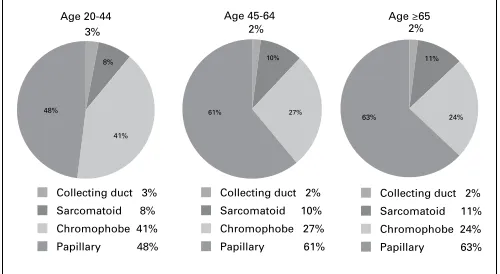
Methods: SEER 18-registries database was queried for all patients ≥20 years old that were surgically treated for renal cell carcinoma between the years 2001 and 2008. Patients with unknown race, grade, stage, histology and those with multiple tumours were excluded from the study. Histologies selected were clear cell, granular, papillary, chromophobe, sarcomatoid and collecting duct. Granular tumours were combined with clear cell during analysis as they are now considered one histologic entity. Three cohorts were created with the ages 20-44, 45-64 and ≥65 year olds that contained 3,514, 15,368, and 10,445 patients respectively. Chi-square analysis was used to compare the histologic distributions between the cohorts.
Results: There was no difference in the incidence of clear cell RCC between the three cohorts (p=0.50). The histology distribution was not different in the 45-64 year olds compared to those ≥65 (p=0.44). The non-clear cell histologies were different between the 3 age groups (p <0.001). There were a larger percentage of patients in the younger patients that had chromophobe tumours compared to all non-clear cell histologies (p<0.001, Fig. 1).
Conclusion: The difference in the non-clear cell histologic distribution between the groups may be due to genetic mutations predisposing these
patients to chromophobe RCC. There has been limited data on HRCs, due in large part to its low incidence. Although the HRCs are known to have a most common histology, it is likely that this information is incom-plete, as younger patients have undiagnosed genetic mutations that led to development of chromophobe tumours.
P71
Contemporary Series of Recurrent Superficial Bladder Cancer Treated with Intravesical Thiotepa
Kevin J. Rycyna, Tara Nikonow, Ronald Hrebinko, Benjamin J. Davies University of Pittsburgh Medical Center, Pittsburgh, PA, USA
Background: Intravesical thiotepa is an infrequently utilized therapy for superficial bladder cancer, with few reports in the current literature. We report our institution’s experience with this treatment over the previous 10 years.
Methods: After obtaining IRB approval, we retrospectively searched our institution’s clinical CPT coding for thiotepa use. Over the previous 10 years, there were 18 patients with thiotepa use recorded in their chart. These charts were then reviewed for pertinent information related to their bladder cancer management. Of the 18 patients initially collected, we excluded two from analysis due to incompleteness of the medical record, one for lack of a true recurrence before thiotepa, and one for having never received thiotepa. The remaining 14 patients all had a history of recurrent superficial urothelial carcinoma of the bladder and received at least one 6 week course of intravesical thiotepa.
Results: Nine out of fourteen (64%) were given thiotepa for recurrent low grade disease while the remaining five (36%) had recurrent superficial high grade disease. In the low grade group, five (55%) developed a high grade recurrence, one (11%) developed another low grade recurrence, and three (33%) did not recur after thiotepa. Median time to recurrence was 12.5 months (95% CI 3.4-84.6). In the high grade group, two (40%) had another high grade recurrence and two (40%) had no further recur-rences after thiotepa. One patient with high grade disease was lost to follow up after receiving thiotepa. Median time to recurrence was 13.5 months (95% CI 7 to 20). There was no significant difference in time to recurrence between the low and high grade groups (p=0.87). Seven of the fourteen patients were given thiotepa as a second or third line intra-vesical therapy. Three of these patients (43%) had no further recurrences following treatment. In the low grade group, there was no difference in time to recurrence between the four patients who received thiotepa as a primary intravesical therapy and the two patients who received it as second line (p=0.64).
Conclusions: Recurrent superficial bladder cancer can be a difficult enti-ty to treat, despite the development of improved intravesical therapies over the last two decades. We report a contemporary series of intravesi-cal thiotepa use, demonstrating a limited yet still relevant role for this therapy. Given the ongoing shortage of mitomycin C as well, thiotepa may become an increasingly useful second or third line agent for these challenging patients.
P72
Influence of Gender on Histologic Distribution and Stage at Presentation of Urethral Carcinomas
Ilija Aleksic, Mickey Daugherty, Gennady Bratslavsky SUNY Upstate, North Syracuse, NY, USA
Background: Urethral cancer is rare and histologically heterogeneous, and the literature on this topic is sparse. We aimed to evaluate the influ-ence of gender on histologic distribution and stage at presentation of urethral carcinomas.
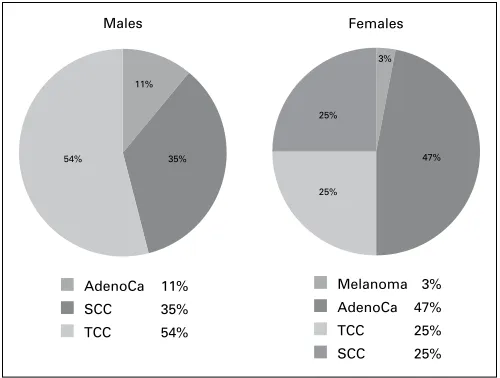
Results: A total of 419 patients with primary urethral carcinoma were identified in 250 males and 169 females. In males, the most common histology was TCC (134 of 250; 53.6%), followed by SCC (87 of 250; 34.8%). The distribution of urethral carcinoma for females varied from males, with adenocarcinoma being the most common (79 of 169; 46.7%), followed by SCC (43 of 169; 25.4%).
Adenocarcinoma accounted for the highest proportion of locally advanced (T3 and T4 tumours) in both genders (41%, in men and 65% in women). While the nodal and metastatic spread was more likely to occur with urethral SCC in men (37 and 15%, respectively), in women it was most commonly seen with urethral TCC (26 and 19%) (Fig. 1).
Conclusions: Histologic types of urethral carcinoma, mode of presenta-tion, and distant disease are different among men and women. Despite the same terminology, the behavior and aggressiveness of these tumours are indeed affected by gender. While embryologic origin likely regulate the histology and behavior of these tumours, knowledge of gender influ-ence may dictate further work-up, treatment, and subsequent follow-up.
P73
Concomitant Inguinal Hernia Repair at the Time of Open Radical Prostatectomy
Robert M. Turner, II, Benjamin T. Ristau, Jeffrey J. Tomaszewski, Elen Woldemichael, Steven Evans, Leonard E. Evans, Joel B. Nelson University of Pittsburgh Medical Center, Pittsburgh, PA, USA
Background: Inguinal hernia (IH) is a widely recognized complication of radical prostatectomy (RP) with most series demonstrating a 15-20% risk at 2 years postoperatively. Because of this, some have advocated for simultaneous herniorrhaphy at the time of RP in patients with IH identified intraoperatively. We sought to characterize risk factors for postopera-tive hernia development and to examine the efficacy of concomitant IH repair at the time of RP in patients with IH discovered on preoperative physical examination.
Methods: Patients from a prospectively collected cohort who underwent open RP by a single surgeon and had at least 2-years of follow-up were included. Men identified on preoperative physical examination to have an IH underwent hernia repair concomitantly with RP. Univariate and multivariate analyses were performed to identify factors that may predict postoperative inguinal hernia development.
Results: 2144 patients underwent open RP during the study period with a median follow-up of 71.5 months. 94 patients had 103 IH identified on preoperative physical examination and underwent concomitant her-nia repair. 3/94 (3.2%) patients undergoing IH repair at the time of RP recurred during the follow-up period. 112/2050 (5.5%) patients who did not undergo IH repair developed IH postoperatively, 51 (45.5%) of whom required corrective surgery. There was no difference in operative time
between the two groups (144m RP vs. 146m RP+IH, p=0.268). In those patients who did not undergo concomitant hernia repair, age, tobacco use, and bladder neck contracture were not risk factors for postoperative IH on univariate analysis. BMI was significantly lower in those patients who developed postoperative IH (26.8 vs. 28.0, p<0.001). Patients with a history of hernia were more likely to develop postoperative IH (8.1% vs. 4.7%, p=0.005, OR 1.77, 95% CI 1.18-2.67). On multivariate analy-sis, BMI and history of hernia remained significant (p=0.002 and 0.012, respectively).
Conclusion: IH repair at the time of RP in patients does not add sig-nificant time to the operation and should be performed in patients with preoperative evidence of IH. The low rate of postoperative hernia in this series compared to other published cohorts may be due to directed pre-operative physical examination and surgical technique. Consistent with previously published series, BMI and history of a hernia are significant predictors of IH after RP.
P74
The Impact of the USPSTF PSA-Based Prostate Cancer Screening Recommendations on Academic Institution Referral Volume Matthew C. Ferroni, Timothy D. Lyon, Tara N. Nikonow, Robert M. Turner, II, Benjamin J. Davies
University of Pittsburgh Medical Center, Pittsburgh, PA, USA
Background: In May 2012, the United States Preventative Services Task Force (USPSTF) published recommendations against PSA-based screening for prostate cancer in men in the general U.S. population. We aim to determine the immediate impact of the USPSTF screening recommenda-tions on the referral volume for urologic evaluation of elevated PSA at a large, academic institution.
Methods: We conducted a retrospective review of outpatient referrals to our urologic practice for evaluation of elevated PSA. Patients were catego-rized into two groups based on the date of referral. Group A represented the 10-month period prior to the recommendations initial appearance on the USPSTF website in October of 2011. Group B represented the 10-month period after the recommendations were published in print in May of 2012. Demographics collected included age and PSA value at the time of referral. Differences between mean age and PSA were calculated using t-tests and Mann-Whitney-U tests, respectively.
Results: 94 patients were referred for evaluation of elevated PSA during the study periods (52 in Group A and 42 in Group B). Subjects had a mean age of 62.4 ± 7.9 and mean PSA of 7.7±12.0 ng/dL. There was a 19.2% decrease in the number of referrals following release of the USPSTF recommendations. There was no significant difference between mean age of patients in groups A and B (62.8 vs. 61.9, p=0.57) or PSA (7.59 vs. 7.88, p=0.907).
Conclusions: Our practice saw a modest decrease in referrals for evalua-tion of elevated PSA in the early period following the release of the new USPSTF recommendations for PSA-based prostate cancer screening. There was no significant change in the mean age or PSA of subjects referred.
P75
Preoperative Albumin Level as a Predictor of Immediate Postoperative Outcomes following Radical Cystectomy Timothy D. Lyon,1 Thomas William Fuller,1 Nicholas J. Farber,2 Jeffrey
R. Gingrich,1 Tatum V. Tarin1
1University of Pittsburgh Medical Center, Pittsburgh, PA, USA, 2University
of Pittsburgh School of Medicine, Pittsburgh, PA, USA
Background: Low preoperative serum albumin, used as a marker for nutritional deficiency, has been associated with an increased risk of mor-tality within 90 days of cystectomy. We sought to investigate whether preoperative serum albumin had any predictive value on complication rates immediately following cystectomy.
Methods: A retrospective chart review for all patients who underwent radical cystectomy for bladder cancer at our institution from 2011-2012 was performed. Serum albumin levels drawn within one month prior to surgery were included. The incidence and type of complications during the immediate postoperative hospitalization were recorded.
AdenoCa 11%
SCC 35%
TCC 54%
Melanoma 3% AdenoCa 47%
TCC 25%
SCC 25%
Males Females
11%
35%
54% 47%
25% 25%
3%
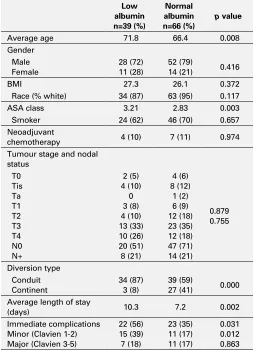
Results: A total of 105 patients had data sufficient for analysis. Thirty-nine patients had low preoperative albumin levels (less than 3.5 g/dL) while 66 patients had normal levels. Patients with low albumin were older, had a higher American Society of Anesthesiologists (ASA) class, and were more likely to undergo ileal conduit diversion than their counterparts in the normal albumin group. Low serum albumin was a statistically significant predictor of increased length of stay (10.3 vs. 7.2 days, p=0.002) and increased incidence of complications during the immediate postoperative hospital course (56% vs. 35%, p=0.031). These effects remained statisti-cally significant after an analysis of covariance to control for the effects of differences in age and ASA class.
Conclusions: This retrospective, single-institution study demonstrates serum albumin to be a significant predictor of increased length of stay and increased risk of complications following cystectomy. In an age where increasing importance is placed on delivering cost-effective care, serum albumin level may be a potentially modifiable preoperative risk factor.
Table 1. P75. Patient characteristics and outcomes
Low albumin n=39 (%)
Normal albumin n=66 (%)
p value
Average age 71.8 66.4 0.008 Gender
Male Female
28 (72) 11 (28)
52 (79)
14 (21) 0.416
BMI 27.3 26.1 0.372
Race (% white) 34 (87) 63 (95) 0.117 ASA class 3.21 2.83 0.003 Smoker 24 (62) 46 (70) 0.657 Neoadjuvant
chemotherapy 4 (10) 7 (11) 0.974 Tumour stage and nodal
status T0 Tis Ta T1 T2 T3 T4 N0 N+
2 (5) 4 (10)
0 3 (8) 4 (10) 13 (33) 10 (26) 20 (51) 8 (21)
4 (6) 8 (12)
1 (2) 6 (9) 12 (18) 23 (35) 12 (18) 47 (71) 14 (21)
0.879 0.755
Diversion type Conduit Continent
34 (87) 3 (8)
39 (59)
27 (41) 0.000 Average length of stay
(days) 10.3 7.2 0.002
Immediate complications Minor (Clavien 1-2) Major (Clavien 3-5)
22 (56) 15 (39) 7 (18)
23 (35) 11 (17) 11 (17)
0.031 0.012 0.863