Development and implementation of a mobile version of the O-SCORE assessment tool and case log for competency-based assessment in urology residency training: An initial assessment of utilization and acceptance amongst residents and faculty
Ryan Fitzpatrick, MD1; Nicholas R. Paterson, MD1; James Watterson, MD, FRCSC1; Christine Seabrook, MEd2; Matthew Roberts, MD, MEd, FRCSC1
1
Division of Urology, Department of Surgery; 2Office of Education, Department of Surgery; University of Ottawa, Ottawa, ON, Canada
Cite as: Can Urol Assoc J 2018 July 31; Epub ahead of print. http://dx.doi.org/10.5489/cuaj.5482
Published online July 31, 2018
***
Abstract
Introduction: In competency-based models of residency training, work-based assessments of residents’ technical skills are essential for both providing formative feedback and assessing surgical competence. The Ottawa Surgical Competency
Operating Room Evaluation (O-SCORE) is a previously validated paper-based evaluation tool created to assess a surgical trainees’ operative competence. To address some of the barriers to assessment, we developed and implemented a mobile application that
combines the O-SCORE with a surgical case log.
Methods: A description of the development implementation process for the mobile O-SCORE and case log is provided. Following implementation, a survey was developed and administered electronically to all faculty and residents within the University of Ottawa’s Division of Urology to assess user perceptions and utilization of the application. The survey was administered and data collected via Survey Monkey.
Results: The overall response rate was 94%. The majority of residents (94%) reported that it was easy to log cases with the application, and 81% felt that it had a positive impact on their training; 75% of faculty were willing or very willing to complete evaluations when assigned and 66% felt that the application had a positive effect on the quality of feedback they provided.
O-SCORE mobile application represents a practical electronic surgical log and work-based assessment instrument that can be easily adopted into any surgical training program.
Introduction
In surgical residency training, the assessment of residents’ competence continues to be largely knowledge-based, with only a limited number of validated tools to assess and provide feedback for surgical and technical skills.1 While national certification bodies focus on written and oral examinations to determine competence, residency training programs are responsible for ensuring trainee’s ability to perform all relevant operative procedures independently. Competence By Design (CBD) is an approach that focuses on learning the ‘outcomes’ or the abilities needed to practice, and involves designing
training with an explicit progression of expertise, from novice to expert. Work-based assessments (WBAs) consist of observations in the workplace that provide performance rating information and feedback to the learner, and are shared with trainees in a way that guides learning improvement towards achieving competence.2 With the ongoing
transition of residency programs nationwide to CBD, there is a need for validated WBAs. Traditionally, the assessment of surgical trainees’ operative skills has been accomplished through informal intraoperative observations and feedback from faculty (which are rarely documented). In the absence of any formal documentation of a trainee’s surgical
experience, residency programs and some licensing bodies have relied on surgical case logs as surrogate measures of competence. However, surgical case logs alone lack content validity, as simply being in the operating room doesn’t mean the trainee participated in the case or is competent to complete it independently.3
Assessment of resident performance during operative procedures can serve as an important feedback tool for trainees and to help trend performance.1 However, intra-operative assessments are administered at the discretion of individual institutions without standardization and their correlation with national board performance is limited and controversial.4 Surgical training programs should therefore have a reliable form of assessment to determine competency of a trainee by the attending physicians. An assessment tool that combines both operative evaluations and case logging on a user-friendly mobile platform was therefore developed to meet these needs.
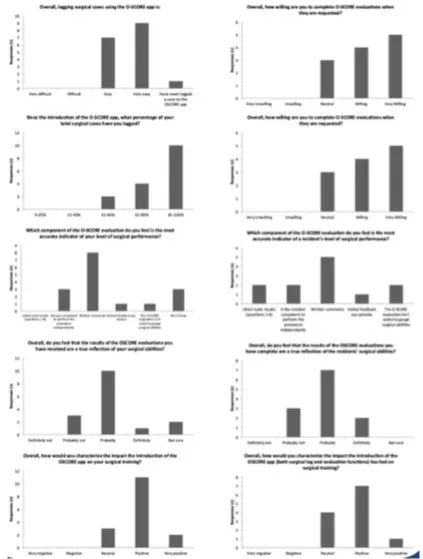
The Ottawa Surgical Competency Operating Room Evaluation (O-SCORE) is a 9-item surgical evaluation tool created to assess operative competence in surgical trainees.5 The development and validation of this tool are described elsewhere.5,6 The O-SCORE focuses on assessment of overall trainee competence to perform a specific procedure, and utilizes entrustment anchors such as “ability to safely perform this procedure
both O-SCORE and the most validated technical skills assessment method (Objective Structured Assessment of Technical Skills) have demonstrated equivalence.7,8
The O-SCORE was initially validated in paper format, with the associated challenges of collecting and collating evaluation forms completed by multiple faculty across several training sites. The implementation and widespread use of iPads for clinical activities within The Ottawa Hospital provided an opportunity to transition the O-SCORE assessment to an electronic version. An electronic OSCORE application coupled with a surgical log was developed to provide a web-based application accessible on all mobile devices, tablets or desk-top computers. In this study, we describe the development and implementation process, and assess the utilization and user perceptions of the mobile O-SCORE application within the University of Ottawa urology residency program.
Methods
Description of the electronic case log and O-SCORE application
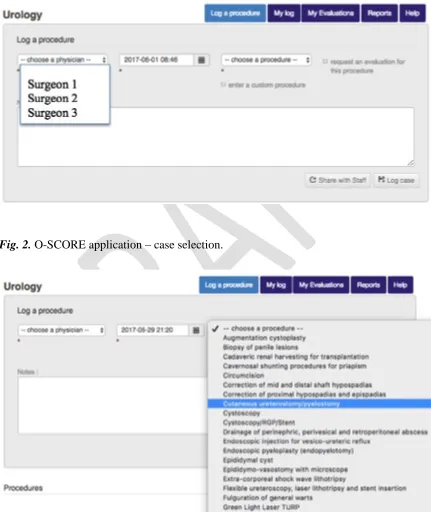
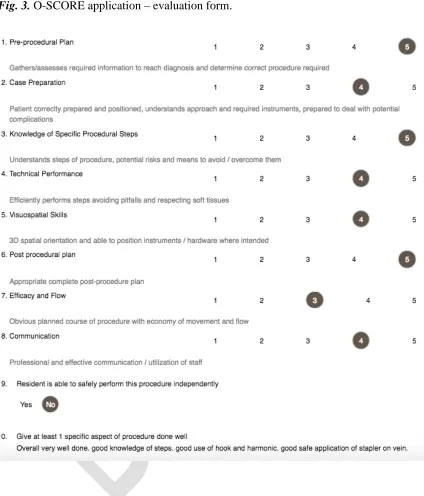
The O-SCORE application is web-based and can be accessed on any mobile device. The case logging and assessment process begins when a resident logs into the application, selects the faculty they are working with from a drop-down list (Figure 1), and selects the case type from a drop-down menu of common procedures (Figure 2). The resident then saves the case and the date and time are logged.
For each logged procedure, a pre-set algorithm randomly selects operative cases to be evaluated. The frequency of assessment for each case type varies and is
customizable by the program director; commonly-performed cases may be selected for evaluation on every third or fourth case that is logged, while less commonly performed cases may be selected every case that is logged. If a case is selected for evaluation, the staff physician immediately receives an e-mail notification. Ideally, cases are logged by the resident prior to beginning the procedure so that if the case is selected for evaluation the staff physician is notified prior to starting the operation. Once the case is complete, the staff physician then fills out the O-SCORE assessment form electronically (Figure 3). If the staff physician does not complete the online evaluation within 24 hours, the
evaluation expires, which limits recall bias, thereby improving the reliability and validity of evaluations.
Survey development
A survey was developed to assess user perceptions and utilization of the O-SCORE application. The survey was administered electronically via Survey Monkey to all faculty and resident members of the University of Ottawa Division of Urology. Use of
Results
The overall response rate was 94% (17/18 residents and 12/13 faculty). Twelve residents were in their senior years of training (PGY 3-5), and 5 were in their junior years (PGY 1-2). Five staff physicians were less than 40 years of age, 3 were between 40-49, 3 between 50-59 and one was older than 59.
Resident responses
Technology use in the workplace
Overall, responses indicate that residents were quite comfortable with using technology in the workplace. 100% of residents reported 1) that they were comfortable with using mobile technology like iPads and cell phones, and 2) that the O-SCORE application was easy to access on their devices. Prior to the launch of the O-SCORE application, 16/17 (94%) of residents used the device on a daily basis for clinical work, and 15/17 (88%) felt the wireless internet connectivity through the hospital networks was reliable. 14/17 (82%) felt that the orientation prior to the implementation and use of the O-SCORE application was helpful, 10/17 (59%) stated technical support for the application was easy to obtain, while 5/17 (29%) had never needed any technical support.
Surgical case logging
Most residents (16/17; 94%) felt that logging their cases using the O-SCORE application was easy. 9/17 (56%) residents felt that the number of available cases to select from was appropriate, while two (13%) felt there were too few cases available, and five (31%) felt there were too many options (Figure 1). Furthermore, 10/17 (63%) felt finding the appropriate procedure in the list was easy. Prior to the introduction of the O-SCORE application, residents used a variety of case logging systems. 8/16 (50%) had previously used T-RES, 3/16 (19%) used an electronic log like an excel spreadsheet, 4/16 (25%) used a paper log and 1/16 (6%) didn’t log cases. 9/16 (56%) of residents found logging cases on the O-SCORE system much easier as compared to T-RES, while 3/16 (18%) found the two systems similar. Since the introduction of the O-SCORE application, residents reported logging the majority of their cases through the application. 10/16 (63%) reported logging between 81-100% of their cases on the O-SCORE application, while 4/16 (25%) logged between 61-80% and 2/16 (12%) logged between 41-60% of their cases.
Assessment tool
after the procedure, 5/16 (31%) received feedback after leaving the OR but on the same day, and 2/16 (12%) received feedback the next day. Since the introduction of the O-SCORE, 12/16 (75%) of residents reported that the overall amount of verbal intra-operative feedback they receive has remained unchanged, while 4/16 (25%) felt it has increased. 9/16 (56%) of residents felt that staff physicians were willing to complete O-SCORE evaluations when requested.
With regards to the O-SCORE evaluation form (Figure 3), residents felt that the most valuable components were the written comments section (8/16; 50%) and the overall procedural competence field (3/16; 19%). No residents felt the 8 Likert-scale questions were the most valuable aspect of the O-SCORE application. 12/16 (75%) felt that the frequency at which cases were randomly selected for evaluation was appropriate. Overall, 11/16 (69%) of residents agreed that the evaluations provided through the O-SCORE were a true indicator of the level of their surgical skill. 100% of residents felt the electronic O-SCORE application made obtaining evaluations much easier compared to their previous experience with paper-based O-SCORE evaluations. Finally, 13/16 (81%) residents felt that the O-SCORE application as a combined surgical log and evaluation tool has made an overall positive impact on their residency training.
Resident comments
Residents commonly requested the ability to modify a case once it was logged so that if the actual operative procedure differed from the planned procedure (i.e simply placing a ureteric stent in the setting of a failed access ureteroscopy), this could be represented accurately in their log. They also requested a searchable feature for cases rather than having to scroll through the entire drop-down menu.
Faculty responses
Technology use in the workplace
8/12 (67%) faculty felt comfortable with using mobile technology and 100% felt they could easily install new applications onto their devices. 8/12 (67%) faculty brought their iPad with them to the hospital on most or all days. 9/12 (75%) of faculty felt that they could easily log onto the O-SCORE application, and that installing the O-SCORE application on their mobile device was easy. 7/12 (58%) felt that technical support was easy to obtain. 9/12 (75%) faculty had received orientation and training prior to using the application, and 100% of those who received the training felt it was helpful.
Surgical case logging
Assessment tool
When cases were selected for assessment, 6/12 (50%) faculty stated they were notified only by e-mail, while 5/12 (42%) were additionally notified by residents either pre- or post-operatively. Faculty varied in the amount of in-person feedback they provided to a resident when they were aware that the case had been flagged for evaluation. 6/12 (50%) reported providing verbal feedback about 50% of the cases, while 1/12 (8%) reported providing feedback 75% of the time and 3/12 (25%) reported only providing feedback 25% of the time. 2/12 (17%) never provided verbal feedback. If the faculty were to provide feedback for the flagged case, 4/12 (33%) provided it immediately following the case and 5/12 (42%) provided the feedback after leaving the OR but on the same day. 6/12 (50%) of faculty felt that since the introduction of the O-SCORE application, the amount of in-person feedback they provided to residents regarding their surgical performance had increased. 9/12 (75%) faculty were willing to complete O-SCORE evaluations when requested.
Concerning the overall O-SCORE evaluation form, faculty felt that the most valuable component was the written comments section 5/12 (42%), followed by the 8 Likert scale questions (2/12; 17%) and the independent competence indicator (2/12; 17%). 9/12 (75%) felt that the results of the O-SCORE evaluations were indicative of a residents overall surgical skill. 10/12 (83%) faculty felt that the frequency of which cases were randomly selected for evaluation was adequate.
Overall, 100% of faculty felt that the electronic version made completing evaluations much easier as compared to the previously used paper format. The majority of faculty felt that the O-SCORE application as a combined surgical log and evaluation tool has had an overall positive impact on surgical training within the division (8/12; 75%).
Faculty comments
In the comments section, faculty mentioned that having to reset passwords frequently was a barrier to accessing the application. They also expressed that it was often challenging to complete evaluation forms within the 24-hour expiration time frame.
Discussion
As the paradigm of medical education shifts towards CBD, residents will need to
demonstrate that they are able to competently perform entrustable professional activities (EPAs) to progress through their training and to graduate.2 CBD will promote greater accountability on behalf of the resident as their training will be centered on their
Currently in Canada, there is no nationally-accepted or well-validated surgical case log or assessment tool for use in urology residency training. The original O-SCORE assessment tool is paper-based and represents an accurate, validated tool to assess
operative competency.5 The electronic application we developed streamlines the process of data collection and resident assessment by combining case-logging with O-SCORE assessment on a mobile platform.
Residents all used their iPad daily, which provided regular access to the electronic application to log their cases and review their evaluations. They felt that logging cases on the application was simple, and the vast majority of them logged all of their cases on the application. However, given their comments, some minor modifications can be made to the application to further improve its usability. Interestingly, most residents felt as though the amount of verbal feedback had not dramatically improved since the introduction of the O-SCORE application despite an obvious increase in the amount of written feedback. This likely has to do with residents still logging cases after the completion of the surgical procedure as opposed to before the case. Therefore, the staff physician may have already left the room and the opportunity for immediate verbal feedback was lost. If residents are able to modify the cases post-operatively as they requested in their comments, we may be able to increase the proportion of cases logged prior to beginning the procedure and thus increase the amount of timely verbal feedback.
The majority of faculty used their iPad regularly at the hospital, and they reported no major problems with using the O-SCORE application. Faculty felt that the written comments were the most useful portion of the O-SCORE evaluation, possibly because they allow direct identification of specific aspects of the procedure that the resident did well and/or identify areas to focus on for improvement. Overall, faculty were very willing to fill out evaluations when requested, although they did highlight that the 24-hour
expiration of the evaluations was limiting. The expiration time was set so that the assessments are done shortly following the procedure in order to maximize their reliability and accuracy.
program, we cannot determine if the experience would be similar in other institutions or specialties. At the University of Ottawa widespread dissemination and use of iPads for clinical care has likely created a positive environment and culture for adoption of electronic applications in general. Availability of technology, as well as institutional culture and user familiarity with mobile devices likely varies across other institutions and residency programs.
Second, many of the domains we assessed regarding utilization relied on the subjective recall of survey respondents. We have not yet obtained objective data on the true frequency of use of the O-SCORE system among our staff and residents. The survey suggests the application has been received favourably, but without a direct comparison between number of cases logged/assessed and number of cases actually performed, we cannot definitely evaluate the utilization rate of the application.
In the future, as more cases are logged and assessments carried out on the application, we hope to generate learning curves for specific procedures in urology in order to determine the approximate number of cases it takes for a resident to achieve competence. Defining time to competence for core, specialty specific procedures will be critical to curriculum development in the transition to CBD for all surgical training programs.
Conclusion
References
1. Boerebach, B. C. M., Arah, O. A., Busch, O. R. C. & Lombarts, K. M. J. M. H. Reliable and valid tools for measuring surgeons’ teaching performance: Residents’ vs. self evaluation. J. Surg. Educ.69, 511–520 (2012).
2. Gofton, W., Dudek, N., Barton, G., and Bhanji, F. Workplace-Based Assessment Implementation Guide: Formative tips for medical teaching practice. 1st ed. (PDF) Ottawa: The Royal College of Physicians and Surgeons of Canada, pg. 1-12. (2017).
3. Fronza, J. S., Prystowsky, J. P., Darosa, D. & Fryer, J. P. Surgical residents’ perception of competence and relevance of the clinical curriculum to future practice. J. Surg. Educ.69, 792–797 (2012).
4. Ray, J. J. et al. Association Between American Board of Surgery In-Training Examination Scores and Resident Performance. JAMA Surg.215, 1–6 (2015). 5. Gofton, W. T., Dudek, N. L., Wood, T. J., Balaa, F. & Hamstra, S. J. The Ottawa
Surgical Competency Operating Room Evaluation (O-SCORE): a tool to assess surgical competence. Acad. Med.87, 1401–1407 (2012).
6. MacEwan, M. J., Dudek, N. L., Wood, T. J. & Gofton, W. T. Continued Validation of the O-SCORE (Ottawa Surgical Competency Operating Room Evaluation): Use in the Simulated Environment. Teach. Learn. Med.28, 72–9 (2016).
7. Doyle, J. D., Webber, E. M. & Sidhu, R. S. A universal global rating scale for the evaluation of technical skills in the operating room. Am. J. Surg.193, 551–555 (2007).
Figures and Tables
Fig. 1. O-SCORE application – faculty selection.