Automatic Metal Separation and Packaging
Using PLC
34T
P.Thirumurugan
Assistant Professor Department of Instrumentation and Control Engineering, Saranathan College of Engineering, Tiruchirappalli-620012.
31TU
R.Aravind, M.Arun Kumar, S.Dharshan Manjunath, R.Kalaiselvan.
B.E Students, Department of Instrumentation and Control Engineering, Saranathan College of Engineering, Tiruchirappalli-620 012.
31TU
[email protected]U31T,31TU[email protected],[email protected],[email protected]
ABSTRACT- In this work is to design, develop the programmable logic controller based Metal Separation and
Packaging. This work will provide high accuracy and flexibility to the system and at the same time it will provide accurate amount of material in box by saving operational time. In this work, a prototype has been designed. The system sequence of operation is being designed by ladder diagram. Components used in this work are programmable logic controller (PLC), proximity sensor, DC Motors.it consist of three sections; the primary conveyor, the secondary conveyor and packing section. The mechanical part of the project consists of mechanical drawing, measuring, welding and fabricating process, while electrical part consists of electrical drawing; electrical wiring and programming.
Keywords: PLC, Proximity sensor, Conveyor, DC motor.
I. INTRODUCTION
Companies must automate in order to deliver what today’s customer is demanding when he wants it and at the price he wants to pay. The various process of this system is controlled by PLC. PLC is heart of the system and the system is controlled according to the programmed PLC. The automatic metal separation system based on PLC control has advantages of smooth operation and high in its efficiency for the metal segregation. So In order to improve the production efficiency, it is quite necessary to apply PLC (Programmable Logical Controller) in automatic separation system. Ladder logic is used to control the process. Separation process is controlled by using various methods using motor, sensors, conveyor belt, PLC. The PLC concept increases reliability and reduces installation costs by localizing control functions near the process plant, with remote monitoring and supervision. The system is used in tools packing industry, waste disposal industry. This work is divided into three sections; the conveyor section (transfer section), sensing section and packing section. The whole sections are controlled by the Delta PLC. The mechanical part of the project consists of mechanical drawing, measuring, welding and fabricating process, while electrical part consists of electrical drawing; electrical wiring and programming. The software of the Delta PLC theory includes the electrical and mechanical actuators for the hardware will be showing a good result to fulfill the objectives.
A. PLC (Programmable Logic Controllers) system
Programmable controller is an industrial digital computer. They were first developed in the automobile industry to provide flexible, ruggedized and easily programmable controllers to replace hard-wired relays, timers and sequencers. When digital computers became available, being general-purpose programmable devices, they were soon applied to control sequential and combinatorial logic in industrial processes. However these early computers required specialist programmers and stringent operating environmental control for temperature, cleanliness, and power quality. To meet these challenges the PLC was developed with several key attributes. The functionality of the PLC has evolved over the years to include sequential relay control, motion control, process control, distributed control systems, and networking.
There are five basic components in a PLC system:
• The PLC processor or controller. • I/O (Input /Output) modules. • Chassis or backplane. • Power supply.
• Programming software that runs in a PC. • Network Interface.
Fig.1 Block Diagram of PLC.
B. The PLC Processor
C. I/O Modules
They physically connect to field devices. Input modules convert electrical signals coming in from input field devices such as pushbuttons, to electrical signals that the PLC can understand. Output modules take information coming from the PLC and convert it to electrical signals the output field devices can understand, such as a motor starter, or a hydraulic solenoid valve. I/O comes in various forms.
D. Power Supply
The function of the power supply is to provide the DC power required to operate the PLC system. It is supplied by single-phase 120 or 240V AC line power that powers the PLC system.
II. BLOCK DIAGRAM OF PLC AUTOMATIC METAL SEPARATION AND PACKING SYSTEM
-Fig.2 Block diagram of packing machine.
The block diagram shows the basic connections of the setup. Initially the input has been given by using the Switch Mode Power Supply [SMPS]. The SMPS has been used here in order to reduce the incoming 230v AC supply to 24v DC supply. Here we convert it to 24v DC supply because the components we used here specification of about 24v DC supply. The SMPS also act as filter purpose that is to reduce unwanted noises. The output from the SMPS is given to the PLC Inputs by using the terminal blocks. Here the diagram shows that the PLC consists of 4 Inputs, they are SMPS, start button, proximity sensor and stop button. The output of the PLC comprised of three motors, they are main motor 1, motor 2, and packaging motor 3.
A.
Process flow diagram
Fig.3 Basic operations of our work in Flow chart manner.
III. DESIGN AND SIMULATION
The basic process of design and simulation has an important role in order to get good results. Here we have attached with some of our basic design methods and the components used for the designing methods. The simulation process has been done through the software process by which the Programmable Logic Controllers has been programmed in the ladder logic manner. In our design and simulation process we have included the overall mechanical setup which we have fabricated and also the packing system in which the incoming products will get segregated.
A. Experimental details
The basic components which we have used in our work are belt conveyors, Switch mode power supply (SMPS), relay cord, DC motors, Proximity sensor, MCB switch. The belt conveyor is usually made from the mica sheet.
The Switch Mode Power Supply has been used in order to get regulate the incoming signal or voltage.
Table 1: Components Used and Its Specification COMPONENTS SPECIFICATION QTY
Belt conveyor length of belt : 80 inch width : 5 inch material :resin
2
Relay Cord -
1
Dc motors 12v ; 30rpm 3
Proximity sensor - 2
Delta PLC - 1
On-off button - 1
Connectors - As
Requi red
SMPS 24v & 12v 2
MCB switch - 1
B. Process model and connections
Fig.4 Design of the packing and separation process.
Fig.5 Separation mechanism prototype.
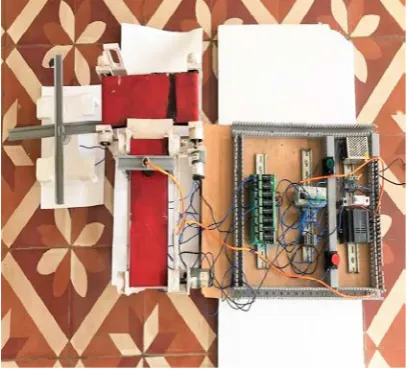
The fig .5 shows that the initial setup of the main two conveyors. The conveyor 1 is the one in which the metallic object has been coming into the sensing area. Based on the sensing type whether it is metal or not, the conveyor 2 will move in its required direction. The metal sensor used here will detect the metals only when it is very nearer to it. For further improvements we can use high range metal sensors which can detect more accurate with a long range.
Here also we can use non-metal sensor by which we can separate the non–metallic products.
C. PLC program for metal detection and packing
Fig.6 Basic Ladder diagram for conveyor
The fig.6 explains the basic operation of the conveyor 1 system. Here the x0, x1, x2, are the inputs of the PLC system and y0, y1, y2 are the outputs of the PLC system.
Fig.7 Ladder diagram for timer process.
Here the fig 7 shows the basic laddar diagram of the initial moving of the conveyor 1 as well as conveyor 2. The extra time delay has also been given in this in order to get a delay for the conveyor to move as per the sensing of the objects.
Fig.8 Ladder diagram for sensor process.
Fig.9 Sensing section.
considerable counts then the motor starts moves for packing section, the next box moves for the cycle of rotation.
IV. RESULT AND DISCUSSION
Thus, from our projects we have got a clear idea about how to automate packing process using PLC automation. The metal separation has been widely used in the present industries in order to easy identification of a metallic and non-metallic product. Then out coming product will undergo into a packing section which is used for collecting metal or non-metallic products. The main application of our project is widely used in the garbage disposal process. The further improvement of our work can be done by increasing the efficiency of the conveyor system and by increasing the high range of sensitivity of the sensor.
V. CONCLUSION
From the above work we have made the fully automatic Metal separation and its packing process. The system meets the demand of high-speed production using the least mechanism requirements. The system also provides high accuracy and precision of incoming metals or any other non-metallic products. Although proposed system illustrates the separation of metallic and non-metallic products with the help of a PLC based conveyor system. It is true that the use of PLC is a costly affair particularly for small industries but it offers many advantages like it can be easily programmable and it is easy to handle.
REFERENCES
[1]. Ranjit R. Bagve, Vithal Kumbhar, Mukund D. Bhat, Sidhesh V. Verleker,Joel Fernandes, “Automatic Packing Machine & Material Handling using Programmable Logic Controller PLC”, IJIRST –International Journal for Innovative Research in Science & Technology Volume 2 Issue 10 March 2016.
[2]. Mangesh B. Nagapure, Dr. R. M. Deshmukh, (2017), “PLC based Segregation of Scrap Material”, Mangesh B. Nagapure Int. Journal of Engineering Research and Application, Vol. 7, Issue 4, Part -3 April 2017, pp.06-10
[3]. A. W. Maynard and H. S. Caldwell, “Identification and Sorting of Nonferrous Scrap Metals, Proceedings of the third mineral waste utilization” symposium, Chicago, Illinois on March 14-16, 1972.
[4]. Marco Colla 2009 "Design and Implementation of industrial Automation Control System: a Survey"; Industrial Informatics; 7th IEEE International Conference on Digital Object Identifier; IEEE.
[5]. Chitra.S, Vijaya Raghavan 2014, “Conveyor Control Using Programmable Logic Controller”,International Journal of Advancements in Research & Technology, Volume 3, Issue 8, August-2014.
[6]. Elhalwagy and Attalla hashad 2010 “Three Layer PLC/ SCADA System Architecture in Process Automation and Data Monitoring” IEEE.
[7]. Guo, L., Pecen, R., “Design Projects in a Programmable Logic Controller PLC Course in Electrical Engineering Technology”, ASEE Annual Conference & Exposition, 2008.
[8]. Petruzella, F. D., Programmable Logic Controllers, McGraw Hill, 2005.
[10
].
Alhade A. Algitta , Mustafa S , Ibrahim F, Abdalruof N, Yousef M, 2015,“
Automated Packaging Machine Using PLC”, IJISET - International Journal of Innovative Science, Engineering & Technology, Vol. 2 Issue 5, May 2015.
[11]. D.Kanimozhi, B.Nantheni Devi, T.Manochandar 2015, “PLC Controlled Automatic Food Packaging Machine” International Journal of Engineering Trends and Technology IJETT – Volume 30 Number 1 - December 2015.
[12]. Ranjit R. Bagve, Vithal Kumbhar, Mukund D. Bhat, Sidhesh V. Verleker 2016, “Automatic Packing Machine & Material Handling using Programmable Logic Controller PLC”, IJIRST –International Journal for Innovative Research in Science & Technology Volume 2 Issue 10 March 2016 ISSN online: 2349-6010.
[13]. Maitrey Trivedi and Vishakha Sheoran 2014 ‘An Analysis and control of a closed loop conveyor system using PLC and sensor', International Journal of Innovative and Emerging Research in Engineering Volume 1.
[14]. Alhade A. Algitta, Mustafa S, Ibrahim F, Abdalruof N, Yousef M, “Automated Packaging Machine Using PLC”, IJISET - International Journal of Innovative Science, Engineering & Technology, Vol. 2 Issue 5, May 2015.