
3(4): 1701-1730, 2013
SCIENCEDOMAIN international www.sciencedomain.org
de Novo Radio Frequency Ablation Therapy:
Application of Unexplored Electromagnetic
Spectral Resources of mm-Wave/THz Band in
Clinical Ablation Procedures – A Review
Perambur S. Neelakanta
1*and Bharti Sharma
11
Department of Computer and Electrical Engineering and Computer Science, College of Engineering & Computer Science, Florida Atlantic University, Boca Raton, Florida 33431, USA.
Authors’ contributions
This work was carried out in collaboration between both authors. Author PSN designed the study including the literature search, developed the algorithms and wrote the first draft of the manuscript. Author BS performed the computations and managed the underlying analyses of the study. Both authors read and approved the final manuscript.
Received 3rd April 2013 Accepted 21st May 2013 Published 3rd June 2013
ABSTRACT
Review Focus: General considerations on ablation procedure advocated in clinical
contexts using electromagnetic (EM) energy are comprehensively reviewed. Relevant radiofrequency (RF) and/or microwave ablation techniques that have been in vogue and in traditional use across clinical procedures are revisited. Traditionally, RF/microwave ablations have been applied to a variety of pathological states, (in lieu of surgical methods and/or electrocautry procedures) so as to remove unwanted/cancerous tissue layers. Relevantly, new avenues of adopting unexplored electromagnetic (EM) energy falling in the spectral range of mm-wave/THz frequencies for such medical ablation purposes are studied. These higher frequencies for ablation can be considered either to supplant or used in parallel with the existing RF/microwave bands (at 915 MHz and 2.45 GHz). The motivation thereof is to identify certain improved ablation feasibility and derivable merits in clinical sense. Hence, the efficacy of the proposed scheme is identified for two exemplar ablation therapy procedures pertinent to Barrett’s esophagus and menorrhagia. Pertinent pros and cons are discussed and practical ablator designs
are indicated.
Study Details: Considering the strategy of using the proposed mm-wave/THz EM
energy would amount to a shallow ablation via ‘thermal scouring’ of the tissue-linings intended for ablation and prevent otherwise undesirable hot-spots in deep-tissue media. This is conceivable because the advocated frequency bands would allow a very shallow skin-depth of penetration of EM energy; and hence, tissue-heating will be limited only to superficial linings. Further, the associated super-high frequency will heat the ablation site extremely fast reducing the procedure time considerably.
In a Nut-shell: The study first offers a comprehensive review on classical and projects
de novo aspects of EM ablation therapy with unexplored electromagnetic spectral resources of mm-Wave/THz band. Illustrated as examples are feasibility details concerning the ablation of the endometrium and Barrett’s esophagus. Design aspects of ablators are presented.
Place and Duration of Study: The study reported is limited to a review on the
subject-matter and provides analytical designs and computational models on the procedure performed (2012-2013) at: Department of Computer and Electrical Engineering and Computer Science, College of Engineering & Computer Science, Florida Atlantic University, Boca Raton, Florida 33431, USA.
Keywords: RF/microwave ablation; mm-wave/THz frequency ablation; Barrett’s esophagus; endometrial ablation.
1. INTRODUCTION
Ablation is a method of eroding a surface so as to scour off the surface material as necessary. In general, it refers to ad hoc removal of material from the surface of an object by vaporization, chipping, or other compatible erosive processes. In clinical contexts, removal or detachment of abnormal and undesired tissue growths either by surgery or by chemical, laser or electrocautry methods is termed as medical ablation procedure [1-22].
Surgically-invasive scalpel procedure was a traditional method pursued in yester years for medical ablation regimens. Later, electrocautry and passing low-frequency AC or pulses of direct current using an invasive catheter needle were advocated for tissue ablations. Such procedures however, directly stimulate the nerves in situ and as such, they similar to surgical methods, still warranted general anesthetic support.
and, RFA has been advocated on a gamut of anatomical sites and medical conditions as will be described later.
Various clinically tangible methods of clinical ablation of a biological region/surface using RF/microwave are indicated in the literature [1-22]. Mostly, they describe the procedure in terms of the basic physics of EM interactions with the tissue and the corresponding conversion of RF/microwave energy into thermal energy. Further, the method of applying RF/microwave energy using an applicator is emphasized. The generic version of applicator or ablator defines the mode of feeding the EM energy and the associated antenna (radiating) structure. Relevant clinical/preclinical details on the efficacy of the procedure are also outlined in [1-22]. However, no rigorous analytical framework has been developed pertinent to a given anatomical site considered as an ablation candidate so as to formulate a comprehensive portrayal of the energy to biomedia interactions, and related thermodynamics of heat patterns generated conducive for effective ablation. For example, given a biological medium, no comprehensive model on the modality of interaction of EM wave versus the biomedia in question is available. As well as, no pertinent details on thermal energy distribution across the biomedium being ablated have been elucidated. Such details are however, necessary to design the associated system vis-à-vis the depth and zone of ablation attainable with a given type of EM excitation and requirements posed on appropriate applicators.
Hence, RF ablation techniques have been developed at certain designated frequencies like 915 MHz and 2.45 GHz (ISM band) [23]. The use of a specific frequency and the corresponding wavelength would directly implicate the depth of penetration of EM energy and the associated volume of heating at the ablation zone of interest. In the prevailing contexts of RF-based ablation methods, with the designated frequencies namely, 915 MHz and/or 2.45 GHz (ISM band), the corresponding depth of penetration of EM energy would correspond to centimeter values in typical tissue media. As such, if the ablation has to be restricted only for superficial areas, the in-depth heating of the tissues is rather unnecessary and it may cause unwanted (clinically undesirable) physiological invasion as well as hot-spots at sites of vulnerability.
Therefore, proposed in this study is to consider a high spectral region of EM energy (like mm through THz band), which implies a very small wavelength (mm to micrometer) and the associated skin-depth of penetration of EM energy in the tissue medium will correspondingly be small. Hence, suggested are appropriate ablation methods toward effectively ablating the superficial region or lining of an anatomical site of interest; and, relevant strategy conforms to a shallow ablation depicting ‘scouring’ just the lining part of the site being ablated, thus avoiding any deep-tissue burns and invasive heating of undesired/unnecessary domains.
2. AN OVERVIEW ON TRADITIONAL RADIOFREQUENCY AND MICROWAVE
ABLATION PROCEDURES
Hyperthermic ablation, as indicated above depends on the mode of thermal energy imparted to the tissues and tissue surfaces by means of different sources including radiofrequency electrical current, microwaves, laser light, and focused ultrasound. The RF spectrum explored for therapeutic applications in ablation procedures includes 433 MHz. In addition, Federal Communications Commission (FCC) and/or International Telecommunications Union (ITU) permit several unrestricted frequency bands for industrial, scientific and medical (ISM) use in several regions, including those most commonly adopted for microwave ablation procedures being: 915 MHz and 2.45 GHz. Further, broadband pulses with spectral energy density between 1 GHz and 10 GHz [24] is also considered for ablation techniques. Specifically RF energy or microwaves based thermal ablation has been found to be a viable treatment option for several conditions, including cancer, cardiac arrhythmias, varicose veins and menorrhagia. Both RFA and microwave ablation are effective in patients especially with early-stages tumor growths. For example, whenever the subjects are ineligible for surgery, standard radiotherapy, or chemotherapy regimens for the treatment of non-small cell lung cancer or pulmonary metastases (with overall tumor size being less than 3.5 cm and median size being 1.5 cm), they have been treated via RFA. Further, RFA has been found to have a promising potential in the treatment of primary and secondary liver diseases, primary and secondary lung malignancies, renal and adrenal tumors, and bone metastases.
Ablative procedures are performed at open surgery, laparoscopically using catheter-based applicators, percutaneously or transcutaneously; and, minimally invasive ablations are typically performed using imaging methods as an adjunct facility/tool for diagnostic, guidance, monitoring and treatment assessment purposes. For example, using the imaging guidance, the tumor is first localized, and a thin (14.5-gauge) microwave antenna is placed directly into the tumor. EM wave generated by a microwave-source proliferates across the biomedium being ablated via an applicator antenna. The associated EM energy agitates the molecules of the tissue and water-content producing heat. This thermal condition introduced would induce typically cellular death via coagulation necrosis. The main advantages of such EM-based ablation technique include consistently facilitating higher intratumoral temperatures, permitting larger tumor ablation volumes, allowing faster ablation times and posing an improved convection profile. The RFA method has been indicated to be still in its infancy; and, future developments plus clinical implementation are sought to help patients clinically eligible for RFA procedures [16,19]. Details on examples pertinent to various clinical trials and adoptions in vogue of RFA/microwave ablations are outlined below:
2.1 Endometrial Ablation
delivered by inserting a compatible ablator into the uterine cavity via intravaginal/cervical passage. The microwaves applied destroy the unwanted basal layer complex of the endometrium by generating heat (caused by dissipative interaction of the EM energy with the biomolecules) in the biomedium to an extent of + 60ºC. The heating envisaged is confined to the partial biomedium of interest and remainder of the uterus is spared. MEA was introduced in 1995 and subsequently, relevant procedure has been rendered safer and simpler. It has been found to be an effective and it is a less invasive alternative to hysterectomy. MEA has several advantages over other treatments of menorrhagia (including hysterectomy) and uterine artery embolization. The procedure is quick and easy to perform, requiring minimal operative skill, and has few complications. Preoperative preparation is also straightforward and the procedure can be performed at a day surgery center. Thus, MEA is relatively cost effective.
Recently, a number of cases documenting successful treatment of menorrhagia with MEA in patients with medical complications have been reported [12,14]. Cases of heavy uterine bleeding caused by submucous myomas have been successfully controlled by MEA. Emergency situations to control uterine bleeding with possibility of eventual hemorrhagic shock have been handled with MEA without intra- or post-operative complications. Patients also have shown complete resolution of menorrhagia with a dramatic reduction in uterine size. MEA is performed under spinal anesthesia using an ablator device consisting of a sounding applicator and a microwave source. Typically, the applicator used at 2450 MHz is about 4 mm in diameter and 20 cm in length with appropriate terminating the tip conforming to a curved microwave radiator. Alternatively, MEA device with an applicator of 8.5 mm in diameter with non-bending tip and excited by microwaves at 9.2 GHz (X-band) has also been advocated for clinical practice. In any design, the shape of the applicator is rendered for easier and safer operation even in a large and distorted uterine cavity. Further, in the existing practice, the microwave source applies 30-70 W power at the irradiated site for approximately 50-200 s. With MEA therapy, a gradual reduction in the size of the myomas and uterus can be expected as confirmed by MRI images. A state of degenerative necrotic endometrium is displayed in such MRI images as an avascular area. Endometrial ablation thus removes or destroys the endometrial layers. In essence, the opposing walls of the myometrium collapse onto each other and the damaged tissue contracts developing into a scar. Any debris of endometrium remaining after the ablation is trapped beneath the scar, preventing further bleeding [25].
2.2 Tumor Ablation
RFA very effectively destroys the core of a tumor—the area that tends not to respond well to radiotherapy. Even if RFA does not remove all of a tumor, a reduction in the total amount of tumor may extend life of the subject to a significant extent. Since RFA is relatively a quick procedure with fast recovery, subsequent chemotherapy may be resumed immediately as needed. Further, RFA toward tumor ablation is less expensive than other treatment options. Usually residual tumor after RFA is found in patients with tumor size greater than 3.7 cm suggesting that such larger tumors are more difficult to eradicate completely with radiofrequency ablation.
2.3 Endocardial Ablation
This refers to ablating the cardiac tissue and performed to cure atrial fibrillation, aortic stenosis or coronary artery disease [20]. Ablation is now the standard treatment for supraventricular tachycardia (SVT) and typical atrial flutter and the technique can also be used in AF [26]. RFA is deployed in such cases pertinent to heart tissues or normal parts so as to destroy abnormal electrical pathways responsible for cardiac arrhythmia. It is used in recurrent atrial flutter, atrial fibrillation (AF), SVT, atrial tachycardia and some types of ventricular arrhythmia. The RF energy-emitting probe (ablator) is positioned at the tip of a catheter, which is placed into the heart usually through a vein. The area of the heart is mapped first to locate the abnormal electrical activity before the responsible tissue is eliminated.
RFA enables the heart back into normal rhythm. It stops the electrical signals that come from places other than the sinoatrial node (SA node). In RFA procedure, thin wires are threaded into the heart through a vein in the arm or leg. One wire is used to find the problem areas in the heart’s electrical system. Then RF energy is sent through another wire to generate heat at the desired problem site to destroy the tissue to a small extent so as to stop the abnormal heart beats. Such RFA procedure can take about three hours.
Treatment of atrial fibrillation denoting the irregular and rapid beating of the upper two chambers of the heart (the atria) can be addressed with microwave ablation procedure. It involves a catheter introduced through a femoral vein. Surgical microwave ablation for atrial fibrillation is also typically carried out in patients undergoing concomitant open-heart surgery, including mitral valve replacement or repair. A microwave probe is used to create lines of conduction block by thermal damage rather than the incisions created in the traditional Cox maze surgery. The endoscopic microwave ablation of atrial fibrillation on the beating heart using bilateral thoracoscopy. The conventional thoracoscopic microwave ablation procedure is done following a systematic clinical protocol [27].
2.4 Varicose Veins Ablation
video display screen and a transducer) for scanning purposes. The RF electrodes carry electrical energy from the source into the body and cause heat generation leading to the desired ablation.
2.5 Esophagus Ablation
Barrett’s esophagus is a precancerous condition that develops as a result of GERD (gastroesophageal reflux disease) caused by repeated acid and non-acid reflux into the esophagus causing cells to change to abnormal state. One of the treatment options for Barrett’s esophagus is RF/microwave ablation of delivering EM energy to the diseased tissue fifteen to thirty minutes so as to heat it for necessary tissue eradication [28]. That is, when RFA procedure is applied to the inner lining of the esophagus, the associated precancerous cells are destroyed as a result of "burn" or thermal injury emulated by the high radiofrequency waves applied. RFA is indicated as a safe and effective option for the treatment of dysplastic Barrett's esophagus; and, RFA is a minimally invasive treatment alternative for dysplastic Barrett's esophagus. When the precancerous cells are destroyed, normal tissue usually regenerates in its place.
Relevant to RFA on Barrett's esophagus, the so-called ‘Halo’ procedure indicated offers an ablative therapy of removing the diseased tissue and allowing new, healthy tissue to regrow. Consistent with the hollow cylindrical geometry of the esophagus site, the RF Halo ablation system involves circumferential treatment using a sizing balloon for treatment delivery. Relevant RF electrode technology delivers high power (about 300 W) in a short period of time (< 300 ms). The Halo balloon with uniform wall tension plus tight electrode spacing (< 250 µm) leads to superficial tissue ablation. That is, it allows just the depth of the penetration to ablate the epithelium and muscularis mucosa without injuring the submucosa. Depths of ablation are generally in the range of 700 µm sparing the Barrett's tissue not extending into the submucosa. The Halo ablation procedure is as follows: Commensurate with esophageal diameter (determined via autosizing balloon) a sizing catheter is used. It is passed over a stiff guide-wire endoscopically and then removed. The electrodes on the Halo treatment catheter are 3 cm in length and treatment is delivered beginning approximately 1 cm above the proximal margin of Barrett's with its location usually confirmed with side-by-side endoscopic observation. The treatment is delivered using between 10 and 12 J lasting 1–2 s [29].
In view of prior successes on the viability of RFA and/or microwave-based ablations as clinical options as indicated in the literature and outlined as above, the task envisaged in the present study is to seek newer options of using EM energy for medical ablations with frequencies in the mm-wave/THz band. This is conceived mostly on the heuristics of deploying shallow ablation as needed to scour the top, superficial tissue parts, rather than deep-body heating and tissue-removal. In order to foresee such viable methods, relevant biophysics of EM wave interaction with biomedia of general interest is considered in the following section.
2.6 RF Ablation for Pancreatic Conditions
cytoreduction [31]. It is shown to temporarily decrease the tumor burden, stall tumor progression and relieve tumor symptoms. However, there are many limitations to RFA in such cases as decided by tumor size and tumor location. Typically tumors that are greater in diameter than 3 cm are difficult to eradicate and RFA has been found to be not compatible for tumors that are greater in diameter than 5 cm [32].
More prospective study on the efficacy and safety of RFA in pancreatic head adenocarcinoma is reported in [33]. The critical points indicated thereof are referred to unresectable, non-metastatic pancreatic head cancer addressing relevant feasibility, safety, effectiveness and long-term results. The procedure adopted includes mobilization of the head of pancreas as the first step and facilitating RFA using Cool-TipTM ablation system. The procedure follows using two or more passes accommodating the RF probe to get the hyperthermic state of 90ºC for 5 minutes. The RFA is followed by necessary surgical procedures. The study in [33] does not however recommend RFA in patients with locally advanced non-metastatic adenocarcinoma.
Another pilot phase of RFA is advocated in a study reported in [34] on a group of patients with locally advanced cytologically proven, unresectable pancreatic cancer (stages III, IVa). This study demonstrates the feasibility and safety of RFA in such locally advanced unresectable pancreatic cancer conditions as a cytoreductive measure in an adjuvant setting, potentially leading to better palliation. Relevant to the technical detail on the RFA procedure adopted in [34], the temperature realized toward ablation is 105ºC or 95ºC. The ablators used are closed-probes or open-hooks. Typically for a tumor size of 2 cm the heating time is 8 minutes; and with open-hooks adopted for tumor sizes 3 to 5 cm the heating time varied between 2 to 10 minutes depending on the spacing of the hooks over a distance of 2 to 5 cm.
The study in [34] also describes the results with reference to a group of patients at different stages of pancreatic cancer. Performed viably by an experienced surgical team relevant procedure is shown to have an overall complication rate of about 24%.
Discussed in [35] is a scheme of short-term chemotherapy followed by RFA in stage III pancreatic cancer. Retrospectively studied thereof are a group of patients affected by locally advanced pancreatic cancer treated by RFA preceded by a short systemic chemotherapy. Particulars relevant to morbidity on mortality rate, time to progression, overall survival, disease specific survival are elucidated. Specifically a model of RFA in locally advanced cancer treatment regimen is elaborated in terms of the local control of the disease. However, the results of [35] do not support the adoption of short neo-adjuvant chemotherapy as a way to identify patients to treat with RFA most beneficially. Further by knowing the role of immune modulation after RFA and its specific involvement in pancreatic carcinoma, RFA is proposed as an upfront treatment. Depending upon tumor size and shape relevant RF probes (such as UniblateTM)is adopted.
Indicated as a repeatable procedure, RFA in conjunction with chemoradiotherapy can help to improve prognosis in patients affected by locally advanced PDAC [37]. It is hence advised that radiotherapy be advocated after and not before RFA due to possible contraindications. Lastly whether RFA can be beneficial for patients diagnosed with advanced ductal pancreatic carcinoma is also systematically reviewed in [37].
3. EM WAVE INTERACTION WITH BIOMEDIA: MEDICAL ABLATION
CONTEXTS
Interaction of electromagnetic force with biological materials is a complex blend of biological, physicochemical and electromagnetic phenomena. As well known, EM spectrum stretches from static (dc) to optical ranges and beyond. In this stretch, the so-called RF, microwave and millimeter regimes are of interest in medical ablation contexts as described earlier. In general, interactive aspects of EM energy versus biomedia can be studied with knowledge on the EM properties of the biomedia, such as the complex dielectric permittivity, complex permittivity and static conductivity. These are largely decided by the molecular structure of the medium, its biological contents and other chemical constituents like water, salts etc. One of the authors [38] has studied comprehensively the EM wave interactions with biomedia in different bioelectromagnetic contexts such as ocular lens in human eye [39], human embryo in utero [40], frozen red-blood cells, bone media and rewarming of human limbs. Using the knowledge-base of such prior efforts, details concerning EM-to-thermal energy transduction in biomedia can be ascertained for assessing the heating profiles in regions being ablated via EM energy. Indicated in Table 1A and 1B thereof are electromagnetic and thermal constants of typical biomedia of interest.
Table 1A. Electromagnetic constants of biomedia [38,41]
Biomedia Electromagnetic properties (approximate values) Frequency
band
Conductivity
(σσσσ) (S/m) Dielectric Constant (εεεεr)
Tissue Static 0.40 2000
RF 10.30 39.90
Bone Static 0.01-0.04 145
RF 0.32-0.54 4.50
Fat Static 0.01-0.04 50.8
RF 0.32-0.54 4.50
Blood
(Hematocrit: ≈ 0.40)
Static 0.91 66.91
RF 1.56 57.53
Table 1B. Thermal constants of biomedia [38,41]
Biomedia Thermal properties (approximate values) Thermal
conductivity ([W/(m-ºC)] ××××103
) (kT)
Specific heat capacity [J/kg-ºC] ××××103 (CH)
Thermal diffusivity [m2/s] ××××10-6 (α(α(α(α= k/ρρρρc
p)
Mass density [kg/m3] ××××103
)(D)
Tissue 0.19−0.54 3.51 0.18 1.07
one 0.32 1.26−2.97 0.14 1.25−1.79
Fat 0.13−0.37 1.21−1.55 0.23 1.06
Biological materials in general are mostly made of more than one constituent. In general, the underlying composite represents a lossy dielectric mixture, existing primarily in solid and liquid phases for example, as indicated for human-blood by Neelakanta et al. in [42]. In the context of such mixture-state of a composite material, it has been shown that the effective permittivity is decided by individual complex dielectric permittivity of the constituents and by the proportion of their presence. Relevant statistical mixture theory on dielectric permittivity can be considered both in terms of static/quasistatic fields as well as in dynamic (time-varying) aspects of EM waves pertinent to elucidating the response of such materials to EM forces. It is shown in [38] that, when the scale of frequency of EM excitation is considered in two extremities namely, at the zero-frequency range (static condition) and in the infinite frequency range, that the corresponding permittivity values tend to be real. In between these frequency extrema, a characteristic frequency (fc) can be prescribed at which the dielectric
absorption tends to be maximum. In the context of EM energy interaction with a biological medium, the phenomenon can be modeled as the response of EM field forces in a dielectric mixture of two or more entities. However, mostly a biomedium can be regarded as a two-phase dielectric mixture with water being a high-proportion inclusion contributing a significant ionic conductivity. Water prevails in a biomedium as a dispersion across the host matrix made of tissues, lipids etc.
Biomedia essentially being nonmagnetic, only the associated dielectric properties are of interest in the present study. The basis of dielectric properties stems from the interaction of matter at the microscopic level with an external electric field force and its manifestation as the macroscopic dielectric property; and, the microscopic property dictates the extent of electric field force of interaction between electric charges in the medium quantified by the well-known Coulomb's law. Further, dielectric materials (like biological substances) refer to those having the basic electric property of being polarized in the presence of an electric field and having an electrostatic field within them under set in a state of polarization. Polarization here refers to the alignment of molecules along the direction of the applied electric field. Consistent with the underlying dielectric polarization and the macroscopic behavior of dielectrics expressed in terms of their permittivity properties, there exists a dielectric relaxation phenomenon, which refers to the response of homogeneous (dielectric) materials to time-varying applied electric fields [38].
When a dipole molecule in the medium is subjected to an electric field, it would tend to align itself and elongate in the direction of the applied field in a finite time; and as such, the observed permittivity characteristics can be viewed in terms of the microscopic entities namely, the average dipole moment and the number of dipoles per unit volume contained in the material. Further, when the externally applied field is removed, the dipoles "relax" to their initial states and the associated dynamics conform to an exponential decay process. The time constant for this exponential decay is referred to as the relaxation time τr for a particular
dipole structure. Hence, the relaxation behavior for a single dipole, or a volume filled with identical non-interacting dipoles having the same orientation would yield the classical Debye response given by: *
S r
ε = ε∞+ (ε −ε∞)/(1+ jωτ )where,
ε
* denotes the complex permittivity, ∞ε
is the permittivity at infinite frequency, εs is the static (or dc) permittivity and ω refers to the applied radian frequency and equal to 2πf. The following relations refer to commonly used terminology adopted in the literature [38]; concerning the permittivity parameters:* *
o r
ε = ( - j ) =ε' ε'' ε ε " o( r)
ε ε − ε' r
= j =εo(ε' - jr ε' tanr δ) − '
o r o
=ε (ε jσ/ωε ) farad/meter.
Further, 2 2
S r
(ε ε ) = (ε ε )/(1+ω τ )
∞ ∞
− − , − ∞ 2 2
s r r
'
ε
= Real part of the complex permittivity (farad/meter).''
ε
= Imaginary part of the complex permittivity (farad/meter).o
ε
= Permittivity of free space, (1/36π× 10−9
) (farad/meter) *
r
ε
= Complex relative permittivity, (complex dielectric constant).r
'
ε
= Real part of complex dielectric constant.r
''
ε
= Loss-factor, (imaginary part of complex dielectric constant).δ
tan
= Loss-tangent (tanδ=ε'' /ε' =ε'' /r ε' =r σ/ωε εo r)σ
= Conductivity (siemens/meter).S
ε
= Static (dc) dielectric constant.∞
ε
= Dielectric constant at infinite frequency (at optical wavelengths).n = (ε∞)1/ 2
= Refractive index of the medium.
When dielectric materials (including biological media) are subjected to time-varying electromagnetic forces, molecular polarization following the applied EM excitation would take place depicting corresponding displacement of molecular dipoles. This time-dependent polarization response or the relaxation process as indicated earlier has a specified rate of response of the molecular polarization. The underlying polarizability of the medium and the bulk dielectric property (or permittivity) are complex numbers, which can be expressed respectively as follows: α*= (α'−jα'') and ε* = (ε'−jε'') . When the frequency of applied field
force is very high, the permanent dipole moments may be unable to "relax" along or reorient themselves with the electric field and their contribution to the polarization of the medium will decrease with increasing frequency. Debye analyzed the dependence of the complex polarizability (α*o ) and deduced the relaxation time and its temperature dependence.
The global effect of complex polarizability or a dielectric material manifests as the complex permittivity of the medium. That is, as indicated earlier, the permittivity of a medium is complex and written as: ε* = (ε'−jε'') where ε
' and ε'' are frequency dependent and ε'' represents the lossy nature of the dielectric. Further, written in terms of the constitutive relation depicting the current density (J) in the dielectric versus the applied electric field E, namely, J= (σ+ jωε)E , the complex permittivity can be specified in terms of the conductivity
parameter (σ) as follows: ε* − −
= (ε jσ/ω) = (ε' jε'') . Here, the real part of the complex permittivity depicts the capacitive term and the imaginary part represents the energy dissipative term; and, a ratio of these two terms is known as the loss tangent given by: tanδ=σ/ωε. In a dielectric material, the power loss or dissipation is not exclusively due to any free-charge that may present, but also is due to bound charges.
Considering an electromagnetic wave propagation through a lossy dielectric the complex propagation constant (γ*) is given by: γ* *
= (α+ jβ) = (jω/ cn ) where c is velocity of propagation of the electromagnetic wave and n* is the complex refractive index of the lossy dielectric medium. Written explicitly, * − 1/ 2 − 1/ 2
o r r
n = [ε jε'' /ε ] = [ε' jε'' ] where ε
o is the
can be specified by the following relation: D(t) =ε∞E(t) + (εs−ε∞)[ (t) * (t)]E φ where (*) indicates the convolution operation and φ(t) is known as the decay function. It is the derivative of a function that describes the time-dependent relaxation effect in the dielectric that causes a sluggish growth of polarization (instead of instantaneous response) when subjected to a step-functional electric field. The sluggishness or transient growth of polarization is dictated by the non-instantaneous (or delayed) molecular dipole orientations and other frictional processes.
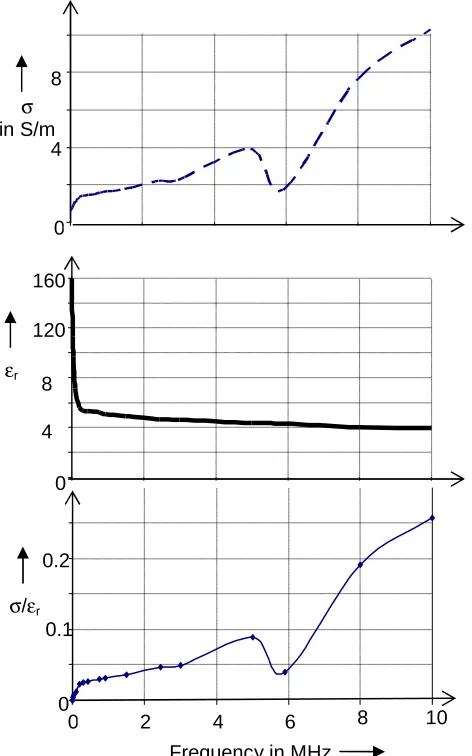
In the literature [38], σ versus frequency of tissue medium (wet with water-content) is available over 1 MHz through 1GHz range along with the corresponding values of dielectric constant as illustrated in Fig.1. Effectively, the EM interaction with the biomedium with the associated transduction of energy into thermodynamic heat is governed by the material property σ/ε, as indicated in the next section. This ratio σ/ε is again is a frequency-dependent parameter as evinced from Fig. 1.
Fig. 1. Plot of electrical conductivity (σσσσ), dielectric constant (εεεεr) and the ratio σσσσ/εεεεr of a
typical (wet) tissue medium
0 4 8
0 4 0 8 0 120 160
Frequency in MHz
σ
in S/m
εr
0 0.1 0.2
σ/εr
3.1 Electromagnetic Heating of a Surface on a Biomedium
The success of EM energy based ablation relies on the effectiveness of EM wave interaction with the biological medium of interest in getting dissipated as heat energy and raising the temperature locally so that the part in question may thermally ablated as clinically desired. Hence, in relevant modeling, the first step is to model the mechanism of interaction pertinent to EM energy versus a biological region. In such modeling efforts, it is necessary to consider the following parameters of interest: Frequency/wavelength of excitation, geometry of the region, associated EM parameters (such as, complex permittivity) and the thermal characteristics of the medium.
In order to estimate the steady-state thermal conditions and temperature distribution at an ablation site (such as the interior lining of the uterus pouch or the tissue lining in the esophagus), relevant model will involve the temperature T (in degree C) distribution at the site consistent with the density of conducted heat Q (in joules/s/m2). Suppose the EM excitation is facilitated via a current source depicting an applicator). Considering any point (x, y, z) within the layer to be ablated, the heat-flux density under stationary (steady-) state along the three co-ordinates x, y and z can be written as follows: {Qx = − kT dT/dx, Qy = − kT
dT/dy, Qz = − kT dT/dz} where, kT depicts the heat conductivity (in calories/cm/°C/s) . Under
stationary conditions, it can be assumed that the heat diverging from an infinitesimal volume at the point of observation must be equal to the generated heat due to EM absorption within that volume. Therefore, if σ is the electrical conductivity in (S/m) of the biomedium being ablated and E is the electric intensity at the point of consideration, then the following gradient relation can be validly specified: ∇Q(x, y, z; T) = σE . Hence, it follows that, 2
∇2 − 2 T
σ T =
k E (1) Assuming the site of ablation is free of thermal source, a general solution to the Poisson’s equation (1) leads to elucidating the associated thermal gradients. Also, the tangential to the surface being ablated, the temperature drop can be reasonably neglected within the short-duration of ablation procedure involved; and, the gradient of electric potential can be set to zero inasmuch as the boundary is a conducting surface.
Further, the initial rise of temperature Ti at an i th
point in the medium due to EM absorption depends mainly on the heat capacity (CH) of the medium and it is determined by the
relations:C [dT (t)H i / dt]=σE yielding a solution2 [σ H
2
i o
T (t) =E / C ]t + T where To is a constant
which can be taken as the reference body-temperature prior to ablation procedure. Now, suppose E is the electric-field intensity (per ampere) induced due to a current source (depicting the applicator) supporting a current I amperes:
( )
2 2
2 2
2 2
i 2 2
H H H
σ σ σ
T (t) = I t = IR t = V t
C R C R C
E E
E (2)
along the curved surface and as such,E(ρ) / R = 1/ρ2. For a locally homogenous and isotropic medium, it is reasonable to assume, the near-surface temperature (neglecting convection and radiation heat transfers) as: Therefore, it follows thatT (t) = (2T [k / C ][i S T H E2/ R ])t2 . Correspondingly, the increase in temperature is given by:
1
∆ ρ2
i S T H
T (t) = (2T [k / C ][ / ])t ; and, the near-surface temperature (Ts) obtained is as follows:
(
)
H [ ] H
σ σ
2 2 2
s o r
T (t) = (E [ / C ])t = { η π /ε H [ / C ]}t (3)
where H is the excitation magnetic-field intensity due to the current source and ηo (=
120π ohm) is the free-space intrinsic impedance and εr is the relative permittivity of the
medium.
4. ELECTROMAGNETIC ABLATION: CLINICAL EXEMPLARS
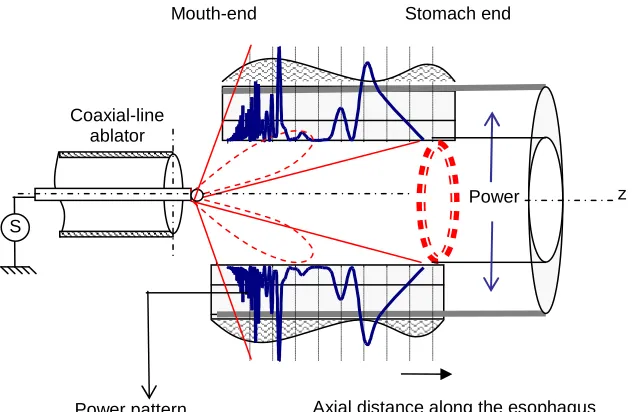
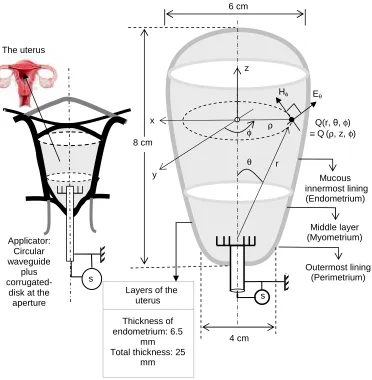
As illustrative examples of medical ablation with EM energy, two candidate bio-surfaces considered in this study refer to the following: (i) The esophagus and (ii) the endometrium; and hence, relevant aspects of these clinical exemplars as candidates for EM ablation are addressed in this section. For this purpose, simple anatomical illustrations of the esophagus and the endometrium are presented in Figs. 2 and 3 respectively. Further illustrated are compatible applicators sourced by EM energy for the anatomical sites in question. (Such ablators/applicators can be designed at the working frequency (such as microwaves, mm-wave or THz frequency) so to irradiate the tissue layer being subjected to thermal ablation resulting from the absorption of EM energy (sourced by the applicator) as will be discussed in the next section).
The EM near-field components that facilitate symmetrical power dissipation on the surface of the tissue-lining in question can be appropriately facilitated by choosing proper geometry of the applicator. For example, in using an open-ended coaxial-line indicated in Fig 2A, the so-called transverse magnetic (TM) field components are realized with corresponding “halo-like” power dissipation pattern presented in Fig. 2B wherein it can be observed that EM energy is dispersed symmetrically into the inner tissue layers of the biomedium (such as esophagus) with no power diversion axially along the cylindrical axis. Likewise, a balloon-like applicator made of an open-ended coaxial-line with its aperture loaded with a hemispherical dielectric can be adopted for the inner surface of a biomedium such as in endometrial ablation. Alternatively, a gaussian beam of EM wave can be launched to achieve spot ablation on a surface.
Pertinent to the type of EM excitation envisaged, relevant EM power dissipation in the biomedium in question and calculation of temperature rise can be done as follows: When a biomedium is exposed to EM energy, a specific absorption rate (SAR) can be defined to specify the rate at which energy is absorbed by the medium. Quantitatively, it is defined as the power absorbed per mass of tissue and therefore, has units of watts per kilogram (W/kg). SAR is usually averaged over the zonal volume of interest (typically of mass 10g of the tissue). Thus, SAR can be calculated in terms of the electric field E within the biomedium as follows: SAR =∫[σ(r) | (r) | / ]dS2 D
S
Fig. 2A. Barrett’s esophagus model toward EM ablation considerations
Fig. 2B. Barrett’s esophagus model: EM excitation from an ablator and corresponding power dissipated along the axial axis
Power Coaxial-line
ablator
S
Mouth-end Stomach end
Power pattern
z
Axial distance along the esophagus 0.35 to 0.50
cm
25 cm A
2R= (1.5 to 2.5 cm) Esophagus
A
Section on “A-A”
Mucous innermost lining (mucosa) Submucous layer (submucosa) Fibrous tissue (muscularis)
Protective covering (tunica adventitia)
Eθ
ρm
Hφ
φ
z j(z)
δ≅ 0.40 cm z 2R ≅ 2.0 cm
rm
Mouth-side end of esophagus
Stomach-side end of esophagus
θ
L1
L2
L4 ≅ 0.05
cm L3
j(z)
x
y
0
y
z s
L1 + L2 + L3≅
0.35 cm Stomach
side
(a) (b)
Qm(rm, θ, φ)
Fig. 3. Endometrium model toward EM ablation considerations
As indicated earlier, knowledge on lossy-dielectric and related thermal characteristics of various biological media in the lower strata of radio-frequency (RF) band has been fairly comprehended; however, pertinent details across the submillimeter wave-band and THz spectrum are rather sparse. However, by sharing judiciously the “similarity” details of bio-media already available as “models” and indicated in the traditional, lower-side EM spectrum, (namely, VLF through micro-/mm-wave), it is possible to deduce the corresponding “inferential prototypes” that represent EM properties of biological media at higher spectral regions like submillimeter/THz frequencies. For this purpose, the principle of similitude due to Edgar Buckingham can be adopted so as to obtain the model-to-(inferential) prototype transformations on generic dielectric and conducting properties of biological materials. In short, while pursuing EM-based clinical ablation, it may be of interest to compare the underlying performance of using the traditional microwave frequency at fM Hz
versus another frequency, say in mm-band or THz spectrum, specified as fT Hz. Then, the
following explicit relations can be derived [23] using the temperature-rise details indicated earlier:
The uterus
Eθ
ρ
φ ≡Q(r, Q(ρθ, z, , φ) φ)
r y
z
θ
Hφ
x
Applicator: Circular waveguide
plus
corrugated-disk at the aperture
Layers of the uterus
Thickness of endometrium: 6.5
mm Total thickness: 25
mm
Mucous innermost lining
(Endometrium) 6 cm
4 cm 8 cm
Middle layer (Myometrium)
Outermost lining (Perimetrium)
H T
s T s M T M
r r H M
t (f ) T (f ) / T (f ) [ (f )] / [ (f )]
t (f )
σ σ
∆ ∆ =
ε ε
(4)
where er is the relative permittivity (dielectric constant) of the medium; and, ∆Ts(.) is the
incremental surface temperature (in ºC) and tH(.) is the time-involved (in seconds) in heating
the medium to realize the increase in temperature. Further, tH(f) = [3700/SAR(f)}/∆T(f)].
Endometrial ablation implies heating uterus-lining so as to “ablate” the uterus-lining and the underlying myometrium to an extent of 6 to 8 mm. That is, the heating enabled by EM energy is confined to a superficial zone dictated by the depth of penetration (skin-depth, d in m) of the EM waves applied. This skin-depth, δ (in m) is given by: 1/(
π
fµσ)1/2 where f is the frequency in Hz, σ (in S/m) denotes the electrical conductivity of the medium and µ (= µoµr)is the permeability of the medium; further, µr is the relative permeability, (which is equal to 1
for the tissue medium) and µo (= 4π × 10− 7
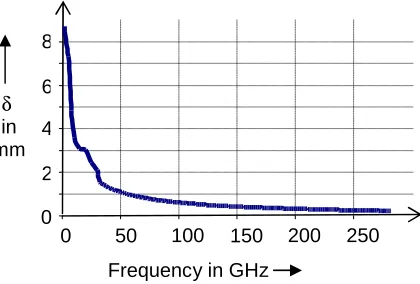
H/m) depicts the free-space permeability. Suppose the value of σ of a tissue-medium (such as, endometrium) is known across the spectrum of microwave through THz band. Then, the skin-depth can be evaluated as a function of frequency. In the literature [38], σ versus frequency of the tissue medium (wet with water-content) is available over 1 MHz through 1GHz range along with the corresponding values of dielectric constant as illustrated earlier in Fig.1. Corresponding skin-depth calculated as a function of frequency is shown in Fig. 4
In terms of fH (in Hz) and fT (in Hz) as indicated earlier, equation (4) can be rewritten as
follows:
s M
s T H T T M
r r H M
s M
T M
r H M r
T (f ) T (f ) / t (f ) [ (f )] / [ (f )]
t (f )
T (f )
(f ) 1 / (f )
t (f )
σ σ ∆ ∆ = ε ε σ ∆ σ = ε ε (5)
In other words, the similitude ratio of: (temperature-rise at fT in ºC/s)/(temperature-rise at fH in
ºC/s) is given by:
s T H T
T M
s M H M r r
[ T (f ) / t (f )]
[ (f )] / [ (f )] [ T (f ) / t (f )]
∆ σ σ
=
∆ ε ε
(6)
That is, equation (6) implies a scaled up “prototype” at fT relative to a “model” at fH written in
terms of the so-called dimensionless Buckingham’s p-format. It thus specifies the temperature-rise (in ºC/s) in the prototype-structure conceived at fT in terms of the
corresponding temperature-rise in the known model-structure at fM for a given EM
power-level of excitation via applicator. It can be noted that, heating involved at fT will be a prorated
value observed at fM and the prorating coefficient is a simple ratio, namely, T M
r r
[σ(f )] / [σ(f )]
ε ε .
Thus, using the pattern of (σ/εr) as a function of frequency (f) as illustrated in Fig. 1, the
5. OBSERVATIONS AND DISCUSSIONS
In EM-energy based clinical ablation, the anticipated design optimizations include: (i) realizing consistently high surface temperatures; (ii) enabling desirable heat conduction profiles (iii) accommodating large ablation regions (viewed in terms of the surface area of endometrium to be ablated and the depth at the ablation site involved); (iv) facilitating faster ablation times toward quick procedure and (v) above all, achieving reduced procedural complexity and less painful ablation method set compatible for the anatomical site in question.
The concept designs and experiments of EM-energy based ablation envisaged in practice mostly offer qualitative details on basic physics concerning EM interactions with the tissue and corresponding conversion of EM (RF/microwave) energy into thermal energy; and, the method of applying EM-energy using an applicator (made of a feed plus antenna combination) is emphasized vis-à-vis the focused ablation site. Commensurate with the associated thermodynamics of heat patterns generated specific to achieve an effective ablation via (EM energy)-to-(biomedia) interactions, designing a proper applicator is a primary design objective. It should be consistent with related details on EM power generation, effective feeding of EM energy to the site of ablation (via a transmission-line such as a coaxial cable) and applying the EM-field to the zone of interest with a controlled proliferation. Safe transduction of (EM energy)-to-(thermal energy) without hot-spots, overheating and/or failures, cooling antenna/feeding structure as necessary so as to avoid unnecessary heating of zones en route and achieving efficient ablation are desired features in the design optimizations.
As indicated before the techniques traditionally developed for various ablations use designated frequencies like 915 MHz and 2.45 GHz (ISM band). The choice of a specific frequency and the corresponding wavelength decide the depth of penetration of EM energy and hence, the associated volume of heating at the ablation zone of interest. Specific to surface ablation (as in the case of endometrium), this consideration on skin-depth translates to ascertaining the crucial role of frequency (or wavelength) in deciding the effective heating zone warranted across the shallow region the tissue-lining and the depth of ablation required is a medical decision pertinent to each patient.
Notwithstanding the existence of RF/microwave ablation, the transition design suggested here refers to identifying the pros and cons of using upper EM spectrum spanning mm-wave through THz band (in lieu of RF/microwaves). In this context, the feasibility aspects, transition design issues and technical challenges vis-à-vis clinical requirements are reviewed in the following subsection as regard to the proposed method of utilizing mm-wave/THz band EM energy.
5.1 Feasibility Considerations
5.1.1 Skin-depth specific constraints
Fig. 4. Skin-depth (δδδδ in mm) versus frequency (in GHz) of a wet tissue medium
It can be observed from Fig. 4 that the skin-depth of a tissue medium at the traditional microwave frequency (2.45 GHz) is about 7.35 mm and it reduces to about 0.8 mm at 250-300 GHz range. Hence, in any attempted transitional design from (microwave ablation)-to-(THz ablation), the choice of mm-wave/THz frequency should be consistent with surgical requirement specified by the depth of shallow ablation required in myometrium. Currently, no specific frequency has been designated for medical applications of mm-wave/THz frequency spectrum. Hence, with any such future prescription of frequency, corresponding depth of EM-energy penetration (skin-depth) and ablation across the transversal depth into myometrium will be design trade-off features in implementing the proposed TEA.
5.1.2 Heating of the tissue-lining
Relevant to the zone (surface area and volume) of topical ablation (such as in endometrium) constrained by medical considerations, the EM-energy based heating should enable a fast heating and uniform heat distribution profile (devoid of hot/cold spots) with sufficient thermal flux so as to realize the required temperature rise in the zone. For a given EM-energy input, the rise in temperature per second in (microwave ablation)-to-(THz ablation) context is given by equation (6).
The general indication thereof is to realize a temperature rise of about 75-85 ºC; and, the ablation procedure lasts for about 150-180 seconds with a typical microwave source of 30-70 W power. Relevant to the data as above on temperature elevation of 43-53ºC body temperature needed during ablation of the tissue-surface, the computed results (obtained using equation 6) on temperature-rise per second with 30 mm-wave through 350 GHz relative to conventional temperature-rise per second feasible with microwaves is plotted in Fig. 5 as a function of frequency. From Fig. 5, it can be inferred that for a given EM power applied, with mm-wave/THz band frequencies, the increase in temperature could be 2-3 orders faster than with traditional microwaves. Thus, the proposed mm-wave/THz can facilitate extremely fast heating; that is, a higher growth/faster rate of ablation zone is feasible with the proposed method. It implies that compatible ablation system design that accommodates fast-heating with necessary cooling and avoidance of hot-spots/burns is mandated.
δ
in mm
0 2 4 6 8
Fig. 5. Plot of surface temperature-rise per second for a given EM power applied with 30 mm-wave through 350 GHz relative to conventional temperature-rise per second with microwaves in the tissue lining as a function of frequency: (a) To realize 85ºC (or 53ºC elevation above the body-temperature); and, (b) to realize 75ºC (or 43ºC elevation
above the body-temperature)
5.1.3 Proliferation of thermal energy across the tissue surface
The zone of tissue-surface ablation includes the surface area and a volume underneath in the tissue-surface as constrained by medical requirements. As such, consistent with the rate of surface-temperature rise indicated above, the associated heat energy at the surface should be conducted into the tissue-surface zone uniformly. Hence, based on the thermal conductivity (of about 0.5 × 10³ W/m ºC), it can be surmised that a fair heat conduction into the thin layer beneath the endometrium can be facilitated. Again, relevant system design calculations on such heat conduction profile and exposure duration involved (to achieve the steady-state conditions) should be viewed in the light of EM power supplied and the type of applicators adopted.
5.2 EM Ablation: Design Considerations
5.2.1 Design constraints
From the existing knowledge on antenna requirements specifically intended for ablation purposes as above, it may be possible to conceive compatible EM radiating structures for applications and requirements in newer EM-ablation efforts vis-à-vis various anatomical sites and EM source plus frequency considerations. However, there are foreseeable technical challenges, which can be identified and listed as follows:
• Designing miniaturized structures consistent with small wavelengths: Suppose in addition to traditional RF/microwave frequencies, the unexplored regimes of EM spectra such as mm-wave and/or THz-band are considered. The compelling reason thereof is to achieve heat generation just topically or in a shallow depth possible with the low wavelength of such mm-wave and/or THz-band excitation; and, relevant scaled-down structures are preferable in some ablation contexts where the accessibility of the ablation zone is constrained by the passage dimensions such as
0 50 100 0 2000
0 50 100 150 200 250 300 350 [∆Ts(fT)/s]
[∆Ts(fM)/s]
(a)
(b)
in intravaginal applicator designs. However, finding a compatible EM source at these frequencies and conceiving compatible ablator geometries are still open-questions.
• Effectively implementing ‘source-matched-to-antenna’: In ablator designs, the distal end of the applicator namely, the radiating antenna should maximize the energy transfer to the biomedium being ablated offering minimal reflection coefficient for low return loss. This is required to avoid load on the generator as well as to reduce return path tissue-heating. Designing mm-wave/THz band antennas with matched VSWR is critical, though feasible.
• Desirable radiation pattern: Essentially, the EM energy interacting with the biomedia under ablation conforms to a near-field pattern. The type of such pattern needed is dependent on application and the site geometry. Typically broadside mode directly launching EM energy radially outward is suitable for tumor ablation wherein the omnidirectional radiation pattern conforms to near-spherical focal tumors. Likewise, end-fire antennas are required for localized/spot heating as in cardiac ablation. Relevant version of antenna is then configured to launch end-fire pattern at a catheter tip. Further, broadside structure may be warranted to heat the geometry-constrained situations as in ablating large surface of the endometrium. On the other hand, if a point ablation is required on a specific spot such as a polyp relevant end-fire antenna designs can be conceived as sleeve versions. Thus, in the existing regimens of clinical practice, ablator designs are essentially based for low return-loss and focused/zone (or partial-body) selective heating considerations. Hence, as indicated earlier, a variety of designs with handle-shaft structure containing slot, monopole, dipole, triaxial and choked radiating elements have been conceived. In addition, looped and helical antennas have also been suggested. For example, miniature helical applicators have been designed to operate at 915 MHz to investigate their potential use in the hyperthermic treatment of Barrett’s esophagus. In the context of adopting mm-wave and/or THz-band, again the above requirements remain unaltered. But, specific structural considerations and source restrictions should be concurrently viewed.
• Cooling the applicator: Avoidance of incidental heating across nearby tissues is required in EM-based ablation techniques. For this purpose, typically cooling-jackets (carrying water) are improvised consistent with applicator dimensions, if the jacket does not prohibitively augment the size of the applicator. Other cryogenic cooling is also feasible. In the mm-wave and/or THz-band since the applicator is down-sized, accommodating appropriate, smaller cooling system is conceivable.
• Mixed-phase state of the bioregion being ablated: In certain ablation sites, the surface of the biomedium could be infested with body fluids. Therefore, the EM energy applied should cope with heating the fluid as well as apply sufficient thermal flux on the surface to achieve a required extent of ablation. For example, suppose endometrial ablation is considered with EM energy as a possible therapy for menorrhagia. In the relevant pathological state, the endometrium grows to a thick, blood vessel-rich, glandular tissue layer; and, the endometrial lining, (which is shed in normal menstruation regularly in about 28 days), never gets the signal to stop thickening. As such, it keeps growing, sheds irregularly and with extra thickness, the bleeding becomes unusually heavy. In such state of DUB, it is not uncommon that the uterus wall is enriched with blood. Therefore, in modeling and assessing electromagnetic heating of the endometrium for the purpose of ablation, the presence of thickened tissue with a heavy smear of blood should be duly specified. Hence, in estimating the power dissipation (manifesting as elevated temperature) while EM ablation is performed, the dielectric-loss due to blood-coating should be concurrently included in addition to power dissipated towards ablating the tissue-lining. In other words, inasmuch a fraction of EM power applied in the ablation procedure could be consumed at the blood sites, adequate extra power-source should be designed while envisaging endometrial ablation.
5.2.2 Applicators for EM Ablation
Table 2. Feasible designs of EM ablators [43-52]
Ablator types and descriptions
Geometry
Coaxial-line (CL) type Waveguide (WG) type
A: Coaxial-line (CL) aperture with protruding central conductor to provide peripheral halo pattern for ablating cylindrical inner surface
B: Corrugated cylindrical WG aperture to provide end-fire balloon beam pattern for ablating near-spherical inner surface
C: CL aperture with protruding central conductor plus a dielectric sphere to provide peripheral narrow halo pattern for ablating cylindrical inner surface
D: Corrugated cylindrical WG aperture plus dielectric sphere to provide end-fire gaussian-beam pattern for ablating spot(s) in the inner surface
E: CL aperture with protruding central conductor plus a dielectric tapered rod to provide peripheral narrow halo pattern for ablating cylindrical inner surface
F: Dielectric cylindrical WG to provide end-fire narrow beam pattern for ablating spot(s) in the inner surface
s
F
s E
s D
s C
s B
G: CL aperture with protruding central conductor plus a dielectric hemisphere to provide peripheral narrow halo pattern for ablating cylindrical inner surface
H: Dielectric cylindrical corrugated WG plus a dielectric hemisphere to provide end-fire narrow gaussian beam pattern for ablating spot(s) in the inner surface
I: CL aperture with protruding cone-shaped and dielectric-coated central conductor to provide peripheral narrow halo pattern for ablating cylindrical inner surface
J: Cylindrical WG plus a corrugated disk at the aperture to provide end-fire narrow beam pattern for ablating spot(s) in the inner surface
K: CL aperture with central conductor terminated at a matched-load and outer surface with an axial slot array to provide peripheral
broadside pattern for ablating cylindrical inner surface
L: Cylindrical WG plus a photoconductor disk provide end-fire narrow beam pattern at THz frequencies for ablating spot(s) in the inner surface
5.2.3 Technical challenges
Experimental/clinical studies: Though RF/microwave ablations have been studied and clinically demonstrated, to the best of authors’ knowledge, no known studies on such efforts with mm-wave/THz band frequencies have been reported. This may be due to the fact that no known frequency band has been formally specified as a standard for ablation applications in mm-wave/THz band (though, use of 120 and 380 THz and mid-infrared 12-120 THz are
Bias
s Photo
conductor L
s K
Matched load
s J
s I
s H
indicated in medical imaging to achieve high resolutions). As such, the effort addressed toward such mm-wave/THz band here is a heuristic proposal yet to be investigated via experimental studies so as to elucidate the underlying technical challenges. At least, modeling uterus and endometrium with bio-phantom materials and designing an appropriate applicator system at some mm-wave/THz frequency can be the first step; and, it is being planned by the authors in the near future.
Nonionizing radiation effects on biomedia at mm-wave/THz band: Since the range of upper mm-wave/THz spectrum is still an unknown territory as regard to the associated hazardous bioelectromagnetic effects on living systems, a technical concern has to be recognized when this spectral range is adopted for medical applications. Currently, no specific standards (such as OSHA/ANSI standard) have been outlined for frequencies beyond 300 GHz. However, adjunct to thermal dissipation of EM energy (EM heating), other athermal influences leading to possible carcinogenic, reproductive and neurological effects etc. cannot be ruled out as possible hazardous bioelectromagnetic effects due to nonionizing radiations. But, relevant details on such athermal effects (like mutagenesis and genotoxicity influences etc.) at the sub-mm (THz region) are not explicitly known at the levels of epidemiological framework. Typically upper mm-wave/THz frequencies correspond to energy levels of molecular rotations, vibrations and proteins. These may provide characteristic fingerprints of interaction vis-à-vis biological infrastructure, but are sparsely explored in medical applications except in THz imaging and spectroscopy. No directed effort on possible health hazard of THz waves that could be implicated in medical uses has been indicated.
Nevertheless, it should be prudently recognized that THz radiation can change the profile of genes expression. The reason is as follows: Though THz radiation is not energetic enough to break chemical bonds and ionize biomolecules, the study in [23] reports the possibility of THz field interacting with the double-stranded DNA; and, the resulting resonant effects may allow THz waves to unzip the double strands causing genetic damage. As such, it is stressed here that while advocating TEA, the associated and desired thermal effect (EM heating) being sought for ablation may concurrently induce possible athermal effects. It is a subject of crucial interest to be investigated in future. Knowledge on athermal effects due to mm-Wave/THz frequencies (such as invasive interactions at DNA level causing possible damages to genes expression) is currently sparse [23]. Futuristic studies thereof are necessary and relevant considerations should duly be specified in TEA designs vis-à-vis the procedure time (of exposure) and intensity of EM power source requirements.
Availability of powerful and tunable sources at mm-wave/THz band: A general technological niche prevails in the state-of-art of high-power generation in the EM spectrum beyond microwave frequency. There are two possible types of power source requirements at the high-frequency spectra namely, continuous-wave (CW) and pulsed-wave power sources. A viable method is to realize appropriate oscillators using solid-state and/or vacuum-based devices. Normally power sources (CW or pulsed) up to 100 GHz are based on Gunn or Schottky barrier diode oscillators with frequency multipliers. At higher frequencies (THz) the attempted efforts include quantum cascade lasers, gyrotrons and parametric amplifiers [23]. However, at THz frequencies, the power requirement could be less than that for MEA due to proportionately scaled-down specific absorption rate (SAR) involved.
![Table 1B. Thermal constants of biomedia [38,41]](https://thumb-us.123doks.com/thumbv2/123dok_us/1751021.1224569/9.612.105.510.413.546/table-b-thermal-constants-of-biomedia.webp)

![Table 2. Feasible designs of EM ablators [43-52]](https://thumb-us.123doks.com/thumbv2/123dok_us/1751021.1224569/23.612.97.511.108.601/table-feasible-designs-em-ablators.webp)