the isolated qubits model
Yi-Kai Liu
Applied and Computational Mathematics Division National Institute of Standards and Technology (NIST)
Gaithersburg, MD, USA [email protected]
Abstract. One-time memories (OTM’s) are simple, tamper-resistant cryptographic devices, which can be used to implement sophisticated functionalities such as one-time programs. Can one construct OTM’s whose security follows from some physical principle? This is not possi-ble in a fully-classical world, or in a fully-quantum world, but there is evidence that OTM’s can be built using “isolated qubits” — qubits that cannot be entangled, but can be accessed using adaptive sequences of single-qubit measurements.
Here we present new constructions for OTM’s using isolated qubits, which improve on previous work in several respects: they achieve a stronger “single-shot” security guarantee, which is stated in terms of the (smoothed) min-entropy; they are proven secure against adversaries who can per-form arbitrary local operations and classical communication (LOCC); and they are efficiently implementable.
These results use Wiesner’s idea of conjugate coding, combined with error-correcting codes that approach the capacity of theq-ary symmet-ric channel, and a high-order entropic uncertainty relation, which was originally developed for cryptography in the bounded quantum storage model.
Keywords: Quantum cryptography; information theory; local opera-tions and classical communication (LOCC); oblivious transfer; one-time programs
1
Introduction
One-time memories(OTM’s) are a simple type of tamper-resistant cryp-tographic hardware. An OTM has the following behavior: a user Alice can write two messagessandtinto the OTM, and then give the OTM to another user Bob; Bob can then choose to read either s or t from the OTM, but he can only learn one of the two messages, not both. A single OTM is not especially exciting by itself, but when many OTM’s are combined in an appropriate way, they can be used to implement
the program “self-destructs,” and it never reveals any information other than the output of the computation.)
Can one construct OTM’s whose security follows from some physical principle? At first glance, the answer seems to be “no.” OTM’s can-not exist in a fully classical world, because information can always be copied without destroying it. One might hope to build OTM’s in a quan-tum world, where the no-cloning principle limits an adversary’s abil-ity to copy an unknown quantum state. However, this is also impos-sible, because an OTM can be used to perform oblivious transfer with information-theoretic security, which is ruled out by various “no-go” the-orems [7,8,9,10].
One way around these no-go theorems is to try to construct protocols that are secure against restricted classes of quantum adversaries, e.g., ad-versaries who can only performk-local measurements [11], or adversaries who only have bounded or noisy quantum storage [12,13,14,15,16,17]. More recently, Liu has proposed a construction for OTM’s in the iso-lated qubits model [1], where the adversary is only allowed to perform local operations and classical communication (LOCC). That is, the ad-versary can perform qubit quantum operations, including single-qubit measurements, and can make adaptive choices based on the clas-sical information returned by these measurements; but the adversary cannot perform entangling operations on sets of two or more qubits. (Honest parties are also restricted to LOCC operations.) The isolated qubits model is motivated by recent experimental work using solid-state qubits, such as nitrogen vacancy (NV) centers; see [1] for a more com-plete discussion of this model, and [18] for earlier work on implementing quantum money using NV centers.1
In this paper we show a new construction and security analysis for OTM’s in the isolated qubits model, which improves on the results of [1] in sev-eral respects. First, we show a stronger “single-shot” security guarantee, which is stated in terms of the (smoothed) min-entropy [19,20]. This shows that a constant fraction of the message bits remain hidden from the adversary. This stronger statement is necessary for most cryptographic applications; note that the previous results of [1] were not sufficient, as they used the Shannon entropy.
Second, we prove security against general LOCC adversaries, who can perform arbitrary measurements (including weak measurements), and can measure each qubit multiple times. This improves on the results of [1], which only showed security against 1-pass LOCC adversaries that use 2-outcome measurements. Our new security proof is based solely on the definition of the isolated qubits model, without any additional assumptions.
Third, we show a construction of OTM’s that is efficiently implementable, i.e., programming and reading out the OTM can be done in polynomial
time. This improves on the construction in [1], which was primarily an information-theoretic result, using random error-correcting codes that did not allow efficient decoding. (In fact, our new construction is quite flexible, and does not depend heavily on the choice of a particular error-correcting code. Our OTM’s can be constructed using any code that satisfies two simple requirements: the code must be linear overGF(2), and it must approach the capacity of theq-ary symmetric channel. We show one such code in this paper; several more sophisticated construc-tions are known [22,23,24].)
We will describe our OTM construction in the following section. Here, we briefly comment on some related work. Note that OTM’s cannot make use of standard techniques such as privacy amplification. This is because OTM’s are non-interactive and asynchronous: all of the communication between Alice and Bob occurs at the beginning, while the adversary can wait until later to attack the OTM. (To do privacy amplification, Alice would have to first force the adversary to take some action, and then send one more message to Bob. This trick is very natural in protocols for quantum key distribution and oblivious transfer, but it is clearly impossible in the case of an OTM.) As we will see below, the security of our OTM’s follows from rather different arguments. (A similar issue was studied recently in [17], albeit with a weaker, non-adaptive adversary.) In addition, it is a long-standing open problem to prove strong upper-bounds on the power of LOCC operations. Previous results in this area include demonstrations of “nonlocality without entanglement” [25] (see [26] for a recent survey), and constructions of data-hiding states [27,28,29,30]. Our OTM’s are not directly comparable to these earlier results, as the security requirements for our OTM’s are quite different.
1.1 Our construction
We now describe our OTM construction, which is based on Wiesner’s idea of conjugate coding [21]. Our OTM will store two messagess, t∈ {0,1}`, and will use nlgq qubits, where q is a (large) power of 2. Let C: {0,1}`→ {0,1}nlgq be any error-correcting code that satisfies the following two requirements:C is linear over GF(2), andC approaches the capacity of the q-ary symmetric channel Eq with error probability
pe:= 12−21q (where the channel treats each block of lgq bits as a single
q-ary symbol). Note that, whenqis large, the capacity of the channelEq
is roughly 1−pe, which is roughly 12, so we havenlgq≈2`.
Given two messages s and t, let C(s) and C(t) be the corresponding codewords, and view each codeword asn blocks consisting of lgq bits. We prepare the qubits in the OTM as follows. For eachi= 1,2, . . . , n,
– Letγi∈ {0,1}be the outcome of a fair and independent coin toss.
– Ifγi= 0, prepare thei’th block of qubits in the standard basis state
corresponding to thei’th block ofC(s).
– If γi = 1, prepare thei’th block of qubits in the Hadamard basis
state corresponding to thei’th block ofC(t).
messaget, we measure every qubit in the Hadamard basis, then follow the same procedure. It is easy to see that all of these procedures require only single-qubit state preparations and single-qubit measurements, which are allowed in the isolated qubits model.2
(We remark that this OTM construction uses blocks of qubits, rather than individual qubits as in [21] and [1]. That is, we setq large, instead of usingq= 2. This difference seems to help our security proof, although it is not clear whether it affects the actual security of the scheme.) We now sketch the proofs of correctness and security for this OTM. With regard to correctness, note that an honest player who wanted to learn swill obtain measurement outcomes that have the same distribution as the output of theq-ary symmetric channelEq acting onC(s); hence the
decoding algorithm will returns. A similar argument holds fort. To prove security, we consider adversaries that makeseparable measure-ments (which include LOCC measuremeasure-ments as a special case). The basic idea is to consider the distribution of the messagessandt, conditioned on one particular measurement outcome z obtained by the adversary. Since the adversary is separable, the corresponding POVM elementMz
will be a tensor product of single-qubit operatorsNnlgq
a=1 Ra (up to
nor-malization). Now, one can imagine a fictional adversary that measures the qubits one at a time, and happens to observe this same string of single-qubit measurement outcomesR1, R2, . . . , Rnlgq. This event leads
to the same conditional distribution ofsandt. But the fictional adver-sary is easier to analyze, because it is non-adaptive, it measures each qubit only once, and the measurements can be done in arbitrary order. Now, our proof will be based on the following intuition. In order to learn both messagess andt, the adversary will want to determine the basis choicesγ= (γ1, γ2, . . . , γn), so that he will know which blocks of
qubits should be measured in the standard basis, and which blocks of qubits should be measured in the Hadamard basis. The choice of the codeCis crucial to prevent the adversary from doing this; for instance, if the adversary could predict some of the bits in the codewordsC(s) and C(t), he could then measure the corresponding qubits, and gain some information about which bases were used to prepare them. (Note moreover that the adversary has full knowledge ofC, before he measures any of the qubits.) We will argue that certain properties of the codeC prevent the adversary from learning these basis choicesγ perfectly, and that this in turn limits the adversary’s knowledge of the messagessand t.
SinceCis a linear code overGF(2), it has a generator matrixG, which has rank`. Thus there must exist a subset of ` bits of the codeword C(s) that look uniformly random, assuming the message s was chosen uniformly at random; and a similar statement holds forC(t). Now, let Abe the subset of`qubits that encode these bits ofC(s) andC(t). We can imagine that the fictional adversary happens to measure these qubits
first. Therefore, during these first `steps, the fictional adversary learns nothing about which bases had been used to prepare the state, i.e., the
2
basis choicesγare independent of the fictional adversary’s measurement outcomes.
One can then show that the conditional distribution of s and t after these first`steps of the fictional adversary is related to the distribution of measurement outcomes when the state N
a∈ARa is measured in a
random basis. This kind of situation has been studied previously, in connection with cryptography in the bounded quantum storage model. In particular, we can use a high-order entropic uncertainty relation from [16] to show a lower-bound on the smoothed min-entropy of this distribution. We then use trivial bounds to analyze the remainingnlgq−`steps of the fictional adversary. Roughly speaking, we get a bound of the form:
H∞(ε S, T|Z)& 1
2`, (1)
for any separable adversary (whereZ denotes the adversary’s measure-ment outcome). Thus, while the OTM may leak some information, it still hides a constant fraction of the bits of the messagessand t. For more details, see Section 3.
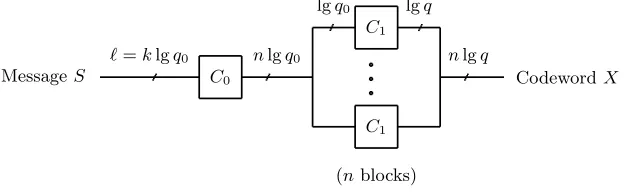
Finally, we show one construction of a codeC that satisfies the above requirements and is efficiently decodable. The basic idea is to fix some q0< q, first encode the messagessandtusing a random linear codeC0 :
{0,1}`→ {
0,1}nlgq0, then encode each block of lgq
0 bits using a fixed linear codeC1 :{0,1}lgq0→ {0,1}lgq. The codeC1is used to detect the errors made by theq-ary symmetric channel; these corrupted blocks of bits are then treated as erasures, and we can decodeC0by solving a linear system of equations, which can be done efficiently. Moreover, choosing C0 to be a random linear encode ensures that, with high probability, C approaches the capacity of the q-ary symmetric channel. For more details, see Section 4.
1.2 Outlook
The results of this paper can be summarized as follows: we construct OTM’s based on conjugate coding, which achieve a fairly strong (“single-shot”) notion of security, are secure against general LOCC adversaries, and can be implemented efficiently. These results are a substantial im-provement on previous work [1].
We view these results as a first step in a broader research program that aims to develop practical implementations of isolated qubits, one-time memories, and ultimately one-time programs. We now comment briefly on some different aspects of this program.
Experimental realization of isolated qubits is quite challenging, though there has been recent progress in this direction [39,40]. Broadly speaking, isolated qubits seem to be at an intermediate level of difficulty, some-where between photonic quantum key distribution (which already exists as a commercial product), and large-scale quantum computers (which are still many years in the future).
construction: we would use a slightly noisier channel to describe the im-perfect measurements made by an honest user, and we would choose the error-correcting codeCaccordingly. The proof of security would still hold against LOCC adversaries who can make perfect measurements. There is plenty of “slack” in the security bounds, to allow this modification to the OTM’s.
In addition, one may wonder whether our OTM’s are secure against so-called “k-local” adversaries [11], which can perform entangled mea-surements on small numbers of qubits (thus going outside the isolated qubits model). There is some reason to be optimistic about this: while we have mainly discussed separable adversaries in this paper, our security proof actually works for a larger set of adversaries, who can generate entanglement among some of the qubits, but are still separable across the partition defined by the subsetA(as described in the proof). Also, from a physical point of view,k-local adversaries are quite natural. In particular, even when one can perform entangling operations on pairs of qubits, it may be hard to entangle large numbers of qubits, due to error accumulation.
Finally, let us turn to the construction of one-time programs. Because our OTM’s leak some information, it is not clear whether they are suffi-cient to construct one-time programs. There are a couple of approaches to this problem. On one hand, one can try to strengthen the security proof, perhaps by proving constraints on thetypes of information that an LOCC adversary can extract from the OTM. We conjecture that, when our OTM’s are used to build one-time programs as in [3], the spe-cific information that is relevant to the security of the one-time program does in fact remain hidden from an LOCC adversary.
On the other hand, one can try to strengthen the OTM constructions, in order to eliminate the leakage. As noted previously, standard privacy amplification (e.g., postprocessing using a randomness extractor) does not work in this setting, because the adversary also knows the seed for the extractor. However, there are other ways of solving this problem, for instance by assuming the availability of a random oracle, or by using something similar to leakage-resilient encryption [32,33] (but with a dif-ferent notion of leakage, where the “leakage function” is restricted to use only LOCC operations, but is allowed access to side-information).
2
Preliminaries
2.1 Notation
For any natural numbern, let [n] denote the set{1,2, . . . , n}. Let lg(x) = log2(x) denote the logarithm with base 2.
For any random variableX, let PX be the probability density function
ofX, that is,PX(x) = Pr[X =x]. Likewise, definePX|Y(x|y) = Pr[X =
x|Y =y], etc. For any eventE, definePEX to be the probability density
function ofXsmoothed byE, that isPEX(x) = Pr[X =xandE occurs].
We say thatC is a binary code with codeword lengthn and message lengthkif C is a subset of{0,1}n
has minimum distanced= minx,y∈CdH(x, y), wheredH(·,·) denotes the
Hamming distance.
We say thatCis a binary linear code ifCis a linear subspace ofGF(2)n. (Note,GF(2) and{0,1}denote the same set, but we will writeGF(2) in situations where we use arithmetic operations.) In this case, there exists a matrixG∈GF(2)k×n, such that the mapx7→xTGis a bijection from
GF(2)k to the code subspaceC. We will overload the notation and use Cto denote the mapx7→xTG; then the codewords consist of the strings C(x) for allx∈GF(2)k.
2.2 The q-ary symmetric channel
Theq-ary symmetric channel with error probabilitype acts as follows:
given an inputx∈GF(q), it returns an outputy∈GF(q), with condi-tional probabilities Pr(y|x) = 1−pe (ify=x) and Pr(y|x) =pe/(q−1)
(ify6=x). The capacity of this channel, measured inq-ary symbols per channel use, is given by [23]:
L(pe) = 1 + (1−pe) logq(1−pe) +pelogq(pe)−pelogq(q−1)
= 1−h2(pe)
lgq −pe
lg(q−1) lgq ≥1−
1 lgq −pe,
(2)
whereh2(·) is the binary entropy function.
2.3 LOCC adversaries and separable measurements
An LOCC adversary is an adversary that uses only local operations and classical communication (LOCC). Here, “local operations” consist of quantum operations on single qubits, and “classical communication” refers to the adversary’s ability to choose each single-qubit operation adaptively, depending on classical information, such as measurement out-comes, that were obtained from previous single-qubit operations. How-ever, the adversary is not allowed to make adaptive choices that depend on quantum information, or perform entangling operations on multiple qubits.
Formally, an LOCC adversary can be described as follows. Consider a system ofn qubits. The adversary makes a sequence of steps, labelled by i = 1,2,3, . . .. At step i, the adversary chooses one of the qubits qi ∈ [n], and performs a general quantum measurement Mi on that
qubit; this returns a measurement outcome, which is described by a classical random variableZi. The adversary’s choices ofqiandMi can
depend onZ1, Z2, . . . , Zi−1. Also, note that the adversary can perform weak measurements, and can measure the same qubit multiple times. Finally the adversary discards the qubits, and outputs the sequence of measurement outcomesZ1, Z2, Z3, . . ..
A POVM measurementM={Mz|z= 1,2,3, . . .}is calledseparableif
every POVM elementMz can be written as a tensor product of
2.4 Leaky OTM’s
We will use the following definition of a leaky OTM [1].
Definition 1. Fix some class of adversary strategies M, some leakage parameterδ∈[0,1], and some failure probabilityε∈[0,1]. Aleaky one-time memory (leaky OTM)with parameters(M, δ, ε)is a device that has the following behavior. Suppose that the device is programmed with two messagess andtchosen uniformly at random in {0,1}`
; and letS and
T be the random variables containing these messages. Then: 1. Correctness: There exists an honest strategyM(1)∈
Mthat interacts with the device and recovers the messageswith probability≥1−ε. Likewise, there exists an honest strategyM(2)∈
Mthat recovers the messagetwith probability≥1−ε.
2. Leaky security: For every strategyM ∈M, ifZ is the random vari-able containing the classical information output byM, thenH∞(ε S, T|Z)≥
(1−δ)`.
HereHε
∞ is the smoothed conditional min-entropy, which is defined as follows [19,20]:
H∞(ε X|Y) = max E: Pr(E)≥1−εminx,y
h −lg
PEX|Y(x|y)
i
, (3)
where the maximization is over all eventsE (defined by the conditional probabilities PE|XY) such that Pr(E) ≥ 1−ε. Observe that a
lower-bound of the formH∞(ε X|Y)≥h implies that there exists an eventE
with Pr(E)≥1−εsuch that, for allxandy, Pr[E, X=x|Y =y]≤2−h.
The definition of a leaky OTM is weaker than that of an ideal OTM in two important respects: it assumes that the messagessandtare chosen uniformly at random, independent of all other variables; and it allows the adversary to obtain partial information about bothsandt, so long as the adversary still has (1−δ)k bits of uncertainty (as measured by the smoothed min-entropy). We suspect that thisdefinition of a leaky OTM is not strong enough to construct one-time programs (although we conjecture that our actualconstructions of OTM’s in Sections 3 and 4 are, in fact, strong enough for this purpose).
2.5 Uncertainty relations for the min-entropy
We will use an uncertainty relation from [16], with a slight modification to describe quantum systems that consist of many non-identical subsystems:
Theorem 1. Consider a quantum system with Hilbert spaceN`0
i=1C
di,
i.e., the system can be viewed as a collection of`0 subsystems, where the i’th subsystem has Hilbert space dimensiondi.
For eachi∈[`0], letBibe a finite collection of orthonormal bases forCdi,
and suppose that these bases satisfy the following uncertainty relation: for every quantum stateρ onCdi, |Bi|−1Pω∈BiH(Pω) ≥hi, where Pω is
the distribution of measurement outcomes whenρ is measured in basis
Now letρbe any quantum state overN`0
i=1C
di, letΘ= (Θ
1, . . . , Θ`0)be
chosen uniformly at random fromB1×· · ·×B`0, and letX = (X1, . . . , X`0)
be the measurement outcome whenρ is measured in basisΘ (i.e., each
Xi is the outcome of measuring subsystemiin basis Θi).
Then, for anyτ >0, and anyλ1, . . . , λ`0∈(0, 1
2), we have:
H∞(ε X|Θ)≥ −τ+
`0
X
i=1
(hi−λi), (4)
whereε≤exp(−2τ2/c), andc=P`0
i=116 lg |Bi|di
λi
2
.
The proof is essentially the same as in [16]; it uses a martingale argument and Azuma’s inequality, but it allows the martingale to have different increments at each step.
In addition, we will use the following chain rule for the smoothed min-entropy [20]:
H∞ε+ε0(X|Y)> H∞(ε X, Y)−H0(Y)−lg(ε10). (5)
3
One-time memories
We now show the correctness and security of the OTM construction described in Section 1.1. Recall that this OTM usesnlgqqubits, stores two messages of length`, and uses an error-correcting code C. We will show how to setnandq, and how to choose the codeC.
Let us introduce some notation. We view the code C as a function C : {0,1}` → {
0,1}nlgq
. We view each codeword x ∈ {0,1}nlgq
as a sequence ofn blocks, where each block is a binary string of length lgq. We write the codeword as x= (xij)i∈[n],j∈[lgq], and we write the i’th
block asxi = (xij)j∈[lgq]. Finally, let H be the Hadamard gate acting
on a single qubit.
We now prepare the qubits in the OTM as follows. For eachi= 1,2, . . . , n,
– Letγi∈ {0,1}be the outcome of a fair and independent coin toss.
– Ifγi= 0, prepare thei’th block of qubits in the state|C(s)ii.
– Ifγi= 1, prepare thei’th block of qubits in the stateH⊗(lgq)|C(t)ii.
To recover the first messages, we measure every qubit in the standard basis, which yields a string of measurement outcomes z ∈ {0,1}nlgq, and then we run the decoding algorithm forC. To recover the second messaget, we measure every qubit in the Hadamard basis, obtain a string of measurement outcomesz, and again run the decoding algorithm for C.
We will prove the following general theorem, which works for any code Cthat satisfies certain properties:
Theorem 2. Letq≥2be any power of 2. LetEqbe theq-ary symmetric
channel with error probabilitype= (1/2)−(1/2q). Let`≥1andn≥1,
and letC:{0,1}`→ {
0,1}nlgq
be any error-correcting code that satisfies the following two requirements:
1. C can transmit information reliably over the channel Eq (where the
2. C is a linear code overGF(2).
Then the above OTM stores two messages s, t ∈ {0,1}`
, and has the following properties:
1. The OTM behaves correctly for honest parties. 2. For any small constants0< λ1
2,0< τ01, and0< δ1, the
following statement holds. Suppose the messagess andtare chosen independently and uniformly at random in{0,1}`
. For any separable adversary,3 we have the following security bound:
Hδ∞+ε(S, T|Z)
≥(12 −λ)−4τ0(1 +√lg1q(1 + lgλ1)) + (2−α1)
·`−lg1δ
&12+ (2−
1
α)
·`.
(6)
HereS andT are the random variables describing the two messages,
Z is the random variable representing the adversary’s measurement outcome, we have ε ≤ exp(−2τ02`/lgq), and α = `/(nlgq) is the
rate of the codeC.
Note that, to get a strong security bound, one must use a codeCwhose rateαis large. It is useful to ask, then, how largeαcan be. LetLqdenote
the capacity of the channelEq, measured inq-ary symbols per channel
use. Using a good codeC, we can hope to have rateα≈Lq. Moreover,
Lq is lower-bounded by:
Lq≥1−lg1q−pe=21−lg1q+21q ≈ 12, (7)
which is nearly tight whenq is large. So we can hope to haveα≈ 1 2, in which case our security bound becomes:
H∞δ+ε(S, T|Z)& 12`. (8)
3.1 Correctness for honest parties
We first show the “correctness” part of Theorem 2. Without loss of gener-ality, suppose we want to recover the first messages. (A similar argument applies if we want to recover the second messaget.) Letz∈ {0,1}nlgq
be the string of measurement outcomes obtained by measuring each qubit in the standard basis. Observe thatz is the output of a q-ary symmet-ric channelEq with error probabilitype = (1/2)−(1/2q), acting on the
stringC(s)∈ {0,1}nlgq
(viewed as a sequence ofnsymbols inGF(q)). Since the codeCcan transmit information reliably over this channel, it follows that we can recovers.
3.2 Security against separable adversaries
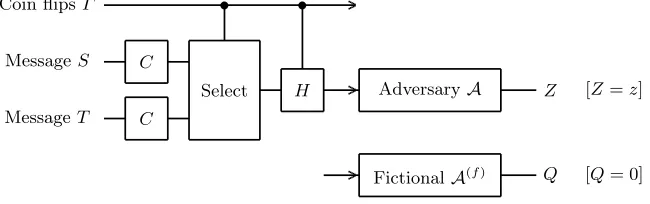
We now show the “security” part of Theorem 2. Let us first introduce some notation (see Figure 1). Suppose the OTM is programmed with
3
two messages s and t that are chosen independently and uniformly at random in{0,1}`
. Let S and T be the random variables representing these messages. LetΓ be the random variable representing the coin flips γ = (γ1, . . . , γn) used in programming the OTM.C denotes the
error-correcting code, which maps{0,1}`
to{0,1}nlgq
. “Select” is an operation that maps{0,1}nlgq× {0,1}nlgq to{0,1}nlgq, depending on the value ofΓ, as follows:
Select(x, y)i,j=
(
xi,j ifΓi= 0,
yi,j ifΓi= 1,
for alli∈[n],j∈[lgq]. (9)
“Select” outputs a string of nlgq classical bits, which are converted intonlgqqubits (in the standard basis states|0iand|1i).H denotes a Hadamard gate controlled by the value ofΓ; that is, for eachi∈[n] and j∈[lgq], ifΓi= 1, thenH is applied to the (i, j)’th qubit.
Fix any separable adversaryA, letLbe the number of possible outcomes that can be observed by the adversary, and letM={Mz|z∈[L]}be
the separable POVM measurement performed by the adversary. LetZ be the random variable representing the adversary’s output; soZ takes values in [L].
Coin flipsΓ
MessageS
MessageT C
Select
C
s
H
s
AdversaryA Z [Z=z]
FictionalA(f) Q [Q= 0]
Fig. 1.OTM with separable adversaryA, and “fictional” adversaryA(f)
. In the proof, we will analyze the distributions of S and T conditioned on the events Z = z and Q= 0.
Fix some small constantδ > 0. We say that a measurement outcome z ∈ [L] is “negligible” if Pr[Z = z]≤ (δ/2nlgq) tr(Mz). Note that the
probability of observing any of these “negligible” measurement outcomes is small:
Pr[Z is “negligible”] = X
z“negl.”
Pr[Z=z]≤(δ/2nlgq) X
z“negl.”
tr(Mz)≤δ.
A fictional adversary We begin by fixing some measurement out-come z ∈ [L] that is not “negligible.” Since the adversary performed a separable measurement, we can write the corresponding POVM ele-mentMzas a tensor product of single-qubit operators. In particular, we
can writeMz= tr(Mz)Nni=1
Nlgq
j=1Rij, where eachRijis a single-qubit
operator, positive semidefinite, with trace 1. We now construct a fictional adversary A(f)
, which we will use in the proof. The fictional adversary acts in the following way: for each qubit (i, j) ∈[n]×[lgq], it performs the POVM measurement{Rij, I−Rij}
on qubit (i, j), which yields a binary measurement outcomeQij (where
Qij= 0 corresponds to the POVM elementRij, andQij= 1 corresponds
toI−Rij). Let us write the vector of measurement outcomes asQ =
(Qij)i∈[n], j∈[lgq], which takes values in{0,1}
nlgq
. Let 0 denote the vector (0,0, . . . ,0)∈ {0,1}nlgq
.
Intuitively, the eventQ= 0 (in an experiment using the fictional adver-sary) corresponds to the eventZ =z (in an experiment using the real adversary). More precisely, for anys, t∈ {0,1}`
, we have
PST|Z(s, t|z) =
PZ|ST(z|s, t)PST(s, t)
PZ(z)
=PQ|ST(0|s, t) tr(Mz)PST(s, t) PQ(0) tr(Mz)
=PST|Q(s, t|0).
(11)
We will proceed by upper-boundingPST|Q(s, t|0) (with the fictional
ad-versary); this will imply an upper-bound onPST|Z(s, t|z) (with the real
adversary).
Properties of the codewords C(S) and C(T) Recall that the messagesS and T are independently and uniformly distributed in GF(2)`. Now consider the codewords C(S) and C(T). We claim that
there exists a subset of`coordinates ofC(S) andC(T) that are inde-pendently and uniformly distributed inGF(2)`.
To see this, recall thatCis a linear code overGF(2). Hence the encoding operationC: GF(2)`→GF(2)nlgqcan be written in the formC(x) = xTGfor some matrixG∈GF(2)`×nlgq. Since the codewordsC(x) are all
distinct, the matrixGmust have row-rank`. Hence the column-rank ofG must also be`, so there exists a subset of`columns ofGthat are linearly independent overGF(2). Let us denote this subset byA⊂[n]×[lgq],
|A|=`.
Now look at those coordinates ofC(S) andC(T) that correspond to the subsetA; we write these asC(S)A= (C(S)ij)(i,j)∈Aand (C(T)ij)(i,j)∈A.
It follows thatC(S)A andC(T)A are independently and uniformly
dis-tributed inGF(2)`.
Behavior of the fictional adversary on the subset of qubits
follows because the fictional adversary isnon-adaptive, in that it makes all its decisions about what measurements to perform, before seeing any of the results of the measurements; and because all of the measurements commute with one another, since each measurement only involves a single qubit.)
For convenience, letB= ([n]×[lgq])\A. LetQA= (Qij)(i,j)∈Adenote
the measurement outcomes of the qubits in the subsetA, and letQB =
(Qij)(i,j)∈Bdenote the measurement outcomes of the qubits in the subset
B.
We claim that the OTM’s coin tossesΓ, conditioned on the eventQA=
0, are still uniformly distributed in{0,1}n. This is a fairly straightfor-ward calculation; see the full paper [2] for details.
Using the uncertainty relation We will upper-bound these prob-abilitiesPST|Γ QA(s, t|γ,0), using an entropic uncertainty relation. The basic idea is to consider another experiment, where one runs the OTM and the fictional adversary “backwards” in time. This experiment can be analyzed using the uncertainty relation in Theorem 1 (originally due to [16]).
We now describe this new experiment (see Figure 2). One prepares the quantum stateN
(i,j)∈ARij, one chooses a uniformly random sequence
of measurement bases Θ = (Θ1, . . . , Θn) (where Θi = 0 denotes the
standard basis andΘi= 1 denotes the Hadamard basis), and then one
measures each qubit (i, j) ∈ A in the basis Θi to get a measurement
outcomeXij (which can be either 0 or 1).
Intuitively, the stateN
(i,j)∈ARijcorresponds to the fictional adversary’s
measurement outcomeQA = 0, the random basesΘ correspond to the
OTM’s coin flips Γ, and the measurement outcomes X correspond to those bitsC(S)A andC(T)A used in the OTM. (Note that the OTM’s
coin flipsΓ are uniformly distributed, even when one conditions on the eventQA= 0, as shown in the previous section.)
H
s
StateN
(i,j)∈ARij
Coin flipsΘ
Measure X
Fig. 2.In order to understand the behavior of the fictional adversary, conditioned on the eventQA= 0, we consider an analogous experiment, where the stateN(i,j)∈ARij
is measured in a random basis. We will analyze this using an entropic uncertainty relation.
To make this intuition precise, we will first show that:
H∞(ε S, T|Γ, QA= 0) =H∞(ε X|Θ) +`. (12)
(See the full version [2] for details.) Then note that conditioning onΓ can only reduce the entropy, hence we have:
We then use Theorem 1 to show a lower-bound onH∞(ε X|Θ); see the
full paper [2] for details.
Combining all the pieces The fictional adversary’s complete se-quence of measurement outcomes is denoted byQ= (QA, QB). So far
we have analyzed the adversary’s actions on those qubits belonging to the subsetA, and we have shown a lower-bound onH∞(ε S, T|QA = 0).
Now, we will show a lower-bound on H∞(ε S, T|Q = 0). To do this, we
bound the adversary’s actions on the subsetB in a more-or-less trivial way, using the fact that Pr[Q= 0] = Pr[Z =z]/tr(Mz)≥δ/2nlgq, since
zwas assumed to be “non-negligible.”
We will then consider the real adversary, and show a lower-bound on H∞δ+ε(S, T|Z). Here we use the following identity that relates the real adversary and the fictional adversary (see equation (11)):
H∞(ε S, T|Z=z) =H∞(ε S, T|Q= 0). (14) Finally we combine these results to prove the theorem; see the full paper [2] for details.
4
Efficient implementations of one-time
memories
In the previous section, we showed that one-time memories can be con-structed from any code that approaches the capacity of theq-ary sym-metric channel, and is linear overGF(2). In this section, we will construct codes that have these properties, and moreover can be encoded and de-coded efficiently. Using these codes, we will get efficient implementations of one-time memories.
MessageS
`=klgq0 C0
nlgq0 lgq0
C1 lgq
C1
(nblocks)
nlgq
CodewordX
Fig. 3.Efficient codes for theq-ary symmetric channel, based on erasure coding and error detection.
The basic idea is to take the messages, encode it using a codeC0 that outputs a string ofq0-ary symbols (whereq0< q), and then encode each q0-ary symbol using a codeC1 that outputs aq-ary symbol. The code C1 is used to detect errors made by theq-ary symmetric channel; once detected, these errors can be treated as erasures. The codeC0 is then used to correct these erasures, which is relatively straightforward. For instance, we can choose C0 to be a random linear code; then we can decode in the presence of erasure errors by solving a linear system of equations, which we can do efficiently.
We now describe the construction in detail. Letk≥2 be an integer, let pe∈(0,1), and choose any small constants 0< ε1, 0< δ1 and
0< θ1. Define:
n=
k 1−pe−θ
, (15)
q= 2c, c= lgq=2
δ εn+ lg(npe)
, (16)
q0= 2c0, c0= lgq0=2δ−2 εn+ lg(npe). (17)
Note that our setting is slightly unusual, in that we will be constructing codes for theq-ary symmetric channel where q is not fixed. In particu-lar, lgq (the number of bits used to describe eachq-ary symbol) grows polynomially with the codeword lengthn, which is proportional to the message lengthk.
We will construct a codeC: {0,1}klgq0→ {0,1}nlgq
as follows: 1. Choose a uniformly random matrix G0 ∈ GF(2)klgq0×nlgq0, and
define a code C0 : {0,1}klgq0 → {0,1}nlgq0 by setting C0(s) = sTG0.
2. Fix any full-rank matrix G1 ∈ GF(2)lgq0×lgq, and define a code C1: {0,1}lgq0 → {0,1}lgq by settingC1(v) =vTG1.
3. Define C(s) = C1◦C0(s), where we viewC0(s) ∈ {0,1}nlgq0 as a sequence of n blocks of lgq0 bits, and C1 acts separately on each of these blocks. Equivalently, we can writeC(s) =sTG0(Ln
i=1G1), whereLn
i=1G1 denotes a direct sum ofncopies of the matrixG1. We use the following decoding algorithm:
1. Given a stringz∈ {0,1}nlgq
, write it as a sequence ofn blocks of lgq bits:z= (zij)i∈[n],j∈[lgq].
2. For eachi∈[n], try to decode theq-ary symbolzi∈ {0,1}lgq, i.e.,
try to find somev∈ {0,1}lgq0 such thatC1(v) =z
i. Letbi be the
result (or setbi=∗ifzi lies outside the image ofC1). Thus we get
a stringb= (b1, b2, . . . , bn)∈ {0,1}lgq0∪ {∗}
n
.
3. Try to decode the stringb, treating the∗ symbols as erasures, i.e., try to find somea∈ {0,1}klgq0 such that, for all i∈[n] such that bi6=∗, and for allj∈[lgq],C0(a)ij=bij. If a solution exists, output
it; if there are multiple solutions, choose any one of them and output it; otherwise, abort.
Finally, we introduce some more notation. Let us choose a message (rep-resented by a random variableS) uniformly at random in{0,1}klgq0. Let Eq be the q-ary symmetric channel with error probability pe. We
take the messageS, encode it using the codeC, transmit it through the channelEq, then run the decoding algorithm, and get an estimate of the
original message; call this ˆS.
Theorem 3. Let k ≥ 2 be an integer, let pe ∈ (0,1), and choose any
small constants0< ε1,0< δ1and0< θ1. Let us construct the code C : {0,1}klgq0 → {0,1}nlgq as described above. Then C has
the following properties:
1. With high probability (over the choice of the random matrix G0),C
can transmit information reliably over theq-ary symmetric channel Eq with error probabilitype.
More precisely, choose any small constant τ such that 0< τ < θ, and choose any large constantλ1. Then, with probability≥1−1
λ
(over the choice of G0), the codeC can transmit information over
the channelEq, and the probability of decoding failure is bounded by:
Pr[ ˆS6=S]≤λ e−2τ2n+ 2−εn+ 2(−nθ+nτ+1) lgq0
≤e−Ω(n). (18)
2. C is a linear code overGF(2). 3. Chas rateα:=klgq0
nlgq ≥(1−pe−θ)(1−δ). (Note that this approaches
the capacity of the channel Eq, as shown in equation (2), when qis
large.)
4. The encoding and decoding algorithms forCrun in time polynomial innlgq. (Also note thatlgq grows at most linearly withn, andnis proportional tok.)
Finally, we can take the codeC constructed above (for pe = 12), and
combine it with the OTM construction of Theorem 2, to get the following result:
Corollary 1. For any k ≥2, and for any small constant 0< µ 1, there exists an OTM construction that stores two messagess, t∈ {0,1}`, where`=Θ(k2), and has the following properties:
1. The OTM behaves correctly for honest parties.
2. The OTM can be implemented in time polynomial ink.
3. Let 0< δ1 be any small constant. Suppose the messagess and
tare chosen independently and uniformly at random in{0,1}`. For any separable adversary,4 we have the following security bound:
H∞δ+ε(S, T|Z)≥(12 −µ)`−lg 1
δ. (19)
HereS andT are the random variables describing the two messages,
Z is the random variable representing the adversary’s measurement outcome, and we haveε≤exp(−Ω(k)).
Acknowledgements: It is a pleasure to thank Serge Fehr, Stephen Jordan, Maris Ozols, Rene Peralta, Eren Sasoglu, Christian Schaffner, Barbara Terhal, Alexander Vardy, and several anonymous reviewers, for helpful suggestions about this work. Some of these discussions took place at the Schloss Dagstuhl – Leibniz Center for Informatics. This paper is a contribution of NIST, an agency of the US government, and is not subject to US copyright.
4
References
1. Liu, Y.-K.: Building one-time memories from isolated qubits. In: 5th Conference on Innovations in Theoretical Computer Science (ITCS 2014), pp.269-286 (2014).
2. Liu, Y.-K.: Single-shot security for one-time memories in the isolated qubits model. ArXiv:1402.0049.
3. Goldwasser, S., Kalai, Y.T., Rothblum, G.N.: One-Time Programs. In:CRYPTO 2008, pp.39-56.
4. Goyal, V., Ishai, Y., Sahai, A., Venkatesan, R., Wadia, A.: Founding Cryptography on Tamper-Proof Hardware Tokens. In:TCC 2010, pp.308-326.
5. Bellare, M., Hoang, V. T., Rogaway, P.: Adaptively Secure Garbling with Applications to One-Time Programs and Secure Outsourcing. In:ASIACRYPT 2012, pp.134-153.
6. Broadbent, A., Gutoski, G., Stebila, D.: Quantum one-time pro-grams. In:CRYPTO 2013, pp.344-360.
7. Lo, H.-K., Chau, H.F.: Is quantum bit commitment really possible?
Phys. Rev. Lett.78, 3410 (1997).
8. Lo, H.-K.: Insecurity of quantum secure computations.Phys. Rev. A, 56(2): 1154-1162 (1997).
9. Mayers, D.: Unconditionally secure quantum bit commitment is im-possible.Phys. Rev. Lett., 78:3414-3417 (1997).
10. Buhrman, H., Christandl, M., Schaffner, C.: Complete Insecurity of Quantum Protocols for Classical Two-Party Computation.Phys. Rev. Lett.109, 160501 (2012).
11. Salvail, L.: Quantum Bit Commitment from a Physical Assumption. In:CRYPTO 1998, pp.338-353.
12. Damgaard, I., Fehr, S., Salvail, L., Schaffner, C.: Cryptography In the Bounded Quantum-Storage Model. In:FOCS 2005, pp.449-458. 13. Koenig, R., Terhal, B.M.: The Bounded Storage Model in the Pres-ence of a Quantum Adversary.IEEE Trans. Inf. Th., vol. 54, no. 2 (2008).
14. Damgaard, I., Fehr, S., Salvail, L., Schaffner, C.: Secure Identi-fication and QKD in the Bounded-Quantum-Storage Model. In:
CRYPTO 2007, pp.342-359.
15. Wehner, S., Schaffner, C., Terhal, B.: Cryptography from Noisy Stor-age.Phys. Rev. Lett.100, 220502 (2008).
16. Damgard, I., Fehr, S., Renner, R., Salvail, L., Schaffner, C.: A Tight High-Order Entropic Quantum Uncertainty Relation with Applica-tions. In:CRYPTO 2007, pp.360-378.
17. Bouman, N.J., Fehr, S., Gonzalez-Guillen, C., Schaffner, C.: An All-But-One Entropic Uncertainty Relation, and Application to Password-Based Identification. In:TQC 2012, pp.29-44.
18. Pastawski, F., Yao, N.Y., Jiang, L., Lukin, M.D., Cirac, J.I.: Un-forgeable Noise-Tolerant Quantum Tokens. Proc. Nat. Acad. Sci.
109, 16079-16082 (2012).
20. Renner, R., Wolf, S.: Simple and Tight Bounds for Information Reconciliation and Privacy Amplification. In: ASIACRYPT 2005, pp.199-216.
21. Wiesner, S.: Conjugate coding. ACM SIGACT News, Volume 15, Issue 1, 1983, pp.78-88; original manuscript written circa 1970. 22. Bleichenbacher, D., Kiayias, A., Yung, M.: Decoding of Interleaved
Reed Solomon Codes over Noisy Data. In:ICALP 2003, pp.97-108. 23. Shokrollahi, A.: Capacity-approaching codes on theq-ary symmetric
channel for largeq. In:ITW 2004, pp.204-208.
24. Brown, A., Minder, L., Shokrollahi, A.: Improved Decoding of Inter-leaved AG Codes. In: Cryptography and Coding 2005, LNCS 3796, pp.37-46.
25. Bennett, C.H., DiVincenzo, D.P., Fuchs, C.A., Mor, T., Rains, E., Shor, P.W., Smolin, J.A., Wootters, W.K.: Quantum nonlocality without entanglement.Phys. Rev. A59, pp.10701091 (1999). 26. Childs, A.M., Leung, D., Mancinska, L., Ozols, M.: A framework for
bounding nonlocality of state discrimination. Comm. Math. Phys.
323, pp.1121-1153 (2013).
27. DiVincenzo, D.P., Leung, D.W., Terhal, B.M.: Quantum Data Hid-ing.IEEE Trans. Inf. Theory, Vol. 48, No. 3, pp.580-599 (2002). 28. Eggeling, T., Werner, R.F.: Hiding Classical Data in Multipartite
Quantum States.Phys. Rev. Lett.89, 097905 (2002).
29. DiVincenzo, D.P., Hayden, P., Terhal, B.M.: Hiding Quantum Data.
Found. Phys.33(11), pp.1629-1647 (2003).
30. Hayden, P., Leung, D., Smith, G.: Multiparty data hiding of quan-tum information.Phys. Rev. A71, 062339 (2005).
31. Winter, A.: Coding theorem and strong converse for quantum chan-nels.IEEE Trans. Inform. Theory 45(7), pp.2481-2485 (1999). 32. Akavia, A., Goldwasser, S., Vaikuntanathan, V.: Simultaneous
Hard-core Bits and Cryptography against Memory Attacks. In:TCC 2009, pp.474-495.
33. Naor, M., Segev, G.: Public-Key Cryptosystems Resilient to Key Leakage. In:CRYPTO2009, pp.18-35.
34. Nielsen, M.A., Chuang, I.L.:Quantum Computation and Quantum Information. Cambridge University Press (2000).
35. Maassen, H., Uffink, J.: Generalized Entropic Uncertainty Relations.
Phys. Rev. Lett., Vol. 60, pp.1103 (1988).
36. Wehner, S., Winter, A.: Entropic uncertainty relations - A survey.
New J. Phys., Vol. 12, 025009 (2010).
37. Dubhashi, D.P., Panconesi, A.: Concentration of Measure for the Analysis of Randomized Algorithms. Cambridge University Press (2009).
38. Horodecki, R., Horodecki, P., Horodecki, M., Horodecki, K.: Quan-tum Entanglement.Rev. Mod. Phys.81, pp.865-942 (2009). 39. Saeedi, K., et al: Room-Temperature Quantum Bit Storage
Exceed-ing 39 Minutes UsExceed-ing Ionized Donors in Silicon-28. Science 342 (6160) pp.830-833 (2013).