Charmonium-nucleon interactions from the time-dependent HAL
QCD method
Takuya Sugiura1,⋆,Yoichi Ikeda1, andNoriyoshi Ishii1
1Research Center for Nuclear Physics (RCNP), Osaka University, Osaka 567-0047, Japan
Abstract. The charmonium-nucleon effective central interactions have been computed by the time-dependent HAL QCD method. This gives an updated result of a previous study based on the time-independent method, which is now known to be problematic because of the difficulty in achieving the ground-state saturation. We discuss that the result is consistent with the heavy quark symmetry. No bound state is observed from the analysis of the scattering phase shift; however, this shall lead to a future search of the hidden-charm pentaquarks by considering channel-coupling effects.
1 Introduction
Properties of hadrons having more complex structure than those of the standard three-quark baryons or the quark-antiquark mesons, called exotic hadrons, have not been established yet. Recently, the LHCb collaboration have reported the observation of two hidden-charm pentaquark candidates, Pc(4380)
andPc(4450), in the J/ψpinvariant mass distribution from the weak decay of theΛ0b → J/ψpK
−
[1]. The fit with the Breit-Wigner parameterization shows the masses and widths as MPc(4380) = 205±18±86MeV,ΓPc(4380)=205±18±86MeV,MPc(4450)=4449.8±1.7±2.5MeV, andΓPc(4450)= 39±5±19MeV. Three acceptable spin-parity combinations (3/2−,5/2+),(3/2+,5/2−
),(5/2+,3/2− ) are also obtained.
A lot of theoretical works have been done to reveal the structure of thePc’s [2–6]. These results
do not give a consistent answer about what the reportedPcresonances actually are like, and even
the existence of such resonances. We believe this situation originates from the lack of knowledge of interactions between charmed hadrons. Shown in figure1is a diagram for the decayΛb→PcK. The
observed peaks ofPcmust couple to the J/ψN were they really resonances. Therefore, it would be
desirable to consider the 2-body scattering without the spectatorK to studyPc. Obviously such an
experiment is unaccessible, and another approach is in demand.
To settle the above issue, we aim at studying the structures of thePc’s via the lattice QCD
sim-ulations without requiring further experimental data. We employ the potential approach developed by the HAL QCD collaboration[7]. The method, which we shall call the (time-independent) HAL QCD method, utilizes the spatial part of hadron correlators, called the Nambu-Bethe-Salpeter (NBS) amplitude. The long-distance asymptotic behavior of the NBS amplitude is identical to that of a scat-tered wave function in quantum mechanics; therefore, by solving the Schrödinger equation for the potential with such an amplitude as input, we can be sure that the potential is faithful to the QCD
S matrix. It has already been applied to a variety of systems, including the nucleon-nucleon (NN), nucleon-hyperon (NY), YY, and NNN interactions [8]. The above method relies on the ground-state saturation in correlation functions. However, the ground-state saturation has turned out difficult to achieve in actual calculations. To avoid this problem, the HAL QCD collaboration has introduced an-other method, calledthe time-dependent method[9]. In the time-dependent method, we assume that correlation functions are dominated not only by the ground state but by the elastic states. By solving a time-dependent Schrödinger-like equation, we calculate the same potential as in the original method. Since the elastic-state saturation is much easier to achieve than the ground-state saturation, the time-dependent method should always be preferred. Moreover, the HAL QCD method is straightforwardly applied to coupled-channel systems [8]. Since channel-coupling is expected to be crucial to study the origin of the peak corresponding to thePc’s, this feature is quite helpful.
In the present study, we have set out on our coupled-channel analysis from the J/ψN andηcN
single-channel interactions. We focus on the S-wave angular momentum, so we have three channels: J/ψN(JP =1/2−
),J/ψN(JP =3/2−
), andηcN(JP=1/2−). These channels are a part of the coupled
channels that can couple toPc. TheJ/ψN(JP=3/2−) in particular, is the lowest-lying channel of the
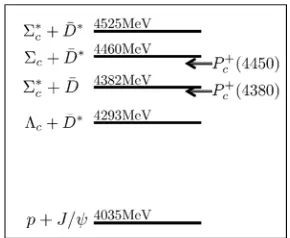
five S-wave meson-baryon channels in Figure1. We calculate the effective central potential for each of the three channels, so that the couplings to the other meson-baryon channels, to the channels with higher angular momentum, and betweenJ/ψN andηcN in theJ = 1/2 case, are all integrated out.
The charmonium-nucleon effective central interactions have already been studied with the quenched lattice QCD in Ref. [10]. They found no bound state between ηcN norJ/ψN. In contrast, authors
in Ref. [11] have reported contradictory results from the direct method: theηcNsystem has a deeply
bound state with binding energy of 19.8MeV. In this way, there exists a conflict between the HAL QCD potential method and the direct method as in the NN sector where the ground state saturation plays a key role [12]. Since the authors of Ref. [10] have employed the old-fashioned HAL QCD method (i.e. the time-independent method) which can be afflicted with the problem of the ground state saturation, we shall improve their results by employing the new one (i.e. the time-dependent HAL QCD method) to avoid the problem. Moreover, we shall see that the comparison of our results for the two spin assignments of theJ/ψNgives an implication of the heavy quark spin symmetry.
Figure 1. Feynman diagram for theΛ0 b→P
+
cK−decay.
S matrix. It has already been applied to a variety of systems, including the nucleon-nucleon (NN), nucleon-hyperon (NY), YY, and NNN interactions [8]. The above method relies on the ground-state saturation in correlation functions. However, the ground-state saturation has turned out difficult to achieve in actual calculations. To avoid this problem, the HAL QCD collaboration has introduced an-other method, calledthe time-dependent method[9]. In the time-dependent method, we assume that correlation functions are dominated not only by the ground state but by the elastic states. By solving a time-dependent Schrödinger-like equation, we calculate the same potential as in the original method. Since the elastic-state saturation is much easier to achieve than the ground-state saturation, the time-dependent method should always be preferred. Moreover, the HAL QCD method is straightforwardly applied to coupled-channel systems [8]. Since channel-coupling is expected to be crucial to study the origin of the peak corresponding to thePc’s, this feature is quite helpful.
In the present study, we have set out on our coupled-channel analysis from the J/ψN andηcN
single-channel interactions. We focus on the S-wave angular momentum, so we have three channels: J/ψN(JP=1/2−
),J/ψN(JP=3/2−
), andηcN(JP=1/2−). These channels are a part of the coupled
channels that can couple toPc. TheJ/ψN(JP=3/2−) in particular, is the lowest-lying channel of the
five S-wave meson-baryon channels in Figure1. We calculate the effective central potential for each of the three channels, so that the couplings to the other meson-baryon channels, to the channels with higher angular momentum, and between J/ψN andηcN in theJ = 1/2 case, are all integrated out.
The charmonium-nucleon effective central interactions have already been studied with the quenched lattice QCD in Ref. [10]. They found no bound state between ηcN norJ/ψN. In contrast, authors
in Ref. [11] have reported contradictory results from the direct method: theηcNsystem has a deeply
bound state with binding energy of 19.8MeV. In this way, there exists a conflict between the HAL QCD potential method and the direct method as in the NN sector where the ground state saturation plays a key role [12]. Since the authors of Ref. [10] have employed the old-fashioned HAL QCD method (i.e. the time-independent method) which can be afflicted with the problem of the ground state saturation, we shall improve their results by employing the new one (i.e. the time-dependent HAL QCD method) to avoid the problem. Moreover, we shall see that the comparison of our results for the two spin assignments of theJ/ψNgives an implication of the heavy quark spin symmetry.
Figure 1. Feynman diagram for theΛ0 b→P
+
cK−decay.
Figure 2. The five S-wave meson-baryon channels that possibly couple to the pentaquarks withJP=3/2−.
2 Method
We start from computing a normalized four-point correlation functionRof each charmonium-nucleon system,
R(�r,t)≡ �0|T N(x�+�r,t)φ(�x,t)J(t0 =0)|0�/e−(mN+mφ)t, (1)
whereN(�x,t) denotes an interpolating operator for the nucleon,φ(�x,t) for the charmonium (eitherJ/ψ
orηc), andJ(t0) the corresponding wall-source operator. In actual lattice calculations, the exponential
factor involving the nucleon massmNand the charmonium massmφis replaced by the single-hadron correlators. The non-local potentialU(�r,�r′) satisfies the Schrödinger-like equation attlarge enough for the elastic-state saturation
−∂
∂t+
� ∇2 2µ
R(�r,t)= �
d3�r′U(�r,�r′)R(�r′,t), (2)
whereµ=1/(1/mN+1/mφ) is the reduced mass. We neglect the relativistic effects, which in principle appear as higher-order time derivatives on the left-hand side, since they are much smaller than the other terms. The non-locality of the potentialU(�r,�r′) can be well-tamed by the derivative expansion, such that the scattering phase shift computed from the expanded potential approaches the exact one order by order [13]. By taking the leading order term of the derivative expansion,U(�r,�r′)≃V(r)δ3
(�r−
�r′), we get the effective central potential
Veff(r)=− ∂tR(�r,t)
R(�r,t) + 1 2µ
�
∇2R(�r,t)
R(�r,t) ≡Vt(r)+V∇(r). (3)
Note thatVeff(r) does not depend ontalthough theRcorrelator does. This is true when the elastic-state saturation is achieved and the local potential well approximates the non-local kernelU(�r,�r′). Furthermore, when the ground-state saturation is achieved,Vt(r) is reduced to just a constant,Vt(r)=ǫ
withǫindependent of bothtandr. In other words, whenVt(r) is dependent onr, the time-independent
method will presumably fail.
3 Simulation Setup
We employ the 2+1 flavor full QCD gauge configurations by the CP-PACS and JLQCD Collabo-rations [14]. They are generated with the renormalization-group improved gauge action and a non-perturbativelyO(a) improved clover quark action atβ = 1.83 (corresponding to the lattice spacing ofa = 0.1209fm [15]) on a 163 ×32 lattice, so that the spatial volume is (1.93fm)3. The heavy mass of charm quarks may bring large discretization errors, for which the relativistic heavy quark (RHQ) action [16] should be employed. However, in this present study, we use the clover action for all quarks. The hopping parameter for the light (up and down) quarks and the strange quark are set toκud = 0.13760 andκs =0.13710, respectively. For the charm quark, the valueκc = 0.11660
is determined by fitting the 1/κvsm2
PSplot to reproduce the physicalηcmass of 2983MeV on this
lattice.
The Dirichlet boundary condition is imposed att−t0 =26 to prevent inverse propagation. In the
spatial directions we imposed the periodic boundary condition. We average the results from 16 source positionst0to reduce statistical error. The spatial correlation is averaged based on the 48 octahedral
4 Results and Discussion
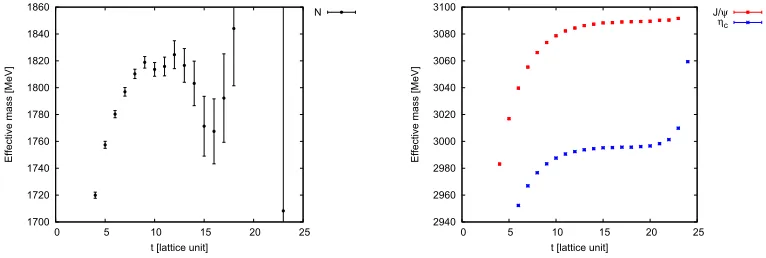
In Figure3, we show the effective masses ofN,ηc, andJ/ψextracted from single-hadron correlation
functions. We see plateaux in all those plots. We have performed a single exponential fit to each of the single-hadron correlators. The resulting masses aremN =1816MeV (t=8−14),mηc =2996MeV (t=15−18), andmJ/ψ=3089MeV (t=16−19), where the time slices used for the fit are shown in the parentheses.
1700 1720 1740 1760 1780 1800 1820 1840 1860
0 5 10 15 20 25
Effective mass [MeV]
t [lattice unit]
N
2940 2960 2980 3000 3020 3040 3060 3080 3100
0 5 10 15 20 25
Effective mass [MeV]
t [lattice unit]
J/ψ ηc
Figure 3. The effective masses of (left) nucleon, (right,blue)ηc, and (right,red)J/ψ.
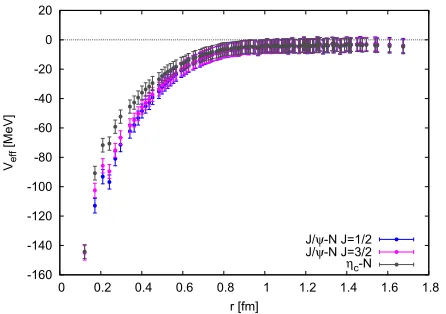
Figure4 shows our results of the effective central potentials at t = 12. They are all attractive overall, and are quite similar quantitatively. Especially, the two total spin assignments ofJ/ψNhave very small difference, which differ in the spin direction of J/ψ relative to that of N, when the S-wave angular momentum considered. This may be because of the following reason. According to the heavy quark spin symmetry [17], light quarks and soft gluons see a heavy quark as a static color source, since they cannot change the velocity or flip the spin of the heavy quark. Thus the dynamics is independent of the heavy quark spin, as the difference is suppressed byO(1/mh) for heavy quark
with massmh. This picture seems to be applicable to the two spin assignments of theJ/ψN. TheηcN
potential has a little weaker attraction than theJ/ψNpotentials. This might be because of the lighter mass ofηcthan ofJ/ψby 93MeV. The authors of Ref. [10] have also observed a similar tendency
between theηcNand spin-averaged J/ψN potentials. They have discussed that the difference in the
reduced masses is too small to account for theO(10)% difference in the potentials, and thus it is caused by different structures ofηcandJ/ψ. We cannot draw a definite conclusion either; however we
remark that the similarity in the behavior of the charmonium-nucleon interactions, and yet the small difference between theηcNandJ/ψN, are compatible with the heavy quark symmetry.
In figure5, we show theJ/ψN(J=1/2) potentials extracted att=12−15, where the filled areas express statistical error bars. We see all the results agree within the errors. Therefore we conclude that the elastic-state saturation is achieved and the derivative expansion is converged at the lowest order at t =12. The same check has been done to the other two potentials, and they are found qualitatively similar to this case.
Notice that theRcorrelator in Eq. (1) is normalized by a single exponential factor, so that we assume the ground-state saturation of the J/ψandN single-hadron correlators. As can be seen in figure3, however,t=12 is a little too small for the single-charmonium (bothηcandJ/ψ) correlators
4 Results and Discussion
In Figure3, we show the effective masses ofN,ηc, andJ/ψextracted from single-hadron correlation
functions. We see plateaux in all those plots. We have performed a single exponential fit to each of the single-hadron correlators. The resulting masses aremN =1816MeV (t=8−14),mηc =2996MeV (t=15−18), andmJ/ψ=3089MeV (t=16−19), where the time slices used for the fit are shown in the parentheses. 1700 1720 1740 1760 1780 1800 1820 1840 1860
0 5 10 15 20 25
Effective mass [MeV]
t [lattice unit]
N 2940 2960 2980 3000 3020 3040 3060 3080 3100
0 5 10 15 20 25
Effective mass [MeV]
t [lattice unit]
J/ψ ηc
Figure 3. The effective masses of (left) nucleon, (right,blue)ηc, and (right,red)J/ψ.
Figure4 shows our results of the effective central potentials att = 12. They are all attractive overall, and are quite similar quantitatively. Especially, the two total spin assignments ofJ/ψNhave very small difference, which differ in the spin direction of J/ψrelative to that of N, when the S-wave angular momentum considered. This may be because of the following reason. According to the heavy quark spin symmetry [17], light quarks and soft gluons see a heavy quark as a static color source, since they cannot change the velocity or flip the spin of the heavy quark. Thus the dynamics is independent of the heavy quark spin, as the difference is suppressed byO(1/mh) for heavy quark
with massmh. This picture seems to be applicable to the two spin assignments of theJ/ψN. TheηcN
potential has a little weaker attraction than theJ/ψNpotentials. This might be because of the lighter mass ofηcthan ofJ/ψby 93MeV. The authors of Ref. [10] have also observed a similar tendency
between theηcNand spin-averaged J/ψN potentials. They have discussed that the difference in the
reduced masses is too small to account for the O(10)% difference in the potentials, and thus it is caused by different structures ofηcandJ/ψ. We cannot draw a definite conclusion either; however we
remark that the similarity in the behavior of the charmonium-nucleon interactions, and yet the small difference between theηcNandJ/ψN, are compatible with the heavy quark symmetry.
In figure5, we show theJ/ψN(J=1/2) potentials extracted att=12−15, where the filled areas express statistical error bars. We see all the results agree within the errors. Therefore we conclude that the elastic-state saturation is achieved and the derivative expansion is converged at the lowest order at t =12. The same check has been done to the other two potentials, and they are found qualitatively similar to this case.
Notice that theR correlator in Eq. (1) is normalized by a single exponential factor, so that we assume the ground-state saturation of theJ/ψandN single-hadron correlators. As can be seen in figure3, however,t=12 is a little too small for the single-charmonium (bothηcandJ/ψ) correlators
to achieve the ground-state saturation. It results in∼3MeV deviation in the effective masses of the charmonia att=12 and those extracted from the plateaux int>15. Nevertheless, the deviation is
-160 -140 -120 -100 -80 -60 -40 -20 0 20
0 0.2 0.4 0.6 0.8 1 1.2 1.4 1.6 1.8
Veff
[MeV]
r [fm]
J/ψ-N J=1/2 J/ψ-N J=3/2
ηc-N
Figure 4. Effective central potentials att=12 of (black)ηcN, (blue)J/ψNwithJ=1/2, and (magenta)J/ψN withJ=3/2.
-140 -120 -100 -80 -60 -40 -20 0 20
0 0.2 0.4 0.6 0.8 1 1.2 1.4 1.6 1.8
Veff [MeV] r [fm] t=15 t=14 t=13 t=12
Figure 5. TheJ/ψN(J=1/2) potentials extracted at different time slices,t=12−15.
of∼0.1% relative to the total masses of∼3000MeV, so that it affects little to the potentials, as is actually seen in Figure5.
Figure6shows each term of the J/ψN(J = 1/2) potential in Eq. (3), depicted separately. The second termV∇(r) gives dominant contribution to the short-distance attraction, and it behaves repul-sively forr>0.6. The first termVt(r) is attractive overall with smaller strength at short distances than
V∇(r). At large distances, the small repulsion ofV∇(r) and the small attraction ofVt(r) cancel and
give the totally attractive and short-rangedVeff(r). Notice thatVt(r) is dependent onr; it means that
-50 -40 -30 -20 -10 0 10 20
0 0.2 0.4 0.6 0.8 1 1.2 1.4 1.6 1.8
Veff
[MeV]
r [fm]
Total Vt
V∇
Figure 6. Each term of theJ/ψN(J=1/2) potential in Eq. (3): (red)Vt(r), (blue)V∇(r), and (black)Veff(r) at
t=12.
We have performed a fit of the potentials in Figure4with two Gaussian functions. Then by solving the S-wave radial Schrödinger equation
1 2µr2
d dr
r2 d dr
+E
R(r;E)=V(r)R(r;E) (4)
we obtain the scattering phase shiftδ(E) from the asymptotic form ofR(r;E),
R(r;E)∼ i
2
h(0−)(kr)−e2iδ(E)h(0+)(kr), (5)
whereh(0±)(z) are the spherical Riccati-Hankel functions withl=0.
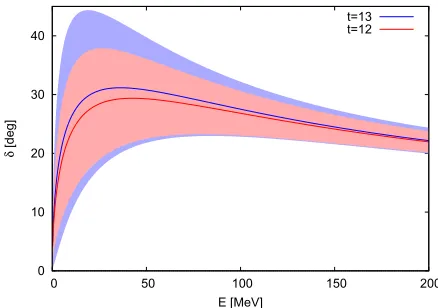
Figure7 shows the result of the phase shift of J/ψN (J = 1/2). We see that the interaction is attractive, but not strong enough to have bound states. Moreover we have performed the eff ective-range expansionkcot(δ)=1/a+rk2/2 to obtain the scattering lengthaand the effective range. At
t=12, the results are:a=0.68±0.44fm andr=1.04±0.03fm forJ/ψN(J=1/2),a=0.63±0.42fm, r=1.11±0.03fm forJ/ψN(J=3/2), anda=0.44±0.34fm,r=1.33±0.06fm forηcN.
5 Conclusions
We have computed the S-wave effective central potentials of the J/ψN (JP = 1/2−
and 3/2−) and
ηcN. We have shown that our results are qualitatively similar to the previous results by Kawanai
and Sasaki, where the time-independent method is employed. However, we have confirmed that the time-dependent method is crucial to extract a reliable potential, as the ground-state saturation is not achieved at a moderate time. Our results show that all the charmonium-nucleon potentials are quite similar, and this is naturally understood through the heavy quark symmetry. We have not observed any bound states as shown in the phase shift analysis. However, inclusion of the other channels might result in emergence of resonance states, which may correspond to thePcresonances. The analysis
-50 -40 -30 -20 -10 0 10 20
0 0.2 0.4 0.6 0.8 1 1.2 1.4 1.6 1.8
Veff [MeV] r [fm] Total Vt V∇
Figure 6. Each term of the J/ψN(J =1/2) potential in Eq. (3): (red)Vt(r), (blue)V∇(r), and (black)Veff(r) at
t=12.
We have performed a fit of the potentials in Figure4with two Gaussian functions. Then by solving the S-wave radial Schrödinger equation
1 2µr2
d dr
r2 d dr
+E
R(r;E)=V(r)R(r;E) (4)
we obtain the scattering phase shiftδ(E) from the asymptotic form ofR(r;E),
R(r;E)∼ i
2
h(0−)(kr)−e2iδ(E)h(0+)(kr), (5)
whereh(0±)(z) are the spherical Riccati-Hankel functions withl=0.
Figure7 shows the result of the phase shift of J/ψN (J = 1/2). We see that the interaction is attractive, but not strong enough to have bound states. Moreover we have performed the eff ective-range expansionkcot(δ)=1/a+rk2/2 to obtain the scattering lengthaand the effective range. At
t=12, the results are:a=0.68±0.44fm andr=1.04±0.03fm forJ/ψN(J=1/2),a=0.63±0.42fm, r=1.11±0.03fm forJ/ψN(J=3/2), anda=0.44±0.34fm,r=1.33±0.06fm forηcN.
5 Conclusions
We have computed the S-wave effective central potentials of the J/ψN (JP = 1/2−
and 3/2−) and
ηcN. We have shown that our results are qualitatively similar to the previous results by Kawanai
and Sasaki, where the time-independent method is employed. However, we have confirmed that the time-dependent method is crucial to extract a reliable potential, as the ground-state saturation is not achieved at a moderate time. Our results show that all the charmonium-nucleon potentials are quite similar, and this is naturally understood through the heavy quark symmetry. We have not observed any bound states as shown in the phase shift analysis. However, inclusion of the other channels might result in emergence of resonance states, which may correspond to thePcresonances. The analysis
with coupled channels and the use of the RHQ action are currently in progress.
0 10 20 30 40
0 50 100 150 200
δ
[deg]
E [MeV]
t=13 t=12
Figure 7. The scattering phase shift of theJ/ψN(J=1/2) att=12 and 13.
Acknowledgements
This work is supported by Japan Society for the Promotion of Science KAKENHI Grands No. JP25400244 and by Ministry of Education, Culture, Sports, Science and Technology as “Priority Issue on Post-K computer” (Elucidation of the Fundamental Laws and Evolution of the Universe) and Joint Institute for Computational Fundamental Science. We thank CP-PACS and JLQCD Collaborations [15] and ILDG/JLDG [18] for the 2+1 flavor QCD gauge configurations. This work is in part based on Bridge++code [19].
References
[1] R. Aaijat al.[LHCb Collaboration], Phys. Rev. Lett.115, 072001 (2015).
[2] J. J. Wu, R. Molina, E. Oset and B. S. Zou, Phys. Rev. Lett. 105, 232001 (2010) doi:10.1103/PhysRevLett.105.232001 [arXiv:1007.0573 [gull-th]].
[3] R. Chen, X. Liu, X. Q. Li and S. L. Zhu, Phys. Rev. Lett.115, no. 13, 132002 (2015).
[4] H. X. Chen, W. Chen, X. Liu, T. G. Steele and S. L. Zhu, Phys. Rev. Lett.115, no. 17, 172001 (2015).
[5] L. Maiani, A. D. Polosa and V. Query, Phys. Lett. B749, 289 (2015).
[6] F. K. Guo, U. G. Meißner, W. Wang and Z. Yang, Phys. Rev. D92, no. 7, 071502 (2015). [7] N. Ishii, S. Aoki and T. Hazed, Phys. Rev. Lett.99, 022001 (2007).
[8] S. Aokiet al.[HAL QCD Collaboration], PTEP2012, 01A105 (2012). [9] N. Ishiiet al.[HAL QCD Collaboration], Phys. Lett. B712, 437 (2012). [10] T. Kawanai and S. Sasaki, Phys. Rev. D82, 091501 (2010).
[11] S. R. Beane, E. Chang, S. D. Cohen, W. Detmold, H.-W. Lin, K. Orginos, A. Parreño and M. J. Savage, Phys. Rev. D91, no. 11, 114503 (2015).
[12] T. Iritaniet al., Phys. Rev. D96, no. 3, 034521 (2017).
[13] T. Sugiura, N. Ishii and M. Oka, Phys. Rev. D95, no. 7, 074514 (2017).