_____________________________________________________________________________________________________ *Corresponding author: E-mail: [email protected];
(Past name: British Journal of Medicine and Medical Research, Past ISSN: 2231-0614, NLM ID: 101570965)
Clinical Features and Outcomes of Mycophenolate
Mofetil-induced Diarrhea: A Systematic Review
Prajwal Dhakal
1, Rakesh K. Gami
2*, Adams Kusi Appiah
3, Smith Giri
4,
Harlan Sayles
3and Vijaya R. Bhatt
31
Michigan State University, East Lansing, MI, USA.
2
All Saints University, Kingstown, Saint Vincent and the Grenadines.
3
University of Nebraska Medical Center, Omaha, NE, USA.
4
The Yale New Haven Hospital, New Haven, CT, USA.
Authors’ contributions
This work was carried out in collaboration between all authors. Authors PD and VRB designed the study. Authors PD, VRB, RKG and SG performed the literature search. Authors AKA and HS performed the statistical analysis. All authors participated in data interpretation. Author PD wrote the first draft of the manuscript. All authors critically reviewed and edited the manuscript. All authors approved the final manuscript.
Article Information
DOI: 10.9734/JAMMR/2017/37412 Editor(s): (1)Muhammad Torequl Islam, Nuclear of Pharmaceutical Technology (NTF), Federal University of Piaui, Brazil.
Reviewers: (1) Maginsh Dahal, Purbanchal University, Nepal. (2)Ihsan Yıldız, Suleyman Demirel University, Turkey. (3)Massimo Berger, Regina Margherita Children Hospital, Italy. Complete Peer review History:http://www.sciencedomain.org/review-history/21836
Received 15th October 2017 Accepted 5th November 2017 Published 9th November 2017
ABSTRACT
Mycophenolate Mofetil (MMF) is an immunosuppressive drug frequently used for prevention of graft rejection in solid-organ and hematopoietic stem cell transplants. MMF-induced diarrhea is a known complication, however, details regarding its clinical manifestations, treatment options, and outcomes are less clear. Differentiating MMF-induced diarrhea from other causes of diarrhea in an immunocompromised host on the basis of histology may be difficult, hence deeper clinical understanding of MMF-induced diarrhea can be valuable. Our objective was to determine the clinical manifestations and outcomes of MMF-induced diarrhea. Major databases were searched to include 44 articles that provided data on 560 episodes of diarrhea induced by MMF or its derivatives.
Results depicted the median age of 45 years (range 8-70); 29% were females. The latency between use of MMF and onset of diarrhea was 990 days (range 12- 5760). Watery diarrhea was the presenting symptom in 98%. MMF was discontinued or dose reduced in 56%, switched to enteric coated mycophenolate mofetil sodium in 12%, and continued in 14%. Eighty-five percent of cases who were managed with discontinuation/dose reduction of MMF and 81% of cases who switched from MMF to enteric coated mycophenolate mofetil sodium responded. The median time to response for either change to enteric coated mycophenolate sodium or discontinuation/dose reduction of MMF was 20 days (range 1-120 days).
Thus, MMF-induced diarrhea generally presents with watery diarrhea, and a majority of patients respond to discontinuation or dose reduction of MMF within a few weeks. Where continuation of MMF is important, a different drug formulation may be an option.
Keywords: Mycophenolate mofetil; mycophenolic acid; diarrhea; mycophenolate mofetil induced diarrhea.
ABBREVIATIONS
EC-MPS : Enteric-coated Mycophenolate sodium
GVHD : Graft versus Host Disease IBD : Inflammatory Bowel Disease MMF : Mycophenolate Mofetil MPA : Mycophenolic Acid
1. INTRODUCTION
Mycophenolate mofetil (MMF) is an
immunosuppressive drug frequently used for prevention of graft rejection in solid-organ transplant and prophylaxis against graft-versus-host disease (GVHD) after hematopoietic cell transplant [1]. MMF is converted to its active metabolite mycophenolic acid (MPA) which inhibits inosine monophosphate dehydrogenase, leading to blockade of the de novo pathway of purine synthesis and ultimately, selective inhibition of lymphocyte proliferation [2]. Since its approval in 1995, MMF use has increased steadily in both solid organ and hematopoietic stem cell transplants. MMF is currently the most common immunosuppressive drug with about 80-90% of solid organ transplants being treated with MMF [3,4]. Additionally, MMF has also been used off-label in other non-transplant cases including lupus nephritis, autoimmune hepatitis, psoriasis, and myasthenia gravis [5-8].
MMF has a low risk profile for nephrotoxicity, cardiotoxicity, and diabetogenic potential. Gastrointestinal side effects such as nausea, vomiting, and diarrhea secondary to MMF-induced diarrhea, are known complications and have been ascribed to local as well as systemic effects of MMF [9,10]. However, details regarding its clinical manifestations, treatment options, and outcomes are less clear. Differentiating MMF-induced diarrhea from other
causes of diarrhea in an immunocompromised host, or from gut GVHD may be difficult [11-14], hence deeper clinical understanding of MMF-induced diarrhea can be valuable. Here we analyze the reported cases of diarrhea secondary to MMF to provide summative data regarding clinical features and outcomes of MMF-induced diarrhea.
2. METHODS
This is a retrospective review of all cases of MMF-induced diarrhea (Fig. 1). Using various search terms such as mycophenolate mofetil, mycophenolic acid, mycophenolate sodium, colitis, diarrhea (see Supplementary File for details), all cases indexed in PubMed, EMBASE, Cochrane, and Scopus from inception to July 2016 were reviewed. The bibliography of each relevant article was searched for additional reports. Inclusion criteria included prospective or retrospective clinical studies and case series, reported in the English language, and providing data on clinical manifestations, treatment options, and outcomes of diarrhea induced by MMF or its derivatives (such as mycophenolic acid, and enteric coated mycophenolate sodium). Cases were included irrespective of the indication of MMF. Non-human studies and diarrhea attributed to other etiologies such as infection, GVHD or inflammatory bowel disease were among the 124 articles that were excluded.
Fig. 1. Flow diagram for selection of article
Statistical analyses included the computation of medians, ranges, frequencies, and proportions. The non-parametric Wilcoxon rank sum test was used to compare latency to diarrhea following first MMF use by whether a subject responded to discontinuation or dose reduction. A Pearson correlation coefficient was used to evaluate a possible linear association between latency to diarrhea following first MMF use and time to response after holding MMF for those patients who responded following MMF discontinuation or decreased in dose. Analyses were completed using the SAS statistical software version 9.4 (The SAS Institute, Cary, NC).
3. RESULTS
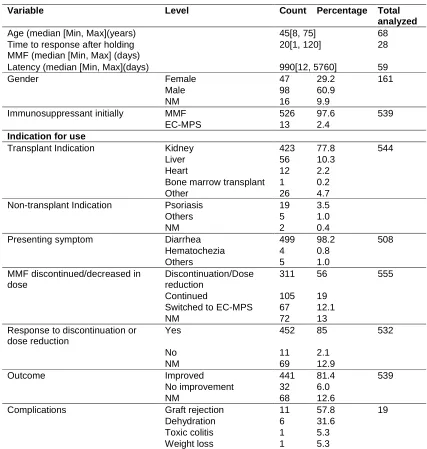
Forty-three articles with a total of 544 patients and 560 episodes of suspected or confirmed MMF-induced diarrhea were included [1,11-14, 16-53]. The median age was 45 years (range 8-75), and 29% were females. In 98% of cases, MMF was used for solid organ transplant,
including kidney (n=423), liver (n=56), heart (n=12), kidney and pancreas (n=5), and heart/pancreas (n=5). Bone marrow transplant was the indication in only one case [39]. The non-transplant indications included psoriasis (n=19) [42], systematic lupus erythematosus (n=1) [16,48], autoimmune autonomic dysfunction (n=1), scleroderma (n=1) [30], and chronic active hepatitis (n=1) [26].
The median latency between the use of MMF and onset of diarrhea was 990 days (range 12- 5760). Watery diarrhea, as frequent as every 20 minutes in one case [24], and large volumes at times, was the presenting symptom in 98% of cases. Other less common presentations included bloody diarrhea (n=4) [11,37,44], abdominal pain (n=1) [48], steatorrhea (n=1) [47], anemia (n=1) [1], weight loss (n=1) [48], and abdominal pain as well as weight loss (n=1) [34]. In 7% (n=36) of cases, colonoscopy was done to study the effect of MMF in the gastrointestinal tract even if the patient was asymptomatic.
EXCLUDED=29
Article in foreign language= 12 No colitis= 4
MMF use without diarrhea= 6 Non- human studies= 7
Articles evaluated for full text eligibility= 139
EXCLUDED= 96
Other causes of diarrhea= 80 Articles with no patient level data available= 15
Different articles with same data= 1
Articles included= 43
Total articles= 168 PubMed= 137
EMBASE excluding PubMed articles= 27 Cochrane= 1
For management of diarrhea, MMF was discontinued or dose reduced in 56% (n=311) [1,11-14,16-19,21,22,24,25,27,29-38,40-47,49-52], switched to enteric coated mycophenolate mofetil sodium (EC-MPS) in 12% (n=67) [20,23,46,49,53] and continued in 14% of cases (n=77) [13,21,32,36,46,52] (Fig. 1). The information was missing in other cases. While 85% of cases managed with discontinuation or dose reduction of MMF responded to the treatment, 2% (n=6) [40,41,43] continued to have
diarrhea. The latency from initiation of MMF to onset of diarrhea did not differ by whether a patient responded to discontinuation or dose reduction (Wilcoxon rank-sum p-value = 0.58). About 81% of cases who switched from MMF to
EC-MPS responded and 7% (n=5) [20,46] did not. Among the patients who continued MMF, diarrhea was persistent in 13% (n=13) [13] while it resolved spontaneously in 60%. The information was lacking in the rest of the cases.
Table 1. Clinical features and outcomes of mycophenolate mofetil-induced diarrhea
Variable Level Count Percentage Total
analyzed
Age (median [Min, Max](years) 45[8, 75] 68
Time to response after holding MMF (median [Min, Max] (days)
20[1, 120] 28
Latency (median [Min, Max](days) 990[12, 5760] 59
Gender Female 47 29.2 161
Male 98 60.9
NM 16 9.9
Immunosuppressant initially MMF 526 97.6 539
EC-MPS 13 2.4
Indication for use
Transplant Indication Kidney 423 77.8 544
Liver 56 10.3
Heart 12 2.2
Bone marrow transplant 1 0.2
Other 26 4.7
Non-transplant Indication Psoriasis 19 3.5
Others 5 1.0
NM 2 0.4
Presenting symptom Diarrhea 499 98.2 508
Hematochezia 4 0.8
Others 5 1.0
MMF discontinued/decreased in dose
Discontinuation/Dose reduction
311 56 555
Continued 105 19
Switched to EC-MPS 67 12.1
NM 72 13
Response to discontinuation or dose reduction
Yes 452 85 532
No 11 2.1
NM 69 12.9
Outcome Improved 441 81.4 539
No improvement 32 6.0
NM 68 12.6
Complications Graft rejection 11 57.8 19
Dehydration 6 31.6
Toxic colitis 1 5.3
Weight loss 1 5.3
The median time to response to either change to EC-MPS or dose reduction/ discontinuation of treatment was 20 days (range 1-120). There was no correlation between latency of onset of diarrhea (time in days from the first use to onset of diarrhea) and time to response after dose reduction /discontinuation of MMF (in days) (Pearson correlation coefficient= 0.04, p-value=0.84).
Complications related to the diarrhea and/or its subsequent management developed in 4% (n=19) of cases including graft rejection in solid-organ transplant (n=11) [1,41,46,52] after discontinuation or dose reduction of MMF, acute dehydration (n=6) [17], toxic colitis (n=1) [42], and severe weight loss of >60 pounds (n=1) [24].
All of the graft rejection cases were kidney transplants, thus, leading to hemodialysis [1,41,46,52]. Al-Absi et al. [1] described graft rejection in 3 cases- 2, 3, and 6 months following MMF discontinuation. The data for the duration for graft rejection was lacking in rest of the cases (n=8) [41,46,52].
Other management options, in addition to discontinuation or dose reduction of MMF or switching MMF to EC-MPS, were tried to prevent complications of withdrawal of immunosuppressants, or to treat diarrhea. Such additional therapies included mizoribine (n=22) [46,52], azathioprine (n=14) [1,11,16,17,19,29, 31,34,38,45,50], sirolimus (n=10) [1,17,34], antibiotics (n=2) [41], tacrolimus (n=2) [11,27], octreotide (n=1) [43], infliximab (n=1) [22], and right hemicolectomy (n=1) [34].
4. DISCUSSION
The gastrointestinal toxicity has been ascribed to the local as well as systemic effects of MMF [9,10]. Gastrointestinal side effects have been reported to occur in as many as 45% of cases taking MMF [12,17]. However, the incidence of MMF-induced diarrhea remains unknown.
In this large review of 560 episodes of
MMF-induced diarrhea, watery diarrhea was the most common presenting symptom. Other presentations such as bloody diarrhea, abdominal pain, steatorrhea, and weight loss were uncommon and could raise concerns for certain infectious or other causes of diarrhea.
Since the latency between MMF use and diarrhea ranged widely from early as 3 days to
more than 10 years, the latency may not help in diagnosis. The exact cause for this wide variation in latency of symptoms is unknown. Since the diarrhea as a side effect of MMF typically develops within days or weeks of initiating the drug, this may relate to a bias in the literature or alternatively it may be that MMF is an innocent bystander in the development of diarrhea.
The median time to response after discontinuation or dose reduction of MMF was 20 days with a range of 1-45 days, thus the response may not necessarily be rapid and could take a few weeks. Time to response did not depend on the latency to diarrhea following initiation of MMF.
Although our review focused on clinical findings, histopathological changes have been described in some of the studies reported here. In some cases, colonoscopies and eventually, biopsies were done to study the effect of MMF in the gastrointestinal tract even in asymptomatic patients. Colonic biopsies in patients using MMF have been shown to have various changes similar to inflammatory bowel disease (IBD), acute graft versus host disease or duodenal villous atrophy [12,13,26,39,48]. Calmet et al. [12] grouped histological findings into acute colitis-like findings (50%) and IBD-like characteristics (36%), GVHD-like features (8%), and ischemia-like findings (6%). Selbst et al. [13] described the changes similar to IBD (28%), GVHD (19%), acute colitis (16%), and ischemia (3%). Since these changes are not restricted to MMF-diarrhea, a distinct diagnosis based purely on histology might not be possible, and clinical correlation is frequently required.
have failed to show any statistical difference in gastrointestinal side effects between EC-MPS and MMF although both were effective in preventing transplant rejection [55,56]. This may be explained to an extent by the fact that gastrointestinal effects observed with MMF are the result of both local as well as systemic effects. While local effects are less with EC-MPS, the systemic effects may be similar [10,57].
Additionally, Zhao et al. and Qin et al. have described switches from MMF to mizoribine leading to resolution of cases of severe diarrhea [46,52]. In some cases, azathioprine [1,11,16, 17,19,29,31,34,38,45,50], sirolimus [1,17,34] and tacrolimus [11,27] were the immunosuppressants used after discontinuation or dose reduction of MMF. In Maes et al. [41] in addition to reduction in MMF dose, empirical antibiotics, cholestyramine, probiotic, and loperamide were used in selected cases.
In the remaining 21% of the total cases, MMF or EC-MPS was continued and diarrhea persisted in 13% of them while 87% had spontaneous resolution. Although the exact cause is not known, resolution of symptoms even with continuation of MMF may indicate tolerance to the drug effects and needs further study. However, the reason for persistent diarrhea even after discontinuation or dose reduction in the remaining 2% of cases was not discussed in the studies and it is difficult to speculate the cause.
The outcome of MMF-induced diarrhea was generally good including cases of spontaneous resolution. However, if left untreated, MMF-induced diarrhea may result mainly in dehydration, and rarely in toxic colitis or profound weight loss. The rate of death due to MMF-induced diarrhea has not been reported.
There are several limitations of our review. No definite guidelines exist for diagnosis of MMF-induced diarrhea and the articles in our review used their own criteria, which is a limitation of the retrospective nature of the study. In addition, the definitive diagnosis of any drug induced adverse effect with recurrence of symptoms upon re-challenge with the drug was not done or not reported in these studies. Additionally, in some cases, use of other therapies such as antibiotic therapy may have contributed to improvement of symptoms along with dose reduction or discontinuation of MMF or switching to EC-MPS.
In this context, our systematic review provides valuable information regarding the clinical
manifestations of MMF-induced diarrhea. This study is hoped to lay the foundation for developing diagnostic criteria for MMF-induced diarrhea and may provide baseline epidemiologic information for comparative studies in the future.
5. CONCLUSION
MMF-induced diarrhea generally presents with watery diarrhea; the presence of bloody stool should raise concerns for other possibilities. The latency period can range from months to years, hence a long latency period does not exclude the possibility of MMF-induced diarrhea. A vast majority of patients respond to cessation of MMF or dose reduction within a few weeks, however, cessation of MMF may result in graft rejection. In cases where continuation of immunosuppressive therapy is considered important to prevent graft rejection, alternate management option for management of MMF-induced diarrhea could include switching to a different drug formulation, or initiation of a different immunosuppressant.
SUPPORTING INFORMATION
The supplemental information describes the search strategies used in different databases to identify the eligible articles for our study. The additional supplemental information may be found in the online version of this article.
CONSENT
It is not applicable.
ETHICAL APPROVAL
It is not applicable.
ACKNOWLEDGEMENT
Vijaya Raj Bhatt is supported by the 2016-2017 Physician-Scientist Training Program Grant from the College of Medicine, University of Nebraska Medical Center.
COMPETING INTERESTS
Authors have declared that no competing interests exist.
REFERENCES
Transplantation Proceedings. Elsevier; 2010.
2. Behrend M. Adverse gastrointestinal effects of mycophenolate mofetil. Drug Safety. 2001;24(9):645-663.
3. Maripuri S, Kasiske BL. The role of mycophenolate mofetil in kidney transplantation revisited. Transplantation Reviews. 2014;28(1):26-31.
4. Wiesner RH, Fung JJ. Present state of immunosuppressive therapy in liver transplant recipients. Liver Transplantation. 2011;17(S3).
5. Manns MP, et al. Diagnosis and management of autoimmune hepatitis. Hepatology. 2010;51(6):2193-2213. 6. Menter A, et al. Guidelines of care for the
management and treatment of psoriasis with traditional systemic agents. J Am Acad Dermatol. 2009;61(3):451-85. 7. Cahoon WD, Kockler DR. Mycophenolate
mofetil treatment of myasthenia gravis. Annals of Pharmacotherapy. 2006;40(2): 295-298.
8. Hahn BH, et al. American College of Rheumatology guidelines for screening, treatment, and management of lupus nephritis. Arthritis Care & Research. 2012;64(6):797-808.
9. Arns W. Noninfectious gastrointestinal (GI) complications of mycophenolic acid therapy: A consequence of local GI toxicity? In Transplantation Proceedings. Elsevier; 2007.
10. Pescovitz MD, et al. Intravenous mycophenolate mofetil: Safety, tolerability, and pharmacokinetics. Clin Transplant. 2000;14(3):179-88.
11. Behling KC, et al. Graft-versus-host disease-like pattern in mycophenolate mofetil related colon mucosal injury: Role of FISH in establishing the diagnosis. Case Reports in Gastroenterology. 2009;3(3): 418-423.
12. Calmet FH, et al. Endoscopic and histological features of mycophenolate
mofetil colitis in patients after solid organ transplantation. Annals of
Gastroenterology: Quarterly Publication of the Hellenic Society of Gastroenterology. 2015;28(3):366.
13. Selbst MK, et al. Spectrum of histologic changes in colonic biopsies in patients treated with mycophenolate mofetil. Modern Pathology. 2009;22(6):737-743. 14. Papadimitriou JC, et al. Histologic features
of mycophenolate mofetil-related colitis: A
graft-versus-host disease-like pattern. International Journal of Surgical Pathology. 2003;11(4):295-302.
15. Maes B, et al. Severe diarrhea in renal transplant patients: Results of the DIDACT
study. American Journal of
Transplantation. 2006;6(6):1466-1472. 16. Aiyangar A. Mycophenolate mofetil
diarrhoea: 3 case reports. Reactions. 2010;1326:6.
17. Andrade LGM, et al. Clinicopathologic
features and outcome of
mycophenolate‐induced colitis in renal transplant recipients. Clinical Transplanta-tion. 2014;28(11):1244-1248.
18. Arslan H, et al. Etiologic agents of diarrhea in solid organ recipients. Transplant Infectious Disease. 2007;9(4):270-275. 19. Bandin F, et al. Cryptosporidiosis in
paediatric renal transplantation. Pediatric Nephrology. 2009;24(11):2245-2255. 20. Barrera-Pulido L, et al. Switching from
mycophenolate mofetil to enteric-coated mycophenolate sodium in liver transplant patients with gastrointestinal complica-tions. In Transplantation Proceedings. Elsevier; 2009.
21. Bouamar R, et al. Mycophenolic acid-related diarrhea is not associated with polymorphisms in SLCO1B nor with ABCB1 in renal transplant recipients. Pharmacogenetics and Genomics. 2012; 22(6):399-407.
22. Bouhbouh S, Rookmaaker MB. Rapid resolution of persistent mycophenolate mofetil-induced diarrhoea with a single dose of infliximab. Nephrology Dialysis Transplantation. 2010;25(10):3437-3438. 23. Breidenbach T, Spangenberg M, Nagel E.
Complete resolution of severe diarrhoea after conversion from mycophenolate mofetil to enteric-coated mycophenolate sodium (myfortic®) in a patient at high immunological risk. Drugs. 2006;66(2):25-27.
24. Childers R, et al. Gastrointestinal: Chronic cellcept‐induced colitis. Journal of Gastroenterology and Hepatology. 2011; 26(7):1214-1214.
25. Cotter MB, et al. Coeliac‐like duodenal pathology in orthotopic liver transplant patients on mycophenolic acid therapy. Histopathology. 2015;66(4):500-507. 26. Coyne JD, Campbell F. Microscopic
27. Curtin BF, Rachakonda VP, Von Rosenvinge EC. Unusually late-onset mycophenolate mofetil-related colitis. American Journal of Health-System Pharmacy. 2014;71(21).
28. Dalle I, et al. Crohn's‐like changes in the colon due to mycophenolate? Colorectal Disease. 2005;7(1):27-34.
29. Frühwirth M, et al. Elevated tacrolimus trough levels in association with mycophenolate mofetil‐induced diarrhea: A case report. Pediatric Transplantation. 2001;5(2):132-134.
30. Gorospe EC. Chronic diarrhoea from mycophenolate mofetil-induced colitis.
BMJ Case Reports. 2012;2012:
bcr1220115344.
31. Hamouda M, et al. Mycophenolate mofetil-related pancolitis in a kidney transplant recipient. Experimental and Clinical Transplantation: Official Journal of the Middle East Society for Organ Transplantation. 2012;10(5):501-505. 32. Heller T, et al. Plasma concentrations of
mycophenolic acid acyl glucuronide are not associated with diarrhea in renal transplant recipients. American Journal of Transplantation. 2007;7(7):1822-1831. 33. Jacqz-Aigrain E, et al. Pharmacokinetics
and tolerance of mycophenolate mofetil in renal transplant children. Pediatric Nephrology. 2000;14(2):95-99.
34. Jakes A, et al. Case report: Crohn's-like mycophenolate-induced colitis, a fallout in steroid-free regimens. In Transplantation Proceedings. Elsevier; 2013.
35. Johal K, et al. Mycophenolate mofetil-induced segmental colitis mimicking ischemic colitis. Case Reports in Gastroenterology. 2014;8(1):95-100. 36. Kamar N, et al. Questionnaire-based
evaluation of gastrointestinal disorders in de novo renal-transplant patients receiving either mycophenolate mofetil or enteric-coated mycophenolate sodium. Nephrology Dialysis Transplantation. 2005;20(10):2231-2236.
37. Kim H, Park S. Mycophenolate mofetil-induced ischemic colitis. In Transplantation Proceedings. Elsevier; 2000.
38. Kim K, Schwartz JMGM, Ro MLTJY. Mycophenolate mofetil-related colitis. Korean Journal of Pathology. 2010;44(3): 333-337.
39. Lee S, et al. Pointers and pitfalls of mycophenolate-associated colitis. Journal of Clinical Pathology. 2013;66(1):8-11.
40. Lemahieu W, et al. Cytochrome P450 3A4 and P‐glycoprotein activity and assimilation of tacrolimus in transplant patients with persistent diarrhea. American Journal of Transplantation. 2005;5(6):1383-1391. 41. Maes BD, et al. Erosive enterocolitis in
mycophenolate mofetil-treated renal-transplant recipients with persistent afebrile diarrhea. Transplantation. 2003; 75(5):665-672.
42. Marinari R, et al. Mycophenolic acid in the treatment of psoriasis: Long-term administration. Archives of Dermatology. 1977;113(7):930-932.
43. Mohsin N, et al. Rapid resolution of mycophenolate associated diarrhea with a small dose of octreotide: A case report. In Transplantation Proceedings. Elsevier; 2003.
44. Patra S, et al. Mycophenolate mofetil-induced colitis with graft versus host disease-like features in a liver transplant recipient. Indian Journal of Pathology and Microbiology. 2012;55(4):506.
45. Phatak UP, et al. Mycophenolate mofetil-induced colitis in children. Journal of Clinical Gastroenterology. 2009;43(10): 967-969.
46. Qin Y, et al. Efficacy and safety of enteric‐coated mycophenolate sodium in patients with de novo and maintenance renal transplantation. International Journal of Clinical Practice. 2014;68(s181):17-22. 47. Tagboto S, Akhtar F. Steatorrhoea
complicating post-infectious diarrhoea in a renal transplant patient on mycophenolate mofetil therapy. Clinical and Experimental Nephrology. 2009;13(2):182-184.
48. Weber A, Marques-Maggio E. Apoptotic colonopathy under immunosuppression: mycophenolate-related effects and beyond. Pathobiology. 2013;80(6):282-288.
49. Weclawiak H, et al. Duodenal villous atrophy: A cause of chronic diarrhea after solid‐organ transplantation. American Journal of Transplantation. 2011;11(3): 575-582.
50. Wiley JR, et al. Diarrhea in a post-renal transplant child: Questions. Pediatric Nephrology. 2015;30(4):589.
52. Zhao Y, et al. Late, severe, noninfectious diarrhea after renal transplantation: High-risk factors, therapy, and prognosis. In Transplantation Proceedings. Elsevier; 2013.
53. Meng FH, et al. Clinical effect of mycophenolate sodium enteric-coated tablets in the treatment of mycophenolate
mofetil-related chronic diarrhea after renal transplantation. World Journal of Gastroenterology.
2014;22(30):4691-4694.
54. Langone AJ, et al. Enteric-coated
mycophenolate sodium versus
mycophenolate mofetil in renal transplant recipients experiencing gastrointestinal intolerance: A multicenter, double-blind,
randomized study. Transplantation. 2011; 91(4):470-478.
55. Budde K, et al. Enteric-coated mycophenolate sodium can be safely administered in maintenance renal transplant patients: Results of a 1-year study. Am J Transplant. 2004;4(2):237-43. 56. Salvadori M, et al. Enteric-coated
mycophenolate sodium is therapeutically equivalent to mycophenolate mofetil in de novo renal transplant patients. Am J Transplant. 2004;4(2):231-6.
57. Meier-Kriesche HU, et al. Mycophenolate sodium does not reduce the incidence of GI adverse events compared with mycophenolate mofetil. American Journal of Transplantation. 2005;5(5):1164-1164. _________________________________________________________________________________
© 2017 Dhakal et al.; This is an Open Access article distributed under the terms of the Creative Commons Attribution License (http://creativecommons.org/licenses/by/4.0), which permits unrestricted use, distribution, and reproduction in any medium, provided the original work is properly cited.
Peer-review history: