Secure Multiparty Computations on Bitcoin
Marcin Andrychowicz, Stefan Dziembowski
∗, Daniel Malinowski, Łukasz Mazurek
University of Warsaw, Poland{marcin.andrychowicz, stefan.dziembowski, daniel.malinowski, lukasz.mazurek}@crypto.edu.pl ∗on leave from SapienzaUniversity of Rome
Abstract
Bitcoin is a decentralized digital currency, introduced in 2008, that has recently gained noticeable popularity. Its main features are: (a) it lacks a central authority that controls the transactions, (b) the list of transactions is publicly available, and (c) its syntax allows more advanced transactions than simply transferring the money. The goal of this paper is to show how these properties of Bitcoin can be used in the area of secure multiparty computation protocols (MPCs).
Firstly, we show that the Bitcoin system provides an attractive way to construct a version of “timed commitments”, where the committer has to reveal his secret within a certain time frame, or to pay a fine. This, in turn, can be used to obtain fairness in some multiparty protocols. Secondly, we introduce a concept of multiparty protocols that work “directly on Bitcoin”. Recall that the standard definition of the MPCs guarantees only that the protocol “emulates the trusted third party”. Hence ensuring that the inputs are correct, and the outcome is respected is beyond the scope of the definition. Our observation is that the Bitcoin system can be used to go beyond the standard “emulation-based” definition, by constructing protocols that link their inputs and the outputs with the real Bitcoin transactions.
As an instantiation of this idea we construct protocols for secure multiparty lotteries using the Bitcoin currency, without relying on a trusted authority (one of these protocols uses the Bitcoin-based timed commitments mentioned above). Our protocols guarantee fairness for the honest parties no matter how the loser behaves. For example: if one party interrupts the protocol then her money is transferred to the honest participants. Our protocols are practical (to demonstrate it we performed their transactions in the actual Bitcoin system), and can be used in real life as a replacement for the online gambling sites. We think that this paradigm can have also other applications. We discuss some of them.
Keywords
bitcoin; multiparty; lottery;
I. INTRODUCTION
Secure multiparty computation (MPC) protocols, originating from the seminal works of Yao [41] and Goldreich et al. [29], allow a group of mutually distrusting parties to compute a joint functionf on their private inputs. Typically, the security of such protocols is defined with respect to the ideal modelwheref is computed by a trusted partyTf. More precisely: it is required that during the execution of a protocol the parties cannot learn more information about the inputs of the other participants than they would learn if f was computed by Tf who: (a) receives the inputs from the parties, (b) computes f, and (c) sends the output back to the parties. Moreover, even if some parties misbehave and do not follow the protocol, they should not be able to influence the output of the honest parties more than they could in the ideal model by modifying their own inputs.
As an illustration of the practical meaning of such security definition consider the case when there are only two participants, called Alice and Bob, and the function that they compute is a conjunction f∧(a, b) =a∧b, where a, b∈ {0,1} are Boolean variables denoting the inputs of Alice and Bob, respectively. This is sometimes called the marriage proposal problem, since one can interpret the input of each party as a declaration if she/he wants to marry the other one. More precisely: suppose a= 1 if and only if Alice wants to marry Bob, andb= 1if and only if Bob wants to marry Alice. In this casef∧(a, b) = 1if and only if bothparties want to marry each other, and hence, if, e.g.,b= 0 then Bob has no information about Alice’s input. Therefore the privacy of Alice is protected.
One can also consider randomized functionsf, the simplest example being thecoin tossing problem[9] where the computed function frnd :{⊥} × {⊥} → {0,1} takes no inputs, and outputs a uniformly random bit. Yet another generalization are the so-calledreactive functionalitieswhere the trusted partyT maintains a state and the parties can interact withT in several rounds. One example of such a functionality is themental poker[39] whereT simulates a card game, i.e. she first deals a deck of cards and then ensures that the players play the game according to the rules.
mean that none of the players is malicious. Hence, the two-party protocols in general do not provide complete fairness (unless the security definition is weakened).
Since the introduction of the MPCs there has been a significant effort to make these protocols efficient [32], [7], [22] and sometimes even to use them in the real-life applications such as, e.g., the online auctions [10]. On the other hand, perhaps surprisingly, the MPCs have not been used in many other areas where seemingly they would fit perfectly. One prominent example is the internet gambling: it may be intriguing that currently gambling over the internet is done almost entirely with the help of the web-sites that play the roles of the “trusted parties”, instead of using the coin flipping or the mental poker protocols. This situation is clearly unsatisfactory from the security point of view, especially since in the past there were cases when the operators of these sites abused their privileged position for their own financial gain (see e.g. [36]). Hence, it may look like the multiparty techniques that eliminate the need for a trusted party would be a perfect replacement for the traditional gambling sites (an additional benefit would be a reduced cost of gambling, since the gambling sites typically charge fees for their service).
In our opinion there are at least two main reasons why the MPCs are not used for online gambling. The first reason is that the multiparty protocols do not provide fairness in case there is no honest majority among the participants. Consider for example a simple two-party lottery based on the coin-tossing protocol: the parties first compute a random bit b, ifb= 0then Alice pays $1 to Bob, if b = 1 then Bob pays $1 to Alice, and if the protocol did not terminate correctly then the parties do not pay any money to each other. In this case a malicious party, say Alice, could prevent Bob from learning the output if it is equal to 0, making 1 the only possible output of a protocol. Since this easily generalizes to the multiparty case, it is clear that the gambling protocol would work only if the majority is honest, which is not a realistic assumption in the fully distributed internet environment (there are many reasons for this, one of them being the sybil attacks [23] where one malicious party creates and controls several “fake” identities, easily obtaining the “majority” among the participants).
The second reason is even more fundamental, as it comes directly from the inherent limitations of the MPC security definition, namely: such protocols do not provide security beyond the trusted-party emulation. This drawback of the MPCs is rarely mentioned in the literature as it seems obvious that in most of the real-life applications cryptography cannot be “responsible” for controlling that the users provide the “real” input to the protocol and that they respect the output. Consider for example the marriage proposal problem: it is clear that even in the ideal model there is no technological way to ensure that the users honestly provide their input to the trusted party, i.e. nothing prevents one party, say Bob, to lie about his feelings, and to set b= 1in order to learn Alice’s inputa. Similarly, forcing both parties to respect the outcome of the protocol and indeed marry cannot be guaranteed in a cryptographic way. This problem is especially important in the gambling applications: even in the simplest “two-party lottery” example described above, there exists no cryptographic method to force the loser to transfer the money to the winner.
One pragmatic solution to this problem, both in the digital and the non-digital world is to use the concept of “reputation”: a party caught on cheating (i.e. providing the wrong input or not respecting the outcome of the game) damages her reputation and next time may have trouble finding another party willing to gamble with her. Reputation systems have been constructed and analyzed in several papers (see, e.g. [37] for an overview), however they seem too cumbersome to use in many applications, one reason being that it is unclear how to define the reputation of the new users in the scenarios when the users are allowed to pick new names whenever they want [26].
Another option is to exploit the fact that the financial transactions are done electronically, and hence one could try to “incorporate” the final transaction (transferring $1 from the loser to the winner) into the protocol, in such a way that the parties learn who won the game only when the transaction has already been performed. It is unfortunately not obvious how to do it within the framework of the existing electronic cash systems. Obviously, since the parties do not trust each other, we cannot accept solutions where the winning party learns e.g. the credit card number, or the account password of the loser. One possible solution would be to design a multiparty protocol that simulates, in a secure way, a simultaneous access to all the online accounts of the participants and executes a wire transfers in their name.1 Even if theoretically possible, this solution is clearly very hard to implement in real life, especially since the protocol would need to be adapted to several banks used by the players (and would need to be updated whenever they change). The same problems occur obviously also if above we replace the “bank” with some other financial service (like PayPal). One could consider using Chaum’s Ecash [17], or one of its variants [18], [16]. Unfortunately, none of these systems got widely adopted in real-life. Moreover, they are also bank-dependent, meaning that even if they get popular, one would face a challenge of designing a protocol that simulates the interaction of a real user with a bank, and make it work for several different banks.
We therefore turn our attention to Bitcoin, which is a decentralized digital currency introduced in 2008 by Satoshi Nakamoto2 [34]. Bitcoin has recently gained a noticeable popularity (its current market capitalization is over $5 billion) mostly due to its distributed nature and the lack of a central authority that controls the transactions. Because of that it is infeasible for anyone to take control over the system, create large amounts of coins (to generate inflation), or shut it down. The money is transferred directly between two parties — they do not have to trust anyone else and transaction fees are zero or very small. Another advantage is pseudonymity3 — the users are only identified by their public keys that can be easily created, and hence it is hard
1Note that this would require, in particular, “simulating” the web-browser and the SSL sessions, since each individual user should not learn the contents of
the communication between the “protocol” and his bank, as otherwise he could interrupt the communication whenever he realizes that the “protocol” ordered a wire transfer from his account. Moreover, one would need to assume that the transactions cannot be cancelled once they were ordered.
2This name is widely believed to be a pseudonym.
to link the real person with the virtual party spending the money. However, since all the transactions and the connections between them are publicly known there are several ways to extract some information about Bitcoin users from the block chain, see e.g. [38].
In Section II we describe the main design principles of Bitcoin, focusing only on the most relevant parts of this system. A more detailed description can be found in Nakamoto’s original paper [34], the Bitcoin wiki webpage en.bitcoin.it (sections particularly relevant to our work are: “Transactions” and “Contracts”), or other papers on Bitcoin [33], [19], [5], [38]. In the sequel “B” denotes the Bitcoin currency symbol.
A. Our contribution
We study how to do “MPCs on Bitcoin”. First of all, we show that the Bitcoin system provides an attractive way to construct a version of “timed commitments” [11], [27], where the committer has to reveal his secret within a certain time frame, or to pay a fine. This, in turn, can be used to obtain fairness in certain multiparty protocols. Hence it can be viewed as an “application of Bitcoin to the MPCs”.
What is probably more interesting is our second idea, which in some inverts the previous one by showing an “application of the MPCs to Bitcoin”, namely we introduce a concept of multiparty protocols that work directly on Bitcoin. As explained above, the standard definition of the MPCs guarantees only that the protocol “emulates the trusted third party”. Hence ensuring that the inputs are correct, and the outcome is respected is beyond the scope of the definition. Our observation is that the Bitcoin system can be used to go beyond the standard “emulation-based” definition, by constructing protocols that link the inputs and the outputs with the real Bitcoin transactions. This is possible since the Bitcoin lacks a central authority, the list of transactions is public, and its syntax allows more advanced transactions than simply transferring the money.
As an instantiation of this idea we construct protocols for secure multiparty lotteries using the Bitcoin currency, without relying on a trusted authority. By “lottery” we mean a protocol in which a group of parties initially invests some money, and at the end one of them, chosen randomly, gets all the invested money (called thepot). Our protocols can work in purely peer-to-peer environment, and can be executed between players that are anonymous and do not trust each other. Our constructions come with a very strong security guarantee: no matter how the dishonest parties behave, the honest parties will never get cheated. More precisely, each honest party can be sure that, once the game starts, it will always terminate and will be fair.
Our two main constructions are as follows. The first protocol (Section IV) can be executed between any number of parties. Its security is obtained via the so-called deposits: each user is required to initially put aside a certain amount of money, which will be paid back to her once she completes the protocol honestly. Otherwise the deposit is given to the other parties and “compensates” them the fact that the game terminated prematurely. This protocol uses the timed commitment scheme described above. A certain drawback of this protocol is that the deposits need to be relatively large, especially if the protocol is executed among larger groups of players. More precisely to achieve security the deposit of each player needs to be N(N−1) times the size of the bet (observe that for the two-party case it simply means that the deposit is twice the size of the bet).
We also describe (in Section V) a protocol that does not require the use of deposits at all. This comes at a price: the protocol works only for two parties, and its security relies on an additional assumption (see Section V for more details).
The only cost that the participants need to pay in our protocols are the Bitcoin transaction fees. The typical Bitcoin transactions are currently free. However, the participants of our protocols need to make a small number of non-standard transactions (so-called “strange transactions”, see Section II), for which there is usually some small fee (currently around0.00005B≈$0.03). To keep the exposition simple we initially present our results assuming that the fees are zero, and later, in Section VI, argue how to extend the definitions and security statements to take into account also the non-zero fees. For the sake of simplicity we also assume that the bets in the lotteries are equal to 1B. It should be straightforward to see how to generalize our protocols to other values of the bets.
Our constructions are based on the coin-tossing protocol of Blum [9]. We managed to adapt this protocol to our model, without the need to modify the current Bitcoin system. We do not use any generic methods like the MPC or zero-knowledge compilers, and hence the protocols are very efficient. The only cryptographic primitives that we use are the commitment schemes, implemented using the hash functions (which are standard Bitcoin primitives). Our protocols rely strongly on the advanced features of the Bitcoin (in particular: the so-called “transaction scripts”, and “time-locks”). Because of the lack of space we only sketch the formal security definitions. The security proofs will appear in an extended version of this paper. We executed our transactions on the real Bitcoin. We provide a description of these transactions and a reference to them in the Bitcoin chain.
B. Applications and future work
Although, as argued in Section I-C below, it may actually make economic sense to use our protocols in practice, we view gambling mostly as a motivating example for introducing a concept that can be called “MPCs on Bitcoin”, and which will hopefully have other applications. One (rather theoretical) example of such application is the “millionaires problem” where Alice and Bob want to establish who is richer.4 It is easy to see that Alice and Bob can (inefficiently) determine who has more coins
4The formal definition is as follows: leta, b∈ Ndenote the amount of coins that Alice and Bob respectively own. In this case the parties compute the
by applying the generic MPC and zero-knowledge techniques. This is possible since the only inputs that are needed are (a) the contents of the Bitcoin ledger (more precisely: its subset consisting of the non-redeemed transactions), which is public, and (b) Alice’s and Bob’s private keys used as their respective private inputs (see Section II for the definitions of these terms). Obviously, using this protocol makes sense only if, for some reason, each party is interested in proving that she is the richer one. This is because every participant can easily pretend to be poorer than she really is and “hide” his money by transferring it to some other address (that he also controls). Since we do not think that this protocol is particularly relevant to practical applications, we do not describe it in detail here. Let us only observe that, interestingly, this protocol is in some sense dual to the coin-tossing protocol, as it uses the Bitcoin system to verify the correctness of the inputs, instead guaranteeing that the outcome is respected (as it is the case with the coin-tossing)5.
We think that analyzing what functionalities can be computed this way (taking into account the problem of the participants “pretending to be poorer than they really are”) may be an interesting research direction. Other possible future research directions are: constructing protocols secure against “malleability attacks” and “eavesdropping attacks” (see Sec. V for more details) that do not require the deposits, providing a more formal framework to analyze the deposit-based technique (this can probably be done using the tools from the “rational cryptography” literature [31], [1], [28]).
C. Economic analysis
Besides of being conceptually interesting, we think that our protocols can have direct practical applications in the online gambling, which is a significant market: it is estimated that there are currently 1,700 gambling sites worldwide handling bets worth over $4 billion per year [25]. Some of these sites are using Bitcoin. The largest of them,SatoshiDice, has been recently sold for over $12 million [14]. All of the popular sites charge a fee for their service, called thehouse edge(on top of the Bitcoin transaction fees). Currently, the honesty of these sites can be verified only ex post facto: they commit to their randomness before the game starts and later prove to the public that they did not cheat. Hence, nothing prevents them from cheating and then disappearing from the market (using the MPC terminology: such protocols provide security only against the “covert adversaries” [40]). Of course, this means that the users need to continually monitor the behavior of the gambling sites in order to identify the honest ones. This system, called the “mathematically provable fairness” is described in a recent article [13], where it is advised to look on a particular page, calledMem’s Bitcoin Gambling List, to check the gambling sites’ reputation. This simple reputation system can of course be attacked in various ways. Moreover, one can expect that the sites with more established reputation will have a higher house edge, and indeed the SatoshiDice site charges more than the other, less well-known, sites. Currently SatoshiDice house edge is around 2% [13].
Compared to the gambling sites, our protocols have the following advantage. First of all, the security guarantee is stronger, as it does not depend on the honesty of any trusted party. Secondly, in our protocols there is obviously no “house edge”. On a negative side, the Bitcoin transaction fees can be slightly larger in our case than in the case of the gambling sites (since we have more transactions, and some of them are “strange”). At the moment of writing this paper, using our solution is cheaper than using SatoshiDice for bets larger than, say, $5, but of course whether our protocols become really widely used in practice depends on several factors that are hard to predict, like the value of the fees for the “strange transactions”.
We also note that, although our initial motivation was the peer-to-peer lottery, it can actually make a lot of sense for the online gambling services to use our solutions, especially the two-party protocol. Of course the business model of such services makes sense only if there is non-zero house edge. This is not a problem since our protocols can be easily used in lotteries where the expected payoff is positive for one party (in this case: the gambling service) and it is negative for the other one (the client). Such “provably guaranteed fairness” can be actually a good selling line for some of these services.
D. Previous, concurrent and subsequent work
Some of the related work has been already described in the earlier sections. Previous papers on Bitcoin analyze the Bitcoin transaction graph [38], or suggest improvements of the current version of the system. This includes important work of Barber et al. [5] who study various security aspects of Bitcoin and Miers et al. [33] who propose a Bitcoin system with provable anonymity. Our paper does not belong to this category, and in particular our solutions are fully compatible with the current version of Bitcoin (except of the ,,malleability” and ,,eavesdropping” problem concerning the last protocol, Section V).
Usage of Bitcoin to create a secure and fair two-player lottery has been independently proposed by Adam Back and Iddo Bentov in [4]. Similarly to our solution, their protocol makes use of the time-locked transactions, but the purpose they are used for is slightly different. Their protocol uses time-locks to get the deposit back if the protocol is interrupted, while this paper uses time-locks to make a financial compensation to an honest party, whenever the other party misbehaves. Additionally, protocol from [4] is not resilient to the malleability attacks, while our main schemes (Section III and IV) are.
Another work relevant to ours is Section 7.1 of [5] where the authors construct a secure “mixer”, that allows two parties to securely “mix” their coins in order to obtain unlinkability of the transactions. They also construct commitment schemes with time-locks, which are similar to these from [4]. Also, the main motivation of this work is different: the goal of [5] is to fix an
5The reader may be tempted to think that a similar protocol could be used with the eCash [17]. This is not the case, as in eCash there is no method of proving
existing problem in Bitcoin (“linkability”), while our goal is to use Bitcoin to perform tasks that are hard (or impossible) to perform by other methods.
Commitments in the context of the Bitcoin were also considered in [19], however, the construction and its applications are different — the main idea of [19] is to use the Bitcoin system as a replacement of a trusted third party in time-stamping. The notion of “deposits” has already been used in Bitcoin (see en.bitcoin.it/wiki/Contracts, Section “Example 1”6), but the application described there is different: the “deposit” is a method for a party with no reputation to prove that she is not a spambot by temporarily sacrificing some of her money.
In the subsequent work [2], [3] we show how to extend the ideas from this paper in order to construct a fair two-party protocol for any functionality. Similar ideas were developed independently by Iddo Bentov and Ranjit Kumaresan [8].
E. Acknowledgments
We would like to thank Iddo Bentov and Ranjit Kumaresan for fruitful discussions and for pointing out an error in a previous version of our lottery (see footnote 18 on page 12).
This work was supported by the WELCOME/2010-4/2 grant founded within the framework of the EU Innovative Economy (National Cohesion Strategy) Operational Programme.
II. ASHORT DESCRIPTION OFBITCOIN
Bitcoin works as a peer-to-peer network in which the participants jointly emulate the central server that controls the correctness of transactions. In this sense it is similar to the concept of the multiparty computation protocols. Recall that, as described above, a fundamental problem with the traditional MPCs is that they cannot provide fairness if there is no honest majority among the participants, which is particularly difficult to guarantee in the peer-to-peer networks where the sybil attacks are possible. The Bitcoin system overcomes this problem in the following way: the honest majority is defined in terms of the “majority of computing power”. In other words: in order to break the system, the adversary needs to control machines whose total computing power is comparable with the combined computing power of all the other participants of the protocol. Hence, e.g., the sybil attack does not work, as creating a lot of fake identities in the network does not help the adversary. In a moment we will explain how this is implemented, but let us first discuss the functionality of the trusted party that is emulated by the users.
One of the main problems with the digital currency is the potential double spending: if coins are just strings of bits then the owner of a coin can spend it multiple times. Clearly this risk could be avoided if the users had access to a trusted ledger with the list of all the transactions. In this case a transaction would be considered valid only if it is posted on the board. For example suppose the transactions are of a form: “user Xtransfers to userYthe money that he got in some previous transaction Ty”, signed by the userX. In this case each user can verify if money from transaction Ty has not been already spent byX. The functionality of the trusted party emulated by the Bitcoin network does precisely this: it maintains a full list of transactions that happened in the system. The format of the Bitcoin transactions is in fact more complex than in the example above. Since it is of a special interest for us, we describe it in more detail in Section II-A.
The Bitcoin ledger is implemented using the concept of the Proofs of Work (PoWs) [24] in the following clever way. The users maintain a chain of blocks. The first block B0, called the genesis block, was generated by the designers of the system in January 2009. Each new blockBi contains a listTi of new transactions, the cryptographic hash of the previous blockH(Bi−1), and some random salt R. The key point is that not everyR works for givenTi andH(Bi−1). In fact, the system is designed in such a way that it is moderately hard to find a valid R. Technically it is done be requiring that the binary representation of the hash of (Ti||H(Bi−1)||R)starts with a certain numbermof zeros (the procedure of extending the chain is calledmining, and the machines performing it are calledminers). The hardness of finding the rightRdepends of course onm, and this parameter is periodically adjusted to the current computing power of the participants in such a way that the extension happens an average each 10 minutes. The system contains an incentive to work on finding the new blocks. We will not go into the details of this, but let us only say that one of the side-effects of this incentive system is the creation of new coins7.
The idea of the block chain is that the longest chain C is accepted as the proper one. If some transaction is contained in a block Bi and there are several new blocks on top of it, then it is infeasible for an adversary with less than a half of the total computating power of the Bitcoin network to revert it — he would have to mine a new chain C0 bifurcating from C at block Bi−1 (or earlier), andC0 would have to be longer thanC. The difficulty of that grows exponentially with number of new blocks on top ofBi. In practice the transactions need 10 to 20 minutes (i.e. 1-2 new blocks) for reasonably strong confirmation and 60 minutes (6 blocks) for almost absolute certainty that they are irreversible.
To sum up, when a user wants to pay somebody in bitcoins, he creates a transaction and broadcasts it to other nodes in the network. They validate this transaction, send it further and add it to the block they are mining. When some node solves the mining problem, it broadcasts its block to the network. Nodes obtain a new block, validate transactions in it and its hash and accept it by mining on top of it. Presence of the transaction in the block is a confirmation of this transaction, but some users may choose to wait for several blocks on top of it to get more assurance.
6Accessed on 13.11.2013.
A. The Bitcoin transactions
The Bitcoin currency system consists of addresses andtransactionsbetween them. An address is simply a public key pk.8 Normally every such a key has a corresponding private keysk known only to one user. The private key is used for signing the transactions, and the public key is used for verifying the signatures. Each user of the system needs to know at least one private key of some address, but this is simple to achieve, since the pairs (sk,pk)can be easily generated offline. We will frequently denote key pairs using the capital letters (e.g. A), and refer to the private key and the public key of A by: A.sk andA.pk, respectively (hence:A= (A.sk, A.pk)). We will also use the following convention: ifA= (A.sk, A.pk)then letsigA(m)denote a signature on a message mcomputed withA.sk and letverA(m, σ)denote the result (trueor false) of the verification of the signatureσ on the messagem with respect to the public keyA.pk.
1) Simplified version: We first describe a simplified version of the system and then show how to extend it to obtain the description of the real Bitcoin. We do not describe how the coins are created as it is not relevant to this paper. Let A = (A.sk, A.pk) be a key pair. In our simplified view a transaction describing the fact that an amount v (called the value of a transaction) is transferred from an address A.pk to an addressB.pk has the following form
Tx= (y, B.pk, v,sigA(y, B.pk, v)),
whereyis an index of a previous transactionTy. We say thatB.pkis the recipient ofTx, and that the transactionTy is aninput of the transactionTx, or that it isredeemedby this transaction (or redeemed by the addressB.pk). More precisely, the meaning ofTxis that the amountv of money transferred toA.pkin transactionTyis transferred further toB.pk. The transaction is valid only if (1)A.pk was a recipient of the transactionTy, (2) the value ofTy was at leastv(the difference betweenvand the value of Ty is called thetransaction fee), (3) the transactionTy has not been redeemed earlier, and (4) the signature of Ais correct. Clearly all of these conditions can be verified publicly.
The first important generalization of this simplified system is that a transaction can have several “inputs” meaning that it can accumulate money from several past transactions Ty1, . . . , Ty`. Let A1, . . . , A` be the respective key pairs of the recipients of
those transactions. Then a multiple-input transaction has the following form:
Tx= (y1, . . . , y`, B.pk, v,sigA1(y1, B.pk, v), . . . ,
sigA`(y`, B.pk, v)),
and the result of it is that B.pk gets the amount v, provided it is at most equal to the sum of the values of transactions Ty1, . . . , Ty`. This happens only if none of these transactions has been redeemed before, and all the signatures are valid.
Moreover, each transaction can have a lock-time t that tells at what time the transaction becomes final (t can refer either to a block index or to the real physical time). In this case we have:
Tx= (y1, . . . , y`, B.pk, v, t,sigA1(y1, B.pk, v, t), . . . ,
sigA
`(y`, B.pk, v, t)).
Such a transaction becomes valid only if time t is reached and if none of the transactions Ty1, . . . , Ty` has been redeemed by
that time (otherwise it is discarded). Each transaction can also have several outputs, which is a way to divide money between several users or get a change. We ignore this fact in our description since we will not use it in our protocols.
2) A more detailed version: The real Bitcoin system is significantly more sophisticated than what is described above. First of all, there are some syntactic differences, the most important for us being that each transaction Tx is identified not by its index, but by its hash H(Tx). Hence, from now on we will assume thatx=H(Tx).
The main difference is, however, that in the real Bitcoin the users have much more flexibility in defining the condition on how the transaction Tx can be redeemed. Consider for a moment the simplest transactions where there is just one input and no time-locks. Recall that in the simplified system described above, in order to redeem a transaction the recipient A.pk had to produce another transaction Tx signed with his private key A.sk. In the real Bitcoin this is generalized as follows: each transactionTy comes with a description of a function (output-script)πy whose output is Boolean. The transactionTx redeeming the transaction Ty is valid ifπy evaluates totrueon input Tx. Of course, one example ofπy is a function that treatsTx as a pair (a messagemx, a signatureσx), and checks ifσxis a valid signature onmxwith respect to the public keyA.pk. However, much more general functions πy are possible. Going further into details, a transaction looks as follows: Tx = (y, πx, v, σx), where[Tx] = (y, πx, v)is called thebody9 of Tx andσx is a “witness” that is used to make the script πy evaluate to trueon
Tx (in the simplest case σx is a signature on [Tx]). The scripts are written in the Bitcoin scripting language, which is a stack based, not Turing-complete language (there are no loops in it). It provides basic arithmetical operations on numbers, operations on stack, if-then-else statements and some cryptographic functions like calculating hash function or verifying a signature. The generalization to the multiple-input transactions with time-locks is straightforward: a transaction has a form:
Tx= (y1, . . . , y`, πx, v, t, σ1, . . . , σ`),
8Technically an address is ahashofpk. In our informal description we decided to assume that it is simplypk. This is done only to keep the exposition as
simple as possible, as it improves the readability of the transaction scripts later in the paper.
9In the original Bitcoin documentation this is called “simplifiedTx”. We have chosen to rename it to “body” since we find the original terminology slightly
where the body [Tx] is equal to(y1, . . . , y`, πx, v, t), and it is valid if (1) time t is reached, (2)everyπi([Tx], σi) evaluates to
true, where eachπiis the output script of the transactionTyi, and (3) none of these transactions has been redeemed before. We
will present the transactions as boxes. The redeeming of transactions will be indicated with arrows (the arrows will be labelled with the transaction values). For example a transactionTx= (y1, y2, πx, v, t, σ1, σ2)will be represented as:
Tx(in:Ty1, Ty2)
in-script1:σ1 in-script2:σ2 out-script(body,arg):
πx(body,arg) val:vB tlock:t
Ty1 Ty2
v1B v2B
vB
The transactions where the input script is a signature, and the output script is a verification algorithm are the most common type of transactions. We will call them standard transactions, and the address against which the verification is done will be called the recipientof a transaction. Currently some miners accept only such transactions. However, there exist other ones that do accept the non-standard (also calledstrange) transactions, one example being a big mining pool10 calledEligius(that mines a new block on average once per hour). We also believe that in the future accepting the general transactions will become standard, maybe at a cost of a slightly increased fee. This is important for our applications since our protocols rely heavily on the extended form of transactions.
B. Security Model
To reason formally about the security we need to describe the attack model that corresponds to the current Bitcoin system. We assume that the parties are connected by an insecure channel and have access to the Bitcoin chain. Let us discuss these two assumptions in detail. First, recall that our protocol should allow any pair of users on the internet to engage in a protocol. Hence, we cannot assume that there is any secure connection between the parties (as this would require that they can verify their identity, which obviously is impossible in general), and therefore any type of a man-in-the middle attack is possible.
The only “trusted component” in the system is the Bitcoin chain. For the sake of simplicity in our model we will ignore the implementation details of it, and simply assume that the parties have access to a trusted third party denotedLedger, whose contents is publicly available. One very important aspect that needs to be addressed are the security properties of the communication channel between the parties and the Ledger. Firstly, it is completely reasonable to assume that the parties can verify Ledger’s authenticity. In other words: each party can access the current contents of theLedger. In particular, the users can post transactions on theLedger. After a transaction is posted it appears on theLedger(provided it is valid), however it may happen not immediately, and some delay is possible. There is an upper boundmaxLedger on this delay. This corresponds to an assumption that sooner or later every transaction will appear in some Bitcoin block. We use this assumption very mildly and e.g. maxLedger = 1day is also ok for us (the only price for this is that in such case we have to allow the adversary to delay the termination of the protocol for timeO(maxLedger)). Each transaction posted on theLedgerhas a time stamp that refers to the moment when it appeared on the Ledger.
What is a bit less obvious is how to define privacy of the communication between the parties and theLedger, especially the question of the privacy of the writing procedure. More precisely, the problem is that it is completely unreasonable to assume that a transaction is secret until it appears on theLedger(since the transactions are broadcast between the nodes of the network). Hence we do not assume it. This actually poses an additional challenge in designing the protocols because of the problem of the malleability11 of the transactions. Let us explain it now. Recall that the transactions are referred to by their hashes. Suppose a party Pcreates a transaction T and, before posting it on the Ledger, obtains from some other party P0 a transaction T0 that redeems T (e.g.: T0 may be time-locked and serve Pto redeem T if P0 misbehaves). Obviously T0 needs to contain (in the signed body) a hash H(T) of T. However, if now Pposts T then an adversary (allied with malicious P0) is able to produce another transaction Tˆ whose semantics is the same as T, but whose hash is different (this can be done, e.g., by adding some dummy instructions to the input scripts ofT). The adversary can now postTˆ on theLedgerand, if he is lucky,Tˆwill appear on theLedgerinstead ofT! In this caseT0 will be invalid, soPmay lose the money. It is possible that in the future versions of the Bitcoin system this issue will be addressed and the transactions will not be malleable. In Section V we propose a scheme that is secure under the assumption that the communication between the parties and the Ledgeris private. We would like to stress that our main schemes (Section III and IV) do not not assume non-malleability of the transactions, and are secure even if the adversary obtains full information on the transactions before they appear on the Ledger.
We do not need to assume any privacy of the reading procedure, i.e. each party accesses pattern to Ledgercan be publicly known. We assume that the parties have access to a perfect clock and that their internal computation takes no time. The communication between the parties also takes no time, unless the adversary delays it. These assumptions are made to keep the model as simple as possible, and the security of our protocols does not depend on these assumptions. In particular we assume that the network is asynchronous and our protocols are also secure if the communication takes some small amount of time. For simplicity we also assume that the transaction fees are zero. The extension to non-zero transaction fees is discussed in Section. VI.
III. BITCOIN-BASED TIMED COMMITMENT SCHEME
Commiti(in:UiC) in-script:sig
e
C([Commiti]) out-script(body, σ1, σ2, x): (H(x) =h∧ver
e
C(body, σ1))∨
(ver
e
C(body, σ1)∧verPei(body, σ2))
val:dB
Openi(in:Commiti) in-script:
sig
e
C([Openi]),⊥, s out-script(body, σ): ver
e C(body, σ) val:dB
PayDepositi(in:Commiti) in-script:
sig
e
C([PayDepositi]),sigPei([PayDepositi]),⊥
out-script(body, σ):ver
e
Pi(body, σ)
val:dB tlock:t
dB dB
dB
dB dB
Pre-condition: 1) The key pair ofCisCeand the key pair of eachPiisPie.
2) TheLedgercontainsnunredeemed transactionsUC
1, . . . , UnC, which can be redeemed with keyCe, each having valuedB.
TheCS.Commit(C, d, t, s)phase
3) The CommitterCcomputesh=H(s). He sends to theLedgerthe transactionsCommit1, . . . ,Commitn. This obviously means that
he revealsh, as it is a part of eachCommiti.
4) If within timemaxLedgersome of theCommititransactions does not appear on theLedger, or if they look incorrect (e.g. they differ in
thehvalue) then the parties abort.
5) The CommitterCcreates the bodies of the transactionsPayDeposit1, . . . ,PayDepositn, signs them and for allisends the signed body [PayDepositi]toPi. If an appropriate transaction does not arrive toPi, then he halts.
TheCS.Open(C, d, t, s)phase
6) The CommitterCsends to theLedgerthe transactionsOpen1, . . . ,Openn, what reveals the secrets.
7) If within timetthe transactionOpenidoes not appear on theLedgerthenPisigns and sends the transactionPayDepositito theLedger
and earnsdB.
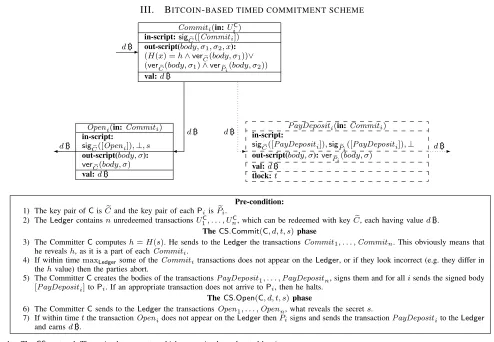
Fig. 1. TheCSprotocol. The scripts’ arguments, which are omitted are denoted by⊥.
We start with constructing a Bitcoin-based timed-commitment scheme [11], [27]. Recall that a commitment scheme [9], [12] consists of two phases: thecommitment phaseCommit and theopening phaseOpen. Typically a commitment scheme is executed between two parties: a committer C and a recipient. To be more general we will assume that there aren recipients, denoted
P1, . . . ,Pn. The committer starts the protocol with some secret valuex. This value will become known to every recipient after the opening phase is executed. Informally, we require that, if the committer is honest, then before the opening phase started, the adversary has no information about x(this property is called “hiding”). On the other hand, every honest recipient can be sure that, no matter how a malicious sender behaves, the commitment can be open in exactly one way, i.e. it is impossible for the committer to “change his mind” and open with some x0 6=x. This property is called “binding”. Although incredibly useful in many applications, the standard commitment schemes suffer from the following problem: there is no way to force the committer to reveal his secretx, and, in particular, if he aborts before theOpen phase starts thenxremains secret.
Bitcoin offers an attractive way to deal with this problem. Namely: using the Bitcoin system one can force the committer to back his commitment with some money, called the deposit, that will be given to the other parties if he refuses to open the commitment within some timet.
We now sketch the definition of aBitcoin-based commitment scheme. First, assume that before the protocol starts theLedger
containsnunredeemed standard transactionsUC
1, . . . , UnC that can be redeemed with a key known only toC, each having value
dB (for some parameterd). In fact, in real life it would be enough to have just one transaction, that would later be “split” inside of the protocol. This would, however, force us to use the multiple-output transactions which we want to avoid, in order not to additionally complicate the description of the system.
committer always opens his commitment by time t. In this case he gets back his money, i.e. the Ledger consists of standard transactions that can be redeemed with a key known only to him, whose total value12 is (d·n)B.
The security definition in the standard commitment scheme: assuming that the committer is honest, the adversary does not learn any significant information aboutxbefore the opening phase, and each honest party can be sure that there is at most one valuexthat the committer can open in the opening phase. Each recipient can also abort the commitment phase (which happens if he discovers that the Committer is cheating, or if the adversary disturbs the communication). However, there is one additional security guarantee: if the committer did not open the commitment by time t then every other party earns dB. More precisely: for every honest Pi theLedger contains a transaction, whose value isdB, that can be redeemed with a key known only to Pi.
Let us also comment on the formal aspects. To satisfy the page limit, we do not provide the full formal model, however, from the discussion above it should be clear how such a model can be defined. We allow negligible error probabilities both in binding and in hiding. Also, the last security property (concerning the deposits) has to hold only with overwhelming probability. As these notions are asymptotic, this requires using a security parameter, denoted by k. Of course, in reality the parameterk is partially fixed by the Bitcoin specification (e.g. we cannot modify the length of the outputs of the hash functions).
A. The implementation
Our implementation can be based on any standard commitment scheme as long as it ishash-based, by which we mean that it has the following structure. LetH be a hash function. During the commitment phase the committer sends to the recipient some value denoted h (which essentially constitutes his “commitment” tox), and in the opening phase the committer sends to the recipient a value s, such thatH(s) =h. IfH(s)6=hthen the recipient does not accept the opening. Otherwise he computesx froms(there exists an algorithm that allows him to do it efficiently). One example of such a commitment scheme is as follows. Supposex∈ {0,1}∗. In the commitment phaseCcomputes s:= (x||r), wherer is chosen uniformly at random from{0,1}k, and sends to every recipient h = H(s). In the opening phase the committer sends to every recipient s, the recipient checks if indeed h=H(s), and recoversx by stripping-off the last k bits from s. The binding property of this commitment follows from the collision-resistance of the hash functionH, since to be able to open the commitment in two different ways a malicious sender would need to find collisions inH. For the hiding property we need to assume thatH is a random oracle. We think that this is satisfactory since anyway the security of the Bitcoin PoWs relies on the random oracle assumption. Clearly, if H is a random oracle then no adversary can obtain any information about x if he does not learn s(which an honest Ckeeps private until the opening phase).
The basic idea of our protocol is as follows. The committer will talk independently to each recipientPi. For each of them he will create in the commitment phase a transactionCommitiwith valuedthat normally will be redeemed by him in the opening phase with a transactionOpeni. The transactionCommiti will be constructed in such a way that the Openi transaction has to automatically open the commitment. Technically it will be done by constructing the output script of Commiti in such a way that the redeeming transaction has to provide s (which will therefore become publicly known as all transactions are publicly visible). Of course, this means that the money of the committer is “frozen” until he reveals s. However, to set a limit on the waiting time of the recipient, we also require the committer to send toPia transactionPayDepositi that can redeemCommiti if time t passes. Of course, Pi, after receiving PayDepositi needs to check if it is correct. The commitment scheme and the transactions are depicted on Figure 1 (page 8). We now state the following lemma, whose proof will appear in the extended version of this paper.
Lemma 1: The CSscheme on Figure 1 is a Bitcoin-based commitment scheme.
IV. THE LOTTERY PROTOCOL
As discussed in the introduction, as an example of an application of the “MPCs on Bitcoin” concept we construct a protocol for a lottery executed among a group of partiesP1, . . . ,PN. We say that a protocol is afair lottery protocolif it iscorrectand secure. To define correctness assume all the parties are following the protocol and the communication channels between them are secure (i.e. it reliably transmits the messages between the parties without delay).
We assume that before the protocol starts, theLedgercontains unredeemed standard transactionsT1, . . . , TN known to all the parties, all of value1B and eachTican be redeemed with a key known only toP
i. Moreover, since we will use the commitment scheme from Section III, the parties need to have money to pay the “deposits”. This money will come from transactions{Uji}, wherei, j∈ {1, . . . , N}andi6=j, such that eachUi
jcan be redeemed only byPiand has valuedB (for some parameterdwhose value will be determined later). We assume that these transactions are on theLedgerbefore the protocol starts. The protocol has to terminate in timeO(maxLedger)and at the moment of termination, theLedgerhas to contain a standard transaction with value NB which can be redeemed with a key known only toPw, werewis chosen uniformly at random from the set{1, . . . , N}. The
Ledgeralso contains transactions for paying back the deposits, i.e. we require that for eachPi there is an additional transaction (that can be redeemed only by him) whose value is(N−1)dB. Of course, in the case of the non-zero fees these values will be slightly smaller, but to keep things simple we assume here that these fees are zero.
To define security, look at the execution of the protocol from the point of view of one party, sayP1 (the case of the other parties is symmetric). AssumeP1is honest and hence, in particular, theLedgercontains the transactionsT1, U21, . . . , UN1, whose recipient is P1 and whose value is: 1B in case of T1 and dB in case of the Uj1’s. Obviously, P1 has no guarantee that the protocol will terminate successfully, as the other party can, e.g., leave the protocol before it is completed. What is important is that P1 should be sure that she will not lose money because of this termination (in particular: the other parties should not be allowed to terminate the protocol after he learned thatP1won). This is formalized as follows: we define thepayoff ofP1 in the execution of the protocol to be equal to the difference between the money that P1 invested and the money that he won. More formally, the payoff ofP1is equal toX1−((N−1)·d+ 1)B, whereX1is defined as the total sum of the values of transactions from the execution of the protocol (including T1, U21, . . . , UN1) thatP1(and only him) can redeem when the protocol terminates. (The payoff of any other participant Pi is defined symmetrically.)
Ideally we would like to require that the expected payoff of each honest player cannot be negative13. However, since the security of our protocol relies on non-perfect cryptographic primitives, such as commitment schemes, we have to take into account a negligible probability of the adversary breaking them. Hence, we require only that these values are “at least negligible”14 in some security parameter k(that is used in the crypto primitives). Formally, we say that the protocol issecureif for any strategy of the adversary, that controls the network and corrupts the other parties, (1) the execution of the protocol terminates in time O(maxLedger), and (2) the expected payoff of each honest party is at least negligible. The expected values are taken over all the randomness in the experiment (i.e. both the internal randomness of the parties and the adversary). We also note that, of course, a dishonest participant can always interrupt in a very early stage. This is not a problem if the transaction fees are zero. In case of the non-zero transaction fees this may cause the other parties to lose a small amount of money. This problem is addressed in Section VI.
A. The protocol
Our protocol is built on top of the classical coin-tossing protocol of Blum [9] that is based on cryptographic commitments. The Blum’s scheme adapted to N parties is very simple — each party Pi commits herself to an element bi ∈ZN. Then, the parties open their commitments and the winner is Pw wherew= (b1+· · ·+bN modN) + 1. As described in the introduction, this protocol does not directly work for our applications, and we need to adapt it to Bitcoin. In particular, in our solution creating and opening the commitments are done by the transactions’ scripts using double SHA-256 hashing15. Due to the technical limitations of Bitcoin scripting language in its current form16, instead of random numbers bi, the parties commit themselves to strings si sampled with uniformly random length from SkN := {0,1}8k∪. . .∪ {0,1}8(k+N−1), i.e. the set of strings of length k, . . . ,(k+N−1)bytes17, wherekis the security parameter. The winner is determined by thewinner choosing function
f(s1, . . . , sN) and in our protocolf(s1, . . . , sN) =P` if PNi=1|si| ≡(`−1) modN, wheres1, . . . , sN are the secret strings chosen from SN
k and|si|is a length of string si in bytes. Honest users first randomly choose length (in bytes) of their strings from the set {k, . . . , k+N−1} and then generate a random string of the appropriate length. It is easy to see that as long as one of the parties draws her string’s length uniformly, then the output of f(s1, . . . , sN)is also uniformly random.
1) First attempt: For simplicity let us start with the case of N = 2parties, called Alice Aand Bob B. Their key pairs are A and B (resp.) and their unredeemed transactions placed on the Ledger before the protocol starts are denoted TA, UA and TB, UB. We start with presenting a naive and insecure construction of the protocol, and then show how it can be modified to obtain a secure scheme. The protocol starts with Alice and Bob creating their new pairs of keys Ae = (A.esk,A.epk) and
e
B = (B.esk,B.epk), respectively. These keys will be used during the protocol. It is actually quite natural to create new keys for this purpose, especially since many Bitcoin manuals recommend creating a fresh key pair for every transaction. Anyway, there is a good reason to do it in our protocol, e.g. to avoid interference with different sessions of the same protocol. Both parties announce their public keys to each other. Alice and Bob also draw at random their secret strings sA andsB (respectively) from the set S2
k and they exchange the hashes hA =H(sA) and hB =H(sB). Moreover Alice sends to theLedger the following transaction:
PutMoneyA 1(in:TA) in-script:sigA([PutMoneyA1]) out-script(body, σ):ver
e A(body, σ) val:1B
13In principle it can be actually positive if the adversary plays against his own financial interest.
14Formally: a functionα:N→Risat least negligibleif there exists a functionβ:N→Rsuch that for everyiwe haveα(i)≥β(i)andβis negligible,
i.e. its absolute value is asymptotically smaller than the inverse of any polynomial.
15Notice that use ofsingleSHA-256 would be insecure here, because it is constructed using Merkle–Damgard transformation and therefore it is susceptible
to thelength extension attack[21]. It this attack an adversary which knowsH(x)can compute a valueH(x||y)for some stringycontrolled by him without the knowledge of the original valuex. It could allow to completely compromise the lottery protocol, because the winner choosing function (described later) highly depends on the lengths of the secrets.
16Most of the more advanced instructions (e.g. concatenation, accessing particular bits in a string or arithmetic on big integers) have been disabled out of
concern that the clients may have bugs in their implementation. Therefore, computing length (in bytes), hashing and testing equality are the only operations available for strings.
17The transactions in the protocol will always check if their inputs are fromSN
k (whenever they are supposed to be from this set). If not, they are considered
Bob also sends to the Ledgera transactionPutMoneyB1 defined symmetrically (recall that TA andTB are standard transactions that can be redeemed by Alice and Bob respectively). If at any point later a party P ∈ {A,B} realizes that the other party is cheating, then the first thing P will do is to “take the money and run”, i.e. to post a transaction that redeems PutMoneyP1. We will call it “halting the execution”. This can clearly be done as long asPutMoneyP1 has not been redeemed by some other transaction. In the next step one of the parties constructs a transaction Compute1 defined as follows:
Compute1(in:PutMoneyA1,PutMoneyB1) in-script1:sig
e
A([Compute1)] in-script2:sigBe([Compute1)]
out-script(body, σ1, σ2,sˆA,ˆsB):
(ˆsA,ˆsB∈ Sk2∧H(ˆsA) =hA∧H(ˆsB) =hB ∧f(ˆsA,sˆB) =A∧verAe(body, σ1)) ∨
(ˆsA,ˆsB∈ Sk2∧H(ˆsA) =hA∧H(ˆsB) =hB ∧f(ˆsA,sˆB) =B∧verBe(body, σ2))
val:2B
Note that the body of Compute1 can be computed from the publicly-available information. Hence this construction can be implemented as follows: first one of the players, say, Bob computes[Compute1], and sends his signature sig
e
B([Compute1)]on it to Alice. Alice adds her signature sig
e
A([Compute1)]and posts the entire transaction Compute1 to theLedger.
The output script ofCompute1is an alternative of two conditions. Since they are symmetric (with respect toAandB) let us only look at the first condition (call itγ). To make it evaluate to trueonbody one needs to provide as “witnesses”(σ1,ˆsA,ˆsB) where ˆsA andsˆB are the pre-images of hA andhB (with respect toH) fromSk2. Clearly the collision-resistance ofH implies that ˆsA andsˆB have to be equal tosA andsB (resp.). Hence γcan be satisfied only if the winner choosing functionf evaluates toAon input(sA, sB). Since only Alice knows the private key ofAe, only she can later provide a signatureσ1 that would make the last part of γ (i.e.: “ver
e
A(body, σ1)”) evaluate totrue.
Clearly before Compute1 appears on the Ledger each party P can “change her mind” and redeem her initial transaction
PutMoneyP1, which would make the transaction Compute1 invalid. As we said before, it is ok for us if one party interrupts the coin-tossing procedure as long as she had to decide about doing it before she learned that she lost. Hence, Alice and Bob wait until Compute1 appears on theLedger before they proceed to the step in which the winner is determined. This final step is simple: Alice and Bob just broadcast sA andsB, respectively. Now: iff(sA, sB) =Athen Alice can redeem the transaction
Compute1 in a transactionClaimMoneyA1 constructed as:
ClaimMoneyA1(in:Compute1) in-script:sig
e
A([ClaimMoney A
1]),⊥, sA, sB out-script(body, σ):verA(body, σ) val:2B
On the other hand Bob cannot redeemCompute1, as the conditionf(sA, sB) =Bevaluates tofalse. Symmetrically: iff(sA, sB) =
B then only Bob can redeemCompute1 by an analogous transactionClaimMoneyB1.
This protocol is obviously correct. It may also look secure, as it is essentially identical to Blum’s protocol described at the beginning of this section (with the hash functions used as the commitment schemes). Unfortunately, it suffers from the following problem: there is no way to guarantee that the parties always send sA andsB. In particular: one party, say, Bob, can refuse to send sB after he learned that he lost (i.e. thatf(sA, sB) = A). As his money is already “gone” (his transaction PutMoneyB1 has already been redeemed in transactionCompute1) he would do it just because of sheer nastiness. Unfortunately in a purely peer-to-peer environment, with no concept of a “reputation”, such behavior can happen, and there is no way to punish it.
This is exactly why we need to use the Bitcoin-based commitment scheme from Section III. Later, in Section V we also present another technique for dealing with this problem, which avoids using the deposits. Unfortunately, it suffers from certain shortcomings. First of all, it works only for two parties. Secondly, and more importantly, to achieve full security it needs an assumption that an adversary cannot see transactions until they appear on the Ledger.
2) The secure version of the scheme: The general idea behind the secureMultiPlayersLotteryprotocol is that each party first commits to her inputs using theCS(C, d, t, s)commitment scheme, instead of the standard commitment scheme (the parameters dandt will be determined later). Recall that theCScommitment scheme can be opened by sending a values, and this opening is verified by checking that s hashes to a value hsent by the committer in the commitment phase. So, Alice executes the CS
protocol acting as the committer and Bob as a recipient (note that there is only one recipient and hence n= 1). LetsA andhA be the variablessandhcreated this way. Symmetrically: Bob executes theCSprotocol acting as the committer, and Alice being the recipient, and the corresponding variables are sB andhB. Once both commitment phases are executed successfully (recall that this includes receiving by each party the signed PayDeposit transaction), the parties proceed to the next steps, which are exactly as before: first, each of them posts his transaction PutMoney on theLedger. Once all these transactions appear on the
PutMoney1(in:T1) in-script:sigP1([PutMoney
1])
out-script(body, σ): ver
e
P1(body, σ)
val:1B
. . .
PutMoneyi(in:Ti) in-script:sigPi([PutMoney
i])
out-script(body, σ): ver
e
Pi(body, σ)
val:1B
. . .
PutMoneyN(in:TN) in-script:sigPN([PutMoney
N])
out-script(body, σ): ver
e
PN(body, σ)
val:1B
ComputeN(in: . . . ,PutMoneyi, . . .) . . . in-script:sig
e
Pi([Compute
N]) . . .
out-script(body, σ,ˆs1,ˆs2, . . . ,sNˆ ): ˆ
s1,ˆs2, . . . ,sNˆ ∈ SkN∧
H(ˆs1) =h1∧. . .∧H(ˆsN) =hN∧verf(ˆs1,...,sˆN)(body, σ)
val:NB 1B
1B
1B
ClaimMoney1(in:ComputeN) in-script:
sig
e
P1([ClaimMoney
1]), s 1, . . . sN out-script(body, σ):verP1(body, σ)
val:NB
. . .
ClaimMoneyi(in:ComputeN) in-script:
sig
e
Pi([ClaimMoney
i]), s 1, . . . sN out-script(body, σ):verPi(body, σ)
val:NB
. . .
ClaimMoneyN(in:ComputeN) in-script:
sig
e
PN([ClaimMoney N]), s
1, . . . sN out-script(body, σ):verPN(body, σ) val:NB
NB NB NB
Pre-condition: 1) For eachi, playerPiholds a pair of keys(Pi.sk, Pi.pk).
2) For eachi, theLedgercontains a standard transactionTithat has value1B and whose recipient isP
i. TheLedger contains also the transactions
{Ui
j}, fori, j∈ {1, . . . , N}andi6=j, such that eachUjican be redeemed byPiand has valued=NB. Initialization phase:
3) For eachi, playerPigenerates a pair of keys(Pi.e sk,Pi.e pk)and sends his public keyPi.e pk to all other players.
4) For eachi, playerPichooses his secretsifromSkN(with uniformly random length). Deposits phase:
5) Lettbe the current time. For eachi, the commitment phaseCS.Commit(Pi, d, t+ 4·maxLedger, si)is executed using the transactions{Uji}as
inputs.
6) If any two commitments of different players are equal (i.e.hi=hjfori6=j) then the players abort the protocol18. Execution phase:
7) For eachi, playerPiputs the transactionPutMoneyito theLedger. The players halt if any of those transactions did not appear on theLedgerbefore
timet+ 2·maxLedger.
8) For eachi≥2, playerPicomputes his signature on the transactionComputeN and sends it to the playerP1.
9) PlayerP1 puts all received signatures (and his own) into inputs of transactionComputeN and puts it to theLedger. IfComputeN did not appear
on theLedgerin timet+ 3·maxLedger, then the players halt.
10) For eachi, the playerPiputs hisOpen transactions on theLedgerwhat reveals his secret and sends back to him the deposits he made during the
executions of CSprotocol from Step. 5. If some player did not reveal his secret in time t+ 4·maxLedger, then other players send the appropriate
PayDeposit transactions from that playerCSprotocols to theLedgerto getNB.
11) The player, that is the winner (i.e.Pf(s1,...,sN)), gets the pot by sending the transactionClaimMoney
f(s1,...,sN)to theLedger.
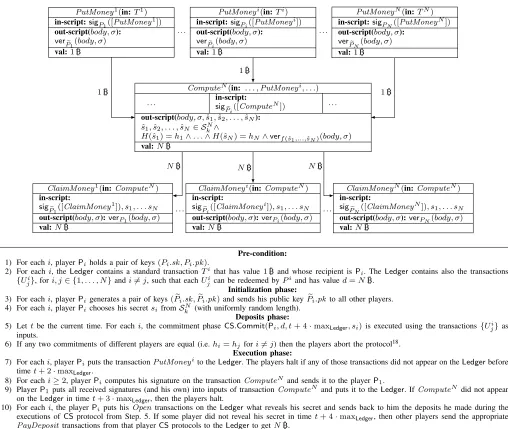
Fig. 2. TheMultiPlayersLotteryprotocol.
other party if she did not open her commitment by executing PayDeposit after the time t passes, and claim her deposit. On the other hand: each honest party is always guaranteed to get her deposit back, hence she does not risk anything investing this money at the beginning of the protocol.
It is straightforward how to extend this protocol for any number of players. The more detailed description is presented on Figure 2 (page 12).
We also need to comment about the choice of the parameterst andd. First, it easy to see that the maximum time in which the honest parties will complete the protocol is at most 4·maxLedger after timet0 — the time when the protocol started. Hence we can safely set t:=t0+ 4·maxLedger.
The parameterdshould be chosen in such a way that it will fully compensate to each party the fact that a player aborted. Let us now calculate the payoff of some fixed playerP1, say, assuming the worst-case scenario, which is as that (a) the protocol is always aborted whenP1 is about to win, and (b) there is only one “aborting party” (soPi is paid only one deposit). Hence his expected payoff is −N−1
N B (this corresponds to the case when he lost) plus d−1
N B (the case when the protocol was aborted). Therefore to make the expected value equal to0 we need to setd=NB. This implies that the total amount of money invested
18We would like to thank Ranjit Kumaresan and Iddo Bentov for pointing out this step. It protects from thecopy attack: e.g. in case of two players lottery
in deposit by each player has to be equal to N(N−1)B. In real-life this would be ok probably for small groupsN = 2,3, but not for the larger ones.
We now have the following lemma, whose proof will appear in the extended version of this paper.
Lemma 2: TheMultiPlayersLottery protocol from Figure 2 is a fair lottery protocol ford=NB andt=t0+ 4·maxLedger, wheret0 is the starting time of the protocol.
V. TWO-PARTY LOTTERY SECURE IN A STRONGER MODEL
In this section we show a construction of a two-party lottery which avoids using the deposits, and hence may be useful for applications where the parties are not willing to invest extra money in the execution of the protocol. The drawback of the protocol presented in this section is that it works only for two parties. Moreover, to achieve full security it needs an assumption that the channel between the parties and theLedgeris private, what means that the adversary cannot see the transactions sent by the honest user, before they appear on theLedger. In reality Bitcoin transactions are broadcast via a peer-to-peer network, so it is relatively easy to eavesdrop the transactions waiting to be posted on the Ledger. Another problem related to eavesdropping is malleability of transaction (already described in Section II-B). Recall, that the problem is that an adversary can modify (“maul”) the transaction T eavesdropped in the network in such a way that the modified transaction is semantically equivalent to the original one, but it has a different hash. Then, the adversary can send the modified version ofT to theLedgerand if he is lucky it will be posted on the Ledger and invalidate the original transactionT (its input will be already redeemed). Hence, e.g., the transactions that were created to redeem T will not be able to do it (as the hash of the transaction is different). In order to be secure for the protocol presented in this section, we need to assume that such attacks are impossible. Technically, we do it by assuming that the channel from each party to the Ledger is private. The protocols secure in this model will be called secure under private channel assumption.
To explain our protocol let us go to the point in Section IV where it turned out that we need the Bitcoin commitment schemes. Recall that we observed that the protocol from Section IV-A2 is not secure against a “nasty behavior” of the party that, after realizing that she lost, simply quits the protocol.
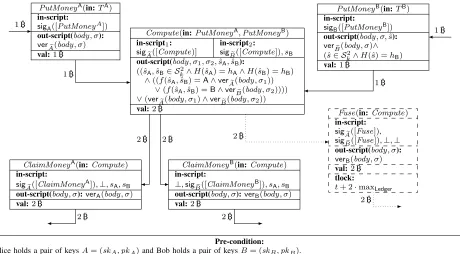
3) An alternative (and slightly flawed) idea for a fix: Suppose for a moment we are only interested in security against the “nasty Bob”. Our method is to force him to reveal sB simultaneously withCompute1 being posted on theLedger, by requiring thatsB is a part ofCompute1. More concretely this is done as follows. Recall that in our initial protocol we said thatCompute1 is created and posted on the Ledger by “one of the parties”. This was ok since the protocol was completely symmetric for A
andB. In our new solution we break this symmetry by modifying theCompute1 transaction (this new version will be denoted
Compute2) and designing the protocol in such a way that Compute2 will be always posted on the Ledger byB. First of all, however, we redefine the PutMoneyB1 transaction that B posts on the Ledger at the beginning of the protocol. The modified transaction is denoted PutMoneyB2.
PutMoneyB 2(in:TB) in-script:sigB([PutMoneyB2])
out-script(body, σ,ˆs):ver
e
B(body, σ) ∧ ˆs∈ S 2
k ∧ H(ˆs) =hB val:1B
The only difference compared to PutMoneyB1 is the addition of the “∧sˆ∈ S2
k ∧(H(ˆs) = hB)” part. This trick forces Bob to reveal the pre-image of hB (which has to be equal tosB) whenever he redeems PutMoneyB2.
The transaction PutMoneyA1 remains unchanged, i.e.: PutMoney A
2 :=PutMoney A
1. Clearly players can still redeem their transactions later in case they discover that the other player is cheating. TransactionCompute2is the same asCompute1, except that sB is added to the input script for the second input transaction:
Compute2(in:PutMoneyA2,PutMoneyB2) in-script1:sig
e
A([Compute2]) in-script2:sigBe([Compute2]), sB
out-script(body, σ1, σ2,sˆA,ˆsB):
(ˆsA,sˆB∈ Sk2∧H(ˆsA) =hA∧H(ˆsB) =hB ∧f(ˆsA,ˆsB) =A∧verAe(body, σ1)) ∨
(ˆsA,sˆB∈ Sk2∧H(ˆsA) =hA∧H(ˆsB) =hB ∧f(ˆsA,ˆsB) =B∧verBe(body, σ2))
val:2B
The parties post their PutMoney2 transactions on the Ledgerand construct transactionCompute2 in the following way. First, observe that both parties can easily construct the body of Compute2 themselves, as all the information needed for this is: the transactions PutMoneyA2 andPutMoneyB2 and the hashes ofsA andsB, which are all publicly available. Hence the only thing that needs to be computed are the input scripts. This computation is done as follows: first Alice computes her input script
sig e