Article
Integration of Web APIs and Linked Data using
SPARQL Micro-Services.
Application to Biodiversity Use Cases
§
Franck Michel1*, Catherine Faron Zucker1, Olivier Gargominy2and Fabien Gandon1
1 University Côte d’Azur, CNRS, Inria, I3S, France. 2 Muséum National d’Histoire Naturelle, Paris, France * Correspondence: [email protected]
§ This paper is an extended version of our paper published in Michel F., Faron Zucker C. and Gandon F. (2018). SPARQL Micro-Services: Lightweight Integration of Web APIs and Linked Data. In Proceedings of LDOW2018, Lyon, France, CEUR vol. 2073.
Abstract: In recent years, Web APIs have become a de facto standard for exchanging machine-readable data on the Web. Despite this success though, they often fail in making resource descriptions interoperable due to the fact that they rely on proprietary vocabularies that lack formal semantics. The Linked Data principles similarly seek the massive publication of data on the Web, yet with the specific goal of ensuring semantic interoperability. Given their complementary goals, it is commonly admitted that cross-fertilization could stem from the automatic combination of Linked Data and Web APIs. Towards this goal, in this paper we leverage the micro-service architectural principles to define aSPARQL Micro-Servicearchitecture, aimed at querying Web APIs using SPARQL. A SPARQL micro-service is a lightweight SPARQL endpoint that provides access to a small, resource-centric, virtual graph. In this context, we argue that full SPARQL Query expressiveness can be supported efficiently without jeopardizing servers availability. Furthermore, we demonstrate how this architecture can be used to dynamically assign dereferenceable URIs to Web API resources that do not have URIs beforehand, thus literally “bringing” Web APIs into the Web of Data. We believe that the emergence of an ecosystem of SPARQL micro-services published by independent providers would enable Linked Data-based applications to easily glean pieces of data from a wealth of distributed, scalable and reliable services. We describe a working prototype implementation and we finally illustrate the use of SPARQL micro-services in the context of two real-life use cases related to the biodiversity domain, developed in collaboration with the French National Museum of Natural History.
Keywords:Web API, SPARQL, micro-service, Data Integration, Linked Data, REST, Biodiversity
1. Introduction
With the advent of the Big Data era during the last fifteen years, many works have tackled the challenge of dealing with large volumes of data produced at a high velocity (commonly known as the first two V’s of Big Data). This has led to the emergence of new types of databases (so-called NoSQL databases [1]) and new processing paradigms (e.g. MapReduce [2]). But volume and velocity are just one part of the new issues that we are given to face. The dramatic proliferation of data sources available on the Web poses an unprecedented challenge upon data integration, i.e. the techniques involved in combining heterogeneous data residing in different systems and locations, into a common, consistent view. This is where we have to tackle the third and fourth V’s of Big Data: variety refers to data syntactic and semantic heterogeneity, while veracity addresses questions such as data interpretation, bias, uncertainty, provenance and, ultimately, trust.
Various types of interfaces can enable access to and querying of big data sets. In particular, Web APIs have gained significant traction during the last decade, to the extent they became a de facto standard for exchanging data on the Web. They are routinely published by Web portals and data producers to enable HTTP-based, machine-processable access to their data. Let us illustrate this with a few examples. As of October 2018, theProgrammableWeb.comportal was registering over 20,000 Web APIs pertaining to topics as diverse as social networks, entertainment or finance. Many governments around the world have set up data portals accessible through Web APIs to inventory open data sets originating from the public sector [3]. In the biodiversity domain, data aggregators and Natural History museums maintain specialized Web APIs giving access to billions of records about taxonomies, occurrences and traits of biological organisms [4].
Despite their success in ensuring a relatively uniform access to resource descriptions, Web APIs fail in making these descriptions interoperable. Indeed, they commonly rely on proprietary vocabularies that are hardly connected with each other. More importantly, these vocabularies lack a clear semantic description that is essential to address the variety and (to a lesser extend) veracity issues. The Linked Data principles [5] specifically seek to address this lack. They propose to publish data (1) in a common machine-readable format (RDF, the Resource Description Framework [6]), (2) using shared and linked vocabularies with clearly defined semantics, (3) while linking related resources throughout datasets. Links bring about the ability to consolidate and make sense of disparate datasets, thus building a uniform distributed knowledge graph. Similarly to Web APIs, large amounts of data about all sorts of topics are increasingly being published in compliance with the Linked Data principles. As of October 2018, over 25,000 Linked Data datasets were inventoried by LODAtlas1.
Given the complementary goals of Web APIs and Linked Data, it is commonly admitted that cross-fertilization could stem from their mutual integration. Major initiatives such as Google’s Knowledge Graph2 or Facebook’s Open Graph3 leverage these two worlds (alongside other types of data sources) to come up with vast knowledge graphs. Strikingly enough though, standard approaches still lack in this domain, as several issues must be overcome:
• Vocabularies: Web APIs typically rely on standard representation formats such as JSON or XML, but how to invoke a Web API and interpret resource representations is usually documented in Web pages meant for human readers. By contrast, Linked Data best practices [7] advocate the use of standard protocols and common, well adopted vocabularies described in machine-readable formats. Consequently, consuming Web API data and RDF triples alike often leads to the development of Web API wrappers implementing bespoke vocabulary alignment.
• Resource identifiers: Web APIs commonly name resources using proprietary, internal identifiers. The downside is that such internal identifiers do not have any meaning beyond the scope of the Web API itself. Linked Data principles address this issue by using HTTP URIs to identify resources. Not only URIs are unique on the Web, but they can also improve the affordance of the resources in that they can be dereferenced to a description of the resource. Therefore, integrating Web APIs and Linked Data requires a mechanism to associate internal identifiers to URIs.
• Parsimony: Web APIs frequently consist of many different services (search by name/tag/group, organize content, interact with contents, etc.). Such that providing a Linked Data interface for all of these services may require substantial efforts, although a tiny fraction of them may fulfill the needs of most use cases. Therefore, a more parsimonious, on-demand approach may be more relevant.
• Suitable interface: Controversy exists with respect to the type(s) of interface(s) most suitable to query Web APIs in a way that allows for their integration with Linked Data. Each type of Linked Data interface has its own benefits and concerns. RDF dumps allow in-house consumption but do not fit in when data change at a high pace; URI dereferencing4provides subject-centric documents hence lacking query expressiveness. At the other end of the spectrum, SPARQL [8], the W3C recommendation to query RDF graphs, is more expressive but puts the query processing cost solely on the server, and studies suggest that allowing clients to run arbitrary SPARQL queries against public endpoints leads to availability issues [9]. Besides, on-the-fly SPARQL querying of non-RDF databases proves to be difficult, as attested by the many works on SPARQL-based access to relational [10,11] or NoSQL [12,13] databases.
In this article, we propose to harness the Semantic Web standards to enable automatic combination of disparate resource representations coming from both Linked Data interfaces and Web APIs. Our contribution is threefold. Firstly, we define theSPARQL Micro-Servicearchitecture aimed at querying Web APIs using SPARQL while assigning dereferenceable URIs to Web API resources (that do not have URIs beforehand). Secondly, we suggest that leveragning the micro-service architectural principles [14] could help to design more distributed and modular Linked Data-based applications. Thirdly, we illustrate the use of SPARQL micro-services in several real-life use cases related to the biodiversity domain.
The rest of this article is organized as follows. Section 2 introduces background elements with respect to Web APIs and micro-service architectural principles. Sections 3 and 4 define the SPARQL micro-service architecture, while sections 5 and 6 present our implementation and the experimentation we have conducted. This is then complemented in section7with the description of two concrete use cases in the biodiversity area. Related works are discussed in section8while the last section sums up our approach and suggests future leads.
2. Background
2.1. Web APIs
Web APIsare a loosely defined category of services accessed over the Web. Since the term is used in the literature to refer to somewhat different things, below we outline more precisely what it means within the context of this article.
Web APIs are invoked over the HTTP/HTTPS protocols. Unlike WSDL-based Web services, they leverage the HTTP protocol to denote actions, spawning relatively simple interfaces where service arguments are traditionally passed as regular parameters of an HTTP query string. These APIs are informally called REST interfaces although they are generally more “REST-like” than RESTful, i.e. they comply with some of the REST architectural principles [15] (stateless interaction, uniform interface) but relax others (self-contained response, resources identified with URIs, hypermedia links to navigate resource states).
Most Web APIs use a standard representation format such as XML and JSON, thereby ensuring a relatively uniform access to resource descriptions. These descriptions however often rely on proprietary vocabularies typically documented in Web pages meant for software developers but hardly machine-readable. This is a major difference with Linked Data best practices [7] that advocate the use of common, well adopted vocabularies whose semantics is described in machine-readable format. Some initiatives attempt to make Web APIs documentation machine-readable, such as OpenAPI5 (formerly Swagger). This description however hardly touches upon semantic concerns;
4 Dereferencinga URI consists in looking it up to retrieve a resource representation in a negotiated media type such as one of the RDF serialization syntaxes.
it mostly consists of a syntactic description of the operations supported by the interface, and aims to automate the generation of client-side and server-side code. In this respect, OpenAPI is no different from what WSDL allowed to do. By contrast, smartAPI [16] extends OpenAPI with an extensive set of metadata, but the link with vocabularies and ontologies from the Web of Data is still to be defined.
2.2. Micro-Service Architectures
The term micro-service, also called fine-grained SOA, refers to an architectural style where an application consists of a collection of services that are fine-grained (designed to fulfill a single function), loosely coupled and independently deployable [14]. There is no standard definition of micro-services at this point, however a consensus is emerging about commonly agreed upon principles [17,18]. For instance, a proposition rewords these principles by stating that micro-services should be elastic, resilient, composable, minimal and complete6. Compared to traditional monolithic applications, the micro-service architectural style improves modularity by making applications easier to develop, maintain and test. Development teams are typically geared towards continuous refactoring, delivery and deployment of the services they are responsible for, independently of other teams and services. Instead of being constrained to use specific technologies, each team picks the programming language(s), software stacks and other third-party technologies that it deems most appropriate for a specific service, hence giving rise topolyglot applications.
Micro-services have been increasingly adopted during the last seven years, not only by major Web companies who inspired this architecture, but also by many other companies that need to speed up their development and deployment processes. Micro-services are often associated with lightweight container technologies such as the popular Docker7. These technologies can underpin the quick and elastic deployment of applications by enabling on-demand scaling up or down of the micro-services.
Like any architecture style, the experience shows that micro-services have pitfalls of their own8. For instance, figuring out the right functional scope of a micro-service so as to keep it minimal and complete is critical in many aspects. With “too minimal” micro-services, an application may soon consist of several hundreds of micro-services, far from the intuitive idea of “easily maintainable”. Furthermore, insofar as complex services are achieved by composing multiple micro-services, “too minimal” services tend to entail complex dependency networks that, again, cause maintainability issues.
Still, despite these downsides, we argue that leveraging micro-service principles may help in the design of distributed, modular Linked Data-based applications structured as a collection of lightweight, loosely-coupled services. These services would typically be RDF stores, URI dereferencing services, SPARQL endpoints, Linked Data Platform [19] services etc. The SPARQL micro-service architecture is a proposition towards this goal.
3. The SPARQL Micro-Service Architecture
3.1. Definition
A SPARQL micro-serviceSµis a wrapper of a serviceSwof a Web API, that allows queryingSw
using SPARQL.Sµbehaves as a regular SPARQL endpoint insofar as it supports the SPARQL Query
Language [8] (including all query forms: SELECT, ASK, CONSTRUCT, DESCRIBE) and the SPARQL Protocol [20]. Accordingly, a client invokesSµ over HTTP/HTTPS by passing a SPARQL queryQ
and optional default and named graph URIs (argumentsdefault-graph-uriand named-graph-uri). In
6 https://www.nirmata.com/2015/02/02/microservices-five-architectural-constraints/ 7 https://www.docker.com/
addition, Sµ accepts a possibly empty set Argw of arguments that are specific to the service being
wrapped. In turn,SµinvokesSwwith the arguments inArgw, and produces a SPARQL result set that
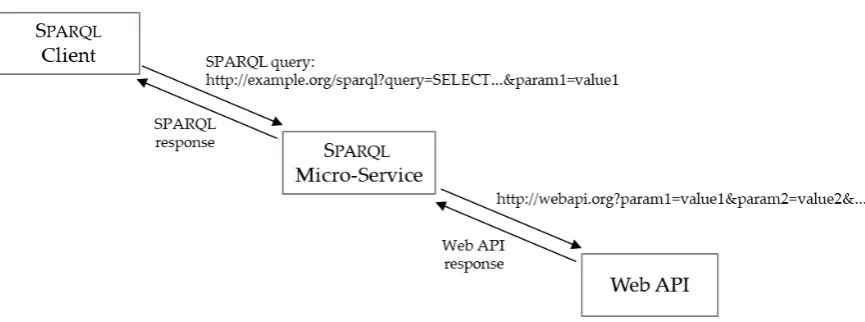
matchesQ. Figure1illustrates this architecture.
Figure 1.Architecture of a SPARQL micro-service with one argument passed in the query string
How Argw is passed to the micro-service Sµ is implementation-dependent. The
implementation we describe in section 5 passes the arguments as parameters of the HTTP
query string. Thus, while the URL of a regular SPARQL endpoint is of the form
“http://example.org/sparql”, a SPARQL micro-service is invoked with additional parameters, like “http://example.org/sparql?param1=value1”. Likewise, how the Web API’s response is transformed into a SPARQL result set matchingQis implementation-dependent. In the context of JSON-based Web APIs, our implementation applies a JSON-LD profile to the Web API response and executes an optional SPARQL query to yield additional triples. Various other methods may be used at this point, involving e.g. different flavors of mapping, reasoning or rule processing.
The semantics of a SPARQL micro-service differs from that of a standard SPARQL endpoint insofar as the SPARQL protocol treats a service URL as a black box, i.e. it does not identify nor interprets URL parameters in any way. By contrast, a SPARQL micro-service can be thought of as a configurable SPARQL endpoint whose arguments (Argw) delineate the virtual graph that is being
queried. Consequently, each pair (Sµ,Argw) is a standard SPARQL endpoint.
As we see it, a SPARQL micro-service provides access to a small, resource-centric, virtual graph that corresponds to a small fragment of the whole dataset served by the Web API. This graph is shaped by (i) the Web API service that is wrapped by the micro-service; (ii) the set of argumentsArgw; and
(iii) the types of RDF triples that the micro-service is designed to produce.
With regards to the micro-service architectural principles, we think of SPARQL micro-services as lightweight, independent software units being developed along with the arising of needs. A micro-service development team focuses on one Web API at a time, defines how to wrap the services of interest for clearly identified use cases, tests and deploys the micro-services. Using a container infrastructure like Docker, each micro-service is deployed within a dedicated container that can scale up or down automatically in response to changes in the workload.
3.2. SPARQL Micro-Services as a Linked Data Fragments Interface
these two extremes lies a spectrum of intermediate approaches. A Linked Data document results from a URI dereferencing. A Triple Pattern Fragment [21] (TPF) results from evaluating a single triple pattern against an RDF dataset. The TPF approach succeeds in balancing the query evaluation cost between the client and the server, thereby ensuring better server availability than full-fledged SPARQL endpoints, at the cost of a loss of efficiency. SaGe [22] mitigates this issue with a modification of the SPARQL protocol. A SaGe server can interrupt the processing of a SPARQL query and send back to the client the current results alongside the information needed by the server to carry on processing during a subsequent invocation.
Figure 2.Granularity of different types ofLinked Data Fragments
We see SPARQL micro-services as an alternative Linked Data Fragment interface. A SPARQL micro-service Sµ provides access to a virtual graph that corresponds to a fragment of the dataset
served by the Web API. By designing it carefully, we can ensure thatSµ will yield small (typically
resource-centric) virtual graphs. In this context, virtually any query can be processed at low cost. In other words, full SPARQL Query expressiveness can be supported without jeopardizing the service availability. Consequently, in Figure2, SPARQL micro-service results stand nearby SPARQL results since SPARQL micro-services allow requests as specific (expressive) as SPARQL, and to the right of SaGe results since they do not put any additional processing cost on the client.
3.3. Caching Strategy
Querying Web APIs is often a time-consuming task, as suggested by the measures we report in section 6. Thus, when possible, defining caching strategies may be necessary to achieve the performance expected by some applications. There typically exist many syntactical variants of the same SPARQL query, hence classic HTTP proxy servers set up between SPARQL clients and servers fail to reach efficient cache reuse. By contrast, Web API queries allow a lesser syntactical variability. Therefore, in the context of SPARQL micro-services, enforcing a cache strategy on the Web API side should ensure better cache reuse. Typically, Web API queries could be used to index either the Web API responses or the temporary graphs produced from them.
Furthermore, some Web APIs provide data expiration information (such as the Expires,
Cache-Control and/or Last-Modified HTTP headers) on which a caching system can rely to figure out a caching strategy. When no such information is provided, a SPARQL micro-service may authoritatively decide on an appropriate expiration period depending on the type of service being wrapped.
3.4. Example
LetSw be a service of Flickr’s Web API9, that retrieves photos posted in a specific Flickr group
and having a specific tag10.Argw(the arguments ofSw) comprises two arguments,group_idandtags.
9 https://www.flickr.com/services/api/
h t t p s :// api . f l i c k r . com / s e r v i c e s / r e s t /?
m e t h o d = f l i c k r . g r o u p s . p o o l s . g e t P h o t o s & f o r m a t = j s o n & p e r _ p a g e = 5 0 0 & g r o u p _ i dg r o u p _ i dg r o u p _ i d = 3 5 0 3 4 3 5 0 7 4 3 @ N 0 1 &t a g st a g st a g s = t a x o n o m y : b i n o m i a l = D e l p h i n u s + d e l p h i s
{ " p h o t o sp h o t o sp h o t o s ": {
"p a g ep a g ep a g e ": 1 , " p a g e sp a g e sp a g e s ": "15" , " p h o t op h o t op h o t o ": [
{ "ididid ": " 3 1 1 7 3 0 9 1 4 0 6 " , " t i t l et i t l et i t l e ": " D e l p h i n u s d e l p h i s 5 (13 -7 -16 San D i e g o )" , " o w n e ro w n e ro w n e r ": " 1 0 7 7 0 2 6 6 @ N 04 " , " o w n e r n a m eo w n e r n a m eo w n e r n a m e ": " B a r b o l " ,
" s e c r e ts e c r e ts e c r e t ": "8 c 7 4 3 7 e 9 7 0 " , " s e r v e rs e r v e rs e r v e r ": "5718" , "f a r mf a r mf a r m ": 6 } ]
}}
Listing 1: Invocation of a Flickr’s Web API service (top) and snippet of the JSON response (bottom).
P R E F I XP R E F I XP R E F I X sss : < h t t p :// s c h e m a . org / >
< h t t p :// e x a m p l e . org / ld / f l i c k r / p h o t o / 3 1 1 7 3 0 9 1 6 2 6 > a
a
a sss : P h o t o g r a p hP h o t o g r a p hP h o t o g r a p h ; s
s
s :n a m en a m en a m e " D e l p h i n u s d e l p h i s 5 (13 -7 -16 San D i e g o )"; s
s
s : i m a g ei m a g ei m a g e < h t t p s :// f a r m 6 . s t a t i c f l i c k r . com / 5 7 1 8 / 3 1 1 7 3 0 9 1 6 2 6 _ 8 8 c 4 1 0 c 3 f 2 _ z . jpg >; s
s
s : m a i n E n t i t y O f P a g em a i n E n t i t y O f P a g em a i n E n t i t y O f P a g e < h t t p s :// f l i c k r . com / p h o t o s / 1 0 7 7 0 2 6 6 @ N0 4 / 3 1 1 7 3 0 9 1 6 2 6 > ; s
s
s : a u t h o ra u t h o ra u t h o r [ s
s
s :n a m en a m en a m e " B a r b o l "; s
s
s :urlurlurl < h t t p s :// f l i c k r . com / p h o t o s / 1 0 7 7 0 2 6 6 @N04 > ].
Listing 2: Example of RDF graph representing the Web API response in Listing 1, in the Turtle syntax [24].
LetSµbe a SPARQL micro-service that wrapsSwand takes its arguments as parameters on the HTTP
query string.
A client wants to retrieve the URLs of photos of dolphins, posted to the Encyclopedia of Life Images group11 wherein photos are tagged with the species scientific name formatted as “taxonomy:binomial=<scientific name>”. To do so, the client may execute the SPARQL query below against any SPARQL 1.1 endpoint, in which the SERVICE clause invokesSµwhile passing thegroup_id
andtagsarguments:
P R E F I XP R E F I XP R E F I X s : < h t t p :// s c h e m a . org / > S E L E C TS E L E C TS E L E C T * W H E R EW H E R EW H E R E {
S E R V I C ES E R V I C ES E R V I C E < h tt p :// e x a m p l e . org / f l i c k r / g e t P h o t o s B y G r o u p B y T a g ? \
g r o u p _ i dg r o u p _ i dg r o u p _ i d = 8 0 6 9 2 7 @ N 2 0 &t a g st a g st a g s = t a x o n o m y : b i n o m i a l = D e l p h i n u s + delphis >
{ S E L E C TS E L E C TS E L E C T ? img W H E R EW H E R EW H E R E { ? p h o t o s : i m a g e ? img . } } }
Sµ invokes Flickr’s Web API Sw with the arguments in Argw in addition to technical arguments
required by the Web API. Listing1 shows the invocation URL (top) and sketches a snippet of the response (bottom). Sµ translates this response into an RDF graph G such as the one depicted in
Listing2. Remember that how this translation is carried out is implementation-dependent. Finally,
Sµevaluates the client’s SPARQL query againstGand returns the response in one of the media types
supported by the SPARQL client (following a regular content negotiation [23]).
4. Assigning URIs to Web API Resources
Web APIs often provide resource descriptions that rely on internal, proprietary identifiers. For instance, Listing1mentions the photo identifier “31173091406” that has no meaning beyond the scope of Flickr’s Web API. One may argue that the URL of this photo’s Web page could serve as a URI, but this would just approve a questionable practice that confuses a resource (a photographic work in this case) with an HTML representation thereof.
Therefore, bridging Web APIs and Linked Data not only requires to enable SPARQL querying of Web APIs, but also to dynamically create URIs that identify Web API resources. Furthermore, according to Linked Data best practices [7], it should be possible to look up these URIs in order to retrieve a description of the resources in a negotiated media type. Conventionally, dereferencing a URI returns a set of RDF triples where the URI is either in the subject or object position. This is typically achieved through a CONSTRUCT or DESCRIBE SPARQL query form.
URI dereferencing can be implemented in a rather straightforward manner with SPARQL micro-services. First, we need to decide on the domain name and URIs scheme. Following up on the example in section 3, we may define the URI scheme of Flickr photographic resources as “http://example.org/ld/flickr/photo/<photo_id>”. Second, we need to set up a Web server to deal with this URI scheme. When the Web server receives a look-up for a URI that matches the scheme, it rewrites the URI into a query string to invoke the relevant SPARQL micro-service. Technically, the Web server acts as a reverse proxy: it queries the SPARQL micro-service and transparently proxies the response back to the client. Figure3sketches this architecture.
This way, by smartly designing SPARQL micro-services, we can build a consistent ecosystem where some micro-services respond to SPARQL queries by translating Web API internal identifiers into URIs, while some micro-services (possibly the same) are able to dereference these URIs.
Figure 3.URI dereferencing: a Web server rewrites a URI look-up query into a query to the relevant SPARQL micro-service.
Example. Let us assume that the getPhotoById SPARQL micro-service retrieves photos by their Flickr identifier (argument photo_id). When the Web server receives a look-up query for URI “http://example.org/ld/flickr/photo/38427227466”, it invokesgetPhotoByIdwith the following inputs: (i) the photo identifier passed as argument photo_id; (ii) a SPARQL query to retrieve a graph representing the resource, typically a DESCRIBE query on the URI being looked up; (iii) the
Accept HTTP header from the look-up query, so that content negotiation be achieved end-to-end. An invocation URL is exemplified below (using the SPARQL’squery via GETmethod, yet the POST methods can be utilized alike [20]):
h t t p :// e x a m p l e . org / f l i c k r / g e t P h o t o s B y I d ?
p h o t o _ i dp h o t o _ i dp h o t o _ i d = 3 8 4 2 7 2 2 7 4 6 6 &
q u e r yq u e r yq u e r y = D E S C R I B E \ % 2 0 \ % 3 C h t t p \%3 A \%2 F \%2 F e x a m p l e . org \%2 Fld \ \%2 F f l i c k r \%2 F p h o t o \%2 F 3 8 4 2 7 2 2 7 4 6 6 \%3 E
Figure 4. Prototype implementation of SPARQL micro-services. A JSON-LD profile interprets the Web API JSON response as a temporary graphGstored in the local RDF triple store. An INSERT query optionally augmentsGwith RDF triples that JSON-LD cannot yield. Lastly, the client’s query is evaluated againstG.
5. Implementation
To evaluate the architecture proposed in section 3, we have developed a prototype implementation written in the PHP language and available on Github12under the Apache 2.0 license. This prototype targets Web APIs able to return a JSON response. This pragmatic choice stems from the fact that most modern Web APIs support JSON. Nevertheless, it would be easy to extend the prototype with respect to other formats such as XML. Also, the prototype requires that the arguments
Argw of a micro-service Sµ be passed as parameters on the HTTP query string (as exemplified in
section3.4). Alternative to this choice are discussed in section5.4.
5.1. Processing SPARQL queries
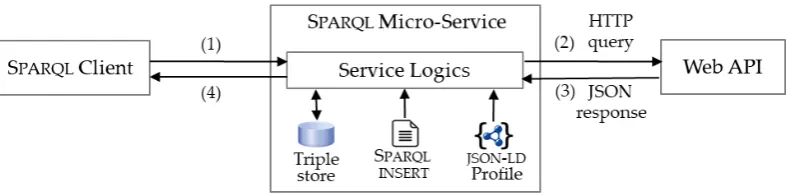
A SPARQL micro-service evaluates a query against an RDF graph built at run-time from data obtained from the Web API. The steps involved in this evaluation are depicted in Figure4, and we describe them further on in Algorithm1(the algorithm’s step numbers match those in Figure1).
Algorithm 1Evaluation of a SPARQL query by a SPARQL micro-serviceSµ.
1. Sµreceives a SPARQL queryQalong with the arguments inArgw.
2. Sµ invokes the Web API service with the arguments in Argw along with other parameters
possibly required by the Web API.
3. Sµtranslates the Web API response (formatted in JSON) into an RDF graph: first, it applies a
JSON-LD profile to the response and loads the resulting graphGinto a triple store; then, it runs an optional SPARQL INSERT query that enrichesGwith additional triples.
4. SµevaluatesQagainstGand returns the result to the client.
Example. To illustrate this algorithm, we follow up on the example introduced in section3.4. Steps 1 and 2 are as exemplified in Listing1. In step 3, let us assume that thegetPhotosByGroupByTag
micro-service provides the JSON-LD profile below, that turns each JSON field name into an ad hoc RDF predicate within name space “http://sms.i3s.unice.fr/schema/” (note that any arbitrary complex profile may be used at this point):
{ " @ c o n t e x t@ c o n t e x t@ c o n t e x t ": {
" @ v o c a b@ v o c a b@ v o c a b ": " h t t p :// sms . i3s . u n i c e . fr / s c h e m a /"
}}
P R E F I XP R E F I XP R E F I X api : < h t t p :// sms . i3s . u n i c e . fr / s c h e m a / > P R E F I XP R E F I XP R E F I X s : < h t t p :// s c h e m a . org / >
I N S E R TI N S E R TI N S E R T {
? p h o t o U r i a s : P h o t o g r a p h ; s : n a m e ? t i t l e ;
s : i m a g e ? img
s : m a i n E n t i t y O f P a g e ? p a g e ;
s : a u t h o r [ s : n a m e ? a u t h o r N a m e ; s : url ? a u t h o r U r l ]. }
W H E R EW H E R EW H E R E {
? p h o t o api : id ? id ; api : s e c r e t ? s e c r e t ; api : s e r v e r ? s e r v e r ; api : f a r m ? fa r m ;
api : t i t l e ? t i t l e ; api : o w n e r ? o w n e r ; api : o w n e r n a m e ? a u t h o r N a m e .
B I N DB I N DB I N D (IRIIRIIRI ( c o n c a tc o n c a tc o n c a t (" h t tp :// e x a m p l e . org / ld / f l i c k r / p h o t o /" , ? id )) AS ? p h o t o U r i ) B I N DB I N DB I N D (IRIIRIIRI ( c o n c a tc o n c a tc o n c a t (" h t t p s :// f l i c k r . com / p h o t o s /" , ? owner , "/" , ? id )) AS ? p a ge ) B I N DB I N DB I N D (IRIIRIIRI ( c o n c a tc o n c a tc o n c a t (" h t t p s :// f l i c k r . com / p h o t o s /" , ? o w n e r )) AS ? a u t h o r U r l ) B I N DB I N DB I N D (IRIIRIIRI ( c o n c a tc o n c a tc o n c a t (" h t t p s :// f a r m " , ? farm , ". s t a t i c f l i c k r . com /" ,
? server , "/" , ? id , " _ " , ? secret , " _z . jpg ")) AS ? img ) }
Listing 3: Insertion of RDF triples based on well-adopted vocabularies (Schema.org, FOAF, Dublin Core).
The resulting graph G is temporarily stored in the local triple store. It exhibits proprietary, technical predicates such as servers and farms identifiers, that are likely irrelevant for a Linked Data representation. The Flickr API documentation describes how to reconstruct photos and user pages URLs from these fields, but this involves the concatenation of values from distinct fields, that JSON-LD is typically not expressive enough to describe. Therefore, the micro-service provides an INSERT query shown in Listing3, that augmentsGwith triples based on the Schema.org vocabulary. Listing4shows the graph obtained after completing both steps. The two blank nodes correspond to the application of the JSON-LD profile, while the other triples result of executing the INSERT query.
Finally, the client’s SPARQL query is evaluated againstGand the response is returned to the client. In the example, it consists of a solution binding for variable ?img, presented below in the SPARQL Results JSON format [25]:
{ "h e a dh e a dh e a d ": {
"v a r sv a r sv a r s ": [ " img " ] } ,
" r e s u l t sr e s u l t sr e s u l t s ": { " b i n d i n g sb i n d i n g sb i n d i n g s ": [
{ " img ": {
"t y p et y p et y p e ": " uri " ,
" v a l u ev a l u ev a l u e ":
" h t t p s :// f a r m 6 . s t a t i c f l i c k r . com / 5 7 1 8 / 3 1 1 7 3 0 9 1 6 2 6 _ 8 8 c 4 1 0 c 3 f 2 _ z . jpg " }
}
] } }
5.2. URIs dereferencing
P R E F I XP R E F I XP R E F I X apiapiapi : < h t t p :// sms . i3s . u n i c e . fr / s c h e m a / > P R E F I XP R E F I XP R E F I X sss : < h t t p :// s c h e m a . org / >
_ : b 1 2 3 api
apiapi :pa g ep a g ep a g e 1; apiapiapi : p a g e sp a g e sp a g e s 15; api
apiapi : p h o t op h o t op h o t o _ : b 4 5 6 .
_ : b 4 5 6 api
apiapi :ididid " 3 1 1 7 3 0 9 1 4 0 6 " ; apiapiapi : t i t l et i t l et i t l e " D e l p h i n u s d e l p h i s 5 (13 -7 -16 San D i e g o )"; api
apiapi : o w n e ro w n e ro w n e r " 1 0 7 7 0 2 6 6 @ N 04 "; apiapiapi : o w n e r n a m eo w n e r n a m eo w n e r n a m e " B i o D i v L i b r a r y "; api
apiapi : s e c r e ts e c r e ts e c r e t "8 c 7 4 3 7 e 9 7 0 "; apiapiapi : s e r v e rs e r v e rs e r v e r " 5 7 1 8 " ; apiapiapi : f a r m 6.
< h t t p :// e x a m p l e . org / ld / f l i c k r / p h o t op h o t op h o t o / 3 1 1 7 3 0 9 1 6 2 6 > a
a
a sss : P h o t o g r a p hP h o t o g r a p hP h o t o g r a p h ; s
s
s :n a m en a m en a m e " D e l p h i n u s d e l p h i s 5 (13 -7 -16 San D i e g o )"; s
s
s : i m a g ei m a g ei m a g e < h t t p s :// f a r m 6 . s t a t i c f l i c k r . com / 5 7 1 8 / 3 1 1 7 3 0 9 1 6 2 6 _ 8 8 c 4 1 0 c 3 f 2 _ z . jpg >; s
s
s : m a i n E n t i t y O f P a g em a i n E n t i t y O f P a g em a i n E n t i t y O f P a g e < h t t p s :// f l i c k r . com / p h o t o s / 1 0 7 7 0 2 6 6 @ N0 4 / 3 1 1 7 3 0 9 1 6 2 6 > ; s
s
s : a u t h o ra u t h o ra u t h o r [ s
s
s :n a m en a m en a m e " B a r b o l "; s
s
s :urlurlurl < h t t p s :// f l i c k r . com / p h o t o s / 1 0 7 7 0 2 6 6 @N04 > ].
Listing 4: RDF graph produced from the Web API response in Listing1by applying successively a JSON-LD profile and the INSERT query in Listing3.
To cope with this issue, our prototype proposes a more flexible and maintainable alternative: each micro-service may provide a CONSTRUCT query that shall be used to answer a URI dereferencing query. In addition, a micro-service checks an optional parameterquery_modewhose values may besparql(the default value) or ld. The latter instructs the micro-service to ignore any SPARQL query passed as parameter and instead return the result of the CONSTRUCT query.
For instance, when a client looks up URI “http://example.org/ld/flickr/photo/38427227466”, the Web server rewrites this into an invocation to the appropriate micro-service, for instance:
h t t p :// e x a m p l e . org / f l i c k r / g e t P h o t o s B y I d ? p h o t o _ i dp h o t o _ i dp h o t o _ i d = 3 8 4 2 7 2 2 7 4 6 6 & q u e r y _ m o d eq u e r y _ m o d eq u e r y _ m o d e = ld
5.3. Deployment
Deploying a new SPARQL micro-service. Within our prototype, deploying a new SPARQL micro-service simply consists of provisioning four files among which two are optional:
• config.ini: a configuration file that declares the arguments expected by the micro-service and the Web API invocation query string.
• profile.jsonld: the JSON-LD profile used to interpret the Web API response as an RDF graph;
• insert.sparql(optional): used to augment the graph with additional triples;
• construct.sparql(optional): used to produce the response to URI dereferencing queries.
If a Web API requires specific actions that cannot be described using theconfig.iniconfiguration file (e.g. intermediate query, authentication process), the developer can customize a simple script13, allowing for more flexibility.
Caching Strategy. Querying Web APIs typically takes in the order of 0.5 to 1 second. Therefore, when a SPARQL query invokes several SPARQL micro-services in sequence, the overall time it takes to consolidate the results may be quite long. To improve performances, we enforce a simple cache strategy where each Web API response is stored in a cache database, indexed with a hash of the Web API query, and annotated with an expiration period that can be configured on a per-micro-service basis. Our live deployment utilizes the MongoDB document store as a cache database, yet using any other database may be achieved with little changes.
Docker Deployment. In addition to the code available on Github, we have created a Docker image published on Docker hub14: it provides an Apache Web server configured with the SPARQL micro-services described in section 6. Note that, for the sake of simplicity, we have defined a single image hosting several micro-services. Nevertheless, more in line with common micro-service practices, it would make sense to define one image per service, enabling the independent deployment of each service. As instructed in the Github README, a single command is sufficient to deploy this image on a Docker server. The deployment comes along with two more images: the Corese-KGRAM in-memory triple store [26] used to store temporary RDF graphs, and the MongoDB database used as a cache for previously executed Web API queries.
5.4. Discussion
In this implementation, a design decision is to pass the arguments ofArgwtoSµas parameters of
the HTTP query string. Arguably, other solutions may be adopted. Below we discuss the respective benefits and drawbacks of some alternatives we identified.
A first alternative consists in defining one predicate for each argument, e.g. api:group_idand
api:tagsbelow:
P R E F I XP R E F I XP R E F I X api : < h t t p :// sms . i3s . u n i c e . fr / s c h e m a / >
P R E F I XP R E F I XP R E F I X s : < h t t p :// s c h e m a . org / > S E L E C TS E L E C TS E L E C T ? img W H E R EW H E R EW H E R E {
S E R V I C ES E R V I C ES E R V I C E < h tt p :// e x a m p l e . org / f l i c k r / g e t P h o t o s B y G r o u p B y T a g > { ? p h o t o s : i m a g e ? img ;
api : g r o u p _ i d " 8 0 6 9 2 7 @ N 2 0 ";
api : t a g s " t a x o n o m y : b i n o m i a l = D e l p h i n u s + d e l p h i s ".
}
}
At a first sight, making the arguments explicit can seem compelling since they can be used in other triples of the graph pattern. Besides, such a SPARQL micro-service is a standard SPARQL endpoint since there is no more variable part in the service endpoint URL. Several concerns should be pointed out however. (i) This solution requires that each SPARQL micro-service be defined along with its own bespoke terms, whereas we seek a solution wherein only terms of well-adopted vocabularies would be exposed. (ii) In this example, thegroup_idand tagsarguments are meaningful for the end user. But some services may require more technical arguments that we typically do not want to define as ontological terms. (iii) Furthermore, this solution questions the nature of the subject to which the arguments are associated. Again, in this specific example, declaring thegroup_id and
tagsas properties of the photographic resource ?photois an acceptable choice, but this would be inappropriate with internal or technical service parameters.
This issue can be solved by associating the arguments to a separate resource depicting the service itself. This is exemplified in the second alternative that, furthermore, defines a vocabulary to pass the arguments in a uniform manner. Note that existing vocabularies may be tapped for that matter, such as Hydra [27] or the Schema.org actions vocabulary15. In the example below, additional triple patterns define an instance of the hypotheticalapi:Serviceclass, that takes arguments declared with theapi:parampredicate.
S E L E C TS E L E C TS E L E C T ? img W H E R EW H E R EW H E R E {
S E R V I C ES E R V I C ES E R V I C E < h t tp :// e x a m p l e . org / f l i c k r / g e t P h o t o s B y G r o u p B y T a g >
{ ? p h o t o s : i m a g e ? img .
[] a api : S e r v i c e ;
api : p a r a m [ api : n a m e " g r o u p _ i d "; api : v a l u e " 8 0 6 9 2 7 @ N 2 0 " ];
api : p a r a m [ api : n a m e " t a g s "; api : v a l u e ? tag ]. }
}
A slight variation could state that the service URL itself is an instance ofapi:Service; the arguments would then configure an execution of this service with predicateapi:execution, e.g.:
< h t t p :// e x a m p l e . org / f l i c k r / g e t P h o t o s B y G r o u p B y T a g >
a api : S e r v i c e ; api : e x e c u t i o n [
api : p a r a m [ api : n a m e " g r o u p _ i d "; api : v a l u e " 8 0 6 9 2 7 @ N 2 0 " ];
api : p a r a m [ api : n a m e " t a g s "; api : v a l u e ? tag ]. ].
While these alternatives avoid defining new predicates for each micro-service, the additional triples bear a somewhat artificial semantics: they provide the service with information as to how to process the other parts of the graph pattern, but they do not actually refer to nor describe the photographic resources that the graph pattern aims to match.
In a third alternative, the service arguments are passed as SPARQL variables with pre-defined names, e.g.?group_idand?tagsin the example below:
S E L E C TS E L E C TS E L E C T ? img W H E R E {
S E R V I C ES E R V I C ES E R V I C E < h t tp :// e x a m p l e . org / f l i c k r / g e t P h o t o s B y G r o u p B y T a g > { ? p h o t o s : i m a g e ? img .
B I N D ( " 8 0 6 9 2 7 @ N 2 0 " ASASAS ? g r o u p _ i d )
B I N D (" t a x o n o m y : b i n o m i a l = D e l p h i n u s + d e l p h i s " ASASAS ? t a g s )
} }
Similarly to the previous alternative, variables?group_idand?tagsare somewhat artificial insofar as they provide the service with information as to how to process the other parts of the graph pattern. The solution proposed in this article is a trade-off meant to satisfy certain goals. Above, we have discussed some alternative solutions, and others may probably be figured out. We believe that further discussions should be engaged to assess the benefits and concerns of these alternatives with respect to the contexts and goals.
6. Experimentation
To evaluate the effectiveness and efficiency of our approach, we conducted a series of tests related to the biodiversity domain. We wrote several SPARQL micro-services to wrap Web APIs
providing various kinds of information about living species (all the services mentioned in this section are available on the project’s Github repository):
1. bhl/getArticlesByTaxon retrieves scientific articles mentioning a given species name from the Biodiversity Heritage Library (BHL)16.
2. flickr/getPhotosByGroupByTag, already described in section3, is used to search theEncyclopedia of Life ImagesFlickr group17for photos of a given species. Photos of this group are tagged with the scientific name of the species they represent, formatted as “taxonomy:binomial=<scientific name>”.
3. macaulaylibrary/getAudioById retrieves audio recordings for a given species identifier from the Macaulay Library18, a scientific media archive related to birds, amphibians, fishes and mammals.
4. musicbrainz/getSongByName searches the MusicBrainz music information encyclopedia19 for music tunes whose title match a given name with a minimum confidence of 90%.
Test Environment. The tests were performed on a CentOS Linux 7.5 server running on a virtual machine equipped with 4 CPU cores and 32 GB of RAM. The SPARQL micro-services were served by an Apache 2.4 Web server. The server also hosted two additional services required for the experimentation: the Corese-KGRAM RDF triple store used to store temporary graphs and the MongoDB document store used as a cache database.
6.1. Performance of individual SPARQL Micro-Services
Each SPARQL micro-service was individually invoked using thecurlcommand. The point was always the same: retrieve information about the common dolphin species (Delphinus delphis). The SPARQL query passed to the service was simply meant to retrieve all the triples generated during the execution: CONSTRUCT WHERE ?s ?p ?o. During each invocation, a metrology service implemented in the SPARQL micro-service carried out two measures: (i) the time it takes to execute solely the Web API query, and (ii) the time it takes to complete the SPARQL micro-service invocation (the latter encompasses the earlier).
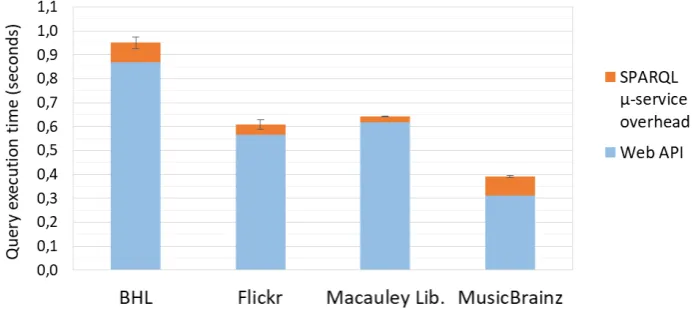
Table1reports the execution time for each SPARQL micro-service with no cache, averaged over ten runs. Figure5depicts the same measures in a more synthetic way. Column “Triples produced” of Table1gives the number of triples generated by applying subsequently the JSON-LD profile to the API response and the optional INSERT query (to spawn additional triples). It is interesting to notice that the overhead imposed by the SPARQL micro-service (in orange in Figure5) always remains low, ranging from 25ms to 80ms. It accounts for 4.11% of the total time for Macaulay library’s API to 25.5% for MusicBrainz’s API which is by far the fastest of the four APIs.
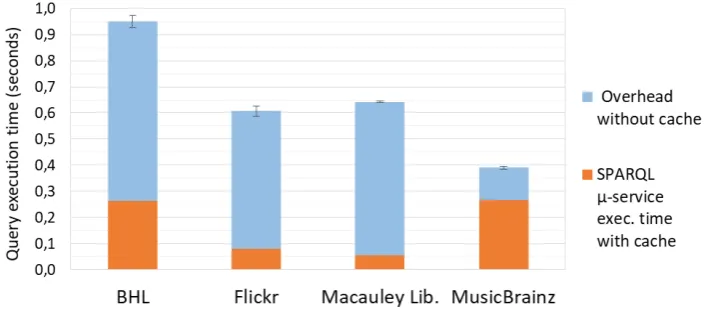
We then performed a second run of the same queries using the cache database. The cache expiration duration was set to several days and a warm-up run was executed to ensure systematic cache hits. Table2reports the execution time for each SPARQL micro-service without and with cache, and the last column gives the percentage of time reduction obtained when using the cache. Not surprisingly, the reduction is substantial since there is no more invocation of the Web APIs, only a document fetch operation from the local MongoDB database. The reduction ranges from 31.7% for MusicBrainz’ API to 91.5% for Macaulay Library’s API. Figure6 depicts the same measures where the orange part represents the SPARQL micro-service execution with a cache database, while the blue part represents the additional time taken by the cacheless execution.
16 http://biodiversitylibrary.org/
17 https://www.flickr.com/groups/806927@N20 18 https://www.macaulaylibrary.org/
Table 1. Cache-less query execution time (in seconds) against a SPARQL micro-service. The last column is the overhead (in %) imposed by the SPARQL micro-service compared to a direct Web API query.
Web API Triples produced
SPARQL
µ-service
exec. time
Web API
exec. time Overhead
Overhead (percentage)
Biodiversity
Heritage Lib. 1161 0.950±0.049 0.870±0.048 0.080±0.004 9.24%±0.44
Flickr 336 0.607±0.039 0.564±0.039 0.044±0.008 7.74%±1.45
Macaulay
Library 87 0.642±0.050 0.617±0.005 0.025±0.004 4.11%±0.07
MusicBrainz 1160 0.391±0.011 0.312±0.009 0.079±0.004 25.5%±1.22
Figure 5.Overhead imposed by a SPARQL micro-service invocation as compared to a direct Web API invocation.
Table 2.Query execution time (in seconds) against a SPARQL micro-service without/with cache. The last column is the percentage of time reduction obtained when using the cache.
Web API
SPARQLµ-service
exec. time without cache
SPARQLµ-service
exec. time with cache
Reduction (percentage)
Biodiversity
Heritage Lib. 0.950±0.048 0.264±0.015 72.3%
Flickr 0.607±0.039 0.080±0.012 86.9%
Macaulay
Library 0.642±0.050 0.547±0.010 91.5%
Figure 6. Impact of a cache database on the query execution time (in seconds) against a SPARQL micro-service.
6.2. Performance when Invoking Multiple SPARQL Micro-Services
After comparing the performance of individual SPARQL micro-services with the performance of the Web APIs they wrap, we designed more realistic tests aimed to gather information simultaneously from several SPARQL micro-services. In particular, we wrote a SPARQL query that invokes the four SPARQL micro-services introduced above within dedicated SERVICE clauses. It retrieves 7 articles from BHL, 15 photos from Flickr, 27 audio recordings from the Macaulay Library and 1 music tune from MusicBrainz. We evaluated the query against two SPARQL engines: the standalone Corese-KGRAM v4.0.1 triple store that embeds a SPARQL client and a SPARQL server (we used a separate instance from that used to store temporary graphs, installed on a different machine), and the Virtuoso OS Edition v7.20 server20.
We tested two versions of the query: in Q1 (Listing 5), the micro-service endpoint URLs are provided statically, while in Q2 (Listing 6), they are built dynamically and bound to SPARQL variables. Corese-KGRAM could properly evaluate the two queries. Conversely, Virtuoso could evaluate Q1 (static service URLs) but failed on Q2 due to the variable service endpoints. Note that the support of this feature is not in the normative part of the SPARQL 1.1 Federated Query recommendation [28]. An implementation is free to support it or not, but the semantics is not formally defined.
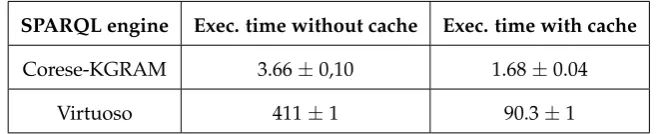
Table3 compares the execution times of query Q1 on Corese-KGRAM and Virtuoso, with or without cache, averaged over ten runs. Strikingly, it highlights the difference between the two SPARQL engine strategies: the time it takes for Virtuoso to complete the query execution is bigger than that of Corese-KGRAM by a factor 53 with cache (1mn30s vs. 1.68s) and a factor 112 without cache (6m51s vs. 3.66s). A detailed analysis of the query log revealed that Corese-KGRAM performed 4 invocations (one for each SERVICE clause as one would expect) whereas Virtuoso performed 424 invocations. In chronological order the MusicBrainz micro-service was invoked once, Macaulay Library once, Flickr 27 times and BHL 395 times. We discussed this issue with Virtuoso’s developers21 who could not bring a clear explanation so far. Nevertheless, further tests with two or three SERVICE clauses suggested that each SERVICE clause is invoked one time for each solution retrieved from previously evaluated SERVICE clauses. This ends up with a very inefficient multiplication of the invocations.
20 Virtuoso OS Edition:http://vos.openlinksw.com/owiki/wiki/VOS/
P R E F I XP R E F I XP R E F I X s : < h t t p :// s c h e m a . org / > C O N S T R U C TC O N S T R U C TC O N S T R U C T {
<# >
s : m a i n E n t i t y O f P a g e ? a r t i c l e ; # B i o d i v e r s i t y H e r i t a g e L i b r a r y s : i m a g e ? p h o t o ; # F l i c k r
s : a u d i o ? a u d i o ; # M a c a u l a y L i b r a r y s : s u b j e c t O f ? m b z P a g e . # M u s i c B r a i n z } W H E R EW H E R EW H E R E {
S E R V I C ES E R V I C ES E R V I C E < h t tp :// e x a m p l e . org / bhl / g e t A r t i c l e s B y T a x o n ? n am e = D e l p h i n u s + delphis > { ? a r t i c l e s : n a m e ? a r t i c l e T i t l e ; s : a u t h o r ? a r t i c l e A u t h o r N a m e . }
S E R V I C ES E R V I C ES E R V I C E < h t tp :// e x a m p l e . org / f l i c k r / g e t P h o t o s B y G r o u p B y T a g ? \
g r o u p _ i d = 8 0 6 9 2 7 @ N 2 0 & t a g s = t a x o n o m y : b i n o m i a l = D e l p h i n u s + delphis > { ? p h o t o s : c o n t e n t U r l ? img . }
S E R V I C ES E R V I C ES E R V I C E < h t tp :// e x a m p l e . org / m a c a u l a y l i b r a r y / g e t A u d i o B y T a x o n ? \ n a m e = D e l p h i n u s + delphis >
{ ? a u d i o s : c o n t e n t U r l ? a u d i o U r l . }
S E R V I C ES E R V I C ES E R V I C E < h t tp :// e x a m p l e . org / m u s i c b r a i n z / g e t S o n g B y N a m e ? \ n a m e = D e l p h i n u s + delphis >
{ [] s : s a m e A s ? m b z P a g e ; s : n a m e ? m b z T i t l e . } }
Listing 5. QueryQ1uses four SPARQL micro-services to retrieve data related to speciesDelphinus
delphisfrom the Biodiversity Heritage Library, Flickr, the Macaulay Library and MusicBrainz.
P R E F I XP R E F I XP R E F I X s : < h t t p :// s c h e m a . org / > C O N S T R U C TC O N S T R U C TC O N S T R U C T {
<# >
s : m a i n E n t i t y O f P a g e ? a r t i c l e ; # B i o d i v e r s i t y H e r i t a g e L i b r a r y s : i m a g e ? p h o t o ; # F l i c k r
s : a u d i o ? a u d i o ; # M a c a u l a y L i b r a r y s : s u b j e c t O f ? m b z P a g e . # M u s i c B r a i n z } W H E R EW H E R EW H E R E {
B I N D
B I N DB I N D (" D e l p h i n u s + d e l p h i s " as ? s p e c i e s )
B I N D
B I N DB I N D (IRIIRIIRI ( c o n c a tc o n c a tc o n c a t (" h t t p s :// e x a m p l e . org / bhl / g e t A r t i c l e s B y T a x o n ? \ n a m e =" , e n c o d e _ f o r _ u r ie n c o d e _ f o r _ u r ie n c o d e _ f o r _ u r i (? s p e c i e s ))) as ? bhl )
B I N D
B I N DB I N D (IRIIRIIRI ( c o n c a tc o n c a tc o n c a t (" h t t p s :// e x a m p l e . org / f l i c k r / g e t P h o t o s B y G r o u p B y T a g \ ? g r o u p _ i d = 8 0 6 9 2 7 @ N 2 0 & t a g s = t a x o n o m y : b i n o m i a l =" , \
e n c o d e _ f o r _ u r ie n c o d e _ f o r _ u r ie n c o d e _ f o r _ u r i (? s p e c i e s ))) as ? f l i c k r )
B I N D
B I N DB I N D (IRIIRIIRI ( c o n c a tc o n c a tc o n c a t (" h t t p s :// e x a m p l e . org / m a c a u l a y l i b r a r y / g e t A u d i o B y T a x o n ? \ n a m e =" , e n c o d e _ f o r _ u r ie n c o d e _ f o r _ u r ie n c o d e _ f o r _ u r i (? s p e c i e s ))) as ? m a c a u l a y )
B I N D
B I N DB I N D (IRIIRIIRI ( c o n c a tc o n c a tc o n c a t (" h t t p s :// e x a m p l e . org / m u s i c b r a i n z / g e t S o n g B y N a m e ? \ n a m e =" , e n c o d e _ f o r _ u r ie n c o d e _ f o r _ u r ie n c o d e _ f o r _ u r i (? s p e c i e s ))) as ? m z b r n z )
S E R V I C ES E R V I C ES E R V I C E ? bhl { ? a r t i c l e s : n a m e ? a r t i c l e T i t l e ; s : a u t h o r ? a u t h o r . } S E R V I C ES E R V I C ES E R V I C E ? f l i c k r { ? p h o t o s : c o n t e n t U r l ? img . }
S E R V I C ES E R V I C ES E R V I C E ? m a c a u l a y { ? a u d i o s : c o n t e n t U r l ? a u d i o U r l . }
S E R V I C ES E R V I C ES E R V I C E ? m z b r n z { [] s : s a m e A s ? m b z P a g e ; s : n a m e ? m b z T i t l e . } }
Listing 6.QueryQ2. Invocation of a SPARQL micro-service using a variable endpoint URL: variables ?bhl, ?flickr, ?macaulayand ?mzbrnzare built dynamically using the species name in variable
Table 3.Execution time (in seconds) of queryQ1on Corese-KGRAM and Virtuoso OS Edition, without
or with cache database.
SPARQL engine Exec. time without cache Exec. time with cache
Corese-KGRAM 3.66±0,10 1.68±0.04
Virtuoso 411±1 90.3±1
The evaluation ofQ1by Corese-KGRAM took an average 3.66s without using the cache database, while the four individual invocations sum up to 2.59s (2nd column of Table 2). Similarly, the evaluation took an average 1.68s when using the cache while the individual invocations sum up to 1.16s (3rd column in Table2). The overhead of 1.07s and 0.52s respectively can be attributed to the query processing by Corese-KGRAM’s SPARQL engine as well as networks overheads. The log also revealed that the SERVICE clauses are evaluated sequentially, although they could be evaluated in parallel since they are independent from each other. We discussed this question with the developers who confirmed that, as of today, Corese-KGRAM does not support parallel evaluation of independent SERVICE clauses.
7. Biodiversity-Related Use Cases
7.1. Aggregating Various Types of Data Related to Biological Taxa
Many existing data aggregators in the biodiversity domain consolidate data with respect to a certain perspective (species occurrences, life traits, taxonomy etc.) from multiple sources. Yet, orthogonal approaches lack, that would allow biologists to aggregate and visualize data spanning these different perspectives. To address this need, we have designed an application that provides biologists with a convenient way to get a quick outlook at the various types of data collected by independent biodiversity programs about a given taxon.
In a joint initiative with the French National Museum of Natural History, we have produced a dataset called TAXREF-LD [29], a Linked Data representation of TAXREF [30], the French taxonomic register for fauna, flora and fungus22. It models 236.000+ biological taxa along with the 509.000+ scientific names used to refer to the taxa. TAXREF-LD is accessible through a public SPARQL endpoint23, and the URIs of all taxa and scientific names are dereferenceable.
In the application we present here, a SPARQL CONSTRUCT query24 first retrieves from TAXREF-LD the information available about the taxon that bears a given scientific name. Then, it enriches TAXREF-LD’s taxon description with data from five SPARQL micro-services: BHL, Flickr and MusicBrainz already described in section6, and two additional services:
1. macaulaylibrary/getAudioByTaxon is very similar to macaulaylibrary/getAudioById previously described, but retrieves audio recordings for a taxon by scientific name, not by identifier. 2. eol/getTraitsByTaxonretrieves life traits related to a taxon’s scientific name from the Encyclopedia
of Life trait bank [31].
The RDF graph resulting from this query exhibits URIs identifying each BHL article, each Flickr photo and each Macaulay audio recording. These URIs are built upon the Web API’s internal identifier. They are made dereferenceable according to the mechanism we described in section5.2: while the
22 https://inpn.mnhn.fr/programme/referentiel-taxonomique-taxref?lg=en 23 TAXREF-LD public SPARQL endpoint: http://taxref.mnhn.fr/sparql
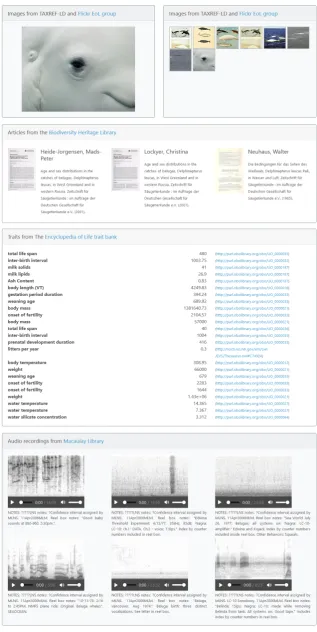
micro-services invoked in the SPARQL query retrieve information by scientific name, complementary micro-services retrieve information by Web API’s identifier. To do the wiring, the Web server is configured to rewrite a look up query on one of those URIs into the relevant micro-service invocation. In a next step, the result RDF graph is transformed into an HTML page using the SPARQL Template Transformation Language (STTL) [32]. For each resource retrieved by SPARQL micro-services (e.g. a photo, an article), a SPARQL Template query fetches data from the result graph and passes it on to an HTML template tailored for the resource type. In turn, the latter produces the piece of HTML code necessary to properly display the resource25. For instance a photo is rendered as one element of a carousel while an audio recording is rendered using an HTML5 audio player. A global template assembles the partial HTML snippets to form the final HTML page. Figure7depicts a part of the HTML page generated for speciesDelphinapterus leucas.
7.2. Assisting Biologists in Editing Taxonomic Information
Taxonomic registers are key tools to comprehend the diversity of nature and develop natural heritage conservation strategies. They are used as the backbone of biodiversity programs and aggregators such as the Global Biodiversity Information Facility26 (GBIF) and the Encyclopedia of Life27 (EoL) that aggregate over 50 data sources each. Unfortunately, there does not exist a single register of the taxonomic knowledge that would mark global consensus. Instead, multiple taxonomic registers cover complementary and often overlapping regions, epochs or domains, while possibly disagreeing on the circumscription of some taxonomic concepts. It is therefore of utmost importance for biologists to be able to confront the knowledge they have about a taxon with related data coming from the manifold data sources available in the biodiversity area.
To tackle this issue, the French Museum of Natural History has developed the TAXREF-Web application28 enabling biologists to edit biological taxa’s information available in TAXREF. The application offers forms not only to edit TAXREF’s database, but more importantly to display data collected from other programs, compare it with TAXREF’s data and provide biologists with the ability to add, remove or amend data accordingly. To do so, TAXREF-Web’s developers have to write a specific piece of code to query each Web API of interest and manually align the data elements within its results with the corresponding data elements within the results of the other Web APIs. For instance, TAXREF’s Web API codes the habitat wherein a species lives as an integer (e.g. 1 stands for marine environment, 2 for fresh water). By contrast, the World Register of Marine Species29(WoRMS) codes the same information as multiple Boolean fields (e.g. isMarine, isFreshwater). Therefore, TAXREF-Web’s code must carry out a cumbersome alignment to convert from one representation into the other. This approach is time-consuming in terms of development and maintenance, and hardly scales to many more Web APIs.
In its current status, the TAXREF-Web application queries the following programs: WoRMS, Fishbase30, Index Fungorum31, Pan-European Species directories Infrastructure32 (PESI) and World Spider Catalogue33. Depending on the programs, the Web interface may simply present a link to the program’s corresponding Web page, point out a disagreement, or point out a disagreement along
25 The code of the STTL transformations is available on Github underhttps://github.com/frmichel/sparql-micro-service/ tree/0.1.0/demo
26 http://gbif.org/ 27 http://eol.org/
28 https://taxref.mnhn.fr/taxref-web/ 29 http://www.marinespecies.org 30 http://fishbase.org
P R E F I XP R E F I XP R E F I X dwc : < h t t p :// rs . t d w g . org / dwc / t e r m s / >
P R E F I XP R E F I XP R E F I X tn : < h t t p :// rs . t d wg . org / o n t o l o g y / voc / T a x o n N a m e # >
<# > dwc : s c i e n t i f i c N a m e " A c e t a b u l a r i a c r e n u l a t a "; tn : a u t h o r s h i p " J . V . L a m o u r . , 1 8 1 6 " ;
tn : r a n k < h t t p :// rs . t d w g . org / o n t o l o g y / voc / T a x o n R a n k # Species >; dwc : t a x o n o m i c S t a t u s " a c c e p t e d ".
Listing 7: RDF graph produced by invoking the TAXREF micro-service at
http://example.org/taxref/getNameDetails?name=Acetabularia+crenulata.
with the means for a biologist to update TAXREF accordingly. The considered disagreements pertain to taxonomic information in the following situations:
• Synonymy disagreement. A taxon may be associated with a reference name (the preferred name used to refer to the taxon) and a set of synonyms. A disagreement may occur when a program states a reference name that is considered as a synonym in TAXREF, or when they disagree on the synonyms.
• Taxonomic rank disagreement: a taxon or name has different taxonomic ranks in different programs. For instance, a taxon is considered as a species in TAXREF but as a sub-species in WoRMS.
• Author disagreement: different author names or different spellings and/or abbreviations.
• Habitat disagreement.
We are currently developing a new implementation of TAXREF-Web based on SPARQL micro-services, covering the set of Web APIs considered so far in TAXREF-Web and extending it with the Web APIs of GBIF, EoL, Zoobank34, the International Plant Names Index35(IPNI), Flickr and the Macaulay library. Furthermore, we intend to extend the functional perimeter so as to address the following situations:
• Bibliographic references: retrieve bibliographic references currently unknown in TAXREF, or point out and fix inconsistent references.
• Life traits: query WoRMS, Fishbase and EoL for life traits not referenced in TAXREF, or point out and fix inconsistencies.
• Multimedia material: display material available in TAXREF, suggest adding links to photos in Flickr and audio/video recordings in the Macaulay library.
Our point is to demonstrate that, once the Web APIs are wrapped in SPARQL micro-services relying on common vocabularies, the integration task is amply simplified: data aggregation and comparison essentially consist of writing the appropriate SPARQL queries, thus significantly alleviating the development and maintenance efforts.
Example. We now illustrate the use case sketched above in the context of a synonymy disagreement, exemplified in the case of taxonAcetabularia crenulata. Let us assume that we have defined SPARQL micro-services for TAXREF and WoRMS Web APIs36, whose invocations produce the graphs depicted in Listings7 and 8 respectively. According to TAXREF, Acetabularia crenulata
is a reference (or “accepted”) name, whereas according to WoRMS, it is a synonym name and the reference name should beAcetabularia (Acicularia) crenulatainstead.
Detecting this disagreement can be achieved easily using SPARQL queryQ3in Listing9. The query searches solutions whereAcetabularia crenulatawould have status accepted in TAXREF and a
34 http://zoobank.org/ 35 http://www.ipni.org/
P R E F I XP R E F I XP R E F I X dwc : < h t t p :// rs . t d w g . org / dwc / t e r m s / >
P R E F I XP R E F I XP R E F I X tn : < h t t p :// rs . t d wg . org / o n t o l o g y / voc / T a x o n N a m e # >
<# > dwc : s c i e n t i f i c N a m e " A c e t a b u l a r i a c r e n u l a t a "; tn : a u t h o r s h i p " J . V . L a m o u r o u x , 1 8 1 6 " ;
tn : r a n k < h t t p :// rs . t d w g . org / o n t o l o g y / voc / T a x o n R a n k # S u b s p e c i e s >; dwc : t a x o n o m i c S t a t u s " u n a c c e p t e d ";
dwc : a c c e p t e d N a m e U s a g e " A c e t a b u l a r i a ( A c i c u l a r i a ) c r e n u l a t a ".
Listing 8: RDF graph produced by invoking the WoRMS micro-service at
http://example.org/worms/getNameDetails?name=Acetabularia+crenulata.
P R E F I XP R E F I XP R E F I X dwc : < h t t p :// rs . t d w g . org / dwc / t e r m s / >
S E L E C TS E L E C TS E L E C T (" A c e t a b u l a r i a c r e n u l a t a " as ? t a x r e f R e f N a m e ) ? w o r m s R e f N a m e W H E R EW H E R EW H E R E {
S E R V I C ES E R V I C ES E R V I C E < h t tp :// e x a m p l e . org / t a x r e f / g e t N a m e D e t a i l s ? n a me = A c e t a b u l a r i a + c r e n u l a t a > { [] dwc : t a x o n o m i c S t a t u s " a c c e p t e d ". }
S E R V I C ES E R V I C ES E R V I C E < h t tp :// e x a m p l e . org / w o r m s / g e t N a m e D e t a i l s ? n a m e = A c e t a b u l a r i a + c r e n u l a t a > { [] dwc : t a x o n o m i c S t a t u s ? s2 ;
dwc : a c c e p t e d N a m e U s a g e ? w o r m s R e f N a m e . F I L T E RF I L T E RF I L T E R ? s2 != " a c c e p t e d "
} }
Listing 9: QueryQ3detects the disagreement between TAXREF and WoRMS with respect to the status (reference vs. synonym) ofAcetabularia crenulata.
different status in WoRMS. IfQ3returns a non-empty solution set, then both sources disagree and the solution provides the reference name according to WoRMS. In turn, the Web application must point out this disagreement and provide the user with a way to accept or dismiss this change. Figure8 depicts an extract of TAXREF-Web’s edition page where this option is denoted by the red button “MAJ REF” (update reference name). A similar SPARQL query (not shown here) can detect a disagreement with respect to the author’s name spelling, “J.V.Lamour.” in TAXREF and “J.V.Lamouroux” in WoRMS. The red button “MAJ AUTEUR” (update author) allows to acknowledge this change in TAXREF.
Let us finally mention that example queryQ3may be invoked on the Web server side, as part of the HTML page generation process, as well as on the client side using asynchronous queries processed in JavaScript. An advantage of the latter is to alleviate the load required to generate the page on the server’s side.
8. Related Works
Figure 8.TAXREF-Web suggestions for editing taxonAcetabularia crenulata.
In the Semantic Web community, works aiming to translate heterogeneous data sources into RDF triples started very early37. In [34] for instance, a triple store contains semantic descriptions that are used to semantically annotate Web services, explaining how to invoke them and what kind of information can be obtained by invoking them.
Approaches specifically concerned with Web APIs are often ad hoc solutions. For instance, Flickcurl38is a hardwired wrapper for Flickr’s Web API services. Twarql [35] wraps Twitter’s Web API to enable filtering and analysis of streaming tweets. It encodes tweets content in RDF using common vocabularies and enables SPARQL querying. Yet, this approach is very specific to the Twitter and micropost content in general.
With a similar rationale, Hydra [27] is a vocabulary aimed to describe Web APIs in a machine-readable format. It puts a specific focus on the generation of hypermedia controls so as to enable the generation of truly RESTful interfaces. Hydra, used in conjunction with JSON-LD, forms a basis to build hypermedia-driven Linked Data interfaces [36]. This basis can be harnessed to turn existing Web APIs into RESTful Linked Data interfaces whose documentation can be interpreted at run time by a generic Hydra client. Our incentive with SPARQL micro-services is to provide client applications with the whole expressiveness of the SPARQL Query language, which would be more difficult to achieve using a Hydra-described REST interface. Closer to our work, Linked REST APIs [37] is a framework dedicated to the semantic annotation of Web APIs and the automatic specification of SPARQL query execution plans that invoke these Web APIs. A major difference with our approach is that the framework requires the deployment of a middleware that stores the Web APIs descriptions and their mapping towards domain ontologies, and computes and enacts query execution plans. The SPARQL micro-services architecture, on the other hand, relies on a totally distributed architecture wherein independent service providers may publish SPARQL micro-services usable by regular SPARQL clients. Yet, a key point for the SPARQL micro-services architecture to scale up easily will be to address the description of micro-services. In the last section, we suggest several leads in this respect.
SPARQL-Generate [38] extends SPARQL 1.1 to enable querying RDF graphs along with non-RDF documents. A SPARQL-Generate query relies on several extension functions to fetch and parse documents in different data formats, and defines the shape of RDF triples to be produced thenceforward. As such, it could be used to query a Web API in a way similar to that of a SPARQL micro-service. Two main differences can be observed though. (i) SPARQL-Generate is