33 |
P a g e
TURNING PROCESS PARAMETER OPTIMIZATION
USING SHUFFLED LEAF FROG ALGORITHM
R. Karthikeyan
1, S. Hariharan
2, M. Murali
3Department of Mechanical Engineering, P.A.C.Ramasamy Raja Polytechnic College,
K.R.Nagar (Post), Rajapalayam-626108. (India)
ABSTRACT
The iterative techniques are found to be more effective in solving hard combinatorial optimization problems that
are less feasible by the real world experimentation due to the cost, time consumption, and safety risks involved
in conducting the experiments. Among them, the bio-inspired algorithms because of their simplicity,
adaptability, flexibility and less computation time are found to be very efficient in the selection of optimal
cutting parameters for the specialized operations that are very complex in nature. In this article, it is intended to
simplify the complex relations of tool geometry and machining parameters with tool life, roughness, and the
quality of the machined products. This non-linear relation is carefully considered, analyzed and optimized using
the Shuffled Leaf Frog Algorithm (SLFA). The worst frog in each memeplex is identified by a local exploration
process and improved in every iteration by updating its position to make the algorithm more convergence. The
shuffling of frogs between all memeplexes made this algorithm to explore a global search. The biological
phenomenon of frogs can be successfully applied in the selection of optimized cutting parameters for the single
pass turning process and is found to be excelling in solution quality as well as in computation time.
Keywords
:Turning, Cutting Parameters, Shuffled Leaf Frog Algorithm, Memeplexes, And Local
Exploration.
I INTRODUCTION
In this article, an attempt is made to develop a procedure using SLFA to optimize the machining parameters in one of the turning process. A mathematical model is built for the problem with an objective of minimizing the overall machining time. Here, the cutting speed and feed rate are taken as the decision variables. The constraints which represent the functional relationship between the decision variables and other design parameters satisfying certain physical phenomenon and certain resources limitations include, the minimum and maximum permissible cutting speed, the available spindle speed, the minimum and maximum permissible feed rate and the feed ranges available with the machine, the maximum cutting force the machine can withstand and maximum power, the maximum tool life desired and the surface finish required.
34 |
P a g e
conditions depends on the availability of quantitatively reliable technological machining performance equations relating to various cutting parameters such as cutting feed, speed, machining time and surface accuracy, etc. Furthermore, a detailed knowledge of the machine tool capabilities is needed as well as an economically balanced performance measure is to be optimized together with the associated constraints. The complexity of the multi-constrained optimization for single pass turning operations has been demonstrated in a number of publications [2].
Here, it is proposed to develop an algorithm based on SLFA to achieve the minimization of the machining time by optimizing the cutting parameters. The obtained results are compared with the conventional results and other global optimal procedural results. The developed procedure was found to be producing best results that are nearer to the global optimal values. By involving the developed procedure for other machining operations, the total manufacturing time can be reduced considerably.
II EARLIER RESEARCH WORK
Generally, the selection of cutting parameters for metal cutting is left to the operator. The specialized skills and experiences acquired by the operator play a vital role in making such decisions. Unfortunately, it becomes very difficult for any skilled operator to select optimal values for all the processes. The basic parameters of metal cutting processes such as spindle speed, feed and depth of cut, etc are having direct impact on the quality of the components to be produced. When the tool life equation derived by Taylor [3] was introduced, many researchers carried out their work towards the optimization of process parameters related to metal cutting processes. Armarego and Brown [4] investigated the unconstrained machine parameter optimization using differential calculus. Brewer and Rueda [5] carried out their work related to the simplified optimum analysis of non-ferrous metals. They employed a criterion to reduce the machining cost for cast iron and steel materials. Brewer [6] suggested the use of Lagrangial multipliers for the optimization of unit cost, with cutting power as the main constraint. Bhattacharya, et al. [7], used the Lagrange method to optimize the unit cost for turning taking the surface roughness and cutting power as constraints.
Walvekar and Lambert [8] used the geometric programming to select the metal cutting variables with an objective of minimizing the production cost by optimizing the cutting speed rate. Petropoulos [9] optimized the selection of cutting parameters such as cutting speed and feed rate using geometric programming. Wang, et al. [10], presented an optimization analysis, strategy and computer aided manufacturing software for the selection of economic cutting conditions in single pass turning operations using a deterministic approach. They aimed at the maximization of production rate with some practical constraints and had proved the economic benefits of using optimization procedures in the single pass turning process.
35 |
P a g e
derivatives of objectives and constraint functions, requirement of mathematically well-defined objective and constraint functions, difficulty in handling mixed variables, involvement of more numerical steps and need for more computation time and moreover the real world is so complex [11].
Recently, a huge collection of optimization techniques have been suggested by many researchers of different fields starting from evolutionary algorithms, local search methods, trajectory based search algorithms and population based algorithms, etc. They are gaining greater significance because of their advantages in the computational time required, simplicity of formation and the adaptability to apply for any kind of simple to complex problems.
The bio-inspired algorithms especially, the swarm based optimization techniques were derived from Darwin’s Evolutionary Theory of “Survival of fittest” [12]. Evolutionary algorithms are becoming very popular now because of their performances are independent of the nature of objective functions and constraints. Among them Shuffled Leaf Frog Algorithm (SLFA) has found to have a great potential in solving complex optimization problems that are non-linear, non-differentiable and having multi-model nature. [13] [14].
In this article, an evolutionary based swarm algorithm, SLFA is proposed to solve the process planning of single pass turning. The various parameters, terminologies and methodology of the proposed algorithm are discussed and the effectiveness of the SLFA is proved by considering a real world manufacturing problem.
III PROBLEM DESCRIPTION
In a research work by Taylor, a new tool life equation for CBN tools has been proposed and given in the equation Eqn.(1). This proposed tool life equation has two extreme values and is valid for the whole cutting speed range for a given feed rate and depth of cut.
v
B
v
C
v
A
T
3
2
:
--- Eqn. (1)Where, “T” is tool life time and “v” is cutting speed. The coefficients A, B and C were calculated by fitting the
Eqn. (1) to data which is obtained under different cutting conditions.
3.1. Problem Specifications
3.1.1. Material used:
Aluminum alloy; Diameter of job: 55 mm; Length of job: 60 mm (machining length); Tool life period: 300 min; Desired accuracy: 2 microns; Maximum power: 32 kW and Maximum force: 2000N.
3.2. Constraints
32
36 |
P a g e
where, v - permissible cutting speed; f - permissible feed rate; TL - tool life time; Fc - actual cutting force; Ra -
actual surface finish; Pm - actual power and min & max stands for the minimum and maximum values
3.3. Cutting parameters
Turning is the operation to remove excess material from the workpiece to produce a cylindrical surface. Speed, feed, depth of cut and machining time are some important cutting parameters for the turning process.
3.3.1. Selection of Tool material:
Cemented Carbide tools are produced by the cold compaction of the tungsten carbide powders in a binder such as cobalt followed by the liquid phase sintering. The major advantageous properties of these tools are their very high resistance to heat and wear. The working temperature may be 1273 K. However these are very brittle, have low resistance to shock and must be rigidly supported to avoid cracking. Cemented Carbide tools are most suitable for high cutting speed.
3.3.2. Selection of workpiece material:
Aluminium alloy is used for the workpiece material. It is a light weight material and gives good surface finishes. It has high heat transfer ratio and requires more cooling. Because of its ductility, resistance to corrosion, low melting point and less specific weight, it is used for the workpiece.
3.3.3. Cutting Speed
The speed of the milling cutter is its peripheral linear speed resulting from rotation. It can be defined as the speed at which the cutting edge passes over the material. It is often referred to as surface speed and is expressed in meters per minute.
:
v
3
.
14
N
1000
--- Eqn. (2)Where,
is the diameter of the component and N is the spindle speed in rpm3.3.4. Feed rate
It is the distance the tool advances into or along the workpiece each time the tool point passes a certain position in its travel over the surface of the component under machining.
3.5.5. Tool Life
Tool life directly depends on the cutting speed and feed rate. :
T
L
2
.
4554
10
9
v
10.245
f
10.411
--- Eqn. (3) 3.5.6. Cutting force::
F
1456
.
26
D
1.06f
0.67e
c
--- Eqn. (4)Where, De is the depth of cut
3.5.7. Surface finish:
37 |
P a g e
3.5.8 Spindle Speed:
:
S
v
s
1000
d
--- Eqn. (6) 3.5.9 Power::
P
D
f
v
e
m
67 . 0 06 . 1
0242
.
0
--- Eqn. (7)IV SHUFFLED LEAF FROG ALGORITHM
The researchers carried out several studies about mimicking the biological phenomena in the field of operations research. Lot of evolutionary algorithms were framed and found to be very excellent in solving the optimization problems belonging to several domains especially in the manufacturing field. The wonderful characteristics of swarms were observed and the process of correlating them with the optimization problems is growing in a rapid manner. SFLA is a bio-inspired algorithm that mimics the metaphor of natural biological evolution of frogs’ population in searching of their food for survival [15] [16]. The SLFA is a convergence based local search algorithm that is always stochastic in nature.
4.1. SLFA Procedure
The various parameters, stages and criteria involved in this local search meta-heuristic procedure are explained in this chapter.
Step 1. Initialization of Population
This SLFA procedure starts with an initial population similar to most of the bio-inspired algorithms. Usually the initial population of frogs (F_ini_pop) is generated randomly. These randomly generated frogs represents the decision variables of the objective function.
For a K-dimensional problem i.e., problems with “k” number of variables, a frog “i” is represented as, Fi = (fi1, fi2, fi3, ……….., fik) --- Eqn. (8)
Step 2. Evaluation & Ranking of Population
The objective function of each frog in the initial population is evaluated. Then the frogs are ranked according to their fitness values and are sorted in a descending order for further process.
Step 3. Distribution of Population
Then the total population (m * n) is divided into “m” number of sub groups called as memeplexes with “n” number of frogs in each memeplex. During this process, the first frog goes to the first memeplex, the second frog goes to the second memeplex, … , frog “m” goes to mth memeplex, and the frog “m+1” goes to the first memeplex, and so on.
Step 4. Assignment of Population
38 |
P a g e
Step 5. Local ExplorationThen an evolution process is applied to improve the location of needy frog i.e. frog with worst value in each iteration. The new location of the frog with worst fitness, F_mem_worst is calculated and improved as described below.
Change in location of frog (F_mem_worst) is,
: ΔX = rand (#) * [X(F_mem_best) – X(F_mem_worst)] + rand (#) * [X(F_pop_best) – X(F_mem_worst)] --- Eqn. (9)
New location of the frog (F_mem_worst) is,
: X(F_mem_new) = X(F_mem_worst) + ΔXi; ΔXmax ≤ ΔXi ≤ ΔXmax --- Eqn. (10) where rand (#) is random number between 0 to 1 and ΔXmax is the maximum permitted change value in the frog’s location in an iteration.
Step 6. Appraisal Function
The fitness value of the frog (F_mem_new) is evaluated and compared with its original fitness value i.e. fitness value of frog (F_mem_worst). If there is an improvement then frog (F_mem_worst)’s location is replaced with location of frog (F_mem_new).
Otherwise, the location of the frog (F_pop_best) is modified as per above equations eqn. (New1) and eqn. (New2) i.e., we are replacing the frog (F_mem_worst) by frog (F_pop_best). Then the fitness value of frog (F_pop_best) is calculated as frog (F_pop_new).
Step 7. Update Function
Now the fitness value of frog (F_pop_new) is compared with fitness value of frog (F_pop_best) for any improvement. If there is an improvement, then, then frog (F_mem_worst)’s location is replaced with location of frog (F_pop_new).
Otherwise, a new virtual frog (F_virtual) is randomly generated to replace the worst frog (F_mem_worst) with another frog having any arbitrary fitness.
This evaluation process continues for a predefined number of iteration within each memeplex.
Step 8. Shuffling Operation
Here all the frogs (p) in all the memeplexes (n * m) are shuffled for global information exchange.
Step 9. Termination criteria
39 |
P a g e
4.2. SLFA Flowchart
Evaluation & Ranking of Population Sort (p) in descending order;
Initialization of Population
Population Size (p = m x n); number of memeplexes (m); Iteration within each memeplex (it_mem);
Generate population (p) randomly;
START
Distribution of Population Distribution of “p” into “m” Memeplexes;
Assignment of Population Determine F_mem_best, F_mem_worst; and F_pop_best;
Is new Frog better than
Worst?
Apply Eqn.(9) & Eqn.(10) with replacing F_mem_worst by F_mem_best;
m = m+1;
it_mem = it_mem +1;
Is new Frog better than
Worst?
Generate new Frog randomly & Replace F_mem_worst by F_mem_best;
Update function Replace F_mem_best by F_mem_worst;
Does number of iterations over?
Yes
Yes
No
No
No
Yes
No Does number of
memeplexes over?
Yes
Shuffling Operation Shuffle P (m, n);
Does Termination criteria satisfied?
No
Yes
STOP
40 |
P a g e
V
RESULTS AND DISCUSSIONS
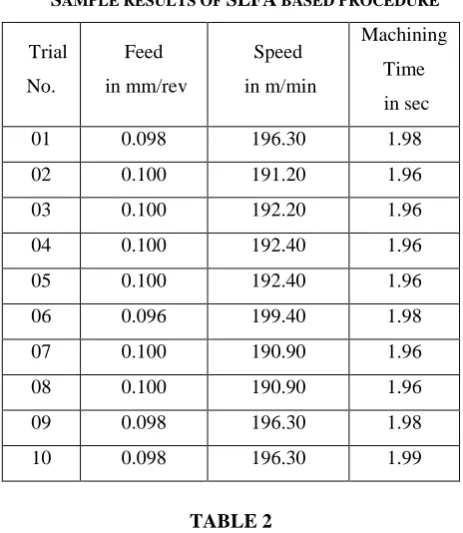
Here carbide coated cutting tool was used to remove the excess material from the aluminium workpiece. The cutting speed and feed rate of the turning process were taken as decision variables and the constraints were formed as discussed above. For the designed SLFA Method, a procedure is developed using software to conduct experiments. A list of worst solutions is used to denote frogs to be updated in the particular iteration and are allowed to evolve as elite solutions by global shuffling among the memeplexes. For the experimental problem, the optimal values obtained by SLFA are given in the Table II. The comparison between different techniques are given in the Table III. It reveals that the desired optimization procedure will produce economical results in terms of reduced manufacturing time for the single pass turning process.
TABLE 1
SAMPLE RESULTS OF SLFA BASED PROCEDURE
Trial No. Feed in mm/rev Speed in m/min Machining Time in sec
01 0.098 196.30 1.98
02 0.100 191.20 1.96
03 0.100 192.20 1.96
04 0.100 192.40 1.96
05 0.100 192.40 1.96
06 0.096 199.40 1.98
07 0.100 190.90 1.96
08 0.100 190.90 1.96
09 0.098 196.30 1.98
10 0.098 196.30 1.99
TABLE 2
COMPARISON BETWEEN DIFFERENT TECHNIQUES
S l. No . Me th o d o lo g y Feed in m m /r ev Sp ee d in m /m in Ma ch in in g T im e in s ec
01 Conventional
Techniques 0.100 180.00 2.20
02 Particle
41 |
P a g e
Optimization Procedure
03
Bee Colony Optimization algorithm
0.096 199.40 1.98
04
Shuffled Leaf Frog
Algorithm
0.096 196.40 1.96
VI CONCLUSION
In this paper a new methodology developed using SLFA is employed for the optimization of cutting parameters such as speed, feed and machining time for turning process. The machining time results obtained by this mechanism are compared with conventional methodologies and were found to be superior. Although the main focus of this research is to devise a mechanism to produce optimum parameters for turning process, it has been found that there is also ample scope for further research relating to choice of other parameters of SLFA algorithm. This theoretical research work leads to a conclusion that the developed procedure can suitably be modified to any kind of machining process and by applying this developed algorithm the total machining time can be reduced to a significant level.
REFERENCES
[1] V.Kizhanatham and B.K.Lambert, Cost optimization for a single pass turning operation including inventory and penalty costs, International Journal of Production Research, 1366-588X, Volume 12, Issue 3, pp.331 - 344, 1974.
[2] H.Singh and P.Kumar, "Tool Wear Optimization in Turning Operation by Taguchi Method," Indian Journal of Engineering & Materials Sciences, Vol.11, pp. 19-24, 2004.
[3] F.W.Taylor, On the art of cutting metals, Trans. ASME, 28, pp.31–35, 1907.
[4] E.J.A.Armarego and R.H.Brown, The machining of metals, Englewood Cliffs, NJ: Prentice Hall, 1969. [5] R.C.Brewer and R.Rueda, Engineers’ Digest, Vol. 24, No. 9, pp.133-150, 1963.
[6] R.C.Brewer, Parameter Selection Problem in Machining, Ann. CIRP, 14: 11, 1966.
[7] A.Bhattacharya, R.Faria-Gonzalez and H.Inyong, Regression analysis for predicting surface finish and its application in the determination of optimum machining conditions, Trans. ASME. 92: 711, 1970.
[8] A.G.Walvekar B.K.Lambert, An application of geometric programming to machining variable selection. International Journal on Production Research, 8: 3, 1970.
42 |
P a g e
[10]J.Wang, T.Kuriyagawa, X.P.Wei and D.Guo, “Optimization of Cutting Conditions for Single Pass Turning
Operations Using a Deterministic Approach”, International Journal of Machine Tools and
Manufacture, Vol:42, Issue:9, pp.1023-1033, 2002.
[11]Kalyanmoy Deb, “Optimization for engineering design: algorithms and examples”, Prentice-hall of India Pvt. Ltd., New Delhi, 1998
[12]Elbeltagi E., Hegazy T., and Grierson D., “Comparison among Five Evolutionary-based Optimization Algorithms”, Advanced Engineering. Inf., 19(1), 43-53, 2005
[13]Jianguo Jiang, Qian Su, Ming Li, Mengnan Liu, and Liyuan Zhang, “An Improved Shuffled Frog Leaping
Algorithm”, Journal of Information & Computational Science, 10:14, 4619-4626, 2013
[14]Mehdi Tavakolan, Baabak Ashuri, and Nicola Chiara, “Applying The Shuffled Frog-Leaping Algorithm To
Improve Scheduling Of Construction Projects With Activity Splitting Allowed”, Management and Innovation for a Sustainable Built Environment, June 2011.
[15]Eusuff M.M., and Lansey K.E., “Optimizing of Water Distribution Network Design Using the Shuffled Frog
Leaping Algorithm”, Journal of Water Resource Plan Management, 129(3), 201-225, 2003.