AN ENERGY SAVING CLUSTERING ROUTING
PROTOCOL BASED ON LEACH WITH ITS
VARIANTS IN WIRELESS SENSOR
NETWORKING
Archana Verma
1, Samreen Eram
21
Mtech Scholar,
2Assistant Professor, Department of ECE,
GRD Institute of Management & Technology, Dehradun(India)
ABSTRACT
The growth of Wireless device Network is efficiently increasing because it could be a network of device nodes while not having associatey central controller and there's an vast field for analysis during this space. Sensors entirely rely upon the battery for power, that can't be revived. therefore the style of energy aware protocol is important in relation to enhance the network period. LEACH is associate energy-efficient hierarchical primarily based protocol that balances the energy expense, saves the node energy and therefore prolongs the period of the network. during this survey paper we are going to be that specialize in wireless device network that has some challenges and a few limitations. The paper also will discuss concerning LEACH protocol that is predicated on hierarchic routing protocol utilized in wireless device network. Comparison of varied network parameters is worn out the shape of tables and graphs and within the last conclusions is drawn.
Keywords: LEACH, Cluster Head , WSN, Hierarchal, Energy efficiency.
I. INTRODUCTION
A WSN typically consists of a large number of sensor nodes deployed in an area of interest [1]. Sensor nodes
are used to monitor physical or environmental conditions, such as temperature, sound, pressure, etc. These
nodes are low-power, low-cost devices small in size basically equipped with a sensing device to collect data
from the environment, a processing unit to do some operations on data, a transceiver to send and receive
collected, and an energy source to provide the required energy to operate (usually a battery). These sensor nodes
sense the information and transmit it to the base station where the analysis of received data and computation is
performed. The energy supply for a sensor node is important as the batteries have small capacity and recharging
by energy scavenging is complicated and volatile. Hence, the energy consumption of a sensor node must be
carefully done. In most applications sensor nodes are randomly deployed in the field. Therefore, battery
replacement or charging is not practical. The resource constrained nature of sensor nodes poses the unique
challenges to the design of WSNs for their applications. The limited power of sensor nodes mandates the design
to prolong the network lifetime .For this purpose clustering routing protocol is the most common technique used
for energy aware routing in WSNs.The routing protocols on this scheme impose a structure on the network to
achieve energy efficiency, stability, and scalability. In this class of protocols, network nodes are organized in
clusters in which a node with certain properties takes the role of a cluster head. Clustering has the potential to
reduce energy consumption and extend the lifetime of the network. It has high delivery ratio and scalability and
can balance the energy consumption. Low Energy Adaptive Clustering Hierarchy (LEACH) is known to be a
mac protocol to reduce the energy utilization required to generate and preserve clusters which further improve
the life of a wireless sensor network [1, 2]. LEACH is taken to find the improvement scope due to its
hierarchical structure and well developed algorithm for wireless sensor network. In this, cluster head gets the
data from its member nodes of the cluster and aggregate the data before sending to the base station.
This paper reviews the following subjects. In Section 2, we mentioned about classification of routing protocols
in WSNs. In Section 3, we discuss a brief about hierarchical routing protocol along with cluster based
hierarchical model along with some difficulties arise in hierarchical cluster based routing. In Section 4, we
discuss about LEACH protocol along with its advantages and disadvantages. In Section 5, we discuss some
improvement of LEACH protocols in an energy efficient way. In section 6, we discuss the comparative study of
different improved version LEACH with LEACH routing protocol based on different criteria. In Section 7, we
finally conclude the paper.
II. WSN DESIGN CHALLENGES & ISSUES: ROUTING ISSUES
The ways how to effectively route the collected data among nodes is very challenging in WSNs because of
several discriminated characteristics of WSN that distinguish them from wireless ad hoc networks. In WSNs,
there are applications that need the real- time requirements of the message delivery and maximization of
network lifetime. Different architectures and constraint have been considered for sensor networks, depending on
the application. The process to forward the data packets between each pair of source- sink nodes is an important
issue in WSNs. So the challenges of routing in these networks because of low power wireless sensor networks
are:
A. Limited Energy Capacity
Energy poses a big challenge for the network designers in hostile environments. Since sensor nodes are battery
powered, they have limited energy capacity. So when the energy of a sensor reaches a certain threshold, they
become faulty and are not able to function properly which affects the overall network performance to great
extent. Consequently, the routing protocols designed for sensors should be as energy efficient as possible to
extend their lifetime and hence prolong the network lifetime.
B. Network Characteristics and Unreliable Environment
Routing protocol must be capable of sustain the network topology dynamics, increase network size, energy
consumption level, sensor nodes mobility and their related issues like coverage and connectivity to retain
specific application requirements. The WSN is consistently prone to frequent topology changes because of
extremely vulnerable to node failure, sensors addition, deletion, node damage, link failure, sensor energy
multihop sensor network, communicating nodes are linked by a wireless medium. To enable global operation of
these networks, the chosen transmission medium must be available worldwide.
C. Node capabilities
In a sensor network, different functionalities can be associate with the sensor nodes. Depending on the
application a node can be dedicated to particular special function such as relaying, sensing and aggregation since
engaging the three functionalities at the same time on a node might quickly drain the energy of that node.
D. Scalability
Scalability is very important in WSN as the number of sensor nodes may vary in the order of hundreds,
thousands or more. So the routing protocols should be designed to work consistently, keeping in consideration
that sensors may not necessarily have the same capabilities in terms of energy, processing, sensing, and
particularly communication
E. Fault Tolerant Communication
Some sensor nodes may fail or be blocked due to lack of power, have physical damage or environmental
interference. Due to faulty and unreliable nodes some nodes cannot communicate other nodes. Thus failure of
sensor nodes should not affect the overall task of the sensor network.
F. Power Consumption
Power may be either stored (e.g., in batteries) or scavenged from the environment by solar cells. Transmission
power is directly proportional to distance squared or even higher order in presence of obstacles. Nodes lifetime
is strongly dependent on its battery lifetime.
G. Data Aggregation
Similar packets from multiple nodes can be aggregated to reduce the extra overhead due to number of the
transmissions. Data aggregation is done to remove redundancy and to minimize the number of transmissions.
H. Node Deployment
Topological deployment of the sensors in WSNs is application dependent and finally affects the performance of
the routing protocol. The deployment is either deterministic or self-organizing. In that infrastructure, the
position of the sink or the cluster-head is also crucial in terms of energy efficiency and performance.
I. Sensor Location
Managing the locations of the sensors is another challenge that features the design of the routing protocols. Most
of the proposed protocols assume that the sensors either are equipped with GPS receivers or use some
localization technique to learn about their locations.
III. ROUTING PROTOCOLS CLASSIFICATION
Routing protocols in WSNs might differ depending on the application (Protocol-Operation-based) and network
architecture (Network-Structure-based) [2],[3]. Figure2 shows the classification of routing protocols in WSNs
Fig.1. Routing protocols classification for WSNs
Among the various routing protocols as can be seen in figure 1, One of the most proficient routing protocols in
WSN is hierarchical cluster-based routing protocols as it has greater energy efficiency, scalability of network
and retransmission of data scalability, lifetime, reduces the size of the routing table by localizing the route setup
within the clusters [3],[,5]. In this type of routing, sensor nodes are organized into clusters, where the nodes with
higher energy as served as cluster head(CH) used to collect data from cluster members(CM) having lower
energy. The sensed data is sent to cluster heads by cluster members where data aggregation and data fusion is
done to decrease the number of transmitted messages to the sink. This process of creating the clusters and
cluster head rotation increases the network lifetime cycle, network scalability, and network reliability. The main
goal of cluster-based routing protocol is to efficiently maintain the energy consumption of sensor nodes by
involving them in multi-hop communication within a cluster.
Fig.2. Clustering Model Hierarchical routing
IV. ENERGY EFFICIENT NETWORK: LEACH
Low-Energy Adaptive Clustering Hierarchy (LEACH) is the first and most popular energy efficient hierarchical
clustering algorithm for WSNs proposed for reducing power consumption and also to increase the lifetime of the
network [6]. LEACH includes distributed cluster formation. LEACH randomly selects a few sensor nodes as
cluster-heads and rotates this role to evenly distribute the energy load among the sensors in the network. In
LEACH, the cluster-heads compress data arriving from nodes that belong to the respective cluster and send an
aggregated packet to the BS in order to reduce the amount of information that must be transmitted to the BS.
Being a cluster-head node consumes more energy than a non-cluster head node which leads the cluster head
nodes to die earlier than other nodes. LEACH forms clusters by using a distributed algorithm where nodes make
autonomous decisions without any centralized control
Set-up Phase:
In the set-up phase, the cluster head nodes are randomly selected from all the sensor nodes and several clusters
are constructed dynamically. Each node decides independent of other nodes if it will become a CH or not. This
decision is made by looking into account when the node served as a CH for the last time (means the node that
hasn't been a CH for long time is more likely to elect itself than nodes that have been a CH recently). This is
done according to a threshold value, T (n).
T(n)= p/1-p × (r mod p-1 ), Where p is the cluster head probability
Based on all messages received within the cluster, the CH creates a TDMA schedule, pick a CSMA code
randomly, and broadcast the TDMA table to cluster members every node wanting to be the cluster-head chooses
a value, between 0 and 1. If this random number is less than the threshold value, T(n), then the node becomes
the cluster- head for the current round. Then each elected CH broadcasts an advertisement message to the rest of
the nodes in the network to invite them to join their clusters. Based upon the strength of the advertisement signal,
the non-cluster head nodes decide to join the clusters.
Steady Phase:
The steady-state operation is broken into frames where nodes send their data to the cluster-head at most once per
frame during their allocated transmission slot. This stage is for data transmission where normal nodes sense data
and send this sensed data to their respective cluster-head nodes. The processing of received data (data
aggregation and data fusion) is done by cluster head nodes and processed data will be sent to the base station.
The set-up phase does not guarantee that nodes are evenly distributed among the cluster head nodes. Therefore,
the number of nodes per cluster is highly variable in LEACH, and the amount of data each node can send to the
cluster-head varies depending on the number of nodes in the cluster. To reduce energy dissipation, each
non-cluster-head node uses power control to set the amount of transmits power based on the received strength of the
cluster-head advertisement. The radio of each non-cluster-head node is turned off until its allocated transmission
time. Since all the nodes have data to send to the cluster-head and the total bandwidth is fixed, using a TDMA
schedule is efficient use of bandwidth and represents a low latency approach, in addition to being
energy-efficient [9],[19]. Once the cluster-head receives all the data, the CH aggregate these data and send it to the BS.
.
Disadvantages of LEACH protocol
The different disadvantages that the LEACH protocols having are as follows [19],[ 12]
A. In classical LEACH protocol, the cluster head node consumed more energy as compared to normal nodes in
sending aggregated data to the base station (located far away). Therefore, the cluster head node dies early
and the whole cluster will become useless, results data loss.
B. Leach does not work well with the applications require large area coverage along with multi-hop
inter-cluster communication .It relies on inter-cluster heads rather than inter-cluster members which incurs issues like
failure of the cluster heads. In LEACH CHs are not uniformly distributed within the cluster. It incurs
overhead due to calculations which leads to the energy inefficiency for dynamic clustering in large scale
networks. There is no inter-cluster communication in the network because CHs directly communicate with
sink. This process requires high range of transmission power in the network. For this only,LEACH is not
V. COMPARISION OF EXPLORED ADVANCED LEACH PROTOCOL WITH BASIC
LEACH
Many researchers worked to describe the improved version on LEACH to perform better and remove the
drawbacks in Leach. Some of them summarized in this paper [14] are:
A. LEACH-B (Balanced Low Energy Adaptive Clustering Hierarchy)
LEACH-B uses de-centralized approach of cluster formation in which each sensor node knows about its own
position and position of final destination irrespective of position of rest of the nodes in the network. It works in
three stages: Cluster head selection, Cluster formation and data transmission with multiple accesses. The energy
dissipated in the path between destination node and originating node is calculated and based on this only each of
the sensor nodes would choose its own cluster heads. LEACH-B has better energy efficiency than basic LEACH
protocol [4],[16],[17].
B. LEACH-C (Centralized Low Energy Adaptive Clustering Hierarchy)
Centralized LEACH has same steady-state as basic LEACH but the set-up phase varies. The cluster head nodes
are chosen by base station. In steady state phase, each node sends information about its current position and
energy level to BS. In the set-up phase, each node would send its current location and energy level information
to the sink node. Based on this information the BS will determine the different clusters along with CH node and
non-CH nodes of each and every cluster. The BS would able to produce better clusters by utilizing its global
information of the whole network and by this process less energy is being consumed for data transmission. The
assumption usually is that each node has a GPS receiver. The BS have to insure the evenly distribution of
energy among nodes. So it determines a threshold for energy level. Advantage of this protocol over basic
LEACH is the deterministic approach of choosing number of cluster head nodes in each round which is
predetermined at the time of deployment. But LEACH-C requires current location information of all nodes
using GPS which is not robust [17],[18], [19].
C. LEACH-S (Solar aware Centralized and Distributed Low Energy Adaptive Clustering Hierarchy)
In Centralized LEACH-S, the base station selects the CHs with the help of improved central control algorithm
and selects solar powered nodes having maximum residual energy the solar status along with the energy of the
sensor nodes is transmitted to the base station and the nodes with having the higher energy are selected as the
CHs. When the number of solar-aware nodes is getting increased, the performance of sensor network is also get
increased and by this the lifetime of the network also get increased.
In Distributed LEACH-S, the solar driven nodes are given more preference than the battery driven nodes for
choosing CHs. The cluster head handover takes place if the sun duration is smaller [20].
D. V-LEACH (Vice Cluster Level Low Energy Adaptive Clustering Hierarchy)
V-Leach was proposed to overcome the problem in basic Leach that when a CH dies the cluster would become
useless, because the information collected by the cluster members will not able to transmit to the sink. In
V-LEACH protocol, along with CH, there is a vice-CH that comes to act as a CH when the CH dies and thus the
protocol reduces overhead of selecting new cluster head each time when a cluster head dies and the data will
Fig3.Vice Cluster Level Leach
E. TL-LEACH (Two level Low Energy Adaptive Clustering Hierarchy)
In LEACH protocol cluster heads send data to sink directly in a single hop, and because of this CH dies early
due to loss of energy for transmission to sink. TL-LEACH protocol was proposed to overcome this as works in
two-level hierarchy. The aggregated data from each cluster head is collected by a cluster head lies between
cluster heads and the base station, instead of sending directly to the base station and it improves energy
efficiency by using a cluster head node as relay node in between cluster head nodes. [18]
Fig4.Two Level Leach
F. I-LEACH (Improved Low Energy Adaptive Clustering Hierarchy)
I-Leach was designed to serve the Detection of Twin nodes and assignment of Sub-Cluster Head (SCH) nodes.
In I-Leach two nodes located very close to each other called Twin nodes would sense the same information.
Thus it is necessary to keep one node sleep until the energy of another node depletes. I-LEACH has uniform
distribution of cluster head so that it doesn’t run out of energy for longer distance. It uses threshold approach to
manage the number of cluster members for each cluster head in the network at a time [20].
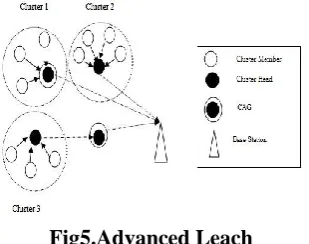
G. LEACH-A (Advanced Low Energy Adaptive Clustering Hierarchy)
Leach-A is a heterogeneous energy protocol to decrease the node’s failure probability and increase the time
interval before the first node dies called as stability period. Each sensor knows the starting of each round using
synchronized clock. The maximum energy nodes are selected as cluster head for each cluster and these nodes
are called as CAG node and they will continue to send data even after failure of all normal nodes. It uses
Fig5.Advanced Leach
H. LEACH-M (Mobile Low Energy Adaptive Clustering Hierarchy)
Mobility is an important issue in any protocol and LEACH-M was proposed to meet this. This protocol provides
mobility to the both non-cluster head nodes and cluster head nodes in the set-up and the steady-state. Nodes are
homogeneous and location of each node is calculated by GPS. The nodes with minimum mobility and the lowest
attenuation are chosen as cluster head and broadcast their status to all nodes within its transmission range [20].
Table I Performance Comparision Between Leach Protocol Variants
Clusterin g Routing Protocol Classificati on Mobilit y Scalibi lity Self Orga nisati on Rand omize d Rotati on Distri buted Hop Count Energ y Effici ency Homo genou s Use of Locati on Infor matio n Data Aggr egati on
LEACH Hierachical Fixed BS
Limite d
Yes Yes Yes Single
Hop
High Yes No Yes
A- LEACH
Hierachical Fixed BS
Good Yes Yes Yes Single
Hop
Very High
Yes Yes Yes
LEACH- A
Hierachical Fixed BS
Good Yes Yes Yes Single
Hop
Very High
No No Yes
LEACH- B
Hierachical Fixed BS
Good Yes Yes Yes Single
Hop
Very High
Yes Yes Yes
LEACH- C
Hierachical Fixed BS
Very Good
Yes Yes No Single
Hop
Very High
Yes Yes Yes
C- LEACH
Hierachical Fixed BS
Very Good
Yes Yes Yes Single
Hop
Very High
Yes Yes Yes
I- LEACH
Hierachical Fixed BS
Good Yes Yes Yes Multi
Hop
Very High
Yes Yes Yes
LEACH- M
Hierachical Fixed BS
Mobile BS and Nodes
Yes Yes Yes Single
Hop
Very High
Yes Yes Yes
M-LEACH
Hierachical Fixed BS
Very Good
Yes Yes Yes Multi
Hop
Very High
LEACH- S
Hierachical Fixed BS
Very Good
Yes Yes Yes Single
Hop
Very High
Yes No Yes
TL- LEACH
Hierachical Fixed BS
Very Good
Yes Yes Yes Single
Hop
Very High
Yes Yes Yes
V- LEACH
Hierachical Fixed BS
Very Good
Yes Yes Yes Single
Hop
Very High
Yes Yes Yes
VI. CONCLUSION & FUTURE WORK
The resource constrained nature of sensor nodes poses the unique challenges to the design of WSNs for their
applications. Routing protocols must be energy-efficient to prolong the network lifetime. For this purpose,
clustering routing protocol is the most common technique used for energy aware routing in WSN. LEACH has
found one of the most energy efficient protocols used in WSN. In this survey, LEACH protocol has been
discussed with its drawbacks and how these drawbacks are overcome by its descendants. A brief study of
various improved versions of LEACH protocol has been done in order to compare performance of these
descendants with the classical LEACH. Each of the routing protocol has its own advantages compared to the
fundamental leach routing protocol. This paper also compares the features and performance of each hierarchical
clustering routing protocol It is concluded from given survey that there is need to explore more robust, reliable
and efficient protocols in future. The process of data aggregation and fusion among clusters is also one of an
interesting problem to explore. It is needed to satisfy the constraints introduced by factors such as fault tolerance,
topology change, cost, environment, scalability, and power consumption for realization of sensor networks.
Since these constraints are highly specific and stringent for sensor networks, new wireless ad-hoc networking
techniques will have to be explored further.
REFERENCES
[1] Akylidiz LF, Su W, Sankarasubraniam Y, Cayirci E, “A survey on sensor networks”, IEEE Communication
Magazine, 40(8): 102~114. Vol.25, No.4, 2002, 114-124.
[2] Shio Kumar Singh, M P Singh and D K Singh, “A Survey of Energy-Efficient Hierarchical Cluster-Based
Routing in Wireless Sensor Networks”, in Int. J. of Advanced Networking and Applications, Vol. 02,
Issue 02, 2010, pp. 570-580.
[3] Neetika & Simarpreet Kaur, “Review on Hierarchical Routing in Wireless Sensor Networks”, in
International Journal of Smart Sensors and Ad- Hoc Networks (IJSSAN), Vol. 2, Issue 3, 4, 2012, pp.
85-90.
[4] Sandeep Verma, Richa Mehta, Divya Sharma and Kanika Sharma,“Wireless Sensor Network and
Hierarchical Routing Protocols: A Review”, International Journal of Computer Trends and Technology
(IJCTT), Vol. 4, Issue 8, August, 2013, pp. 2411-2416.
[5] A.Braman and Umapathi G.R, “A Comparative Study on Advances in LEACH Routing Protocol for
Wireless Sensor Networks: A survey,” International Journal of Advanced Research in Computer and
[6] Sabarish B A, Guru Moorthy S M, Dhivya M A, Sakthi Naveen K, Vaishnavi S “A survey on clustering
protocols in Wireless Sensor Networks” International Journal of Advances in Computing and Information
Technology, published on April 2012.
[7] W. B. Heinzelman, A. Chandrakasan and H. Balakrishnan, “Energy-Efficient Communication Protocol
for Wireless Micro Sensor Networks,” Proc. 33rd Hawaii Int’l. Conf. Sys. Sci., Jan. 2000.
[8] M. Bani Yassein, A. Al-zou'bi, Y. Khamayseh, W. Mardini “Improvement on LEACH Protocol of
Wireless Sensor Network (VLEACH)”, International Journal of Digital Content Technology and its
Applications Volume 3, Number 2, June 2009.
[9] M. J. Handy, M. Haase, D. Timmermann,”Low Energy Adaptive Clustering Hierarchy with Deterministic
Cluster-Head Selection", IEEE MWCN, 2002.
[10] Parminder Kaur1, Mrs. Mamta Katiyar, “The Energy-Efficient Hierarchical Routing Protocols for WSN:
A Review” International Journal of Advanced Research in Computer Science and Software Engineering,
Vol. 2, Issue 11, November 2012, pp. 194-199.
[11] J.Gnanambigai, Dr.N.Rengarajan, K.Anbukkarasi, “Leach and Its Descendant Protocols: A Survey”,
International Journal of Communication and Computer Technologies, Vol. 01, No.3, Issue 02, September
2012, pp. 15-21.
[12] Jia Xu,Ning Jin, Xizhong Lou,Ting Peng,Qian Zhou,Yanmin Chen“Improvement of LEACH protocol for
WSN”, 2012, IEEE.
[13] Amit Bhattacharjee, Balagopal Bhallamudi and Zahid Maqbool, “Energy-Efficient Hierarchical Cluster
Based Routing Algorithm in Wsn: A Survey”, International Journal of Engineering Research &
Technology (IJERT), Vol. 2 Issue 5, May, 2013, pp. 302-311.
[14] Ali Norouzi1, Abdul Halim Zaim, “An Integrative Comparison of Energy Efficient Routing Protocols in
Wireless Sensor Network”, in Scientific Research of Wireless Sensor Network, Vol. 4, 2012, pp. 65-67.
[15] Wendi B. Heinzelman, Member, IEEE, Anantha P. Chandrakasan, Senior Member, IEEE, and Hari
Balakrishnan, Member, IEEE, “An Application-Specific Protocol Architecture for Wireless Microsensor
Networks” IEEE TRANSACTIONS ON WIRELESS COMMUNICATIONS, VOL. 1, NO. 4,
OCTOBER 2002
[16] ThiemoVoigt,Hartmutt Ritter,Jochen Schiller, Adam Dunkels, and Juan Alonso,”Solar-aware Clustering
in Wireless Sensor Networks”,In Proceedings of the Ninth IEEE Symposium on Computers and
Communications,June 2004.
[17] M.Ahmad Jan and M.Khan, “A Survey of Cluster-based Hierarchical Routing Protocols,” International
Journal of Computer Networks and Wireless Communications (IJCNWC),vol.3, no.2, pp. 138-143, April
2013.
[18] P.Manimala and R.Senthamil selvi, “A Survey on Leach-Energy Based Routing Protocol,” International
Journal of Emerging Technology and Advanced Engineering (IJETAE), vol.3, issue 12, pp. 657-660,
December 2013
[19] A. Depedri, A. Zanella and R. Verdone, “An Energy Efficient Protocol for Wireless Sensor Networks” in
Proc. AINS, 2003, pp. 1-6.
[20] M.Usha and Dr.N.Sankarram, “A Survey on Energy Efficient Hierarchical (Leach) Clustering Algorithms
Communication Engineering (IJIRCCE), Proceedings of International Conference On Global Innovations
In Computing Technology (ICGICT’14), vol.2, special issue 1, pp. 601-609, March 2014.
[21] RENGUGADEVI G & SUMITHRA M.G, “Hierarchical Routing Protocols for Wireless Sensor
Network–A survey” International Journal of Smart Sensors and Ad Hoc Networks (IJSSAN), Vol. 2,