IMPLEMENTATION OF OPEN-ENDED LABORATORY (OEL) IN
ENVIRONMENTAL
ENGINEERING
SUBJECT
FOR
CIVIL
ENGINEERING DIPLOMA PROGRAM
A. B. Azinoor
Azida1+M. H. Nora Farina
2M. Z. Zuhaida
3B. Fauzi
4H. B. Muhamad
Hasbullah51,2Faculty of Civil Engineering, Universiti Teknologi MARA, Johor Branch,
Pasir Gudang Campus, Bandar Seri Alam, Johor, Malaysia
3,5Faculty of Civil Engineering, Universiti Teknologi MARA Pulau Pinang,
Kampus Bukit Mertajam, Permatang Pauh, Pulau Pinang, Malaysia
4Faculty of Civil Engineering, Universiti Teknologi MARA, Shah Alam,
Selangor, Malaysia
(+ Corresponding author)
ABSTRACT
Article History
Received: 1 March 2018 Revised: 23 March 2018 Accepted: 26 March 2018 Published: 28 March 2018
Keyword
s
Civil engineering program Environment
Engineering laboratory Open-ended laboratory Practical test Psychomotor.
An open-ended laboratory is where students are given the freedom to develop their own experiments, instead of merely following the already set guidelines from a lab manual or elsewhere. It will create the students to think critically and also out of the box. The students here have to devise their own strategies and back them with explanations, theory and logical justification. One of the subjects that implement OEL in Civil Engineering Diploma Program is Environmental Engineering subject. The students have to work in groups to come out with the laboratory reports and they also have to undergo 2 practical tests which have to be done individually. The laboratory reports were used to measure their teamwork and practical skills while the practical tests measure the psychomotor ability. Overall marks for OEL reports for this subject shows that all groups achieved 78% marks and above. As for practical tests marks indicate that practical test 1 is higher than practical test 2. It is proved that by implementing OEL, increased the independent learning amongst students by giving them a platform to be innovative and creative in designing and executing their own experiments.
Contribution/ Originality:
This study is one of very few studies which have investigated the practicality of implementing the open-ended laboratory activities at different levels of Environmental Laboratory course for a three-year engineering diploma program and how it was implemented at the Faculty of Civil Engineering.1. INTRODUCTION
Various methods of innovative teaching may be implemented in the teaching and learning activities to simulate an environment where students are encouraged to be proactive. These innovative methods may be in the form of Project Based Learning (PBL), Project Oriented Problem Based Learning (POPBL), Active Learning (AL), Cooperative Learning (CL), Independent Learning (IL) and others. Previous methods of teaching laboratory courses are basically in the form of fully guided assignment. The methods are described as prescriptive or traditional methods. However these methods are now no longer adequate within the context of outcome based
International Journal of Asian Social Science
ISSN(e): 2224-4441 ISSN(p): 2226-5139
DOI: 10.18488/journal.1.2018.84.173.178 Vol. 8, No. 4, 173-178
learning environments (Rahman et al., 2011). It could not provide the platform where students are given opportunities to explore their own simulation and design their own experimental works. Engineering Accreditation Manual (EAC Manual) (2012) stipulated that:
“Students should receive sufficient laboratory work to complement engineering theory that is learnt through lectures. The laboratory should help students develop competence in executing experimental work. Throughout the program there should be adequate provision for laboratory or similar investigative work, which will develop the young engineer the confidence to deal with new and unusual engineering problem”(EAC, 2012).
Thus, the needs for an open-ended laboratory is emphasized in enhancing independent learning cultures and inculcate creativity and innovativeness of students. In a fully open–ended laboratory activity students will exposed to a practical problem and they are required (as a group) to determine the objectives and scope, identifying apparatus needed and preparing the methodology, running the experiment and finally submitting the technical report. Through this process students must understand the principles of technical reasoning and the experimental design (Petropol-Serb et al., 2011).
This paper looks at the practicality of implementing the open-ended laboratory activities at different levels of Environmental Laboratory course for a three-year engineering diploma program and how it was implemented at the Faculty of Civil Engineering, Universiti Teknologi MARA, Pasir Gudang.
2. METHODOLOGY
2.1. Students
All third year Civil Engineering diploma program will undergo this Environmental Laboratory course. 46 students who undergo these subjects were chosen and they were divided in a group of 4-5 students. They were divided in small group to allow them to communicate, work in team and discuss within peers for the whole process of laboratory investigation until completion of technical report submission. The lab sessions were spread over fourteen consecutive weeks, 2 hours each. For the first week of lab session, students were briefed on matters pertaining to safety and regulations, and on what they needed to do during the OEL session. Hence, students could make early preparations before attending the lab session. Two practical tests will be given to the students in week 7 or 8 and week 13 or 14 of the lab session. The practical tests can be any of the laboratory experiments that have been conducted by the students. The practical test is mainly to assess the student’s psychomotor ability.
2.2. Level of Openness
Amongst the many papers (Kilinc, 2005; Rahman et al., 2011) which the author managed to review stated that fully open ended laboratory activities should be introduced in the third year of the four year degree program. However, syllabi of most engineering program contain laboratory courses spanning throughout the four-year program. Thus, it is impractical to introduce the open-ended laboratory activities for all laboratory courses from Year 1 to Year 4. Hence it is imperative that the conduct of laboratory activities should be carried out at different levels of openness throughout the period of study of the engineering program.
Table-1. Level of Openness according to Schwab-Herron
Schwab/Herron Levels of Laboratory Openness
Level Problem Ways & Means Answers
0 Given Given Given
1 Given Given Open
2 Given Open Open
3 Open Open Open
Source:McComas (1997)
Petropol-Serb et al. (2011) categorized the elements to be addressed in the open ended laboratory activities as the experimental set-up, the experimental design and data analysis and report. (Asanovic and Beamer, 2009; Asanovic and Celio, 2011) referred to the elements as a directed portion and an open ended portion.
To simplify the matter, it is suggested that there should be four (4) levels of openness, namely Levels 0-3, and three categories of element to be incorporated into the laboratory manual, namely problem, ways and means and answers. The scientific enquiry rubric, as given by Fay et al. (2007) for the levels of openness are summarized and described as in Table 2 below by the University of New South Wales, Australia (UNSW, 2017).
Table-2. Scientific Enquiry Rubric
Establishing the level of independence and autonomy expected of students to carry out an assessment task
Level of
Enquiry Description
0 The problem, procedure and methods for achieving solutions are provided to the student. The student performs the experiment and verifies the results with the manual 1 The problem and procedure are provided to the student. The student interprets the data in order to propose viable solutions 2 The problem is provided to the student. The student develops a procedure for investigating the problem, decides what data to gather, and interprets the data in order to propose viable solutions 3 A “raw” phenomenon is provided to the student. The student chooses the problem to explore, develops a procedure for investigating the problem, decides what data to gather, and interprets the
data in order to propose viable solutions Source: Fay et al. (2007)
2.3. Course Outcome and Program Outcome
Couse Outcome described what students are expected to know and able to perform or attain by the end of the course. While program outcome described what graduates are expected to know and able to perform or attain by the time of graduation which include the skills, knowledge and behavior. So, in this Environmental Laboratory course consists of two CO’s and two PO’s which is CO3, CO4, PO4 and PO7.
CO3 indicate that at the end of this course the students should be able to conduct, analyze and interpret data of water and wastewater parameters characterization through laboratory experiments while CO4 state that at the end the students should be able to perform effectively as a team in preparing laboratory reports.
For PO4 is to show the ability to act affectively as an individual and act as a group with leadership capabilities and PO7 is the ability to design and conduct experiments as well as to analyze, interpret data and to construct engineering drawing.
2.4. Implementation of the Laboratory Activities
students but new lecturers taking the courses. Manual preparation for each laboratory activities would include the elements as shown in Table 3. The preamble to the laboratory manual should include introduction, objectives and learning outcomes. The lecturers may also include basic theoretical information as and when necessary.
Table-3. Elements in a Laboratory Manual
Level Preamble Problem Ways & Means Answers Common Name of Lab Activities Degree of Open Ended
0 Given Given Given Given Traditional 0 %
1 Given Given Given Open Partially open 33%
2 Given Given Open Open Partially open 66%
3 Given Open Open Open Fully open 100%
Source: EAC (2012)
2.5. Method of Evaluations
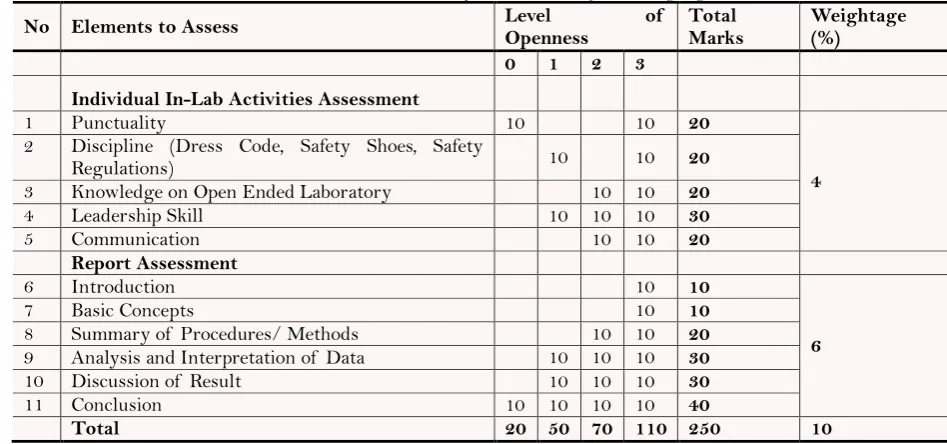
Table 4 shows the rubrics for the total achievable mark by students and the respective weightage. Assessment methods are not based solely on the laboratory reports submitted by the students but also take into account additional attributes that represent their teamwork skills, and practical skills. Assessments were carried out using the rating given in the rubrics. The rubrics are utilized in order to avoid large variations in the assessments. The content of the lab report includes the introduction, basic concepts, procedure, analysis, discussion and conclusion. The overall marks for the experiment were obtained by taking into consideration the rating given for the laboratory report, and practical and teamwork skills. The result of assessment of COs and POs will then be used to consider the Continuous Quality Improvement (CQI) recommendations.
Table-4. Total Achievable Mark by Students and Respective Weightage
No Elements to Assess Level Openness of Total Marks Weightage (%)
0 1 2 3
Individual In-Lab Activities Assessment
1 Punctuality 10 10 20
4 2 Discipline (Dress Code, Safety Shoes, Safety
Regulations) 10 10 20
3 Knowledge on Open Ended Laboratory 10 10 20
4 Leadership Skill 10 10 10 30
5 Communication 10 10 20
Report Assessment
6 Introduction 10 10
6
7 Basic Concepts 10 10
8 Summary of Procedures/ Methods 10 10 20
9 Analysis and Interpretation of Data 10 10 10 30
10 Discussion of Result 10 10 10 30
11 Conclusion 10 10 10 10 40
Total 20 50 70 110 250 10
2.6. Laboratory Practical Tests
3. RESULTS AND DISCUSSIONS
3.1. Open-Ended Marks
The overall mark of the open ended is a combination of the reports and also the teamwork and practical skills. From the data, it is found that overall marks for all groups in this course achieved 78% marks and above on the open-ended laboratory. Figure 1 shows the marks of the students based on the level of openness. It is found that the marks for level 0 is the most highest followed by level 3 and there were not much different in marks for level 1 and 2. Those results show that for level 0 the laboratory is actually same as traditional lab so the students excel in conducting the laboratory for this level.
Level 3 is the second highest and it shows that the implementing of open ended laboratory is successful because the students can conduct and prepare the report for level 3 which is 100 percent came from the students.
Figure-1. Students marks based on level of openness
3.2. Laboratory Practical Tests
The practical test is mainly to assess the student’s psychomotor ability. Most of the Laboratory courses for Civil Engineering Diploma Program including this Environmental Laboratory course have two practical tests that the students should take. So, based on Figure 2 the first practical test is higher than the second practical test. It is due to the time the practical test is done. For practical test 1 the test is in week 7 or 8 while for practical test 2 is in week 13 or 14. As the Environmental Laboratory is for the third-year students or in other words the final year students, so at the end of the semester they will have a lot of assignments and projects to be done. That is the reason the marks of practical test 2 is lower than practical test 1.
4. CONCLUSIONS
From the results, it can be concluded that Open Ended laboratory (OEL) is a suitable method to measure student achievement in the practical skills and also the psychomotor ability. It is also closely related to students’ perception of their communication achievement throughout the course. It also helps their communication skills through a working group in achieving certain objectives. From our experiences, it can be concluded that the open-ended laboratory increased the independent learning amongst students by giving them a platform to be innovative and creative in designing and executing their own experiments. The open-ended laboratory experiment resulted in an overall marks score that represents the students’ abilities in designing and conducting the experiment, analyzing and interpreting the result, and working in a group. By implementing OEL also makes the students fully and actively participate in the lab session.
Funding: The authors acknowledge support from Universiti Teknologi MARA (UiTM) Malaysia under the
Academic & Research Assimilation (ARAS) research grant scheme (600-IRMI/DANA 5/3/ARAS (0098/2016)).
Competing Interests: The authors declare that they have no competing interests.
Contributors/Acknowledgement: The authors also would like to thank FKA UiTM, IRMI UiTM and
UiTMCJ Pasir Gudang for their support to this research.
REFERENCES
Asanovic, K. and S. Beamer, 2009. C152 laboratory exercise 6. Retrieved from
https://inst.eecs.berkeley.edu/~cs152/sp09/assignments/lab6.pdf.
Asanovic, K. and C. Celio, 2011. C152 laboratory exercise 1. Retrieved from
https://inst.eecs.berkeley.edu/~cs152/sp11/assignments/lab1.pdf.
EAC, 2012. Board of engineers (BEM), Malaysia: 14. Retrieved from
http://www.eac.org.my/web/document/EACManual2012.pdf.
Engineering Accreditation Manual (EAC Manual), 2012. Board of engineers (BEM), Malaysia: 14. Retrieved from
http://www.eac.org.my/web/document/EACManual2012.pdf.
Fay, M.E., N.P. Grove, M.H. Towns and S.L. Bretz, 2007. A rubric to characterise inquiry in the undergraduate chemistry
laboratory. Chemistry Education Research and Practice, 8(2): 212–219.View at Google Scholar | View at Publisher
Kilinc, A., 2005. The opinions of Turkish high school pupils on inquiry based laboratory activities. Turkish Online Journal of
Educational Technology, 6(4).View at Google Scholar
McComas, W.E., 1997. The nature of the laboratory experience: A guide for describing, classifying and enhancing hands-on
activities. CSTA Journal, 6: 9.View at Google Scholar
Petropol-Serb, G.D., I. Petropol-Serb, I. Cautil and A. Munteanu, 2011. Open ended laboratory method applied in the conception of a test bench to simulate a diesel-electric transmission. Annals of the University of Craiova, Electrical Engineering Series, No. 35.
Rahman, N.A., N.T. Kofli, M.S. Takriff and S. Abdullah, 2011. Comparative study between open ended laboratory and traditional laboratory. IEEE Global Engineering Education Conference, Amman, Jordan, April 4-6, 2010. pp: 40-44.
UNSW, 2017. UNSW, Australia. Assessment toolkit. Assessing laboratory learning. Retrieved from
https://teaching.unsw.edu.au/assessing-laboratory-learning.