"'RCGRA~ME (:>1'0;) ~t="'EL~,vi?
The development and evaluation of a
r-esQu;ree--Clf\<';,SR-C::OfW\ f{\I\NA.Gr&f{\'I::N"\'
suitable for use in teacher education
By
Maeve Martin
A thesis submitted to the Institute of Education,
University of London,
for the Degree of Doctor of Philosophy.
1
ABSIRACT
The theme of this research project is classroom management. The purview adopted
throughout the work is broader than that implied in more old-fashioned terms like
"discipline" or "control." The focus within the work is on the range of teacher
behaviours aimed at eliciting and maintaining pupil learning and cooperation. The
project is teacher focused and the model of management is preventive. The concern is
not so much with what teachers do to curtail disruption when it manifests itself, but
rather with what teachers do to create classroom conditions that are conducive to high
levels of pupil on-task behaviours and minimal levels, or indeed total absence of pupil
disruption.
The project is situatedin Ireland, and was prompted by the researcher's perception of the
development of a malaise among the teaching force there. The theme of classroom
management seemed to be an appropriate research topic, as it touched on many of the
areas referred to by teachers as typically neglected in teacher education. The project
aimed to develop a practical resource and this too seemed a fitting way to respond to the
needs articulated by the teachers of Ireland.
The modern data base on classroom management was examined, and certain key
research findings were translated into a range of teacher behaviours associated with
effective classroom management. The research base owes its origins to the seminal work of Kounin (1970) and to subsequent research in this field, carried out at the
Research and Development Centre for Teacher Education at the University of Texas, at
Austin. The approach adopted to classroom management in the work is
cognitive-behavioural in orientation. This perspective to a topic of considerable
importancein the research literature, combines the current trendinteacher education with
its emphasis on the reflective practitioner and the more traditional emphasis on the craft
An examination of the research base culminated in a programme called "Effective
Classroom Management." Resources in the form of a training video and manual were
developed and incorporated into the overall programme. The programme was evaluated
on two separate occasions when piloted during an Inservice Course in Ireland. A
disciplined eclectic research design was used to evaluate the programme. The design is
in line with recent trends in the evaluation of programmes and it owes its origins to both
the classical positivistic paradigm and to the recently popular naturalistic paradigm.
Evaluation results show that positive outcomes of both a cognitive and behavioural
nature followed programme participation. While some limitations inhere in the work,
there is evidence to suggest that classroom management is a research theme that has
practical applications. It is a topical and relevant theme, and is very powerful and
influential in many aspects of teaching. As such itwarrants systematic treatment in
3
DEDICATION
This research project is dedicated to my late parents, who as competent and influential teachers, aroused in me a curiosity about the art
ACKNOWLEDGEMENTS
The completion of this research project would not have been possible without the help of
a number of people. To these I am grateful and muchly appreciative of their
contribution.
Dr. Brahm Norwich, as my supervisor, provided rigorous and challenging guidance
throughout the work. To him lowe a great deal; from him I learned a lot
My colleagues at Carysfort and Maynooth accommodated me in every possible way.
Their unstinting cooperation made the development of the work possible.
Many teachers and pupils participated in the work at various stages. Without them, it
could not have been conducted in its present form. Special thanks to them.
The staff at the Institute of Education Library provided excellent and courteous service at
all times. To them, I also say thanks.
Maura Ward, who proof-read with great diligence, and offered emotional and
professional support. Thanks must go to her.
Monica Dowdall, my patient and superb key-board specialist, offered both skill and
encouragement. To her I am deeply grateful.
And to all those friends and members of my family who shared an interestinthe work, I
wish to say thank you. Without your support, it would not have been easy to sustain a
5
CONTENTS
Page
LIST OF TABLES
LIST OF APPENDICES
CHAPTER 1 - Situating the Project
8
9
1 : 1 1: 2 1:3 1 : 4 1:5 1 : 6
Introduction
The Background to the Project Theterm "ClassroomManagement"
The Approach of Choice toClassroomManagement The General Purpose of the Project
The Organisation of the Document
10 10 11 13 16
17
CHAPTER 2 - Review of the Literature
2 : 1 Overview 18
2 : 2 Classroom Management Literature 19
2 : 3 The Kounin work 20
2 : 4 The Kounin/Texas contribution 21
2 : 5 The Beginning of the School Year 28
2 : 6 Planning Rules and Procedures 30
2 : 7 Reservations 35
2 : 8 Classroom Contexts 36
2 : 9 Alternative Approaches to Classrooms and Classroom Management 50 2 : 10 Sharing Classroom Management Research Data with Practitioners 70
2: 11 Classroom Management and the Process-Product Tradition 80
CHAPTER 3 - Current Issues in Irish Education pertaining to Classroom Management Section A 3: 1
3:2
3:3 3:43:5
3:6
3:7
3:8
Section B3:2:1
3:2:2
3:2:3
3:2:43:2:5
3:2:6
3:2:7
3:2:8
3:2:9
IntroductionThe National Situation Class Size
Curriculum
In-service Provision Absence of Resources Redundancy Scheme
Abolition of Corporal Punishment
Introduction
Construction of the Questionnaire Format of the Questionnaire Survey Subjects
Analyses of the Survey Data Quantitative Data Analysis Crosstabulations
Qualitative Data Analysis Discussion 89
90
94
100101
101
102
105
109
109
110
111
111
111
114
115
127
CHAPTER 4 - The Development of a Programme on Effective Classroom Management
4: 1 4:2
4:3
4:4
4:5
4:6
4:7
4:8
4:9
4: 10
4: 11 IntroductionThe Goals of the Programme The Objectives of the Programme The Training Materials
Rationale for the Consituent Elements within the Programme Rationale for the Methods used in the Programme
The Programme Data Gathering Programme Participants Programme Facilitator Time Required Resume 130
130
132 138143
151
152
154
155
156
156CHAPTER 5 - Theoretical Issues Relevant to Evaluation
5: 1
5:2
5:3
5:4
5:55:6
5:7
5:8
5:9
IntroductionThe Notion of Fit between the Theoretical Approach and the Research Project
Axiomatic differences between
the Naturalistic and Positivistic Paradigms Methodological differences between
the Naturalistic and Positivistic Paradigms Threats to the Rigour of the Project
The Efforts to Establish the Trustworthiness of the Enquiry The Training Workshops
7
CHAPTER 6 - Evaluation Procedures
6: 1
6:2
6:3 6:4 6:5 6:6 6:7 6:8 6:9 Introduction Pilot Run 1 Pilot Run 2Programme Assessment Procedures Short Term Evaluation Process Independent Evaluator
Medium Term Evaluation Long Term Evaluation Conclusion
204
204
207
212
214
214
216
217
221
CHAPTER 7 - Evaluation Findings
7: 1
7:2
7:37:4
7:5
7:6 7:7 7:8 IntroductionPreparation of the Data for Quantitative Analysis Considerations in Dealing with the Qualitative Data General Approach to the Task
Organising the Data Records for Qualitative Analysis Short Term Results
Medium Term Results Long-Term Results
222
222
223
225227
231
254
262CHAPTER 8 - Interpretation and Implications
8: 1
8:2
8:38:4
8:5
8:6 8:78:8
IntroductionTABLE Page
2.1 Teacher Behaviours derived from Kounin 24
2.2 Continuum of Classroom Management Strategies 51
2.3 Guidance for Staff Development Programmes 72
2.4 Content Outline for a Programme on Classroom Management 77
3.1 Primary School Class Size - Academic Year 1985/86 96
3.2 Pupil-Teacher Ratios in Western Europe 98
3.3 Disability Claims 104
3.4 Quantitative Data Frequency Counts 112
3.5 Survey Items for Qualitative Analysis 116
4.1 Features of the Programme Effective Classroom Management 158
4.2 Programme Data Base 159
5.1 Research Project Characteristics 161
5.2 Axiomatic Differences between the Positivistic
and Naturalistic Paradigms 169
5.3 Methodological Differences between the Positivistic and
Naturalistic Paradigms 173
5.4 The Unit of Analysis 179
5.5 Equivalence of Terms for Positivistic
and Naturalistic Paradigms 188
5.6 Analysis of Observer Relationships 200
5.7 Pearson Correlation Coefficients
for Principal Observer and Co-Observers 202
6.1 Features of the Trials 211
6.2 Field Work Schedule detailing Programme Trials
and Assessment Procedures 213
6.3 Long Term Evaluation Data Gathering Procedure 220
7.1 Main Research Question and Related Issues 224
7.2 Qualitative Data considerations 226
7.3 Categories Derived from Qualitative Data 230
7.4 ANOVA Findings for Experimental and Control Groups 264
7.5 Self Ratings and Observer Ratings
for Effective Classroom Management 266
7.6 Meta Matrix of Derived Categories 268
7.7 A Summary of the Long-Term Evaluation Findings 277
Appendix
9
I Survey Questionnaire 319
II Rules and Procedures 325
III Course Manual 329
IV Content of Training Workshops 344
V Evaluation Records (Short Term) 347
Day 1 Evaluation 349
Day 2 Evaluation 351
Day 3 Evaluation 352
Summative Evaluation Day 4 354 Evaluation Record (Medium Term) 355 Evaluation Records (Long Term) 360
Guidelines for Observers Using
The Kounin Classroom Observer Schedule 361 Annotations for Using The Classroom Observation Schedule
Based on Kounin Concepts 366 Classroom Observation Schedule using Kounin Concepts 373 Guidelines for Conducting the Teacher and Pupil Interview 383 Teacher Interview Schedule 385
Pupil Interview Schedule 390
Suggested Categories for Writing Up The Teacher
and Pupil Interview/Schedules 396
VI Brochure of In service Courses at Carysfort College, July, 1987 397
VII Programme Pilot-Run Timetable 398
VIII Guidelines for Independent Evaluator 401
IX Follow-Up Workshop Questionnaire/Checklist 405
QiAPTER
ONE
Situatim~
1JlU>roject
1.1 INTRODUCTION
The central theme of this research project is classroom management. Within
this introductory chapter, the background to the work will be sketched, a
rationale for using the term classroom management will be presented, the model
of management adopted will be introduced, the general purpose of the project
will be outlined, and the chapter will finish with an overview of the document.
1.2 THE BACKGROUND TO THE PROJECT
The project is set in Ireland. It was undertaken in response to a tangible sense
of malaise that was creeping into Irish education. The sources of the malaise
were twofold, viz.,
(i) swinging economic cut-backs that appeared to be dismantling an education system that was already spartan in the provision of resources for teachers,
(ii) a range of social ills in Irish society, that were hitherto unfamiliar to previous generations of teachers.
Against this background, teachers began to register their concerns. These
centred on the increasing complexity of their role, and on the inadequacy of
provision to help them in its discharge. These rumblings on the ground were
manifested by an increase in the number of pupil referrals to outside agencies for
professional help. Teachers felt under siege, and they articulated their anxieties
loudly and clearly.
As a teacher educator, the researcher was close to these pervasive concerns.
1 1
to produce something tangible and practical for Irish teachers. The theme of
classroom management suggested itself as an appropriate research topic,
because of its broad base. There is a sense in which it embraces all that is
involved in being a teacher. Traditionally, classroom management issues had
been dealt with in a diffuse manner in teacher education programmes. In many
instances the theme received scant attention. The research project was
motivated by a wish to make good this position. It represents an attempt to
produce a systematic, comprehensive approach to an important topic.
1.3 THE TERM "CLASSROOM MANAGEMENT"
The concept of classroom management is broader in scope than that implied in
more old fashioned terms like discipline" or "control". Itincludes all the things
a teacher must do to foster pupil involvement and cooperation in classroom
activities and to establish a learning environment. The concept spans a very
broad range of activities, encompassing such things as arranging the physical
setting, establishing and maintaining classroom procedures, monitoring pupil
behaviours, dealing with deviant behaviour, keeping pupils accountable for
work, and conducting lessons that keep pupils on task (Emmer, 1987; Sanford,
Emmer& Clements, 1983). The characteristics of a well managed class that are
supported by research include:
1. high levels of learner engagement;
2. clear expectations of behaviour for all classroom inhabitants, i.e. teacher and pupils;
3. minimal levels of disruption, time-wasting or confusion;
4. a work-oriented but pleasant and relaxed climate.
In short, a well-managed classroom is a task oriented, predictable environment
where students know what is expected of them and how to succeed. Research
shows that in a class such as this, a majority of pupils will attain well (Brophy,
findings also converge on the conclusion that teachers who approach classroom
management as a process of establishing and maintaining effective learning
environments tend to be more successful than teachers who place more
emphasis on their role as authority figures or disciplinarians (Brophy, 1988).
Thus the purview adopted throughout this work goes beyond the notion of an
authoritarian handing down of rules. It conceptualises the classroom as a
workplace inhabited by a teacher and a large number of pupils, some of whom
are ready, willing and capable of learning, others of whom are not. These
inhabitants jointly evolve a classroom ethos that is conducive to, or obstructive
of, the teaching/learning enterprise. Classroom management offers the potential
to create and to maintain an environment that is not only productive, but safe and
caring. It goes beyond reprimanding and disciplining with their focus on
instilling respect for authority and eliciting obedience, to the broader range of
teacher behaviours that support instruction.
Before moving off the justification for using the term "classroom management",
some linkages with the world of industry make interesting comparisons.
"Management" was nOJ a word that was in common currency in education until
recently. Consequently, there is a less clear concept of what it means or implies
than is the case in industry. Indeed, it can have pejorative connotations, posing
a threat to autonomy and values and conjuring up ideas of authoritarian, power
seekers who lack compassion. But this is a false view of management. It does
not and should not imply the naked exercise of power, nor the subservience of
anyone managed. In well-managed organisations, the ends do not justify the
means. The ends must have quality - they must feel good, and the means must
allow people to take pride in their work.
An industrialist would expect a manager to:
•
•
know what he wants to happen and cause it to happen;
1 3
• promote effectiveness in work done, and search for continual improvement;
• be accountable for the performance of the unit he is managing, of which he is a part;
• set a climate or tone conducive to enabling people to give of their best (Bush, 1986; Desforges, 1988; Everard, 1986).
The range of activities just cited have direct applicability to the world of the classroom. For "unit manager," substitute "classroom teacher" and the analogy with industry holds. This project is not simply about issues of reprimanding or rule enforcement. It is about the acquisition of the requisite expertise, that enables teachers to perform an effective management role, comparable to the one outlined above.
1.4 THE APPROACH OF CHOICE TO CLASSROOM MANAGEMENT
et al. This later work in the 1980s, took the Kounin work, which had lain
dormant, and elaborated it and integrated itinto a corpus of knowledge that is
influential to-day in the literature on classroom management. The research
findings, pioneered by the Texas group, have made heavy claims on slim data.
One of the underlying motives for adopting this cognitive-behavioural approach
to classroom management was, of course, a fascination with the work, but also
a curiosity to examine how well the findings would travel.
Description of the Model
The model is two-pronged. It situates itself in an information-processing
framework and extrapolates from this cognitive domain the routines and
behaviours that the teacher uses to solve problems posed by the special demands
of the classroom environment. From an information-processing perspective,
classroom knowledge is the product of basic cognitive mechanisms by means of
which experience is transformed into semantic representation. Through such
concept formation processes as chunking and differentiating, discrete elements
of the classroom environment are grouped into units, and units are categorised
and labelled. Grouping and classifying encompass not only people but also
events and objects within, and impinging upon, the classroom. At the same
time, these units of environmental experience are ordered by means of a network
or schema that reflects the activity structure of the classroom.
A schema is an ordered representation of objects, episodes, actions or situations
which contains slots or variables into which specific instances of experience in a
particular context can be fitted. A schema provides a framework for structuring
and interpreting experience and for making inferences to complete the picture of
association and causality among events or episodes. From this perspective,
teachers' knowledge of classrooms consists of schemata or scripts that permit
them to interpret instances of behaviour and predict the likely configuration of
1 5
These intellectually rooted abilities, or, cognitive representations of
action-situation relationships are central to the cognitive behavioural model. The
schemata are built gradually through direct instruction, practical experience, and
systematic reflection on experience (Doyle, 1985).
The other element or prong in the cognitive-behavioural approach to classroom
management focuses on the behavioural. This aspect owes its origins to the
behaviourist school of thought and caters for the overt range of behaviours
engaged in by the teacher to implement an effective classroom management
system. It translates the interpretation, decisions and promptings of the
information-processing into a set of routines and automatic behaviours that are
consistent with the teachers' schemata.
Teachers who are competent in a cognitive behavioural approach to management
not only have knowledge of why, but also of how and when to act. If
successfully operated, the model is preventive in orientation, i.e. it precludes the
manifestation of disruption by engaging the pupils' interest and cooperation in
socially acceptable behaviours. These socially acceptable behaviours constitute
the main vector of action (Doyle, 1986) within the classroom. The teacher's
task is to provide a vector of action that is sufficiently attractive and powerful to
harness and to hold the pupils' attention. Where this does not occur, pupils are
pulled into competing vectors, and classroom order is jeopardised. From this
perspective, a task approach to classroom management is appropriate. Teachers
perceive their day's teaching in terms of a series of tasks to be accomplished.
These may be referred to as "lessons" or "activities," but they have common
characteristics. Doyle (1987) describes an academic task in terms of the
following components:
1. a goal state or end product to be achieved;
3. the operations involved in assembling and using resources to reach the goal state or generate the product;
4. the importance of the task in the overall work system of the class.
The cognitive behavioural approach to management adopted in this work lends
itself to incorporation within this task framework. It is the tasks that drive the
day and protect the system of order which their accomplishment requires. This
bidirectionality and interdependence of task and order are recurring themes
within this work. It seemed logical to introduce them at an early stage.
1.5 THE GENERAL PURPOSE OF THE PROJECT
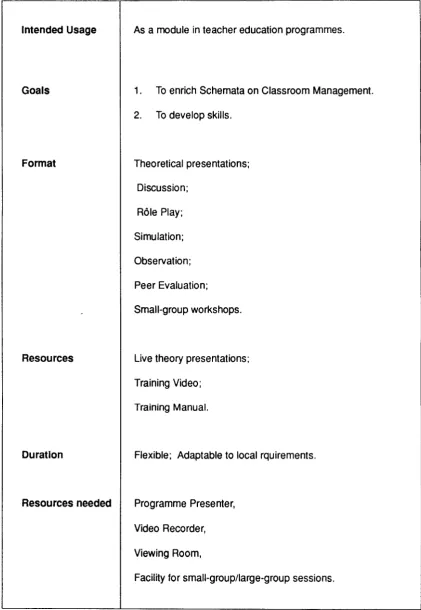
This research project has as a general purpose the provision of a resource on
classroom management suitable for use in teacher education. In this context,
the word resource is loosely interpreted. It refers to a systematic packaging of
the key research findings on classroom management. The effort is aimed at the
integration of a wide data base into modular form flexible enough to suit the
characteristics of the teacher education enterprise for which the module is
required, e.g. preservice, inservice, short term courses, long term courses etc.
Within this overarching purpose, the project has the following aims:
•
•
•
•
•
•
•
to gain insight into the concerns of Irish teachers;
to select certain findings from the modem data base on classroom management and to translate these into precepts for teacher behaviours;
to incorporate these operationalised research findings into a programme on Effective Classroom Management;
to evaluate the programme in an Irish context;
to use an eclectic research design in the evaluation of the programme;
to develop links between theory and practice and practice and theory.
1 7
Many of these aims are nested within each other. Taken as a whole they
provided the impetus for this work, and determined its conception and the
course of its subsequent development.
This introductory chapter finishes with an overview of the presentation of the
project within this document.
1. 6 THE ORGANISATION OF THE DOCUMENT
In all there are eight chapters that contribute to the total account of the work.
Chapter One has aimed to introduce the topic, to trace its background, to justify
the approach taken and to describe the aspirations of the work. Chapter Two
examines two bodies of literature, viz., (i) that pertaining to classroom
management, and (ii) that pertaining to the sharing of classroom management
findings with teachers. Chapter Three focuses on the Irish context in which the
project is set. It (a) touches on current issues in Irish education and (b) reports
on a survey carried out with a sample of Irish teachers on matters relevant to the
research theme. Chapter Four describes the development of a training video
and accompanying manual, on effective classroom management, based on the
available data base. Chapter Five raises theoretical issues related to evaluation
and situates these amid the current literature in the area. Chapter Six describes
two pilot runs with the programme "Effective Classroom Management" that
developed from close involvement with the research literature. Chapter Seven
presents the results that followed the evaluation of the pilot runs. Chapter Eight
reflects on the programme as a whole, and teases out the implications of the
Reyiew of..1he Literature
2.1 OVERVIEW
This research project has been influenced by three main bodies of literature,
viz.,
(i) the literature on classroom management;
(ii) the literature on staff development;
(iii) the literature on the theoretical issues that pertain
to evaluation.
The programme and its evaluation reflect these data bases. The literature on
classroom management is extensive, continues to grow and is characterised by
its repetitiveness. The literature on staff development is likewise extensive,
continuing to grow and also extremely repetitive. The result is that despite
lengthy, close involvement with these bodies of literature, the yield is finite.
Study after study produces findings that are similar to previous studies in the
area. But despite this limitation, the positive outcome in terms of this project,
with its practical orientation, is that the findings are amenable to translation into
practice.
The literature on evaluation paradigms is characterised by an often acrimonious
debate, and it is exciting and intriguing. This aspect of the literature review is
presented here but chapter five is devoted to a consideration of theoretical issues
1 9
2.2 CLASSROOM MANAGEMENT LITERATURE
Introduction
The study of classroom management has always lurked in the shadows of research on teaching, despite a widespread concern for management among teachers and the public (Coates and Thoresen, 1976; Elton, 1989; Fuller, 1969; Gallup, 1983; Kyriacou, 1987; Veenman, 1984; Wragg, 1981). Research conducted in the past twenty years has moved the topic from relative obscurity to a prominent place in the research literature on teaching (Brophy, 1988; Doyle, 1986). In his review "Classroom Organisation and Management" in the Handbook of Research on Teaching, Doyle (1986) attributes this to three factors:
1. the increased public concern about discipline that warranted attention from researchers;
2. the linkages between classroom management and pupil attainment that were emerging in the teaching effectiveness literature;
3. the impetus for qualitative work on classrooms following the pioneering work of Jackson (1968) and Smith and Geoffrey (1968).
There are recurring themes that permeate the corpus of literature on classroom management. These are:
1. the influence of the work of Kounin (1970); 2. the focus on the Beginning of the School Year; 3. the emphasis on planning and the role of rules
and procedures.
2.3 THE KOUNIN WORK
Research literature on classroom management invariably refers to the seminal
work of Kounin (1970) at Wayne State University. The widely influential
study of eighty first and second grade classes (each containing at least one
emotionally disturbed child) involved the use of a videotape recording. Two
types of classrooms were video recorded. One type reflected smoothly
functioning activities with little or no disruption and high levels of pupil
engagement with allocated tasks. In contrast, teachers in the comparison
classrooms were fighting to maintain order. Activities suffered from poor
attention and frequent disruption, transitions were lengthy and often chaotic, and
much time was spent dealing with misconduct.
Kounin began by analysing the teachers' methods of dealing with misconduct
and disruption. This focus of attention reflected the interest in discipline or
control that was popular at the time. Considering the great differences in
management success displayed by the two groups of teachers, the Kounin team
expected major differences in methods of dealing with misconduct. To their
surprise, they found no systematic differences at all. Good classroom
managers were not notably different from poor ones when responding to student
misconduct. What makes this Kounin work pivotal in the classroom
management research literature is not the result on teacher approaches to dealing
with disruption which prompted the investigation, but the subsequent analyses
of the video recordings which contributed valuable information on the
distinguishing characteristics of effective and ineffective classroom managers.
The Kounin team was surprised by the findings on their specific research
question of the day. This prompted them to look further, and the fallout from
the subsequent analyses of the tapes has been the cornerstone of effective
management recommendations ever since. Writing in 1988, Brophy attributes
the turning point, or coming of age of classroom management research, to "the
21
It is his view that, apart from making a worthwhile contribution to the
knowledge base on effective management, Kounin also established a paradigm
for collecting fine grained data in the naturalistic setting of the classroom that has
been "remarkably effective" (p.5).
It appears that while pursuing a specific research question, Kounin and his
collaborators stumbled on a rich and powerful data source. It also appears that
however dramatic this research discovery may have been, it lay dormant for
some years until interest in it was renewed by the team of workers at Texas, e.g.
Everson, Emmer, Doyle et al. Their efforts replicated, expanded and elaborated
the Kounin work and the knowledge base, which he had accidentally unearthed,
became both more integrated and differentiated. To-day the evolved work
_ represents an internally consistent and mutually supportive set of concepts and
strategies that can be taught and learned as a single integrated system. (Brophy,
1988).
2.4 THE KOUNIN/TEXAS CONTRIBUTION
Kounin (1970) identified a set of teacher behaviours that research showed
correlated positively with effective management. These behaviours are now
presented:
Withitness
This teacher characteristic is used to describe the degree to which a teacher is
aware of what is happening in all parts of the classroom, at all times, and the
degree to which this awareness is communicated to the class. Its most obvious
manifestation is when a teacher accurately and promptly intervenes to stop
misbehaviour. Itis a very powerful variable and taken in conjunction with
overlap, it strengthens the teacher's capacity to maintain a smooth-functioning,
task-engaged class of pupils. This withitness is akin to the "vigilance"
environment.
This Kounin concept refers to the teacher's ability to attend to more than one
event or issue at a time. Simultaneous events are handled smoothly while the
"overlapping" teacher is neither totally diverted by deviancy nor interruption,
nor "glued" to anyone activity. Routine housekeeping tasks are handled and
individual student needs are met without disrupting the ongoing activities of the
class as a whole.
Si~alContinuity and Momentum
This twofold Kounin concept refers to:
(a) the focus on academic work communicated to the students by the teacher and
(b) aspects of the teacher's pace and movement through different activities.
Lessons are conducted smoothly and at a brisk pace while students are provided
with a continuous signal on which to focus attention.
Challenge and Variety in Seatwork
This other twofold Kounin concept refers to:
(a) the level of difficulty of the task and
(b) variety, to stimulate student interest.
The concept recognises that students spend a lot of their classroom time working
independently rather than under the direct supervision of the teacher. Inorder
23
(easy enough to allow successful completion but difficult or different enough
from previous work to provide a degree of challenge to each student) and dispel
a sense of what Kounin called" satiation," i.e. absence of progress.
Added to the above Kounin behaviours, there is another feature of teachers'
management style, identified by him, that enhances performance - that is, group
alerting and accountability. This involves keeping the class on its toes and
involving students in a way that suggests they may be called on at any moment
to respond. Table 2.1 identifies the major Kounin behaviours that have come to
TABLE 2.1
TEACHER BEHAVIOURS
ASSOCIATED WITH
EFFECTIVE CLASSROOM MANAGEMENT
WITHITNESS
OVERLAP
SIGNAL CONTINUITY AND MOMENTUM
CHALLENGE AND VARIETY IN SEATWORK
25
Subsequent research has supported most of Kounin's observations (Brophy,
1982a). In a correlational study at the second and third grade level (Brophy &
Evertson, 1976), and in an experimental study of instruction in first grade
reading groups (Anderson, Evenson & Brophy, 1979), indicators of withitness,
overlappingness, and smoothness of lesson pacing and transitions were
associated both with better group management and with better student learning.
Irving and Martin (1982) reported a failure to replicate Kounin's findings for
withitness and raised questions about the definition and measurement of the
variable. Other investigators, however, have found that withitness is positively
associated with student achievement (Brophy& Evertson, 1976) that situational 1
awareness and overlap capabilities predict the acquisition of classroom
management skills (Copeland, 1983), and that eye contact and group scanning
increase work involvement and order, especially at the beginning of the year
(Brooks, 1985; Emmer et al, 1980; Evenson& Emmer, 1982).
In addition to staying aware of classroom events and their momentum, teachers
must also communicate this awareness to students. Kounin (1970) emphasized
that teachers demonstrated awareness through the timeliness and accuracy of
reprimands. Catching the real culprit early impresses on the students that the
teacher is aware of what is going on in the room. Moreover, Kounin's (1970)
work suggests that communicating awareness prevents the initiation and spread
of off-task and disruptive behaviour and this reduces the need for reprimands.
Emmer and his colleagues (Emmer et al, 1980; Evertson& Emmer, 1982) found
that successful managers were concrete, explicit and thorough in their
description of rules and procedures, and they commented frequently and
accurately on the appropriateness of students' behaviour. Finally, Doyle's
(1984) analysis of junior high school English classes indicated that teachers
communicated situational awareness by commenting frequently on events as
they were occurring in the class. They used a multiplicity of contextualization
cues to establish and maintain classroom events. The image here is clearly one
There are some studies which cast doubt on the value of group alerting and
accountability techniques, especially the notion of being random and
unpredictable in calling on students to recite (Brophy & Evertson, 1976;
Anderson, Evertson & Brophy, 1979). Good & Grouws (1977), in a study of
fourth grade mathematics instruction, found that group alerting was positively
related to student learning but accountability was related curvilinearly. These
various findings are all compatible with the interpretation that group alerting and
accountability devices are appropriate for occasional use within classroom
management contexts established by the apparently more fundamental and
important variables of withitness, overlapping, signal continuity and momentum
in lessons, and variety and appropriate level of challenge in seatwork activities.
Group alerting and accountability devices do stimulate student attention in the
short run, but if they have to beused too often, it is likely that the teacher is
failing to implement some of the more fundamental classroom management
strategies sufficiently.
The Texas Contribution
Greatly influenced by the Kounin (1970) work, the Texas researchers developed
and refined it. Their contribution led to a clarification of the goals of
management and to a focus on the Beginning of the School Year as an important
milestone in the life of a class. The work of Ball (1980) in this country on the
establishment process at the beginning of the year also emphasises the
importance of this critical time.
Evertson& Emmer (l982a) identified the following three goals for management:
1. to establish a climate for learning;
2. to socialise children into the routine of classroom and school life;
27
In similar vein, Doyle (1987) describes the task of teaching as twofold
(a) to solve the problem of order in classrooms;
(b) to represent and enact the curriculum.
This perspective on management and teaching suggests that management and
teaching co-occur. It is a false dichotomy to separate them. Effective
management of itself does not guarantee successful teaching, but in its absence
successful teaching is unlikely to occur. In this regard Dunkin and Biddle
(1974) comment:
" .it seems to us that adequate management of the classroom environment also forms a necessary condition for cognitive learnings: and if the teacher cannot solve problems in this sphere, we can give the rest of teaching away." (p.135).
Emmer (1987) summarises the findings of a number of studies and concludes
that:
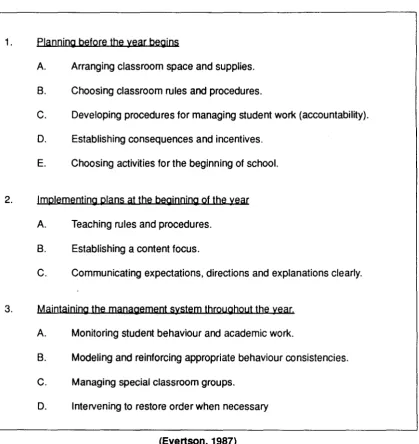
1. good management has three distinguishable phases:
(a) planning before the school year begins;
(b) implementation;
(c) maintenance.
2. The components of good management include:
(a) the identification of clear expectations for student behaviour in a wide array of
classroom activities;
(b) establishment of procedures and rules;
(c) consequences;
(d) monitoring;
(e) prompt handling of inappropriate behaviour;
(f) student accountability for assignments;
Doyle and Carter (1987) suggest that successful managers are able to:
1. Construct lessons that fit the externally-paced schedule of the school day.
2. Use activities that have a clear programme of action for participants.
3. Explicitly mark the boundaries of activities and the transitions between activities.
4. Demonstrate situational awareness by attending to details and commenting on events taking place in the room.
5. Protect activities until they are established by actively ushering them along, focusing public attention on work, and ignoring misbehaviour that disrupts the rhythm and flow of classroom events.
6. Push students through the curriculum even when misbehaviour is prevalentin the class.
These researchers also speculate that successful classroom managers tend to
think about classrooms in terms of activities and movement, whereas, less
successful managers tend to concentrate on individual student contacts. The
thrust of their work makes a strong case for the importance of the knowledge
structures and comprehension processes a teacher uses to interpret classroom
scenes, rather than a set of skills per se in determining how the problem of order
is solved in a classroom. Because order is a property of a social system, the
language of management must be addressed to group dimensions of the
classroom environment and to the contexts within which order is defined and
achieved. Management is a complex enterprise because order is jointly
accomplished by teachers and students and because a large number of immediate
circumstances affect the nature of orderliness, the need for intervention, and the
consequences of particular teacher and student actions.
2.5 THE BEGINNING OF THE SCHOOL YEAR
There is a neat but burgeoning literature available on classroom practices, that
29
1980; Ball, 1980; Biles, Billups& Veitch, 1983; Brooks, 1985; Doyle, 1980;
Emmer, 1987; Evertson & Emmer1982, Wragg & Wood 1984) This research
emphasises the importance of first encounters with classes and its impact in
determining the pattern and quality of management that ensues. Doyle (1979b)
suggests that there is a rhythm to the beginning of the school year. Students
may begin by being passive, even hesitant, in their initial meetings with their
teachers. However, before long, some students begin to test the rules and the
teacher's management skills. If the teacher is successful in handling the testing
at the beginning of the year, then incidents of misbehaviour decrease until they
reach a stable level. Testing is typically initiated by only a few students, but
given the public character of classrooms, the outcomes of these tests are visible
to all students and evaluated by them. In Ball's (1980) terms, the process of
establishment has been successful.
The Texas research has culminated in two manuals - one for use by teachers at
primary level and one for use at secondary level (Evertson, Emmer, Clements,
Sanford & Worsham, 1984; Emmer, Evertson, Sanford, Clements, &
Worsham 1984). These manuals provide detailed accounts for teachers who
wish to establish and maintain an effective classroom management system. The
manuals each include a chapter on the Beginning of the School Year.
Guidelines are provided to ensure that this milestone is successfully negotiated.
These guidelines are as follows:
1. Resolve Student Uncertainties.
2. Help students Be Successful by planning uncomplicated lessons.
3. Keep a whole class focus.
4. Be available, visible and in charge.
The Doyle (1986a) review of classroom organisation and management examines
the beginning of the year studies. The results converge on the following.
and deliberately taught this system to the students. Rules and procedures were
concrete, explicit, and functional, that is, they contributed to order and work
accomplishment. In addition, items were clearly explained to students, signals
were used to indicate when actions were to be carried out or stopped, and time
was spent rehearsing procedures. Effective managers avoided information
overload by focusing initially on immediate concerns and then introducing more
procedures as they were needed. At the same time, they appear to have
anticipated possible interruptions or problems and had procedures readily
available to handle these situations. The more effective managers also
continued to remind students of the rules and procedures for the first weeks of
school. The studies reviewed (Emmer, 1981; Evertson & Emmer, 1982;
Sanford & Evertson, 1981) contrast the behaviours of effective managers with
those of less effective managers. The latter group were characterised by their
unpreparedness for the beginning of the school year and by the absence of the
strategies referred to as typical of the effective managers.
2.6 PLANNING RULES AND PROCEDURES
The classroom management literature stresses the importance of planning. The
development of an effective management system involves designing the system
before the year begins, implementing it at the beginning of the school year, and
monitoring itthroughout the remainder of the year (Evertson & Emmer, 1982).
Emmer (1984) suggests that the key concepts and principles involved in
successfully accomplishing this tripartite task are:
1. identification of desirable student behaviour,
2. clear communication of expectations to the students;
3. monitoring;
4. prompt handling of non-trivial inappropriate behaviour;
31
Within this framework the teacher plans, and these plans become the "scripts"
the teacher uses for carrying out interactive teaching. These scripts exert a
strong influence and research has shown that planning decisions influence
context, subject-matter, social climate and the instructional process (Shavelson,
1987). The planning phase of classroom management has three major steps:
A. determining expected behaviours;
B . translating expectations into procedures and rules;
C. identifying consequences.
STEP A -Determinin~Expected Student Behaviours
With regard to step A, this critical management task is far more complex than
simply stating several rules about conduct. Itis true that rules can be useful,
but establishing clear expectations requires more time and effort because
desirable behaviours frequently vary according to the classroom activity. These
must be clearly represented in the teacher's congnitive map of classroom life, if
they are to accurately mirror real life situations. This underscores the relevance
of the cognitive-behavioural model adopted in this research project.
Management practices are deeply embedded in the knowledge structures and
comprehension processes a teacher uses to interpret classroom scenes. It is
how a teacher understands action - situation relationships in classrooms rather
than what skills he or she possesses that determines how the problem of order
will be solved in the classroom (Doyle and Carter, 1987). Once the behaviour
needed in a particular setting has been identified, the teacher can then decide
whether a procedure or routine should be established to help bring about the
behaviour. Eventually, the routine or procedure will be used to guide a class of
pupils, in a confined space through a series of disparate activities. One of the
major characteristics of effective classroom managers is their ability to
communicate a clear set of expectations about appropriate behaviour to their
students. This task is fundamental and should receive due attention in teacher
STEP B - Translatin~Expectations into Procedures and Rules
The process of identifying expectations is accompanied by the formulation of
classroom procedures and routines to promote behaviour in accordance with the
expectations. Sometimes the process may be very direct, while other
procedures may be more complex. The point of these rules and procedures
(dealt with in some detail in Chapter 4) is to allow large numbers of students to
coexist, move about, and do what is needed in order to preserve time and energy
for accomplishing schools' primary goals. Failure to develop a workable set of
procedures and routines will result in poor conditions for constructive use of
time, and may cause students' attention and interest to wane.
The formulation of classroom procedures should parallel the functional analysis
of classroom behaviour referred to in Step A. Important areas for consideration
include:
whole class, small group, and individual seatwork, transitions, opening and closing routines, room and materials use, and accountability systems.
Rules function as general guidelines for behaviour rather than directions for
accomplishing specific classroom tasks. They should, of course, be consistent
with the procedures the teacher plans to use. A clearly articulated set of rules
and procedures is introduced by effective classroom managers early in the year,
and is painstakingly implemented, so that the students become "grooved" in
acceptable patterns of behaviour. The research literature suggests that during
this implementation phase the teacher is "front and centre" in classroom
activities, avoiding loss of contact with individual students or groups (Evertson,
Emmer, Sanford & Clements, 1983). Life in classrooms begins with the
creation of a work system and the setting of rules and procedures to hold the
systeminplace.
Monitoring student behaviour is also important in this phase, along with
33
takes hold and may require only periodic injections to sustain it throughout the
year. Kounin & Gump (1977) claim that settings have "holding power."
Holding power consists of a setting's capacity to sustain participation. This
implies that the length of time a pupil will be actively involved is more likely
attributable to an activity's holding power than to pupil attention span. The
rules and procedures protect the activity, and for this reason alone, they warrant
consideration in teachers' planning towards effective management
Doyle (1986) points out that rule-setting forms part of classroom life each year
even though pupils in the upper grades may already be well versed in the
going-to-school rules. He makes the point that the quality of the rule setting not
only determines the degree of order that prevails in a class, but brings with it
significant messages about the importance of order and an indication of the level
of vigilance and accountability that will prevail in the class. By setting rules, a
teacher communicates to pupils an awareness of what can happen in a classroom
and demonstrates a degree of commitment to work (Ball, 1980; Brooks, 1985).
In this way, a class of students is introduced to valuable information early in the
year. This communication by the teacher, taken in conjunction with the
reputation the teacher has within the particular school system, serves to indicate
the teacher's approach and expectations for behaviour. The more explicit the
rules and the more clearly they are communicated, the more likely the teacher
will care about maintaining order and not tolerate inappropriate and disruptive
behaviour. Stating the rules in itself is not sufficient. A teacher must also
demonstrate a willingness and an ability to act when rules are broken. For this
reason, reprimands and consequences playa central role in the rule-setting
process. Pollock, Thorpe and Freshwater (1977) in a large scale survey of
pupil opinion found that about two thirds of the pupils (N
=
1049) thought theirschool rules were acceptable, 10% found the rules too lenient, 32% too strict.
STEP C - Identifyin~ConseQuences
operationalise norms for acceptable classroom behaviour but they go one step
further and identify the consequences of student compliance with, or violation
of, the rules and procedures (Emmer 1987, Evertson & Emmer, 1982).
Ideally, the natural consequences of appropriate behaviour should be reinforcing
of themselves and in need of no external rewards, (Dreikurs et al, 1982).
However, it is refreshing to think of a management system that is so thorough
as to dwell on the consequences of behaviour. Traditionally the linkages are
blurred and fuzzy, despite frequent references to the important influence of
reinforcers. By planning consequences ahead of time, teachers increase the
liklihood that they will be reasonable, and they avoid the inconsistencies that
occur when confronted by events for which they have no immediate response.
Incentive systems need not be elaborate but they are important, especially for
young children, in acquiring appropriate "going-to-school" behaviours.
Careful attention must also be paid to what will happen when students behave
inappropriately. The teacher's response can range from imposing a penalty to
ignoring an unobtrusive and innocuous violation. Handling inappropriate
behaviour well, and minimising its recurrence, depends on careful consideration
of what responses are available to the teacher and what is reasonable in the
context in which the inappropriate behaviour occurs. A logical connection
between the inappropriate behaviour and its consequence helps students learn to
avoid the inappropriate behaviour. Emmer et al (1984) recommend that
penalties should be used sparingly and serve mainly as deterrents. It is
preferable to rely on rewards and personal encouragement to maintain good
behaviour. This recommendation is in line with a preventive approach to
classroom management.
The dictum "Be consistent" is common advice to the new teacher.
Unfortunately, its meaning is not usually clear to the novice. What appears to
be important is that the teacher has a clear idea of what behavioural expectations
and consequences are appropriate. This implies that the planning stages
35
classroom management and not ad hoc management. Next, the students must
have clearly understood what penalties are to be used and under what
conditions. Then, the teacher must follow through when necessary. This is
what being consistent is all about. Teacher education needs to develop this
approach with beginning teachers.
2.7 RESERV ATIONS
While acknowledging that the Kounin work in conjunction with the Texas
extensions to it have made an impressive contribution to the classroom
management area, some reservations must be aired. In many instances the
research samples were small and in a number of instances reports constitute little
more than in-depth Case Studies. Most of the work occurred in very specific
settings, so problems of generalisability come immediately to mind. The
research message coming from this body of research is clear. Plan, design,
communicate, implement and monitor, and smooth functioning classrooms will
follow. It is difficult to know whether this is naive or arrogant as a message.
It is true that in certain circumstances the Kounin/Texas work will be successful,
and may be described as preventive. But this is not true for all settings. It is
not anything as powerful as the proponents seem to suggest. Reservations
must also be expressed concerning the Kounin language. His research is hailed
as the beginning of a new era on classroom management that got away from
fuzzy concepts! Terms like "withitness," "overlap" and "signal continuity" are
not exactly terms of great clarity. They require a lot of elucidation to become
meaningful. But despite the questionable validity of the work under review, it
has something to offer. What is important is that what it offers be kept in
2.8 CLASSROOM CONTEXTS
Introduction
An important feature of the classroom management literature is the emphasis it
puts on contexts. This emphasis on contexts represented a new focus for the
researcher and prompted an examination of the relevant literature in the area.
This is now examined and its inclusion is justified by the recurring theme in the
management literature about the complexities of the classroom as a workplace.
A focus on contexts leads to research in a wide variety of disciplines, viz,
ethnography, sociology, linguistics, psychology and curriculum. All fields
contribute to an understanding of the dynamic work environment - the
classroom.
Ecological psychology gives us a clear sense of the classroom as a tangible
context that people inhabit. Research in this field owes its origins to the parent
disciplines and intellectual traditions of anthropology, sociology and linguistics.
This family of research lacks the orientation of the more traditional
process-product paradigm which emphasised the role of achievement outcomes,
the relative decontextualization of analyses and the objectification of data in the
search for positive laws (Shulman, 1986a). For researchers concerned with
translating principles for policy or maxims for practice, based on the aggregation
and accumulation of usable knowledge, the yield of research in the ecological
framework may be questionable (Shulman, 1986a). But the modem era of
research on classroom management, dating from Kounin's work (1970s) and
the broader field of teacher effectiveness research, attest to the importance of the
ecological approach to classroom research.
The classroom is now acknowledged and recognised as a behaviour setting
(Gump,1967,1969,1982), or
"an ecobehavioural unit composed of segments that surround and regulate behaviour."
37
Gump, (1982) describes the classroom as being made up of subsections or segments. The segments have the following characteristics:
(i) an action structure;
(ii) a physical milieu;
(iii) a fit between the action structure and the milieu; (iv) a set of spatial and temporal boundaries.
These mini-environments or segments function as contexts for more particular aspects of teacher and learner action. A segment framework provides a structured vision of a classroom in operation. Events in the classroom occur in one segment or another, or in transitions between them. The students and the teacher are physically located in one or other of the segments. The action structure dimension of the segment is of great importance as it drives the classroom day. Once segments have been identified they are commonly labelled and various dimensions, such as time, focal concern, type of pacing, number of participants and level of involvement are coded for analysis (Grannis,1978; Gump,1967; Stodolsky et al, (1981). Doyle (1986) suggests that there are at least four structural levels in classrooms:
1. The class session, or the unit of time defined by the signal for students to assemble into the room and the signal for them to leave for recess, lunch, or home.
2. The lesson, or the set of activities bounded together by a common focal content.
3. The activity, or the distinctive pattern for organising students for working for a unit of time within a lesson.
4. The routine, or the supplementary programme of action for handling housekeeping matters in a classroom.
In terms of classroom management the key facet of segments is the action structure. Order is defined by the programmes of action embedded in classroom activities. Apart from providing slots and segments for participants' behaviour, these programmes of action have direction, momentum and energy (Arlin, 1979, 1982; Erickson, 1982a; Kounin, 1970). They constitute the classroom timetable and move rhythmically towards the attainment of academic and social-interactional goals. In Merritt's (1982) language, classroom activities contain "vectors" that, once entered into, pull events and participants along their course. Doyle (l979a, 1983, 1987) has utilised the concept of "academic task" to account for the substance of classroom events. It is academic work which provides a context that guides student attention and information processing as well as student attitudes towards participation and cooperation.
The significance of the classroom as an ecological system in which students build their understandings, attitudes and feelings about themselves and their social world is now very much to the forefront in the educational literature (Ball, 1980; Chazan & Galton, 1984; Davies 1982; Doyle, 1977a, 1981; Fenstermacher, 1978; Hargreaves et.al. 1975; Harre & Secord, 1979; Pollard, 1984, 1985, 1986; Woods, 1983). The ecological framework is particularly useful for illuminating the intrinsic properties of the classroom system. Its contribution enhances a necessary conceptual base for research on teaching and for informing teacher education. The findings of research in this perspective capture the fine grain and richness of classroom life and they serve to counterbalance the practice of the process-product paradigm of extracting units of behaviour from the classroom context, and imposing interpretations based primarily on the investigator's theory or on some theory influenced by psychological research (Delamont& Galton, 1986).
39
naturalistic. This is to suggest that the research places primary emphasis on detailed, finely grained descriptions formulated on the basis of extensive unstructured experience in classrooms. The reality of the classroom impinges on the researcher's subjectivity until categories for description are determined by the phenomena of the classroom itself. During this process of formulating descriptions, an attempt is made to account for the meaning of events and actions from the perspective of the participants in the situation under investigation. The database for ecological studies is typically a set of chronicles (Gump, 1967; Ross, 1984) or narrative records of classroom meetings on videotape (Kounin, 1970). These provide a reasonably complete description of the behaviour stream and contain information about what Burnett (1973, pg.193) calls the "scene coordinates" i.e. the temporal boundaries, the physical milieu, the site, the number and types of participants, the use of available space, the props, the programme of action for participants etc. This kind of data gathering has the advantage of capturing variables that simply do not occur in laboratory settings or are not included in standard category systems of observation. The result of this may be that naturalistic studies are characterised by unexpected phenomena and a language may evolve to reflect the special feature under observation. Kounin's (1970) term "withitness" is just such an example. From a researcher's perspective - even for a researcher in the naturalistic mould, it is difficult to focus exclusively on the unstructured experiences or views of classroom life. Becker (1971) cautions that when observing classrooms, it demands great willpower and imagination to see other than what everyone knows to be already there. This mental set makes it difficult for the researcher to come up with anything new.
students. Their behaviour is viewed in terms of the classroom environment
which plays a major role in determining behaviour. Ananalysis of behaviour in this perspective is a two-tier process. One tier involves defining the dimensions
of the classroom environment, while the other tier concentrates on the strategies
employed by students and teachers in their efforts to function successully in that
environment. The classroom setting has distinctive properties that affect
participants, and these important elements are in position, irrespective of the
kind of teacher or students allocated to these settings (Doyle, 1986). These
intrinsic features create constant pressures that influence and shape the
behaviour of the classroom inhabitants as a class moves through time. The
studies by Weinstein (1981) and Smith & Connally (1980) show the
relationship between such matters as amount of space, seating arrangements or
kind and amount of physical resources to student behaviour.
In his review of the research in this area, Weinstein (1979) pointed up the
effects of physical features of the classroom environment on student behaviour.
The findings on classroom design and furniture arrangements suggest that
different patterns of spatial organisation have little effect on achievement or
verbal interaction but some effect on attitudes and conduct. In particular, it
seems to be important to clearly designate and separate areas in the room serving
different purposes and to pay careful attention to traffic avenues. The work on
density indicates that this factor increases dissatisfaction and aggression and
decreases attentiveness. Students are apt to be distracted by the actions of
others and the more work-oriented may seek to be seated away from students
whotalk or persistently interrupt.
The work of Adams (1969) and Adams and Biddle (1970) focuses on the
relationship between students' location and participation. Students seated in the
"action zone" (i.e. in the front, centre rows in a traditional room arrangement)
interact most frequently with the teacher. Brooks, Silvern & Wooten (1978)
report that post primary students in the social-consultive zone (also front and
41
from the teacher, while students in the public zone (middle and back of the
room) receive more lecturing and one-way communication. The work of
Sommer (1969) bears out an association between location and participation and
argues that the degree of visual contact with the instructor is positively related to
amount of participation. Research conducted by Totusek & Staton-Spicer
(1982) suggests that these may be special characteristics typifying students who
prefer to sit in the action zone, while findings from the research work of
Schwebel and Cherlin (1972) seem to indicate that it is the location that is the
influencing factor rather than the learner's characteristics, that determines
attention rates. On balance, the research evidence suggests that location in the
classroom influences access to classroom events, and when a choice is given,
some students opt for locations that enable them to participate actively in these
events.
Another aspect of the physical features of the classroom environment, explored
in the Weinstein (1979) research review, is the differences between traditional
enclosed classrooms and open-plan. The findings suggest that students in
open-plan classrooms spend more time working together, initiating their own
tasks, and working without teacher attention than is the case in enclosed
classrooms. Students in enclosed classrooms spend more time in whole-class
activities and are more structured and closely monitored. Moreover, the
research indicates that there is more informality and spontaneity and more
simultaneous activities in open-plan than in traditional rooms. The teachers in
traditional rooms spend more time lecturing and disciplining students, whereas
open-plan classroom teachers spend more time interacting with individuals and
small groups. The work of Gump (1975) and Denscombe (1980b) concerning
noise in open-plan situations, suggests that noise levels bother teachers more
than students, and the disruptive effect of noise is linked to the nature of the
activity, the content of the message, and the density of the setting. The research
cited carries with it implications for the management system operating in a
classroom. It forms part of an understanding of the workplace scaffolding and
A third feature of the ecological enquiry relates to its
organising question.
Thisis fundamentally diagnostic, in that it seeks to find answers to why the
inhabitants of a setting behave as they do. The focus is on the functional value
or adaptive significance of behaviours in an environment. This investigative
thrust contrasts with the more traditional orientation in teaching research where
the question typically is "How can teachers be changed to become more
effective?" The answer often reflects the researcher's preconceived notions of
what constitutes effective teaching style or effective management style. These
notions may be derived from studies conducted in settings other than
classrooms. By contrast, the ecological approach guides an analysis of the
meanings participants attribute to their behaviour in particular settings.
Consequently a more accurate and sensitive understanding of what is at play, is
developed. The constraints of the setting are accounted for and the implications
in human terms, of altering physical or behavioural dimensions, are appreciated.
An ecological analysis of classroom processes results in the acquisition of some
interpretive propositions. These interpretations are valid for their contributors.
They represent an honest effort to get at the real meaning and intentionality of
the behaviour stream of individuals in collective life. As such, they cannot be
ignored by those who seek to build accurate schemata of classroom life. The
data in this area constitute a very fertile and important contribution to teacher
education programmes.
Having dealt with the features of the ecological research paradigm, it now seems
in order to tie in the implications of this research paradigm for classroom
management studies. The work of Hamilton (1983) in this area, examining the
criteria for ecological research spells out the pertinent issues. Hamilton (1983)
argues that the criteria are: