RECENT DEVELOPMENTS IN ONLINE
CLUSTERING
Divya Dadhich
1,
Dr. Amit Sharma
21
M.Tech Scholar,
2Professor, Department of Computer Science & Engineering
,
V
edant College of Engineering & Technology, Bundi , Rajasthan,(India)
ABSTRACT
In this research Paper I am focusing on The Online clustering has emerged as a new field for
research. The limitations of the k-means algorithm of handling a fixed amount of known data is solved
through the online settings of the algorithm which effectively clusters the arriving data sequence of
unknown nature and size. The online clustering has wide applicability in clustering of real data. In
recent years, the management and processing of so-called data streams has become a topic of active
research in several fields of computer science such as, e.g., distributed systems, database systems,
and data mining. A data stream can roughly be thought of as a transient, continuously increasing
sequence of time-stamped data. In this paper, we consider the problem of clustering parallel streams
of real-valued data, that is to say, continuously evolving time series. In other words, we are interested
in grouping data streams the evolution over time of which is similar in a specific sense. This paper
discusses the subject and deduces the open problems for research in the field. A brief survey of recent
proposals in this direction aiming at solving the discussed problems is presented in the later part of
the paper.
Keywords: Clustering, Data Mining, Data streams, fuzzy sets
I. INTRODUCTION
The study of unsupervised learning is motivated by the raw data produced from various data sources but not yet
labeled for any classification task. Clustering, an unsupervised machine learning approach, aims to group or
cluster similar data together. Need for clustering arises because in today’s era where the data is continuously
increasing, analyzing it later for purposes like storing, updation, searching and sorting becomes all the more
difficult.
The k-means clustering algorithm [1] is one of the most widely used clustering algorithms, mostly because its
robustness and simplicity to effectively cluster the given data. Its ease of implementation makes it the first
choice of a data analyst who has to cluster randomly put data into meaningful clusters. The applicability of the
k-means algorithm can be seen in almost every field of science and engineering like forecasting, market
analysis, image segmentation, image processing, real-time decision making and many more. The algorithm
initialization of k cluster centres followed by assigning the (n-k) data points to the k clusters based on the
shortest Euclidean distance between them. The algorithm continues till the desired k-clusters are formed or no
more data remains to be clustered.
However, the algorithm is bounded by a number of limitations, the major of them being the need of the
algorithm to know in prior the set of data points to be clustered and the value of “k” and the random
initialization of initial centroids. Despite of all the settings, the algorithm still fails to obtain good performance
results in terms of theoretical guarantees. An extension of the algorithm, k-means++ by Arthur and
Vassilvitskii[2], as an improvement to the initialization problem of the algorithm, is worth mentioning because
of its O(log(k)) approximation.
The description of the algorithm presented above corresponds to the offline setting of the algorithm. The input
to the algorithm in this case is fixed, known and the output comes in a single pass of the algorithm. But in cases
where the data comes in streams like forecasting, stock prices or the data is too big to be accessed sequentially,
the online setting of the algorithm is the best option. The data points arriving as input to the online k-means
clustering algorithm one by one can be assigned to any one of the k-clusters or can a form a new single cluster.
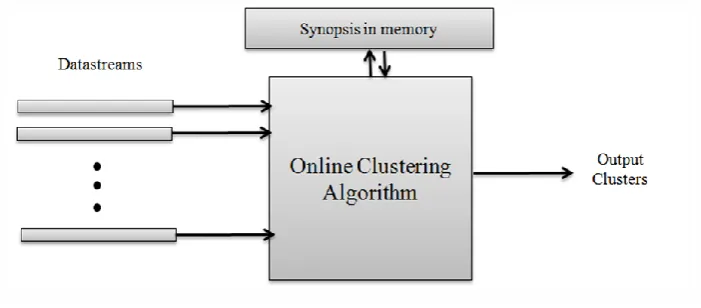
The online clustering model is shown in Fig. 1.
Fig. 1 The online data clustering model
The online setting should however not be confused with the streaming model of the algorithm because of the
sequential nature of the data. The online k-means clustering algorithm has a fixed memory and is able to handle
an endless stream of data points where each point is visited by the algorithm only once unlike the streaming
k-means algorithm where the memory is proportional to the fixed known length of the data stream and the data
points can be visited more than once by the algorithm. Testing of the algorithm is done only at the end in the
streaming model and at each time step in the online model. Both the algorithms can be converted to each other
through processes like divide-and-conquer and random sampling.
This paper deals with exploring the online setting of the k-means algorithm. It is a hot topic of research due to
the inability of the traditional and the streaming clustering algorithms to handle arbitrary amount of data that can
be consumed in one pass which results in postponing of the clustering decisions. The online model too is
subjected to a variety of constraints which is the focus of the recent proposals in this direction. A brief survey
II. ABOUT ONLINE CLUSTERING
Online Clustering is a vast field with many open research problems. An online variant of the k-means clustering
should focus on eradicating the shortcomings of the original algorithm, should be scalable and allow soft
movement of data streams from one cluster to another. The online algorithm should support the objective
function of the k-means clustering algorithm and identify “bad” sequences that hamper the growth of the
algorithm. Data arriving as input can also not be only stationery and therefore methodologies should be
proposed for handling variety of data of the arriving streams.
Based on the discussion above, the various fields of research/ open problems in handling online data streams are
listed as
Approximation of the k-means objective using online learning
Scalable Clustering of parallel real-valued data streams
Fuzzy variant of the k-means online clustering algorithm
Working on limitations of the traditional k-means clustering before jumping to its online versions
Identifying “bad” sequences
Applicability of online clustering in various fields
Handling non-stationery data
Integration with stream clustering or conversion of both the algorithms into each other
The coming section discusses some of the noteworthy research works proposed recently focus of which is one of
the above mentioned open problems.
III. WORKING MODULE OF ONLINE CLUSTERING
Beringer and Hullermeier [3] proposed an online algorithm for clustering incoming parallel data streams where
each stream consists of real valued data. The incoming data has to be analyzed along with taking into account,
that a delay not more than a specific time is encountered in the process. The proposed online variant of the
k-means algorithm is scalable as a result of the online transformation done to the original data. The online
transformation is a preprocessing step that calculates the distance between data streams using approximations
from original data thereby making the algorithm feasible to be used in a real world environment for clustering of
thousand data streams. The authors also proposed a fuzzy variant of the online k-means algorithm to allow
shifting of data stream from one cluster to the other smoothly.
Barbakh and Fyfe [4] address the limitations of the traditional k-means algorithm of converging to a local
optima and its sensitivity to the initial centroids. The reason they point out is the performance function of the
algorithm for which they propose an improvement in the algorithm. The proposed improvement makes the
algorithm able to effectively work even in the worst case scenario when all the points are initialized in the same
positions. Their idea is based on the knowledge of a data point about the locations of all the remaining data
points and its relative positions from the others before it changes its location. This can effectively improve the
performance of the algorithm as no clusters will be left free or overcrowded at the convergence of the algorithm.
The authors develop a family of new algorithms using the proposed improvement in both online and offline
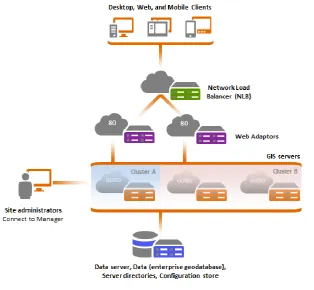
Figure. 2 The Online Clustering Model
Choromanska and Monteleoni [5] worked on online clustering using experts. The aim of the proposal is to
compute approximation guarantees of the online clustering algorithm in terms of the k-means objective function.
In cases where it needs to be checked which of the batch clustering algorithms are effective for working in
online setting, the proposal helps determine the needed effectiveness. The batch clustering algorithms of [6] and
[7] are taken as experts and their approximations are calculated based on the computation of approximation to
the current value of the k-means objective through each expert. The guarantee is in terms of cost of the entire
data stream as the k-means objective desires, even though the setting of the algorithm is now online. The
inspiration behind the proposal is the work of Dasgupta based on regret analyses [8]. Another work on regret
analyses is done by Gentile et al [9] for content recommendation using clustering of exploration-exploitation
strategies.
Khaleghi et al’s work [10] in the direction of online time-series clustering is motivated by the fact that the data
arriving in sequences, either new or merged with the older ones, come from various distributions and proper
distinction of the source of the sequence, if not done by the clustering algorithm, can hamper the performance of
the algorithm. Inability of the algorithm to distinguish can be a result of the “bad” sequences with not enough information regarding their generating distributions. In any way, not detecting “bad” sequences can affect the
clustering algorithm even if the remaining sequences have proper information or are “good”. For the same, a
non-parametric asymptotically consistent online clustering algorithm has been proposed that works well for
sequences arriving from stationary or ergodic. The algorithm is robust to “bad” sequences with zero error rates
and is applicable to real data.
Angie King [11] proposed clustering non-stationery data in online settings. The author notes down the
not effective for the problem. An online non-stationery data clustering algorithm is proposed in the paper with
proved performance and practical guarantees. Liberty et al [12] proposed working in an integrated environment
of online clustering model and stream clustering model.
IV. CONCLUSION
The paper provides a brief survey on the recent trends in the field of online clustering. An introduction to the
subject pointing out the various open areas of research in the field has been provided in the paper. The survey
lists some of the noteworthy research works aiming to further expand and improve the online k-means clustering
algorithm.
REFERENCES
[1] E.W.Forgy, “Cluster analysis of multivariate data: efficiency v/s interpretability of classifications”,
Biometrics, Vol. 21, pp. 768–769, 1965.
[2] D. Arthur and S. Vassilvitskii, “k-means++: The Advantages of Careful Seeding”, Proceedings of the
eighteenth annual ACM-SIAM symposium on Discrete algorithms, pp. 1027-1035, 2007.
[3] J. Beringer and E. Hullermeier, “Online Clustering of Parallel Data Streams”, Data and Knowledge
Engineering, Volume 58, no.2, pp.180-204, 2006.
[4] W. Barbakh and C. Fyfe, “Online Clustering algorithms”, International Journal of Neural Systems,
Volume 18, no. 03, pp. 185-194, 2008.
[5] A. Choromanska and C. Monteleoni, “Online Clustering with experts”, Proceedings of the 15th
International Conference on Artificial Intelligence and Statistics(AISTATS), pp. 227-235, 2012.
[6] M. Herbster and M.K. Warmuth, “Tracking the best expert”, Machine Learning, Volume 32, pp. 151-178,
1998.
[7] C. Monteleoni and T. Jaakkola, “Online Learning of non-stationery sequences”, NIPS, 2003.
[8] Sanjoy Dasgupta, “Lecture 6: Clustering in an online streaming setting”, Course notes, CSE 291: Topics
in unsupervised learning, Section 6.2.3, in http://www-cse.ucsd.edu / ~dasgupta/291/lec6.pdf, University
of California, San Diego, Spring Quarter, 2008.
[9] C. Gentile, S. Li and G. Zappella, “Online Clustering of Bandits”, 2014. Available at arXiv preprint
arXiv: 1401.8257.
[10] A. Khaleghi, D.Ryabko, Jeremie Mary and Philippe Preux, “Online Clustering of Processes”,
Proceedings of the 15th International Conference on Artificial Intelligence and Statistics (AISTATS), pp.
227-235, 2012.
[11] A. King, “Online k-Means Clustering of Nonstationary Data”, 15.097 Prediction Project Report, Machine
Learning and Statistics, 2012.
[12] E. Liberty, R. Sriharshay and M. Sviridenkoz, “An Algorithm for Online K-Means Clustering”, 2015.