Picosecond photoisomerization and rotational reorientation dynamics in solution
M. Lee, A. J. Bain, P. J. McCarthy, C. H. Han, J. N. Haseltine, A. B. Smith III, and R. M. Hochstrasser
Citation: The Journal of Chemical Physics 85, 4341 (1986); doi: 10.1063/1.451806 View online: http://dx.doi.org/10.1063/1.451806
View Table of Contents: http://scitation.aip.org/content/aip/journal/jcp/85/8?ver=pdfcov Published by the AIP Publishing
Articles you may be interested in
Photodissociation and photoisomerization dynamics of CH 2 CHCHO in solution J. Chem. Phys. 132, 124510 (2010); 10.1063/1.3352421
Rotational reorientation dynamics of polar dye molecular probes by picosecond laser spectroscopic technique
J. Chem. Phys. 93, 8498 (1990); 10.1063/1.459288
Picosecond reorientation dynamics in polymer solutions AIP Conf. Proc. 160, 608 (1987); 10.1063/1.36830
Rotational dynamics of electronically excited aniline in solution from picosecond fluorescence anisotropies J. Chem. Phys. 86, 5146 (1987); 10.1063/1.452635
Picosecond dynamics and photoisomerization of stilbene in supersonic beams. I. Spectra and mode assignments
J. Chem. Phys. 81, 4685 (1984); 10.1063/1.447519
Picosecond photoisomerization and rotational reorientation dynamics
in solution
a
)
M. Lee, A.
J.
Sain, P.J.
McCarthy, C. H. Han,J.
N. Haseltine, A. S. Smith III, andR.
M. HochstrasserDepartment of Chemistry, University of Pennsylvania, Philadelphia, Pennsylvania 19104
(Received 23 May 1986; accepted 2 July 1986)
The trans-cis isomerization rates for stiff-diphenylbutadiene (S-DPB) in n-alkane solvents
were measured using single photon counting methods and the rotational reorientation times 'T R
for S-DPB and trans stilbene were obtained by picosecond polarization spectroscopy. In
neither case did 'TR vs viscosity show Stokes-Einstein-Debye (SED) behavior. The values of 'T R were used to calculate the angular velocity correlation frequencies
/3
using the Hubbardrelation. The variation of isomerization rate with
/3
was found to be predicted well by the Kramers equation when barrier frequencies of 154 cm-I for stilbene and 16 cm-I for S-DPBwere used. This Kramers-Hubbard fit finesses questions regarding the validity of the one dimensional Kramers model and focuses attention on the SED equation. The dynamical relationship between the torsional friction, important in isomerization, and rotational friction, which determines the overall angular motion of the molecules, is discussed.
I. INTRODUCTION
The angular motion of a large molecule immersed in surrounding media is usually partitioned into the overall ro-tation and the internal roro-tation describing conformational changes. Both motions are influenced by solvent frictional forces. One theoretical approach to this stochastic dynami-cal problem has been based on the Fokker-Plank theory in which molecular rotation is described by an angle dependent Langevin equation. The equation of motion for internal rota-tion is distinguished from that for overall rotarota-tion in that it includes forces from a potential barrier. The solution of this internal motion problem gives a barrier crossing rate de-scribing the decay of reactant configurations into the prod-uct well. The problem of a Brownian particle escaping over a barrier, first solved by Kramers about five decades ago,1 has since attained considerable attention in chemical reaction dynamics.2-22 In Kramers' method the entire friction range
is divided into an inertial regime, controlled by energy diffu-sion, and a diffusive regime, controlled by spatial diffusion. In the energy diffusion region the rate increases with the friction, or collision frequency, whereas when spatial diffu-sion is controlling the internal motion, the rate decreases as the friction increases. Therefore a peak known as Kramers turnover should exist in the variation of rate with friction. According to Kramers, this peak is the upper limit of the two barrier crossing rates and is always less than the value given by the transition state theory.
In a previous study2 we reported the Kramers turnover
region for the isomerism of stilbene in supercritical fluid eth-ane at 350 K. The experimental temperature was chosen to be as high as possible above the critical temperature of eth-ane (305.2 K), within the limits of the experimental appara-tus, in order to avoid the density gap between gas and liquid. The result clearly showed a peak rate at 120 atm,
corre-a) This research was supported by grants from NSF (CHE83-03916) and
NIH (GM-12592): and in part by the NSF/MRL program under Grant No. DMR8S19059.
sponding to a shear viscosity of 0.03 cpo However, the result showed an anomaly near the critical pressure, indicating that solvent effects such as spatial correlations are important to the isomerism in this region.
The spatial diffusion regime has also been the subject of extensive experimental studies including measurements of nonradiative decay rates of stilbene and diphenylbutadiene in n-alkane solvents.3
•7 The trans-cis isomerization rates for these aromatic molecules in nonpolar solvents were exam-ined as a function of solvent viscosity. To fit these data to the Kramers model a hydrodynamic description of solute-sol-vent interaction was assumed in which the shear viscosity, a measurable macroscopic solvent property, is a linear func-tion of the fricfunc-tion. Both stilbene and diphenylbutadiene showed significant deviations from Kramers equation in the high viscosity region. However the deviations were rationa-lized by introducing a frequency dependent friction which amounts to employing a generalized (non-Markovian) Lan-gevin equation.13,14 Although this introduction of memory
effects has permitted the experiments to be fitted to a Kramers equation, the resulting harmonic potential surface seemed unphysical, leading to a barrier frequency of - 10 cm - I. Furthermore, the effect of frequency dependent
fric-tion is expected to be pronounced only for high barriers, so that the applicability of this theory to these model systems having barriers of a few kcaVmol requires validation. IS
On the other hand, the viscosity dependent isomerism of diphenylbutadiene8 and binaphthylS in polar solvents, such
as the n-alcohol series, were well fit by a Kramers model. For
trans-stilbene in hydroxylic solvents limiting
(Smolu-kowski) behavior was observed.4 The photoisomerization of
stiff-stilbene in nonpolar solvents also showed a barrier crossing time that was proportional to viscosity.3 However in that case there is also a reduction in the potential barrier compared with trans-stilbene thus rendering the Kramers theory less applicable.
. In this paper we address experimentally the validity of uStng hydrodynamic variables in the Kramers theory. Such
4342 Lee et af. : Picosecond photoisomerization
an assumption was not involved in the original development by Kramers. There were already reports in literature which show the breakdown of the Stokes-Einstein-Debye (SED) equation which relates the rotational reorientation time to the solvent viscosity. Rhodamine 6G23.24 and DODCI25 in
n-alcohol solvents andp-terphenyl in n-alkane solvents26 are typical examples. Evidently the hydrodynamic description of rotational motion in the liquid phase often fails just as expected on elementary grounds when the size of the solvent is larger than that of the solute. It is appealing to relate these deviations to the free volume effect27 arising from the molec-ular nature of the solution. The trans-cis isomerization pro-cess is a torsional motion around a fixed axis and so the frictional forces that determine it may be simply proportion-al to those determining the overproportion-all rotation. We might there-fore expect the free volume to be important in the isomeriza-tion reacisomeriza-tion. The solvent drag coefficients or rotaisomeriza-tional correlation frequencies obtained directly from measured ro-tational relaxation times may therefore provide a route to the velocity correlation frequencies needed to evaluate the Kramers prediction for the isomerization. The purpose of this paper is to test these ideas on the molecules stilbene and stiff-diphenylbutadiene (S-DPB).
Velsko, Waldeck, and Fleming7
(b) found that the
as-sumption of proportionality between the rotational friction and the effective friction for the isomerism of DODCI did not generate an improved fit of the Kramers equation. They concluded that the isomerism motion in that case feels a different friction than isomerization. As mentioned below, the different frictions are expected to be proportional only when the response to collisions is linear.
First we review briefly the Kramers theory in order to focus more sharply on the purpose of the work. Then experi-ments on the rotational relaxation times and isomerism ofS-DPB and stilbene in n-alkanes are described. Finally the consequences of the connections between the angular veloc-ity correlations and the rotational corelation function are discussed in relation to the experiments.
II. KRAMERS THEORY
Trans-cis isomerization is basically the escape over a barrier of a solute molecule in a reactant configuration, un-der the influence of the irregular fluctuating torque exerted by surrounding media. If the isomerization were an internal rotation (twisting), the dynamics would be described by a Langevin equation with one independent variable 0, the di-hedral angle between two twisting subgroups around a fixed axis,
(1)
where I is the moment of inertia,
t
r is the angular dragcoeffi-cient, andf(t) is a random fluctuating torque. A delta corre-lated torque is appropriate when the time scale of the motion of the solvent molecule is much faster than the internal rota-tional motion. V( 0) is the relevant part of the excited state potential surface. Quantum mechanical ab initio calcula-tions and spectroscopic studies have confirmed that in the excited singlet state of trans-stilbene and all
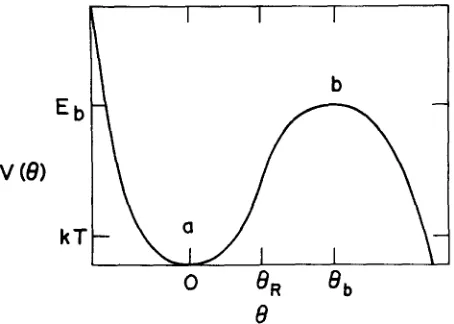
trans-diphenyl-butadiene a barrier exists between the trans and twisted con-figurations. To obtain an analytic solution of Eq. (I) the intramolecular potential is assumed to be piecewise parabol-ic,
(2)
where (J)a and (J)b are the well frequency and barrier
frequen-cy, respectively. The OR is an inflection point, joining two piecewise potentials as shown in Fig. 1. A description of the product well is not necessary20 in a Kramers model.
Kramers assumed that for sufficiently high barriers compared with kT, the probability density in the initial well would decay exponentially with rate constant knr' so that the solution of the stochastic differential Eq. (1) becomes
1.11
knr = 2::
b
~
{[ 1+
(~b
)2] 1/2 -
1 }exP( - Eb/kT) ,(3)
where
/3
is angular velocity correlation frequency.When
/3
approaches a sufficiently large value, the rate becomes inversely proportional to/3
(the Smoluchowski ap-proximation) :(4)
However, for small
/3
the reaction is controlled by energy diffusion as in the Lindeman-Hinshelwood theory28 so that the rate increases monotonically with/3.
In the foregoing simple analysis the multidimensiona-lity is not incorporated into the rate. The partition functions for transition state and reactant will in general be different and this will alter the rate. 22,29 In the present instance we
assume these factors are unity so that the interpretation of
(J) a obtained by fitting data to Eq. (3) is not straightforward.
This competition between the energy controlled and dif-fusion controlled processes results in a turnover of the reac-tion rate. However it is now experimentally suspected that the turnover region can be complicated by density changes.2.22.30 The turnover region was extensively studied by us, but in this paper we will focus on the moderate friction
v
(8)FIG. 1. The schematic potential function diagram ofS-DPB in the excited state, relevant to the Kramers model.
J. Chem. Phys., Vol. 85, No.8, 15 October 1986
Lee et al. : Picosecond photoisomerization 4343
regime for which one would naturally use Eq. (3). The ques-tion addressed here concerns what value of the angular ve-locity correlation frequency {3 should be used when compar-ing experiment and theory.
III. EXPERIMENTAL
Two laser systems were used in this experiment. A time correlated single photon counting (TCSPC) system was em-ployed to measure the fluorescence lifetimes of stiff-diphen-ylbutadiene. The UV excitation pluse at 327 nm was ob-tained by doubling the DCM dye laser pulse in a lithium iodate crystal. Data were collected at 410 nm with magic angle polarization and processed on an IBM personal com-puter. The number of counts in the peak channel of the 512 channels was about 104 and the ratio ofthe counting rate to the repetition rate was less than 1 % for the entire experi-ment. The instrument function was 180 ps and time scale per channel 3.53 ps. Measurements of the fluorescence anisotro-py of the molecule were carried out with the computer con-trolled rotating analyzer and an instrument function of 130 ps; the deconvolution procedure yielded rotational reorien-tation times which agreed well with those obtained from pi-cosecond polarization spectroscopy. The rotational reorien-tation times of trans-stilbene were only measured by the polarization method, largely confirming the values pub-lished earlier on the basis of the fluorescence anisotropy, 31
the details of which are described elsewhere.32 The initially
prepared first singlet excited state (SI) produced by pump-ing at 296 nm was probed with a visible pulse at 592 nm in the region of the Sl"-+Sn transient absorption. The dye laser pulse width was 6--8 ps. The lifetime and reorientation time measurements were performed at 19 and 22.5-24 DC, respec-tively.
E,E-Ditetrahydronaphthylidene-ethane
(stiff-diphen-ylbutadiene): C22H22(mp 144--146°C) was prepared from commercially available a-tetralone (Aldrich) in four steps. Specifically, a-tetralone was converted to I-vinyl-l-tetralol via the method ofNormae3 and in tum treated with
concen-trated hydrobromic acid to afford the 1,3-rearranged allylic bromide. Reaction of the latter with triphenylphosphine led to the phosphonium bromide which was then subjected to Wittig reaction34 with a-tetralone. The purity ofS-DPB was
checked by the excitation wavelength independence of the fluorescence quantum yield. All n-alkane solvents (pen-tane-hexadecane) were obtained from Aldrich. Some sol-vents, not labeled as Gold or Spectroscopic grade were puri-fied by distillation. Those 99% pure solvents showed no detectable differences in the lifetime measurements com-pared with the purified solvents for 327 nm excitation. The radiative decay rate determination required the fluorescence emission spectra of stiff-diphenylbutadiene in hexane and
hexadecane which were recorded by a Perkin Elmer MPF-4 spectrofluorometer. A solution of quinine sulfate in IN H2S04 was used as a fluorescence intensity standard.
IV. RESULTS AND DISCUSSION
A. Photolsomerizatlon dynamics of stlff-DPB
The time constants from the polarization spectroscopy experiments were obtained by deconvolution of the instru-ment functions using a simple numerical procedure. The previously unreported lifetimes of stiff-DPB in various al-kane solvents are shown in Table I. They all satisfactorily fit single exponential decays and gave acceptable values of
X
2•
The nonradiative decay rate was obtained from the inverse of the measured lifetime kobs through the following relation:
kObS = kr
+
knr = F(7J)exp( - Eb1kT)+
k" (5)where kr is radiative rate constant and F( 7J) is a viscosity dependent frequency factor. kr was determined in several solvents from the Strickler and Berg formula35 and the
aver-age value 6.2X 10+8 S-1 was used. This value can be com-pared with the kr for trans-DPB of7.7X 10+8 S-I. The
iso-merization process of diphenylpolyenes usually dominates all other nonradiative pathways and, therefore we will as-sume that the isomerization rate of stiff-DPB is given by the nonradiative rate, although this has not yet been directly measured.
The excited state potential surface of trans-stilbene and diphenylbutadiene has been frequently studied.7
(a) ,36 The
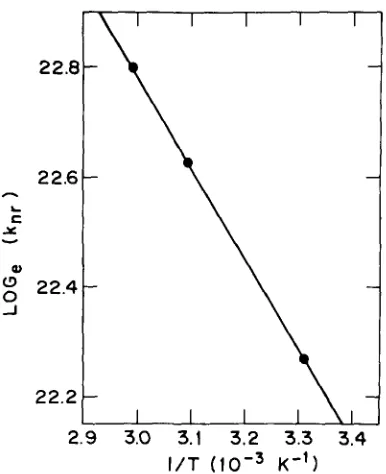
nature of the potential surface ofDPB in the excited state is thought to arise from the avoided crossing of a Bu state with an A g state just as in the stilbene case. The frequency factor F( 7J) depends on viscosity, so the barrier to isomerism can be obtained by an isoviscosity plot which measures the rate in several solvents at the same viscosity but at different tem-peratures. The result of this experiment is shown in Fig. 2, which yields 3.3 kcal mol-1 for the barrier. Figure 3 shows
the isomerization rate as a function of viscosity for stiff-D PB and for stilbene3: in both cases a best fit to Eq. (3) is also
shown.
B. Reorientation time and breakdown of Stokes' law
The decay curve obtained by polarization spectroscopy depends on both the rotational relaxation and fluorescence
TABLE I. Fluorescence lifetimes for stilf-diphenylbutadiene
Viscosity' Lifetime
Solvent (cp) (ps) Xl
n-Pentane 0.226 54 1.09
n-Hexane 0.308 70 1.06
n-Heptane 0.413 88 1.29
n-Octane 0.546 109 1.01
n-Nonane 0.713 131 0.97
n-Decane 0.920 ISS 1.27
n-Undecane 1.176 174 1.02
n-Dodecane 1.488 203 1.13
n-Tridecane 1.865 230 1.00
n-Tetradecane 2.319 261 1.00 n-Pentadecane 2.862 288 1.16 n-Hexadecane 3.505 311 1.21
4344 Lee et al. : Picosecond photoisomerization
22.8
22.6
...
coX
CII (!) 22.4
0 ....J
22.2
2.9 3.0 3.1 3.2 3.3 3.4 liT (10-3 K-1)
FIG. 2. The isoviscosity plot for the radiationless rate constants of stiff-DPB in normal alkanes, a shear viscosity of 1.57 cp was used.
lifetimes. The rotational reorientation time can be obtained from
(6)
where 7' R is rotational reorientation time, 7'p the measured
decay time, and 7'f the known fluorescence lifetime,
tabulat-ed in Table I.
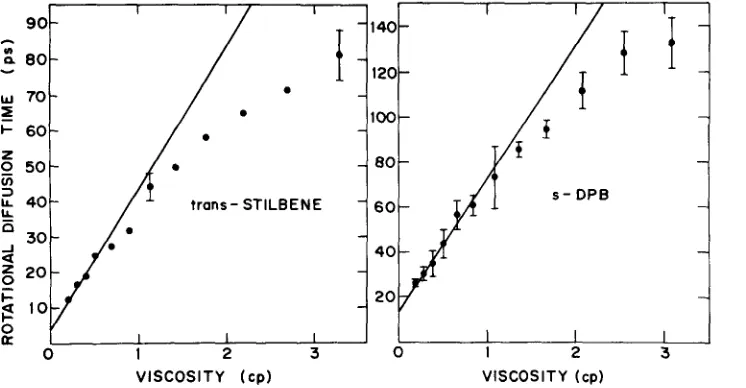
Figure 4 shows the rotational correlation times of stiff-DPB and trans-stilbene in n-alkane solvents as a function of viscosity at 24 and 22.5 ·C, respectively. These plots clearly demonstrate the breakdown of the Stokes-Einstein-Debye relation, because the rotational correlation time is not pro-portional to viscosity and it does not linearly extrapolate to zero at zero viscosity. We will briefly summarize the hydro-dynamic description of rotational motion in a liquid and dis-cuss its applicability to these observations.
According to Stokes' law a particle moving in a contin-uous fluid feels a friction which is a monotonic function of
20
I
on
C1I
0 15
I.l.I
I-~
0:
10
z
0
j:
~
N
0: 5 I.l.I ::E
0
(J)
•
•
0 2 3 0
viscosity. Einstein and Debye extended this idea to the rota-tional motion of the molecule and so the rotarota-tional orienta-tion time is often given approximately by the formula known as SED equation:
7'R = (VhlkT)1], (7)
where Vh is the hydrodynamic volume of the molecule. This relationship has customarily been adjusted by relaxing the following assumptions which are usually invoked in its deri-vation: (a) The shape of molecule: The SED equation as-sumes the rotating molecule is a sticky sphere and Vh is
41Ta3/3, where a is the radius of the molecule. Many mole-cules, such as diphenylpolyenes, are better approximated as ellipsoidal rather than spherical. When the molecule can be treated as a prolate or oblate ellipsoid, the correction for the hydrodynamic volume is given by the Perrin formula37
which contains the axial ratio of the rotor. (b) Changing boundary conditions: The SED equation is based on a stick boundary condition. In other words, the velocity of the sol-vent molecules is zero on the "surface" of the solute. It is experimentally known that this is probably valid only when there is a strong solvent-solute interaction such as hydrogen bonding. Otherwise the slip boundary condition is more ap-propriate. There is no rotational friction on the surface for slip boundary conditions and the rotational correlation time of the perfect smooth hard sphere does not depend on viscos-ity. Of course, for real molecules the rotational friction is never zero on the surface and the solute molecule can dis-place the solvent molecules upon rotation. In addition, it has been reported that there are some cases of partial slip or subslip boundary conditions.38 (c) Free volume effect: The rotational relaxation is a result of collisional events between the solute and the solvent. The discontinuous nature of the solution phase rationalizes the concept of there being, at any instant, free space between the solute and solvent molecules, which lessens the friction, or angular momentum transfer, which may occur only on "contact." Qualitatively, the so-lute molecule can be considered to have a larger probability of being found in a freely rotating state. The leveling off observed in the viscosity dependence of rotational relaxation in condensed media has been explained by this free volume
trons- STILBENE
FIG. 3. The Kramers fit of the photoiso-merization rate of diphenyl-polyenes vs viscosity. (i) The parameters for S-DPB are: 1= 1.l7x 10-44 m2 kg, d = 4.3
A,
and r = 1.8 A. The calculated curve is optimized to the low viscosity region with Wa = 5.0X 10" s-' andWb = 3.0X 10¹² s-'. (ii) The
hydrody-namic parameters for trans-stilbene are taken from Ref. 3, with Wa = 3.5 X 10" s-' andw. = 2.9X 10" s-'.
•
2 3
VISCOSITY (cp) VISCOSITY (cp)
J. Chem. Phys., Vol. 85, No.8, 15 October 1986
Lee et al. : Picosecond photoisomerization 4345
90
~ 80
w 70
:E
I- 60 z
0 50
iii
:::l
40 IJ.. IJ..
0
-J
~
z
0
j:
~
0
a: 0
•
•
•
trans - STILBENE
•
I
o
II
FIG. 4. The rotational diffusion times of diphenylpolyenes in n-alkane solvents as a function of viscosity. The solid lines are the least square fits of the six data points (pentane-decane) for S-DPB and the four data points (pentane-oc-tane) for trans-stilbene corresponding to the most linear regime .
VISCOSITY (cp) VISCOSITY (cp)
effect. The idea of introducing the molecular nature of the solution into the hydrodynamic theory was initiated by
Gierer and Wirtz39 and modified and improved by Dote
et
a/.27 According to the free space model the correction factor
is given as a function of the hydrodynamic volume of solvent and solute. The uncertainty involved in the evaluation of the correction factor may be large.26,27 (d) Free rotor correla-tion time: When a molecule rotates without suffering a colli-sion, classical time correlation function formalism gives a characteristic decay time estimated by the free rotor correla-tion time
rO=
(~)1/2
kT '
(8)
where] R is the moment of inertia about the axis under
consi-deration. The hydrodynamic description of rotational reor-ientation on the other hand gives zero intercept at zero vis-cosity. But experimentally the zero viscosity intercept appears to have some value. This intercept, rR 0, has been suggested to equal r>.40,41
Based on these four factors the modified SED equation is of the form
rR = (VhlkT)1](jC)
+
rR 0, (9)where
f
is a variable parameter depending on molecular shape, C is a dimensionless parameter which accounts for boundary conditions associated with the free volume ef-fect.27 Figure 4 illustrates that r R is linearly proportional tothe solvent shear viscosity in the low viscosity region for the cases studied here. But at higher viscosities than n-octane (stilbene) and n-decane (S-DPB) the rotational reorienta-tion time starts to deviate significantly from linearity. The deviations become important when the solvent molecules are longer than the solutes, so that the hydrodynamic de-scription is not expected to be valid and the SED equation can be expected to break down. This failure of the SED equa-tion has now been observed in many experiments.23-26.38 We suggest that the deviation results from the breakdown of Stokes' law, that is, the effective friction is not a linear func-tion of shear viscosity when the solvent becomes larger than the solute.
The linear portions of the r R vs 1] curves gave slopes of
39 ps/cp for stilbene and 59 ps/cp for S-DPB. The intercepts are 4 and 13 ps for stilbene and S-DPB. These values are 3 to
4 times larger than (/RlkT)
112.
C. Comparison with Kramers model
When the hydrodynamic interaction between two twist-ing groups is ignored, the angular velocity correlation fre-quency in Kramers equation is usually regarded as a reduced friction coefficient given by
{3 =
tTl],
(10)where
tr
is the friction coefficient for the rotation of the twisting group about the relevant axis and] is its moment of inertia. And the hydrodynamics relates the friction constant to the solvent shear viscosity,(11)
where the slip boundary condition was applied. 13
Figure 3 shows the photoisomerization rate of stilbene and stiff-DPB in the series of n-alkane solvents as a function of viscosity. The solid lines are best fit to Eqs. (3), (10), and
( 11) using the parameters noted in the figure captions. The calculated barrier crossing rate deviates significantly from the experimental data in the high viscosity region. Such data were previously suggested to illustrate the breakdown of the
Kramers theory
for stilbene3 and diphenylbutadiene.7 How-ever, it seems reasonable to test the applicability of Stokes' law. This was carried out as discussed in the previous section through measurements of the rotational correlation times of the molecule in the same solvents, as shown in Fig. 4. From this information it is evident that the torsional friction coeffi-cient in Kramers equation cannot be obtained from the mac-roscopic solvent viscosity through Eq. (11). The (reduced) friction constant or angular velocity correlation frequency can be directly related to the rotational reorientation time by the Hubbard relation426kT
{3= - - · rR •
] (12)
4346 Lee et al. : Picosecond photoisomerization
18
16
'
...
1401
0
12
w
~ 10
II::
Z
8
0
f:
<t
N 6
II::
W
~ 4
0
en
2
0 0
0 0
trons -STILBENE
6
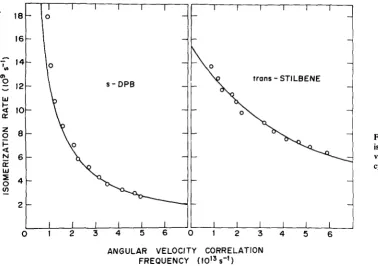
FIG. 5. The Kramers-Hubbard fit oftbe isomerization rate of dipbenyl-polyenes vs angular velocity correlation frequen-cy tJ. calculated from Eq. (12).
ANGULAR VELOCITY CORRELATION FREQUENCY (1013 5-1 )
T R' If the collisions determining the friction have a linear response on the motion along the reaction coordinate in the isomerism process then by choosing I as I R, the angular
ve-locity correlation frequency will be that for the isomerism motion up to a constant value:
(J = 6pkTTR p. (J n' IR
(13)
where we have introduced a constant of proportionality (p) to accommodate the possible differences in the effectiveness of collision in the isomerization and overall rotation process. Equation (12) is obtained from Fokker-Plank theory and was extensively tested by molecular dynamics simulations.43
It is expected to be an exact proportionality in the regime where the angular momentum correlations decay very ra-pidly compared with orientational correlations. Figure 5 shows the variation of the isomerization rates of stiff-DPB and stilbene with angular velocity correlation frequency. The plots in Fig. 5 were obtained by the following procedure: The value of T R for a particular solvent Cn H2n + 2 was used
to calculate a quantity proportional to the angular velocity correlation frequency
/3
for that solvent through Eq. (12).The observed isomerization rate for that solvent was plotted vs (J n in Fig. 5. The solid lines in Fig. 5 are the best fit of Kramers equation (3) to these data points. The variables in the fit are {J)a and {J)b1p. Values of IR = 6.67X lO-44 m2 kg
for S-DPB and 3.4 X 10-44 m2 kg for trans-stilbene were
used. The optimum fit for stilbene yielded {J)aI21TCO
=
196 cm-I and {J)bI21TCo = 176p cm-I and for S-DPB,{J)aI21TCo
=
424 cm- I and {J)bI21TCo=
16p em-I. The quan-tity (J)a cannot be regarded as a molecular frequency forrea-sons given above. In both cases the Kramers-Hubbard fit to the data is excellent.
The Hubbard relation, as we have employed it, implies that the rate of overall tumbling of the molecule is
propor-tional to the decay time of the correlations of the angular momentum in the isomerization coordinate. The rotational diffusion in the case of stilbene corresponds to motion about the axes perpendicular to the longest axis of the molecule. The validity of the assumed proportionality seems to rest on whether or not the isomerization motion is really linearly dependent on the solvent friction or whether the nature of the solvent interaction is modified by motion in the isomeri-zation coordinate. For example, the isomeriisomeri-zation may in-troduce spatial correlations into the solvent. However, in the absence of such nonlinear effects the Hubbard relation is expected to be valid in the present context. Apparently, in the case of the molecule DODCI these conditions do not apply7(b) so there remain interesting questions to address.
v.
CONCLUSIONSThe measured rotational diffusion times of
trans-stil-bene and stiff-diphenylbutadiene in hydrocarbon solvents deviate markedly from the Stokes-Einstein-Debye predic-tion of linearity with viscosity. The breakdown occurs when the solvent starts to exceed the length of the solutes. We have used the rotational diffusion times to obtain the angular ve-locity correlation frequencies appropriate for the isomerism motion and used these in the one dimensional Kramers equation to predict the isomeration rates in each of the sol-vents. The Kramers equation provides an excellent descrip-tion of the data when the derived correladescrip-tion frequencies are used rather than the viscosities. This Kramers-Hubbard fit procedure is expected to be valid ifthe response to the colli-sional forces is linear for both the rotational diffusion and the angular momentum fluctuations associated with motion along the reaction coordinate.
The barrier frequencies are only determined up to a con-stant value in the Kramers-Hubbard fit. The values
ob-J. Chem. Phys., Vol. 85, No. 8,15 October 1986
Lee et al. : Picosecond photoisomerization 4347
tained for stilbene are much more physically acceptable than the previous low values3 if the constant p is chosen around
unity. For S-DPB the low value of fl)b represents an extreme-ly flat barrier, so perhaps in this case p is considerably larger than unity.
The present study does not diminish the importance of frequency dependent friction 13 in the isomerization process.
Rather the emphasis is transferred from the Kramers equa-tion to the Stokes-Einstein-Debye relaequa-tion: We are suggest-ing that the Kramers equation can work well if the appropri-ate angular velocity correlation frequencies are used.
ACKNOWLEDGMENT
We thank Professor David Chandler for helpful discus-sions.
IH. A. Krarners, Physica 7,284 {194O).
2M. Lee, G. R. Holtorn, and R. M. Hochstrasser, Chern. Phys. Lett. 118, 359 (1985).
3G. Rothenberger, D. K. Negus, and R. M. Hochstrasser, J. Chern. Phys.
79,5360 (1983).
4R. M. Hochstrasser, Pure Appl. Chern. 52, 2683 (1980).
sD. P. Millar and K. B. Eisenthal, J. Chern. Phys. 83, 5076 (1985).
6S. Russo and P. J. Thistlethwaite, Chern. Phys. Lett. 106,91 (1984).
7(a) S. P. Velsko and G. R. Fleming, J. Chern. Phys. 76, 3553 (1982); (b) S. P. Velsko, D. H. Waldeck, and G. R. F1erning, ibid. 78, 249 (1983).
8K. M. Keery and G. R. Fleming, Chern. Phys. Lett. 93, 322 (1982).
9J. L. Skinner and P. G. Wolynes, J. Chern. Phys. 72, 2143 (1978).
IOJ. A. Montgomery, D. Chandler, and B. J. Berne, J. Chern. Phys. 70, 4056 (1979).
l1J. S. McCaskill and R. G. Gilbert, Chern. Phys. 44, 389 (1979).
12B. Wilhelmi, Chern. Phys. 66, 351 (1982).
13R. F. Grote and J. T. Hynes, J. Chern. Phys. 73, 2715 (1980).
14B. Carmeli and A. Nitzan, J. Chern. Phys. 79, 393 (1983).
ISJ. T. Hynes, Annu. Rev. Phys. Chern. 36, 573 (1985).
16A. G. Zawadski and J. T. Hynes, Chern. Phys. Lett. 113,476 (1985).
17M. Borkovec and B. J. Berne, J. Chern. Phys. 82, 794 (1985).
18J. E. Straub, M. Borkevec, and B. J. Berne, J. Chern. Phys. 83, 3172 (1985); 84, 1788 (1986).
19B. Bagchi and D. W. Oxtoby, J. Chern. Phys. 78, 2735 (1983).
2Op. B. Visscher, Phys. Rev. B 13,3272; 14, 347 (1976).
21(a) G. W. Robinson, W. A. Jalenak, and D. Statman, Chern. Phys. Lett.
110,135 (1984); (b) D.StatrnanandG. W. Robinson,J. Chern. Phys. 83,
655 (1985).
22(a) J. Schroeder and J. Troe, Chern. Phys. Lett. 116, 453 (1985); (b) G. Maneke, J. Schroeder, J. Troe, and F. Voss, Ber. Bunsenges. Phys. Chern.
89,896 (1985).
23T. J. Chuang and K. B. Eisenthal, Chern. Phys. Lett. 11, 368 (1971).
24S. A. Rice and G. A. Kenny-Wallace, Chern. Phys. 47,161 (1980).
2sD. H. Waldeck and G. R. Fleming, J. Phys. Chern. 85, 2614 (1981).
26J. A. Philips, S. P. Webb, andJ. H. Clark, J. Chern. Phys. 83, 5810 (1985).
27J. L. Dote, D. Kivelson, and R. N. Schwartz, J. Phys. Chern. 85, 2169 (1981).
28See, for example, P. J. Robinson and K. A. Holbrook, Unimolecular Reac-tions (Wiley-Interscience, New York, 1972).
29L. R. Khundka, R. A. Marcus, and A. H. Zewail, J. Phys. Chern. 87, 2473 (1983).
30(a) S. H. Courtney and G. R. Fleming, J. Chern. Phys. 83, 215 (1985);
(b) G. R. Fleming, S. H. Courtney, and M. W. Balk, J. Stat. Phys. 42, 83 (1986).
31D. K. Negus and R. M. Hochstrasser, J. Lurnin. 31, 3 (1984).
32A. J. Bain, P. J. McCarthy, and R. M. Hochstrasser, Chern. Phys. Lett.
125,307 (1986).
33A. Marcou and H. Normant, Bull. Soc. Chirn. Fr. 3491 (1965).
34J. I. G. Cadogan, Organophosphorous Reagents in Organic Synthesis
(Academic, New York, 1979).
3SJ. Strickler and R. A. Berg, J. Chern. Phys. 37, 814 (1962).
36G. Orlandi and W. Siebrand, Chern. Phys. Lett. 30, 352 (1975).
37p. F. Perrin, J. Phys. Radium 5, 497 (1934); 7,1 (1936).
38S. Canonica, A. A. Schmid, and U. P. Wild, Chern. Phys. Lett. 122, 529 (1985).
39 A. Gierer and K. Wirtz, Z. Naturforsch. Teil A 8, 532 (1953).
4°D. R. Bauer, J. I. Braurnan, and R. Pecora, J. Am. Chern. Soc. 96, 6840 (1974).
41 B. J. Berne and R. Pecora, Dynamic Light Scattering (Wiley, New York,
1976).
42p. S. Hubbard, Phys. Rev. 131,1155 (1963).
43J. O'Dell and B. J. Berne, J. Chern. Phys. 63, 2376 (1975).
"Selected Values of Physical and Thermodynamic Propenies of Hydrocar-bon and Related Compounds, edited by F. D. Rossini (American