554 | P a g e
APPENDIX-II
An Improved Method for Outdoor Scene Image
Segmentation using Graph Cut technique
M. Tejasvini
1S.M.RIyazoddin
2M.Janga Reddy
2CSE,CMR Institute of Technology Hyderabad,India
ABSTRACT
In this paper enhanced method for outdoor scene image segmentation using graph cut in analyzed and
improved. The basic objective is to make the distinction between the structured and unstructured images such as
sky, ground, vegetation and buildings people etc. respectively of the outdoor scene images based on their color
and texture information. This paper shows the comparison of results obtained using graph cut method, graph
cut based on color information and also with other techniques of image segmentation such as Clustering
techniques and threshold techniques. A graph cut is the process of partitioning a directed or undirected graph
into disjoint sets. The results obtained by using graph cut with color information are found to be accurate and
satisfactory which highlights the foreground and darkens the background.
Keywords
—
Image segmentation, Threshold Techniques, Clustering techniques, Graph cut method
etc
I. INTRODUCTION
Image segmentation is one of the fundamental problems for computer vision. A primary goal of image
segmentation is to partition an image into various regions of coherent properties so that each region corresponds
to an object or area of our interest. [10]. In general, objects in outdoor scenes can be divided into two categories,
namely, unstructured objects (e.g., sky, roads, trees, grass, ground etc.) and structured objects (e.g., vehicles,
buildings, people, etc.). Unstructured objects usually consist of the backgrounds of images. The background
objects have nearly homogenous surfaces and are distinct from the structured objects in images. Segmentation
algorithms are based on two basic properties of intensity values discontinuity and similarity. 1st category is to
partition an image based on abrupt changes in the intensity. 2nd category is based on partitioning an image into
regions that are similar according to the predefined criteria. Histogram Threshold approach falls under this
category. In this we have taken second category (threshold techniques). Threshold segmentation techniques can
be grouped in three different classes:
1. The Local techniques are based on the local properties of the pixels and their neighborhoods
2. The Global techniques segment an image on the basis of information obtain globally (e.g. by using image
histogram; global texture properties ).
3. Split, merge and growing techniques use both the motions of homogeneity and geometrical proximity in
order to get good segmentation results. Finally image segmentation, say a field of image analysis, is used to
555 | P a g e
They proposed an auto-adaptive threshold method of two dimensional (2-D) histogram based on
multi-resolution analysis (MRA), by decreasing the calculation complexity of 2-D histogram whereas improving the
searching precision of multi-resolution threshold method. Such method can originates from the extraordinary
segmentation effects achieved by 2-D histogram threshold segmentation method through the spatial correlation
of gray level and the flexibility as well as efficiency of the threshold searching of multi-resolution threshold
segmentation method. Experimental results demonstrated that such a method can obtain segmentation results
similar with the exhaustive 2-D histogram methods, whereas the calculation complexity decreases exponentially
with the increase of resolution level [12]. The image threshold problem is treated as an important issue in image
processing, and it not only reduces the image data, but also lays a good foundation for target recognition and
understanding images. Character of both the local threshold segmentation and global threshold was analyzed in
image segmentation. A new threshold statistic iterative arithmetic is presented to overcome the direct worth
method in threshold, aiming at bigger arithmetic figure in ratio in a variety in gray of background image.
Statistics iterative threshold segmentation based on Gauss statistics distributing and image gray histogram,
obtain the expression of statistics iterative method in theory and the best worth threshold method and steps.
Aviation image was threshold segmentation using adaptive method
,
histogram technique and statistic iterativearithmetic respectively. Compared three threshold results, it shows that statistic iterative method greatly
improved the anti-noise capability of image segmentation and have good result to the image of the worth and
not easy to segment in full value threshold method [4].
Threshold techniques can be categorized into two different classes: global threshold and local or adaptive
threshold. In the global threshold, a single threshold value is used in an image. In the local or adaptive threshold,
a threshold value is assigned to each pixel to determine whether it belongs to the foreground or the background
pixel using local information around the pixel basically it groups the pixels having nearly same values.Because
ofimplementation, the the advantage of simple and easy global threshold has been a popular technique since
many years [5][6][7].
Bias correction is the procedure to estimate the bias field and restore true signals, thereby eliminating the side
effects of the intensity in homogeneity [2][3]. Among all the various bias correction methods, those based on
segmentation are more attractive. Segmentation and bias correction can be obtained by a level set evolution
process. A salient advantage of this method is the smoothness of computed bias field is ensured by the
normalized convolution [8] without giving extra cost. Moreover, the evolution is less sensitive to the
initialization, thus well suited for the automatic applications
.
II . THRESHOLD TECHNIQUES
Threshold is one of the most popular methods for image segmentation. It is useful in differentiating foreground
from the background. By selecting a proper and adequate threshold value T, the gray level image is converted
into binary image. The binary image contains all the essential information about the position and shape of the
objects of interest (foreground). It is advantageous to obtain first a binary image as it reduces the complexity of
the data and simplifies the process of recognition. The most common way to convert a gray-level image to
556 | P a g e
black, and those above T will be white. The segmentation problem becomes one of selecting the proper value
for the threshold T. A frequent method used to select T is by analyzing the histograms of the type of images that
want to be segmented. When the histogram presents only two dominant modes and a clear valley is the ideal
case. In this case the value of T is selected as the valley point between the two modes. Histograms are more
complex, with many peaks and not clear valleys in ideal cases, and are not always easy to select the threshold
value. The results of threshold techniques both global and local are shown in fig (d) and fig (e).
2.1 Automatic Thresholds –
In this the threshold value for each image is selected automatically by the system without human intervention is
called an automatic threshold scheme. This requires the knowledge about the sizes of the objects, intensity
characteristics of the objects, fractions of the image occupied by the objects and the number of different types of
objects appearing in the image. Then automatic threshold is possible and is the simplest way of threshold.
2.2 Threshold Techniques
Threshold technique is one of the important techniques in image segmentation. Threshold technique can be
expressed as:
Let
T
T
t
1,
t
2,
g
t
1,
t
2
,
f
(
t
1,
t
2)
where T is the threshold value Where: T.t
1,
t
2 are the coordinatesof the threshold value point. g (
t
1,
t
2) ,f(t
1,
t
2) are points the gray level image pixels.Threshold image I(t
1,
t
2) can be defined: In Global threshold technique only one threshold value is selected T .The region having pixelvalues belowthis threshold value T will be considered as background and the region having pixel values above
this threshold value T will be considered as foreground or object.
In local or adaptive threshold method more than one threshold values are required. Some methods for selecting
the threshold values are as follows:
2.2.1) Mean Technique
This technique uses the mean value of the pixels as the threshold value and works well in strict cases of the
images that have approximately half to the pixels belonging to the foreground and the other half to background.
This technique is rarely being used now a day.
2.2.2) Histogram Technique
The histogram technique is dependent on the success of estimating the threshold value that separates the two
homogonous region of the image that is foreground and background. This required, the image formation be of
two homogonous and well-separated regions and there exists a threshold value that separated these regions. The
histogram technique is suitable for image with large homogonous and well separate regions where all area of the
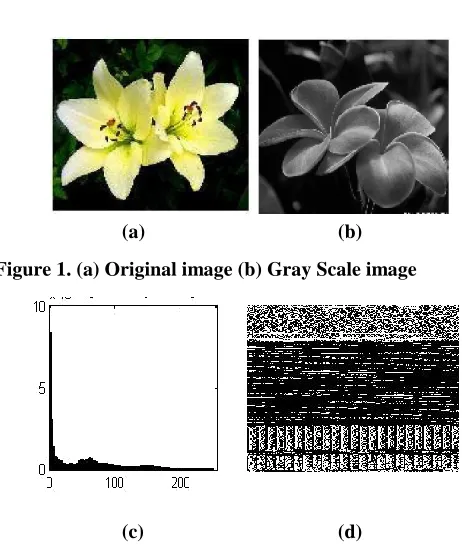
objects and background are homogonous and except the area between the objects and background. The fig(c)
shows histogram of original image.
2.2.3) EMT Technique
When there is more than one homogenous region in an image EMT technique is used or where there is a change
on illumination between the object and background. In this portion of the object may be merged with the
background or portions of the background may as an object. To this reason any of the automatic threshold
557 | P a g e
regions. This techniques segmentation depend on the research about the maximum edge threshold in the image
to start segmentation that image with help the edge detection techniquesoperators.
III. CLUSTERING TECHNIQUES
Clustering is nothing but grouping of similar pixels in an image. By Using Clustering technique for image
segmentation it forms clusters of similar value pixels. There are various techniques available for clustering such
as Hierarchical Clustering, K-mean clustering etc among which K-mean clustering is most popularly used and is
the standard clustering technique. This process can be repeated for fixed number of iterations. The result of
K-mean clustering is as shown in fig (b).
IV. GRAPH CUT METHODS
The process of partitioning a directed or undirected graph into disjoint sets is known as Graph cut method. It is a
very popular approach as it minimizes an energy function consisting of a data term and a spatial coherency term.
Many low-level vision problems can be posed as finding energy minimizing cuts in graphs these techniques
have received a lot of attention in the computer vision community Graph cut methods have been successfully
applied to image restoration, stereo, image segmentation and texture synthesis. The results of Graph cut method
is as shown in fig (c).
V. RESULTS
(a) (b)
Figure 1. (a) Original image (b) Gray Scale image
(c) (d)
558 | P a g e
Fig. 3.(a) Local Threshold (b) K-mean clustering
Figure 4 Graph cut Method
V. CONCLUSION
A comparative study of outdoor image segmentation by using threshold segmentation techniques: Global and
Local technique, clustering technique and Graph Cut method of image segmentation and tried to make the
distinction between structured i.e foreground images and unstructured i.e. background. Because of the
advantage of simple and easy implementation, of threshold techniques along with Graph cut technique found to
be more significant in making the distinction. Further work can be done in order to improve and obtain more
accurate results in recognizing background and foreground in an outdoor scene image.
REFERENCE
[1]. Purnashti Bhosale , Aniket Gokhale “Segmentation of Color Images Based on Different Segmentation
Techniques “International Journal of Electronics and Computer Science Engineering ISSN
2277-1956/V2N2-640-644
[2]. Gonzalez and Woods, "Digital image processing", 2nd Edition,prentice hall, 2002. Kenneth R. Castelman,
"Digital image processing", Tsinghua Univ Press, 2003.
[3]. Shuqian He, Jiangqun Ni, Lihua Wu, Hongjian Wei ,Sixuan Zhao.," Image threshold segmentation method
with 2-D histogram based on multi-resolution analysis", Computer Science & Education, ICCSE, 25-28
July 2009, PP.753 – 757,Nanning, China..
[4]. Guang Yang, Kexiong Chen, Maiyu Zhou, Zhonglin Xu, Yongtian Chen, "Study on Statistics Iterative
Thresholding Segmentation Based on Aviation Image," snpd, vol. 2, pp.187-188, Eighth ACIS International
Conference on Software Engineering, Artificial Intelligence,Networking, and Parallel/Distributed
Computing (SNPD2007), 2007.
559 | P a g e
Computer Vision, Graphics, and Image Processing, Vol.47, PP.22-32, 1989.
[6]. J. Kittler and J. Illingworth, “Minimum Error Thres holding”, Pattern Recognition, Vol.19, No.1, PP.41- 47,
1986.
[7]. K.H. Liang and J.J.W Mao, “Image Thresholding by Mi nimizing the Measures of Fuzziness”, Pattern
Recogn ition, Vol.28, No.1, PP.41-51, 1995.
[8]. Du Gen-yuan,Miao Fang,Tian Sheng-li,Guo Xi-rong.,"Remote Sensing Image Sequence Segmentation
Based on the Modified Fuzzy C-means", Journal of Software, Vol. 5, No. 1, PP.28-35, 2009.
[10]. K.Shah, “Performance modeling and algorithm cha racterization for robust image segmentation,” Int. J.