An Efficient way of Virtual Client Tracking
Mechanism using Desktop Virtualization
P.Kasthuri1, N.Anu2, B.Koormisha3, Sudharson K4., Asst. Prof.
Department of CSE, T.J.S Engineering College, Chennai, India1,2,3,4
ABSTRACT: RMS (Remote Management System) is a intranet-based remote laboratory environment for technical education. The necessary architecture to maintain academic integrity and imparting quality laboratory education via remote laboratories involving the instructor, faculty, and the students has been discussed. Intranet-based laboratory teaching and learning may be augmented by virtualization protocols for teacher-student interaction. Remote laboratory management system ensuring quality of service, security, and monitoring of student progress has been proposed. The main contribution of this paper is to develop a reference model which may help the educators to monitor the student system activities and even to control the student through remote messages; it can be sent to the student via chat application. RMS (Remote Management System) is an administrative tool that is platform independent, which is designed to facilitate the system administrators to install software and troubleshoot the problems from the server side.
KEYWORDS: RMS, RDP, VNC, Remote, Client, Server,Desktop, Desktop-as-a-Service.
I. INTRODUCTION
CELLULAR phones have shown a dramatic improvement in their functionality to a point where it is now possible to have cellular phones execute Java programs. As a result, cellular users throughout the world are now able to read and write e-mail, browse Web pages, and play Java games using their cellular phones. This trend has prompted us to propose the use of a cellular phone as a device for remotely controlling computers. For example, if a cellular user is able to remotely access computers (such as workstations in offices and personal computers (PCs) in homes) or other networked digital appliances, it would provide the user with the following capabilities:
• To see the contents of a file placed on the desktop of a remote computer
• To reboot a remote server as an administrator
This project presents a virtual network computing (VNC) based architecture for accessing the desktop of remote systems MS-Windows from a server. It is assumed that the remote computer system is running a VNC server and that it is attached to a network. The admin or user can see and manipulate the desktop on the remote place.
The most sophisticated form of remote access enables users on one computer to see and interact with the actual desktop user interface of another computer. Setting up remote desktop support involves configuring software on both the host (local computer controlling the connection) and target (remote computer being accessed). When connected, this software opens a window on the host system containing a view of the target's desktop.
Current versions of Microsoft Windows include Remote Desktop Connection software. However, this software package only supports target computers running Professional, Enterprise or Ultimate versions of the O/S, making it unsuitable for use with many home networks. For Mac OS X computers, the Apple Remote Desktop software package is also designed for business networks and sold separately. For Linux, various remote desktop software exists.
remote system administrate tasks can also be performed from the cellular phone. Whether you are travelling on business or you are out of office, this system will give you the right solution to keep you connected. In computing, this is a graphical desktop sharing system which uses the protocols to remotely control another computer, but now we are trying to implement access to remote computers from Android phones. It transmits the keyboard and mouse events from remote computer to cellular phones. This system makes use of Virtual Network Computing.VNC are platform-independent — a VNC is a viewer on any operating system and can usually connect to a VNC server on any other operating system.
There is a server in Java that can be used to communicate to any operating system running Java. This system can be use to remote technical support and getting access to files on remote computer.
Many remote desktop solutions are based on Virtual Network Computing (VNC) technology. Software packages based on VNC work across multiple operating systems. The speed of VNC and any other remote desktop software can vary, sometimes performing effectively the same as the local computer but other times exhibiting sluggish responsiveness due to network latency.
II. EXISTING SYSTEM
In Existing System controlling the experiment instrumentation through a computer interface, using virtual instrumentation or virtual reality environments; and directly controlling the experiment instrumentation by remote access to control software[6]. [1] Borting Chen et al., proposed a
Desktop Application Service (DAP) Framework. The framework components manage desktop applications and interact with browsers. Service Manger - The service manager processes application requests and manages the applications’ life cycle to support a Web server in hosting multiple desktop applications simultaneously. Service Agent - The service agent converts the graphical output of an application to Web content, allowing a browser to render the application window inside its viewing area. It provides for multiuser access. Several virtual machines are installed on the central server and connected to experiments. Users can access all the experiments through the regular web browser from any remote computer without any additional soft-ware. The LabShare Sahara Web-interface includes real-time audio/visual monitoring tools to provide the users more realistic perception of experiments [7]. JING MA AND JEFFREY V. NICKERSON says simulated labs are the imitations of real experiments. The entire infrastructure required for laboratories is not real, but simulated on computers. Remote labs are characterized by mediated reality. Similar to handson labs, they require space and devices[8]. [9] Ingvar Gustavsson, et al, says free access to online experimental resources as a supplement to the equipment in traditional laboratories. A Laboratory Using Remote Desktop, Collaborative Remote Laboratories.[10] Cheng-I Chen, The installation of numerous terminal units usually would increase the cost for the wide-area measurement., Remote Installation , Arsen Melkonyan, et al, says Remote connectivity services to lab providers using a Relay Gateway Server Architecture and they designed new Remote desktop architecture[11]. [2] Bernhard Egger et al. proposed a check pointing method for efficient process. The Efficient Check pointing Method to reduce space and time of running VMs
David Roth proposed VDI- Virtual Desktop Infrastructure implementation the desktop images are accessed over a network using a remote desktop protocol Desktop-as-a-Service (DaaS) – Cloud based virtual. Desktop Comparison of both VDI and DaaS. Bei Guan et al., proposed VMM(Virtual Machine Monitor)
Communication-aware inter-VM scheduling (CIVSched) technique that takes into account the communication behavior between inter-VMs running on the same virtualization platform.
Limitations of Existing System:
• No Interaction between student and staff
• Educator only Monitor cannot control the student activities.
• At a time only one user desktop has been captured.
• Server cannot access the multiple clients simultaneously.
This paper is organized as follows. Section III Proposed Model, Section IV Techniques and Section IV show an experimental result and future enhancement.
III. PROPOSED MODEL
The principle of mobile cloud computing physically separates the user interface from the application logic. Virtual network computing (VNC) is a desktop sharing system which uses the RFB (Remote Frame Buffer) protocol to remotely control another computer. It transmits the user events from one computer to another relaying the screen updates back in the other direction, over a network using Buffered IO Stream.
In a mobile cloud computing environment, the remote display protocol deliver complex multimedia graphics over wireless links and render these graphics on a resource constrained mobile device. Offloading applications to the cloud is a straight forward way to save on energy consumption because the amount of local processing is reduced. Efficient compression techniques to reduce the amount of exchanged data are done using compression techniques and versatile graphics encoding, downstream data peak reduction and Optimization of upstream packetization overhead.
Virtual Network Computing protocol is used to access Graphical User Interface of remote computer. It is based on the concept of a Remote Frame Buffer or RFB. The system will use Remote method invocation (RMI) and screen image capturing techniques of API‟s to implement VNC. All functions such mouse clicking, opening files, Playing media can be perform on server computer
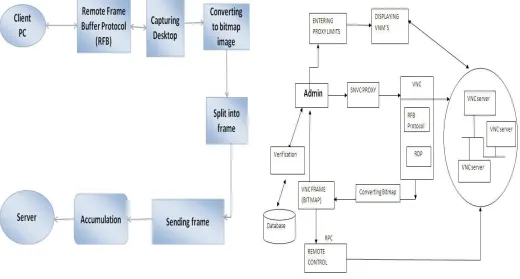
While developing the system portability was the main aim of our system. To achieve portability targeting the architecture was main issue, we proposed a VNC based architecture. VNC is an implementation of a remote display system based on a Remote Frame Buffer (RFB) protocol. It consists of VNC servers running on one or more remote computers, a Smart VNC (SVNC) proxy, and a SVNC viewer on Server. A VNC server sends a remote desktop display as bitmap images in RFB protocol. A SVNC proxy converts the display image and then transfers the converted image to a SVNC viewer in response to a user request that was received from that SVNC viewer. Then, the SVNC viewer displays the transferred images. Key events received by the SVNC viewer are transmitted to a SVNC proxy that coverts them and sends them to the server. When the user first tries to connect to a remote computer, he must specify his user name and password for authentication as well as the host name of the computer that is running a VNC server. If authentication succeeds, the SVNC proxy establishes a session with the VNC server and the SVNC viewer starts user services. Usually, color display images are transferred from the SVNC proxy to the SVNC viewer. However, while the user is manipulating the remote desktop, such as scrolling and moving the pointing device, the display images are gray-scaled to reduce the number of bytes required to encode the image.
IV. DESIGN TECHNIQUES
A) RFB PROTOCOL
the design of the RFB protocol is to make very few requirements of the client. In this way, clients can run on the widest range of hardware, and the task of implementing a client is made as simple as possible. The protocol also makes the client stateless. If a client disconnects from a given server and subsequently reconnects to that same server, the state of the user interface is pre- served. Furthermore, a different client endpoint can be used to connect to the same RFB server. At the new endpoint, the user will see exactly the same graphical user interface as at the original endpoint. In effect, the interface to the user's applications becomes completely mobile. Wherever suitable network connectivity exists, the user can access their own personal applications, and the state of these applications is preserved between accesses from different locations. This provides the user with a familiar, uniform view of the computing infrastructure wherever they go.
Fig. 1. SYSTEMARCHITECTURE
Fig. 2. RFB PROTOCOL
ARCHITECTURE B) Desktop viewing module
The computer screens view is fragmented into 8 to 16 parts to synchronize with the display area of the server using Remote frame buffer protocol (RFB). A VNC server sends a remote desktop display as bitmap images in RFB protocol. A SVNC proxy converts the display image and then transfers the converted image to a SVNC viewer in response to a user request that was received from that SVNC viewer.
V. EXPERIMENTAL RESULTS
high quality and low latency compare to windows remote desktop software. The performance also increased while capturing the desktop, without any delay the desktop has been viewed in the server. Conventional desktop applications are redesigned as a portable view.
Also we can access the full functionality of the desktop system. So we use internet connection and some the protocols are used for effective communication. This process increases the reliability, and able to access the full functionality of the desktop system of anywhere in the organization i.e., we can able to access the remote desktop system.
Here we have captured the desktop of our Lab PC with high quality with low latency; we have proved that our virtualization technique will give significant performance over all other desktop virtualization.
VI. CONCLUSION AND FUTURE ENHANCEMENT
This project developed in java so it can support any platform to run, it is useful in monitoring the activities of student in lab and it can be used for Remote classroom education, it can have so many real time applications like teleconferencing, remote maintenance etc., we limited the desktop capturing technique in standalone PC, further we enhance this technique to capture the PC desktop via mobile and capture mobile screen from another mobile device etc., Already many work is going for capturing desktop in mobile application but it is having only limited functionalities but we focus our research to capture the desktop of PC in mobile with full functionalities.
REFERENCES
[1] Borting Chen, Ho-Pang Hsu, and Yu-Lun Huang, National Chiao Tung University, “Bringing Desktop Applications tothe Web”, IEEE computer society, 0018-9340, 2016.
[2] Bernhard Egger, Eunbyung Park, Younghyun Jo, Changyeon Jo, and Jaejin Lee, Seoul National University, Seoul, Korea, “Efficient Check pointing of Live Virtual Machines‖, IEEE Transactions on Computers, 0018-9340,Pg: 3041 - 3054 Jan-Feb 2016.
[3] Arsen Melkonyan, Student Member, IEEE, Andreas Gampe, Murillo Pontual, Grant Huang, Student Member, IEEE, and David Akopian, Senior Member, IEEE “Facilitating Remote Laboratory Deployments Using a RelayGatewayServerArchitecture‖,IEEE
TRANSACTIONS ON INDUSTRIAL ELECTRONICS, VOL. 61, NO. 1, JANUARY 2014
[4] Virtual Desktop Computing, DIRECTOR OF CLOUD PRODUCT MARKETING, ASG Software Solutions,USA -White Paper - by David Roth, Dec 2014.
[5] Bei Guan, Jingzheng Wu, Yongji Wang, and Samee U.Khan, Senior Member,IEEE,” CIVSched: A Communication-aware Inter-VM Scheduling Technique for Decreased Network Latency between Co-located VMs‖, Citation information: DOI 10.1109/TCC.2014.2328582, IEEE Transactions on Cloud Computing
[6] Arsen Melkonyan, Student Member, IEEE, AndreasGampe, Murillo Pontual, Grant Huang, Student Member, IEEE, and David Akopian, Senior Member, IEEE“Facilitating Remote Laboratory Deployments Using a RelayGatewayServerArchitecture‖,IEEE
TRANSACTIONS ON INDUSTRIAL ELECTRONICS, VOL. 61, NO. 1, JANUARY 2014
[7] Cheng-I Chen, Member, IEEE, “Design of Measurement System Based on Signal Reconstruction for Analysis and ProtectionofDistributedGenerations‖,IEEE
TRANSACTIONS ON INDUSTRIAL ELECTRONICS, VOL. 60, NO. 4, APRIL 2013
[8] Federico Lerro, Susana Marchisio, Sebastián Martini, Horacio Massacessi, Emmanuel Perretta, Andrés Gimenez,Nicolás Aimetti, and Juan Ignacio Oshiro―Performing Real Experiments From a Remote Learning ManagementSystem―,IEEEREVISTA
IBEROAMERICANA DE TECNOLOGIAS DEL APRENDIZAJE, VOL. 9, NO. 1, FEBRUARY 2014
[9] Bei Guan, Jingzheng Wu, Yongji Wang, and Samee U.Khan, Senior Member,IEEE,” CIVSched: A Communication-aware Inter-VM Scheduling Technique for Decreased Network Latency between Co-located VMs‖, Citation information: DOI
10.1109/TCC.2014.2328582, IEEE Transactions on Cloud Computing
[10] V. S. Pendyala and S. S. Y. Shim, ―The Web as the Ubiquitous Computer,‖ COMPUTER, vol. 42, no. 9, pp.90–92, SEP, 2009. [11] [11] F. Lamberti and A. Sanna, ―A streaming-based solution for remote visualization of 3D graphics on mobile
devices,‖ IEEE TRANSACTIONS ON VISUALIZATION AND COMPUTER GRAPHICS, vol. 13, no. 2, pp. 247–260, MAR- APR 2007. [12] H. Kawashima, K. Koshiba, K. Tuchimochi, K. Futamura, M. Enomoto, and M. Watanabe, ―Virtual PC-type thin client system,‖ NEC
TECHNI-CAL JOURNAL, vol. 2, no. 3, pp. 42–47, SEP 2007.
[13] P. Simoens, F. A. Ali, B. Vankeirsbilck, L. Deboosere, F. De Turck, B. Dhoedt, P. Demeester, and R. Torrea-Duran, "Cross-Layer Optimization of Radio Sleep Intervals to Increase Thin Client Energy Efficiency," IEEE COMMUNICATIONS LETTERS, vol. 14, no. 12, pp. 1095-1091, DEC 2010.
[15] Virtual Desktop Computing, DIRECTOR OF CLOUD PRODUCT MARKETING, ASG Software Solutions,USA -White Paper - by David Roth, Dec 2014.
[16] M. Mitrea, P. Simoens, B. Joveski, J. Marshall, A. Taguengayte, F. Pre-teux, and B. Dhoedt, "BiFS-based approaches to remote display for mobile thin clients," in Proceedings of the SPIE - The International Society for Optical Engineering, vol. 1444, 2009, p. 14440F (8pp.).
[17] G. Paravati, C. Celozzi, A. Sanna, and F. Lamberti, "A Feedback-Based Control Technique for Interactive Live Streaming Systems to Mobile Devices," IEEE Transactions On Consumer Electronics, vol. 56, no. 1, pp. 190-191, FEB 2010.
[18] A. Boukerche, R. W. N. Pazzi, and J. Feng, "An end-to-end virtual environment streaming technique for thin mobile devices over heterogeneous networks," Computer Communications, vol. 31, no. 11, pp. 2116-2125, JUL 15,2008.
BIOGRAPHY