Response of Flexible Base with Different
Shapes of Raft Footing: A Soil Structure
Interaction Analysis
Gaurav D. Dhadse
1Assistant Professor, Department of Applied Mechanics, Govt. College of Engineering, Jalgaon, Maharashtra, India
ABSTRACT: Soil-structure interaction is a complex phenomenon, which involves mechanism of interaction between various components of a building system. In common, design practice interaction between soil, foundation and structure is neglected to simplify the structural analysis. A stress analyst generally ignores the influence of the settlements of supporting soil on the structural behavior of the super-structure. But due to flexible soil the differential settlements, rotation of footing and stiffness of the frame cause redistribution of forces/stresses in the frame members. A more rational solution of a soil-structure interaction problem can be achieved by appropriate analysis. In this paper the response of flexible base with different shapes of Raft footing is discussed. A ten story building with various shapes of raft are taken into consideration. The ten storeyed frame comprises of 3 bays x 3 bays. The footing is assumed to be embedded in the cohesive soil mass. For the purpose of the analysis, a simplified idealization ismade in the theory of finite elements. The, beams and columns of the superstructure frame and footing of the sub-structure are idealized as the two dimensional plane elements (Plane 82). The soil mass is idealized by Plane 82. The effect ofdifferent shapes of raft footing on flexible base is evaluated through Interaction Analysis. The response of the soil mass includes the displacement and stress analysis. In addition, optimum shape of raft is decided from displacement and stress analysis.
KEYWORDS: Foundation, Frame, shapes of Raft Footing, Simplified Models, Soil-Structure Interaction (SSI), Displacement, stress, optimum shape, etc.
I. INTRODUCTION
Foundation is the interface between the superstructure and the ground. Its task is to transfer the building loads safely into the ground and to keep settlement within the permissible limit. It supports superstructure weight, resists horizontal forces from the adjacent ground and forces imposed on foundation due to wind and earthquake. Raft foundation is one of the most effective types of foundation. It carries the load to the soil with out differential settlement in the soil. Raft is used where the base soil has low bearing capacity and where the bearing capacity of raft is satisfactory but settlement is not within permissible limits. Thus in this paper response of soil mass for different shapes of raft footing is demonstrated. Many a times it is observed raft footing is not economical as compare to combine or isolated footings, thus it is decided to vary shapes of raft and provide optimum shape of raft for optimum stress and displacement by soil structure interaction analysis using Finite Element Method. A ten story building with various shapes of raft are taken into consideration. The ten storeyed frame comprises of 3 bays x 3 bays. The raft footing is assumed to be embedded in the cohesive soil mass. Basically there are five different shapes of raft slab are considered on the basis of cross-sectional area i.e. Actual raft = 13.05 sq.m., A1 = 9.075sq.m., A2 = 10.95 sq.m., A3= 10.90sq.m., A4 = 6.9250sq.m.All the models are analysis by FEM using ANSYS as analysis tool.
II. LITERATURE SURVEY
had worked on shape optimization of raft footing after interaction analysis. Thus in this paper response of different shape of raft on soil mass is analysed through interaction analysis and results are correlated to provide the optimum shape of raft. Following are some literature, which are studied during analysis.
ChinmayiH.K et.al. (2013) studied Structural failures during earthquakes in the past demonstrated the importance of soil-structure interaction (SSI) effects and its consideration to avoid failure and ensure safety. The present study focuses on SSI analysis of RC frame shear wall building over raft foundation subjected to seismic loading. Multi story buildings symmetric in plan of height below 45m, located in seismic zone V according to IS1893:2002 are considered. The stress resultants in the structure and raft foundation considering SSI are compared with stress resultants obtained by the conventional method of analysis assuming rigidity at the base of the structure. The results show the significance of SSI effect [1].
Pallavi Ravishankar et. al. (2013) said that Tall asymmetric buildings experience more risk during the earthquakes.This happens mainly due to attenuation of earthquake waves and local site response which get transferred to the structure and vice versa. This can be well explained by the Dynamic Soil Structure Interaction (DSSI) analysis. In this research paper 150 m tall asymmetrical building with two different foundation systems like raft and pile is considered for analysis and assuming homogeneous sandy soil strata results are studied for input of Bhuj ground motion (2001, M= 7.7). The response of structure in terms of SSI parameters under dynamic loading for a given foundation systems has been studied and compared to understand the soil structure interaction for the tall structures. It has been clearly identified that the displacement at top is more than that at bottom of the building and stresses are more at immediate soil layer under foundation than the below layers [2].
Mohd Ahmed et.al. (2014) studied the analysis of building structure in contact with soil involves an interactive process of stresses and strains developed within the structure and the soil field. The response of Piled-Raft Founda- tion system to the structure is very challenging because there is an important interplay between the component of building structure and the soil field. Herein, soil-foundation-structure interac- tion of buildings founded on Piled-Raft Foundation is evaluated through 3D-Nonlinear Finite Ele- ment Analyses using PLAXIS3D FOUNDATION code. The soil settlements and forces demand of the high-rise building structures and foundation is computed. The parametric study affecting the soil- foundation-structure response has been carried out. The parameters such as construction phasing, sequential loading, building aspect ratios, soil failure models and thickness proportion of soil field stiff layer, are considered. It is concluded that the interaction of building foundation-soil field and super-structure has remarkable effect on the structure [3].
SeitzK.-F. (2015) presents the topology optimization for the design of two dimensional basic geotechnical structures. The SIMP method is applied in order to optimize the structures’ topologies concerning their deformational behaviour within the serviceability state. The finite element analysis is conducted with Abaqus standard using a hypoplastic constitutive model. Two boundary value problems – pile and retaining wall – are analysed and complement recently presented topology optimization of strip footings. This paper summarizes the results in order to give an overview on the current application of topology optimization of basic geotechnical structures [4].
Thus from all above literatures it is observed that the basic analysis is done in interaction effect but after interaction effect, how the structure can be optimized is not explained. Hence the gap observed in literature encourages to do further analysis.
III.METHODOLOGY
A. MODELING OF STRUCTURE
Fig. 1: Plan and Elevation of Structure under Consideration
Fig. 2: Actual Raft Footing (C/S area = 13.05 sq.m)
(a) (b) (c) (d)
B. MODELING OF SOIL
Soil is model as linear elastic having modulus of elastic 200 x 106 N/m2, poissons ratio 0.2 and unit weight as 20 kN/m3, and safe bearing capacity as 200 kN/m2. The extent of soil is taken as 100 m x 100 m x 50 m.
C. FINITE ELEMENT MODELING
The FEM modeling is done in Ansys 11.0 and 2D analysis is carried out on inner frame. Plane 82 element is used for discreatization of frame, footing and soil mass. Whereas contact between footing and soil are models by TARGE169 and CONTA172. The FEM model is shown in Fig. 4.
Fig. 4: Finite Element Model of Structure under Consideration
IV.ANALYSIS
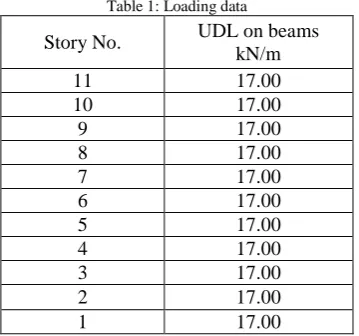
As it is well know that inner frames are more critical as far as gravity loadings are considered, so here inner frame is taken for analysis with gravity loading in 2D. The gravity loading is shown in Table1.And analysis is carried out by considering soil mass as elastic.
Table 1: Loading data
Story No. UDL on beams
kN/m
11 17.00
10 17.00
9 17.00
8 17.00
7 17.00
6 17.00
5 17.00
4 17.00
3 17.00
2 17.00
V. RESULT AND DISCUSSION
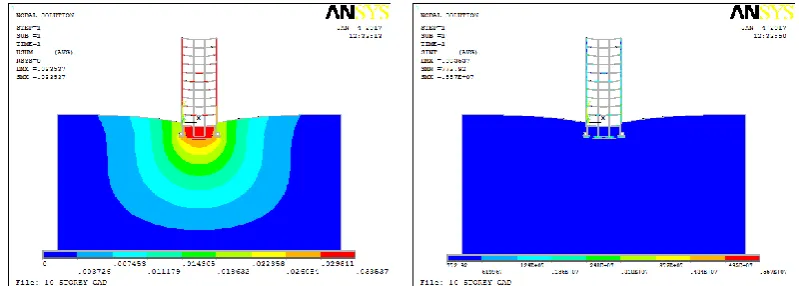
After considering all above data, all the FEM models (Models considering various shapes of raft) are analysed using Ansys 11.0. The results for Vertical Displacement and Stresses in Soil Mass are displayed in Fig 5 (a), (b), (c), (d) and (e) respectively.
Fig. 5 (a): Vertical Displacement Contour and Stress Contours in model 1considering Actual Raft(C/S A = 13.05 sq.m)
Fig. 5 (b): Vertical Displacement Contour and Stress Contours in model 2considering First Raft (C/S A = 9.075 sq.m)
Fig. 5 (d): Vertical Displacement Contour and Stress Contours in model 4considering third Raft(C/S A = 10.90 sq.m)
Fig. 5 (e): Vertical Displacement Contour and Stress Contours in model 5 considering fourth Raft(C/S A =6.9250 sq.m)
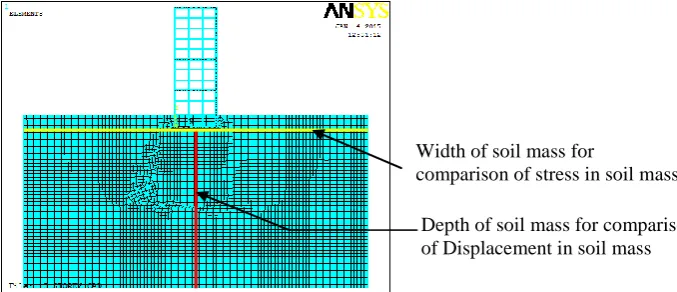
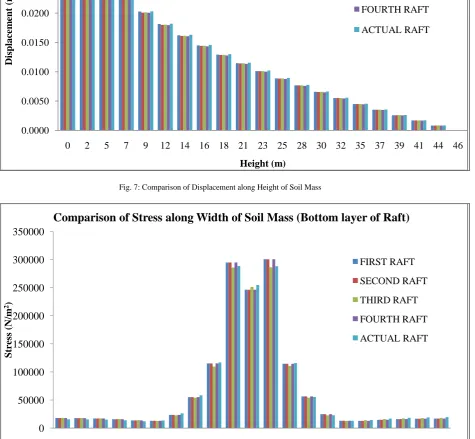
The above results are individual results for each model. Thus to get exact behavioural change in performance of soil mass for different shapes of raft, the comparative analysis is most important. Therefore the comparative analysis of above all models are explain in bar charts. The results for displacements are plot along the height of soil mass of each model from mid bottom of raft and the results for stresses are plot along width of soil mass just a layer below the raft as shown in Fig. 6. The comparative results are shown in following Fig. 7 (Displacement Results Comparison) and Fig. 8 (Stress result comparison).
Fig. 6: Location of height and width of soil mass for displacement and stress comparison
Width of soil mass for
comparison of stress in soil mass
Fig. 7: Comparison of Displacement along Height of Soil Mass
Fig. 8: Comparison of Stress along Width of Soil Mass
0.0000 0.0050 0.0100 0.0150 0.0200 0.0250 0.0300 0.0350
0 2 5 7 9 12 14 16 18 21 23 25 28 30 32 35 37 39 41 44 46
Dis pla ce m ent ( m ) Height (m)
Comparison of Displacement along Height of soil mass
FIRST RAFT SECOND RAFT THIRD RAFT FOURTH RAFT ACTUAL RAFT 0 50000 100000 150000 200000 250000 300000 350000
0 5 10 15 20 25 30 35 40 45 50 55 60 65 70 75 80 85 90 95 100
Str
ess
(
N/m
2)
Width of Soil mass (m)
Comparison of Stress along Width of Soil Mass (Bottom layer of Raft)
FIRST RAFT
SECOND RAFT
THIRD RAFT
FOURTH RAFT
From Fig. 7, it is observed that,
Displacement is gradually decreasing from top to bottom but upto top 25 m of soil mass displacement are varying as shape of footing change.
The Displacement of soil for Second Raft (Raft having slits) shows least displacement at top but as it goes dipper and dipper the displacement for Second and third raft are matching.
The displacement of soil for actual raft shows least value at top layer only but after this displacement is found more as compare to other.
Thus it may be concluded that slit raft is difficult to cast still it shows best result for displacement thus it is better to go with third shape raft.
From Fig. 8, it is observed that,
The stress below the raft are more than safe bearing capacity of soil, thus it may happen that footing is in tension. As it is observed generally that stress are distributed in soil mass uniformly but the behaviour is different for
different shapes of footing.
Stress in Soil Mass for First, Second and Fourth footings are higher as compare with Third and actual footing. However, stress value for third type of footing provides considerable and least value.
So it may be concluded that third footing shows comparatively best result.
Thus from Fig 7 and Fig. 8 it is very clear that as shape of Raft changes the behaviour of soil mass is also changing. The difference is found only due to critical zones, which are created during shape change. Thus at geometric discontinuities the stress values are more hence it is more rational to check different shapes of raft for optimum result.
VI.CONCLUSION
From the above analysis following points are concluded,
1. It is essential to do Interaction analysis for actual response of Flexible base.
2. As all the literatures are focusing on strengthening the structure for SSI analysis but in this paper it is shown that after SSI analysis the raft is optimized to best suitable shape by stress and displacement comparison.
3. The basic objective of checking response of soil mass for different shapes of raft is fulfilled with positive results. 4. From the above stress and displacements results it is concluded that both second raft and third raft shows better
result but it is always to better to go with third raft from execution point of view.
5. As it is well known that at geometric discontinuities, the stress concentration is more so all the shapes are modelled considering this concept.
6. Due to optimization study, raft footing become economical (due reduction of concrete).
7. The concept depicted in this paper is useful for further study on shape optimization of RCC Components of building for SSI effect.
REFERENCES
[1] H.K Chinmayi, B.R Jayalekshmi, “Soil-structure interaction analysis of RC frame shear wall buildings over raft foundations under seismic
loading”, International Journal of Scientific & Engineering Research Volume 4, Issue 5, May-2013 ISSN 2229-5518.
[2] Pallavi Ravishankar, Dr D Neelima Satyam, “Finite Element Modelling To Study Soil Structure Interaction of Asymmetrical Tall Building”, Workshop of TC207 during the 18th International Conference on Soil-Mechanics and Geotechnical Engineering, Paris Report No: IIIT/TR/2013/-1.
[3] Mohd Ahmed, Mahmoud H. Mohamed, Javed Mallick, Mohd Abul Hasan, “3D-Analysis of Soil-Foundation-Structure Interaction in Layered Soil”, Open Journal of Civil Engineering, 2014, 4, 373-385 Published Online December 2014 in SciRes. http://www.scirp.org/journal/ojce
http://dx.doi.org/10.4236/ojce.2014.44032.
[4] K.-F. Seitz, “Topology optimization for the design of geotechnical structures” , Proceedings of the 24th Euporean Young Geotechnical