An Efficient Detection Method for
Authenticating Devices using SDR
Receivers
M.Hema malini1, R.Komathi2, K.Nikkitha 3, F.Niveditha4, M.Ashok Kumar5
U.G. Students, Department of ECE, Adhiyamaan College of Engineering, Hosur, Tamilnadu, India1,2,3,4.
Assistant Professor, Department of ECE, Adhiyamaan College of Engineering, Hosur, Tamilnadu, India5
ABSTRACT: In this paper, we describe an efficient detection method for unknown wireless devices using software defined radio (SDR) receivers, which is to estimate the position of unknown devices and their transmission power by sensing carrier frequency and measuring the received signal strengths (RSSs). RSS based positioning techniques are attractive for their low implementation complexity, but they are very sensitive to the path loss exponent in field environment. Most RSS based techniques calculate the position and transmission power of unknown devices assuming that the value of the path loss exponent is known before. However, the position estimation accuracy largely depends on the discrepancy of the path loss exponent. To improve the accuracy, the proposed method introduces a new process for the path loss exponent estimation when calculating the position and transmission power of unknown devices. The simulation results show that the proposed method has better position estimation accuracy compared with existing ones.
KEYWORDS: Position estimation, RSS, SDR, transmission powerestimation, path loss exponent
I.INTRODUCTION
Recently, our society is filled with various things equipped with wireless devices all around us. These things include not only mobile devices, wireless sensors and Internet of Things devices, but also unmanned aerial vehicle, self-driving car, unmanned robot, etc. Some of them may cause malfunction or erroneous operation, which may be malicious or harmful to other users. Hence, many researches have been achieved on the position and transmission power estimation of wireless devices for security, safety, sensor networks and cognitive radio network. To detect things around us, one of the common ways is a wideband spectrum sensing by software defined radio (SDR) due to its low implementation and computational complexity. The SDR receivers can perform spectrum sensing over a wide frequency range and measure the received signal strength (RSS) of a received signal by using software modifications.
The position of a device and its transmission power can be obtained from a set of RSSs of nodes with known position. RSS based techniques are very attractive from a practical point of view because these techniques are available in most wireless transceiver without any additional features. However, it is known that RSS is very sensitive to the path loss exponent (PLE), shading and fading parameter depending on field environment. Especially, the RSS falls off proportional to the distance to power of the PLE between two devices. The path loss exponent is a function of carrier frequency, environment, obstructions, etc.
To mitigate the performance degradation caused by the PLE error, this paper introduces a new process of PLE estimation during position estimation. The remainder of this paper is organized as follows. In Section II, we describe the overview of device detection scheme using SDR receivers, and a new position estimation algorithm to reduce position estimation error is presented in Section III. In Section IV, simulation environments and results are examined to verify the performance of the algorithm. Finally, we conclude this paper in Section V.
II.EXSISTING SYSTEM
A general architecture of position estimation systems, which consists of multiple SDR receivers, networks and a device detection system. The three unknown devices having a wireless transmitter, radiosonde, self-driving car and unmanned aerial vehicle, as an example. It has been done with the help of radio signals which is quite dumb. The device detection system then performs spectrum sensing, selects the frequency band of an unknown device, and calculates the RSS of the selected frequency band.
After collecting more than three RSSs, it locates the position of the unknown devices, calculates its transmission power considering the PLE in the field environment, and marks the position on the map. Since the existing system has many problems we are shifting it to the SDR [software defined radio] receivers that is considered to be a efficient tool. Hence the proposed system will explain all the new possibilities that are introduced to it.
2.1.Disadvantage of Existing system:
The output of the measurement will not be accuracy.
Many existing works mentioned in strive to optimize heading estimation based on the data solely from
low-cost sensors.
III.PROPOSED METHOD
The proposed algorithm can find the nearest position of the device under RSS measurement errors. The proposed method introduces a new process for PLE estimation. By adopting the process, it can estimate the optimum position of a device and its transmission power. The proposed method has better position estimation accuracy compared with existing ones
A. PROPOSED METHOD ADVANTAGES
Low-cost, fast and efficient data collection.
Distribution automation.
Improved fraud detection.
The proposed algorithm can find the nearest position of the device under RSS measurement errors.
The proposed method introduces a new process for PLE estimation.
By adopting the process, it can estimate the optimum position of a device and its transmission power.
The proposed method has better position estimation accuracy compared with existing ones.
IV.SYSTEM DESCRIPTION
The flight termination system consists of mainly two sections. 1. Transmitter section
2. Receiver section
Figure 1: Transmitter Block diagram
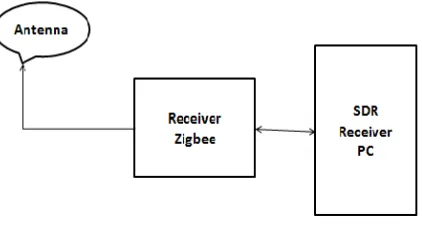
Figure 2: Receiver Block diagram
In this flight termination project two zigbee modules has been used. One at the transmitter side and one at the receiver side. One zigbee is connected to the personal computer which is placed inside the control room. The other one is at the landing module which is in the flight itself. The main component of this project is the pic micro controller that performs all the main task that has to be done possible with the flight termination. The main purpose of using zigbee module is to match the frequency and that too be specifically applicable to SDR platform.
V.EXPERIMENTAL RESULT
Figure 3. Alert Output
VI.CONCLUSION
introduces a new process for PLE estimation. By adopting the process, it can estimate the optimum position of a device and its transmission power.
The position estimation errors of the method are examined through computer simulation. Simulation results are shown that the method can estimate the position of a device under simplified propagation model without RSS errors. Further studies are needed to verify the position estimation error under log-normal path loss model with RSS errors in detail.
REFERENCES
[1] Sunghun Kim, Hyoungsuk Jeon, Hyuckjae Lee, and Joong Soo Ma, “Robust Transmission Power and Position Estimation in
Cognitive Radio,” ICOIN’07, Estoril Portugal, Jan. 2007.
[2] Zafer, M.; Bong Jun Ko; Ho, I.W.-H. "Transmit Power Estimation Using Spatially Diverse Measurements Under Wireless Fading",
Networking, IEEE/ACM Transactions on, On page(s): 1171 - 1180 Volume: 18, Issue: 4, Aug. 2010
[3] Franklin, Alex Joseph A , “Wireless Device Positioning and Finding Intruder Using RSS,” International Journal of Computer Science
& Network Security, Vol. 14 Issue 6, 2014, pp. 118
[4] N Patwari, JN Ash, S Kyperountas, IAO Hero, RL Moses, NS Correal, Locating the nodes: cooperative localization in wireless sensor
networks. IEEE Signal Processing Magazine 22(4), 5469, 2005
[5] D. Zhang, F. Xia, Z. Yang, L. Yao, and W. Zhao, “Localization technologies for indoor human tracking,” in Proceedings of the 5th
International Conference on Future Information Technology (FutureTech '10), May 2010.
[6] I Sabek, M Youssef, Multi-entity device-free wlan localization, in 2012 IEEE Global Communications Conference (GLOBECOM).
Anaheim, 3-7 Dec 2012
[7] L. Pucker, “Channelization Techniques for Software Defined Radio,” in. Proceedings of SDR Forum Conference, Jun 2003, pp. 1–6.
[8] Digham, F.F., M. Alouini and M.K. Simon, 2007. On the energy detection of unknown signals over fading channels. IEEE J. Trans.
Commun., 55: 21-24.
[9] Ian F. Akyildiz, Brandon F. Lo, Ravikumar Balakrishnan, “Cooperative spectrum sensing in cognitive radio networks: A survey,” Volume 4, Issue 1, March 2011, Pages 40-62.
[10] G. Mao, B.D.O. Anderson, and B. Fidan, “Path Loss Exponent Estimation for Wireless Sensor Network Localization,” Computer
Networks, vol. 51, pp. 2467-2483, 2007.
[11] Hernandez-Perez, E.; Navarro-Mesa, J.L.; Martin-Gonzalez, S.; Quintana-Morales, P.; Ravelo-Garcia, A. , “Path loss factor