Research Development Cell, Government College of Engineering, Jalagon (M. S), India
Passive Heat Transfer Augmentation Methods
in a Circular Tube: A Review
P.Dipak 1, R.Y.Patil 2
P.G. Student, Department of Mechanical Engineering, SGD COE Jalgoan, Maharashtra, India1
Associate Professor & HOD, Department of Mechanical Engineering, SGD COE Jalgoan , Maharashtra, India2
ABSTRACT: This paper features a broad discussion on review of heat transfer augmentation technics that performed
the key role to improve the heat transfer rate by using various passive augmentation technics invented in the past. These technics can be used in the heat exchangers to improve the performance of it by simply inserting the various geometries of the twisted tapes and wire coils of different pitches, by implementing these various passive heat augmentation technics formations of swirl flow and mixing of the fluid that assisted in the enhancement in the heat transfer coefficient. Effect of Nusselt number, frictional factor and thermal enhancement factor also reviewed in this paper.
KEYWORDS: heat transfer augmentation, geometry of the contact surface, inserts.
I. INTRODUCTION
Heat exchangers are extensively used in a variety of manufacturing processes for heating and cooling applications like air habituation and refrigeration structures, heat revival processes cooking and dairy processes, element procedure plants etc. The main confront in designing a heat exchanger is to build the tools compact and attain a high heat transfer pace using lowest amount pumping power. Methods for heat transmission increase are related to several engineering
applications.The heat exchangers have an important role in the energy storage and recovery. Due to the development of
modern technology, the heat exchangers required in various industries for high heat-flux cooling to the level of megawatt per meter square. At this level, cooling with conventional fluids such as water and ethylene glycol and so forth, are challenging. Hence, it is necessary to increase the heat transfer performance of working fluids in the heat transfer devices. Heat transfer augmentation techniques (passive, active and compound) are commonly used in areas such as process industries, heating and cooling in evaporators, thermal power plants, air-conditioning equipment, refrigerators, radiators for space vehicles, automobiles, etc. The rate of heat transfer can be increased passively by increasing the surface area, roughness, and by changing the boundary conditions.
mechanical aids and the use of a magnetic field to disturb the light seeded particles in a flowing stream, etc.
Passive method
The Passive heat transfer augmentation methods does not need any external power input. In the convective heat transfer, one of the ways to enhance heat transfer rate is to increase the effective surface area and residence time of the heat transfer fluids. By Using, this technique causes the swirl in the bulk of the fluids and disturbs the actual boundary layers, which increase effective surface area, residence time and simultaneously heat transfer coefficient increases in an existing system. Methods generally used are, extended surface, displaced enhancements devices, rough surfaces surface tension devices, Inserts requires additional arrangements to make to fluid flow which enhance and augment the heat transfer. The types of inserts are twisted tape, wire coils, ribs, baffles, plates, helical screw insert, mesh inserts, convergent – divergent conical rings, conical rings etc. Twisted tapes are the metallic strips twisted using some of the suitable techniques as per the required shape and dimension, which are inserted in the flow to enhance the heat transfer. The twisted tape inserts are most suitable and widely used in heat exchangers to enhance the heat transfer. Twisted tape inserts increase heat transfer rates with less friction factor. The use of twisted tapes in a tube gives simple passive technique for enhancing the convective heat transfer by making swirl into the heavy flow which disrupting the boundary layer at the tube surface due to rapidly changes in the surface geometry. Which means to say that such type of tapes induce turbulence and swirl flow which induces inside the boundary layer and which gives better results of heat transfer coefficient and Nusselt number due to the changes in geometry of twisted tape inserts. Simultaneously, the pressure drop inside the tube will be increases when using twisted-tape as an insert. For this a many researchers have been done by experimentally and numerically to investigate the desired design to achieve the better thermal performance with less frictional losses. The heat transfer enhancement of twisted tapes inserts depends on the Pitch In addition, twist ratio.
Compound Method
When any two or more techniques i.e. passive and active may be employed simultaneously to enhance the heat transfer of any device, which is greater than that of produced by any of those techniques separately, the term known as compound enhancement technique.
II. RELATED WORK
Number of investigations has been carried out by using various inserts and tube geometries for heat transfer augmentation. Investigations of various researchers and their findings are as follows.
M.M.K. Bhuiya [1] experimentally investigated the effect of triple twisted tape inserts on Thermal characteristics in a
Research Development Cell, Government College of Engineering, Jalagon (M. S), India
Fig 1 (a) Geometry of twisted tape inserts & (b) cut section
It was observed that the Nusselt number, friction factor and thermal enhancement efficiency increased with decreasing twist ratio. The results indicated that the presence of triple twisted tapes led to a higher increase in the heat transfer rate over the plain tube. The Nusselt number and friction factor of using the triple twisted tape inserts were found to be increased up to 3.85 and 4.2 times when compared with the plain tube, respectively. The heat transfer performance was evaluated based on the constant blower power and the performance was achieved to be 1.44 by the use of triple twisted tape inserts. In addition, author observed that the heat transfer rate increased with decreasing twist ratio of the tape inserts.
V. Sudheer Kumar [2] did the CFD analysis of the horizontal tubes having five types of different inserts inserted into
the horizontal rod having fluid of different values of Reynols numbers . The overall conclusions which he found during the study that increase in friction factor, Enhancement of heat transfer in comparison to plain tube
h
exp
W.H.Azmi [3] uses Nano fluid as the working fluid and experimentally concluded that the heat transfer coefficient ofNano fluids with twisted tape is higher than the water flow for the same twist ratio, The maximum heat transfer
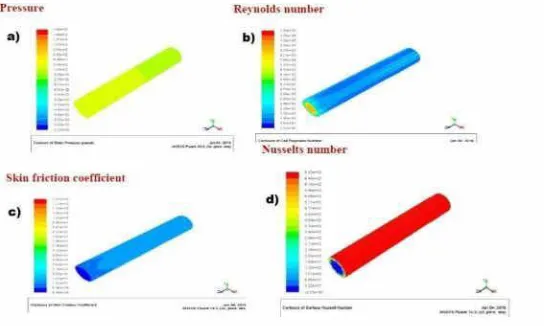
enhancement with twisted tape, by using following formula we can conclude that heat transfer rate is increases as Nusselt number is increases as shown following
Xiaoyu Zhang [4] says Heat transfer and friction factor characteristics of a tube fitted with helical screw-tape without
Research Development Cell, Government College of Engineering, Jalagon (M. S), India
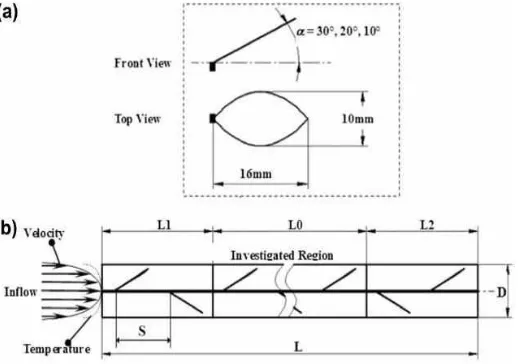
Fig 4 (a) Geometry of the louvered strip insert, and (b) Schematic of a circular tube fitted with louvered strip inserts
(C ) (d)
Fig (C) Variation of the Nusselt number with Reynolds number for different slant angles. The pitch of the inserts is 30 mm in this case. (d) Variation of the Nusselt number with Reynolds number for different slant angles. The pitch of the
inserts is 45 mm in this case.
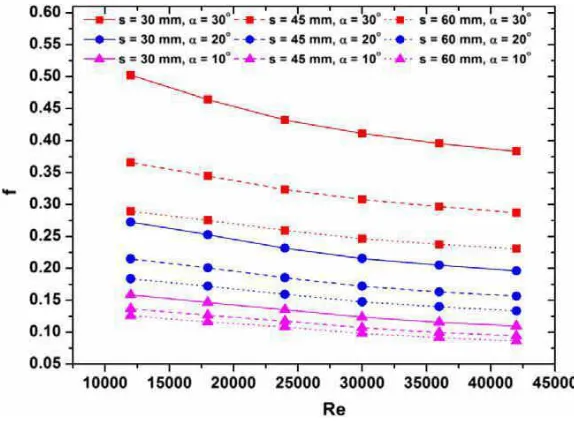
Fig 4 (e) Variation of the friction factor with Reynolds number for different slant angles and pitches.
E. Kannan [5] Experimental investigated heat transfer characteristics of circular tube fitted with the with perforated
Research Development Cell, Government College of Engineering, Jalagon (M. S), India
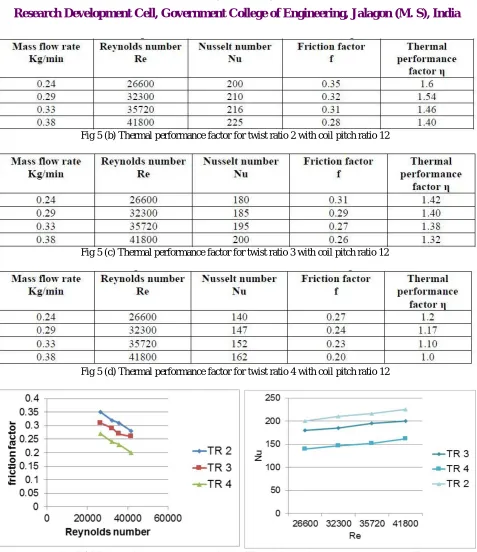
Fig 5 (b) Thermal performance factor for twist ratio 2 with coil pitch ratio 12
Fig 5 (c) Thermal performance factor for twist ratio 3 with coil pitch ratio 12
Fig 5 (d) Thermal performance factor for twist ratio 4 with coil pitch ratio 12
Fig 5 (e) Relation between nusselt number and Reynolds number for various twist ratio The results
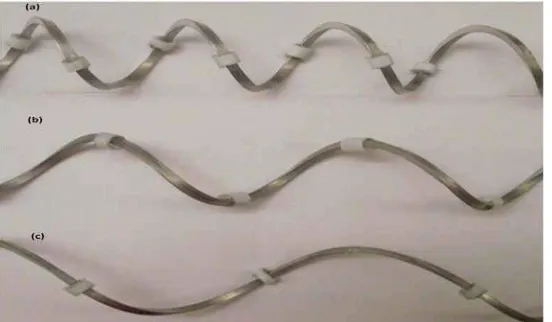
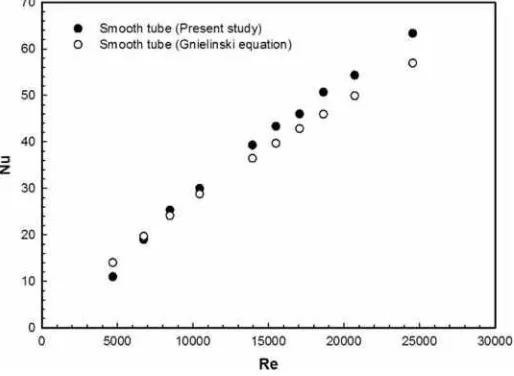
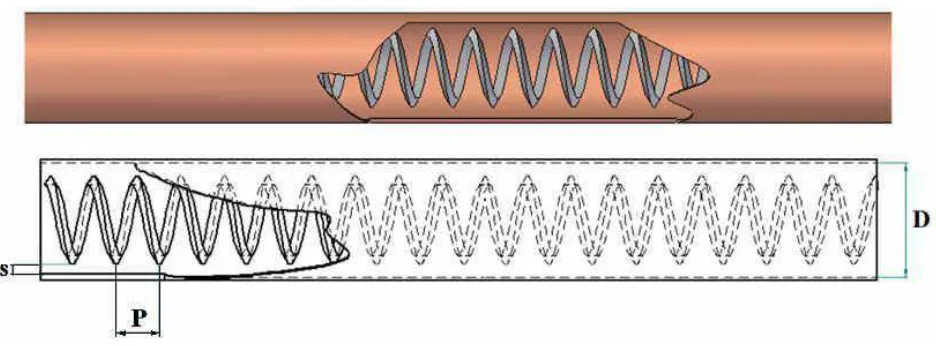
Orhan Keklikcioglu [6] done the experimental investigation on heat transfer enhancement of a tube with coiled -wire 2 inserts installed with a separation from the tube wall. Investigation was conducted for the thermo-hydraulic performance of a circular tube with coiled-wire inserts, which were installed with a small separation from the inner wall of the tube. The wire inserts had an equilateral triangular cross-sections with a constant side length of e =6 mm and they were coiled with three different pitch-to-diameter ratios: P/D=1, P/D=2, P/D=3. A specific method was employed to coil the wires so that an edge of the triangle was oriented to face the incoming airflow. The coiled-wire inserts were installed with 1 and 2 mm separation from the inner tube wall so that the heat transfer enhancement due to the laminar boundary layer disturbance could be investigated. Experiments were performed for Reynolds numbers from 3429 to 26,663. The coiled-wire inserts led to a significant increase in both the heat transfer rate and friction factor over the smooth tube based on coil pitches and clearance. The maximum thermal performance was observed around 1.82 for the P/D=1, s=1 type at a Reynolds number of 3429. In conclusion, the laminar boundary layer disturbance can be effectively enhanced by using these types of coiled-wire inserts
Fig 6 (a) The coiled-wire inserts with Teflon rings (a) P/D= 1, (b) P/D = 2, (c) P/D = 3.
Research Development Cell, Government College of Engineering, Jalagon (M. S), India
Fig 6 (c) Validation of Nusselt number in the smooth tube.
The thermal enhancement efficiency of 82% at a Reynolds number of was observed in the case of a wire with s=1 mm and P/D=1 the author finally concluded that heat transfer rates were enhanced with the increasing pitch ratio.
Parag S. Desale [7] reviewed the various passive augmentation technics. The thermal performance behaviour for tube
in tube heat exchanger is studies for wire coil inserts, twisted tape inserts and their combination. The research was carried for constant/periodically varying wire coil pitch ratio. Some of them have varied three coil pitch ratios. The twisted tapes were also been tested by many of them for different twist ratios. These inserts are tested individually and in combine, form and results were compared. The wide range of Reynolds number is selected for allowing the inserts to be tested for different flow conditions from laminar to turbulent. The improved performance was found in the increasing order for wire coil inserts, twisted tapes and combined inserts. In addition, few of researchers have developed correlations for these inserts for Nusselt number as a function of Reynolds number.
Fig 7 (b) the equilateral triangle cross-sectioned coiled wire inserted in a tube separated from tube wall
Fig 7 (c) The Test section fitted with wire coil and twisted tape
Fig 7 (d) Verification of Plain tube by Nusselt Number and Friction Factor
DI-Research Development Cell, Government College of Engineering, Jalagon (M. S), India
coil, shows the highest thermal performance which is higher than the wire coil alone, the TT alone, the TT with uniform wire coil, and the TT with D-coil.
K.G.KULKARNI [8] investigated the circular horizontal tube by using clockwise and counter clockwise-corrugated
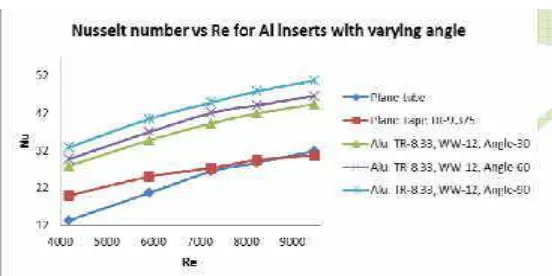
twisted tape inserts with working fluid is air. Experiments conducted on plain circular tube with or without c-cc corrugated twisted tube. During experiment constant heat flux and different mass flow rate condition. The c-cc corrugated twisted tape are of same pitch and twist ratio but three different angle of rotation in clockwise and counter clockwise direction as 30°, 60°, 90° respectively. The Reynolds no. varied from 4000 to 10000. Heat transfer coefficient and pressure drop are calculated and results are compared with the plain tube without inserts. Finally, heat transfer enhances with clockwise and counter clockwise-corrugated twisted tape inserts as compared to plain tube varied from 8 % to 44 % for various inserts. Plain twisted tape results are also compared with the same results.
Fig 8 (a) Corrugated twisted tape insert
Fig 8 (b) Effect on Nusselt number for various Reynolds number
maximum friction factor rise was about 175% for 60º angle of rotation. And 150% for 30 º angle of corrugated twisted tape inserts compared to plain tube. The overall enhancement for the tubes with c-cc corrugated twisted tape inserts is 1.65 for 90 º angle of rotation and 1.4 for 60º angle of rotation c -cc corrugated twisted tape insert. Thus, the enhanced performance can be achieved using Clockwise and counter clockwise corrugated twisted tapes as compared to plane twisted tape.
Nivedita Uzagare [9] done the experimental work on the circular tube fitted with the V-Jagged Twisted Tape theHeat
Transfer Rate, Friction Factor, Nusselt Number Were Determined and Compared with the Plain Tube and Plain Tape. The twisted Tape Having Jag Of Width And Depth (We=10mm, De=8mm) And (We=10mm,De=10mm) Were used & her conclusion made finally that with An Increase In The Reynolds Number (Re) Ranging From 6000 To 13000, The Heat Transfer Coefficients Increases For V-Jagged Twisted Tape By 52% To 90% For Copper And 50% To 75% For Aluminium With Respect To Plain Tube Whereas The Friction Factor Decreases. The Results Are Compared With Plane Twisted Tape & It Is Found That Aluminium V-Jagged Twisted Tape With (We=10m,De=8mm) Gives Highest Enhancement Of 75%. When Theoretical And Experimental Values Are Compared Of Nusselt Number Then The Copper V-Jagged Twisted Tape With Width Of Jagg 10mm & Depth Of Jagg 8mm Gives 85% Rise In Nusselt Number And When Friction Factor Values Are Compared Then It Is Having Lowest Of 2.0 As Compared To The Other Inserts, Hence Proving The Insert To Be Better In Terms Of Heat Transfer Enhancement And Also At Lesser Pumping Power.
Fig 9 (a) Variation of Nusselt Number with Reynolds Number for Various Inserts
Research Development Cell, Government College of Engineering, Jalagon (M. S), India
A Dewan P Mahanta K Sumithra Raju P Suresh Kumar [10] from Indian institute of Guwahati also reviewed the
passive heat transfer augmentation techniques and listed all the passive Augmentation like twisted tape in laminar flow, twisted tape turbulent flow, wire coil in laminar flow, wire coil in turbulent flow technics and their effect on the heat transfer parameters in their studies. They together concluded that after inserting inserts in the circular tube heat transfer enhance but friction factor is decreases by some extent.
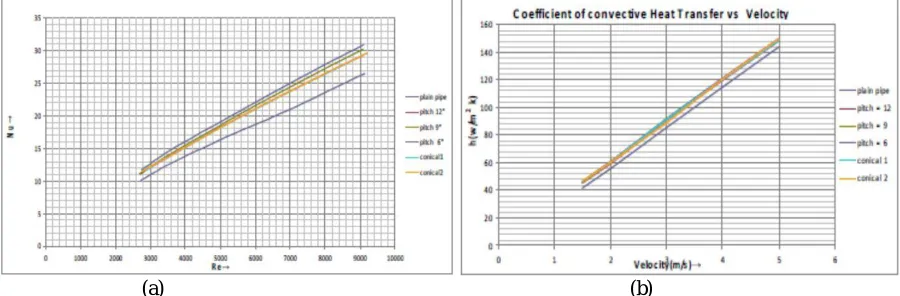
PARDEEP KUMAR [11] done extensive experimental study on five wire coils of different pitch inserted in asmooth
tube in laminar and transition regimes. Isothermal pressure drop tests and heat transfer experiments under
uniform heat flux conditions have been carried out the air flow friction and heat transfer characteristics in a round tube
fitted with coiled wire tabulator’s for the turbulent regime, Re = 2000 –10,000 and Pr = 0.7. The use of coiled
circular wire causes a high-pressure drop increase, which depends mainly on spring pitches and wire thickness the heat transfer in case of the conical coil is highest as compare to the plain pipe and the pipe containing the coil of different pitches. The enhancement efficiency increases with the decreasing pitches and found highest in the conical sets. The friction factor is highest around at a Reynolds number 2200- 3000
(a) (b)
( C ) (d)
Fig 11 (a) Effect on Nusselt number of varying pitch. (b) Effect of the velocity on the heat transfer coefficient (C) Effect of Friction factor on Reynolds number (d) Variation of temperature on Reynolds number.
III.SUMMERY
From the above discussion, various researchers’ done the experimental on the circular tube inserting the various
geometries of twisted tape, Wire coiled that promotes the swirl of the fluid and then occurs the mixing. The fluid travelled towards the heated wall following curvilinear path this will very important in the heat exchangers applications for better heat transfer rate. Mostly use of louvered strip insert using various arrangements and the small pipe insert in a circular heat exchanger tube shows great improvement in heat transfer rate when co mpared with other geometries used by various researchers. Friction factor is also affected due to the surface geometry alteration.
IV.CONCLUSION
Passive technics are the simple and possible technics to enhance heat transfer rate in the circular tubes by various geometrical combination of inserts, which generally used in the heat exchangers. In this paper, we reviewed the various passive augmentation technics on which the researchers have done various experiments in order to augment the heat transfer, nusselt number and various other factors by using circular tube with inserts of different shapes, sizes and orientation. The enhancement in the heat transfer rates of the circular tube having inserts in fluid flow as compared to the circular plane tube because of the curvilinear motion of the fluid causes mixing of it. Active technics are requirement of external power source so power cost have to be consider
REFERENCES
1. M.M.K. Bhuiya, Thermal characteristics in a heat exchanger tube fitted with triple twisted tape inserts, International Communications in Heat and Mass Transfer, 48 (2013) 124–132
2. V Sudheer Kumar CFD Analysis on Heat Transfer Enhancement in Horizontal Tube by Forced Convection with Inserts, International Journal & Magazine of Engineering, Technology, Management and Research Volume 3(2016) issue no 2 Feb 2016
3. Xiaoyu Zhang, Numerical studies on heat transfer and friction factor characteristics of a tube fitted with helical screw -tape without core-od inserts, International Journal of Heat and Mass Transfer 60 (2013) 490–498
4. A.W. Fan, Parametric study on turbulent heat transfer and flow characteristics in a circular tube fitted with louvered strip inserts, International Journal of Heat and Mass Transfer 55 (2012) 5205–5213
5. E. Kannan, Experimental investigation on convective heat transfer characteristics in a circular tube fitted with perforated twisted tape and wire coil, Journal of Chemical and Pharmaceutical Sciences, JCPS Volume 9 Issue 4, October - December 2016
6. Orhan Keklikcioglu, Experimental investigation on heat transfer enhancement of a tube with coiled-wire inserts installed with a separation from the tube wall, International Communications in Heat and Mass Transfer, 2016.08.024
7. Parag S. Desale, Heat Transfer Enhancement in Tube-in-Tube Heat Exchanger using Passive Techniques, International Journal of Innovative Research in Advanced Engineering (IJIRAE) ISSN: 2349-2163 Volume 1 Issue 10 (November 2014)
Research Development Cell, Government College of Engineering, Jalagon (M. S), India
9. Nivedita Uzagare, Enhancement Of Heat Transfer Using V-Jagged Twisted Tape In Circular Tube, IOSR Journal of Mechanical and Civil Engineering (IOSR-JMCE) e-ISSN: 2278-1684, ISSN: 2320-334X, Volume 13, Issue 2 Ver. I (Mar. - Apr. 2016), PP 14-17
10. A Dewan, Review of passive heat transfer augmentation techniques, Proc. Instn Mech. Engrs Vol. 218 Part A: J. Power and Energy.
11. PARDEEP KUMAR, enhancement of heat transfer using wire coil insert in tubes, International Journal of Mechanical Engineering and Technology (IJMET), ISSN 0976 – 6340(Print), ISSN 0976 – 6359(Online) Volume 3, Issue 2, May-August (2012).
12. Dr. A. G. Matani, experimental study on heat transfer enhancement in a tube using counter/co -swirl generation, International Journal of Application or Innovation in Engineering & Management, Volume 2, Issue 3, March 2013
13. Mr Yogesh B Rakate, Experimental & numerical analysis of heat transfer augmentation through the pipe using twisted tapes,International Journal for Innovative Research in Science & Technology| Volume 2 | Issue 10 | March 2016 ISSN (online): 2349-6010
14. Sumit S. Kalmegh, Passive Heat Transfer Augmentation Methods in a Circular Tube: A Review, International Journal for Scientific Research & Development| Vol. 2, Issue 11, 2015 | ISSN (online): 2321-0613
15. A M Mulla, experimental study on heat transfer and friction factor characteristics in laminar flow through tubes of shell and tube heat exchanger fitted with twisted tapes with baffles, International Journal of Research in Engineering and Technology, Volume: 03 Issue: 05 May-2014 16. N. C. Kanojiya, Heat Transfer Enhancement in Heat Exchangers With Inserts: A Review, Heat Transfer Enhancement in Heat Exchangers With Inserts: A Review, International Journal of Engineering Research & Technology, Vol. 3 Issue 10, October- 2014
17. Naresh Dhamane, Augmentation of Heat Transfer using Drilled Hole & Cut Twisted Tape Inserts, International Journal of Current Engineering and Technology, 104| MMIT, Lohgaon, Pune, Maharashtra, India, NCPSM- 2016, INPRESSCO IJCET Special Issue-6 (Oct 2016)