Improved Service Selection Algorithm in
Heterogeneous Cloud Network
Sonal Janbandhu
1, Sharadha Pandit
2M.Tech Student, Dept. of CS., IES College of Technology and Management, Bhopal, India1
Assistance Professor, Dept. of CS., IES College of Technology and Management, Bhopal, India2
ABSTRACT: Today's recent advances in technology It is possible to utilize cloud computing to address the problems of resource usage, extendibility and flexibility for managing large scale workflow applications worldwide. Therefore, the inspection of workflow systems based on cloud computing, basically cloud workflow systems is a timely issue and worthwhile for increasing efforts. Now a day the technology and smart application of workflow in cloud computing environment also becomes a research focus.
The paper firstly proposes a brief introduction to the cloud workflow system. Followed by, based on cloud architecture, the paper presents the advance architecture of cloud workflow system. Then, as the key content of the dissertation, it considering the service selection strategy based on constraint, this thesis presents a new service selection algorithm– SSA. The simulation results shows that SSA algorithm further decreases the total cost of execution and total time of execution in comparison with other algorithms.
KEYWORDS: Cloud computing, Software as a Service, Platform as a Service, Hypervisor, Service proximity,
I. INTRODUCTION
The term “cloud computing” has at its core a single element: computing services are delivered over the Internet, on demand, from a remote location, rather than residing on one‟s own desktop, laptop, mobile device, or even on an organization‟s servers. For an organization, this would mean that, for a set or variable, usage-based free or even possibly for free it would contract with a provider to deliver applications, computing power, and storage via the web. Cloud computing is a combination of software and computing delivered as a networked service that provides a model for enabling anytime access to a shared pool of applications and resources. These applications and resources can be accessed using a simple front-end interface such as a Web browser, and as a result enables users to access the resources from any client device including notebooks, desktops and mobile devices.
In plain English Cloud Computing can be defined as the ability to use computing resources whether it is applications, or storage or processing entities, over the internet. The National Institute of Standards and Technology defines cloud computing as “Cloud Computing is a model for enabling ubiquitous, convenient, on-demand network access to a shared pool of configurable computing resources, for example networks, servers, storage, applications, and services) that can be rapidly provisioned and released with minimal management effort or service provider interaction. Cloud computing is an emerging concept. It has many names, including: grid computing, utility computing, and on-demand computing.
the workload is encountered is done by the load balancer, whose aim is to distribute the load in such a way that no virtual machine is flooded by requests at one time, while remaining idle at other times. Above this level lies another abstraction called the service broker, which is the intermediary between the users of the cloud and the cloud service providers. It makes use of the existing service broker policies in order to rote the user .
Job scheduling: In cloud computing, an Infrastructure as a Service (IaaS) provider divides its physical resources (such as CPU, memory disk) into different types of virtual machines (VMs). These Virtual Machines types may have distinct sizes and features, and are offered as services to the general public[15]. A Virtual Machine is an efficient and independent substitute for a real machine.
A Virtual Machine is an efficient and independent substitute for a real machine. A particular service is chosen and the client issues its ob requests to that service. The service is selected on the basis of unit price, distance, response time, trafficc volume, storage space, processor of nodes/VMs (VM stands for Virtual Machine), etc. The VM we refer to acts as a system virtual machine providing a complete system platform which supports the execution of a complete operating system.Now once a service is selected, the service implements an algorithm to allocate servers and VMs to the jobs requested by its users. Now this algorithm has to efficiently manage the allocation so that it ultimately aims for fastest execution time Virtualization along with proper usage/management of resources.
Static job scheduling algorithms
Static Load balancing algorithms assign the tasks to the nodes based only on the ability of the node to process new requests. The process is based solely on prior knowledge of the nodes‟ properties and capabilities [7].
Dynamic job scheduling algorithms
Dynamic load balancing algorithms take into account the different attributes of the nodes‟ capabilities and network bandwidth. Most of these algorithms rely on a combination of knowledge based on prior gathered information about the nodes
II. RELATED WORK
The entire process of serving a client is a part of any one of the services defined in the service model. It begins with a request for a particular resource or application, be it for development, or just accessing the storage of the service provider. The request is serviced by the cloud service provider through a series of steps, the first one passing through a cloud service broker, which acts as the intermediary between a cloud consumer and the cloud service providers. The service broker makes use of any one of the available service broker policies in order to send the request to the most appropriate data centre. The role of a service broker is shown in figure 1.
Selection of Virtual machine
After choosing the data centre that is going to perform computation, the load balancer at the data centre comes into action. It makes use of the implemented load balancing algorithms
(1) Select the appropriate virtual machine to which the request has to be sent for execution. The innermost abstraction layer comprises virtual machine management. The hypervisor
(2) The virtual machine manager is responsible for the management and migration of virtual machines in the cloud data centers. Out of the above tasks, the use of an efficient service broker policy is quite necessary to ensure that the later tasks are carried out with efficiency and least response time. Literature shows that quite a lot of research has been done in this regards.
Optimal response time policy: This service broker first identifies the closest data centre by making use of the network latency parameter, as in the previous policy. Then, the current response time is estimated for each of them. If the estimated response time is the one for the closest data centre, then the closest data centre is selected.
Dynamically reconfigurable routing with load balancing:This broker policy [4] makes use of the current execution load in order to scale the application deployment. It also increases or decreases the number of virtual machines accordingly.
III. PROPOSEDALGORITHM
The proposed algorithm is based on the service broker policy which is selecting the data center on the region. The data center selection algorithm makes use of proportion weights in order to provide an insight into the computation power of the data center. Different data centers may be of the same hardware configuration but they often contain physical machines in varied number. So the data center with more number of physical machine have the capability the process more amount of resource with respect to the data center within which number of physical machine is less.
In the service proximity based algorithm the resource allocation is done uniformly by ignoring the underlying infrastructure of data center. As for example, if more than one data centers are present in a region, one of these data centers may contain one physical machine while the other may contain three physical machines. Though the hardware configuration is the same, but the data centers can handle different amount of workloads because of the provision of larger number of computing elements in the second data center.
The proposed strategy therefore, makes use of this logic to assign workloads to the data centers to consider the underlying infrastructure of the data center. A proportion weight is assigned to both the data centers according to the number of computing elements available. In above mentioned case, the first data center is assigned a proportion of 1 and the second one is assigned a proportion 3. This is used to direct the cloudlets to the data centers in the specified way, i.e., for every burst of cloudlets, the selection of data centers by the ratio of 1:3. This is bound to improve resource utilization of the data centre as well as the disadvantage of random selection and also make a great improvement in overall response time and data center processing time.
The key steps of the proposed algorithm are summarized below:-
i. Calculate the number of data centers present in the region for which the simulation is to be performed. ii. If only one data centre is present then go to step (vi), else go to the next step for further execution. iii. For multiple data centers in that region, calculate the resource handling capacity of each data centre.
iv. Assign a proportion weight to the data centre according to the underlying infrastructure to handle the resource.
v. Select the data centre in a circular fashion, followed by the number of resources allocated to each data centre according to their proportion weight.
vi. Send the request to the selected data centre.
vii. Analyses the result of simulation.
This algorithm is implemented using the Cloud Analyst simulation toolkit, to analyze the result graphically. The implemented algorithm is modified with respect to the service proximity algorithm. The changes are done on data center selection process and how the selection process is done according to the
proportion weight of the data center.
Step 1: Input no. Of region.
Step 2: Calculate the no. of DC available in region.
Make the regionalList.size. else
if (listsize == 1)
data center name ← regionalList.get
END
Assign the weight to the entire data center
end
Step 4: go to step 3. dcName ← regionalList.get(dataCenterID);
return dcName Step 5: End.
IV. SIMULATIONRESULTS
This algorithm is implemented on CloudSim platform with jdk 1.7 and also Flanagan jar file for internal computation of the workloads given in CloudSim folder itself. Some of the implementation done is on the basis of the firstly the NetBeans 8.0.2 in installed successfully and then the CloudSim is imported into the NetBeans. After that the different jar files are imported into the libraries of CloudSim and jdk used is 1.7. After successful installation the CloudSim will run successfully and finally the algorithm implemented can be run into the cloud. Input to the algorithm can be given from the example workloads given in the CloudSim package itself.
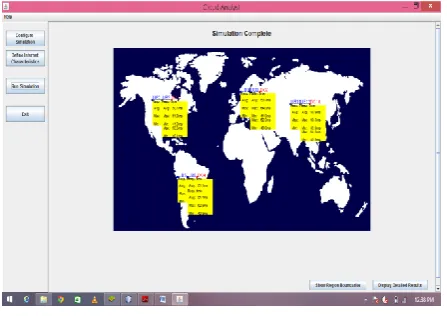
CloudAnalyst Design The CloudAnalyst is built on top of CloudSim tool kit, by extending CloudSim functionality with the introduction of concepts that model Internet and Internet Application behaviours.
Fig. 2. Simulation result
Fig.3 Overall response time for the three Brokers polices
V. CONCLUSIONANDFUTUREWORK
The technology and application of this workflows in cloud computing environment becomes a research focus. In this dissertation, we have presented the architecture of cloud workflow system. We discussed the characteristic of e service selection strategy based on constraint. Ultimately, as the focus of this dissertation, we present SSA which has an advantage on execution time and cost compared to other algorithm.
The proposed algorithm considers different data centres that are of the same configuration. The future work in this regards can be done by maintaining a proportion for data centres in such a way that distinct hardware configurations are also considered.
REFERENCES
[1] National institute of standards and Technology computer security Resource Center –www.CSRC.nist.gov.
[2] LizheWang,Jie Tao, Marcel Kunze”Scientific Cloud Computing: Early Definition and Experience”The 10th IEEE International Confrrence Computing and Communications 2008.
[3] Gunho Lee, Byung-Gon Chun, Randy H. Katr, “Heterogeneity-Aware Resource Allocation and Scheduling in the cloud ” University of California, Berkely, Yahoo!Research .
0 100 200 300 400 500 600 700
UB1 UB2 UB3 UB4 UB5 UB6 UB7 UB8 UB9 UB10 UB11 UB12
Overall responce Time
[4] Steve Crago, Kyle Dunn, Patrick Eads, Lorin Hochstein, Dong-In Kang, Mikyung Kang, Devendra Modium “Heterogeneous Cloud Computing” University of Southern California 2011 IEEE International Conference on Cluster Computing
[5] Timothy wood, Emmanuel Cecchet and K.K. Ramakrishna, “Disaster Recovery as a cloud service: Economic Benefits &deployment challenges” HotCloud'10 2nd USENIX conference on Hot topics in cloud computing USENIX Association Berkeley, ACM, CA, USA ©2010
[6] Pradeep K.Sinha, “Distributed operating Systems Concepts and Design” IEEE Computer Society Press
[7] Fei Hu, Meikang Qiu, Jiayin li, Travis Grant, Draw Tylor,Seth McCaleb, Lee Butler and Richard Hamner , ”A Review on Cloud Computing: Design Challenges in Architecture and Security” journal of Computing and Information Technology-CIT 19, 2011
[8] Rimal, B. Prasad, E. Choi and I. Lumb, "A taxonomy and survey of cloud computing systems." In proc. 5th International Joint Conference on INC, IMS and IDC, IEEE, 2009
[9] Nishant, K. P. Sharma, V. Krishna, C. Gupta, KP. Singh, N. Nitin and R. Rastogi, "Load Balancing of Nodes in Cloud Using Ant Colony Optimization." In proc. 14th International Conference on Computer Modelling and Simulation (UKSim), IEEE, pp: 3-8, March 2012 [10] Kolb, L., A. Thor, and E. Rahm, E, "Load Balancing for MapReduce-based Entity Resolution," in proc. 28th International Conference on Data
Engineering (ICDE), IEEE, pp: 618-629, 2012
[11] Al-Jaroodi, J. and N. Mohamed. "DDFTP: Dual-Direction FTP," in proc. 11th IEEE/ACM International Symposium on Cluster, Cloud and Grid Computing (CCGrid), IEEE, pp:504-503, May 2011
[12] Kimberly Keeton, Dirk Beyer, Ernesto Brau Merchant “ ON the road to Recovery: Restoring data after Disaster” EuroSys '06 1st ACM SIGOPS/ EuroSys European Conference on Computer Systems 2006
[13] Dmitry L.Petrove and Yury S.Tatarinov “Data Migration in the Scalable Storage Cloud” Ultra Modern Telecommunications & Workshops, 2009. ICUMT '09. International Conference on 12-14 Oct. 2009
[14] Gong Zhang, Lawrence Chiu, Ling Liu “Adoptive Data Migration in Multi-tiered Storage Based Cloud Environment” CLOUD „10 IEEE 3rd International Conference in Cloud Computing ISBN: 978-0-769541303 year-2010 doi>10.1109/ CLOUD. 2010.60
[15] Wei hoe, I -Len yen “Dynamic service and data migration in clouds” Computer Software and Applications Conference, 2009. COMPSAC '09. 33rd Annual IEEE International ISBN: 978-0-7695-3726-9 doi> 10.1109/COMPSAC.2009.127
[16] Rajiv Gandhi and Julian Mestre “Combinatorial Algorithms for Data Migration to Minimize Average Completion Time” LNCS Springer Volume 4110/2006, 128-139, DOI: 10.1007/11830924_1
[17] E. Anderson, J. Hall, J. Hartline, M. Hobbes, A. Karlin, J. Saia, R. Swaminathan, and J. Wilkes. An Experimental Study of Data Migration Algorithms. Proc. of the Workshop on Algorithm Engineering, pages145-158, 2001.
[18] Ali Khajeh-Hosseini ,David Greenwood and Ian Sommerville “Cloud Migration: A Case Study of Migrating an Enterprise IT System to IaaS” CLOUD '10 Proceedings of the 2010 IEEE 3rd International Conference on Cloud Computing ISBN: 978-0-7695-4130-3 doi>10.1109/CLOUD.2010.978-0-7695-4130-37
[19] Zhang Jian-hua and Zhang Nan “Cloud Computing-based Data Storage and Disaster Recovery” Future Computer Science and Education (ICFCSE), 2011 International Conference on Aug. 2011 Page 629-632
[20] Gong Zang , Lawerence Chiu “Adaptive Data Migration in Multi-tiered storage based cloud environment” Cloud Computing (CLOUD), 2010 IEEE 3rd International Conference on Issue Date: 5-10 July 2010 On page(s): 148 - 155 Print ISBN: 978-1-4244-8207-8
[21] Bhathiya Wickremasinghe, Rodrigo N. Calheiros, Rajkumar Buyya “Cloud Analyst: A CloudSim-based Visual Modeller for Analysing Cloud computing enviroments and applications”, 24th Internaltion networking and Application IEEE 2010.
[22] Rodrigo N. Calheiros, Rajiv Ranjan, Cesar A. F. De Rose, Rajkumar Buyya “Cloudsim-A Novel Framework for Modeling and simulation of cloud computing Infrastructure and services” CoRRabs/0903.2525.2009
[23] Mohsen Tarighi , Seyed Ahmad Motamedi , Ehsan Arianyan. “Performance Improvement of Virtualized Cluster Computing System Using TOPSIS Algorithm” CIE, 2010 40th International Conference on 25-28 July 201
[24] http://www.visionsolutions.com/WebForms/WP-Essential-Disaster-RecoveryGuide Dynamic.aspx?CampaignId=701300000002fmV&WhitePaper=EssentialDR.pdf [25] http://www.itcomparison.com/DR/VizioncorevsVeeam/VizioncorevsVeeam.htm