Software Development Risk Aspects and
Success Frequency on Spiral and Agile Model
M. Soumya Krishnan
Assistant Professor, Department of Computer Science & IT, Amrita School of Arts and Sciences,
Amrita Vishwa Vidyapeetham, Kochi Campus, Kerala, India
ABSTRACT:Software companies face a lot of difficulties in choosing a correct development model when projects
have to confront a lot of risk factors ranging from low to high. When software development becomes complex in nature due to risk, companies usual practice is to switch over to the only risk detection traditional model – the Spiral. Spiral model is considered to be the best conventional model for risk analysis. But in modern developmental style, all the development cycles around a single trend – the Agile. The main objective of this paper is to make a study on these two models and to get a conclusion on the impact of risk assessment and its success factors on complex software developmental projects.
KEYWORDS
:
Risk Factors, Risk Assessment, Spiral Model, Agile model, Software Development, SDLC.I. INTRODUCTION
In this fast growing modern Information Technology world, software development has become a great challenge for the developers as well as the organization. The main challenge is related to various risk factors associated with the project. The identification, assessment, management and mitigation have really paved a challenging situation for the software companies. Most of the software development projects found to use more resources, more time and more budget than the specified and reach at a lesser quality and functionality product, giving rise to a dissatisfied customer.
On analysis, it is found that, all these problems occurred due to the lack of risk assessment during the inception of the project and the various activities during SDLC. Project risks are those that could prevent the achievement of the objectives stated by the Project manager and the Project team. Risks usually arise from the relationships among the technology and people. Inefficient assessment and poor management of risk may create a huge negative impact on the business growth of the company itself.Through this paper, I have tried to choke out some of the various generic risk factors and have studied on the impact range of risks on various software developmental issues by taking into account, the two main giant SDLC models –thetraditional Spiral Model and the latest new generation lightweight model - the Agile.
II. RELATED WORK
inherently possessed risk management capability and are inevitable in nature. [7] refers to the comparison between the five different software models by stating their advantages and disadvantages very clearly.And finally, in [8], the author has discussed about the linear sequential model and its risk factors throughout its development phases. All these together helped me to gain an insight about risk and their effect on various software models.
III. OVERVIEW OFRISK ASSESSMENT ON SDLC MODELS
Risk assessment and management has become a vital part in software development. There occurred a huge transformation from the traditional risk analysis model –the spiral to the latest trendy model – the Agile. This change has created new challenges in the field of risk analysis and their management.
In this paper, I have made a comparative study on different aspects of risks and the efficiency of the two models while dealing and assessing these risk factors. For this study, I have chosen the two famous models – Spiral and Agile. Let us first have an overlook on these models and their general characteristics and then apply them on the generic risk factors and find out the efficiency of these models to cope up with these risks during the normal software development life cycle.
SPIRAL MODEL
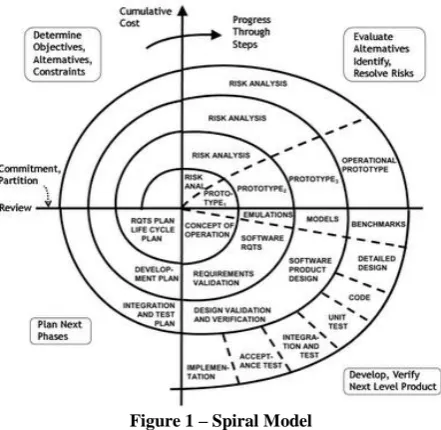
The Spiral Life Cycle Model is a type of iterative software development model which is generally implemented in high risk projects. It was first proposed by Barry Boehm in 1986 through his article – “A Spiral Model of Software Development and Enhancement"[3]. In this approach, we combine the characteristics of both, waterfall model and prototype model. In Spiral model we can arrange all the developmental activities in the form of a loop or spiral.
Each loop in a spiral indicates a development phase (and we can have any number of loops according to the size and nature of the project). Each loop has four quadrants: First quadrant is used to determine the objectives, alternatives and constraints. Here, we try to understand the product intentions, changes in design and constraints enforced due of cost, technology, and schedule.Second quadrant indicates the Risk analysis and evaluation of alternatives. Here we try to find which other methods can be implemented in order to fulfil the identified constraints. Here, operational and technical issues are given importance. Risk identification and mitigation is given primary focus in this phase. And based on these factors future action are determined.Third quadrant indicates the execution of that phase of development. Now, we develop the planned product. Testing is also given equal importance. In order to do software development, waterfall or incremental approach can be considered. Fourth quadrant helps planning the next phase. Here we evaluate the progress and take decisions by considering all constraints. During this phase, the developer has the privilege to decide whether to continue with the project or to stop working with the project. If solvable issues are identified, it could be resolved and necessary steps to proceed further can be planned. Consequent loops of spiral model involve similar phases. Here, analysis and engineering efforts are applied. Huge, expensive or complicated projects use this type of life cycle. At any point of time, if one feels that the risk involved in the project is large and unmanageable than expected, there is a provision to abort it. Assessments at different phases can be done by an internal person or by an external client.
Spiral – A Meta Model
Spiral model is also called as meta-model because in a way it combines the properties of other models of SDLC. Mostly waterfall and prototype models are taken into consideration. Here we do software development systematically over the loops (following the waterfall approach) and at the same time we make a prototype and show it to user after completion of various phases (as that of prototype model). In this way, we are able to assess and reduce risks as well as follow a systematic approach.
Figure 1 – Spiral Model
The highpoint of this model is that each of its cycle is completed through a fruitful interaction between the customers and the developers related with the project. Though this model has many positive point associated, as usual, the model has many negative side also. Let us summarize the merits and de-merits of this model as follows:-
Advantages
Spiral Life Cycle Model is one among the most flexible SDLC models. Development phases can be
determined by the project manager, according to the complexity, size and type of the project.
Supervising the Project is very easy and active. Each phase, or each loop, requires a review from concerned
authority. This makes the model more apparent.
Risk management is one of the major characteristics of the model, which makes it more reliable compared to
other models.
Changes can be announced later in the life cycle.
Project guesstimates in terms of schedule, cost, quality etc. becomes more realistic as the project moves forward and loops around the spiral and gets completed.
It is most suitable for high risk projects, where business needs may be unstable and non-predictive in nature.
A highly personalized product can be developed using this.
Disadvantages
Cost involved in this model is usually unpredictable high.
It is a complicated method especially for projects with a clear specification (SRS).
Skills required, for evaluating and reviewing project from time to time, need high expertise.
Procedures and protocols should be followed properly to effectively implement this model. By following such
activity through-out the period of project is really a threatening aspect.
Due to various customizations acceptable from the customer at any time, using the same prototype in other projects, will invariably affect in future
It is not a suggested model for low risk projects.
Meeting economic and planning requirements is dangerous if this way of development process is practised.
AGILE MODEL
Agile model is the modern trend in software development methodology used to quicken the operational product/system delivery within a scheduled time frame using set of values that include adaptability, transparency, simplicity and unity in effective and light weighted manner.Agile model is extensively practiced model which has a frequent approach in simplifying the process by dividing it into short and light weighted phases such as Requirements, Specification, Architecture, Design, Implementation, Testing, Deployment and Maintenance that results in effective software systems.There are many specific agile development methods. Most encourage the development, team spirit, association, and process compliance throughout the life-cycle of theproject.
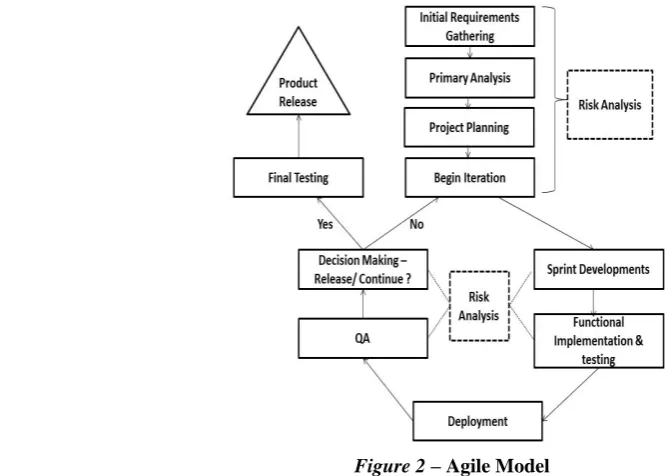
Agile methods break tasks into small increments with minimal planning and do not directly involve long range planning. Iterations are very short time frames which are also called timeboxes that typically range from one to four weeks. Each of the iteration involves a cross functional team working in all tasks like project planning, requirement analysis, system and architectural design, coding, unit level testing, and finally the acceptance testing. At the end of every iteration, a working product is validated to the stakeholders. This allows to minimize the overall risk and allows the project to adapt to the changes quickly. Much numberof iterations might be required to release a product. A model showing the agile life cycle along with its risk analysis phase is pictured in Figure 2.
Figure 2 – Agile Model
Some of the well-established and used agile software development methods include:
Crystal Clear
Dynamic Systems Development Method or (DSDM)
Extreme Programming (XP)
Feature Driven Development (FDD)
Kanban (development)
Lean software development
Scrum
Advantages
Customer satisfaction is guaranteed by releasing rapid, continuous delivery of the required software.
People and interactions are accentuated rather than process and tools. Customers/users, developers and testers
constantly interact with each other.
Face-to-face conversation is the best adapted form of communication.
Close and daily interaction and cooperation between business people and developers are found.
Continuous attention to technical perfection and good design is taken into consideration.
Regular adaptation to changing environments is accepted.
Welcomes changes in requirements even at the later stages.
Disadvantages
In case of larger software projects, it is reallydifficult to evaluate the effort required at thestarting of the software development lifecycle.
There occurs a lack of prominence on necessary designing and documentation.
The project can easily change track if the customer is not clear about the final outcome thatthey require.
Only senior programmers are proficient in taking theproper decisions required during thedevelopment process. Hence it has no place for newbie or junior level programmers, unless combined with experienced resources.
IV. GENERIC RISK FACTORS ASSESSED DURING SDLC
Risk is always defined as the term which creates the potential future harm that may arise due to some present actions. Risk management is the most important issue involved in the software project development. Risk management consists of the different processes, methodologies and tools that are used to deal with various risk factors in the SDLC process of software development. It is also defined as the activity that identifies a risk, assesses the risk and defines the strategies to minimize or mitigate the risk. Risk Management can also be defined as the practice of systematically deciding cost effective approaches for minimizing the outcome of threat and maximizes the opportunities in the future.
Some of the basics factors regarding software risk are:-
Risks are influencing aspects that might harmfully affect the outcome of a project.
Risk is the direct consequence of uncertainty. If there is no uncertainty, it is never called a risk – it is known as certainty.
Risk analysis is used to help a team to understand the different forms of uncertainty which could affect the outcome of the project.
Risk management (sometimes called Risk Mitigation) is the method that the team puts into place to anticipate,
and mitigate the effects of risk to a project.
The important aspect to remember is that even in simple projects, things are subjected to go wrong, and that you need to make plans to minimize the impact of those events when they occur. The major activities or steps in dealing with risk are:
- Risk Identification
- Risk Classification
- Risk Quantification
- Risk Planning & taking Action
- Risk Repetition based on situations.
In this paper, I have tried to classify the risk that is probable to occur during the development of software. And then to make a comparative study on the two above mentioned models and to find out the real effect of risk assessment and the impact created on these models.
Some of the major potential risk categories related with the software development, which I have chosen for study includes:-
Mission and Goal of Organization
Project Management Capability
Decision Teamsters
Organizational Management
Customer/User Relationship
Software Content
Deployment Factors
Development Activities
Development Environment
Project Management
Project Team
Technology Issues
Maintenance Factors
These above mentioned risk types have many number of sub category risk too. Let us go through each and every factor and classify the risk as low, medium or high based upon their impacts on software development. And then compare the Spiral and Agile model to see their assessment ability to deal with the so called potential risk situations.The risk assessment models, methods and techniques are widely used to control risk in a software development. Risk assessment produces either a positive or negative outcome. Bad outcomes are risks and good outcomes are possibilities to produce good quality software.Now, let us see how we can make this risk assessment using our traditional Spiral Model and the new generation Agile Model. And find out the efficiency of these two models in Risk Assessment capacity and their management methodologies.
V. RISK ASSESSMENT CAPABILITYOF SPIRAL AND AGILEMODELS – A COMPARATIVE
STUDY
According to Barry Boehm and Richard Turner, Risk analysis can be used to choose between adaptive (agile –
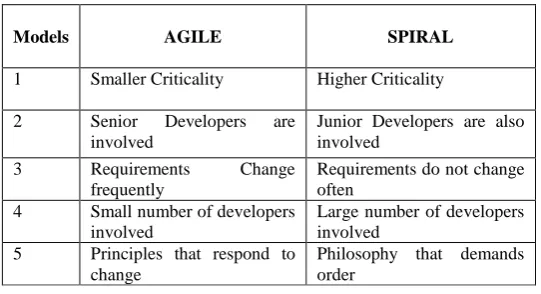
Value-driven) and predictive (Spiral - Plan-driven) methods and have concluded that each side of the range has its own associated features, as shown in Table1:
Models AGILE SPIRAL
1 Smaller Criticality Higher Criticality
2 Senior Developers are involved
Junior Developers are also involved
3 Requirements Change frequently
Requirements do not change often
4 Small number of developers involved
Large number of developers involved
5 Principles that respond to change
Philosophy that demands order
Table 1: Aptness of Agile and Spiral Models
Table 1 describes clearly the difference in the risk assessment capability of spiral and Agile Model. It stresses mainly on five different points regarding criticality, class of developers, requirement change, number of developers involved as well as the principles and philosophies followed. Overall, we can find that Agile Model supports the overall issues and gives a lesser risk probability during the development life cycle.
Now, let us have a comparative check of the various risk factors and its associated effect on both models which are depicted in Table 2. The risk effect is graded as low, medium and high on the two great risk analysis models.
RISK
CATEGORY RISK FACTORS
Effect on SPIRAL
Effect on AGILE
Mission and Goal of Organization
Project Fit to Provider / Customer
Organization High Low
Customer Insight High Medium
Work Flow Medium High
Management Resource Conflict Medium Medium
Customer Conflict Low Low
PM Experience Low Medium
Project Definition High Low
Decision Teamsters
Political Issues Low Low
Deadlines High Low
Technology Used High Low
Organizational Management
Stability Low Low
Roles & Responsibilities Medium Low
Policies & Standards Medium Low
Support from Management Low Low
Managerial Involvement Medium Low
Project Objectives High Medium
Customer/ User Relationship
Customer Involvement Medium Low
Customer Experience High High
Customer Acceptance Medium Medium
Customer Training Needs Medium Medium
Customer Validation Medium Low
Project Constraints
Project Size Low High
Hardware Limitations Medium Low
Reusable Constituents High Low
Budget size High Low
Budget Constraints High Medium
Cost Regulation High Low
Delivery Issues High Low
Development Calendar High Low
Software Content
Requirements Permanence High Medium
Requirements Completeness & Clarity High Medium
Testability Matters Medium Medium
Design issues High Medium
Implementation complications Medium Medium
System Reliance Medium Low
Deployment factors
User Service Impact High Medium
Team Involvement Medium Low
External Hardware / Software Interfaces High` Medium
Development Activities
Alternate Analysis High Medium
Documentation Preparation Low Low Use of specified engineering mechanisms Low Low
Initial Defect Tracking Medium Low
Development Environment
Hardware Platform Medium Medium
Availability of Tools Medium Medium
Vendor Support Medium Medium
Project Management
Project Manager Approach Medium Low
PM Interaction Medium Low
PM Expertise & Knowledge Medium Low
Attitude of PM Medium Low
Support from PM Medium Low
Project Team
Availability of Team Members Medium Low
Team Skills Medium Low
Domain Experience Medium Medium
Familiarity with Hardware & Software Medium Medium
Process Experience Low Low
Team Training Medium Medium
Team Spirit & Attitude Medium Low
Team Productivity Medium Low
Domain Expertise Medium Low
Technology Issues
Technology compliance with Project Medium Low Team Experience with Project Technology High Medium Obtainability of Technology Expertise High Medium
Maintenance factors
Design Complexity Medium Medium
Support Personnel Medium Low
Vendor Support Low Low
Table 2 –Risk factors and its effect on Spiral and Agile Models
Table 2 expresses some of the major risk categories and their related risk factors based on which I have made an assessment on the impact of risk and how the two models - Spiral and Agile deal with the situation.These are the data which was collected from various software development companies and had done a quantitative study based on these facts.
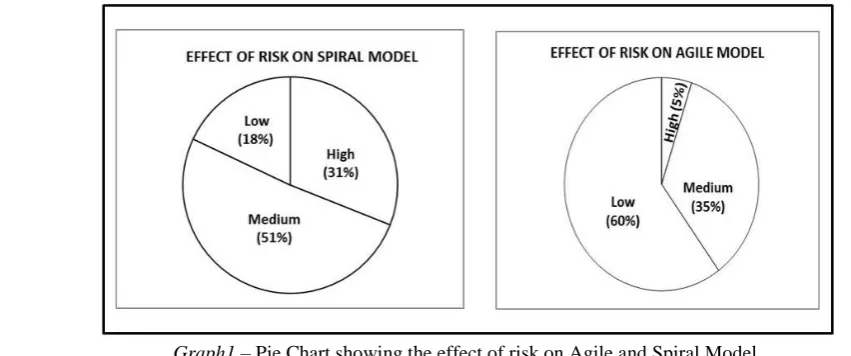
Based on these facts, a quantitative means of analysis has been carried out as shown in Table3. This exactly shows
Rate of Risk on Spiral and Agile Model
Risk Effect
HIGH MEDIUM LOW Model
SPIRAL 31% 51% 18%
AGILE 5% 35% 60%
Table 3 – Risk Rate Percentage on Spiral and Agile
To make it more clear a pie chart is drawn using these data as shown in Graph1.
Graph1 – Pie Chart showing the effect of risk on Agile and Spiral Model.
Thus, it was found that, depending upon many of the risk factors, Agile Model showed a good effect on minimizing the risk and produces a better success frequency result in developing software using this model. Many criteria and their sub criteria’s were considered during this relative study.
VI. CONCLUSION AND FUTURE WORK
From this comparative study, we can find that the level of risk is higher when dealing with Spiral Model or the development of software when compared with the latest lightweight methodology – the Agile. Though we have a notion that Agile methodologies are inefficient in large organizations and certain types of projects, it seems to be best for development of small and non-sequential projects based on the risk assessment done herewith. Many organizations believe that agile methodologies, adopt a hybrid approach that mixes elements of agile and plan-driven -Spiral approaches.Spiral Model is found to have higher order risk than Agile Model. Even then.we can conclude that based on the type of projects and its huge size, Spiral model also plays a very important role in software development and dealing with the risk factors associated with the software project development.
helps the organization to assess the various risk factors and based on which the organization can release a quality product on time and within the given budget.
REFERENCES
1.Boehm Barry W, “Software Risk Assessment”, IEEE Computer Society Press, Vol.15 (7), pp.902-916,1989.
2.Michael Lant, “Five Simple Steps to Agile Risk Management”, http://michaellant.com/2010/06/04/five-simple-steps-to-agile-risk- management/, June 4, 2010
3.Boehm, B.W. –“Software risk management: principles and practices”-Software, IEEE (Volume:8 , Issue: 1 ), ISSN :0740-7459,
4. Sanajana Taya – “Comparative Analysis of Software Development Life” – ISSN:2229-4333 (print), SSN:0976-8491(online), vol.2ISSUE 4, Oct- Dec2011
5.V. Szalvay, “An Introduction to Agile Software Development,” technical report, Danube Technology, 2004.
6. HaneenHijazi, “ A Review of Risk Management in Different Software Development Methodologies “,International Journal of Computer Applications (0975 – 8887) Volume 45– No.7, May 2012
7. Nabil Mohammed Ali Munassar and A. Govardhan,” A Comparison Between Five Models Of Software Engineering”, IJCSI International Journal of Computer Science Issues, Vol. 7, Issue 5, September 2010, ISSN (Online): 1694-0814
8. R. Dash and R. Dash, “Risk assessment techniques for software development,” European Journal of Scientific Research, Vol 42, No. 4, 2010, pp. 629–636.
BIOGRAPHY