Previous Allocation Based Active Monitoring
Algorithm for Load Balancing in
Cloud Computing
Harsha M B1, Dr. Sarojadevi H2
P.G Scholar, Dept. of Computer Science and Engineering, NMAMIT, Udupi, Karnataka, India1
Professor and Head, Dept. of Computer Science and Engineering, NMAMIT, Udupi, Karnataka, India2
ABSTRACT: Balancing load is very important in cloud computing environment. Now a days, cloud computing is very popular and rapid growing technology. Clients from all over the world request for various cloud computing services. In present situation the load balancing algorithms are built to allocate the user requests to cloud resources (Data centre) in very efficient and intelligent way, so that over/under utilization of resource will not occur in cloud environment. In this paper, we proposed Modified Active Monitoring load balancing algorithm which allocates the user requests to all virtual machine in efficient manner. Simulation of this algorithm is done in Cloud Analyst simulator and we compare the results with existing Active Monitoring algorithm. Proposed algorithm distributes the load to all virtual machine without over/under utilization.
KEYWORDS: Cloud computing, Load balancing, Resource utilization, Virtual machine, Cloud Analyst.
I. INTRODUCTION
Cloud computing is emerging and innovative technology adopted in both industry and academia to store and retrieve the data file and we can access the software and computing resource over a network. Cloud technology is getting popular and large numbers of users are accessing the cloud services. Balancing load is major task of cloud service provider with minimum response time and better satisfaction of service level agreement of users. Many algorithms like Round Robin, Random Distribution and Throttled are used to distribute the load to virtual machine running in data centre with minimum response time and better throughput. But constraints such as over/under utilization of virtual machine and communication delay are not addressed clearly. Generally load balancing algorithms can be classified into static and dynamic algorithms. Static load balancing algorithms do not depend on the state and behaviour of system while allocating the user request. These algorithms are mostly suitable for homogeneous and stable environment but in dynamic environment they produce a poor response time. Dynamic Algorithms depends on the state and behaviour of the system, while allocating the user request they are more flexible and take different types of system attributes.
Cloud system consists of several servers, virtual machine, storage etc., which are interconnecting efficiently in network. Nowadays, cloud computing fully depends on virtualization technique and thus enables the server to run several applications. In this paper, we present the Modified Active Monitoring load balancer to overcome the over/under utilization problem in Active Monitoring load balancer.
II. RELATED WORK
ISSN(Online) : 2319-8753 ISSN (Print) : 2347-6710
I
nternational
J
ournal of
I
nnovative
R
esearch in
S
cience,
E
ngineering and
T
echnology
(An ISO 3297: 2007 Certified Organization)
Vol. 5, Special Issue 9, May 2016
response time. There are many load balancing algorithms proposed by researchers to balance the load in cloud, of which three load balancing algorithms are as follows.
A. Round Robin Algorithm:
Round robin algorithm is static in nature, it allocate the user requests to virtual machine in rotation manner. When first request arrives, it selects virtual machine randomly then next requests are allocated in rotation manner. Drawback of this algorithm is that, it does not consider the state or size of the server while allocating the user requests.
B. Active Monitoring Load Balancer:
Active load balancing algorithm is dynamic in nature. It has index table to store the information of number of user requests currently running in each virtual machine. When next request arrives, it finds the least loaded virtual machine from the index table. Drawback of this algorithm is that, virtual machines are over and underutilized while balancing the load.
C. Throttled Load Balancer:
Throttled load balancing algorithm is also dynamic in nature, in which at a time one virtual machine executes only one user request. The Load balancer maintains index table to store the state (Available or Busy) of each virtual machine. When a request arrives load balancer parses the index table and finds the available state virtual machine for allocation. If all virtual machine are busy it returns -1 and then requests are stored in waiting queue. Drawback of this algorithm is that it checks table from first index every time to allocate. Because of this virtual machines are over/under utilized.
III. PROPOSED MODIFIED ACTIVE MONITORING ALGORITHM
In proposed work we are considering Active Monitoring load balancer to propose a Modified Active Monitoring load balancer. This algorithm focuses on finding the least loaded virtual machine (VM) and how user requests are assigned intelligently to it, so that optimum utilization of virtual machine is done. Algorithm of Modified Active Monitoring load balancer is given below. It checks the least loaded virtual machine to allocate the user request also considering previous allocation. If the least loaded VM is previously used, it goes for next least loaded VM for user request.
Algorithm: Modified Active Monitoring Load Balancer
Input: Number of incoming requests A1, A2 . . . An, Available virtual machines B1, B2.………Bm
Output: All incoming requests A1, A2 . . . . .. An are allocated least loaded virtual machine status among the available B1, B2··· Bm
1: Initially all the virtual machines have 0 request allocations.
2: Modified Active Monitoring maintained the index table of virtual machines which has number of requests currently allocated to each virtual machine.
3: When requests arrive at the data centre, it passes to the load balancer.
4: Load balancer parses the index table and finds the least loaded virtual machine for allocation. Case I: if found
a. Check whether the chosen least loaded virtual machine is used immediately in the last iteration.
If YES
Go to step 4 to find next least virtual machine If NO
Least loaded virtual machine is chosen
5: Modified Active Monitoring load balancer returns the virtual machine id to the data centre.
6: Request is assigned to the virtual machine. Data centre notifies the Modified Active Monitoring load balancer about the allocation.
7: Modified Active Monitoring load balancer updates the requests hold by each virtual machine.
Figure1: Flow of proposed Modified Active Monitoring Algorithm
There is “n” number of user who sends requests to data centre. Data centre controller sends “n” user request to “m” virtual machine which are running on it. Modified Active Monitoring load balancer maintained index table to store the number of requests that are currently executing in each virtual machine, When request comes it checks the least loaded virtual machine, if the least loaded virtual machine is previously allocated then the algorithm choose the next least loaded virtual machine for user request, so we achieve the efficient utilization of all virtual machine.
IV. EXPERIMENTAL SETUP
ISSN(Online) : 2319-8753 ISSN (Print) : 2347-6710
I
nternational
J
ournal of
I
nnovative
R
esearch in
S
cience,
E
ngineering and
T
echnology
(An ISO 3297: 2007 Certified Organization)
Vol. 5, Special Issue 9, May 2016
Figure 2: Architecture of Cloud Analyst simulator
Snapshot graphical user interface of Cloud Analyst simulator is shown in Figure 3.It enables the user to create and configure the data centre & user base (Traffic generator) in all the regions easy and quickly. Simulator generates the output in the form of graph and tables enable the modeller easy analysis of performance parameter.
Figure 3: Snapshot of simulator
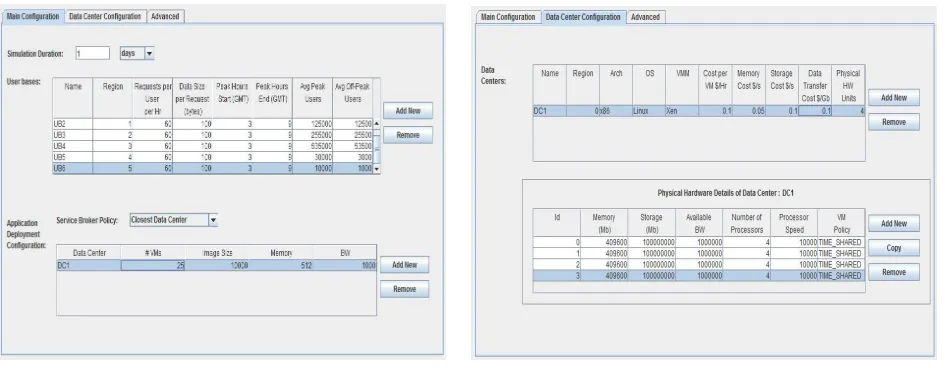
Simulation configuration of user base and data centre is given in Figure 4 and 5. User base configuration consists of generation of traffic at given time and Application router algorithm for routing the traffic to different region. Data centre configuration consists of hardware specification like storage, processor, bandwidth etc.
Figure 4: User base configuration. Figure 5: Datacenter configuration
V. RESULTS AND ANALYSIS
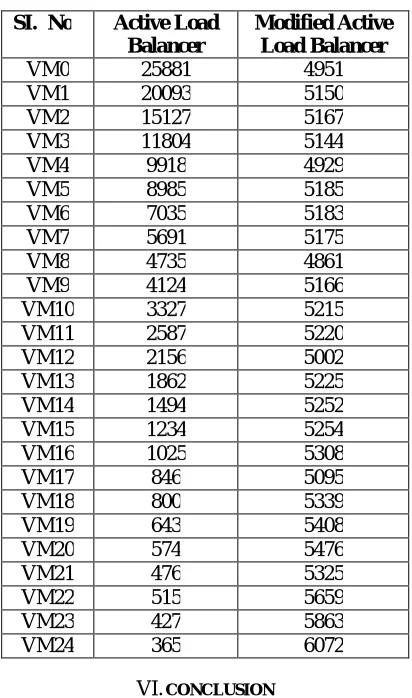
We analysed the result based on the efficient utilization of virtual machines. The proposed Modified Active Monitoring algorithm does not allow the virtual machines which are allocated in the previous request. It finds next least loaded virtual machine for allocation. So we can utilize all virtual machines without over/under utilization. We simulated experiment using 5, 25 and 50 virtual machines respectively.
Table 2: Virtual machine usage with 5 VMs
SI. No Active Load Balancer
Modified Active Load Balancer
VM0 1174 258
VM1 78 252
VM2 11 253
VM3 4 251
VM4 2 254
ISSN(Online) : 2319-8753 ISSN (Print) : 2347-6710
I
nternational
J
ournal of
I
nnovative
R
esearch in
S
cience,
E
ngineering and
T
echnology
(An ISO 3297: 2007 Certified Organization)
Vol. 5, Special Issue 9, May 2016
Table 3: Virtual machine usage with 25 VMs
VI. CONCLUSION
Good load balancing algorithm distributes the load to all virtual machines with minimum response time, maximum throughput and efficient utilization of all virtual machines. In this paper, we proposed the Modified Active Monitoring load balancer which manages the load by considering all virtual machine requests for allocation and previous allocation. In Active Monitoring load balancer, virtual machines are extremely over/under utilised. To overcome the drawback, we modified Active Monitoring load balancer. Modified Active Monitoring Load Balancer distributes the load across the virtual machine efficiently. VM0 and VM4 are over and underutilized in Active Monitoring whereas in proposed algorithm all virtual machines are efficiently and evenly utilized. As a future work, we can further improve the proposed algorithm by considering more dynamic situation of the incoming request.
REFERENCES
[1] Klaithem Al Nuaimi, Nader Mohamed, Mariam Al Nuaimi and Jameela AI-Jaroodi, “A Survey of Load Balancing in Cloud Computing: Challenges and Algorithms”, in Second Symposium on Network Cloud Computing and Applications, pp 137-142, Dec. 2012.
[2] Reena Panwar, Bhawna mallick, “A Comparative of Load Balancing Algorithm In Cloud Computing” International Journal of Computer Application , vol.117, no. 24, May 2015.
[3] Darji, Vinay, Jayna Shah, and Rutvik Mehta. “Dynamic Load Balancing For Cloud Computing Using Heuristic Data and Load on Server” IOSR Journal of Computer Engineering, vol. 16, no. 4, pp 59-69, Aug. 2014
[4] Zhen Xiao, Weijia Song and Qi Chen, "Dynamic Resource Allocation Using Virtual Machines for Cloud Computing Environment" IEEE transactions on parallel and distributed systems, vol. 24, no. 6, june 2013.
[5] Hemant S. Mahalle, Parag R. Kaveri and Vinay Chavan, “Load Balancing On Cloud Data Centres” in International Journal of SI. No Active Load
Balancer
Modified Active Load Balancer
VM0 25881 4951
VM1 20093 5150
VM2 15127 5167
VM3 11804 5144
VM4 9918 4929
VM5 8985 5185
VM6 7035 5183
VM7 5691 5175
VM8 4735 4861
VM9 4124 5166
VM10 3327 5215
VM11 2587 5220
VM12 2156 5002
VM13 1862 5225
VM14 1494 5252
VM15 1234 5254
VM16 1025 5308
VM17 846 5095
VM18 800 5339
VM19 643 5408
VM20 574 5476
VM21 476 5325
VM22 515 5659
VM23 427 5863
Advanced Research in Computer Science and Software Engineering, vol. 3, no. 1, January 2013.
[6] Brototi Mondal, Kousik Dasgupta and Paramartha Dutta, “Load balancing in cloud computing using stochastic hill climbing-a soft computing Approach” in Procedia Technology , vol. 4, pp783 - 789, ELSEVIER C3IT-2012.
[7] Rajkumar Buyya, Rodrigo N. Calheiros, Rajiv Ranja, Anton Beloglazov, A. F. De Rose, “CloudSim: a toolkit for modeling and simulation of cloud computing environments and evaluation of resource provisioning algorithms”, 2010.
[8] B. Wickremasinghe, R.N.Calheiros,R.Buyya, “Cloudanalyst: A cloudsim-based visual modeller for analysing cloud computing in:Proceedings” of the 24th International Conference on Advanced Information Networking and Applications (AINA 2010), Perth, Australia" 2010.
[9] Mr.Manan D. Shah, “Allocation Of Virtual Machines In Cloud Computing Using Load Balancing Algorithm” in International Journal of Computer Science and Information Technology & Security , vol. 3, no.1, February 2013.