ABSTRACT
STONE, SOPHIA JEFFRIES. Instructors’ Perceptions of Three-Dimensional (3D) Virtual Worlds: Instructional Use, Implementation and Benefits for Adult Learners. (Under the direction of Dr. Brad Mehlenbacher and Dr. Diane Chapman.)
The purpose of this dissertation research study was to explore instructors’ perceptions of the educational application of three-dimensional (3D) virtual worlds in a variety of
academic discipline areas and to assess the strengths and limitations this virtual environment presents for teaching adult learners. The guiding research question for this dissertation study was: What are instructors’ perceptions of the strengths and limitations of three-dimensional virtual worlds as learning spaces for teaching adult learners? The following four questions supported this research: a) How do instructors implement educational experiences in 3D virtual worlds, for adult learners? b) How do instructors facilitate adult learning in 3D virtual worlds across disciplines? c) What insights do instructors describe about the adult learners’ needs in this virtual environment? and d) How do instructors describe a successful immersive learning experience implemented in a 3D virtual world?
This dissertation research study was conducted as a heuristic case study with instructors interviewed from multiple locations that taught in private and public institutions of higher education in the southeastern United States. Instructors were asked to reflect on their experiences teaching in a virtual world, and to describe their perceptions of
virtual worlds, the social learning made possible, and the digital artifacts this space affords. The dissertation concludes with recommendations for faculty and higher education
Instructors’ Perceptions of Three-Dimensional (3D) Virtual Worlds: Instructional Use, Implementation and Benefits for Adult Learners
by
Sophia Jeffries Stone
A dissertation submitted to the Graduate Faculty of North Carolina State University
in partial fulfillment of the requirements for the degree of
Doctor of Education
Adult and Higher Education
Raleigh, North Carolina 2009
APPROVED BY:
_______________________________ ______________________________
Dr. Brad Mehlenbacher Dr. Diane D. Chapman
Committee Co-Chair Committee Co-Chair
_______________________________ _______________________________
Dr. Julia Storberg-Walker Dr. Len Annetta
DEDICATION
BIOGRAPHY
Sophia J. Stone is currently Assistant Director for Distance and Independent Learning at Duke University. In her role with the Talent Identification Program, she oversees the development and implementation of innovative distance education services for gifted and talented students. Sophia was born in Montreal, Quebec. She has a B.A. from McGill University, an M.L.S from the University of North Carolina at Chapel Hill, an M.Ed. from NC State University, and is currently a doctoral candidate for the Ed.D. at NC State University. She was inducted to Phi Kappa Phi in 2002.
ACKNOWLEDGMENTS
With deep gratitude, I would like to thank my dissertation committee: Dr. Brad Mehlenbacher and Dr. Diane D. Chapman, dissertation co-chairs, the late Dr. Colleen Wiessner, dissertation committee member and qualitative methodologist, Dr. Julia Storberg-Walker, who kindly served after Dr. Wiessner’s sudden passing, and Dr. Len Annetta, dissertation committee member. Thank you for your guidance, feedback, and encouragement throughout this process. Dr. Mehlenbacher, thank you for your wisdom and guidance. You helped me keep the big picture in mind and you made this dissertation an enjoyable process. Dr. Chapman, you have been a great mentor, and I am deeply grateful for all you have done so I can reach this point today. Thank you Dr. Annetta, for subject matter expertise and for guiding me as I developed this dissertation. A very special thanks to Dr. Julia Storberg-Walker, who graciously agreed to serve on my committee after the very sudden and
unexpected passing of Dr. Wiessner. A great qualitative methodologist, a very wise woman, and a genuinely lovable individual, Dr. Wiessner was one the kindest individuals I have ever had the privilege of knowing. Thank you Dr. Luckadoo, for giving me a roadmap after I defended the proposal, and for offering encouragement so I could complete this dissertation. Thank you to Dede Nelson, Dr. Lynne Gregorio, and Dr. Nancy Fire, for your
TABLE OF CONTENTS
LIST OF TABLES...xi
LIST OF FIGURES ...xii
CHAPTER ONE: INTRODUCTION...1
Background ...2
Statement of the Problem...4
Purpose of the Study ...6
Research Questions...7
Significance of the Study...7
Conceptual Framework and Literature ...9
Andragogy: A Model for Adult Learning...9
Theories of Adult Learning...11
Summary of Conceptual Framework and Literature ...14
Definitions...15
Gaming and Simulations...15
Social Networking ...16
Virtual Worlds ...17
Chapter Summary ...19
CHAPTER TWO: LITERATURE REVIEW...20
Introduction ...20
Part I: Origin, Predecessor Technologies and Contemporary Uses...21
MUDs and MOOs ...25
MMOGs/MMORPGS ...26
Web 2.0: The Social Web ...27
3D Virtual Worlds: Use and Implementation as Learning Spaces …29 Part II: Conceptual Framework and Learning Theories ...31
Conceptual Framework: Andragogy...32
Theories of Adult Learning Relevant to Virtual Worlds ...39
Experiential Learning...39
Situated Learning ...43
Constructivism ...50
Summary of Adult Learning Theories ...55
Part III: Barriers and Potential Educational Benefits...57
Virtual Worlds in Adult Education and Training ...57
Barriers to Use and Implementation ...62
Potential Educational Benefits...70
Chapter Summary ...81
CHAPTER THREE: METHODOLOGY ...82
Research Design...83
Qualitative Paradigm ...84
Case Study Approach...85
Participants and Purposeful Sampling ...90
Participants’ Background...93
Data Collection Methods ...97
Interviews...98
Observations ...98
Document Review...99
Data Analysis ...102
Overview of the Data Analysis Process...102
Overview of the Coding Process...103
Themes...109
Ethical Considerations ...110
Limitations ...111
Subjectivity and Positionality ...113
Trustworthiness, Validity, Reliability...114
Chapter Summary ...117
CHAPTER FOUR: FINDINGS...119
Key Findings of the Study ...119
Finding 1. 3D Virtual World Implementations ...120
Theme: Instructor Preparation ...120
Theme: Experiential and Constructivist Learning: 3D Visualization,
Authenticity, and User-Generated Content...128
Theme: Situated Learning: Presence and Immersion ...133
Theme: Situated Learning, Constructivism, and Community ...138
Finding 2. 3D Virtual Worlds: Facilitating Learning ...140
Theme: Instructional Tools: Social and Visual ...140
Theme: Instructional Strategies ...145
Theme: The Changing Role of the Instructor ...148
Finding 3. Adult Learners’ Needs in the Virtual World ...152
Theme: Safety and Privacy Needs ...152
Theme: Support Needs ...153
Theme: Social Needs ...157
Finding 4. Virtual world implementations: Success Indicators ...158
Theme: Success Indicators: Performance Assessments ...160
Theme: Success Indicators: Social Learning Measures ...160
Instructors’ Perceptions of a Successful Learning Experience ...162
Chapter Summary ...164
CHAPTER FIVE: DISCUSSION, IMPLICATIONS, AND RECOMMENDATIONS...166
The Benefits of Learning in Virtual Worlds ...166
Experience Collective Wisdom...176
Experience Immersion ...179
Experience Authentic Learning ...180
Experience a “Sense of Home”...183
Characteristics of Successful Implementations ...186
Summary of Benefits ...187
Implications...190
Implications for Practice: Planning for Implementation...190
Implications for Practice: Technical Expertise, Funding, and Sustainability...192
Implications for Practice: The Faculty Role and Faculty Development ...192
Implications for Practice: Institutional Support...195
Implications for Practice: Collaborative Learning...196
Recommendations for Future Research ...197
Chapter Summary ...199
REFERENCES ...201
APPENDICES ...219
APPENDIX A: INTERVIEW GUIDE (INSTRUCTOR) ...220
APPENDIX B: INTERVIEW GUIDE (TECHNOLOGY SUPPORT)...224
APPENDIX C: DOCUMENT SUMMARY SHEET ...225
APPENDIX E: IRB APPLICATION ...227
APPENDIX F: INFORMED CONSENT (FACULTY)...236
APPENDIX G: INFORMED CONSENT (SUPPORT STAFF) ...238
APPENDIX H: START CODES MASTER LIST ...240
APPENDIX I: CODES ...241
LIST OF TABLES
Table 2.1: Andragogical Adult Learner Principles ...34
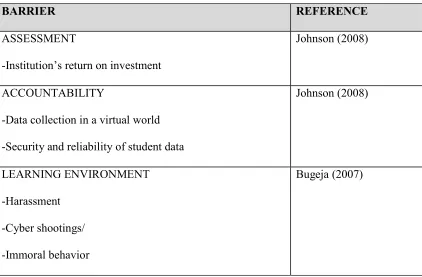
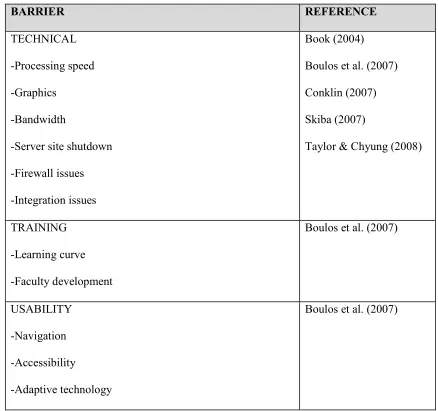
Table 2.2: Categories of Barriers: 3D Virtual World Implementations...…63
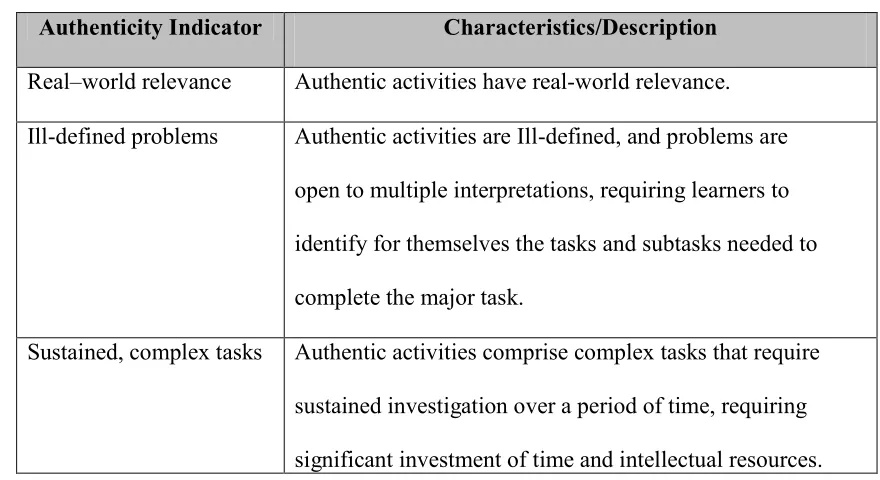
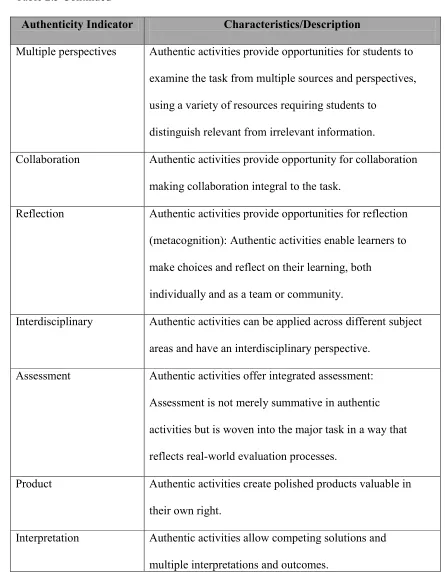
Table 2.3: Characteristics of Authentic Activities...72
Table 3.1: Participant Background, Part I...95
Table 3.2:Participant Background, Part II ...96
Table 3.3: Case Study Data Collection Plan...100
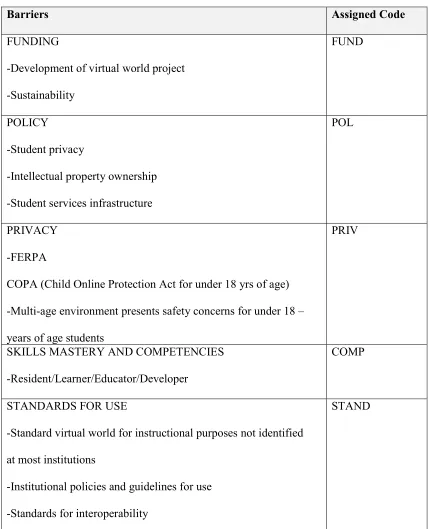
Table 3.4: Preliminary Barriers with Assigned Codes...105
Table 4.1: Educational Application of 3D Virtual Worlds ...126
Table 4.2: Educational Tools and Instructional Strategies ...143
Table 4.3: Instructor Roles in a Virtual World ...148
LIST OF FIGURES
Figure 5.1: 3D Virtual Lab...168
Figure 5.2: Space Sciences Outreach Project... ...168
Figure 5.3: Social Aggregators in a Virtual World...170
Figure 5.4: 3D Virtual Learning Environment (Informal)...171
Figure 5.5: 3D Virtual Learning Environment (Class) ...172
Figure 5.6: Social Constructivist Learning in a 3D Virtual World...173
Figure 5.7: Extending Boundaries Beyond the Virtual Classroom Space ...174
Figure 5.8: Authentic Learning Experience...177
Figure 5.9: The Display Panel: Collective Wisdom ...177
Figure 5.10: Immersive Learning ...180
CHAPTER 1: INTRODUCTION
Three-dimensional (3D) virtual worlds are increasingly implemented as instructional
spaces for teaching adult learners in academic and corporate settings (Kluge & Riley, 2008;
NMC, 2008). While there are many potential educational benefits to learning in this virtual
space, this innovative technology and its educational application in the field of adult
education and training raise questions for research, policy, and practice. The problem is many
instructors who implement 3D virtual worlds in their teaching are confronted with unforeseen
issues and barriers that have not been fully addressed in the research, as many virtual worlds
were not created specifically for educational purposes (Boulos, Hetherington, & Wheelert,
2007; Taylor & Chyung, 2008; Hayes, 2006). More extensive research is needed to identify
the specific strengths and limitations these virtual learning environments present for teaching
adult learners (Hayes).
The purpose of this dissertation research study was to explore the educational
application of 3D virtual worlds in a variety of academic disciplines and to assess the
strengths and limitations this virtual learning environment presents for teaching adult
learners. The guiding research question for this dissertation study was: What are instructors’
perceptions of the strengths and limitations of three-dimensional virtual worlds as learning
spaces for teaching adult learners? The following four questions supported this research: a)
How do instructors implement educational experiences in 3D virtual worlds for adult
learners? b) How do instructors facilitate adult learning in 3D virtual worlds across
disciplines? c) What insights do instructors describe about the adult learners’ needs in this
experience implemented in a 3D virtual world? By interviewing instructors who taught in a
virtual world, I was able to understand their perceptions of the barriers virtual learning
environments present for teaching adult learners. Instructors were asked to reflect on their
experiences teaching in a virtual world, and to describe their perceptions of characteristics of
a successful virtual world implementation.
This first chapter introduces the reader to 3D virtual worlds and describes the
characteristics of virtual worlds and the immersive educational experiences they make
possible. The chapter highlights current 3D virtual world implementations in adult education
and training and explores the potential educational benefits these virtual spaces provide.
Reports on the barriers and challenges instructors face teaching in virtual worlds are
discussed. This first chapter describes the purpose, problem statement, research questions,
and the significance for this dissertation research study.
Background
Instructors have available a variety of educational technologies for teaching adult
learners, synchronously and asynchronously. Learning management systems, Web
conferencing software, Web 2.0 technologies, and three-dimensional (3D) virtual worlds are
just a few of the instructional technologies available for teaching adult learners in an online
environment. 3D virtual worlds are receiving increased attention by educators for their
potential to deliver immersive, authentic learning experiences in a socially situated context
(Kluge & Riley, 2008). These immersive learning experiences are made possible by recent
historic antecedents lie in gaming and social networking, are spaces for collaboration,
learning, training, work, and e-commerce (Messinger, Stroulia & Lyons, 2008).
Virtual worlds are characterized by a shared social space, user-created content, a
graphical user interface, and a virtual space that can be experienced in multi-user mode
within the context of a three dimensional (3D) virtual environment (Chittaro & Ranon, 2007;
Hayes, 2006). Virtual worlds combine graphics and audio with the ability to communicate
and interact synchronously with multiple users (Bell, Peters & Pope, 2007; Kushner, 2004:
Meall, 2007). Shroeder (2008) explains what makes virtual worlds distinct from other virtual
environments is they are persistent online social spaces that exist over time after the user has
left the virtual environment, and they are a synchronous, immersive world for social
interaction. A defining characteristic of 3D virtual worlds is their capacity to deliver
authentic learning experiences rooted in context in a social environment (Dodds, 2007).
3D virtual worlds are increasingly being implemented as instructional spaces for
teaching in the academic setting and in corporate training. According toThe Horizon Report: Virtual worlds offer an opportunity for people to interact in a way that conveys a
sense of presence lacking in other media. These spaces can be huge, in terms of the
number of people that use them, and they are growing in popularity because they
combine many of the elements that make Web 2.0 really exciting: social networking;
the ability to share rich media seamlessly; the ability to connect with friends; a feeling
of presence; and a connection to the community. (NMC, 2008, p. 18)
The latest developments in virtual worlds provide a new level of immersive experience,
learning environment” (Carter & Click, 2006, p. 2). These virtual environments are designed
to facilitate total immersion in context. As an innovative learning technology virtual worlds
have the potential to “significantly enhance the experience and transfer of learning” by
providing an enhanced visual and immersive virtual environment for social and collaborative
learning in a context that closely mimics real-world scenarios (Cross, O'Driscoll & Trondsen,
2007, p. 1).
Statement of the Problem
The research on the instructional use and implementation of 3D virtual worlds, much
of it based in the research on game-based learning, makes reference to the potential
educational benefits of these virtual learning environments (Carter & Click, 2006; Chittaro &
Ranon, 2007; Cross et al., 2007; Dede, 2005; Delwiche, 2006; Dickey, 2005;2005a; Gee,
2003; Hayes, 2006; Karagiorgi & Symeou, 2005; Steinkuehler, 2004). However, there are
reports of the challenges these environments present for both instructors and adult learners
(Boulos et al., 2007; Bugeja, 2007; Gronstedt, 2007a; Hayes, 2006; Johnson, 2007; Kluge &
Riley, 2008; Taylor & Chyung, 2008). Challenges include the design, development, and
sustainability of this virtual learning environment (Boulos et al.; Gronstedt). Boulos et al.
caution many of the educational possibilities still need to be fully identified, explored, and
carefully researched before virtual worlds can be used extensively in teaching. Prior to
making the decision to select and implement a virtual world in their teaching, educators
should inquire about the effectiveness for teaching adult learners, within the context and
For example, Second Life and many other virtual worlds were not created specifically
for educational purposes; however, they are being adapted by educators for instructional use
(Kluge & Riley, 2008). Kluge and Riley explain many of the features educators take for
granted in learning management systems do not exist in virtual worlds. Learning
management systems typically provide teaching functionalities such as a grade book, an
assignment drop box, asynchronous discussion tools, online surveys, and objective
assessments. Many of these teaching tools are not available in virtual worlds that are adopted
for educational purposes.
3D virtual worlds are evolving and experimental learning spaces. According to Hayes
(2006), “As we launch such educational experiments, we need to bear in mind issues such as
the balance of control and freedom granted to learners in such worlds. At the frontiers of
adult learning, they offer unanticipated riches as well as unforeseen challenges” (p. 159). The
problem is many instructors who implement 3D virtual worlds in their teaching are
confronted with a host of unforeseen issues and barriers that have not been fully addressed in
the research, as many virtual worlds were not created strictly for educational purposes. In
addition, the skills and competencies instructors need to teach adult learners in these virtual
spaces have not been fully examined and documented (Boulos et al., 2007). Taylor and
Chyung (2008) explain there is a need for considerable research before this technology can
be “realized in an appreciable manner by instructors or trainers” (p. 24).
Purpose of the Study
Cross et al. (2007) suggest virtual worlds require careful examination prior to their
us to ask: “What can this technology do that will enhance the learner’s experience that my
current learning technology portfolio cannot?” (p. 2). The Distance Education Report (2007)
cautions educators to look critically at virtual worlds, not simply as a representation of a
learning space, but to question how this space can enhance learning in a way the physical
space can not, given the challenges unique to virtual worlds. Hayes (2006) explains:
Despite growing interest in such spaces for adult education, we know little about their
strengths and limitations as environments for learning. There have been isolated
studies of attributes of these worlds, but little attempt to develop holistic analyses of
how features of particular worlds (they are not all alike by any means) contribute to
and combine with emergent social and cultural properties to create distinctive
“learning ecologies” (Seely Brown, 2000, as cited in Hayes, p. 154).
The purpose of this case study was to explore instructors’ perceptions of the educational
application of 3D virtual worlds in a variety of academic discipline areas and to critically
assess the strengths and limitations this virtual learning environment presents for teaching
adult learners. By interviewing instructors who taught in a virtual world, I was able to
understand from their perspective the barriers these environments present for teaching adult
learners. The study reflected a variety of academic disciplines, and examined the types of
learning experiences instructors delivered in virtual worlds for adult learners. Instructors
were asked to reflect on their experience teaching in a virtual world, and to describe their
perceptions of characteristics of a successful virtual world implementation.
The guiding research question for this dissertation study was:What are instructors’ perceptions of the strengths and limitations of three-dimensional virtual worlds as learning spaces for teaching adult learners?The following four questions supported this research:
1. How do instructors implement educational experiences in 3D virtual worlds for adult
learners?
2. How do instructors facilitate adult learning in 3D virtual worlds across disciplines?
3. What insights do instructors describe about the adult learners’ needs in this virtual
environment?
4. How do instructors describe a successful immersive learning experience implemented
in a 3D virtual world?
Significance of the Study
This dissertation study has significance for research, policy, and practice. As an
emerging and innovative technology in the adult education area, research is needed that
describes the instructional use and implementation of learning experiences using this
platform, and the potential educational benefits for adult learners. A considerable amount of
research exists documenting the effectiveness of virtual worlds as learning environments in
K-12 education. However, a limited amount of research specifically addresses the
effectiveness of this virtual learning environment and its ability to meet the needs of adult
learners, from the instructor’s perspective in the field of adult education.
The study findings provided much needed analysis and documentation of the
potential benefits and disadvantages virtual worlds present for teaching adult learners. In
provided documentation on assessment techniques used in virtual worlds to evaluate adult
learning. Further, the reflective nature of the research design, case study approach, facilitated
instructors’ reflection on their own assumptions about teaching adult learners in an online
environment, providing much needed research on how to facilitate adult learning in this
virtual space. The findings of this dissertation study provided insights into the need for
faculty development, support and training for those teaching or designing educational
experiences in 3D virtual worlds.
The implementation of virtual worlds raises a host of policy issues in educational
organizations, in universities and in corporate training, and an awareness of these issues is
particularly relevant to instructors who are considering using virtual worlds for educational
purposes. Virtual university campuses have had incidents of “griefing” “cyber-shootings”
and “harassment and immoral behaviors” (Bugeja, 2007). As Bugeja notes:
When it comes to Second Life, we're not only talking about money. We're talking
about whether you as a professor or administrator will be held accountable for
introducing your students and/or employees to a virtual world that accepts little
responsibility for anything that happens among avatars, including online harassment
and assault.
Student privacy, intellectual property ownership, student services infrastructure, and
accessibility issues are important considerations. For instructors, additional administrative
policy issues concern funding the development and sustainability of the virtual world project,
Bugeja notes: “Any one of those purchases could result in personal or institutional liability
with few, if any, processes in place to resolve legal or ethical complaints.”
Conceptual Framework and Literature
Understanding the needs of adult learners, how they learn best, and the potential for
virtual worlds to meet their learning needs will become more important as the number of
adults entering higher education continues to increase. Recent reports on the increase of adult
learners in higher education and the advanced digital literacies they possess imply a changing
adult learner student demographic. According to Howell, Williams, and Lindsay (2003),
online learners are becoming an “entirely new subpopulation of higher-education learners”
unlike past generations, with new requirements for literacy that extend beyond text, to media
rich environments. Foreman (2004), Dede (2005), and Oblinger (2004) speak of the Net
generation learners as digital learners, who possess multiple media fluency. In addition, the
adult learner population is growing in higher education as Howell, Williams and Lindsay
(2003) point to a 170% increase in the number of adult students between 1970 and 2000.
Andragogy: A Model for Adult Learning
The andragogical model provides a framework specific to the needs of the adult
learner and is a useful model for instructors teaching adults in 3D virtual worlds. Andragogy
provides adult educators with a framework for understanding how adults learn. Knowles’
(1998) six core adult learning principles carry implications for the design and implementation
of educational experiences to meet the needs of adult learners. Knowles’ principles of adult
learning emphasize a self-directed, problem-solving, experiential approach to adult
model for designing, implementing, and evaluating educational experiences with adult
learners (Merriam, 2001). These core adult learning principles serve as a model for teaching
adults—“the art and science of helping adults learn” (Sandlin, 2005, p. 25). As a guiding
framework, andragogy helps instructors to evaluate (a) instructional strategies, (b)
instructional design models, (c) teaching techniques/assumptions, (d) content presentation,
and (e) the use of appropriate learning theories. Self-directed learning focuses on the process
of learning, and makes the assumption that adult learners will assume primary responsibility
for their own learning. The role of adult educators is to facilitate or guide the learning
process (Merriam, Caffarella & Baumgartner, 2007). Self-directed learning theory is
favorable to virtual learning environments, as the environment is unbounded in time and
space and requires learners to assume a higher level of autonomy and self-direction.
Although andragogy has a long tradition in the field of adult education, it has been
critiqued by Hartree (1984) who questioned whether andragogy was a theory, suggesting
instead the six assumptions are simply principles of good practice. Sandlin (2005)
summarized the five main critiques as (a) andragogy makes an incorrect assumption that
education is value neutral and apolitical and fails to recognize that knowledge is value-laden
(Tisdell, 1998), (b) andragogy promotes an adult learner with white, middle-class values
(Collins, 1995; Flannery, 1994; Guy, 1996; Pratt, 1993), (c) andragogy does not include other
ways of knowing and ignores voices of the disenfranchised (Flannery, 1994; Welton, 1995),
(d) andragogy is very individualistic and does not consider the relationship between self and
Theories of Adult Learning
There are several adult learning theories that are relevant for learning in 3D virtual
worlds. Traditional theories of adult learning, such as andragogy and self-directed learning
pertain to online learning as they focus on the characteristics that make adults unique as
learners, the six assumptions, mentioned previously. Other adult learning theories, such as
experiential learning, situated learning, and constructivist theories are useful tools of analysis
as we examine how learning takes place in these multi-user, social virtual spaces.
Experiential Learning
Experiential learning involves the reflective construction of meaning through critical
reflection and dialogue. Net generation learners are experiential learners (Oblinger and
Oblinger, 2005). David Kolb (1984) argued that learning must be experiential, proposing a
four stage model of the learning process: (a) a concrete experience, (b) reflection on the
experience, and (c) abstract generalization from the experience and the application of the
concepts to another situation (Holmes & Gardner, 2006). Experiential learning involves the
reflective construction of meaning with emphasis on critical reflection and dialogue
(Fenwick, 2000; 2000a). According to Fenwick, a learner’s reflection on lived experience
and the subsequent interpretation that forms knowledge is constructivist in nature and
reflected in the writings of Schon (1983), Kolb (1984) and Brookfield (1987). Schon
examined how adults learn from experience and found learning occurs through
reflection-in-action and reflection-on-reflection-in-action. Rogers (2002) as well as Bersin (2004) asserted the highest
level of mastery comes from experiential learning as this creates a high level of
(2004) noted the role experiential learning plays in simulation-based environments. Tennant
and Pogson (1995) affirmed that experience plays a central role in the practice of adult
education. “Focusing on the learner’s experience is an integral part of the tradition that places
the learner at the center of the education process” (p. 149). The justification for placing
experience at the center of learning is founded on Dewey’s assertion that education rests
solidly on experience as a foundation for learning.
Situated Learning
Situated learning theory suggests that knowledge must be socially situated in an
authentic context for learning to occur (Lave & Wenger 1991). Situated learning theory is
relevant for adults learning in virtual worlds because the theory takes into account adult
cognition with a focus on the importance of socially situating learning in an authentic
context. Situated learning theory considers the interaction of a number of factors that
influence learning: the adult learner, the context, the learning task, the process for learning,
and the social environment in which learning takes place. Situated learning theory has two
main tenets: (a) knowledge needs to be presented in an authentic context, i.e., settings and
applications that would normally involve that knowledge; and (b) learning requires social
interaction and collaboration, as learners become part of a “community of practice.”
According to Lave and Wenger (1991), meaning is contextual, and learning takes place when
individuals become increasingly involved as participants in social communities of practice.
Individuals learn through participation and interaction with the community, its history,
purposes, norms, and practical challenges. Knowledge emerges as a result of these elements
interacting. When problems and context are similar to real-world scenarios, situated learning
is possible (Hayes, 2006).
Constructivism
Constructivism has three main tenets: (a) understanding comes from interactions with
the environment, (b) cognitive conflict is the stimulus for learning and determines the
organization and nature of what is learned, and (c) knowledge evolves through social
negotiation with the learning environment, providing alternative views to test the learner’s
understanding of the knowledge construct. Constructivist theorists (Jonassen, 1991; Savery &
Duffy, 1996) believe learners construct their own reality and form their own interpretations
based upon their perceptions of experiences. Constructivists maintain learners construct
knowledge through relationships, rather than acquire knowledge through the transmission of
information (Dickey, 1999). Knowledge is dynamic and built around the process of discovery
(Huang, 2002).
From a constructivist perspective, learning is a process of making sense of the world
and negotiating meaning with others (Kirkley & Kirkley, 2005). Constructivism suggests
learning is an active process and learners construct knowledge by understanding new
information built upon their current understanding and expertise. Problem-based learning is
one example of constructivist learning. Constructivists such as Dewey (1916), Piaget (1973),
Vygotsky (1978) and Bruner (1996) each proposed learners could learn to actively construct
new knowledge based on their prior knowledge. According to Dewey (1916), knowledge is
Constructivism implies that learning is effective when it is contextual, active, and social
(Oblinger & Oblinger, 2005). Constructivists claim individuals learn through a process of
knowledge construction that takes place when learners are intellectually engaged in
“personally meaningful tasks” (Chittaro & Ranon, 2007). Virtual worlds are favorable to
constructivist design because they provide first person interaction with the environment, and
a “first-person experience allowing for spontaneous knowledge acquisition” (Chittaro &
Ranon).
Summary of Conceptual Framework and Literature
The guiding conceptual framework for this dissertation research study is andragogy,
and the adult learning theories, experiential, situated learning, and constructivism, that
facilitate learning in the virtual world environment. The andragogical model provides a
framework specific to the needs of the adult learner and is a useful model for instructors
teaching adults in 3D virtual worlds as it provides adult educators with a framework for
understanding how adults learn within the framework of Knowles’ (1998) six core adult
learning principles. The literature review includes a discussion of adult learning theories
relevant to learning in 3D virtual worlds: experiential learing, situated learning, and
Definitions
There are many definitions relevant to this study. A review of literature on the history
of virtual worlds finds the term virtual worlds is used interchangeably with a multitude of
terms, including 3D virtual worlds (Dickey, 2003), 3D social virtual worlds (Hendaoui,
Limayem & Thompson, 2008), multiplayer online games (MMOs), multi-user virtual
environments (MUVEs), synthetics worlds, MMOs, MMORPGs, social virtual worlds,
MUDs, MOOs, and MUSHes (Delwiche, 2006). The historical roots of virtual worlds in
social networking and massively multiplayer online games (MMOGs) require a glossary of
terms that emerge from the literature base for Web 2.0 technologies as well. The categories
of definitions are (a) gaming and simulations, (b) social networking, and (c) virtual worlds.
Gaming and Simulations
Multi-User Domain (MUD).A MUD as a “synchronous, networked, communication that accesses a shared database of text descriptions of “rooms” exits” and “objects” which
users access and interact by way of a textual interface” (Dickey, 1999, p. 12 – 13). Most
MUDs are user-extensible systems providing for the creation of “objects” and “rooms” for
interaction with other users.
Multi-user virtual environments (MUVEs). Virtual worlds, also called MUVEs, are three-dimensional virtual environments that combine graphics and audio with the ability to
communicate and interact with multiple users in a synchronous 3D virtual environment (Bell,
Massively multiplayer online games (MMOGs). MMOGs are graphical multi-user 3D games played in persistent virtual worlds, also referred to as massive multi-user online
role-playing games (MMORGPs) (Dickey, 1999).
Simulations. Simulations are open-ended evolving situations with a host of interacting variables and options. Simulation programs have several general characteristics in common.
They (a) present a similar model of a real-world situation with which the student interacts,
(b) have a specific role for each participant, (c) offer a data rich environment that gives
students a range of strategies and opportunities to choose from, and (d) provide feedback for
participant actions (Gredler, 2004).
Social Networking
Social networking site (SSN).Social networking sites are defined by (Boyd & Ellison, 2007) as “web-based services that allow individuals to: (1) construct a public or semi-public
profile within a bounded system, (2) articulate a list of other users with whom they share a
connection, and (3) view and traverse their list of connections and those made by others
within the system” (p. 2). Facebook and MySpace are two popular social networking sites.
Profile. Profiles are web pages that typically include descriptors such as age, location, interests, and an “about me” section, and a profile picture, and/or multimedia content (Boyd
& Ellison, 2007). Facebook, Myspace, Linked In, and other social networking sites display a
user-created profile.
Web 2.0. A concept that refers to a host of social, collaborative Internet tools such as
grassroots video, digital storytelling, web collaboration tools, and data mashups (Downes,
2007).
Virtual Worlds
Virtual World (VW).Dickey (2003) describes three important features of virtual worlds: (a) The illusion of 3D space, (b) avatars that serve as visual representations of users,
and (c) an interactive chat (or audio) environment for users to communicate with one
another. Virtual worlds are persistent, multi-user spaces where individuals, in the form of
avatars, interact with one another over the Internet. Boulos et al. (2007, p. 233) describe a
virtual world as a “computer-based, simulated multi-media environment, usually running
over the Web, and designed so that users can ‘inhabit’ and interact via their own graphical
self-representations known as avatars.”
Avatar. An avatar is a form of a virtual self, an online persona (Cross et al., 2007). According to Castronova (2003) an avatar is a surrogate for the physical body in the virtual
environment.
Virtual learning environment (VLE). A virtual learning environment is defined as “a three-dimensional world where multiple students can interact in real-time while using avatars
as representations of themselves” (Annetta & Holmes, 2006, p. 27). A VLE is also referred
to as a virtual world in this study.
Online persistent world. Shroeder (2008) explains what makes virtual worlds distinct from virtual environments is they are persistent online social spaces, they exist over time, and
online persistent world is a virtual community that exists even after a user exits, or has left
the virtual world.
Metaverse.A 3D virtual reality (VR)-based space in which people interact and communicate with each other through their avatars (graphical representations of themselves).
Metaverse is another term for 3D virtual worlds (Hendaoui, Limayem & Thompson, 2008).
Active Worlds. A popular 3D virtual world, also used in education and training.
www.activeworlds.com. Active Worlds dates to 1995 and remains one of the most active 3D
virtual world applications online today (Dickey, 2003).
Second Life. A popular 3D virtual world, also used in education and training,
www.secondlife.com. Hendaoui, Limayem and Thompson (2008) describe Second Life as a
social virtual world in which people, calledresidents, can communicate, collaborate, and buy, sell, and rent virtual goods and services such as clothes and real estate through their
customized virtual spaces and avatars.
Authentic learning environment. Authentic learning involves tasks that focus on real-world, complex problems and their solutions, using role-playing exercises, problem-based
activities, case studies, and participation in virtual communities of practice. The learning
environment is similar to a ‘real world’ application (Lombardi, 2007).
Immersive Education. Immersive Education is a combination of interactive virtual reality and digital media tools such as voice chat, audio/video and authentic learning
environments in a 3D virtual world that immerse and fully engage students in the learning
Chapter Summary
Virtual learning spaces, well suited to social learning and constructivist ways of
knowing are potentially effective learning spaces for today’s adult learner. However, an
understanding of the unique needs of adult learners is critical to designing immersive
learning experiences that support this learner demographic and promotes their academic
success. 3D Virtual worlds are currently explored in many educational institutions, and they
are being implemented with limited research that speaks to the host of practice, policy, and
institutional issues and concerns that surround their use and implementation. Prior to making
the decision to select and implement a virtual world in their teaching, educators should
inquire about the overall strengths and limitations this technology presents within the context
of its intended purpose. The goal of this dissertation case study was to explore how
instructors implement virtual worlds in their teaching, to describe the learning experiences
they deliver in a virtual world, to assess the barriers and challenges to implementation, and to
document the educational benefits this virtual learning environment presents for teaching
adult learners.
This first chapter explained the background, problem, purpose, research questions,
and significance for the dissertation research study. Chapter two provides a review of the
literature. Included is a review of the origin, predecessor technologies and contemporary uses
of 3D virtual worlds as learning spaces, an overview of the conceptual framework and the
foundational learning theories suited to teaching adults in virtual worlds, and a description of
the barriers and potential educational benefits virtual worlds present for teaching adult
CHAPTER 2: LITERATURE REVIEW
Introduction
The purpose of this case study was to explore instructors’ perceptions of the educational
application of 3D virtual worlds in a variety of academic discipline areas and to critically
assess the strengths and limitations this virtual learning environment presents for teaching
adult learners. By interviewing instructors who taught in virtual worlds, I was able to
understand from their perspective the barriers and challenges these environments present for
teaching adult learners. The study reflected a variety of academic disciplines, and examined
the types of learning experiences instructors delivered in virtual worlds for adult learners.
Instructors were asked to reflect on their experience teaching in a virtual world, and to
describe their own perceptions of characteristics of successful virtual world implementations.
The guiding research question for this dissertation study was:What are instructors’
perceptions of the strengths and limitations of three-dimensional virtual worlds as learning spaces for teaching adult learners?The following four questions supported this research:
1. How do instructors implement educational experiences in 3D virtual worlds for adult
learners?
2. How do instructors facilitate adult learning in 3D virtual worlds across disciplines?
3. What insights do instructors describe about the adult learners’ needs in this virtual
environment?
4. How do instructors describe a successful immersive learning experience implemented
The chapter is divided into the following literature areas that inform the supporting research
questions: Part I: Origin, Predecessor Technologies and Contemporary Uses describes
virtual worlds, their characteristics, how they originated, and the tools and technologies that
influenced their development. An overview of the contemporary uses of 3D virtual worlds as
learning spaces is included. Part II: Conceptual Framework and Learning Theories describe
the conceptual framework and the foundational learning theories that pertain to learning in
virtual worlds. Part III: Barriers and Potential Educational Benefits describe the challenges
and potential educational benefits virtual worlds present for teaching adult learners.
Part I: Origin, Predecessor Technologies and Contemporary Uses
Virtual worlds, whose origins lie in gaming and social networking, are
three-dimensional virtual environments populated by thousands of users around the world
simultaneously. They combine graphics and audio with the ability to communicate and
interact with multiple users in a synchronous 3D virtual environment (Bell, Peters & Pope,
2007; Meall, 2007). Virtual worlds, often referred to as MUVEs have been called persistent
worlds, 3D virtual worlds, and MMOs (massively multiplayer on-line games). A virtual
learning environment is defined as “a three-dimensional world where multiple students can
interact in real-time while using avatars as representations of themselves” (Annetta &
Holmes, 2006, p. 27). Often referred to simply as 3D virtual worlds, this technology allows
many users to immerse themselves in the virtual environment and to create, communicate,
learn and interact with one another (Kushner, 2004). There are over 30 virtual worlds on the
market (Hedley, 2007). Popular virtual worlds includeActive Worlds,Second Life,
3D virtual worlds have been influenced by several predecessor technologies,
including gaming and social computing, and contain a combination of many of the tools
offered by simulations and social networking. Messinger, Stroulia and Lyons (2008) explain
virtual worlds represent a blending of the elements of immersive 3D gaming environments,
together with the elements of online social networking.
3D virtual worlds have been strongly influenced by the multi-user virtual gaming
environment and predecessor technologies such as simulation programs, video/role-playing
games, MUDs (Multi-User Domains/Multi-User Dungeons), MOOs (Multi-user
Object-Oriented environment), IRC (Internet Relay Chat) and the Internet gaming community.
Holmes & Gardner (2006) explain the more recent 3D virtual worldsare founded on the
text-based virtual worlds of MUDs and MOOs. As role-playing games, MUDs and MOOs have
been instrumental in the emergence of highly engaging and innovative e-learning
environments.
Simulations
3D virtual worlds, as simulated environments, have been influenced by the use of
simulations as experiential instructional tools. The use of simulations for experientially based
learning is extensively documented in the education literature (Bersin, 2004; Billhardt, 2004;
Gredler, 2004; Green & Sulbaran, 2006; Rogers, 2001). Simulations have been used to
enhance adult learning in corporate and military settings for over 50 years (Carter & Click,
2006). Simulations enjoy widespread usage in the military, medical education,
in industry and retail areas such as architecture, interior design, and landscaping (Green &
Sulbaran).
Gredler (2004) defines simulations as open-ended evolving situations with a host of
interacting variables and options. According to Gredler, simulation programs have several
characteristics in common. They (a) present a similar model of a real-world situation with
which the student interacts, (b) have a specific role for each participant, (c) offer a data rich
environment that gives students a range of strategies and opportunities to choose from, and
(d) provide feedback for participant actions. The simulated environments in 3D virtual
worlds such as Active Worlds and Second Life, with role-play, experiential learning, and
problem-solving activities situated within an authentic, social context, share these
characteristics.
Simulations and games offer several benefits as an instructional tool. According to
Carter and Click (2006), they help adult learners manage reaching levels of attainment
without feeling overwhelmed. They allow learners to link learning to goals and roles, they
present a safe, multimodal-learning environment, and they support a framework of inquiry
(Carter & Click; Jenkins, 2005). They promote cooperative learning, and they develop
problem solving and critical thinking skills. Simulations help learners work through complex
problems, and they motivate students by providing authentic environments for learning
(Billhardt, 2004). Bersin (2004) and Rosenberg (2006) promote the potential of interactive
simulations to foster deep learning through immersion. Simulations give students an
opportunity to direct their own learning and to interactively engage with course content and
simulations have become one of the fastest growing segments of the e-learning industry
(Rosenberg).
Simulations have many of the elements found in games, although they are less
likely to involve competition between learners. Thus, they offer adult learners a safe learning
space to practice and receive reinforcement for skills training. A well-known benefit of using
simulations is the experiential learning opportunity for students. Students can address the
issues and problems that arise in a given situation by selecting among available
options/solutions. Students receive immediate feedback on how effective their
problem-solving skills are with regards to their decision-making abilities (Bersin, 2004; Gredler,
2004).
3D virtual worlds share many characteristics of these simulations. Simulation
exercises facilitate learning through experience and the learner is “directly in touch with the
realities being studied” (Pimentel, 1999). For example, in 3D virtual worlds learners can
interact with content by manipulating objects in their environment. Simulations provide a
student-centric, interactive learning environment with immediate feedback and the ability to
develop students’ problem solving strategies (Lean, Moizer, Towler & Abbey, 2006). As
Billhardt (2004) states, “The learners’ individual choices determine where they find
themselves later in the simulation” (p. 38). According to Dede (2004), simulations foster
immersive presence and enhance learning. Dede explains that simulations in 3D virtual
worlds combine action along with symbolic and sensory factors that induce a “psychological
MUDs and MOOs
The influence of simulations is one part of the historical perspective on 3D virtual
worlds along with the text-based virtual worlds of MUDs (Multi-User Domains/Multi-User
Dungeons) and MOOs (Multi-user Object-Oriented environment). A MUD is a virtual world
in which one can interact with other participants in real time. Dickey (1999), Childress and
Braswell (2006) and Holmes and Gardner (2006) offer detailed accounts of the history of
MUDs and MOOs and their influence on 3D virtual worlds. Childress and Braswell (2006)
explain that MUDs combine text instant message chat and role-playing, with most MUDs
based in a fantasy or mythical world context. Dickey (1999) defines a MUD as a
“synchronous, networked, communication that accesses a shared database of text descriptions
of “rooms” exits” and “objects” which users access and interact by way of a textual
interface” (p. 12-13). MUDs have multiple users logged in at one time. Although MUDs
were originally text based, they now have visual graphic interfaces (Holmes & Gardner,
2006). As a shared virtual environment MUDs allow users to manipulate database content
from inside the environment, and to speak to one another via text chat. The early MUDs
(from the 1960s) were single user games, such as fantasy or combat games, and they were
influenced by the early text-based Dungeon and Dragons fantasy game. These single user
games evolved into multi-user games played by email or through bulletin boards (Dickey;
Holmes & Gardner). In summary, MUDs, which were text-based environments, were an
early precursor to the social multi-user virtual worlds that are popular today.
MOOs, originally developed by Stephen White (Dourish, 1998) and based on the
text-based virtual communities and later into graphical multi-user environments (Dickey,
1999). LambdaMOO was the largest MOO implemented environment (Dourish). The ability
of avatars in 3D virtual worlds to role-play, to take on multiple identities, and to view
scenarios from multiple perspectives is founded on these early MOOs. The significance of
MOOs is their learning design was modeled on a constructivist framework. In addition, they
promoted many of the learning benefits of simulations, such as cooperative learning,
developing problem-solving/critical thinking skills, and authentic learning. However, they
lacked the 3D visual representations of space available today in platforms such as Active
Worlds and Second Life (Dickey, 1999; 2005).
MMOGs/MMORPGS
MMOGs evolved from the role-playing MUDs. By the late 1980s, graphical,
multi-user, persistent world games were available on proprietary servers. The first MMOG
available via the Internet wasMeridian 59released in 1996.EverQuest, released in 1999 became the first fully three-dimensional game that could truly support a massive community,
and quickly reached over 500,000 subscribers (Kent, 2003). Popular games such as World of
Warcraft, Everquest, Lord of the Rings Online, and Age of Conan offer “quests” or
“designer-provided objectives that serve as games within the larger game” (p. 5). MMOGs
are highly graphical multi-user 3D games played in persistent virtual worlds, and some of
these worlds are very large. For example,World of Warcrafthas over 10 million subscribers (Messinger et al., 2008).
explains that today’s virtual worlds are three-dimensional multi-user Internet communities
that are graphically intensive, persistent worlds sharing many similarities to MMOGs
(massively multiplayer online games) and MMORPGs (massively multiplayer online
role-playing games). However, the environment of today’s 3D MUVEs is more open-ended and
lacks the fantasy genre and science fiction settings of MMOGs (Book, 2004).
Web 2.0: The Social Web
Social networking sites have also influenced the development of virtual worlds
(Messinger et al., 2008). Social networking sites (SNS) are defined by Boyd and Ellison
(2007) as “web-based services that allow individuals to (a) construct a public or semi-public
profile within a bounded system, (b) articulate a list of other users with whom they share a
connection, and (c) view and traverse their list of connections and those made by others
within the system” (p. 2). These virtual spaces popular with today’s college students allow
them to create a profile and build an expansive network of contacts by sharing textual,
pictorial, audio and video content (Messinger et al.). Social networking sites (SNS) have
proliferated, with many sites supporting a wide range of interests. The most popular sites
include MySpace (2003), Facebook (begun as a Harvard only SNS in 2004), Bebo, and
Cyworld. As the sites continue to develop and become more sophisticated, they support
additional features such as such as blogging and photo/video-sharing.
Additional social tools on the web include digital video, which ranges from
user-created content on popular video sharing sites such asYouTube, Google Video, Viddler, or Blip.tv to machinima (Second Life), to live, interactive broadcasting with Ustream
According to recent statistics “In January 2007 alone, 7.2 billion videos were viewed online
by nearly 123 million Americans” (NMC, 2008, p. 10). Video for educational content is
available throughiTunes UandYou Tube. Online collaborative workspaces (Facebook, Ning, and Pageflakes) allow students to share resources, socialize, and collaborate on projects. Web
conferencing tools such as Elluminate Live support virtual meetings. Social software, in the
form of blogs, wikis, social networking tools, and videoblogs is a major component of the
Web. 2.0 movement (Alexander, 2006).
Web 2.0 collaboration tools converge to build a collective intelligence through data
mashups. Collective intelligence implies knowledge imbedded within societies or large
groups of individuals and is evident on the web with Wikipedia, Cellphedia, and del.icio.us
social bookmarking (NMC, 2008). Web 2.0 sites allow users to pull data from different
sources, creating data mashups (Ankolekar et al., 2008). Mashups are a combination of data
from multiple sources in a single tool, and they allow information to be shared, collectively
among a group of users (Ankolear et al,; NMC).
Collective intelligence is a characteristic of 3D virtual worlds. Virtual worlds take the
power of simulations, gaming, and Web 2.0 tools combined to create a learning space that
exploits the power of many technologies, which have previously found their way in
education as separate tools. Some of the more popular Web 2.0 tools like grassroots video,
digital storytelling, web collaboration tools, and data mashups have a special emphasis on
their link to virtual world platforms. According to Downes (2007), the significance of Web
social networks and communities, the emphasis on creation rather than consumption, and the
decentralization of content and control” (p. 2).
3D Virtual Worlds: Use and Implementation as Learning Spaces Today’s 3D Virtual Worlds
Virtual worlds are defined by the following characteristics (a) a shared social space,
(b) user-created/generated content, (c) a graphical user interface, and (d) a world that can be
experienced in multi-user mode, within the context of a three dimensional (3D) virtual
environment (Chittaro & Ranon, 2007; Hayes, 2006). Castronova (2005) refers to these
virtual spaces as “synthetic worlds” to capture the virtual reality of these worlds as a product
of human action. Malaby (2006) states:
[S]ynthetic worlds are domains that present for their users an increasingly varied and
complex set of affordances, including technical and architectural constraints, market
forces, regularly applied national and other law, and social conventions. Domains are
not set apart from everyday life—their separability from each other is practical, not
fundamental. (p. 144-145)
3D virtual worlds are immersive, allowing avatars to interact in real time with other avatars,
and with graphical objects, in a visually rich, simulated environment. Childress and Braswell
(2006) explain the principle behind 3D virtual worlds is they provide a virtual social world
with 3D online representations that supports thousands of users simultaneously (massively
multiplayer capabilities).
Virtual worlds are highly interactive in a number of ways. 3D virtual worlds offer
can create and interact with content and with 3D objects and with each other via one
another’s avatars. Shroeder (2008) explains what makes virtual worlds distinct from virtual
environments is they are persistent online social spaces, they exist over time, and they are
experienced together with others as an immersive world for social interaction.
According toThe Horizon Report(2008), organizations are exploring various forms of virtual reality, in platforms likeOpen Croquet, Second Life, and Active Worlds, where the benefit of enhanced visualization these immersive environments provide facilitates teaching.
Since 1999, 3D virtual worlds have proliferated, and currently there are over 30 major virtual
worlds available, although not all of these are used for educational purposes (Hedley, 2007).
Two popular virtual worlds receiving increasing attention in education are Second Life and
Active Worlds, and both have separate areas designated for educational purposes. Active
Worlds, with over 2 million users, has its own “Educational Universe” (AWEDU), which
includes over 80 educational worlds (Kelton, 2008), andCampusSecond Life is available for educators (Childress & Braswell, 2006; Kelton, 2007). Second Life, which began in June
2003, experienced phenomenal growth in 2006, and currently has more than 300 colleges and
universities engaged in virtual-based education (Bell, Peters & Pope, 2007; Meall, 2007). As
of 2008 the number of virtual citizens in Second Life reached 14 million, although not all of
these citizens are using the platform for educational purposes (Kelton). The average “citizen”
in Second Life is 35 years old, and 40% of its “citizens” are female (Watson, Grant, Bello &
Hoch, 2008). According to Hendaoui, Limayem and Thompson (2008) approximately half a
Today’s SVWs [social virtual worlds] are beginning to realize Stephenson’s vision of
the metaverse: a future massive network of interconnected digital worlds. Tens of
millions of people already use these kinds of environments to communicate,
collaborate, and do business. Big companies are also moving into these digital realms
(p. 92).
Other virtual worlds includeThere.com,Central Grid,Kaneva,Twinity,CyberNet Worlds,
The Palace,Furcadia, andProject DarkStar(Kelton). The Arts Metaverse
(http://artsmetaverse.arts.ubc.ca/) developed by the University of British Columbia’s Arts
Instructional Support and Information Technology unit and based on the open-source
Croquetplatform is an immersive 3D virtual learning environment that provides a
collaborative learning space for scholars, teachers, and students. Gartner, Inc. (2007) predicts
that “by the end of 2011, 80 percent of active Internet users (including Fortune 500
enterprises) will have a “second life’ in a virtual world” using these immersive virtual
environments for education, training, business, and social networking.
Part II: Conceptual Framework and Learning Theories
3D Virtual worlds offer the potential for educators to design learning experiences that
build upon adult learning theory, constructivism, experiential learning, situated learning, and
andragogy and self-directed learning. Virtual worlds support formal and informal learning
and foster self-directed learning in keeping with adult learning principles. They are rich
experiential learning environments that support learning situated in a social context. They are
constructivist environments with user created content. As collaborative, learner-centered
learning, and constructivist theories support the potential for learning in these multi-user,
social virtual spaces.
Traditional theories of adult learning, andragogy and self-directed learning, focus on
the characteristics that make adults unique as learners. According to Knowles, Holton, and
Swanson (2005), technology presents new opportunities to provide a learning experience
uniquely suited to the adult learner in the “andragogical tradition.” For example,
Macpherson, Elliot, Harris & Homan (2004) have noted that adult learning in a virtual
environment provides the flexibility adults need to suit their individual capabilities, fostering
lifelong learning. The enhanced social presence made possible by the virtual world platform
fosters a “deliberative, reflective, and thoughtful exchange” between learners (McWhorter et
al., 2008).
Conceptual Framework: Andragogy
Knowles’ (1980) proposed the theory of andragogy as “the art and science of teaching
adults” (Kiely, Sandmann & Truluck, 2004). Andragogy holds relevance for online and
face-to-face learning and remains the best-known set of principles to guide adult learning practice,
the six assumptions of adult learners. Andragogy considers the self-directed learning of
adults and advocates a ‘problem-based’ approach with teaching techniques and strategies
geared to adult learners (Darbyshire, 1993). Knowles believed adults are independent and
more self-directed in their learning. Adults bring a wealth of experience to the learning
environments, as they have a larger and more diverse set of experiences to draw from. Adults
knowledge is presented in real-life context. Adults are relevancy-oriented and have a need to
know, and they bring to the learning experience their own intentions of what they would like
to learn (Baumgartner, Lee, Birden & Flowers, 2003; Merriam & Caffarella, 1999; Rogers,
2001; 2002).
The humanistic view on learning, the tradition of andragogy “views learning as the
active engagement of the learners with the world around them and with themselves” (p. 93,
Rogers, 2002). Self-directed learning focuses on the process of learning, and makes the
assumption that adult learners will assume primary responsibility for their own learning. The
role of the adult educator is to facilitate or guide the learning process (Merriam, Caffarella &
Baumgartner, 2007). Self-directed learning theory fits with virtual learning environments, as
the environment is unbounded in time and space and requires learners to assume a higher
level of autonomy and self-direction.
The andragogical model provides a framework specific to the needs of the adult
learner and is a useful model for instructors teaching adults in 3D virtual worlds. Andragogy
provides adult educators with a framework for understanding how adults learn. The six adult
learner principles are detailed in Table 2.1. Knowles’ principles of adult learning emphasize
Table 2.1: Andragogical Adult Learner Principles (Knowles, Holton & Swanson, 1998)
Adult Learning Principles
1. Learner’s need to know: adults are “ready to learn” when they experience a need
to know something or to change a life situation
2. Self-concept of the learner: as adults mature their self-concepts move from
dependence towards self-directness; adults are autonomous and self-directing
3. Prior experience of the learner: adults enter educational activities with life
experience which is a rich resource for learning
4. Readiness to learn: learning must be immediately relevant to adult learners: life
related, developmental tasks; adults have a readiness to learn
5. Orientation to learning: adults are life-centered in their orientation to learning:
problem-centered, contextual
6. Motivation to learn: adults are internally motivated to learn: intrinsic value,
personal payoff
How Andragogy Informs Teaching Practice
Knowles’ (1998) six core adult learning principles carry implications for the design
and implementation of educational experiences that would meet the needs of adult learners.
Andragogy makes the central claim that meaningful adult learning is associated with the
everyday problems of adults in their social world (Merriam, 2001). The set of assumptions
must find ways to build on that breadth and diversity of experience. They also need to
anticipate obstacles to education and eliminate situational (cost, time, life situation),
dispositional (beliefs, attitudes, confidence), and institutional barriers (support services,
access) (Rogers, 2002).
Adults bring a rich background of life and work experiences to the learning
environment. Most adults have typically held a variety of roles and have a more sophisticated
accumulation of experience that results from these roles. Rogers (2001; 2002) explains this
broad range of experience requires that adults receive application of concepts and a
real-world perspective in the learning process. Adults have a need to recognize how the learning
can be incorporated into practice outside the classroom. As Schon (1983) asserts, through
reflective practice, adults can examine the knowledge they have accumulated through
experience and reflect how this knowledge is used in their practice. Adult learners connect
what they have learned from their past experience to their current situation and draw future
implications. When learners incorporate new knowledge into the framework of their existing
knowledge, they are more likely to retain and use the information.
Brookfield (1995) identified four major unique adult learning processes that build on
the self-directed nature of adult learning.According to Brookfield, adults will establish their own learning goals, seek out appropriate resources, and evaluate their progress. Adults
engage in critical reflection; thus, the learning environments should be based on adults’
experiences, which is a valuable resource in learning. Knowles and Brookfield clearly have
the adult learner at the center of the learning activity. Andragogy is relevant to learning in 3D