efficacy, and Composing from Multiple Sources: A Mixed Methods Study. (Under the direction of Carl A. Young.)
This study used a convergent parallel mixed methods design to explore the relationships between first-year college students’ high school writing experiences, their writing self-efficacy, and their preparation for composing from multiple sources, a skill essential to the research-based writing commonly assigned at the college level. Using a sample of over 500 students in first-year writing courses at a large university in the Southeast, the researcher collected quantitative survey data about students’ high school writing experiences and their writing self-efficacy. Concurrently, the researcher collected qualitative essay data requiring students (n = 57) in a subset of three participating classrooms to synthesize information from multiple sources to generate an original argument.
Descriptive statistics, factor analysis, and cluster analysis were used to identify types of high school writing experiences. The researcher then used one-way analysis of variance (ANOVA) tests to compare writing self-efficacy scores with types of high school writing experiences. To develop an understanding of associations between high school writing experiences, writing self-efficacy, and differences in students’ ability to compose from multiple sources, a subset of the essays (n = 8) was then used for qualitative analysis.
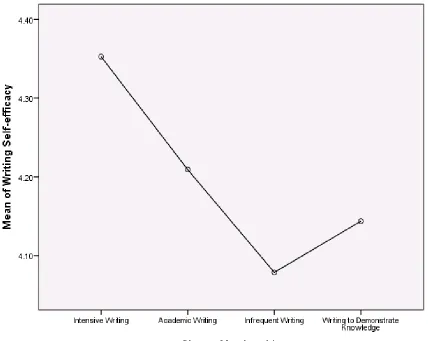
differ significantly in writing self-efficacy from Cluster 1 students. Cluster 3 students (Infrequent Writing group), who were assigned writing tasks least often in high school, and Cluster 4 students (Writing to Demonstrate Knowledge group), whose twelfth-grade writing was dominated by tasks such as short answer, copying text, and completing worksheets, demonstrated the lowest writing self-efficacy.
by
Sonya Ammons Massengill
A dissertation submitted to the Graduate Faculty of North Carolina State University
in partial fulfillment of the requirements for the degree of
Doctor of Philosophy
Curriculum & Instruction
Raleigh, North Carolina 2015
APPROVED BY:
_______________________________ ______________________________
Carl A. Young Carol A. Pope
Committee Chair
________________________________ ______________________________
DEDICATION
BIOGRAPHY
A North Carolina native, Sonya Massengill graduated with a B. A. from Meredith College in 1981 with a double major in English and music. She then pursued graduate study in music history and vocal performance at the University of North Carolina at Chapel Hill, graduating with a M. M. in 1985. After teaching voice at UNC-Chapel Hill and privately, she shifted focus to raising two delightful daughters and volunteering in their elementary school. Those experiences led her to return to graduate school to pursue teacher certification in English Education at Campbell University in the 1990s. In 1998 she began teaching middle school language arts and social studies, moving five years later to teaching high school English. She has also combined teaching English with teaching private voice lessons and serving as a choral director at the high school level.
ACKNOWLEDGMENTS
I would like to thank my advisor and committee chair, Dr. Carl Young. Your support and guidance have been invaluable as I have navigated the sometimes foreign waters of doctoral studies. Your advice and encouragement have kept me on track. Thank you for investing your time and energy in helping me to reach my goals.
I would also like to thank the other members of my committee: Dr. Nancy Penrose, Dr. Carol Pope, and Dr. Margareta Pop. I hope you realize that, along with Dr. Young, you are the dream team. To Dr. Penrose, I owe the beginning of this journey; my interest in composition studies began in your courses in the master’s program, and your impact as a teacher, researcher, and mentor has been immense. Dr. Carol Pope modelled excellence in teaching, creating an environment that required me to wrestle with my own beliefs about teaching – and patiently giving me space and permission to wrestle honestly. Dr. Pop, I’ve often said that it doesn’t get any better than having a professor whose research interest is motivation. Your course not only led to my interest in self-efficacy in this research project, but it has transformed my relationships with my own students.
Finally, I would like to thank Darrell, Katie, Mary Beth, and Jacob for your support and encouragement through this final graduate program. I’ve missed far too many
TABLE OF CONTENTS
LIST OF TABLES ... xiii
LIST OF FIGURES ...xv
CHAPTER I: INTRODUCTION ...1
Research Area ...2
Background of Study ...4
Purpose Statement ...7
Research Questions ...8
Definitions of Terms ...9
Summary ...10
CHAPTER II: LITERATURE REVIEW ...12
Failure of High Schools to Prepare Students for College Writing ...12
Persistence of Inequities in High School Writing Experiences ...14
Self-efficacy and Composing from Multiple Sources ...17
Lack of Research on Composing from Multiple Sources ...23
Cognitive Challenge of Composing from Multiple Sources...26
Research Questions ...34
Summary ...34
CHAPTER III: METHODS ...36
Research Design...36
Survey Participants ...38
Essay Participants ...40
Data Collection ...41
Instruments ...41
Procedures ...43
Data Analysis ...44
Procedures ...44
Validity/Reliability ...46
Summary ...50
CHAPTER IV: RESULTS ...52
Introduction ...52
Quantitative Analysis: Survey Results...53
Data Screening ...53
Accuracy ...53
Missing data ...54
Outliers ...57
Normality and linearity ...57
High School Writing Experiences (HSWE) Survey ...59
Descriptive statistics ...60
Factor analysis ...63
Cluster 1: Intensive writing ...71
Cluster 2: Academic writing ...72
Cluster 3: Infrequent writing ...73
Cluster 4: Writing to demonstrate knowledge ...73
High School Writing Experiences (HSWE) and Writing Self-efficacy (WSE) Surveys...76
Descriptive statistics ...76
Writing behaviors subscale items ...78
Writing tasks subscale items ...80
Writing skills subscale items ...82
One-way analysis of variance (ANOVA) ...83
Writing behaviors subscale ANOVA results ...86
Writing tasks subscale ANOVA results ...89
Writing skills subscale ANOVA results ...93
Summary of Quantitative Results ...98
Qualitative Analysis: Essay Results...100
Within-case Findings ...101
Case #22: Intensive writing cluster ...101
Selection ...102
Evaluation ...103
Connection ...105
Documentation ...106
Case #22 Summary ...107
Case #60: Intensive writing cluster ...108
Selection ...109
Evaluation ...111
Organization ...112
Connection ...113
Documentation ...113
Summary of Case #60 ...114
Case #23: Academic writing cluster ...115
Selection ...116
Evaluation ...117
Organization ...118
Connection ...119
Documentation ...119
Summary of Case #23 ...120
Case #52: Academic writing cluster ...120
Selection ...121
Evaluation ...123
Connection ...124
Documentation ...125
Summary of Case #52 ...125
Case #71: Infrequent writing cluster ...126
Selection ...126
Evaluation ...127
Organization ...128
Connection ...130
Documentation ...131
Summary of Case #71 ...132
Case #17: Infrequent writing cluster ...132
Selection ...133
Evaluation ...134
Organization ...135
Connection ...136
Documentation ...138
Summary of Case #17 ...139
Case #65: Writing to demonstrate knowledge cluster ...139
Selection ...140
Evaluation ...141
Connection ...143
Documentation ...145
Summary of Case #65 ...145
Case #26: Writing to demonstrate knowledge cluster ...146
Selection ...147
Evaluation ...148
Organization ...149
Connection ...150
Documentation ...151
Summary of Case #26 ...152
Within-case Findings Summary ...153
Selection and evaluation ...153
Organization and connection ...154
Documentation ...155
Cross-case Findings ...156
Out-of-control essay: Case #71 ...158
Source-dominated essay: Case #65 ...158
Writer-dominated essays: Case #s 23, 22, 52, and 60 ...160
Conversation-dominated essays: Case #s 17 and 26...163
Summary of cross-case findings ...165
Summary ...167
CHAPTER V: DISCUSSION ...169
Differences in High School Writing Experiences ...172
Relationships between High School Writing Experiences and Writing Self-efficacy ...179
Composing from Multiple Sources ...186
Implications for Teaching Writing...189
Limitations ...194
Suggestions for Future Research ...195
Conclusion ...196
REFERENCES ...199
APPENDICES ...216
Appendix A: IRB Approval ...217
Appendix B: Participant Consent Form – Survey and Essay Participants ...218
Appendix C: Participant Consent Form - Survey Only Participants ...219
Appendix D: Survey of High School Writing Experiences ...220
Appendix E: Writing Self-efficacy Measures (Jones, 2008) ...224
Appendix F: HSWE Survey – Missing Variable Patterns ...226
LIST OF TABLES
Table 3.1. Demographic Characteristics of Participants (N = 503) ...39
Table 3.2. Participants’ SAT Scores and GPAs (N = 503) ...40
Table 4.1. Data Transformations ...58
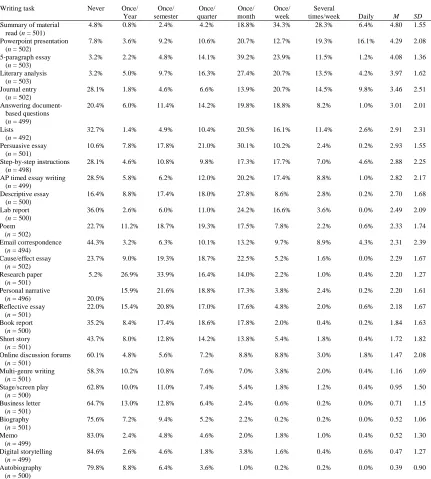
Table 4.2. HSWE Survey: Frequencies Students Reported Being Assigned Writing Tasks in Twelfth Grade ...60
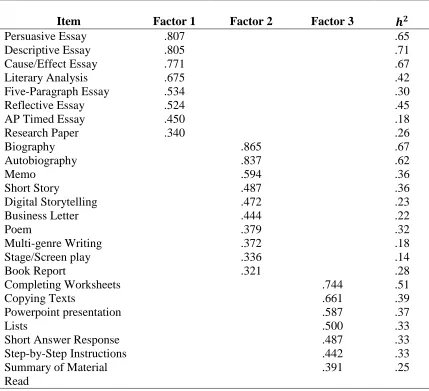
Table 4.3. Factor Loadings and Communalities (ℎ2) for 25 items from HSWE Survey (n=441) ...66
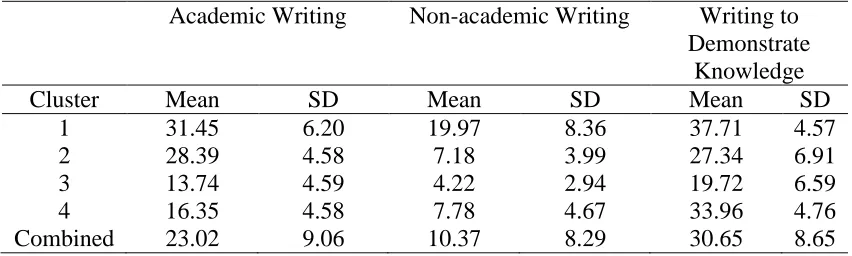
Table 4.4. Mean Factor Scores and Variances for Clusters ...71
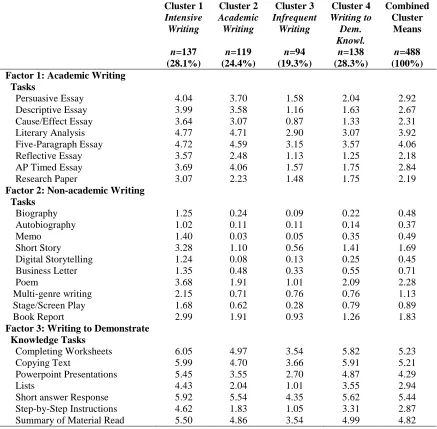
Table 4.5. Cluster Means ...72
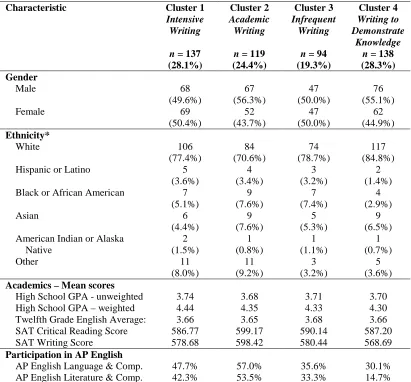
Table 4.6. Cluster Demographics...75
Table 4.7. Writing Self-efficacy Results by Cluster ...78
Table 4.8. ANOVA Results for WSE Survey Subscales ...84
Table 4.9. ANOVA Results for Writing Behaviors Subscale Items ...88
Table 4.10. ANOVA Results for Writing Tasks Subscale Items ...90
Table 4.11. ANOVA Results for Writing Skills Subscale Items ...95
Table 4.12. Case #22 Writing Self-efficacy for Composing from Multiple Sources ...102
Table 4.14. Case #23 Writing Self-efficacy for Composing from Multiple
Sources ...115 Table 4.15. Case #52 Writing Self-efficacy for Composing from Multiple
Sources ...121 Table 4.16. Case #71 Writing Self-efficacy for Composing from Multiple
Sources ...126 Table 4.17. Case #17 Writing Self-efficacy for Composing from Multiple
Sources ...133 Table 4.18. Case #65 Writing Self-efficacy for Composing from Multiple
Sources ...140 Table 4.19. Case #26 Writing Self-efficacy for Composing from Multiple
LIST OF FIGURES
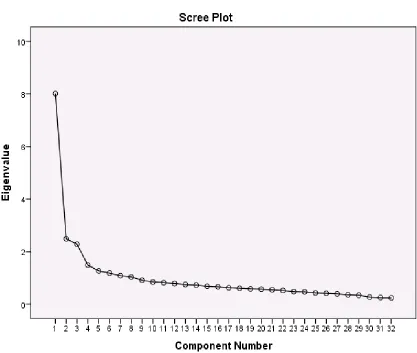
Figure 4.1. Scree Plot with Varimax Rotation ...65
Figure 4.2. Comparison of Writing Self-efficacy Mean Scores by Cluster Membership ...77
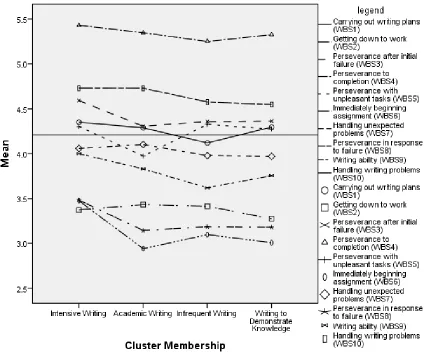
Figure 4.3. Writing Behavior Subscale Comparison ...80
Figure 4.4. Writing Tasks Subscale Comparison...81
Figure 4.5. Writing Skills Subscale Comparison ...83
CHAPTER I: INTRODUCTION
As the National Commission on Writing (2003) has observed, “Writing today is not a frill for the few, but an essential skill for the many” (p. 49). The gatekeeping role of writing at the college level has long been acknowledged. With three-quarters of American students now enrolling in college (National Commission on Writing, 2003), preparing an increasingly diverse student population for the demands of college level writing becomes all the more imperative. Yet, most first-year college students struggle with language errors in their writing and are unable to analyze arguments or synthesize information to compose from multiple sources (National Commission on Writing, 2003). Furthermore, almost 35% of college students have reported feeling unprepared for college writing (Achieve, 2005), and
postsecondary instructors report that high school is not preparing students for college writing (ACT, 2009; ACT, 2013). In 2006, the National Commission on Writing noted that schools had made only “limited progress in terms of student achievement” in the two decades since the public began to call for higher standards (p. 22). According to the most recent NAEP reports on writing, only 27% of twelfth graders are identified as Proficient or Advanced in writing; 21% are identified as not even possessing Basic writing skills – a level designated by NAEP as “denot[ing] partial mastery of prerequisite knowledge and skills that are
of Hispanic twelfth graders scored above the Basic level (National Center for Education Statistics, 2011). Moreover, writing is now identified as functioning in a gatekeeping role for “higher-skill, high-wage, professional” jobs as well (National Commission on Writing, 2004, p. 19). While 59% of employers frequently require workers who can produce technical reports, and 62% require formal reports (National Commission on Writing, 2004), a population of high school students who cannot move beyond basic writing and synthesize information from multiple sources presents significant challenges for instructors at the college level charged with the task of addressing students’ lack of writing proficiency and preparing them for the writing demands of the workplace. According to a 2006 report from the National Commission on Writing, “we need a better understanding of what takes place in many classrooms” (p. 30). Unfortunately, the only age group less represented in recent research on writing than preschool and younger populations is high school students (Juzwik, et al., 2006).
Research Area
only 10.4% of the research focused on the high school level. Moreover, 80.9% of recent research about genres and writing examined the postsecondary and adult age range (Juzwik, et al., 2006).
Epistemological battles may be contributing to the lack of adequate information about high school writing experiences. The interdisciplinary nature of writing research and the complexity of the problems involved in teaching writing lead to natural conflicts among positivist, post-positivist, and constructivist methodologies that are not easily resolved. Federal mandates for more experimental and quasi-experimental research (U. S. Department of Education, 2005) render many of the qualitative studies that have dominated composition research since Janet Emig’s (1971) seminal qualitative study of the composing processes of twelfth graders less competitive for funding. While experimental and quasi-experimental studies like those discussed in Hillocks’ (1986) report on writing research from 1963 to 1982 are still being conducted, more recent reviews suggest growing interest in qualitative
research designs (MacArthur, Graham, & Fitzgerald, 2006; Smagorinsky, 2006). Without funding, the extensive engagement in the field needed for qualitative approaches to writing research may be less feasible outside the university setting, thus contributing to the
dominance of research related to postsecondary and adult writing.
National Council of Teachers of English and the Conference on College Composition and Communication led Haswell to charge these organizations with being “at war” with one branch of composition research (p. 200). The journal Written Communication grew out of Stephen Witte’s vision of broadening the range of composition research, including studies using combinations of research methods (Haswell, 2005). Nonetheless, according to Juzwik and her colleagues’ (2006) review of over 1500 refereed journal articles with writing
research from 1999 to 2004, qualitative research dominates the field. Only 11% of published writing research in their study used experimental or quasi-experimental methods; another 8.8% used correlation designs (Juzwik, et al., 2006). Clearly, the composition community is rejecting the Department of Education’s position that quantitative methods alone can answer the significant questions the composition field needs to consider.
In this context, Berkenkotter’s (1991) recommendation that researchers be trained to be “epistemologically ecumenical” and to “become conversant with more than one model of inquiry in order to make informed choices” (p. 166) remains sound advice for researchers interested in writing instruction. In addressing the challenges of preparing high school students for college-level writing, a mixed methods approach offers a useful range of methods for exploring a complex research problem.
Background of Study
writing that dominate college writing revealed major differences in skill and self-efficacy for the writing task. Particularly striking were skill differences and differences in students’ writing self-efficacy for tasks requiring them to synthesize information from multiple sources to generate an original text. While these differences might be due to academic ability rather than to high school writing instruction, comments suggesting some students’ lack of
familiarity with the conventions of research-based writing indicated that inequities in high school writing instruction were contributing to students’ frustrations with the writing task. Anecdotal reports from students I had previously taught in high school also suggested that they were frequently in first-year college writing classes with other students who were unfamiliar with the conventions of research-based writing. Despite the National Commission on Writing’s (2003) call for high school programs to require writing assignments
“demand[ing] analysis, synthesis, and research from every student” (p. 34), a nagging
suspicion that not all high school students have been engaging in these rigorous writing tasks still lingers.
Kreth, 2010; Brockman, Taylor, Kreth, & Crawford, 2011; Melzer, 2003, 2009). The
cognitive demands of research-based writing render the task overwhelming to many students. Even for students who understand the task demands, effective task management strategies and persistence are necessary for success with research-based writing. Since differences in students’ writing self-efficacy can contribute to differences in writing performance, a greater understanding of the relationship between high school writing experiences and writing ability beliefs should facilitate the use of more effective instructional approaches by writing
instructors at the secondary and college levels.
self-efficacy, and students’ ability to compose from multiple sources for the kind of research-based writing that dominates college writing would be useful.
A mixed methods study based on the conceptual framework of Morse’s (1991) methodological triangulation with simultaneous collection of three sources of data to provide complementary information at the interpretation stage offers a practical strategy for obtaining information about a wide range of high school writing experiences and making connections between those experiences, students’ writing self-efficacy, and their preparation for research-based writing at the college level. This study seeks to answer questions about differences in first-year college students’ high school writing experiences; relationships between those experiences and writing self-efficacy; and students’ preparation for composing from multiple sources, a skill also referred to in the research literature as discourse synthesis. Composing from multiple sources is the writing that requires students to read and evaluate information from other sources, organize that information, and then synthesize information to generate an original text (Nash, Schumacher, & Carlson, 1993; Spivey & King, 1989).
Purpose Statement
The purpose of this mixed methods study was to address first-year college students’ high school writing experiences, their writing self-efficacy, and their preparation for
number of high schools, quantitative survey data were used to obtain information about the high school writing experiences of first-year college students in freshman composition classes at a large university in the Southeast. Additional quantitative survey data collected concurrently provided information about these students’ writing self-efficacy. At the same time in the study, an essay task was used to provide qualitative data about a subset of these students’ ability to compose from multiple sources. The qualitative essay data from the students were then used to compare differences in students’ high school writing experiences and writing self-efficacy with students’ ability to compose from multiple sources. Qualitative analysis consisted of fine-grained analysis of a subset of these essays to develop an
understanding of the associations between students’ high school writing experiences, writing self-efficacy, and specific skills needed in order to compose from multiple sources. The reason for collecting both quantitative and qualitative data was threefold: 1) to add to the knowledge base about differences in high school writing experiences; 2) to promote questioning about the relationship between high school writing experiences, writing self-efficacy, and preparation for composing from multiple sources; and 3) to lead to improved teaching practices.
Research Questions
1. What are the differences, if any, in high school writing experiences among first-year college students in English composition classes?
2. What are the relationships between first-year college students’ writing self-efficacy and their high school writing experiences?
3. What differences in students’ competencies in composing from multiple sources are evident in purposefully selected essays from first-year college students?
Definitions of Terms
For the purposes of this research project, key terms are defined below:
Composing from multiple sources – Also referred to as discourse synthesis or writing from sources, composing from multiple sources refers to the process of selecting,
organizing, and connecting information from more than one source to construct a new text (Spivey & King, 1989)
Preparation for college-level writing – Although writing tasks assigned at the college level reflect diverse beliefs about writing, including critical/cultural studies, expressivist, and rhetorical approaches (Dickson, Mejía, Zorn, & Harkin, 2006; Fulkerson, 2005), college-level writingemphasizes transactional writing with an emphasis on research-based writing (Addison & McGee, 2010; Melzer, 2003, 2009). Preparation for college-level writing is defined in the current study as students’ competency in
Research-based writing – A term often used in the research literature to refer to term papers
or research papers, research-based writing is a common writing task at the college level, requiring students to synthesize information from several sources in order to inform, to integrate with their own arguments, or to generate new knowledge (Brockman, Taylor, Crawford, & Kreth, 2010; Brockman, Taylor, Kreth, & Crawford, 2011; Melzer, 2003, 2009).
Self-efficacy – An important construct in Bandura’s (1977, 1986) social cognitive theory,
self-efficacy is a task-specific construct that indicates “people’s judgments of their capabilities to organize and execute courses of action required to attain designated types of performances” (Bandura, 1986, p. 391).
Transactional writing – One of Britton’s three “functions” of writing, transactional writing
is writing for the purposes of informing, advising, persuading, or instructing others (Britton, Burgess, Martin, McLeod, & Rosen, 1975).
Summary
This chapter has presented the rationale for using a mixed methods research design in order to obtain information about the relationships between first-year college students’ high school writing experiences, their writing self-efficacy, and their ability to compose from multiple sources, a skill often required for research-based writing at the college level. By using methodological triangulation to collect data simultaneously from three sources, this study aimed to accomplish three goals: 1) to add to the knowledge base about differences in high school writing experiences; 2) to promote questioning about the relationship between
high school writing experiences, writing self-efficacy, and preparation for composing from
CHAPTER II: LITERATURE REVIEW
Failure of High Schools to Prepare Students for College Writing
Over thirty years since the National Commission on Excellence in Education (1983) reported that American students were unprepared for the writing demands of the workplace, educators continue to struggle to teach an increasingly diverse student population to
communicate effectively. One thing is clear. Too many high school students are unprepared for college-level writing. Despite improved writing scores on the 2007 National Assessment of Educational Progress, in 2011 only 79% of twelfth graders demonstrated Basic writing skills -- a 3% decline from 2007 (National Center for Education Statistics, 2008, 2011). In addition, performance differences associated with ethnicity persist. Scores for White, Asian, and multi-racial students were higher than scores for Black, Hispanic, and American
Indian/Alaska Native students (National Center for Education Statistics, 2011). Score
differences by gender were not significant at the Basic level, but females outperformed males in Proficient and Advanced levels.
remedial writing programs at the college level were insufficient to address writing weaknesses that secondary education has failed to resolve.
A lack of agreement between high school and college instructors about effective writing instruction only exacerbates the problem. According to the ACT National Curriculum Survey 2005-2006, only thirty-three percent of postsecondary writing instructors agreed that state writing standards were effective in preparing students for college-level writing, in contrast to seventy-six percent of high school English teachers (ACT, 2007). These findings seem to confirm claims by Robert Tremmel and William Broz (2002) that a lack of
communication between college English Departments and secondary English teachers is contributing to misunderstandings about how to prepare school students for college writing.
Despite the relationship between high stakes testing and instruction emphasized in U.S. schools, few secondary-level writing assessments correlate with the demands of college-level writing (Beck & Jeffery, 2007; Hillocks, 2003). In light of teachers’ tendency to teach the skills necessary for passing standardized tests (Anagnostopoulos, 2003; Scherff & Piazza, 2005), the mismatch between high stakes writing assessments and college writing
adjusting to college writing expectations. George Hillocks (2003) and Miles McCrimmon (2005) have similarly challenged the inadequacy of high stakes writing assessments, citing tests that encourage formulaic writing or supply no source material for students to use in formulating arguments. Although 27% of students received Proficient or Advanced writing scores on the 2007 NAEP, those scores may not reflect students’ preparation for the
sophisticated writing required at the college level. Even at the twelfth-grade level, the NAEP assesses only writing to explain, persuade, or convey experience (National Center for
Education Statistics, 2011). What neither high stakes writing assessments nor the research adequately addresses is the degree to which secondary writing instruction is preparing students for composing from multiple sources, the research-based writing often associated with writing at the college level (Addison & McGee, 2010; Bridgeman & Carlson, 1985; Council of Writing Program Administrators, 2005-2014; Melzer, 2003, 2009).
Persistence of Inequities in High School Writing Experiences
academic standards (Applebee, Langer, Nystrand, & Gamoran, 2003; Carbonaro & Gamoran, 2002). In their study of the effectiveness of AP English in preparing students for college writing, Hansen and her colleagues (2006) similarly concluded that students who took AP English courses in high school were better prepared for college writing than those who did not. Nonetheless, inequities in high school writing experiences seem to persist despite
evidence of a positive relationship between rigorous academic demands and student progress (Gamoran, 1993; Valli, 1990) and more specific relationships between rigorous writing tasks and improved reading comprehension for students across ability levels (Applebee, 1996; Carbonaro & Gamoran, 2002; Langer & Applebee, 1987).
Reports of differences in the frequency of personal writing and research-based writing are of particular concern. In a study of students in urban and suburban tenth-grade classrooms, Sperling and Woodlief (1997) observed that students at an urban high school with a diverse population, most of whom did not go on to college, were frequently assigned personal writing – a kind of writing less often assigned at the college level (Addison & McGee, 2010; Bridgeman & Carlson, 1985). Students in a suburban high school consisting largely of white, middle-class students, many of whom were accepted in competitive
American universities, were more frequently involved in research-based assignments in line with college writing expectations (Sperling & Woodlief, 1997).
writing, while one fourth of the students surveyed did personal writing almost every week. The authors found these differences in frequency of personal writing assignments to be clearly linked to ability-level tracking, with students in high level tracks assigned personal writing less often (Scherff & Piazza, 2005). At one of the four schools included in the study, one fourth of the students reported almost never doing narrative writing; almost half of these students were from the IB program, a rigorous curriculum for advanced students. In contrast to the study by Sperling and Woodlief (1997), Scherff and Piazza (2005) found research-based assignments to be infrequent across ability levels. Nonetheless, only thirty-five
percent of students across ability levels reported writing formal research papers once or twice a year (Scherff & Piazza, 2005). Moreover, thirty-five percent of ninth graders and 45% of tenth graders never engaged in any research-based writing, a phenomenon the authors
attributed as likely due to state testing requirements at those grade levels. Rather than writing for a variety of purposes, as recommended in the research literature, students in this survey seemed to be writing in response to high stakes testing and writing goals related to ability-level tracking. The authors concluded that more studies were needed to examine further the apparent inconsistencies between effective teaching practices supported by research and the writing practices students are actually being taught in response to high stakes testing (Scherff & Piazza, 2005).
extent to which they are common throughout U. S. high schools. Although Scherff and Piazza’s (2005) study did not clearly define the distinction in their survey questions between writing a research paper and engaging in some research-based writing, the fact that only thirty-five percent of students wrote research papers once or twice a year seems to provide strong evidence that a disturbingly large number of high school students may not be
adequately prepared for research writing at the college level. Although Kiuhara, Graham, and Hawken (2009) found more evidence of research papers being assigned, 17% of the teachers they surveyed reported never assigning research papers. More recently, Addison and McGee (2010) provided a more positive assessment of the prevalence of research-based writing at the high school level. While 34% of college faculty reporting assigning research papers to college freshmen and sophomores, and 47% reported assigning research papers to juniors and seniors, research papers were frequently assigned by high school teachers in their survey only at the eleventh- and twelfth-grade years. Nonetheless, although they did not report the
percentage of high school teachers assigning research papers, the authors concluded that “high school faculty are following the lead of college faculty and working to prepare students for the types of writing they will encounter in college” (Addison & McGee, 2010, p. 164). What is unclear from the research literature is the percentage of college students who were not assigned research-based writing while in high school.
Self-efficacy and Composing from Multiple Sources
construct that describes individuals’ beliefs about their abilities to accomplish a specific task. The current study uses Bandura’s (1986) definition of perceived self-efficacy as “people’s judgments of their capabilities to organize and execute courses of action required to attain designated types of performances” (p. 391). According to social cognitive theory, self-efficacy beliefs are “a major determinant of people’s choice of activities, how much effort they will expend, and of how long they will sustain effort in dealing with stressful situations” (Bandura, 1977a, p. 194). Although other constructs related to ability beliefs can be useful in predicting achievement outcomes (Wigfield & Eccles, 2000), the relationship between the self-efficacy construct and specific tasks renders it most effective for an examination of influences on students’ preparation for college-level research-based writing.
In Bandura’s (1977b, 1986) conceptualization, self-efficacy can be influenced by past experiences, by vicarious experiences involving the observation of the successes and failures of others, by feedback from creditable sources, and by physiological responses to a task. While past successes increase perceptions of self-efficacy, past failures increase feelings of personal inefficacy. High school writing experiences, then, might be expected to play a role in students’ beliefs about their ability to succeed at college-level research-based writing tasks.
between writing self-efficacy and writing achievement (McCarthy, Meier, & Rinderer, 1985; Meier, McCarthy, & Schmeck, 1984; Pajares, 2007; Pajares & Johnson, 1994, 1996; Schunk & Swartz, 1993; Shell, Colvin, & Bruning, 1995; Shell, Murphy, & Bruning, 1989).
Related to writing achievement is the issue of choice. As Schunk (1995) argues, the relationship between self-efficacy and choice is complex since students often lack the ability to make choices about academic assignments. Although academic writing imposes limits related to genre, discourse community conventions, and course-specific goals for writing assignments, students do, nonetheless, have the ability to make choices about how much effort to exert, whether to give up or persist, and whether or not to use effective strategies, including self-regulation, in order to manage complex writing tasks. Self-efficacy functions as an important influence on these choices (Bandura, 1977a, 1986) and thus influences behaviors that contribute to achievement outcome.
Academic achievement is also influenced by the negative association between self-efficacy and task anxiety (Bandura, 1986; Pajares, 1997). Self-self-efficacy theory addresses the question of why individuals avoid particular tasks even when they have the requisite
writing tasks requiring composing from multiple sources was consistent with Bandura’s discussion. The authors found a significant negative relationship between writing self-efficacy and writing anxiety; that is, as writing self-self-efficacy increased, writing anxiety decreased. For complex writing tasks common at the college level, failure to persist through time-consuming and often stressful processes can be a formula for failure. As Bandura (1977) explains, “The self-assurance with which people approach and manage difficult tasks determines whether or not they make good or poor use of their capabilities. Insidious self-doubts can easily overrule the best of skills” (p. 35).
When considering the influence of choice and anxiety on writing achievement, the well-documented positive relationships between self-efficacy, effort, persistence, strategy use, and self-regulation are important (Bandura, 1989, 1997; Pajares, 1996, 1997; Pintrich & De Groot, 1990; Shell & Husman, 2008: Zimmerman & Bandura, 1994). Lack of confidence in writing ability and anxiety over research-based writing has been identified as a factor in students’ decisions to drop out of first-year college writing courses (Cox, 2009). Similarly, Penrose (2002) found lower academic preparation, lower self-confidence in writing, and lower retention rates among first-generation (FG) students. Consistent with Penrose’s
achievement since self-efficacy influences the degree to which individuals “mobilize in pursuit of adopted goals, and how they respond to discrepancies between their performances and what they seek to achieve” (Bandura, 1986). Of additional concern is the observation by Mattern and Shaw that writing self-efficacy was lower for African American, Asian, and Hispanic students than for White students.
Of particular significance to writing instruction is the malleability of self-efficacy. In contrast to fixed psychological constructs, self-efficacy changes in relation to specific task demands, as well as to personal and social contexts (Bandura, 1997). Students may then have strong efficacy for writing in some academic contexts, but not others. Since students’ prior experiences influence their initial domain-specific self-efficacy when encountering a new learning context (Schunk, 1989b), high school writing experiences provide a social context in which initial self-efficacy for college-level research-based writing may be established.
Contextual factors related to a mismatch between high school writing experiences and post-secondary writing goals may then contribute to students’ struggles in adapting to
experiences align more closely with the types of writing assigned at the college level, those students may enter the academic environment of the first-year writing course with a distinct advantage, both in terms of skill development and self-efficacy beliefs.
For research-based writing that must be adapted to diverse disciplinary contexts as students apply writing skills to the conventions of different discourse communities, the concept of operant efficacy becomes important: “Operant efficacy calls for continuously improvising multiple subskills to manage ever changing circumstances, most of which contain ambiguous, unpredictable, and often stressful elements” (Bandura, 1986, p.
391).When faced with obstacles, individuals with high self-efficacy exert greater effort; those with low self-efficacy are more likely to experience stress and a sense of failure (Bandura, 1977a, 1986). Perhaps most important for the teaching of writing is the relationship between self-efficacy and skills development: “If some of the subskills [for difficult] tasks are lacking, efficacy-sustained effort promotes their development. Conversely, misbeliefs in one’s
inefficacy may retard development of the very subskills upon which the more complex performances depend” (Bandura, 1986, p. 395). Thus, students with low writing self-efficacy may become locked in a cycle of failure as they become overwhelmed by the continuing challenge of adapting their writing to unfamiliar contexts.
Due to the prevalence of research-based writing at the college level and the
students experience for this genre of academic writing. Although overly optimistic assessments of ability can lead to productive task engagement (Bandura, 1986; Pajares, 1996), inaccurate perception of ability can also render the engagement of appropriate writing strategies difficult. Students may inaccurately assess their ability to perform a task when they have mastered some of the skills required for a task but fail to understand that “solving problems typically requires applying multiple cognitive operations” (Bandura, 1986, p. 397). As students approach composing from multiple sources, the complex relationship between self-efficacy and multiple cognitive tasks associated with research-based writing is
significant.
Lack of Research on Composing from Multiple Sources
Although few recent empirical studies have addressed the types of writing assigned at high school and college levels, the research does suggest that research-based assignments, the type of writing requiring students to synthesize information from multiple sources, may be the most commonly assigned writing task at the college level. Bridgeman and Carlson’s (1985) survey of faculty across disciplines at 34 universities continues to be frequently cited in the research literature, identifying research-based writing as the most common type of writing assignment at the college level. More recently, Addison and McGee (2010) have identified research papers as the most frequently assigned writing task for students in all four years of college. Recent curriculum changes in AP English Language and Composition, the AP English course designed to help high school students place out of freshman composition at the college level, reflect beliefs about the importance of composing from multiple sources at the college level. In 2008, College Board added a synthesis essay to the AP English Language and Composition Exam, acknowledging the importance of preparing students for research-based writing at the college level. Perceptions about the importance of composing from multiple sources are reflected in College Board’s (2011b) recommendation to AP English teachers:
Less clear is the extent to which students in non-AP tracks are exposed to instruction for source-based argumentation. If the findings of Scherff and Piazza (2005) and Sperling and Woodlief (1997) are representative of the larger population, then far too many high school students are not being prepared to compose from multiple sources – and those students who do receive instruction in research-based writing are more likely to be in higher ability-level tracks.
Cognitive Challenge of Composing from Multiple Sources
In addition to general consensus that too little is known about writing from sources, researchers agree that composing from multiple sources is cognitively challenging. Spivey and King (1989) noted the difficulty of the task for secondary students; cognitive demands related to “selecting, organizing, and connecting” information render the task of composing from multiple sources inherently challenging (p. 9). According to Spivey and King, discourse synthesis, or composing from multiple sources, requires students to weigh the relative
importance of source material, provide new organizational structures, and generate
connective tissue to link ideas from multiple sources. Nash, Schumacher, and Carlson (1993) identified six tasks involved in composing from sources: “choosing a topic, locating and evaluating sources, selecting information from sources, and organizing and composing the essay” (p. 159). Their division of the task resembled Spivey and King’s three-step model but added three earlier tasks typically present in authentic assignments requiring students to synthesize sources. The recognition that topic selection, source location, and source
evaluation (cognitively demanding tasks in their own right) usually precede the actual task of discourse synthesis highlights the fact that composing from sources is one of the most
complex writing tasks student undertake in academic settings. Mateos & Solé (2009)
Contributing to the cognitive demands of composing from multiple sources is the fact that students must engage in task analysis in order to develop appropriate organizational structures. For instance, the organizational demands for integrating sources for summary in expository texts differ from those for comparison/contrast or persuasive writing. Moreover, cognitive demands when synthesizing information from sources with different organizational structures further complicate the task of composing from sources (Kirkpatrick & Klein, 2009; Nash, Schumacher, & Carlson, 1993). In an experimental study with 84 undergraduate
students, Nash, Schumacher, and Carlson (1993) found that students composing from sources with the same organizational structures generated essays with better organization than did students using sources with different organizational structures. Since authentic tasks requiring synthesis from multiple sources usually involve sources with different
organizational schemes (e.g., chronological, topical), the cognitive demands are high when text selection is not artificially manipulated to ensure similar structure. In view of the predictive ability of “global organization and the use of genre-appropriate text structure” in relation to writing quality (Kirkpatrick & Klein, 2009), these increased cognitive demands related to reading and writing with multiple sources are significant.
assignment, and consider process and content demands of the writing task. Only one student moved beyond exposition to integrate sources successfully in a persuasive essay; analysis of interview responses revealed this student to have 65% procedural (as opposed to content) goals. She was also the student who asked the most questions during the writing task, frequently seeking confirmation that she was doing the assignment correctly. Procedural goals were more common than content goals for all but one participant, though, suggesting that “how to” questions alone did not explain the difference in her approach to synthesizing sources. Closer analysis of her questions revealed that this student recognized the fact that her previous experiences with composing from multiple sources had only required
exposition; her perception that this assignment called for her to integrate information from her sources to compose a persuasive text (a task with which she had experience without
composing from sources) was reflected in persistent questions as she constructed an
Ironically, the cognitive demands of composing from sources may contribute to the value of the task. In an experiment with 64 University of Pittsburgh undergraduates, even when students were provided the same information for a writing task, those who viewed the material divided into eight separate sources were more successful in transforming, as
opposed to borrowing, information than students who viewed the material as a single source in a textbook (Wiley & Voss, 1999). Increasing the cognitive demand in the University of Pittsburgh study by asking students to generate an argument, rather than a narrative,
summary, or explanation, significantly increased the quality of students’ essays. Moreover, university students reading from multiple sources and instructed to write arguments were more successful in recognizing logical inferences from the assigned readings and extending their reading to identify situations with underlying similarities to those discussed in reading passages (Wiley & Voss, 1999). In view of the generally acknowledged difficulty of
synthesizing information from multiple sources and the equally acknowledged value of combining reading and writing tasks, the lack of attention to composing from sources in the research literature seems odd.
In the last twenty-five years, research has slowly begun to answer some questions about the developmental nature of students’ approaches to composing from sources. Younger students have been found to use more linear, or sequential, procedures than the more
when composing from multiple sources have also been observed (Mateos & Solé, 2009). The complexity of students’ approaches to composing from sources has been observed to increase with developmental levels, but the significance of those changes remains unclear. Seventy-five percent of unsuccessful syntheses in Mateos and Solé’s (2009) study, for instance, reflected “low complexity” procedures while reading, planning, and composing (p. 445). More complex procedures tended to be associated with more successful products, but results were not conclusive.
Developmental differences have also been associated with students’ perceptions of authority when composing from multiple sources. In a case study examining differences in composing from sources at the college level, Penrose and Geisler (1994) noted that a college freshman viewed sources as authoritative and “resisted inserting herself in the text” (p. 515), whereas a more experienced graduate student viewed himself as a participant in a debate in which he weighed evidence presented in sources in order to construct meaning for himself. Even among students at the same developmental level, differences in processes used to compose from multiple sources have been found to contribute to differences in writing quality. In a case study with seven undergraduate education majors (all junior or seniors), McGinley (1992) observed important differences in participants’ approaches to composing from sources. One student seemed to regard the synthesis task as one of reconciling
combination of linear and non-linear processes, students who wrote more successful syntheses, transforming rather than merely summarizing information from sources, used more purposeful processes. One student who successfully integrated information from sources to generate an argument used “reading, writing, and thinking activities strategically throughout the task . . . . to develop her own stance” (McGinley, 1992, p. 237).
Reading comprehension also has been identified as contributing to students’ ability to compose from multiple sources. According to Spivey and King (1989), proficient readers in 6th, 8th, and 10th grades have been found to be more successful in using location and
repetition as clues to determine the importance of information in sources than less proficient readers. Although the ability to select important details when synthesizing information from sources increased with grade level, more significant associations were found between reading ability and success in composing from sources. Spivey and King also found proficient
readers to generate more integrated organizational structures and to score higher on holistic measures of quality when composing from multiple sources. Organizational ability was not associated with grade level in their study. The proficient readers in Spivey and King’s study also planned more extensively and spent more time composing from resources. The
researchers hypothesized that passivity on the part of less proficient readers might be a factor in their lack of success in composing from multiple sources.
reflect the difficulty of source materials more than the developmental levels of students. Only the 14- to 15-year olds in their study did not demonstrate problems related to reading
comprehension, but the difficulty of the texts assigned to be used at that level was “Medium-high,” in contrast to “High” level difficulty of texts for older students in the study and a “Medium-low” difficulty level for the texts assigned to the youngest students in the study (Mateos & Solé, 2009, p. 441). The researchers cautioned, however, that students whose essays did not reflect problems with reading comprehension also struggled to integrate information from sources successfully; thus, the role of reading comprehension in composing from multiple sources remains unclear.
The relationship between reading ability and composing processes of college students has also received some attention in the research literature. In one of the earliest studies on writing from multiple sources, Kennedy (1985) observed six college students in an
initial reading stage primarily to locate quotations to use in their essays. More fluent readers reread passages and took more notes at more varied points in the process of composing from sources. Overall, fluent readers spent twice as much time planning as less fluent readers. Once they began writing, they returned to the sources less often than weaker readers.
Kennedy observed important differences between students who “read the text with pencil-in-hand” and less fluent readers who “were passive processors who read the text with hands tied behind their backs, rarely using study-type strategies or acting upon the texts in an assertive way” (p. 451).
Research Questions
In order to address an important gap in the research literature, this study examined differences in first-year college students’ writing experiences and the relationship between those experiences, their writing self-efficacy, and their success in synthesizing information from multiple sources to generate an effective argument. Three research questions guided the current study:
1. What are the differences, if any, in high school writing experiences among
first-year college students in English composition classes?
2. What are the relationships between first-year college students’ writing self-efficacy and their high school writing experiences?
3. What differences in students’ competencies in composing from multiple sources are evident in purposefully selected essays from first-year college students?
Summary
To explore the relationship between high school writing experiences, writing self-efficacy and students’ ability to compose from multiple sources, the current study addresses three research questions: 1) What are the differences, if any, in high school writing
experiences among first-year college students in English composition classes? 2) What are
the relationships between first-year college students’ writing self-efficacy and their high
school writing experiences? 3) What differences in students’ competencies in composing
from multiple sources are evident in purposefully selected essays from first-year college
CHAPTER III: METHODS
The purpose of the current study was to examine the kinds of writing tasks students are assigned in high school and the relationship between those writing experiences and students’ writing self-efficacy and their ability to synthesize information from multiple sources to develop an argument. To that end, this study explored three questions:
1. What are the differences, if any, in high school writing experiences among first-year college students in English composition classes?
2. What are the relationships between first-year college students’ writing self-efficacy and their high school writing experiences?
3. What differences in students’ competencies in composing from multiple sources are evident in purposefully selected essays from first-year college students?
Research Design
This study used a convergent parallel mixed methods (QUAN + QUAL = complete understanding) design. Quantitative and qualitative data were collected simultaneously, with both types of data equally important for understanding the relationship between high school writing experiences, writing self-efficacy beliefs, and students’ ability to compose from multiple sources (Creswell & Plano Clark, 2011).
Setting and Participants
Participants in this study were students in first-year writing courses at a large
state, all 50 U.S. states, and 94 foreign countries, the research location provided a useful population for studying high school writing experiences from a large number of high schools.
Survey Participants
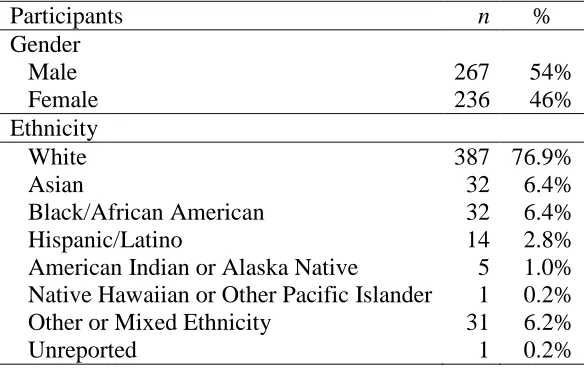
From the 30 participating sections of first-year writing, 503 of the 596 enrolled students completed the survey phase of the study. Four of these students were enrolled in English 100, and the remaining 499 students were enrolled in English 101. To address ethical concerns, a consent form provided information to students about the voluntary nature of participation and measures for providing anonymity (Appendices B and C).
Table 3.1
Demographic Characteristics of Participants (N = 503)
Participants n %
Gender
Male 267 54%
Female 236 46%
Ethnicity
White 387 76.9%
Asian 32 6.4%
Black/African American 32 6.4%
Hispanic/Latino 14 2.8%
American Indian or Alaska Native 5 1.0% Native Hawaiian or Other Pacific Islander 1 0.2% Other or Mixed Ethnicity 31 6.2%
Unreported 1 0.2%
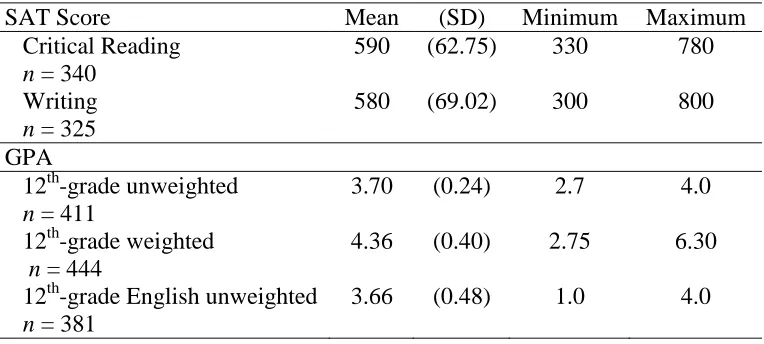
at least to the extent that standardized assessments accurately measure ability. Participants’ self-reported standardized testing scores and GPAs are summarized in Table 3.2.
Table 3.2
Participants’ SAT Scores and GPAs(N = 503)
SAT Score Mean (SD) Minimum Maximum
Critical Reading n = 340
590 (62.75) 330 780
Writing n = 325
580 (69.02) 300 800
GPA
12th-grade unweighted n = 411
3.70 (0.24) 2.7 4.0 12th-grade weighted
n = 444
4.36 (0.40) 2.75 6.30 12th-grade English unweighted
n = 381
3.66 (0.48) 1.0 4.0
Essay Participants
Data Collection Instruments
To answer the first research question about differences in high school writing experiences among first-year college students in English composition courses, a survey was used. Students’ high school writing experiences were measured by self-report, using common high school writing activities identified on a survey designed by Kiuhara, Graham, and Hawken (2009). The survey, which Kiuhara et al. administered to a random sample of 361 language arts, social studies, and science high school teachers across the United States, included 22 writing tasks. For the current research project, 7 additional writing tasks that Kiuhara et al. identified in open-ended responses to their survey were also included. Three additional writing tasks were also added to reflect technology trends that may not have been captured in previous surveys: online discussion forums, digital storytelling, and multigenre writing. Students were asked to report the frequency of their twelfth grade experiences with the 32 types of writing; an open-ended question allowed students to add types of writing not included on the survey. The 8-point Likert-like scale used by Kiuhara, Graham, and Hawken was used to measure how often students completed each type of writing task, ranging from
never to daily. A combination of open- and close-ended questions was used to indicate demographic information (Appendix D).
related to writing behaviors, writing tasks, and writing skills was used for comparison with responses to the self-report survey of high school writing experiences.
Jones’ instrument, designed to reflect the writing demands of first-year college composition and Writing Program Administrators’ (WPA) outcomes for first-year college writing, as well as students’ responses to challenging writing tasks, uses a 6-point Likert-like scale. Jones’ instrument includes three subscales: writing approach, writing tasks, and writing skills. Several survey items were particularly relevant to the focus in the current study on students’ preparation for composing from multiple sources. In addition to general questions about writing self-efficacy beliefs, Jones’ instrument (Appendix E) includes questions related to students’ self-efficacy beliefs for “making connections among a variety of textual
sources”; “incorporat[ing] text sources representing points of view different from [students’ views]”; generating “a thesis that integrates a variety of information and many perspectives”; “organiz[ing] a lot of material into well developed and clearly arranged paragraphs”; using MLA format, and using library and online resources to locate information to support students’ ideas (Jones, 2008, pp. 235-236).
Procedures
Students in first-year writing courses were asked to complete the self-report survey during class early in the semester. The instrument asked students to report high school writing task demands (types of writing and frequency assigned in the twelfth grade), SAT Critical Reading scores, SAT Writing scores, high school GPA, grade in twelfth-grade English, the number of Honors and AP English courses taken in high school, gender, and ethnicity. The survey included both open- and close-ended items (Appendix D). At the same time, students completed a writing self-efficacy self-report instrument (Appendix E). Time for completing the two surveys averaged 15-20 minutes.
Next, a small subset of essays (n = 8) was purposefully selected based on types of high school writing experiences identified in the cluster analysis and self-efficacy scores. Maximum variation sampling was used to select cases reflecting the highest and lowest writing self-efficacy from each of the four types of high school writing experiences identified in cluster analysis.
Data Analysis Procedures
two-step cluster analysis works well when assumptions are not met (Norušis, 2008). Since order of cases may affect cluster analysis results, cases were entered in random order. In the first step of the analysis, data were grouped into preclusters; in the second step, these
preclusters were used to form hierarchical clusters.
To answer the second research question, examining relationships between students’ writing self-efficacy and their high school writing experiences, both descriptive statistics and inferential statistics were used. In Chapter 4, a table was used to report means and standard deviations for each self-efficacy subscale (i.e., writing behaviors, writing tasks, and writing skills) for each type of high school writing experience identified in the cluster analysis. One-way analysis of variance (ANOVA) tests then were used to compare writing self-efficacy results among students with different kinds of high school writing experiences. ANOVA test results, along with post hoc comparisons for significant differences, are reported in Chapter 4 to indicate relationships between types of high school writing experiences and students’ scores on the writing self-efficacy instrument.
sources. Essays were treated as individual cases, using cross-case synthesis to identify similarities and differences among the essays and to generate naturalistic generalizations. Validity/Reliability
A variety of strategies were used to address threats to validity and reliability (Johnson & Turner, 2003). To address content validity for the survey of high school writing
experiences, the current study used Kiuhara, Graham, and Hawken’s (2009) survey of high school writing activities. Kiuhara and her colleagues pilot tested their survey with language arts, science, and social studies high school teachers and then used a stratified random sampling procedure to identify teachers representing the four geographical regions of the United States. A survey return rate of 51% yielded 361 participants. Their use of close- and open-ended questions with a broad sample of teachers across disciplines provides a valid measure of the kinds of writing that are being assigned in American high schools.
By using two-step cluster analysis instead of hierarchical or k-step cluster analysis, several threats to validity were minimized. Although cluster analysis assumes independent variables and normal distribution of continuous variables, the non-random sample should not have impacted validity for cluster analysis since two-step cluster analysis is robust to
violations of these assumptions (Garson, 2010; Norušis, 2008). An additional threat to validity in cluster analysis was addressed through analysis within SPSS. Since the order of dataset observations can affect results in two-step cluster analysis, randomization of cases was used (Garson, 2010).
To address validity and reliability of the measurement of students’ writing self-efficacy beliefs, three writing self-self-efficacy scales developed by Jones (2008) were used. Content validity for the scales was established by developing task and skills scales based on the College English I curriculum at a university in the Northeast and the WPA outcomes statement for first year writing. Of particular usefulness to the current research study was Jones’ inclusion of several survey items specifically related to skills needed for composing from multiple sources.
To examine test reliability for the original instrument, Jones (2008) administered the scale twice to 18 psychology students, repeating the administration three weeks after the initial data collection. Cronbach’s alpha coefficient estimates were .85 for the writing approach subscale, .94 for the writing task subscale, and .93 for the writing skills subscale.
the participants in the current study. Cronbach’s alpha coefficient indicated strong internal consistency for the total 28 survey items (α = .92). The three writing self-efficacy subscales
exhibited good internal consistency reliability. Cronbach’s alphas for writing approach, writing task, and writing skills subscales were .82, .88, and .87, respectively.
For the essay used to evaluate students’ ability to compose from multiple sources, content validity was addressed by using the synthesis essay prompt from a previous year’s AP English Language and Composition exam – a national exam created by College Board and widely accepted by colleges for placing out of freshman composition. According to College Board, content validity for AP English Language and Composition exam essay questions is achieved by expert review and revision during a process that takes
approximately two years. Final drafts of the exam are reviewed by the test development team for validity and reliability (College Board, 2011a; Ewing, Huff, & Kaliski, 2010). For the purposes of the current study, the AP synthesis essay provided an appropriate instrument for measuring participants’ ability to compose from multiple sources since students are required to read prepared sources, select information from three or more of those sources to synthesize in an original argument, and connect ideas in a well-organized essay.
all the essays multiple times and used the full data set for precoding, improving validity through submersion in the research data (Merriam, 1995). Essays used in this phase of analysis were analyzed for patterns related to composing from multiple sources. Since the goal of the analysis was to examine the extent to which skills necessary for effectively composing from multiple sources were present, open coding would provide information about patterns in the data but might overlook evidence of important skills that might be missing in the data set. To balance the need for openness to emerging patterns with questions stemming from the current knowledge base, an a priori coding scheme based on the research literature, along with open coding to allow additional codes to emerge from the data, was used (Creswell, 2007). Once patterns emerged, thick, rich description was used to provide more specific information about patterns within the data and their relationship to high school writing experiences. In addition, frequency counts were used to note the number of sources students included in their essays; since this was an easily identifiable characteristic of students’ writing, copies of the essays were included in the appendices for verification.
occurred during the first two weeks of the first-year writing courses, before students would have received instruction that might influence their writing self-efficacy or their ability to compose from multiple sources. Validity threats related to reactive effects were minimized since essays were used by course instructors as a preliminary sample of students’ writing, as well as for data in the current study.
Demographic information has been provided to allow readers to make decisions about generalizability of results from the cluster analysis and ANOVA tests since a non-random sample was used. Two-step cluster analysis is fairly robust to violations of normality, assuming a large sample, usually of 200 or more (Egan, 1984; Garson, 2010). Cluster
analysis in the current study included a sample of 440 participants. To increase
generalizability of findings from qualitative analysis of students’ essays, a subset of essays (n
= 8) was purposefully selected for maximum variation cases (Flyvbjerg, 2006, Miles & Huberman, 1994), based on results from cluster analysis of the school writing experience survey and writing self-efficacy scores.
Summary