DOI: 10.1534/genetics.110.123273
A Bayesian Framework for Inference of the Genotype–Phenotype Map
for Segregating Populations
Rachael S. Hageman,* Magalie S. Leduc,
†Ron Korstanje,* Beverly Paigen*
and Gary A. Churchill*
,1*The Jackson Laboratory, Bar Harbor, Maine 04609 and†Southwest Foundation for Biomedical Research, San Antonio, Texas 78227
Manuscript received September 16, 2010 Accepted for publication January 2, 2011
ABSTRACT
Complex genetic interactions lie at the foundation of many diseases. Understanding the nature of these interactions is critical to developing rational intervention strategies. In mammalian systems hypothesis testingin vivois expensive, time consuming, and often restricted to a few physiological endpoints. Thus, computational methods that generate causal hypotheses can help to prioritize targets for experimental intervention. We propose a Bayesian statistical method to infer networks of causal relationships among genotypes and phenotypes using expression quantitative trait loci (eQTL) data from genetically randomized populations. Causal relationships between network variables are described with hierarchical regression models. Prior distributions on the network structure enforce graph sparsity and have the potential to encode prior biological knowledge about the network. An efficient Monte Carlo method is used to search across the model space and sample highly probable networks. The result is an ensemble of networks that provide a measure of confidence in the estimated network topology. These networks can be used to make predictions of system-wide response to perturbations. We applied our method to kidney gene expression data from an MRL/MpJ 3 SM/J intercross population and predicted a previously uncharacterized feedback loop in the local renin–angiotensin system.
M
ULTIFACTORIAL experiments performed with arandomized experimental design provide con-ditions for uncovering causation (Fisher1926). In
pop-ulations derived from inbred strain crosses, the genetic variation that occurs naturally within a population serves as a multifactorial perturbation ( Jansenand Nap2001).
Randomization of alleles during meiosis ensures the unidirectional influence of genotype on phenotype, allowing for the identification of quantitative trait loci (QTL) causal to phenotypes. Expression quantitative trait loci (eQTL) data consist of genotypes at markers across the genome, genome-wide gene expression, and other phenotypes. Identifying causal relationships between complex traits from eQTL data has recently become a topic of great interest (Rockman 2008; Liet al.2010).
QTL can act as causal anchors to distinguish direct and indirect relationships between pairs of phenotypes (Liet al.2006). Conditional independence tests among
triplets (two phenotypes and a shared QTL) have been widely used to sort out causal, reactive, and independent
relationships between pairs of phenotypes (Schadt
et al. 2005). These methods have been extended to allow for the interaction between genotype and pheno-type (Kulp and Jagalur 2006). The TRIGGER
algo-rithm was developed for large-scale inference using conditional independence tests to generate networks at a desired false discovery rate (Chenet al. 2007). In
another approach, an undirected network is estimated using only continuous phenotypes and QTL are added and used to direct the edges in the network (Chaibub
-Netoet al.2008). Bayesian Network (BN) methodology
has been previously implemented with structural priors derived from QTL analysis and the conditional anal-ysis of triplets (Zhu et al.2004, 2007). Many current
approaches are based on the local analysis of small sets of variables that are pieced together from multiple ca-usality tests between phenotypes. This can be problem-atic because local relationships between variables can be altered in the context of a larger network of interactions. Recently methodologies have emerged for the joint modeling of genotypes (discrete variables) and pheno-types (continuous variables). A method that employs simulated annealing and Markov chain Monte Carlo (MCMC) methods was proposed and applied to dy-namic data (Winrow et al. 2010). A method called
QTLnet uses a modified Metropolis–Hastings algorithm to estimate the QTL network conditional on a proposed phenotype network (Chaibub-Netoet al.2010).
Supporting information is available online athttp://www.genetics.org/ cgi/content/full/genetics.110.123273/DC1.
Available freely online through the author-supported open access option.
Sequence data from this article have been deposited with the National Center for Biotechnology Information’s Gene Expression Omnibus Data Library under accession no. GSE23310.
1Corresponding author: The Jackson Laboratory, 600 Main St., Bar
Harbor, ME 04609. E-mail [email protected]
In this article we describe a Bayesian approach to the joint inference of the genotype–phenotype map from eQTL data. We define local models in which a child node representing a continuous phenotype is causally connected to parent nodes that may be discrete (gen-otypes) or continuous (phen(gen-otypes) and describe their relationships through hierarchical regression models, which can accommodate interaction terms. We derive a scoring metric for evaluating local models and place constraints on the network through a structural prior. A search procedure designed for efficient graph sam-pling is proposed. We have applied our method to expression data from the kidneys of an MRL/MpJ 3 SM/J intercross to infer causal relationships among genes known to react in the renal renin–angiotensin system (RAS).
METHODS
Statistical model and sampling strategy: Bayesian
networks are graphical models that leverage conditional independencies between variables to describe joint mul-tivariate probability distributions (Heckerman 1997).
Network nodes correspond to discrete or continuous random variables and edges represent variable depen-dencies. We define the data as
D¼ fX1;. . .;Xn;Q1;. . .;Qmg;
where X and Q are the sets of random variables rep-resenting phenotypes and genotypes at QTL markers, respectively.
The graph G is restricted to be a directed acyclic graph (DAG). G obeys the Markov condition, which states that, each variable,Di, is independent of its non-descendants (unconnected), given its parents in G. Under these assumptions, the joint probability distribu-tion can be conveniently decomposed into the product
PðD1;D2;. . .;DNÞ ¼
Yk
i¼1
P Dð ijpGðDiÞÞ; ð1Þ
wherepG(Di) is the set of parents ofDiinG. The posterior probability of the graphGafter the dataDis taken into account and can be written as the product of the structural priorP(G) and the marginal likelihoodP(DjG):
PðGjDÞ}P Dð jGÞPðGÞ:
The marginal likelihood requires integration over the parametersu,
P Dð jGÞ} ð
P Dð ju;GÞPðujGÞdu;
whereP(ujG) is the prior on the parameters for a given graph structure. The DAG restriction permits factoriza-tion of the marginal likelihood according to Equafactoriza-tion 1. Identifying the DAG that best explains the data is a nondeterministic polynomial-time hard (NP-hard)
prob-lem. We imposestructural priorsto constrain the model space and apply a search procedure to sample highly probable graphs. Following Imotoet al.(2004), we
ex-press prior knowledge through an energy function
eðGÞ ¼ X
N
i;j¼1
jBi;jGi;jj;
where B is the prior matrix with elements 0#bi;j#1 that express the prior probability that there is a causal edge from node Xi to nodeXj. The prior distribution takes the form of an energy function embedded in a Gibbs distribution,
PðGÞ}eteðGÞ;
where t is referred to as the inverse temperature hyperparameter. The prior parameter matrix can be thought of as aGaussian belief networkwhere the indexes
bi,j represent the strength of the dependency between variables Xi and Xj (Heckerman 1997). The energy function measures the Manhattan distance between the belief network and the graph at hand. In our applications, we enforce a noninformative prior by settingB¼0m3n andt¼0.1, which promotes sparsity by penalizing dense graphs. In principle, biological knowledge of the graph structure from previous experiments and literature can be encoded into this framework, but this is outside the scope of this article (Werhliand Husmeier2007).
The computational intensity of the sampling scheme necessitates an additional constraint on parent cardi-nalities. We enforce a fan-in restriction of at most k
parents for every node in the network. In our applica-tions we setk¼3. For each child node we enumerate and precompute scores for all possible parent sets, penalizing for more complex graph structures.
We define a local family to be a child node and its parents (Figure 1) and model them with multilevel regression models (Gelmanand Hill2007). Consider
the general case, when a continuous child nodey¼Xm has parentspG(y)¼{Q1,. . .,Qk,X1,. . .,Xn}. We use the model
y¼b01b1QA;i1b2QB;i1b3QH;i1 . . . 1bs2QA;k1bs1QB;k 1bsQH;k1bs11X11 . . . 1btXn1e;
where b0 is constant, b1;. . .;bsN 0;s21
and
bs11;. . .;btN 0;s22
. The model in matrix notation is given by
y¼Ab1e;
For convenience, we make the assumption that un-known parameters of local probability distributions are independent and utilize the normal and inverse gamma distributions, which are conditionally conju-gate. In addition, we assume that the prior distribution of the parameters for local models depends only on the parents (parameter modularity). For a local model, the joint distribution for the parameters is
Pðb;s2Þ ¼Pbjs2Pðs2Þ;
where
Pbjs2 Nm pr;c2
X
pr
;
Pðs2Þ IGða;bÞ:
The parametersa andbcan be thought of as carrying information from a prior experiment, where a is the number of observations andb¼la/(a1) is the prior estimate ofs2(Georgeand McCulloch1993). Small
values for a and b can convey ignorance about the parameters. Notably, asa,b/0, the posterior does not have a proper limiting distribution, and posterior inference has been shown to be sensitive (Dongen
2006; Gelman2006). We use values between 103and
101 and have not encountered any instability. In our
experience, changing the values ofaandbdoes have an effect on the precomputed scores, but overall the sampled networks do not change much. The resulting marginal likelihood for a modelGis given by
P Yð jGÞ ¼cp jSpostj
jSprj
1=2 1
2SSpost1b
n=2a
;
wherepis the dimension of the parameter vectorb,nis the sample size, andjjis the determinant (Ntzoufras
2009).
The posterior sum of squares, SSpost, is defined as
SSpost¼yTybˆTATAbˆ
1ðbˆmprÞTððATAÞ11
c2SprÞ1ðbˆmprÞ;
where the posterior estimates ofbandsare
bpost ¼SpostðATAbˆ1c2S1prmprÞ; S1post¼ATA1c2S1pr:
The regression matrix A is typically ill-conditioned and can give rise to unstable parameter estimates. We implement a Tikhonov regularization scheme that sta-bilizes the least-squares problem and penalizes the cur-vature of the solution (Hansen 1998; Calvetti et al.
2006). The least-squares solution for the regression pa-rameters ˆb is obtained by solving the following mini-mization problem,
min Aby
2 2
1l2
L2b
2 2
;
where L2is the discrete approximation of the second derivative,
L2 ¼
1 2 1
1 1 1
1 2 1
0 @
1 A;
and l is a Tikhonov regularization parameter. For convenience, in the global model (full graph), we omit reference to the regression matrix A, as it is implicit in the local graph structuresGk. The scoreufor a local familyGkcan be calculated as
cðGkjDÞ ¼P Yð jGkÞPðGkÞ;
where Gk is the model that contains parents pGkðyÞ.
The posterior distribution for the full DAG can be calculated as the product of scores for local regression models:
p Gð jDÞ ¼Y
n
i¼1
cðGnjDÞ:
We implement a Metropolis–Hastings strategy to sample networks from the posterior distribution.Single edge proposals of adding, deleting, or reversing an edge in the current graph are known to not mix well and are slow to converge (Madigan and York1995).
The reversible edge (REV) proposal takes into account whether the reversal of an edge is useful in combination with the other nodes in the parent sets (Grzegorczyk
and Husmeier2008). The REV move reverses the edge
between two nodes and then samples new parent sets such that the new graph structure is acyclic. We propose a combination of modified edge reversals and single-edge proposals for the discrete-continuous domain that Figure 1.—Example of a local family, where continuous
arises in eQTL data (supporting information,File S1). This adaptation is restricted to edge reversals between continuous nodes, thereby preserving the unidirec-tional relationship between genotype and pheno-type. Although the modified REV move operates only between continuous nodes (phenotypes), the geno-type topology can be substantially changed indirectly through the re-estimation of the parent sets. All calcu-lations are done in Matlab and the code is available upon request.
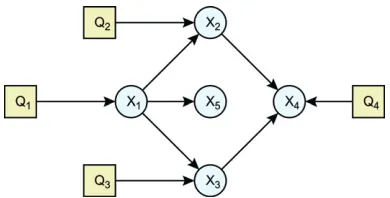
Applications: Simulation study: We simulated five
continuous phenotypes and four discrete QTL (Figure 2) for intercross populations of size 500 using R/QTL (Bromanand Sen2009). The genome consists of five
chromosomes of length 100, with 10 genetic markers randomly distributed across each chromosome. Pheno-types X1, X2, X3, and X4 have one QTL each on chromosomes 1, 2, 3, and 4, respectively, and pheno-typeX5has no QTL. The QTL are unlinked and occur near the center of the chromosome. Additive and dom-inance effects were generated fromU[0.5, 1] andU[0, 0.5], respectively. Phenotypes were generated from a normal distributionX N(0, 1) and were then modi-fied according to a conditional Gaussian distribution,
N m1X
m
j¼1
bi;jðXjmjÞ;e
!
;
to preserve the structural relationships shown in Figure 2. The regression coefficients,bi,j, were fixed at 1=
ffiffiffi 2 p
, and the variance,e, was of the order of 1e1.
MRL/MpJ 3SM/JF2 intercross:We applied our
meth-ods to kidney eQTL data from an MRL/MpJ3 SM/J
intercross (Figure S1; Hageman et al. 2011). Pathway
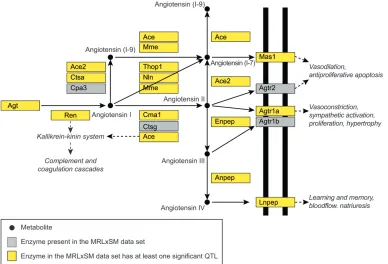
enrichment analysis revealed the RAS pathway (Figure 3) as overrepresented (P-value ,0.001) in the chro-mosome 4 trans-band. Of 18 genes in this pathway, 7 have a QTL in the chromosome 4 region, all of which weretrans-regulated (Table S1). We identified 7 addi-tional genes in this pathway that have at least one significant QTL elsewhere in the genome. These 14 genes, along with SNPs corresponding to signifi-cant QTL, were selected as variables. In cases with more than one significant SNP per chromosome, the SNP corresponding to the highest LOD score was selected
(Table S2). These data are available in NCBI’s Gene
Expression Omnibus under accession no. GSE23310 (Edgaret al.2002).
RESULTS AND DISCUSSION
We have proposed a Bayesian statistical framework for the joint inference of the causal phenotype–genotype network from the natural genetic variation in segregat-ing populations. Networks are decomposed into local models with continuous children and scored using a Bayesian posterior probability. Structural priors that can encode sparsity and biological knowledge are used to constrain the model space. The modified Metropolis– Hastings algorithm relies on a single edge and reversible edge proposals for efficient DAG sampling. The result is an ensemble of highly probable networks from which predictions can be made.
In the simulation study, four chains were run from different random initial DAGs for 50,000 iterations for each data set. The acceptance rate in all cases was between 21% and 33%, and the reduction of scale parameters was,1.2 (Gilkset al.1996). The initial
burn-in was discarded, and the chains were combined for Bayesian model averaging (BMA) over graphs of high probability (Madigan and Raferty 1984). For
each simulated data set, the BMA result is a matrix with entries that are estimates of the marginal proba-bility of an edge (e.g.,Table S3). To summarize this in-formation, we compare the posterior probabilities for the causal relationship,Xi/Xj, and reactive relation-shipXj/Xifor each phenotype. If there is a negligible difference (,0.05), we conclude that we are unable to establish the nature of relationship Xi 4 Xj. To de-termine whether the relationships between QTL and phenotypes were adequately recovered, for each simu-lation we identified the parental QTL with the maxi-mum posterior probability for each phenotype. The number of times features were recovered across the 100 simulated data sets is given in Table 1. Overall, our method performed well recovering both direct and indirect relationships from simulated data. The edges between QTL and phenotype were easier to recover than the edges between phenotypes. We struggled to identify the relationship between X1 and X5, which share a common QTL; however, this may be inherent to the structure of the model.
The RAS pathway plays a major role in blood pressure regulation (Fyhrquistand Saijonmaa2008). Both
sys-temic RAS and the activation of local tissue RAS have been associated with hypertension, diabetes, and car-diovascular and renal damage. We selected this pathway to demonstrate our approach on real kidney data from an F2intercross. Our data, and hence our models, re-flect only the local (renal) RAS, which is different from the more commonly referred to systemic RAS. The local RAS is not a closed system and can interact with the en-Figure 2.—The simulated network was generated as the
docrine RAS as well as other peptide systems outside the kidney that are not considered here.
We applied our method to a reduced RAS pathway with 14 genes that have significant QTL somewhere in the genome. Two parallel chains were seeded from random DAGs and run for 800,000 iterations. Acceptance rates were 10% and 13%. The initial burn-in was discarded. The estimated posterior probabilities of the parameters (edges) were in strong agreement (r¼0.99), indicating convergence (Figure S2), and the distribution of poste-rior probabilities was clearly bimodal. Edges with prob-abilities.0.5 were selected for the final network on the basis of BMA (Figure 4). The posterior probabilities for all edges are given inTable S4. Alternatively, we employed model selection to extract the four most probable networks (Figure S3andFigure S4).
Our final model (Figure 5) differs from the canonical pathway (Figure 3), suggesting enzyme regulation in regions of the pathway that are not directly linked. For example, Mas1, which encodes the MAS1 onco-gene and binds the angiotensin II metabolite angio-tensin(1–7), has a large effect onLnpep. Lnpepencodes the leucyl/cystinyl aminopeptidase, a receptor for an-other angiotensin II metabolite. The expression of
Lnpep affects the expression of both Thop1 and Mme, both encoding enzymes that produce angiotensin(1– 7), the ligand for the MAS1 oncogene. This relation-ship suggests a feedback loop in the canonical pathway.
Mas1 appears to be a master regulator; we predict that intervention at this level will perturb nearly all pathway members with the exception of Ren and Agt. Ren was
found to be causally linked toMmewith low probability (0.366); however, Mme is upstream ofRen with proba-bility 0.245 (Table S4). We believe that Ren and Mme
are causally linked, but the direction of causality is un-clear. The actions of Ren likely do not occur at the transcriptional level.
A major feature of this approach is the ability to generate hypotheses and performin silicoexperiments with the networks. The Markov property allows us to consider each local family as independent of its pred-ecessors. From the BMA network the most probable connections can be determined. Once a network is Figure3.—The RAS path-way as depicted in KEGG was overrepresented in the chromosome 4 trans-band for the MRL/MpJ 3 SM/J intercross. Members of this pathway with significant QTL are indicated. These enzymes and QTL were se-lected as network variables.
TABLE 1
The number of times that each possible causal relationship had the highest posterior probability (top) and number of times that the causal QTL had the highest posterior
probability (bottom)
Phenotypes / ) )/
(X1,X2) 94 0 6
(X1,X3) 92 0 8
(X1,X5) 9 16 75
(X2,X4) 100 0 0
(X3,X4) 100 0 0
QTL–phenotypes /
(Q1,X1) 86
(Q2,X2) 100
(Q3,X3) 100
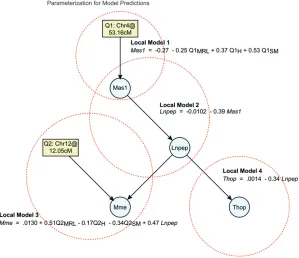
identified it can be parameterized by the regression coefficients of the local families. In the parameterized network, the sign and magnitude of the regression co-efficients reveal the nature of the relationships between variables, and forward quantitative predictions can be made by simulation. We parameterized a highly proba-ble region of the BMA network for the RAS pathway that involved Mas1, Lnpep, Mme, Thop, and QTL on chromosomes 4 and 12 (Figure 6). Examination of the regression coefficients suggestsMas1inhibits theLnpep
receptor, which in turn inhibitsThop. The expression ofMme depends on the expression of Lnpep, but also the genotype on the chromosome 4 locus, e.g., Mme
is strongly activated by a homozygous MRL genotype at the chromosome 4 locus. Further testing is required to validate these hypotheses. Nonetheless, our method provides a framework for predicting the effects of in-terventions, such as drugs, that attempt to modify gene action to alter downstream phenotypes.
The size of the model space grows at a superexpo-nential rate with the number of nodes (Friedmanet al.
2000), and adequate coverage of the model space be-comes difficult and quickly impossible with increasing numbers of variables. These issues are inherent in BN methodologies. Even with the addition of the reversible-edge proposal, our method can reconstruct networks only on the order of 30 nodes before becoming un-stable. This is a far stretch from the number of tran-scripts in an eQTL data set (30,000). The small sample size compared to the number of measured traits (n?p) that arises in eQTL data is another limiting consider-ation. Variable selection is a major challenge for any
network inference method. We found that restriction to a moderate number of biologically motivated varia-bles is required for reliable inference and tractable sampling. A method that can infer mixed-domain dy-namic BNs up to 10,000 nodes has been proposed (Winrow et al. 2010), but it is difficult to assess the
validity of such large-scale networks. We are currently investigating improvements to our sampling scheme and priors that will allow us to infer larger systems, but we expect to achieve only modest increases.
QTLnet is an algorithm similar to our approach that uses homogeneous conditional Gaussian regression models and a hybrid Metropolis–Hastings algorithm to estimate network connections (Chaibub-Netoet al.
2010). In the QTLnet sampling scheme, a phenotype network is generated via single-edge proposals, and then the genetic architecture is estimated conditional on the proposed network. A combination of single-edge proposals and conditional genome scans makes QTLnet computationally intensive. We have applied both QTLnet (version 0.4.1) and our algorithm to the RAS pathway data (Figure S10, Figure S11, and Table S5). Both methods predict many of the same connec-tions, including the identification of Mas1 as a master regulator and feedback in the canonical pathways be-tween Mas1, Lnpep, Mma, and Thop. With no sparsity restrictions, QTLnet predicted a much denser set of interactions, which was expected. When we extended the number of variables by including gene expression data on RAS components that did not have QTL, our Figure 4.—Posterior probabilities estimated by BMA for
each network node. Each point is an entry in the consensus matrix, which represents the probability of a connection asso-ciated with the given node. Connections with probabilities
method provided essentially the same network (
Fig-ure S5,Figure S6,Figure S7,Figure S8,Figure S9, and
Table S6). The QTLnet algorithm did not exhibit the
same concordance (Figure S10,Figure S11, andTable S5); we found that genes with no significant QTL in the single-trait analysis were connected in the network, with the exception ofAgtr1b.
An advantage of the QTLnet method is that it es-timates unobserved QTL genotypes conditional on SNP markers using hidden Markov models (HMM) and co-nditions on them in the sampling process (Broman
and Sen 2009). In contrast, we use selected SNPs
for QTL in the model space. Therefore, the QTLnet model space is always smaller than ours, which eases the sampling process. On the other hand, conditional genome scans are performed and single-edge proposals are made, making iterations more laborious. A disad-vantage of the QTLnet approach is the potential for more than one variable in a close genomic region (e.g., small regions on the same chromosome) to be repre-sented in the network. Genotypes in close regions are not necessarily independent and their inclusion can affect the inferred topology. In our QTLnet-derived RAS networks, there are several instances of this;e.g., in the reduced RAS network there are two SNPs on chromosome 2 that are represented at 73 and 88 cM
(Figure S11). The optimal way to include genotypes to
safeguard against errors in inference due to linkage between variables in the causal network remains an open question.
We have adopted a structural prior in the form of a Gaussian belief network that has the potential to en-code biological knowledge and sparsity. The sparsity prior that we applied can safeguard against overfitting,
which is often an issue in a high-dimensional model space. Growing resources of publicly available data together with annotations from the literature can offer support for relationships between variables. However, methods for encoding this information into a prior belief network remain to be developed.
The interaction between genotype and pheno-type has been shown to play an important role in the causal inference of network interactions (Kulp and
Jagalur 2006). We have modeled the local
relation-ships between continuous children with mixed parents using hierarchical regression models. These models can be extended to investigate the interaction between variables,i.e., phenotype–genotype, genotype–genotype, and phenotype–phenotype. However, the addition of interaction terms will substantially increase the search space. Such models may be feasible for small-scale networks.
Computational methods for network inference are valuable tools for generating and validating hypothe-ses, which can drive new experiments.
This project was funded by grants from the National Institute of General Medical Sciences (GM076468) (to G.A.C. and R.K.); a National Heart, Lung, and Blood Institute NSRA fellowship (1F32HL095240-02) (to R.S.H.); an American Heart Association post-doctoral fellowship (to M.S.L.); and National Heart, Lung, and Blood Institute grants HL077796 and HL081162 (to B.P.).
LITERATURE CITED
Broman, K. W., and S. Sen, 2009 A Guide to QTL Mapping With R/qtl.
Springer-Verlag, Berlin/Heidelberg, Germany/New York. Calvetti, D., J. P. Kaipio and E. Somersalo, 2006 Aristotelian
prior boundary conditions. Int. J. Math. Comput. Sci.1:63–81. Chaibub-Neto, E., C. T. Ferrara, A. D. Attieand B. S. Yandell,
2008 Inferring causal phenotype networks from segregating populations. Genetics179:1089–1100.
Chaibub-Neto, E., M. P. Keller, A. D. Attieand B. S. Yandell,
2010 Causal graphical models in systems genetics: a uni+ed framework for joint inference of causal network and genetic archi-tecture for correlated phenotypes. Ann. Appl. Stat.4:320–339. Chen, L. S., F. Emmert-Streiband J. D. Storey, 2007 Harnessing
naturally randomized transcription to infer regulatory relation-ships among genes. Genome Biol.8:R219.
Dongen, S. V., 2006 Prior specification in Bayesian statistics: three
cautionary tales. J. Theor. Biol.242:90–100.
Edgar, R., M. Domrachevand A. E. Lash, 2002 Gene Expression
Omnibus: NCBI gene expression and hybridization array data re-pository. Nucleic Acids Res.30:207–210.
Fisher, R. A., 1926 The arrangement of field experiments. J. Ministry
Agric.33:503–511.
Friedman, N., M. Linial, I. Nachmanand D. Pe’er, 2000 Using
Bayesian networks to analyze expression data. J. Comput. Biol.
7:601–620.
Fyhrquist, F., and O. Saijonmaa, 2008 Renin-angiotensin system
revisited. J. Int. Med.264:224–236.
Gelman, A., 2006 Prior distributions for variance parameters in
hierarchical models. Bayesian Anal.1:515–533.
Gelman, A., and J. Hill, 2007 Data Analysis Using Multilevel/
Hierarchical Models. Cambridge University Press, Cambridge, UK/London/New York.
George, E. I., and R. E. McCulloch, 1993 Variable selection via
Gibbs sampling. J. Am. Stat. Assoc.88:881–889.
Gilks, W. R., S. Richardsonand D. J. Spiegelhalter, 1996 Markov
Chain Monte Carlo in Practice. Chapman & Hall, London/New York.
Grzegorczyk, M., and D. Husmeier, 2008 Improving the structure
MCMC sampler for Bayesian networks by introducing a new edge reversal move. Mach. Learn.71:265–305.
Hageman, R. S., M. S. Leduc, C. R. Caputo, S. W. Tsaih, G. A.
Churchillet al., 2011 Uncovering genes and regulatory
path-ways related to urinary albumin excretion. J. Am. Soc. Nephrol.
22:73–81.
Hansen, P. C., 1998 Rank-Deficient and Discrete Ill-Posed Problems.
Society for Industrial and Applied Mathematics, Philadelphia. Heckerman, D., 1997 Bayesian networks for data mining. Data
Min-ing and Knowledge Discovery1:79–119.
Imoto, S., T. Higuchi, T. Goto, K. Tashiro, S. Kuhara et al.,
2004 Combining microarrays and biological knowledge for estimating gene networks via Bayesian Networks. J. Bioinform. Comput. Biol.2:77–98.
Jansen, R. C., and J. Nap, 2001 Genetical genomics: the added value
from segregation. Trends Genet.17:388–391.
Kulp, D., and M. Jagalur, 2006 Causal inference of regulator-target
pairs by gene mapping of expression phenotypes. BMC Genomics7:125.
Li, R., S.-W. Tsaih, K. Shockley, I. M. Stylianou, J. Wergedalet al.,
2006 Structural model analysis of multiple quantitative traits. PLoS Genet.2:e114.
Li, Y., B. M. Tesson, G. A. Churchill and R. C. Jansen,
2010 Critical reasoning on causal inference in genome-wide linkage and association studies. Trends Genet.28:493–498. Madigan, D., and A. E. Raferty, 1984 Model selection and
accounting for model uncertainty in graphical models using Occam’s window. J. Am. Soc. Nephrol.89:1535–1546. Madigan, D., and J. York, 1995 Bayesian graphical models for
dis-crete data. Int. Stat. Rev.63:215–232.
Ntzoufras, I., 2009 Bayesian Modeling Using WinBUGS.Wiley, New
York.
Rockman, M. V., 2008 Reverse engineering the genotype-phenotype
map with natural genetic variation. Nature456:738–744. Schadt, E. E., J. Lamb, X. Yang, J. Zhu, S. Edwardset al., 2005 An
integrative genomics approach to infer causal associations between gene expression and disease. Nature37:710–717. Werhli, A. V., and D. Husmeier, 2007 Reconstructing gene
regula-tory networks with Bayesian networks by combining expression data with multiple sources of prior knowledge. Stat. Appl. Genet. Mol. Biol.6:1–42.
Winrow, C. J., D. L. Williams, A. Kasarskis, J. Millstein, A. D.
Laposkyet al., 2010 Uncovering the genetic landscape for
mul-tiple sleep-wake traits. PLoS One4:125.
Zhu, J., P. Y. Lum, J. Lamb, D. GuhaThakurta, S. W. Edwardset al.,
2004 An integrative approach to the reconstruction of gene networks in segregating populations. Cytogenet. Genome Res.
105:363–374.
Zhu, J., M. C. Wiener, C. Zhang, A. Fridman, E. Minch et al.,
2007 Increasing the power to detect causal associations by com-bining genotypic and expression data in segregating popula-tions. PLoS Comput. Biol.3:692–703.