Abstract
PARTHASARATHY, SRIVATSAN. Interfacing AC Coupled Interconnect design with Rocket I/O compatible FPGA systems. (Under the direction of Dr John Wilson).
As data rates continue to increase, there is an increasing need for reliable high-density, high-speed interconnect technologies. AC Coupled Interconnect provides a solution to this problem. The characterizing of high-speed systems in an efficient manner is an important issue and BER (Bit Error Rate) is one of the most important metrics utilized to characterize high-speed interconnect technologies.
In this thesis we have developed circuitry that interfaces AC Coupled Interconnect designs with FPGA based systems that compute the system BER. The FPGA uses Rocket IO transmitters and receivers to communicate with the test chip. Thus the understanding of Rocket IO signaling becomes important. Extensive simulations of the Rocket IO transmitter and receiver models provided by XILINX were carried out across all the process corners to characterize the system behavior accurately. The interface circuitry was designed using the TSMC 0.25 Micron process parameters, and the entire design is validated across a temperature spectrum of -40 C to 120 C and supply voltage of 2.25 V to 2.75 V. The complete self-test vehicle constitutes the FPGA and the test chip on a single PCB.
This system is evaluated based on jitter, signal swing and common mode voltage associated with the signal at the Rocket IO receiver input. HSPICE models for the Rocket IO transceivers provided by Xilinx allow us to simulate the entire system.
Interfacing AC Coupled Interconnect design with Rocket I/O compatible
FPGA systems
by
Srivatsan Parthasarathy
A thesis submitted to the graduate faculty of
North Carolina State University
in partial fulfillment of the
requirements for the Degree of
Master of Science
Electrical Engineering
Raleigh, North Carolina
2006
Approved by:
__________________________ __________________________
Dr. Paul Franzon Dr.W.Rhett Davis
____________________________________
Dr.John Wilson
Biography
Acknowledgements
I thank my parents for all the motivation during the course of this project. It was their encouragement and love that helped me maintain sanity during the course of this thesis.
I wholeheartedly acknowledge the efforts of Dr John Wilson, my academic advisor for providing me with all the possible guidance and encouragement for the completion of this thesis. I learned the nuances of research in his company. I feel this attribute will help me immensely in the coming years.
I am very grateful to Dr Paul Franzon for making me realize the importance continuous progress in a project. I also thank him for his useful comments and time. I am equally thankful to Dr.W.Rhett Davis for being on the committee and for his valuable feedback on the thesis document. Special thanks to Manav, Jian, Bruce, Lei and Yongjin for all those insightful discussions which helped me complete this thesis. I would also like to thank Prem for his help with the bias circuit design.
Contents
List of Figures viii
List of Tables xi
List of Abbreviations xii
1 Introduction...1
1.1 Overview ...1
1.2 Motivation...2
1.3 Thesis Outline ...3
2 Literature Review ...4
2.1 AC Coupled Interconnects...4
2.1.1 Channel Behavior...4
2.1.2 Edge Rate and Coupling Capacitor...7
2.2 Bit Error Rate Testing...8
2.3 Bias Circuit ...9
2.4 Transmission Line Structure on a PCB...13
2.4.1 Termination schemes ...14
3 Rocket IO Signal Environment...18
3.1 Introduction to Rocket IO ...18
3.1.1 Rocket IO Features ...18
3.2 Rocket IO Transceiver ...19
3.2.1 Current Mode Logic...19
3.2.2 Rocket IO Transmitter ...20
3.2.3 Rocket IO Receiver...25
4 System Design...27
4.1 Design Overview (Top Level Hierarchy) ...27
4.3 Front-end Receiver...32
4.4 Limited Swing Differential to Full Swing Single-end conversion ...33
4.5 AC Coupled Interconnect Design ...35
4.5.1 Pulse Signaling...35
4.5.2 ACCI Transmitter ...35
4.5.3 Pulse Receiver...36
4.5.4 Summary ...38
4.6 Single end to Differential Conversion ...38
4.7 Back-end Transmitter...40
4.8 Auto adaptive bias design ...41
5 Simulation Results ...43
5.1 Simulation test setup ...43
5.1.1 Rocket IO Settings ...43
5.2 Top level Simulation setup ...43
5.3 Simulation Results ...45
5.3.1 Simulation Results – Front End Receiver...46
5.3.2 Simulation Results – Differential to Single End Converter...47
5.3.3 Simulation Results – ACCI TX/CHANNEL/RX ...48
5.3.4 Simulation Results – Single-end to Differential Converter ...50
5.3.5 Simulation Results – Rocket IO Receiver ...52
6 ESD Protection for High Speed Circuits ...56
6.1Introduction to ESD ...
566.2 ESD Test Models ...57
6.2.1 Human Body Model...57
6.2.2 Machine Model ...58
6.2.3 Charged Device Model ...59
6.3 MOS Device Physics in High Current High Voltage Region...60
6.4 ESD Protection...62
6.4.1 MOS Based ESD Protection ...62
6.5.1 Issues with Buffer Design for ESD protection ...68
6.5.2 Distributed ESD Protection for High Speed Circuits – A Study ...68
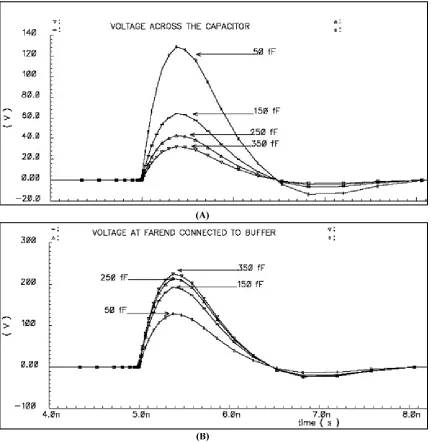
6.6 Impact of CDM on ACCI ...69
7 Conclusion ...73
7.1 Future Work ...73
Bibliography ...75
Appendix A ...78
List of Figures
1.1: System Level description of the BERT [3]...2
2.1: AC Coupled Interconnect System...4
2.2: Capacitively Coupled Interconnect System...5
2.3: Traditional T-Line...5
2.4: Channel Response comparing T-Line and an ACCI channel ...6
2.5: ACCI Channel...7
2.6: Impact of Edge Rate on signal Swing...8
2.7: A Basic BER Measurement System ...9
2.8: Circuit to establish supply-independent currents...10
2.9: Plot of reference current versus VDD...11
2.10: Transient behavior of reference circuit ...12
2.11: Digital Trimming ...12
2.12: Transmission line models ...14
2.13: PI-Termination...16
2.14: T-Termination...17
3.1: Overview of Rocket IO signal environment ...18
3.2: Current Mode Logic...20
3.3: Rocket IO transmitter...21
3.4: Impact of Pre-emphasis ...23
3.5: Rocket IO TX Eye Diagrams with Different Pre-emphasis levels ...24
4.1: System Level Representation ...28
4.2: Digitally Programmable Resistor...29
4.3: Resistor Termination...31
4.4: Front-end Receiver Schematic...32
4.5: Differential to Single-end converter ...34
4.6: Simulated VTC/Gain Characteristics...34
4.7: ACCI Transmitter ...36
4.10: Single end to Differential Conversion ...39
4.11: Transient response depicting equal delays...39
4.12: Back end Transmitter...41
4.13: Adaptive Bias network...42
5.1: Top level simulation setup...44
5.1(a): Differential Input to Rocket IO TX and Front end RX ...45
5.2: Differential Input Eye Pattern ...46
5.3: Transient response of the receiver output ...47
5.4: Differential Eye Diagram of the receiver output ...48
5.5: Eye Diagram and Transient response of the single ended signal ...49
5.6: Transient waveform of ACCI channel ...50
5.7: Eye Diagrams related to ACCI ...51
5.8: Transient response/Eye diagram at the output of single-differential converter...52
5.9: Rocket IO receiver input (Transient response and Eye Diagram) ...53
5.10: Rocket IO receiver outputs (Transient response and Eye Diagram) ...55
6.1: HBM ESD Model and associated waveform...58
6.2: MM ESD Model and associated waveform...58
6.3: CDM ESD Model and associated waveform...60
6.4: (a) Generic I-V curve for an NMOS (b) Cross-section of an NMOS showing the currents in the parasitic NPN transistor ...60
6.5: Equivalent circuit for the MOSFET including the current source, substrate resistance and parasitic bipolar transistor [25] ...62
6.6: Basic ESD protection structure of the gg-NMOS showing the parasitic bipolar transistor [7]...63
6.7: Test setup and simulation result for HBM pu66lses...65
6.8: Test setup and simulation result for MM pulses...66
6.9: Test setup and simulation result for CDM pulses...67
6.10: (A) Voltage across coupling capacitor...70
6.10: (B) Voltage at the end connected to the Buffer ...70
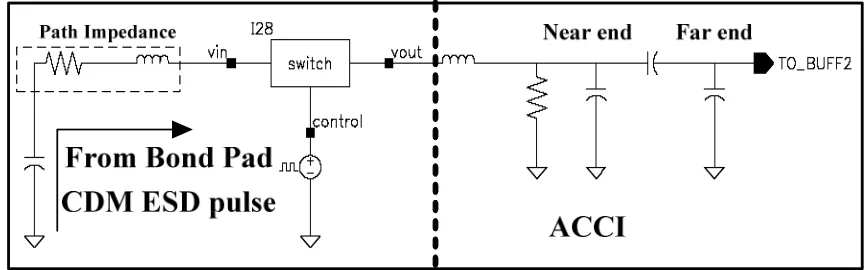
6.11: CDM ESD test setup...71
A.1: Front end Receiver...78
A.2: Differential to Single-end Converter ...79
A.3: ACCI Transmitter ...80
A.4: ACCI ReceiverA.5: Differential to Single end converter...81
A.6: Back end Transmitter...82
A.7: Adaptive Bias Circuit...83
B.1: Eye diagram showing working at worst case condition (-40 C) ...86
B.2: Butterfly plot at 25 C and -40 C for Cross coupled latch...87
B.3: Transient simulation showing Latch functionality...88
B.4: Eye diagram showing working at worst case condition (120 C) ...89
B.5: Butterfly plot at 25 C and 120 C for Cross coupled latch...90
B.6: Eye diagram showing working at worst case condition (-40 C) ...91
List of Tables
3.1: Rocket IO transmitter parameters ...22
3.2: Pre-emphasis Values...23
3.3: Rocket IO receiver parameters ...25
3.4: Recommended VTRX for AC/DC Coupling...26
4.1: Resistor value Calculation for various bits ...30
5.1: Comparing simulated and actual Rocket IO parameters ...54
6.1: Short-circuit HBM ESD waveform specifications ...57
6.2: Short-circuit MM ESD waveform specifications ...59
6.3: Short-circuit MM ESD waveform specifications ...60
B.1: Design functionality at temperature and Voltage...85
B.2: Design functionality at temperature and Voltage...89
LIST OF ABBREVIATIONS
ACCI-AC Coupled Interconnect BER-Bit Error Rate
BERT-Bit Error Rate Tester CDM-Charge Device Model CML-Current Mode Logic DUT-Device Under Test
EMI-Electromagnetic Interference ESD-Electrostatic Discharge
FPGA-Field Programmable Gate Array HBM-Human Body Model
ISI-Inter Symbol Interference I/O-Input/Output
IC-Integrated Circuit MM-Machine Model NRZ-Non Return to Zero PCB-Printed Circuit Board
PRBS-Pseudo-Random Bit Sequence RZ-Return to Zero
RX-Receiver
SCL-Source Coupled Logic
SPICE-Simulation Program with Integrated Circuit Emphasis TX-Transmitter
Chapter 1
Introduction
1.1 Overview
The continuous scaling of Integrated circuits has enabled a rapid increase in operating frequencies, and the increase in circuit density, coupled with synthesis algorithms, has eased the design of large complex digital systems. The primary bottleneck in the construction of these complex digital system is the interconnect technology. This has resulted in the development of novel interconnect techniques that can handle high data rates and high density off-chip I/Os [1]. As data rates continue to climb serial communication systems become very dominant. The fundamental advantages of these systems are that they are less constrained by the timing and alignment problem that limit a parallel system from being used in high frequency design. Thus signal integrity becomes a major issue in the design of high speed serial links. Increasing jitter and reducing jitter budget become the key problems faced in high speed serial link design. Jitter results in the variation of clock and data edges which in turn results in higher bit error rates. For the complex digital systems being designed today the minimum acceptable BER is 10-12 and this should be met for any serial link established between a transmitter and receiver [2].
Figure 1.1 System Level description of the BERT [3]
The test flow is summarized in the following steps:
1) The specified PRBS pattern is generated by the FPGA
2) This is serialized and sent to the DUT (ACCI Design) through the Rocket IO transmitter
3) The interface circuitry designed receives the serial data and provides it to the DUT (ACCI Design)
4) The data from the ACCI design (DUT) is sent back to the FPGA using a custom designed transmitter.
5) The serial data is received at the Rocket IO receiver. It is than deserialized and provided to the error detector present in the FPGA.
1.2 Motivation
Rocket IO signaling levels. The secondary focus of this thesis is to aid in the
development of a complete test system for high speed serial interfaces. This thesis will provide insights into Rocket IO signaling levels which in turn will allow future designers to develop a complete self test system.
1.3 Thesis Outline
Chapter 2
Literature Review
2.1 AC Coupled Interconnects
The fundamental basis for AC coupling is derived from the assumption that it is easier to build a dense array of non-contacting AC connections when compared to DC connections. This is further supported by the fact that all the information pertaining to a digital signal is present in the AC component [4] [5]. This gives rise to the question of how to isolate the AC component. The AC component is isolated by blocking the DC component of the signal by placing a series coupling capacitor or inductor in its path [4] .The capacitive connection can be created by bringing the two opposing metal plates of the two different IC'S into close proximity or by direct fabrication on the chip or on a substrate. An inductive connection can be formed likewise, using two spiral inductors [6]. It has been demonstrated by S. Mick et al that using such non-contacting structures allow very high density interconnects to be realized [6]. A complete AC coupled system consists of capacitive or inductive coupling elements, buried solder bumps for DC connections and transceiver circuits to compensate for the frequency response of the coupling [5].
Figure 2.1: AC Coupled Interconnect System
2.1.1 Channel Behavior
on capacitive coupling. The schematic for a capacitively coupled system is shown in Figure 2.2.
Figure 2.2: Capacitively Coupled Interconnect System
A traditional T-Line sans the coupling capacitor as shown in Figure 2.3 has a low pass channel response.
Figure 2.3: Traditional T-Line
This limits the channels 3dB bandwidth. On the other hand an ACCI channel as shown in
Figure in 2.4 gives you a band pass response. This is due to the presence of the T-Line,
the series coupling capacitor (Cc) and the parasitic capacitor (Cp). These three elements
create a channel from the TX to the RX with a band pass response. The low pass
characteristics of the channel are defined by the T-Line and the parasitic capacitor where
as the high pass characteristics are defined by the series coupling capacitor. The series
coupling capacitor filters out the low frequency component of the transmitted data. Thus
reducing the ISI and increasing the 3dB channel bandwidth to higher frequencies. This is
T-Line with an AC Coupled line. It is very clearly seen that the 3dB bandwidth of the ACCI
channel is around 2.5 times higher than that of a traditional T-Line. On the contrary it
should be noted that receiver sensitivity should be high in the case of the ACCI channel
when compared to the traditional T-line because of the losses [4] [6].
Figure 2.5: ACCI Channel
2.1.2 Edge Rate and Coupling Capacitor
It is observed that a large signal swing at the receiver input will result in a higher
Signal to Noise ration and low BER. In an ACCI system it is the series coupling capacitor
which converts the full swing NRZ signals to RZ pulse signals. Thus it is very important
that the RZ pulses have a sufficiently high signal swing at the receiver. It is observed that
one of the most important factors determining the signal swing at the receiver is the edge
rate of the NRZ input [4]. This is aptly demonstrated in figure 2.6 which shows the
impact of edge rate on signal swing. The experimental setup for this plot was based on
Figure 2.5. It is clearly observed that the signal having the fastest edge rate has the largest
signal swing at the receiver input [4].
A key point is that faster edge rates result in greater signal swing where as the
transition time of the NRZ signal determines the pulse width of the RZ signal at the
receiver input. The best driver designs for ACCI are those that provide fast edge rates and
short pulse durations [7].
Figure 2.6: Impact of Edge Rate on signal Swing
2.2 Bit Error Rate Testing
BER (Bit Error Rate) is technically defined as the number of erroneous bits divided by the total number of bits transmitted, received, or processed over some stipulated period. It is just one of many statistical measures of a communication link or channel, and is usually expressed as a negative power of ten [3].
Figure 2.7: A Basic BER Measurement System
A typical BER testing system shown in Figure 2.7 consists of a pattern generator that generates the pseudo random sequence, a transmitter and receiver combination, the error detector and the system-under-test. In this thesis we have used a Xilinx based FPGA systems that houses the PRBS generator, the error detector and the Rocket IO transmitter receiver combination. There is a detailed description of the Rocket IO portion in the following chapters.
2.3 Bias Circuit
The main objective of reference generation is to establish a dc voltage or current that is independent of the supply and process variations. Apart from this it should also have a very well defined behavior with temperature [9].
In order to arrive at a solution that is independent of supply voltage we need to design a circuit that could bias itself. Figure 2.8 illustrates an implementation where M1 and M2 copy Iout, thereby defining IREF. Depending on the sizes chosen, we have
Iout = KIREF if the channel length modulation is neglected. Since the currents display little
parameters. It is observed that if all the transistors (M1-M4) operate in the saturation region and CLM = 0, then the circuit is governed by only one equation, Iout = KIREF. In
order to uniquely define the currents in the circuit we add a resistor as depicted in Figure 2.8 [9].
Figure 2.8: Circuit to establish supply-independent currents
Note that a start-up circuit is included in the Figure 2.8. In any self-biased circuit there are two possible operating points. The first operating point is based on the assumption that there will be some finite amount of current flowing in the circuit. The second possible operating point suggests that there can be a condition where zero current flows in the circuit. This unwanted state occurs when the gates of transistor M3/M4 are at ground while the gates of M1/M2 are at VDD. The start-up circuit comes to your rescue in this state. Now assuming the circuit settles into this unwanted state, the gate of transistor SU1 is at ground and so it is off. The gate of PMOS SU2 is somewhere in between VDD and VDD-VTHP. The transistor SU3 behaves like an NMOS switch and
SU3 should be close to zero as shown in Figure 2.10. The problem of start-up requires some careful analysis and simulations. The supply voltage must be ramped up from zero in a dc sweep simulation and the behavior of the circuit should be studied with and with out the start-up [10].
Figure 2.9: Plot of reference current versus VDD
Figure 2.10: Transient behavior of reference circuit
2.4 Transmission Line Structure on a PCB
Transmission line structures seen on a typical PCB consist of conductive traces buried into a dielectric material with one or more reference planes. The metal in a typical PCB is usually copper and the dielectric is FR4, which is a type of fiberglass. The two most common types of transmission lines used in digital designs are microstriplines and striplines. A microstriplineis usually routed on an outside layer of the PCB and has only one reference plane. A striplineis routed on an inside layer and has two reference planes.
In this thesis we have used single ended and differential transmission line models. This thesis puts greater emphasis on the differential models because of the complexity involved and use in Rocket IO channel design.
Figure 2.12 gives a cross sectional view of the differential stripline model. As mentioned in the previous paragraph a stripline is routed in between two reference planes. This cross section allows the high frequency current to be distributed equally on both the top and bottom sides of the signal conductor. Apart from this it also spreads out the returning current equally among the top and bottom reference planes. Since the current is spread over a large area conductor losses are minimized.
The other widely used transmission line model is the differential microstripline model. The cross sectional view of this model is also shown in Figure 2.12. In a microstripline the signal is exposed to air and has got only a single reference plane. This makes the line very lossy and is often not utilized for long high speed interconnects. Microstriplines do not require a via to an inner layer of the PCB, hence are very useful for dense routing of low speed lines. To interconnect short distances for high-speed applications, microstriplines can be widened to limit loss. This might also provide performance advantages over stripline approaches, since striplines require vias to interconnect signals, reducing bandwidth [11].
For these cross sections shown in Figure 2.12, the dimensions are as follows: t: Thickness of a signal conductor
w: Width of a signal conductor s: Spacing between two conductors
In addition to this the PCB laminate material has a relative permittivity associated with it which is labeled Er.
Figure 2.12: Transmission line models
2.4.1 Termination schemes
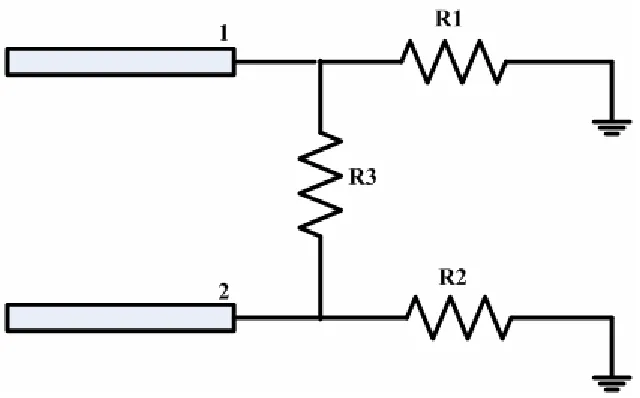
However not all signals on a pair of coupled lines will be differential. The simplest example to take is electrical noise. One reason for using differential pairs is that a low level signal can be faithfully reproduced at the receiver in an electrically noisy environment. As the traces are close, they will suffer from identical noise exposure. Noise induced on the pair will be of both equal amplitude and polarity. So while the original signal has equal and opposite polarity and feels the influence of the virtual ground, the noise will encounter no such ground. In fact as the noise is equal on both traces, the effect is to slightly increase the impedance of both traces. The impedance seen by the noise as it propagates is therefore the even mode impedance. Thus it becomes imperative to terminate both EVEN and ODD mode impedances. Transmission lines need correct termination in order to preserve signal integrity and minimize reflections [12]. The two commonly used techniques to terminate even and odd mode impedances simultaneously are PI and T network terminations. Figure 2.12 depicts the PI network termination. The resistances R1, R2, R3 must be chosen in a way so as to terminate both even and odd mode impedances. First let’s consider even mode termination where the voltage at points 1 and 2 are equal. As the net potential difference between the points 1 and 2 is equal to zero no current will be flowing between these two points. Thus R1 and R2 must be equal to the even mode impedance [13]. To calculate R3 it is required to evaluate the odd mode propagation. In this case V1 and V2 will be equal in magnitude but opposite in polarity i.e. V1= -V2. Thus R3 could be split into two equal resistors with a virtual ground placed in-between. This means that each signal, in odd-mode propagation, is terminated with a value of R1 (or R2), in parallel with R3 [13]. The required values of R1 and R3 that may be used to terminate a pair of tightly coupled transmission lines in both even and odd propagation modes are:
(1) R1 = R2 = Zeven
Figure 2.13: PI-Termination
Figure 2.13 on the other hand shows the T network termination. Let’s initially consider odd mode termination. In this case the voltage at points 1 and 2 are equal in magnitude and opposite in direction, a virtual ground can be placed at the point where R3 is connected. Thus for odd mode propagation the lines are terminated by R1 and R2. Therefore R1/R2 must be set to the value of odd mode impedance. Moving to even mode propagation, it’s clear that no current is going to flow between the points 1 and 2. Since no current will flow between points 1 and 2, the resistor R1 or R2 in series with 2R3 must equal the even-mode impedance [13]. The subsequent values for R1, R2, and R3 in a T
termination network are:
(!) R1 = R2 = Zodd
Chapter 3
Rocket IO Signal Environment
3.1 Introduction to Rocket IO
The primary objective of this thesis is to interface the AC Coupled design with FPGA’s having Rocket IO transmitters and receivers. Rocket IO is a standard that provides Non-Return to Zero (NRZ) or binary serial communications at up to 3.125 Gb/s per serial channel. This standard was developed by XILINX and is being used in their Virtex series FPGA. Figure 3.1 gives a good overview of the Rocket IO signal environment [11].
Figure 3.1: Overview of Rocket IO signal environment
3.1.1 Rocket IO Features
- It has a variable speed full duplex transceiver that can operate any where between 600 Mb/s to 3.125 Gb/s.
- Five programmable output swing levels from 800mV to 1600mV peak to peak. This gives compatibility with other serial systems.
- Four programmable Pre-emphasis levels. This helps minimizing ISI
- It has features for both AC and DC coupling. This gives the advantage of interfacing with different serial receivers.
- It has programmable 50/75 OHM on-chip tunable resistor. This eliminates the use of external termination resistors.
- Serial and parallel TX-to-RX internal loopback modes for testing operability
3.2 Rocket IO Transceiver
The Rocket IO transmitter and receiver work on the principle of differential signaling. It is therefore very important to understand the idea of differential signaling. A serial differential line will have a positive (V+) and a negative (V-) signal driving it. Thus the voltage difference between V+ and V- represents the received data. Differential switching is performed at the crossing of the two signals and thus eliminates the use of a reference level. This feature operates at a supply voltage of 2.5 [11].
3.2.1 Current Mode Logic
swing. This ensures faster switching. The other big reason being the constant current provided by the NMOS current sink greatly minimizes the switching noise which is detrimental in high speed design [15] .Apart from this CML is differential in nature this automatically eliminates the common mode noise [16]
Figure 3.2: Current Mode Logic
3.2.2 Rocket IO Transmitter
Figure 3.3: Rocket IO transmitter
The Rocket IO transmitter specification is shown in Table 3.1.The terms used in the table are described below:
VOUT- Differential peak to peak output (TXP-TXN) VTTX- Output termination voltage
VTCM- Common mode voltage range VSKEW- Differential output skew
Table 3.1: Rocket IO transmitter parameters Parameter Min Max
VOUT 0.8 V 1.600 V
VTTX 1.8 V 2.625 V
VTCM 1.1 V 2.000 V
VSKEW 15 ps
Pre-Emphasis
The microstrip transmission line model built using the FR4 dielectric is highly lossy in nature at the desired frequency of operation. The desired frequency of operation is in the GHZ range. At these frequencies the two main factors that dominate are the dielectric losses and skin effect. Skin effect is caused due to non uniform electric fields present on the surface of the conductor. At high frequencies wire resistance increases. This prevents the electric field from fully penetrating the conductor. These high frequency losses will result in reflections and decrease in the interconnect bandwidth which in turn will result in ISI (Inter Symbol Interference).
Pre-emphasis techniques will help to compensate for these high frequency losses. Pre-emphasis is done by boosting the signal amplitude to create a stronger rising or falling wave form. This will help in improving the distance over which a signal can be transmitted over the lossy media and also improve the SNR at the input of the receiver. This in turn minimizes the BER. The impact of Pre-emphasis is depicted in the Figures 3.4 and 3.5 [11].
levels should be set after careful simulation of the entire system [11]. The four levels of pre-emphasis are shown in Table 3.2
Table 3.2: Pre-emphasis Values. Attribute Value Emphasis (%) 0 10
1 20 2 25 3 33
3.2.3 Rocket IO Receiver
The receiver computes the difference between the two incoming signals to determine if a ‘1’ or a ‘0’ has been transmitted. Common mode voltage is an important parameter to be considered in any kind of receiver design. The common mode voltage level determines how a receiver reads the incoming signal. For the Rocket IO receiver the incoming signal should have a common mode value between 0.5 V to 2.5 V. Table 3.3 summarizes all the parameters associated with the Rocket IO receiver. The terms used in the table are described below:
VIN - Serial input differential Peak to Peak (RXP-RXN) VICM - Common mode voltage level
TJTOL – Total Jitter tolerance for the received data
VSKEW- Total skew associated with the received differential data.
Table 3.3: Rocket IO receiver parameters. Parameter Min Max
VIN 0.175 V 2.000 V
VTCM 0.5 V 2.500 V
TJTOL 0.65 UI (*)
VSKEW 75 ps
Notes:
* UI=Unit Interval
value. Capacitors in the range of 0.01µF are preferred for AC coupling. On the other hand if the transmitter being used belongs to the Rocket IO family than the signal can is DC coupled to the receiver. The VTRX value in this case is set to 2.5 V. The common mode voltage will be automatically set to 1.7 V. The Rocket IO differential receiver produces the best bit-error rates when its common mode voltage falls between 1.6V and 1.8V [11]. The VTRX (Common mode voltage) level for the different environments is shown in Table 3.4.
Table 3.4: Recommended VTRX for AC/DC Coupling
Coupling VTRX VTTX
AC 1.6-1.8 V 2.5 V
DC 2.5 V 2.5 V
Chapter 4
System Design
4.1 Design Overview (Top Level Hierarchy)
The primary motive in this thesis is to design circuitry that interfaces the ACCI design with Rocket IO compatible FPGA systems. This is done in order to verify the BER of the ACCI system. The error detector present in the FPGA receives the data propagated via the ACCI system and computes the BER of the DUT. The top level block diagram is shown in Figure 4.1.The working of this system is as follows:
- The FPGA transmits serial data at 2.5 Gb/s using the Rocket IO transmitter over a 10cm differential stripline.
- There is a programmable on-chip termination network that helps to remove any kind of common mode noise.
- Termination is followed by a front-end receiver designed to receive the 2.5 Gb/s data. It belongs to the SCL (Source Coupled Logic) family.
- A differential to single end converter follows the front-end receiver. This is designed to interface the single ended ACCI circuitry with the receiver.
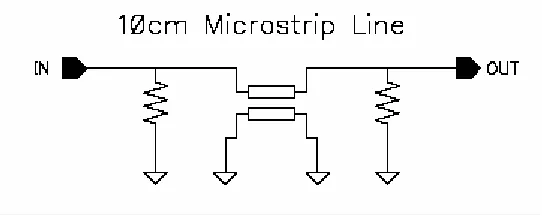
- ACCI design follows this. This is our DUT. The ACCI design consists of a transmitter, series coupling capacitor, 10cm microstrip line, and a receiver.
- The data coming out of the ACCI design is single ended in nature. In order to interface this design with the differential receiver present in the FPGA a single ended to differential converter is designed.
In the following sub-sections the individual blocks will be analyzed in a detailed manner. This will include circuit level representations and supporting results/waveforms.
4.2 Programmable Termination Design
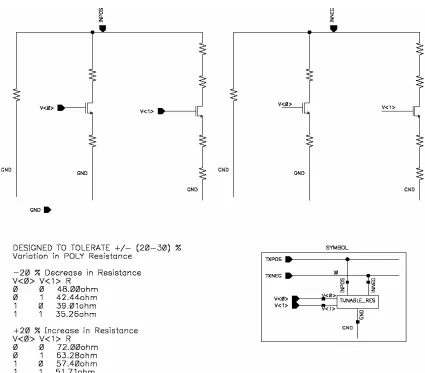
Front end termination is a very important design consideration in this system. The final BER and jitter constraints are greatly affected by improper termination. Since resistors are going to be used in the termination it is very essential to develop a programmable termination system which can be externally adjusted depending on the process variations and temperature. Figure 4.2 shows the schematic of a resistor that can be digitally tuned depending on the process variation [17].
The resistor value is calculated using this simple formula depending on the value of the digital control bits V<0> and V<1>. Table 4.1 computes the resistor value for the different Boolean combinations.
Table 4.1: Resistor value Calculation for various bits V<0> V<1> Net Resistor Value
0 0
0
1 1
R Rterm =
1 0
0 , 2 1 0 1 1 1 ds term R R R r
R = + + +
0 1
1 , 6 5 4 3 0 1 1 1 ds term R R R R R r
R = + + + + +
1 1
1 , 6 5 4 3 0 , 2 1 0 1 1 1 1 ds ds
term R R R r R R R R r
R = + + + + + + + +
Notes
0 – Logic low 1 – Logic high
r
ds,0 ,r
ds,1 – MOSFET (MO,M1) Resistance in linear region of operationThe control bits are realized using two switches present on the PCB. The switch in turn is connected to a 2.5 V supply line. When switch1 is ON control bit V<0> is high and when OFF control bit V<0> is low. Similarly when switch2 is ON control bit V<1> is high and vice versa.
It is also important to understand how the resistor values
r
ds,0 ,r
ds,1 are computed.MOSFETS’S in linear region of operation behave as resistors. This is the underlying principle. The reason being in the linear region of operation the drain to source voltage is directly proportional to the drain to source current. Equations 4.1-4.3 clearly depict the functionality of the MOSFET like a resistor. Equation 4.1 gives the MOSFET drain to source current in the linear region.
(
)
−
−
=
22
1
ds ds th gs ox nD
V
V
V
V
L
W
C
In the equation 4.1 the drain current and the drain to source voltage have a second order relationship. If in equation 4.1 Vds ≤ 2 (Vgs-Vth), equation 4.1 transforms to
(
)
[
gs th ds]
ox n
D
V
V
V
L
W
C
I
≈
µ
−
(4.2)This indicates that the drain current is a linear function of Vds. Thus an important point to be observed here is that a MOSFET will behave like a linear resistor only for small values of Vds. The resistance offered by the MOSFET is computed using equation 4.3.
(
)
[
gs th]
ox n on
V
V
L
W
C
R
−
=
µ
1
(4.3)A MOSFET can therefore act as a resistor whose value is controlled by the overdrive voltage (Vgs-Vth) when the condition Vds ≤ 2 (Vgs-Vth) is met. The design described in the above Figure 4.3 is used realize a 50 OHM termination.
4.3 Front-end Receiver
The most important entity in this system is the front-end receiver. The proposed receiver has two stages. Though a single stage receiver is sufficient a two stage receiver is selected in order to drive the subsequent stages. The receiver stages belong to the SCL family. Simple source coupled inverters are designed as receivers and their main functionality is to amplify the incoming signal and feed the signal to the subsequent stage. Source coupled logic is purely differential in nature. This helps to reject common mode noise in the signal path as well from the power supply. The SCL designs have a resistive load as pull up instead of a PMOS load in order to achieve higher gain. Figure 4.4 shows the schematic of the two stage receiver based on source coupled logic.
Bandwidth, power and signal swing are the most important parameters in the design of the source coupled logic circuitry. The pull up resistors R1, R2 (R1=R2) are designed based on the bandwidth requirements and the load capacitance. The load capacitance is the source to drain capacitance associated with the subsequent MOSFET which is being driven. As a general rule of thumb the drain to source capacitance of a MOSFET is equivalent to twice its width. Once the pull up resistors are designed depending on the input signal swing and the gain required the tail current is calculated. NMOS M5/M6 is than designed to achieve this tail current. M1 – M4 should be designed in a way so as to turn OFF during the lower bound of the input signal. As M1, M2, M3 and M4 are source coupled, the source voltage (Vp1, Vp2) becomes an important design criteria. Vp1/Vp2 should always be set to a value that is greater than the difference between the lower bound of the input signal and Vth. This is done so that the lower bound of the input signal turns OFF the NMOS. Thus MI – M4 are designed to achieve a proper bias level at this computed Vp1/Vp2 value.
The output signal for this design swings from VDD to VDD- R Itail. In order to
increase the signal swing Itail has to be correspondingly increased. This in turn results in
greater power consumption. Based on the bandwidth and signal swing requirement, power dissipation is determined.
4.4 Limited Swing Differential to Full Swing Single-end conversion
The ACCI circuitry in the subsequent stage is single ended in nature. Apart from being single-ended it requires full swing CMOS inputs having rail to rail swing. In order to convert the received differential Rocket IO signals with limited swing to full swing single ended signals this block was designed. Figure 4.5 shows the schematic of the above mentioned design.
or a one. In order to understand this we have to analyze the inverter transfer characteristics in a detailed manner.
Figure 4.5: Differential to Single-end converter
The transfer and gain characteristics of the subsequent stage are shown in Figure 4.6. It is to be noted that the inverter has a PMOS to NMOS ratio of 9:1. This helps to shift the trip point of the inverter to 1.52 V. It is observed that my increasing the PMOS to NMOS ration we can move the trip point. There by increasing the gain. This also helps to shift the VIH and VIL values. The shifting of the VIL value is of particular interest because the
lower bound of the input signal is closer to that value. An inverter reads any value less than VIL as a one/high. So it is important that the lower bound of the input signal falls
within this range. Thus this design gives us a full swing single-ended CMOS output that can serve as an input to the subsequent ACCI transmitter [14].
4.5 AC Coupled Interconnect Design
The basics of AC Coupling have been explained in section 2.1 of Chapter 2. In this section the circuits involved in AC Coupled Interconnect design are described in great detail. These include the transmitter and the receiver.
4.5.1 Pulse Signaling
As mentioned in section 2.1 of chapter 2 the band pass response of the ACCI channel produces return to zero pulses. This minimizes the overall power consumption. In Figure 2.4 of chapter 2 Cc and Cp are the coupling and parasitic capacitors respectively. The combination of coupling capacitor and the termination resistor behaves like a differentiator to convert the full swing Non return to zero (NRZ) data to Return to zero (RZ) pulses [4] [5]. The coupling capacitors will make the DC levels to zero. Thus the pulse receiver should be able to bias the pulsed signal and reconvert it back to NRZ data.
4.5.2 ACCI Transmitter
voltage mode driver are as follows: 1) Faster Edge rates, 2) Lower Dynamic power dissipation, 3) Inverter design is fairly uncomplicated, 4) Chip area consumed is lower. Figure 4.7 shows the schematic of the ACCI transmitter [4].
The ACCI transmitter is a series of progressively sized inverters. The rule of thumb used in progressive sizing is that every stage can drive a subsequent stage whose transistor sizing is twice the previous. This rule of thumb has not been followed for the last two pairs of inverters. A 1:1 ratio has been used in order to have a really good edge rate. As observed in Figure 2.9 of chapter 2 it is very clear that faster edge rates will result in a better signal swing at the input of the ACCI receiver. Thus the goal of transmitter design should be to provide signals that have a very high edge rate.
Figure 4.7: ACCI Transmitter
4.5.3 Pulse Receiver
The main functionality of the pulse receiver is to convert the RZ pulses back to NRZ pulses. In the ACCI design the series coupling capacitor removes the DC component from the signal. Thus the pulse receiver should have the ability to bias the incoming signal apart from amplifying it and converting it to NRZ pulses. Figure 4.8 shows the schematic of the pulse receiver [4] [5].
M8 tied to VDD that provides a constant feedback that stabilizes the bias voltage. This feedback is not very strong [4] [18]
A cross coupled inverter is used to perform the latching operation. It is very useful to understand the working of a cross coupled inverter. A cross coupled inverter is a bistable circuit with two stable stages, each corresponding to one logic level. Figure 4.9 shows the VTC of a cross coupled inverter. The circuit has three possible operation points (A, B, C). C is an unstable operating point. If an inverter is biased at C there is a chance that even a small deviation will result in the operating point being moved from its original bias. Hence it is very rare to see a cross coupled inverter biased at C.
Figure 4.8: Pulse Receiver Design [18]
Operating points with this property are termed metastable. Therefore the two stable operating points are A and B. The loop gain is less than unity at these points. Even a large deviation will not cause the operating point to move from its original bias [14].
both the inverters are ON for a limited period of time. This forces the loop gain to be more than one. The positive feed back translates this and the circuit moves over to state B. Thus to summarize a cross coupled latch has 2 stable states. In the absence of a trigger the latch will continue to remain in the pre existing state [14].
The latch is designed such that it is robust over all the process corners. The prime objective is that the latch should be robust, bandwidth comes next. The reason being the latch can always be made to work at lower data rates.
Figure 4.9: Cross coupled inverter VTC
4.5.4 Summary
The single ended transmitter and receiver circuits are designed using the TSMC 0.25 Micron process. This section on ACCI is based on the work done by Dr Lei Luo, Dr Stephen Mick and Jian Xu under the guidance of Dr Paul Franzon as a part of their respective PhD dissertation.
4.6 Single ended to Differential Conversion
Figure 4.10: Single end to Differential Conversion
Figure 4.11: Transient response depicting equal delays
Path2 as shown in Figure 4. Equal delay was obtained by sizing the inverters and transmission gates optimally in both the paths. The sizing was done based on the transient simulations as shown in Figure 4.11. Plots in Figure 4.11 are the outputs at points A and B as shown in Figure 4.10. This design has a series of buffers. These buffers help to drive the Current Mode transmitter which is the last stage of this design. The buffers in path 1 and 2 are sized equally in order to keep the delays equal.
4.7 Back-end Transmitter
The functionality of this design is to transmit the data back to FPGA over a 10cm differential Stripline. The transmitter belongs to the current mode family. This transmitter is designed in order to meet the Rocket IO receiver specifications. The most important being the signal swing at the Rocket IO receiver end which should not exceed 2 V differential peak to peak. Figure 4.12 gives a clear idea about the transmitter design. A 50 ohm termination is used at the Rocket IO receiver side. This indicates that the transmitter should be designed in a way such that current source provides 50mA of current (2.5V/50 ohm).This is the amount of current required to have the required swing at the receiver input. In order to obtain this current very large transistors are employed. The other main advantage of this design is its ability to set the common mode level depending on the manner in which the termination is biased. Special care is not required to set the optimum common mode level for the output signal. Common mode voltage of the output signal is an important design criterion. This was one of the main reasons why this design was selected. The other reason being its compatibility with the current mode Rocket IO receiver
Figure 4.12: Back end Transmitter
4.8 Auto adaptive bias design
The SCL design used to build the front end receiver has resistive load. It is known that resistors vary heavily with process variations. If the load resistor varies it will have an instant impact on the output signal swing. The auto bias circuitry will adapt to the changes in the resistor values as per the process variations. It has been observed that the resistors vary by as much as +/- 20%. The bias circuitry is shown in Figure 4.13.
Chapter 5
Simulation Results
5.1 Simulation test setup
The circuit design was done using the TSMC 0.25 Micron process parameters.
The XILINX Signal Integrity Simulation kit provides the HSPICE models for Rocket IO transceivers. These include the models for transmitter out buffer, receiver input buffer, package, interconnects and the input data pattern. The transmitter, receiver and the package models are encrypted.
The XILINX SIS kit includes two specific files (prbs.inc, datagen.inc) that generate the PRBS sequence and pre-emphasis sequence. The circuit provided generates a 27 – 1 pseudo random sequence. The pattern has a run length of 7. (Run length is the maximum number of consecutive 1s or 0s in a pattern). The pattern repeats itself very 127 bits. It is almost DC balanced with 63 0s and 64 1s in a 127 bit pattern [20].
The circuit in the file datagen.inc produces the pre-emphasis pattern and the data pattern for the transmitter buffer. The data inputs are reversed and delayed by one bit period to produce the pre-emphasis pattern. The data input signal has to have a high level of 2.1V and low level of 1.42V; whereas, the pre-emphasis input signal has to have a high level of 2.13V and low level of 1.66V. These signaling conventions should be adhered in order to make the Rocket IO transceiver function properly [20].
5.1.1 Rocket IO Settings
Transmitter output swing 800mV (Maximum 1600mV) Pre-emphasis 20 %
Transmitter side termination 50 ohms Data Rate 2Gb/s Receiver side termination 50 ohms
For further details regarding the settings please refer to tables 3.1, 3.2, and 3.3 of chapter 3. It will give a better picture regarding the different parameters.
Figure 5.1: Top level simulation setup
Notes:
VBIAS_BCK_TX : Bias to the back end TX
BIAS_ENB : Lets the user choose between the internal and external bias CHIP_ENB : To switch ON and OFF the Bias Circuitry.
EXT_BIAS_RES (1/2) : To the external bias resistor that is off chip.
5.3 Simulation Results
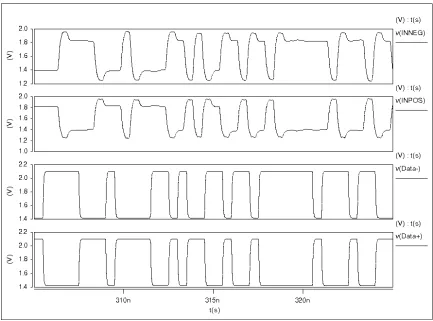
The differential input to the Rocket IO TX and the front end receiver is shown in Figure 5.1. As mentioned in section 5.1 the input to the Rocket IO TX (Data+/Data-)
Figure 5.1 (a): Differential Input to Rocket IO TX and Front end RX
Figure 5.2: Differential Input Eye Pattern
5.3.1 Simulation Results – Front End Receiver
In the previous section the inputs to the Front-end receiver was plotted. As mentioned in Chapter 4 section 4.3 the output from the receiver swings from 1.8-2.5 V. There is a 700mV single ended peak to peak swing. It is also important to start keeping an eye on the jitter budget. The reason being the jitter at the input of the Rocket IO RX is an important design criterion. The input pattern to the receiver may not represent the actual jitter. The reason being the SIS kit does not include the models for the core of the transmitter and the receiver. Only the current mode TX and RX are modeled. Though some extra jitter has been added to the signal, there might be some discrepancies in the jitter representation.
Figure 5.3: Transient response of the receiver output.
5.3.2 Simulation Results – Differential to Single End Converter
Figure 5.4: Differential Eye Diagram of the receiver output
5.3.3 Simulation Results – ACCI TX/CHANNEL/RX
The ACCI transient response is shown in Figure 5.6. The Eye Diagrams associated with the respective signals are shown in Figure 5.7. The coupling capacitor size used for the simulation is 450fF. A 10cm Microstripline is used as the channel. 50ohm termination is used at both the transmitter and the receiver side. The bond wire inductance used in this case is 2nH. The bond pad capacitance values used in simulations are 200fF. The parasitic capacitance associated with the coupling capacitors is equal to 100fF. Figure 2.4 depicts the ACCI channel. The signal swing at the receiver is around 110mV and the common mode level set by the auto bias circuitry is equal to 1.2 V.
Figure 5.6: Transient waveform of ACCI channel
5.3.4 Simulation Results – Single-end to Differential Converter
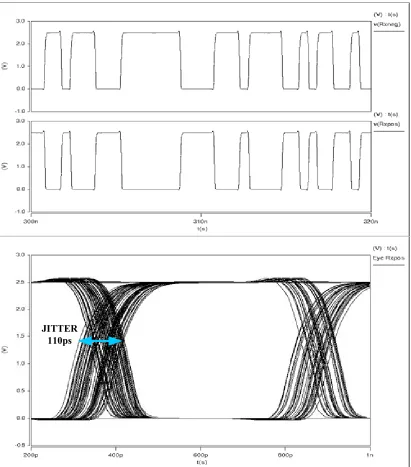
JITTER 110ps
Figure 5.8: Transient response/Eye diagram at the output of single ended-differential converter
5.3.5 Simulation Results – Rocket IO Receiver
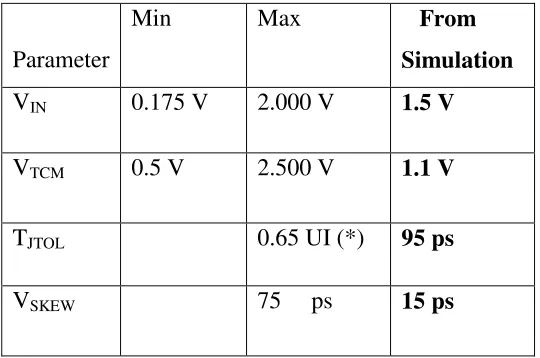
receiver. The results are tabulated in table 5.1 and compared with the Rocket IO specifications provided by Xilinx.
Table 5.1: Comparing simulated and actual Rocket IO parameters
Parameter
Min Max From Simulation
VIN 0.175 V 2.000 V 1.5 V
VTCM 0.5 V 2.500 V 1.1 V
TJTOL 0.65 UI (*) 95 ps
VSKEW 75 ps 15 ps
Notes:
UI=Unit Interval (500ps)
VIN - Serial input differential Peak to Peak (RXP-RXN)
VTCM - Common mode voltage level
TJTOL - Total Jitter tolerance for the received data
VSKEW - Total skew associated with the received differential data.
Chapter 6
ESD Protection for High Speed Circuits
6.1 Introduction to ESD
“An electrical surge of a voltage or current that exceeds a device’s rating can trigger a catastrophic device failure. Such a sudden transfer of charges via induction or direct contact is defined as electrostatic discharge (ESD)” [26]. ESD can also result in latent damages that shorten the life of the exposed device instead of immediate failure. To have a clear understanding of how ESD occurs and what preventive measures to use, it is important to understand the basic ESD models. There are a number of models that simulate the ESD conditions that cause direct damage. These include the human body model (HBM), the machine model (MM), and the charged-device model (CDM). The HBM is used to simulate a condition where a direct transfer of electrostatic charges takes place from the human body. In this case the human body acts like a charge-storage capacitance. The MM approximates the ESD from a charged conductive object, such as a metallic tool or fixture. The CDM applies to the discharge event between a charged electronic device and another conductor.
ACCI is a technology that provides a solution for high-density signal I/O and power/ground pin distribution. It is observed that most of the digital data is carried by AC components. It is easier to build a dense array of non-contacting AC connections when compared to DC connections. This is one of the main advantages in using capacitive coupling for chip to chip connection.
This chapter is divided into 4 subsections. Subsection 6.2 gives a comprehensive overview of the different ESD test models. A conscious attempt has been made to highlight the CDM event. The primary reason for this is with the progress of automation in manufacturing lines, the HBM and MM failures have decreased to a large extant and major failures would be explained by the CDM ESD event. Subsection 6.3 gives an overview of the fundamental ESD device phenomena like snap-back and breakdown. This section also includes a circuit level implementation for modeling MOS snapback using the HSPICE simulator. Subsection 6.4 starts with a description of the various devices used in the protection circuitry and subsequently moves on to the various architectures describing ESD protection. Subsection 6.5 describes the effect of ESD on ACCI.
6.2 ESD TEST MODELS 6.2.1 Human Body Model
The most well understood ESD mechanism is associated with the human body caused electrostatic discharge. The HBM ESD event describes a discharge procedure where in a charged human body contacts a device directly and electrostatic charges transfer from the human body into the device. HBM can be described on the basis of a circuit illustrated below in Figure 6.1. This is a military test model and uses a simplified equivalent circuit where the human charged body is modeled by a charged human body capacitor Cesd=100pF and typical human body discharging resistance is specified as
Resd =1500Ω. A HBM event is than simulated as ESD from a pre-charged capacitor C
into a DUT via the resistance R. To ensure reliable HBM ESD test data, the MIL-STD-883E defines a standard short circuit HBM ESD output waveform. In a real world scenario parasitic effects have a good amount of impact on the transient waveform. All these parasitics can either be represented as second order or fourth order circuits [31].
Table 6.1: Short-circuit HBM ESD waveform specifications
Parameters T(Rise) T(Decay) ( td) I(Peak)
Figure 6.1: HBM ESD Model and associated waveform
6.2.2Machine Model
In addition to the human body caused ESD discharge any charged body can discharge into a DUT without touching it. The most common ESD event of this kind occurs when metallic machinery contacts the IC components. Typical actions include in-line inspection and ATE tests. The main difference between the HBM and the MM is that the parasitic resistance is very low for metallic machinery. This results in a very high peak current. A basic model is described below. Inductor results in the oscillatory current waveform.
Figure 6.2: MM ESD Model and associated waveform
Table 6.2: Short-circuit MM ESD waveform specifications
6.2.3 Charged Device Model
The CDM applies to the discharge event between a charged electronic device and another conductor. Triboelectrification, involving the device package or pins, is the principal cause for the original charge on the device. A CDM-ESD event is a charge driven phenomena. An IC gets charged by triboelectrification, after contact and separation with another body. If this charged device comes in contact with a metallic surface, the charge initially distributed over all the conductive parts of the device is collected at this point and leaves it via the stress pin within a few nanoseconds [26]. There is a potential drop across the device when a charge passes though it. This voltage establishes an electric field in the surrounding objects based on the dielectric material present in the structure. The electric field established results in excessive current which in turn results in joule heating. Joule heating will melt that specific region. There are two failure modes associated with high dielectric fields: Dielectric rupture and charge injection. If the electric field created by the induced voltage is greater than the dielectric strength of the material it will result in dielectric rupture. Charge injection occurs when the surface electrons gain sufficient energy to surmount the oxide–silicon energy barrier. Thus semiconductor devices are damaged by high current densities and high electric fields. CDM discharge is very rapid and produces a large ESD current because of low discharge resistance and inductance. The CDM test setup along with the associated waveforms is shown in Figure 6.3 [26] [21].
The Cesd value is very small in this case because CDM is a self discharging
phenomenon. The Cesd of a device under test will be equal to 7pF approximately. The
parasitic inductance in the discharge path is very unpredictable. That is the precise reason it is difficult to model a CDM wave form. By definition a CDM waveform should have very sharp rise times <0.4nS .The reason being the values of resistances and the
Parameters T(Rise) T(Decay) I(Peak)
inductances in the discharge path are very low. It is this rapid discharge that totally destroys the thin Dielectric film.
Table 6.3: Short-circuit MM ESD waveform specifications
Figure 6.3: CDM ESD Model and associated waveform
6.3 MOS Device Physics in High Current High Voltage Region
A description of the behavior of the MOS device in the high current regime is presented in this section.
(a) (b)
Figure 6.4: (a) Generic I-V curve for an NMOS (b) Cross-section of an [24]
Parameters T(Rise) T(Decay) I(Peak)
ESD operation takes place in regions 3 and 4.The mechanism of operation in these regions involve both avalanche breakdown and turn on of the parasitic lateral NPN transistor. During high current operation the avalanche generation of carriers in the high field region near the drain results in hole current into the substrate. This hole current will result in a voltage drop across the substrate resistance and will eventually result in the source sub-strate becoming forward biased. The electrons injected from the source into the sub-strate are collected at the drain forming a lateral NPN bipolar transistor with the drain as the collector, the source as emitter and the sub-strate as the base. [21] [22] [24] As the gate voltage goes beyond the MOS threshold it will result in current flowing between the source and the drain. Therefore this will reduce the amount of sub-strate current required to turn on the bipolar. As the bipolar turns on, the bipolar current provides an additional current source for avalanche multiplication thus the magnitude of drain voltage can reduce and “snapback” is observed when the drain voltage drops to a minimum sustaining level for the bipolar to be in on condition. Hence the snapback voltage is a function of the sub-strate resistance and the gain of the intrinsic bipolar transistor. [21] [22] [24]
The MOSFET operation is broadly divided into 4 regions. Regions 1 and 2 are governed by the standard MOS equations and modeled in SPICE. Region 3 is the avalanche breakdown region and the standard MOS equations are no longer valid in this region. Similarly Region 4 is the bipolar or the snapback region where the standard models equations do not extend and these regions cannot be modeled in SPICE.
The MOS breakdown region can be modeled in SPICE with a parasitic bipolar transistor in parallel with the MOS device, together with a current controlled source that models the avalanche multiplicative effect. [25]
Figure 6.5: Equivalent circuit for the MOSFET including the current source, substrate resistance and parasitic bipolar transistor [25]
The design and optimization of ESD protection circuits is greatly enhanced by the ability to perform circuit level simulations of the protection circuits and the I/0 buffers. Most available simulators do not cover the high current region of the circuit operation, but still enable an approximate analysis to be made of the behavior under ESD conditions. The growing use of MOS-based protection circuits (rather than the SCR-type structures), and the integration of the protection circuits with the internal circuitry, lead to a need for simulators which are able to more accurately reproduce the behavior of the circuit under ESD conditions.
6.4 ESD PROTECTION
The current levels in Electrostatic Discharge (ESD) events are generally in excess of 1 A for durations between a few nanoseconds and 100 ns, and can cause severe damage in integrated circuits (ICs). The most sensitive areas of an IC are the devices which are directly connected to bond pads. In order to protect the input/output (I/O) buffers from the ESD stress, protection circuits which act as voltage clamps and current shunts are placed in parallel with I/O circuits. The purpose of the ESD protection circuit is to turn on during the ESD event and clamp the voltage before the I/O buffer is damaged [21].
6.4.1 MOS BASED ESD PROTECTION
(B) are shortened together to ground. Figure 6.6 illustrates its cross-section. The principle of ggNMOS operation is as follows. When a positive ESD pulse appears at an I/O pad, i.e., drain with respect to the ggNMOS. The drain body junction is reverse biased till breakdown is reached. This results in avalanche multiplication and electron-hole pairs are generated. Hole current flows into the body of the MOSFET and a potential is built across the lateral parasitic resistor. As the source and body terminals are shortened together, this positive potential actually appears across the body source PN junction diode. As this positive potential increases the body source PN diode turns on and this eventually triggers the lateral NPN transistor and the bipolar transistor moves into snapback region to form a low impedance discharge channel thus discharging the ESD transient safely. Thus the two important reasons for using the ggNMOS are its low ON resistance and satisfactory holding voltage (due to the parasitic bipolar transistor within their structure). One important question to be answered is how quickly the ggNMOS will turn on in the event of a CDM ESD discharge. The turn on time of the device is an extremely important parameter in designing an ESD protection circuit. The reason being a slow device will not be able to provide adequate ESD protection.To ensure triggering under CDM conditions the gate length should be as short as possible in order to decrease the base transit time. [22] [27]
Figure 6.6: Basic ESD protection structure ofthe gg-NMOS showing the parasitic bipolar transistor [7]

![Figure 4.7 shows the schematic of the ACCI transmitter [4].](https://thumb-us.123doks.com/thumbv2/123dok_us/1524879.1186918/49.612.95.519.299.439/figure-shows-schematic-acci-transmitter.webp)