A Review on Digital Image Enhancement
Using Histogram Techniques
Deepika Bansal
1,
Neha Bharti
2, Vinod Sharma
3, Renu Bagoria
4P.G. Student, Department of Computer Engineering, Jagannath University, Sitapura, Jaipur, India1
P.G. Student, Department of Computer Engineering, Rajasthan College & Engineering for Women, Jaipur, India2
Research Scholar, Department of Computer Science, Career Point University, Kota, Rajasthan, India3
Assistant Professor, Department of Computer Engineering, Jagannath University, Sitapura, Jaipur, India4
ABSTRACT: Image enhancement has significance in image processing. This technique is used as a preprocessing step in speech recognition, texture synthesis, Computer graphics, intelligent transportation systems, Digital camera images etc. To enhance the image we use histogram process that is simple and easy to apply and use. However, histogram equalization (HE) usually results in excessive contrast enhancement, which sometimes gives the processed image an unnatural look and creates visual artifacts but this is one of the best technique to enhance the image. Large number of research work is proposed for pixel and window based image fusion in histogram equalization. This paper introduces comparative study of different histograms.
KEY WORDS: Image enhancement, Image restoration,Histogram equalization, Contrast enhancement
I. INTRODUCTION
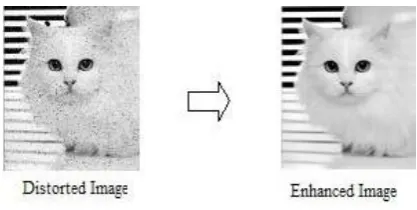
contrast enhancement technique is used as a preprocessing step in speech recognition, Comparison of image processing software, texture synthesis, Intelligent transportation systems, Computer graphics ,Computer vision, Digital camera images, Digitizing, Multidimensional systems, In Medical, In Military, In Industrial production and many other applications.[1]
Fig 1: example of enhancement
In five senses – hearing, sight, smell, taste and touch– which humans use to comprehend their environment, sight is the most powerful. Receiving and analyzing images forms a large part of the everyday cerebral activity of human beings throughout their waking lives. In fact, more than 99% of the activity of the human brain is involved in processing images from the visual pallium. So the image enhancement is required. The image enhancement technique plays an important role in bettering image quality & is good for image post-processing e.g. image tracking and image segmentation. [2] In addition, HE will also make the medium brightness toward the middle gray level of an image disregarding of the input image, and introduce objectionable artifacts and affected contrast effects. This makes the
A large number of research works is done for image enhancement using histogram stipulation technique. Most of the work uses a single image as the target image. In this paper, we have proposed an enhancement technique based on Histogram Specification, where multiple target images are fused to obtain a single target image. Large number of research work is nominated. For pixel and window based image fusion. [3] This last statement would suggest that histogram equalization (HE) must be one of the most effective techniques.
II. IMAGE ENHANCEMENT
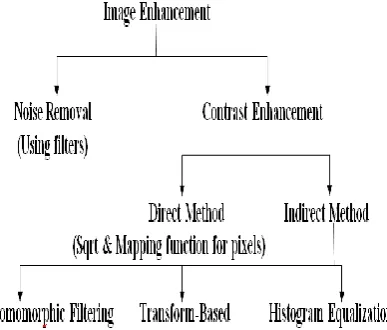
We can categorize image enhancement mainly in this two categories.
Fig 2: image enhancement process
Enhancement of an image can be implemented by using different operations of sharpening, brightness increment, noise removal or blurring. Unfortunately, there is no general theory for determining what „good‟ image enhancement, when it comes to human sensing. [5]
1. Noise Removal
It is an operation to remove undesirable details from an image. This detail gets attached to an image while clicking image or acquisition process. Noise may be capturing device inability, due to environment particles, lack of experience of machine/computer operator or some other reason. [5]
2. Contrast enhancement
Contrast is related to the color and brightness terms. It is basically improving the interpretability, sensing of information in images for human viewers and providing `better' input for other automated image processing techniques.
[6]
A. Direct Method
In direct method of contrast enhancement, firstly contrast measure is defined, which is modified by a mapping function like square root function or exponential function etc., to generate the pixel value of the enhanced image. Various mapping functions have been introduced for the contrast measure modification. However, these functions do not produce satisfactory contrast enhancement results and are usually digitization effects and sensitive to noise. [5]
B. Indirect Method
Indirect methods on the other hand, meliorate the contrast through exploiting the underuse regions of the dynamic range without defining a specific contrast term. Indirect methods can also be divided into several subparts. [5]
Transform-based method
Homomorphic filtering method
Histogram equalization
III. HISTOGRAM EQUALIZATION
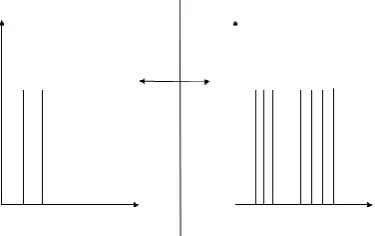
The objective of this method is to make an image apparently accepted for a specific application. One of the most appropriate contrast enhancement methods is histogram equalization (HE). HE mechanism is to transform the gray levels of an image to a uniform histogram based on the probability of occurring gray levels in an input image. In general, by HE method it will flatten out the probability distribution of an image and increase its dynamical range. However, the strength of HE depends on the contrast of the original image. The lower the contrast, the more the strength is. Since its simplicity make it easy to implement. It is usually applied in many areas including texture synthesis, medical image processing and speech recognition. [4]
Fig 3: Histogram equalization
In total techniques to improve contrast one of the most popular global techniques is histogram equalization (HE).The histogram in term of image processing is the operation by which the occurrence of each intensity value in the image is shown. Normally, the histogram is a graph, that showing the number of pixels in an image at each different intensity value found in that image. For an 8-bit gray scale image there are 256 different possible intensities, so the histogram will graphically display 256 numbers showing the distribution of pixels amongst those gray scale values. Histogram equalization is the technique, by which the dynamic range of the histogram of an image is increased. HE puts the intensity values of pixels in the input image so that after applying functions on it the output image contains a uniform distribution of intensities. It improves contrast, and the goal of HE is to obtain a uniform histogram. This technique can be used on whole image or just on a part of an image. This method usually increases the global contrast of many images. Especially, when the usable data of the image is represented by close contrast values. Through these adjustments, the intensities can be better distributed on the histogram. [5]
A.
Advantage:
An advantage of this method is that it is a fairly straightforward technique and an invertible operator. So in theory, if the histogram equalization function is known then the original histogram can be recovered. [5]
B.
Disadvantage:A disadvantage of the method is that it is general method. It will increase the contrast of background noise, while decreasing the usable signal. [5]
C.
Mathematical FunctionConsider a discrete gray scale image {x}and letni be the number of occurrences of gray level i. The Probability of an
L being the total number of gray levels in the image,n being the total number of pixels in the image, and being in fact the image's histogram for pixel value i, normalized to [0,1].
Let us also define the Cumulative Distribution Function corresponding to px as:
This is also the image's Accumulated Normalized Histogram.
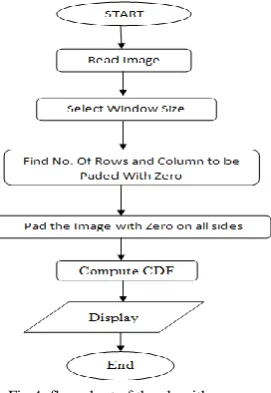
1. Algorithm:
Step1: Read the image and store it in a matrix. Step2: Select the window size.
Step3: Find the number of rows and columns to be padded with zero. Step4: Pad the image with zero on all sides.
Step5: Compute CDF for Every pixel in padded matrix. Step6: Display Image Before and after Enhancement.
2. Flow Chart:
Fig 4: flow chart of the algorithm Other part or we can say in other way image enhancement can be categorized as:
Spatial Domain method is mainly used to do direct operation on the pixel gray values in the space domain, such as the gray scale histogram modification, transformation, image sharpening, spatial domain smoothing and pseudo-color processing. [7]
The frequency domain method means calculating the image transformation value in a certain image transform domain, such as the Fourier transform first then the image frequency domain filtering and after that finally performing inverse transformation of the filtered image transformation value to the spatial domain. To obtain the enhanced image. [6] This method is applied to these methods are histogram modification, amplitude scaling, edge enhancement and noise removal.
IV. METHODS
Here we have comparative study on different histograms:
1. Methodology Caparison
Firstly we have most famous method for contrast improvement is HISTOGRAM EQUALIZATION (HE). In this histogram provides information for the overall intensity distribution and contrast of an image. Other then this in
Brightness preservingBI-HISTOGRAM (BBHE) it operates on tiles (small data regions), rather than the entire image.
[4] In RECURSIVE MEAN SEPARATED HISTOGRAM TECHNIQUE (RMSHE) two sub-histograms are formed
based on the mean brightness of the original histogram. DYNAMIC HISTOGRAM (DHE) in this partition the original
histogram based on local minima without using the median and mean value. [2] Last one is BRIGHTNESS
PRESERVING DYNAMIC HISTOGRAM (BPDHE) in this a smoothing filter is applied to histogram before the
partitioning process is work out. [8] ADAPTIVE HISTOGRAM EQUALIZATION METHOD (AHEM) enhances the
contrast of images by transforming the values in the intensity image. Unlike BBHE, it operates on tiles (small data regions), rather than the entire image. [2]
On the basic of entropy we can have comparative study on different histograms:
Entropy: In general, the entropy is a useful tool to measure the richness of the details in the output image.
Entropy (P) = -P(k) log2 P(k)
Fig 6: table for the entropy comparison
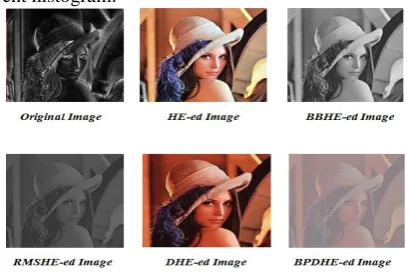
We can see the difference of different histogram:
Fig 7: different type of histogram equalization comparison by images
Methods Entropy
HE 5.05
BBHE 5.01
DHE 5.00
RMSHE 4.86
V. CONCLUSION
The study on image enhancement is done. We study that image enhancement can be done by improving contrast or by removing noise. For improving contrast we can use different type of histogram equalization technique. By the comparison or study we get to know the result by histogram equalization is much better than other techniques that are present for contrast improvement.so here, histogram equalization is successfully applied and comparison between different techniques has been done on the basics of entropy. In future, we can create a GUI for improving quality of image by applying both contrast improvement and noise removal.
REFERENCES
[1] Amit Kamra, Kanchan Rani, “An Improved Method for Image Enhancement Using Fuzzy Approach”, International Journal of Computer Science and Information Technology & Security (IJCSITS), ISSN: 2249-9555 Vol. 2, No.6, December 2012
[2] Rajesh Garg, Bhawna Mittal and Sheetal Garg, “Histogram Equalization Techniques For Image Enhancement”, International Journal of Electronics & Communication Technology, (IJECT )Vol. 2, Issue 1, March 2011
[3] Pavithra P , Ramyashree N, Shruthi T.V, “Image Enhancement by Histogram Specification Using Multiple Target Images”, International Journal of Electronics & Communication Technology, (IJECT ) Vol.1 Issue 2, 3, 4; 2010
[4] Yen-Ching Chang and Chun-Ming Chang, “A Simple Histogram Modification Scheme for Contrast Enhancement”, IEEE Transactions on Consumer Electronics, Vol. 56, No. 2, May 2010
[5] Manvi, Rajdeep Singh Chauhan, Manpreet Singh, “Image Contrast Enhancement Using Histogram Equalization”, International Journal of Computing & Business Research ISSN (Online): 2229-6166
[6] Raman Maini and Himanshu Aggarwal, “A Comprehensive Review of Image Enhancement Techniques”, Journal Of Computing, Volume 2, Issue 3, March 2010, Issn 2151-9617
[7] Yuanfeng Jin, Tinghuai Ma, Donghai Guan, Weiwei Yuan and Chengmin Hou, “ Review of applications of partial differential equations for image enhancement”, Scientific Research and Essays Vol. 7(44), pp. 3766 -3783, 12 November, 2012