Pandian Saraswathi Yadav Engineering College, Arasanoor, Sivagangai, Tamilnadu, India
Reducing Cloud Bandwidth and Eliminate
Redundant Network Traffic in Cloud
Computing
Maheswari.G
1, Revathi.E
2PG Scholar, Department of CSE, PSR Rengasamy College of Engineering for Women, Tamilnadu, India1
Assistant Professor, Department of CSE, PSR Rengasamy College of Engineering for Women, Tamilnadu, India2
ABSTRACT: Cloud computing is technology where the users can use high end services in form of software that exist in on different servers and access data from all over the world. The data can be transmitted between the cloud and its end user with low speed and high bandwidth so traffic can be occurred. Here, bandwidth reduction is an important issue. Existing system does not reduce cloud bandwidth and cost at sensible time. Proposed work presents a predictive acknowledgement and traffic redundancy elimination system and Redundancy aware routing algorithm. Traffic redundancy elimination technique used to eliminate the redundant content and therefore significantly to reduce the network cost and able to send the data in high speed and low bandwidth. On sender side traffic redundancy elimination technique proposed. On receiver side Predictive Acknowledgement algorithm is used by redundancy elimination applications. Redundancy aware routing algorithm has been used to remove the redundant content in cloud storage space so that the usage of cloud storage bandwidth has been saved. Finally Analyze the Predicative Acknowledgement benefits for cloud users using traffic traces from various sources.
KEYWORDS: Traffic Redundancy Elimination System, Predictive Acknowledgement, and Redundancy Aware Routing Algorithm.
I. INTRODUCTION
Pandian Saraswathi Yadav Engineering College, Arasanoor, Sivagangai, Tamilnadu, India
group of people who has joint concern It may be managed by the institutions or a third party like mission, security necessities, rule, or acquiescence considerations. Hybrid Cloud: The cloud communications is a composition of two or more clouds (private, community, or public) that stay unique entities but are bounce mutually by identical or proprietary technology that enables data and application portability like cloud stuffed for load-balancing between clouds. The proposed system comes under the cloud deployment model as public cloud for cloud customers.
II. RELATED WORK
In the Cloud Computing literature, there are various algorithms and techniques were used to reducing cloud bandwidth. The following section deals with most representative work that is related to proposed work.
A Protocol Independent Technique for Eliminating Redundant Network Traffic [1] presents a technique for identify the
cyclical information shift and uses it to evaluate the redundancy of network traffic. The protocol independent techniques were applied to find the high level of redundancy and are able to identify the replication that web caches or not. Rabin finger printing algorithm was applied to find the replication content in the process of stream of packets or data while conversion it increase the web performance. The representative finger print packets are generating by compute finger print for each length substring of the packet.
Understanding and Exploiting Network Traffic Redundancy [2]The Internet carry a huge amount of information and a
wide range of content, Some of this information is more well-liked and accessed more regularly, than others. Make two contributions in this paper. First, study the basic properties of the redundancy in the information passed over the Internet, with a focus on network ends. Second, leverage measurement observations in the design of a family mechanism for eliminate redundancy in network transfer and improving the overall network performance. The mechanisms were proposed can improve the obtainable capacity of distinct network links as well as balance load across many network associations.
Packet Caches on Routers: The Implications of Universal Redundant Traffic Elimination [3]many past systems have
explored how to eliminate redundant transfer from network links and improve network efficiency. An Investigate the benefits of deploy packet-level redundant content removal as a worldwide primitive on all Internet routers. Such a worldwide deployment would instantly reduce link loads all over the place. Then Develop ―redundancy-aware‖ intra and inter domain routing algorithms and show that they permit better traffic engineering, reduce link convention costs, and enhance ISPs’ receptiveness to traffic variations. Consider the benefits of deploying of packet level redundant content elimination as a primitive IP-layer service crossway the entire Internet.
SmartRE: Architecture for Coordinated Network-wide Redundancy Elimination [4] Application-independent
Redundancy Elimination (RE), or identifying and removing repeated content from net transfers, has been used with great achievement for humanizing net presentation on project admittance links. Recently, there is rising interest for sustaining RE as a network-broad service. Such a network-broad RE service benefit Internet service providers by falling link loads and growing the successful network power to improve. Present SmartRE, a sensible and well-organized architecture for network-wide RE. Show that SmartRE can facilitate more successful consumption of the available assets at network campaign, and thus can increase the overall benefits of network-wide RE. Prototype algorithms were using Click and test the framework broadly using a number of valid and artificial traces.
EndRE: An End-System Redundancy Elimination Service for Enterprises [5]Present the design and implementation of
Pandian Saraswathi Yadav Engineering College, Arasanoor, Sivagangai, Tamilnadu, India
The Power of Prediction: Cloud Bandwidth and Cost Reduction [6] present PACK (Predictive ACKs), a original
end-to end transfer idleness Elimination system, designed for cloud computing cusend-tomers. Cloud-based needs end-to apply a judicious use of cloud resources so that the bandwidth cost reduction combined with the additional cost of TRE computation and storage would be optimized. PACK’s main advantage is its capability of offloading the cloud server TRE effort to end-clients, thus minimizing the processing costs induced by the TRE algorithm. Unlike previous solutions, PACK does not require the server to continuously maintain clients’ status. This makes PACK very suitable for pervasive computation environments that combine client mobility and server migration to maintain cloud elasticity. We present a fully functional PACK implementation, transparent to all TCP-based applications and network devices.
III. SYSTEM DESIGN
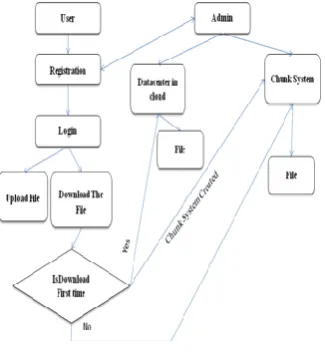
The system design represents the process of reducing the cloud bandwidth and cost. A new user enters into a cloud they need to register to get an account. Admin monitor the cloud database and chunk systems and user details. Admin monitor and verify the user details finally send the acknowledgement to user personal id. The user getting the acknowledgement from admin then enter its username and Password into a login form, and then entering into a cloud and start to do the processing of file as uploading and/or downloading.
Fig 1.System Design
While user enters into the cloud, admin send the authentication key to the user personal mail id. Chunk system created at admin database which stores the replica copy of the previously download file, therefore it reduces server workload. While download the file from cloud database for the first time it will be download from the server and then for next subsequent time the same file will be download from the chunk system. Chunk system reduces the server workload and increases the transaction speed.
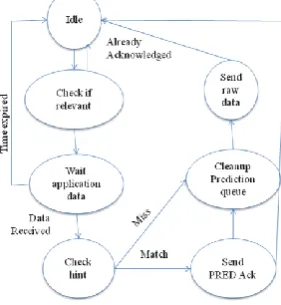
A. Traffic Redundancy Elimination System
Pandian Saraswathi Yadav Engineering College, Arasanoor, Sivagangai, Tamilnadu, India
Fig 2.Traffic Redundancy Elimination System
Traffic Redundancy Elimination pseudo code:
while packet received do if HTTP GET Request then Set binary-flow 0
Set content-length 0
else if HTTP OK Response then
if mime-type is in [video, audio, application] then Set binary-flow 1 for the flow
Set content-length as HTTP Content-Length field end if
Else
Find the flow for the packet
if content-length > 0 and binary-flow = 1 then Pass packet without chunking
else
if content-length = 0 and binary-flow = 1 then binary-flow 0
end if
Continue chunking and matching end if
end while
B. Predictive Acknowledgement
Pandian Saraswathi Yadav Engineering College, Arasanoor, Sivagangai, Tamilnadu, India
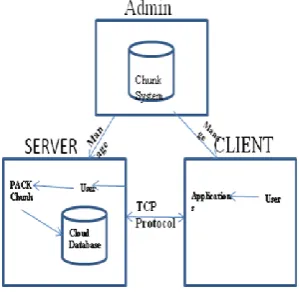
Fig 3.Pack Chunk
Predictive Acknowledgement pseudo code:
Input : R(copy of G)=R1 u R2 u……..Ri-1 Output : Ri, ith of sub topology
Begin
Init Ri is not empty
S{Nodes in R that do not have strong interferers in R} RR/S ; SMax Feasible subset (S); Ri R u S Update weak interference budget
Refine R based on Ri While R is not empty do
S{Nodes in R that do not have strong interferers in R} RR/S
SMax Feasible subset (S)
RiRi u feasible weak interferers (R,S) update and refine(R,S,Ri)
end return Ri end
C. Redundancy Aware Routing Algorithm
Redundancy aware routing algorithm (RARA) that reduces redundant data and delays and provides better performance characteristics for the cloud computing data centers. RARA is used in the cloud data centre to eliminate redundant data in cloud data storage so it increases the storage space.
Redundancy Aware Routing Pseudo code:
Px-Object, R-size of the file, X-Name of file, Hx-Destinationfile
if( Ni is the source node) then Px -->[R,X,];
send Px else
if((R,X are correct) and verify as true)then if(Ni is an intermediate node)then
relay the packet store sigs(R,X,); end if
Pandian Saraswathi Yadav Engineering College, Arasanoor, Sivagangai, Tamilnadu, India
Send Hx Else
drop the packet
send error packet to the source node end if
end if
If(Px is the last packet)then evidence= {R,X,};
report(R,X);
store report and evidance end if
IV. IMPLEMENTATION
The proposed system for reducing cloud bandwidth and cost on cloud computing is based on Traffic redundancy elimination technique and Predictive Acknowledgement and Redundancy aware routing algorithm is implemented in dot net on windows operating system.
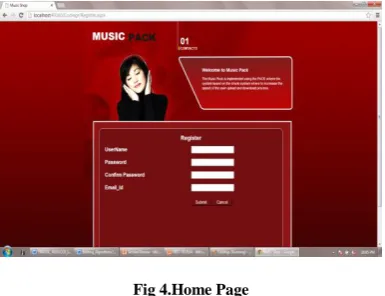
A. Creating an Account
A new user enters into a web site creating an account for them. Admin monitor the user details and sends the acknowledgement to the user personal id. The user starts processing for data upload or download when it receives the acknowledgement message.
Fig 4.Home Page
B. Upload the Music File
Pandian Saraswathi Yadav Engineering College, Arasanoor, Sivagangai, Tamilnadu, India
Fig 5.Upload Music File
C. Predictive Acknowledgement
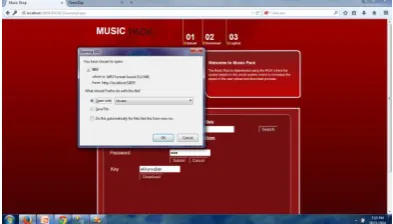
We will find whether the file is presented in the chunk system or not. If it presented in the chunk system it will download from the chunk otherwise it will download from the server. The traffic of the server will be slow down and the chunk system will manage it. The Data is stored into a database as byte stream using Predictive Acknowledgement. The Pack algorithm used to split the data into a bite stream. Pack a framework which uses a carefully designed workload to incur significant delays on the targeted application.
Fig 6.Search File
D. Download Music File
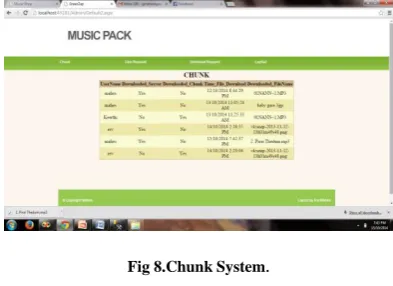
The server will download the file into the chunk system while first request by the user. The chunk system is maintaining the files list in the admin module. If the admin allow user to access the file it can download from chunk. The files can be easily downloaded from the chunk system and it will reduce the workload of the server and increase the download speed .The file will be downloaded to the client system. Admin sends the Authentication key to the client system to download if the user does not receive any authentication key from admin they can’t to download. Initially file will download from server otherwise it will download from chunk system. The chunk system reduces the server workload.
Pandian Saraswathi Yadav Engineering College, Arasanoor, Sivagangai, Tamilnadu, India
E. Admin Management
Admin manage the overall process and can be logged in by the admin only. The admin can allow the user and restrict the user. The data usage is monitored by the admin and list the active and idle user usage. The admin can have the rights to allow the user and restrict the user. Each and every stage checks Admin both Server and Client Side status. Admin is the Controller of Predictive acknowledgement and monitor the Data. Admin providing the authentication key to processing i.e. file upload and download.
Fig 8.Chunk System.
V. CONCLUSION
In cloud computing, the Cloud bandwidth, cost and redundant data in network have been reduced because of the algorithm Traffic redundancy elimination and Predictive acknowledgement. Redundancy aware routing algorithm. Traffic redundancy elimination was used to eliminate redundant data in network links so bandwidth and cloud cost reduced. Predictive acknowledgement was used to create a chunk system it reduce the server workload and increases the transaction speed. Redundancy aware routing algorithm has been used to remove the redundant content in cloud storage space so that the usage of cloud storage bandwidth has been saved. In the future, this work will extend to provide the security and file sharing while transmitting data between cloud and its end user’s.
ACKNOWLEDGEMENT
The authors acknowledge the contributions of the students, faculty of PSR Rengasamy College of Engineering for Women for helping in the design of test circuitry, and for tool support. The authors also thank the anonymous reviewers for their thoughtful comments that helped to improve this paper. The authors would like to thank the anonymous reviewers for their constructive critique from which this paper greatly benefited.
REFERENCES
[1]. N. T. Spring and D. Wetherall, ―A protocol-independent technique for eliminating edundant network traffic,‖ in Proc. SIGCOMM, 2000, vol.30, pp. 87–95.
[2]. A. Gupta, A. Akella, S. Seshan, S. Shenker, and J. Wang, ―Understanding and exploiting network traffic redundancy,‖ UW-Madison,Madison, WI, USA, Tech. Rep. 1592, Apr. 2007.
[3]. A. Anand, A. Gupta, A. Akella, S. Seshan, and S. Shenker, ―Packet caches on routers: The implications of universal redundant traffic elimination,‖in Proc. SIGCOMM, 2008, pp. 219–230.
[4]. A. Anand, V. Sekar, and A. Akella, ―SmartRE: An architecture for coordinated network-wide redundancy elimination,‖ in Proc. SIGCOMM,2009, vol. 39, pp. 87–98.
[5]. B. Aggarwal, A. Akella, A. Anand, A. Balachandran, P. Chitnis, C.Muthukrishnan, R. Ramjee, and G. Varghese, ―EndRE: An end-system redundancy elimination service for enterprises,‖ in Proc. NSDI, 2010, pp. 28–28.
[6]. E. Zohar, I. Cidon, and O. Mokryn, ―The power of prediction: Cloudbandwidth and cost reduction,‖ in Proc. SIGCOMM, 2011, pp. 86–97. [7]. A. Anand, C. Muthukrishnan, A. Akella, and R. Ramjee,‖Redundancy in network traffic: Findings and implications,‖ in Proc.IGMETRICS, 2009, pp. 37–48.
Pandian Saraswathi Yadav Engineering College, Arasanoor, Sivagangai, Tamilnadu, India
[9]. A. Medina, M. Allman, and S. Floyd, ―Measuring the evolution of transport protocols in the internet,‖ Comput. Commun. ev., vol. 35,no. 2, pp. 37–52, 2005.`[10]. U. Manber, ―Finding similar files in a large file system,‖ in Proc. USENIX Winter Tech. Conf., 1994, pp. 1–10.
[11]. E. Lev-Ran, I. Cidon, and I. Z. Ben-Shaul, ―Method and apparatus for reducing network traffic over low bandwidth links,‖ US Patent 7636767, Nov. 2009.
[12]. S.Mccanne andM. Demmer, ―Content-based segmentation scheme for data compression in storage and transmission including hierarchical segment representation,‖ US Patent 6828925, Dec. 2004.
[13]. M. Zink, K. Suh, Y. Gu, and J. Kurose, ―Watch global, cache local YouTube network traffic at a campus network—Measurements and implications,‖in Proc. MMCN, 2008, pp. 1–13.
[14]. A. Z. Broder, ―Some applications of Rabin’s fingerprinting method,‖ in Sequences II: Methods in Communications, Security, and Computer Science. New York, NY, USA: Springer-Verlag, 1993, pp. 143–152.
[15]. A. Medina, M. Allman, and S. Floyd, ―Measuring the evolution of transport protocols in the internet,‖ Comput. Commun. Rev., vol. 35, no. 2, pp. 37–52, 2005.
BIOGRAPHY
G.Maheswari has received B.E degree in Computer Science and Engineering from Anna University, Chennai 2010. She is currently pursuing Master of Engineering in Communication Systems in PSR Rengasamy College of Engineering for Women under Anna University, Chennai. Her areas of interest in research are Cloud Computing.