Minimize Server Load Using Efficient
Social Network-Aided Live Streaming
System (Save)
M.Surya1, K.Shanthalakshmi 2
PG Scholar, Department of ECE, Adhiyamaan College of Engineering, Hosur, Tamilnadu, India1
Asst. Professor, Department of ECE, Adhiyamaan College of Engineering, Hosur, Tamilnadu, India2
ABSTRACT: In peer-to-peer (P2P) live streaming systems, which refer to content deliver live and sharing video, hence each node required to form an overlay. A node triggers to watch a new channel depends upon centralised server. Live streaming applications make users to watch multiple channel simultaneously, which if widely used, server poses heavy load. To improve efficient live streaming systems, we proposed a Social-network-Aided efficient liVe strEaming system (SAVE). SAVE collects information of nodes interests, channel’s watching time and channel interactions. It forms an overlay between nodes with frequent interaction; identify nodes similar interest and watching times. And also builds bridges between overlay of channel with less frequent interactions. We have designed database structure for SAVE systems using MYSQL and constructed templates for user and admin login, video uploads and created friendlist using Net Beans IDE 7.
KEYWORDS: friendlist, channel clustering, P2P networks, SAVE, live streaming
I. INTRODUCTION
Most of P2P live streaming applications such as P2PIPTV & PPstream are centralised server. The success of these applications made the need of decentralized server, which posses to reduce load capacity on centralised server. In P2P live streaming system, which refers to streaming video sharing between nodes through P2P overlay formed during watching all nodes a channel. Each node contact the centralized server for every new channel wants to watch. The support of successive and simultaneously watching of multiple channels at a time is difficult in current P2P live which allow users to share stream in one channel. A node watching multiple channels which required forming multiple P2P overlay and it maintains cost is increased. As a node opens more channels, it leads to heavy burden on centralized server and delay response makes inefficiency in P2P live streaming systems.
SAVE proposed to improve the efficiency of live streaming systems. The design of this project is based on utilization of social network. The two main schemes of SAVE system are: channel clustering and friendlist.
Channel clustering scheme:
Most of nodes watch similar interest channel at same time and node watching limited to small number of channels. Hence SAVE performs channel clustering with frequent interactions of channels. It forms overlay between channels with frequent interactions and constructs bridges between overlay of channel with less frequent interaction. Thus, the successive or multichannel watching of users in its current overlay or bridges form new overlay with interfering server.
Freindlist scheme:
the details of nodes sharing common channels interest and watching time period. If a node wants to watch a channel that is not in present overlay, it refers to friendlist to switch nodes in desired overlay of channel.
II. DESIGNOFSAVESYSTEM
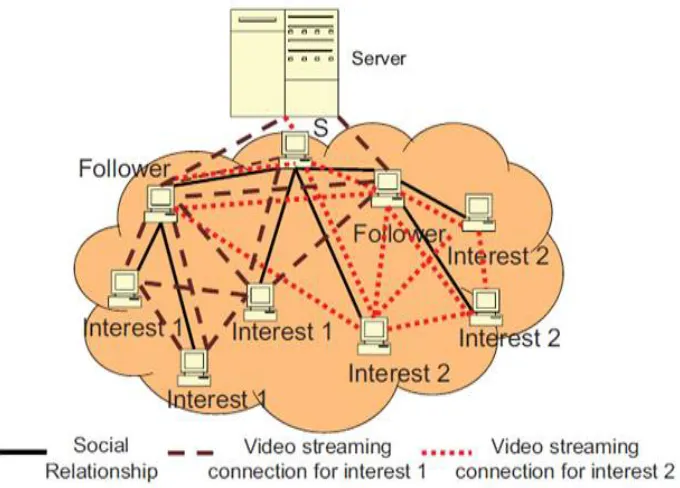
Fig. 1 shows a high level view of the SAVE structure. The centre of the entire network is the server node and it is denoted by ns. Initially, it forms overlay by all nodes in each channel. Each channel overlay has a stable node with highest capacity and longest lifetime in a channel is a channel head denoted by hc. The two main schemes of SAVE: channel clustering and friendlist.
Channel clustering scheme: This scheme considers connecting a group of nodes with frequent interacted channels. It collects the information of watching activities of nodes and single channel grouped to form channel clusters. Channel overlays in one channel cluster are merged into one overlay or bridged. In cluster, each channel overlay head (hc) is connected with other channel overlays head.
Fig 1: high level view of SAVE system
In each channel cluster, has a cluster head denoted by hcr and connects all possible hc in its cluster. The nodes with great probability in each channel cluster can switch to watch their desired channels without interfering ccentral server.
Friendlist scheme: This scheme collects similar interest channels and watching time to maintain a freiendlist. By using friendlist, a node not in its current overlay can join a channel. When a non- first time user can join its desired channel via friendlist without relying the server.
The design format of SAVE structure using JDK.7 was developed coding as shown below:
<%@page import="package
com.oreilly.servlet.*,java.sql.*,databaseconnection.*,java.util.*,java.io.*,javax.servlet.*, javax.servlet.http.*"%> <html xmlns="http://www.w3.org/1999/xhtml">
<meta name="keywords" content="" /> <meta name="description" content="" />
<meta http-equiv="content-type" content="text/html; charset=utf-8" />
<title>A Social-Network-Aided Efficient Peer-to-Peer Live Streaming System</title>
<link href="http://fonts.googleapis.com/css?family=Oxygen" rel="stylesheet" type="text/css" /> <link href="style.css" rel="stylesheet" type="text/css" media="screen" />
<script language="JavaScript" type="text/javascript"> function valid()
{
var a=document.f.n.value; if(a=="")
{
alert("Enter your Name"); document.f.n.focus(); return false; } var b=document.f.p.value; if(b==""){ alert("Enter password"); document.f.p.focus(); return false; } } </script> </head> <body> <div id="wrapper"> <div id="header-wrapper"> <div id="header"> </br> </br>
<h3 align="center"> <font color="#FFFF00" size="+3"><b>A Social-Network-Aided Efficient Peer-to-Peer Live Streaming System </b></font></h3>
<div id="logo"> </div>
</div> </div>
<!-- end #header --> <div id="menu">
<div align="center">
<h2><font color="#FF0000">Admin Login</font> </h2> </div>
</div>
<!-- end #menu --> <div id="page">
<div id="page-bgtop">
<div id="page-bgbtm"><table align="center"><tr><td width="400"><p><img src="images/adminlogo.jpg" width="300" height="150"></p></td><td> <table width="400">
<form action="adminlo.jsp" name="f" onSubmit="return valid()"> <tr>
<td><p><input type="text" name="n"></p></td> </tr>
<tr>
<td><p><font color="#3300FF">Password</font></p></td> <td><p><input type="password" name="p"></p></td> </tr>
<tr>
<td><p></p></td>
<td><p><input type="submit" style="font-face: 'Comic Sans MS'; font-size: larger; color: teal; background-color: #FFFFC0; border: 3pt ridge green" value="Submit">
<input type="reset" style="font-face: 'Comic Sans MS'; font-size: larger; color: teal; background-color: #FFFFC0; border: 3pt ridge green" value="Clear"></p>
</td></tr></form></table> </td></tr></table> <div id="content">
<div class="post">
<div class="entry"> </div>
</div>
<div style="clear: both;"> </div> </div>
<!-- end #content --><!-- end #sidebar --> <div style="clear: both;"> </div>
</div> </div>
</div> <!-- end #page --> </div>
<div id="footer"> <p></p> </div>
<!-- end #footer --> </body>
</html>
III.RESULTSANDDISCUSSIONS
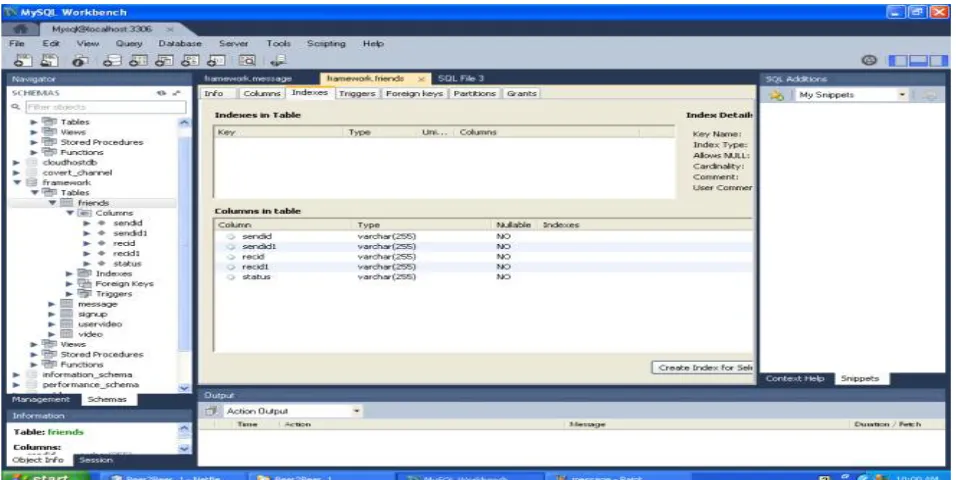
Fig 2 : Database structure using MYSQL
IV.CONCLUSION
In this paper, we propose SAVE, a social-network-aided efficient P2P live streaming system. SAVE supports successive and multiple-channel viewing with low switch delay and low server overhead by enhancing the operations of joining and switching channels. SAVE considers the historical channel switching activities as the social relationships among channels and clusters the frequently interacted channels together by merging overlays or building bridges between the overlays. It maximizes the probability that existing users can locate their desired channels within its channel cluster and can take the bridges for channel switches. In addition, each node has a friendlist that records nodes with similar watching patterns, which is used to join a new channel overlay. SAVE also has the channel-closeness-based chunk pushing strategy and capacity-based chunk provider selection strategy to enhance its system performance. Our survey on user video streaming watching activities confirms the necessity and feasibility of SAVE. Through the experiments, we prove that SAVE outperforms other representative systems in terms of overhead, video streaming efficiency and server load reduction, and the effectiveness of SAVE's two strategies. Our future work lies in further reducing the cost of SAVE in structure maintenance and node communication. Also, we will design algorithms for cluster separation and decentralized cluster head election.
REFERENCES
[1] J. Liu, S. G. Rao, B. Li, and H. Zhang, “Opportunities and challenges of peer-to-peer internet video broadcast,” Proc. IEEE, vol. 96, no. 1,
pp. 11–24, Jan. 2008.
[2] C. Wu and B. Li, “Exploring large-scale peer-to-peer live streaming topologies,” Trans. Multimedia Comput., vol. 4, no. 3, 2008, Art. no.
19.
[3] F. Dobrian, V. Sekar, I. Stoica, and H. Zhang, “Understanding the im- pact of video quality on user engagement,” in Proc. ACM SIGCOMM,
2011, pp. 362–373.
[4] X. Cheng and J. Liu, “NetTube: Exploring social networks for peer-to-peer short video sharing,” in Proc. IEEE INFOCOM, 2009, pp. 1152–1160.