INVESTIGATION
Novel Transcript Truncating Function of Rap1p
Revealed by Synthetic Codon-Optimized
Ty1 Retrotransposon
Robert M. Yarrington,*,†,1Sarah M. Richardson,*,‡,2Cheng Ran Lisa Huang,*,‡and Jef D. Boeke*,†,3 *High Throughput Biology Center,†Department of Molecular Biology and Genetics, and‡McKusick-Nathans Institute of Genetic Medicine, Johns Hopkins University School of Medicine, Baltimore, Maryland 21205
ABSTRACTExtensive mutagenesis via massive recoding of retrotransposon Ty1 produced a synthetic codon-optimized retrotransposon (CO-Ty1). CO-Ty1 is defective for retrotransposition, suggesting a sequence capable of down-regulating retrotransposition. We mapped this sequence to a critical20-bp region within CO-Ty1 reverse transcriptase (RT) and confirmed that it reduced Ty1 trans-position, protein, and RNA levels. Repression was not Ty1 specific; when introduced immediately downstream of the greenfluorescent protein (GFP) stop codon, GFP expression was similarly reduced. Rap1p mediated this down-regulation, as shown by mutagenesis and chromatin immunoprecipitation. A regular threefold drop is observed in different contexts, suggesting utility for synthetic circuits. A large reduction of RNAP II occupancy on the CO-Ty1 construct was observed 39to the identified Rap1p site and a novel 39truncated RNA species was observed. We propose a novel mechanism of transcriptional regulation by Rap1p whereby it serves as a transcriptional roadblock when bound to transcription unit sequences.
S
ACCHAROMYCES cerevisiaeTy1 is the best-characterized and most abundant offive retrotransposon families pres-ent in the genome. Ty1 shares many similarities with retro-viruses, such as HIV-1 and makes similar use of an RNA intermediate in its propagation. Unsurprisingly, this Ty1 RNA intermediate is essential for Ty1 retrotransposition. Not only does this“mRNA”code for the GAG and POL pro-teins required for retrotransposition, but it also serves a crit-ical function as the genetic material for replication. Both Ty1 mRNA and its cDNA product contain cis-acting nucleotide determinants required for retrotransposition.Mutagenesis of Ty1 and screening for cis-acting nucleo-tide determinants has been previously performed with various strategies, including in-frame linker insertion muta-genesis (Braiterman et al.1994; Devine and Boeke 1994;
Monokian et al.1994), analysis of synthetic Ty1 DNA frag-ments to determine minimal requirefrag-ments for the integra-tion reacintegra-tion (Eichinger and Boeke 1990; Braitermanet al. 1994; Devine and Boeke 1994; Sharonet al.1994), deletion analysis and PCR-mediated mutagenesis of mini-Ty1 ele-ments (Xu and Boeke 1990; Bolton et al. 2005), and comparative sequence analysis followed by targeted muta-genesis and/or generation of complementary mutations in RNA stem regions (Chapman et al. 1992; Heyman et al. 1995; Lauermann et al.1995; Friant et al.1998; Cristofari et al. 2002; Bolton et al. 2005). These studies provided insights into mechanisms underlying Ty1 retrotransposition and revealed several cis-acting sequences, including the Meti-tRNA:primer binding site (PBS) interaction (Chapman et al.1992; Friantet al.1998), LTRs (Eichinger and Boeke 1990; Braiterman et al. 1994; Devine and Boeke 1994; Sharon et al. 1994), polypurine tracts (PPTs) (Heyman et al.1995; Lauermannet al.1995), the GAG-POL frameshift region (Belcourt and Farabaugh 1990; Lawler et al.2001), CYC5 and CYC3 (Cristofariet al.2002), and an extensive 59 RNA structure required for efficient initiation of reverse transcription (Bolton et al. 2005). Additionalcis-sequences may remain undiscovered in Ty1. To discover these requires mutagenesis on a much larger scale. This motivated the present study, which in the end led in a different direction.
Copyright © 2012 by the Genetics Society of America doi: 10.1534/genetics.111.136648
Manuscript received April 7, 2011; accepted for publication November 14, 2011 Supporting information is available online at http://www.genetics.org/content/ suppl/2011/12/01/genetics.111.136648.DC1.
1Present address: Department of Pathology, University of Utah Health Sciences
Center, Salt Lake City, UT 84112.
2Present address: DOE Joint Genome Institute, Walnut Creek, CA 94598. 3Corresponding author: High Throughput Biology Center, Johns Hopkins University
A near-comprehensive method of coding region mutagen-esis is based on gene synthmutagen-esis. Typically, synthetic genes encode the same product as the gene of interest; extensively recoding affects expression and/or base composition. This technique has been used with great success (Han and Boeke 2004; Neves et al. 2004; Tian et al. 2004; Patterson et al. 2005), often producing codon-optimized (CO) genes capable of elevated expression or expression in nonhost organisms. Furthermore, this strategy has also been utilized on other retroelements, such as HIV-1, to optimize expression and to remove negativecis-acting sequence elements such as the Rev response element (Kotsopoulou et al. 2000; Nguyen et al. 2004). Despite these successes, synthetic biology’s use of si-lent mutations also has the potential to introduce negativecis -acting sequence elements and to generate synthetic genes with reduced expression and/or decreased RNA stability (Kim and Lee 2006; Kudlaet al.2009; Welchet al.2009).
In this study, we designed a synthetic element on the basis of Ty1-H3 with GeneDesign (Richardson et al. 2006) to recode Ty1-H3 with codons optimized forSaccharomyces cer-evisiaeexpression, introducing 1209 base changes. The result-ing synthetic codon-optimized Ty1 (CO-Ty1) was defective for Ty1 transposition and had reduced Ty1 protein and full-length RNA levels even though the known Ty1cis-sequences had not been altered, suggesting identification of a novelcis -acting sequence capable of regulating Ty1 expression. Map-ping and testing of thiscis-acting sequence, however, revealed that the defect was the consequence of an inhibitory sequence in CO-Ty1 in the form of a Rap1p binding site.
Rap1p (RepressorActivatorProtein) is a multifunctional protein with the binding site consensus ACACCCRYACAYM (Liebet al.2001) with transcriptionally opposing roles in the activation of transcription at promoters of ribosomal and glycolytic genes (Woudtet al.1987; Tornow and Santangelo 1990) as well as in transcriptional silencing through the re-cruitment of silencing factors to the HM loci and telomeres (Shore and Nasmyth 1987; Buchman et al. 1988; Kyrion et al. 1992). The latter activity has been attributed to the nonessential Rap1-S domain, which is separate from the DNA binding domain (Sussel and Shore 1991; Kyrion et al. 1992). We describe here a new role for Rap1p in controlling expression via its ability to bind Rap1p sites in-side transcription units (TUs) and thereby block and/or ter-minate transcriptional elongation. As Rap1p has been shown to ChIP within several TUs (Lieb et al. 2001), this finding may reveal a previously unexplored level of expression reg-ulation and/or sequence constraints available within TUs.
Materials and Methods
Strains and media
All yeast strains used in this study, unless specified other-wise, were in the genetic background of GRF167 (JB740; MATahis3D200 leu2D1 ura3-167).SaccharomycesGenome Deletion strains BY4742 and BY4743 were used for analysis
of rrp6D and rap1 variants, respectively. Media were pre-pared as described (Shermanet al.1987).
Gene synthesis and plasmid construction
CO-Ty1 design was performed with GeneDesign (Richardson et al. 2006); construction of CO-Ty1 has been described (Yarrington 2009).
Gal-Ty1-mhis3AIplasmids pRY022, pRY091, and all chi-meric CO-Ty1 variants were described previously (Curcio and Garfinkel 1991; Yarrington 2009). GFPexpression vec-tors used the GFP reporter cassette from pFA6a-kanMX6-Gal1-GFP (Longtine et al. 1998) subcloned into pRS416 (Sikorski and Hieter 1989) via the EcoRI andSalI sites of the multicloning site. GFP70WT and GFP70CO, as well as all mutants and deletions, were constructed by subcloning the appropriate hybridized oligos with AscI nucleotide over-hangs into the AscI site immediately downstream of the GFPstop codon.
Primers and oligos
All primer and oligo sequences are available in Supporting Information,Table S3,Table S4, andTable S5.
RNA isolation
Yeast cells harboring the pGal-Ty1-mhis3AIand CO-Ty1 ele-ments were grown in 5 ml 0.2% glucose at 30overnight for 12–16 hr. The following day, yeast culture A600was mea-sured and 2 OD of culture was used to reinoculate a 10-ml 2% galactose culture at 0.2 A600grown at 22for 20–24 hr to an A600 of 1.0. Total RNA was extracted by hot acid phenol (Collart and Oliviero 2001), purified by RNeasy min-ikit (Qiagen), and either fractionated on formaldehyde aga-rose gels or reverse transcribed into cDNA (SuperScript III First Strand Synthesis, Invitrogen) for quantitative real-time PCR (Q-PCR) analysis.
RNA Northern blot analysis
For Northern quantification of Ty1-mhis3AIRNAs, 10mg total RNA was heat denatured in sample buffer (55% deionized formamide, MOPS buffer, pH 7.0, 5% formaldehyde, 8 mM EDTA, and 0.1% bromophenol blue) before electrophoresis on 1% agarose gels containing MOPS buffer, pH 7.0 (40 mM MOPS, 10 mM sodium acetate, and 1 mM EDTA) and 2% formaldehyde. RNA was transferred by capillary action and
fixed by UV crosslinking to Gene Screen Plus filters as de-scribed by the manufacturer (NEN Life Science Products, Boston, MA). Membrane-bound RNAs were hybridized with either a HIS3-specific (0.5-kb fragment of pECB4B) or CO-Ty1–specific (0.1-kb fragment, 1 kb upstream of the Rap1p site) probe. DNA probes were internally labeled and purified over G25 Sephadex spin columns. Filters were ex-posed to a Molecular Dynamics phosphoimager screen.
Q-PCR
the 2(-DDC(T)) method, using actin as reference, and nor-malized to the amount of native Ty1-H3 at the 0 min time point.
Transposition assay
Transformants containing the URA3-marked Ty1 GAL-Ty1-mhis3AI plasmid, pRY022, and synthetic variants were patched onto SC2Ura with 2% glucose (Curcio and Garfinkel 1991). After 2 days at 30, yeast patches were replica plated to SC2Ura medium with 2% galactose and incubated at 22 for 2 days. After this period, plates were replica plated to YPD and incubated at 30for 1 day and then replica plated again the following day to SC 2His for an additional day at 30. Transposition was recorded quantitatively by the ability of patches to grow on SC2His plates.
Immunoblot analysis
Yeast cells harboring the pGal-Ty1mhisAIand CO-Ty1 chimeric elements were grown in 5 ml 0.2% glucose at 30overnight for 12–16 hr. The following day, yeast culture ODs were mea-sured and 1 OD was used to reinoculate a 5-ml 2% galactose culture at 0.2 A600 and grown at 22 for 20–24 hr. Yeast cultures were then harvested and 2.5 A600of cells were spun down for immunoblot analysis.
Protein extraction of cells was performed by mild alkaline treatment (Kushnirov 2000) by resuspending 2.5 A600of cells in 200 ml of 0.2 M NaOH for 10 min, centrifugation and re-moval of supernatant, and boiling in 100 ml of SDS/PAGE sample buffer for 10 min. Ten microliters of each extract was run onto a 4–20% Tris-glycine polyacrylamide gel (Invitrogen). Proteins were transferred onto 0.45 mm PVDF membranes (Immunobilon-P from Millipore, Bedford, MA) in transfer buffer (25 mM Tris base, 192 mM glycine, and 20% methanol) at 30 V for 12–16 hr or 100 V for 2 hr. Membranes were washed three times (10 min each) with blocking buffer (Tris-buffered saline containing 1% nonfat milk and 0.1% Tween 20) and incubated for 1 hr with a 1/1000 dilution of Anti-IN 8B11 ascites to detect Ty1 integrase (IN) (Eichinger and Boeke 1990). Membranes were washed as indicated above and incubated for 1 hr with 1/2000 dilutions of ECL antimouse (to detect IN). Immunoblots were washed again as indicated above and visualized by ECL Plus chemifluorescence (Amersham).
Flow cytometry
Flow cytometry on yeast was performed as previously described (Starlinget al.2003). Briefly, yeast cells harboring the GFP70WT and GFP70CO variants were grown in 5 ml 0.2% glucose at 30overnight for 12–16 hr. The following day, yeast culture A600was measured and 1 OD was used to inoculate a 5-ml 2% galactose culture at 0.2 A600grown at 22for 20–24 hr to an A600of1.0. Yeast culture A600was measured again, and 5 ·105cells were added to 1 ml so-lution of PBS and sorted on a BD LSR II (BD Biosciences) FACS machine. GFP fluorescence was measured using the
fluorescein isothiocyanate (FITC) channel of the BD LSRII
and analyzed by the BD FaCSDIVA software package. Yeast cells were gated such that an empty vector control plasmid reported only 0.1% GFP+cells.
Chromatin immunoprecipitation
Chromatin immunoprecipitation (ChIP) was performed as pre-viously described (Meluh and Broach 1999). Antibodies to yeast Rap1p (Y-300, Santa Cruz) and RNAP II subunit Rpb3p (IY26, Neoclone) were used for Rap1p and RNAP II IP, respectively. Occupancy values and percent IP were calculated by dividing the amount of PCR product (derived from the Ctvalue in the best-fit regression real-time PCR standard curve for the specific primer set) in the IP by the amount of the PCR product in the total chromatin prep. IP values were normalized to a control (i.e., GFP70WT for Rap1p ChIP) and enrichment of occupancy or IP was calculated by dividing the experimental percent IP by that of its specific control.
Circularized rapid amplification of cDNA ends analysis
Circularized rapid amplification of cDNA ends was per-formed as previously described (Rissland and Norbury 2009). Briefly, the isolated total RNA wasfirst dephosphory-lated with antarctic phosphatase (NEB, M0289) according to the manufacturer’s instruction. The reaction was then purified by RNeasy Mini kit (Qiagen, 74104) and the 59 cap was removed using 2.5 units of tobacco acid pyrophos-phatase (Epicentre Biotechnologies, T81050). The reaction was incubated at 37for 1 hr and then treated with another round of cleanup using the RNeasy Mini kit. Three micro-grams of the decapped product was ligated using T4 RNA ligase (Epicentre Biotechnologies, LR5010) at 16overnight in a total reaction volume of 40ml. A separate ligation re-action was performed without the 59decapping treatment as a control. Ligation products were reverse transcribed with SuperScript III First-Strand Synthesis system (Invitrogen, 18080-051) using the supplied random hexamers or a 20-bp reverse primer (CTTAGAAGTAACCGAAGCAC) mapping 100 bp after the 59end of the Ty1 message. Five micro-liters of the resulting cDNA was used for PCR (30 cycles, 1-min extension) using the above reverse primer and a forward primer (GTTTGGGTGGTATTGGTGACTCTAA) mapping 400 bp upstream of the Rap1p site to amplify the circular-ized product. The resulting amplicons were cloned into the T-Easy vector (Promega, A1360) and sequenced.
Results
Construction of a synthetic codon-optimized Ty1 element
genes inS. cerevisiae(Sharpet al.1988). Because the 59and 39LTRs of Ty1 are essential for transposition (Eichinger and Boeke 1990), the sequence used for codon optimization was the coding sequence for GAG-POL, corresponding to the re-gion spanning bases 294–5562 of the Ty1-H3 sequence. To fuse GAG and POL into one ORF, C1596 (Belcourt and Farabaugh 1990) was deleted prior to optimization and re-stored afterward. Furthermore, as manycis-acting sequences are already known to affect Ty1 retrotransposition, only sequences outside these regions were recoded. The resulting CO-Ty1 sequence is 77% identical to that of the native se-quence. Further details of oligo design, PCR assembly, and cloning have been described previously (Yarrington 2009).
CO-Ty1 is defective for both Ty1 transposition and processed protein levels
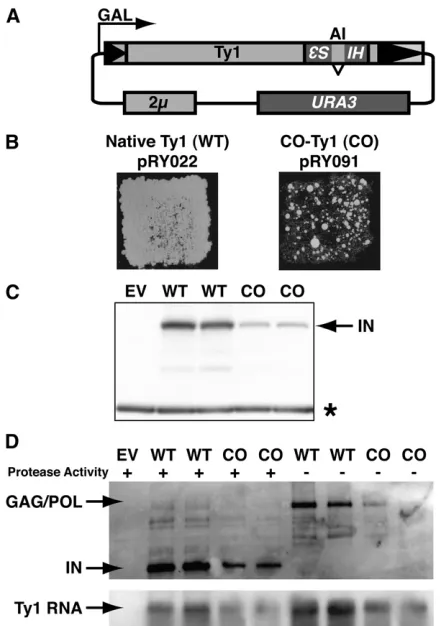
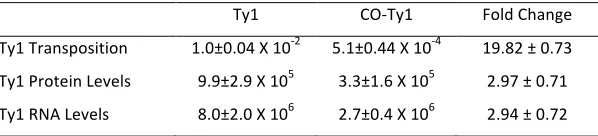
To assay retrotransposition of CO-Ty1, the retrotransposi-tion indicator/reportermhis3AI(Curcio and Garfinkel 1991) was inserted downstream of the GAG-POL stop codon and the construct was subcloned behind theGAL1promoter, cre-ating pRY091, in which retrotransposition is measured by formation of His+colonies after exposure to galactose (Fig-ure 1A). Retrotransposition assays revealed a significant de-fect in CO-Ty1 retrotransposition relative to native Ty1-H3 (Figure 1B), suggesting sequence changes deleterious to Ty1 transposition. A quantitative assay revealed a 19.8-fold re-duction in retrotransposition frequency (seeTable S1).
To further characterize CO-Ty1, we examined Ty1 IN and RT levels. Surprisingly, the synthetic CO-Ty1 displayed3-fold diminished levels of integrase protein (Figure 1C), in spite of the fact that protein sequences were not altered; a similar re-duction in RT was also observed (not shown). In both cases, a reduction of2.97-fold was observed (seeTable S1).
CO-Ty1 is defective for GAG-POL expression
The IN and RT proteins are proteolytically processed from a GAG-POL precursor protein. To determine whether the effect was on the precursor protein or restricted to the individual products of precursor processing, we introduced an inactivating in-frame linker insertion into the Ty1 pro-tease (Monokianet al.1994) of the native and CO-Ty1 plas-mids. Immunoblot analyses revealed that GAG-POL protein levels of the CO-Ty1 were similarly reduced in full-length precursor, as was processed IN (Figure 1D), consistent with an overall deficit in CO-Ty1 gene expression.
CO-Ty1 has reduced Ty1 RNA
Diminished GAG-POL gene expression in CO-Ty1 presum-ably results directly from a full-length mRNA deficit. Indeed, RNA levels in CO-Ty1-mhis3AIdisplayed reduced full-length Ty1 RNA levels (2.98-fold) relative to native Ty1 (Figure 1D andTable S1).
To determine whether the reduced CO-Ty1 RNA levels resulted from a defect in Ty1 transcription or in RNA stability, we assessed Ty1 RNA levels after adding glucose to shut off new transcription from the galactose-inducible
Ty1 constructs (Figure 2). A 4.37-fold difference in RNA levels was observed before glucose was added, in close agreement with steady-state CO-Ty1 protein and RNA lev-els. The time course showed that CO-Ty1 did not have de-creased RNA stability; rather it may have slightly inde-creased RNA stability. The native Ty1 RNA level time course was consistent with a previous estimate of Ty1 RNA half-life (Nonetet al.1987), validating the assay. These results sug-gest that RNA formation is defective in CO-Ty1.
Critical CO-Ty1 sequence maps to a 70-bp region in the N-terminal region of RT
sites, to map a criticalcis-acting sequence capable of regulating Ty1 retrotransposition to the N-terminal region of the Ty1 RT gene (Figure 3) (Yarrington 2009). The critical CO-Ty1 se-quence was mapped by examination of Ty1 transposition and IN levels in a series of chimeric CO-Ty1/native Ty1 clones.
Effects of critical CO-Ty1 sequence are transplantable
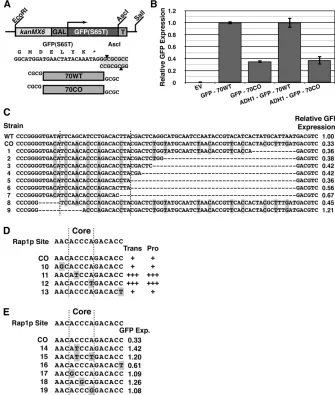
To determine whether or not the critical region represented a novel sequence requirement for Ty1 transposition, we determined its effects in a non-Ty1 context. The 70-bp critical region was cloned immediately after the stop codon of GFP in the pFA6a-kanMX6-Gal1-GFP construct (Figure 4A) (Longtine et al. 1998). The GFP reporter system was then further subcloned into pRS416 (Sikorski and Hieter 1989), creating GFP70CO. The corresponding native Ty1 sequence was similarly cloned into GFP in the same way, creating GFP70WT; this construct had a minimal impact on GFP expression (not shown).
FACS analysis of the GFP70WT and GFP70CO GFP reporter constructs revealed that the critical CO-Ty1 se-quence down-regulated GFP expression 2.84-fold, a value very similar to the reduced expression level in CO-Ty1 (Figure 4B and Table S2). Thus the CO-Ty1 sequence did not represent a novel Ty1 sequence requirement for retro-transposition but rather appeared to be a portable synthetic negative regulatory sequence inadvertently introduced by codon optimization. Repression via the synthetic sequence was independent of the GAL1promoter of the CO-Ty1 and GFP70CO constructs as an ADH1-GFP70CO was similarly reduced in expression relative to ADH1-GFP70WT (Figure 4B). Furthermore, as this sequence was able to mediate its effects in the 39-UTR of GFP and in multiple reading frames (not shown), the effect of this synthetic sequence was in-dependent of protein translation. By monitoring FACS of various terminal deletion constructs of GFP70CO, the mini-mal required sequence for gene repression was mapped to a 20- to 25-bp region (Figure 4C).
Critical CO-Ty1 sequence contains a Rap1p binding site
As GFP and Ty1 repression were mediated by neither de-creased RNA stability nor protein translation, the mechanism of repression was likely affecting RNA production. To that end, the identified critical CO-Ty1 sequence was entered into a matrix search for transcription factor binding sites program, Match (Kel et al. 2003), to determine whether the critical CO-Ty1 sequence matched a unique binding factor. Within both the 70-bp CO-Ty1 and the 20- to 25-bp subregion, Match identified a unique Rap1 binding site with a 1.00 core match and 0.979 matrix match.
Interestingly, the repressive Rap1p site identified here ACACCCAGACACC is nearly identical to Rap1p sites found at yeast telomeres (ACACCCAYACAYY in which the Ys are more likely to be Cs (Idrissi and Pina 1999). Mutating residue 12 to a T, a change more similar to a ribosomal protein promoter Rap1p site (Idrissi and Pina 1999), somewhat alleviated down-regulation of GFP (Figure 4C, compare strain 5 to 6). This result may indicate that not all Rap1p sites are equally able to down-regulate in this context.
Mutation of ACCCA core binding site of Rap1p rescues expression
Nearly all Rap1 binding sites contain a core ACCCA sequence; mutation of this site abrogates binding (Buchman et al. 1988; Lieb et al. 2001). Mutagenesis of the Rap1p binding site was used to confirm Rap1p specificity. Restoring either position 2 (C/T) or 5 (A/T) to the native Ty1 sequence in the ACCCA core was sufficient to entirely relieve Rap1p-mediated repression of CO-Ty1 transposition and protein levels (Figure 4D). No other bases, when restored to native Ty1 counterparts outside the Rap1p ACCCA core binding site could alleviate down-regulation in both Ty1 and Figure 2 Ty1 RNA stability. Native (WT) and CO-Ty1 (CO) Ty1-HIS3RNA
levels were measured by Q-PCR after addition of glucose to shut off new transcription at the indicated time points. Ty1 RNA levels were normalized to the native Ty1 0 min time point, and error bars are the standard de-viation of two biological replicates. Native Ty1-HIS3RNA is indicated by triangles and CO-Ty1-HIS3RNA is indicated by circles.
GFP constructs (Figure 4E). Furthermore, mutation of the core at positions 1, 3, and 5 individually to G pre-vented down-regulation of GFP (Figure 4E). Interestingly, changes to the Rap1p ACCCA consensus at position 2 to T and/or position 5 to G are present in some ribosomal pro-tein promoter Rap1p binding sites (Idrissi et al. 2001; Lieb et al. 2001). These specific changes in our system prevented down-regulation of GFP, thus not all Rap1p binding sites are equally capable of TU-specific down-regulation.
Down-regulation depends on orientation and number of sites
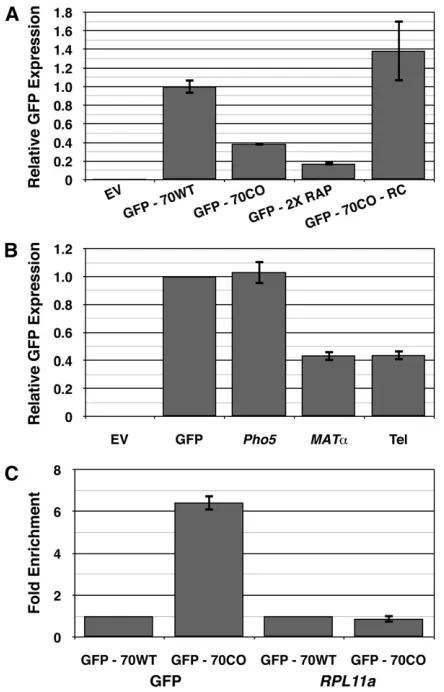
Rap1p sites are found in promoters of ribosomal and glycolytic genes in either orientation and, especially within ribosomal promoters, in multiple copies (Woudt et al. 1987; Tornow and Santangelo 1990). Surprisingly, the inverted Rap1p site had no effect on GFP expression (Figure 5A). This suggests that the Rap1p site must be presented in the same orientation as ongoing transcrip-tion to mediate down-regulatranscrip-tion.
Furthermore, inserting two Rap1p sites into GFP essentially doubled down-regulation, leading to an approximately sixfold drop in GFP expression of the GFP2XRAP construct compared to GFP70WT (Figure 5A). Introduction of additional Rap1p sites resulted in further, but diminishing, down-regulation of GFP (data not shown). The approximately twofold increase in GFP down-regulation observed with GFP2XRAP suggests that the Rap1p site can be modular for down-regulation within a TU. These results are less consistent with models based on internal transcriptional activation from the introduced Rap1p site or effects on histone repression as mechanisms for Rap1p-mediated down-regulation, as we did not see a synergistic effect from the addition of extra Rap1p sites, an effect that has been observed for both transcriptional activation and re-lease from histone repression at the promoter of Rap1p bound genes (Woudtet al.1987; Idrissi and Pina 1999; Idrissi et al.2001).
Genomic Rap1 sites can down-regulate GFP
Rap1p sequences from a telomere-like sequence, MATa, and PHO5, which are known to bind Rap1p in vitro and activate transcription in vivo (Buchman et al. 1988) into GFP. With both telomere and MATa sites, we observed
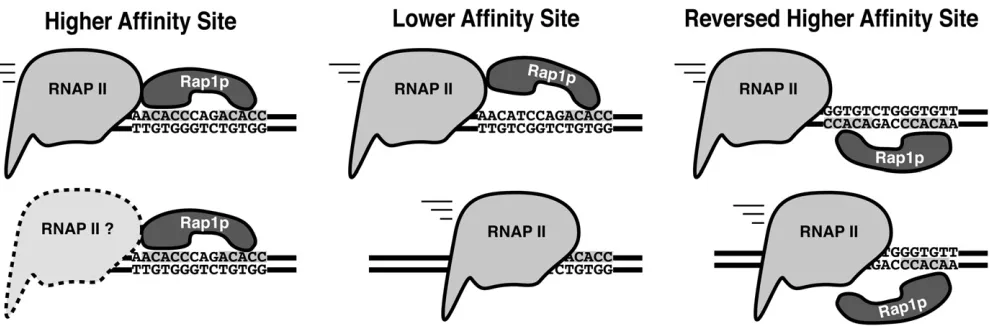
robust down-regulation when the respective Rap1p bind-ing sites were subcloned into GFP (Figure 5B). We ob-served no down-regulation of GFP, however, when the PHO5 Rap1p binding site was inserted into GFP (Figure 5B). The latter lack of down-regulation likely reflects low affinity of the site,40-fold less than that observed for the telomere sequence (Buchmanet al.1988). This result sug-gests that Rap1p-mediated down-regulation requires a cer-tain affinity between Rap1p and its binding site for effective down-regulation, consistent with a transcriptional roadblock model for repression, and likely explains why not all Rap1p sites are capable of down-regulation.
Rap1p binds to critical CO-Ty1/Rap1 sequence
To demonstrate that Rap1p binds to the identified binding site, we employed ChIP. Rap1p was crosslinked to its binding sites by fixing exponentially growing cultures containing the GFP reporters with 1% formaldehyde and performing ChIP.
Q-PCR analysis revealed that DNA fragments surround-ing the Rap1p site of GFP70CO were enriched .6.43-fold compared to amplification of the same region from GFP70WT (Figure 5C and Table S2). Q-PCR analysis of a known Rap1p site present in the promoter ofRPL11A(Lieb et al. 2001; Zhao et al. 2006) revealed similar levels of RPL11A pull-down with the two GFP constructs, validating our ChIP results. This demonstrates that the site indeed binds Rap1pin vivo.
Rap1p-mediated down-regulation is not mediated via N- or C-terminal domains
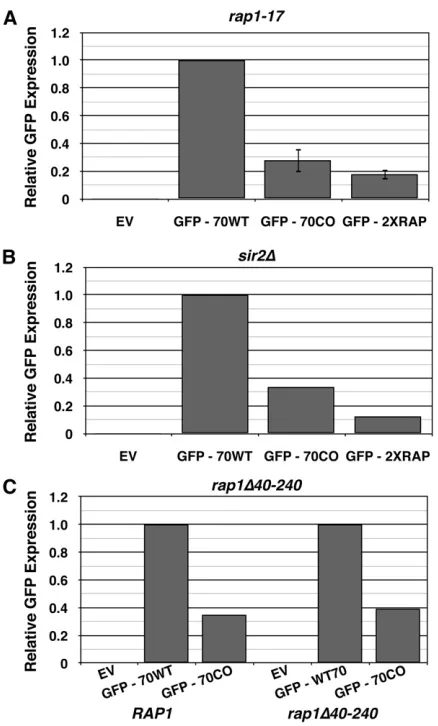
Because telomeric Rap1p binding sites, which consist of sequences very similar to the identified Rap1p binding site, silence transcription at and near telomeres via recruitment of Sir proteins (Shore and Nasmyth 1987; Buchman et al. 1988; Kyrionet al.1992), gene silencing was a likely mech-anism of down-regulation. To determine whether silencing was involved, arap1-17allele (Kyrionet al.1992) was uti-lized. The rap1-17 allele lacks the C-terminal 165 amino acid residues and is defective for silencing at both HMloci and telomeres (Kyrion et al. 1992; Moretti et al. 1994). Yeast expressing rap1-17, however, did not rescue GFP ex-pression from GFP70CO or GFP2XRAP (Figure 6A), indicat-ing that neither the C-terminal domain of Rap1p nor silencing were responsible for Rap1p-mediated repression of GFP70CO.
The reporter constructs were also transformed into a sir2D strain incapable of supporting transcriptional si-lencing (Rine and Herskowitz 1987); no rescue of GFP expression was observed (Figure 6B). Thus the observed Rap1p-mediated down-regulation is not mediated by ca-nonical silencing.
The N-terminal domain of Rap1p can be deleted without functional consequence to the cell, and is capable of causing .50bends in DNA upon Rap1p binding (Mulleret al.1994). To determine whether this domain and/or DNA bending Figure 5 Rap1p binding sites are capable of down-regulating expression. (A)
contributed to Rap1-mediated down-regulation, an N-terminal deletion (D40–240) of Rap1was constructed. The rap1D40– 240 was shuffled (Boeke et al. 1987) into a haploid rap1D strain, and the resulting strain was transformed with the GFP reporter constructs (Figure 6C); no rescue of GFP expression
was observed. Thus neither N- nor C-terminal domains of Rap1p underlie Rap1p-mediated down-regulation.
Rap1p functions as a transcriptional roadblock or terminator
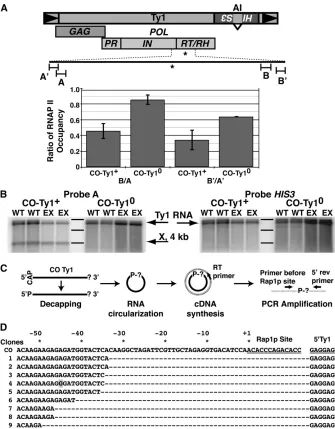
As Rap1p-mediated repression within TUs did not appear to be a function of the N- or C-terminal domains, it was formally possible that the Rap1p DNA-binding domain mediated repression via binding within our constructs, serving as a steric transcriptional block and/or terminator of elongation. To determine whether Rap1p inhibited ex-pression in this way, RNA polymerase II (RNAP II) occu-pancy along CO-Ty1 was evaluated using ChIP/Q-PCR of sequences1000-bp up- and downstream of the Rap1p site (Figure 7A). A CO-Ty1 from which the Rap1p site had been removed (CO-Ty10, pRY177) served as a control. DNA was sheared by sonication, and fragments occupied by RNAP II were selected using monoclonal antibody raised against Rpb3p, an RNAP II subunit.
Q-PCR with primers hybridizing 1000-bp 59and 1000-bp 39of the Rap1p site showed a large decrease in downstream RNAP II occupancy, which was reversed by mutating the binding site (Figure 7A). The decreased RNAP II occupancy downstream of the site agrees well with the observed decreases in RNA and protein expression levels in CO-Ty1, consistent with Rap1p’s mode of action in this context as a transcription block or elongation terminator.
To further probe the role of Rap1p as a block or ter-minator of transcription, we extracted total RNA from yeast cells and probed with CO-Ty1 sequences 1000 bp 59of the Rap1p binding site. A novel band (X) appears, which is con-sistent with RNAP II stalling or terminating transcription (Figure 7B). As a control we probed the same blot with sequence derived from theHIS3gene 39of the CO-Ty1 cod-ing sequence (Figure 7A) and no band was detected. The nuclear exosome complex does not affect the appearance of X, afinding consistent with the stalling model (Figure 8). To determine whether X was polyadenylated and thus a candi-date to be degraded by the cytoplasmic exosome, the X RNA was circularized Rissland and Norbury(2009), converted to cDNA, and finally sequenced across the 59–39 junction (Figure 7C). Rather than polyadenylation of the X RNA mes-sage, we observed a direct ligation of CO-Ty1 sequence34 bp upstream of the Rap1p site to the 59 start of the Ty1 message; no poly(A) sequences were observed (Figure 7D). Allfindings are consistent with a polymerase stalling model.
Discussion
Rap1p is an essential DNA-binding factor found at the promoters of genes, especially those involved in ribosomal protein and glycolytic pathways, theHMlocus, and at telo-meres. At these sites, this multifunctional protein is capable of both transcriptional activation or transcriptional silenc-ing, disparate functions dependent on adjoining sequence context, including the presence of other DNA binding Figure 6 Neither the N nor the C terminus of the Rap1p protein affect its
factors, and the number and spacing of Rap1p sites (Grossi et al.2001). We describe here a novel Rap1p transcriptional function independent of sequence context, provided the Rap1p site lies within a TU. The identified Rap1p site in this study was equally capable of regulating gene transcription within the Ty1 ORF or the 39-UTR of GFP. Further, this re-pression was not specific to the isolated Rap1p site as the telomere and theHMlocus Rap1p sites also regulated GFP expression. The major determinant for this down-regulatory capacity of Rap1p appears to be the binding affinity of Rap1p to its respective site. Interestingly, the Rap1p sites capable of transcriptional silencing at telomeres and the HM locus also have the highest affinities for Rap1p (Buchman et al.1988; Pinaet al.2003).
the Rap1p DNA binding domain folds back toward the first Myb DNA binding domain, making additional contacts with thefirst half of the Rap1p binding site, completely enveloping it. Furthermore, these additional contacts induce an opening of the major groove by 5–6 Å (Koniget al.1996; Tayloret al. 2000). It is possible that the additional contacts with the C terminus of the Rap1p DNA binding domain and the dis-tortion of the DNA at the 59half of the Rap1p site provide the mechanism for orientation specificity. Furthermore, this ori-entation specificity is also not without precedent. Reb1, the yeast terminator for RNAP1, shares the Myb-like DNA binding domain and functions as a terminator in only the forward orientation with regard to transcription (Reeder and Lang 1994). Consistent with this model, we observed a large de-crease in RNAP II occupancy downstream of the Rap1p site found within our CO-Ty1 element that did not occur when the Rap1p site was replaced with native Ty1 sequence. A probe of a total yeast RNA blot with sequence upstream of the Rap1p site revealed a novel band consistent with a stalled or terminated transcript, further supporting this model. As native termination in yeast occurs either early within the first few hundred nucleotides of transcription or late with the cooperative actions of the polyadenylation ma-chinery (Buratowski 2009; Perales and Bentley 2009), nei-ther mechanism explains our results. Ranei-ther, our results are consistent with a pronounced transcriptional pause. Testing of CO-Ty1 in anrrp6nuclear exosome mutant revealed that the nuclear exosome complex does not affect the appear-ance of the novel truncated band. Futhermore, the novel band is also unlikely to be affected by the cytoplasmic exo-some as mapping of the 39end failed to reveal the presence of poly(A). Rather than termination per se, stalling is the likely mechanism of Rap1p-mediated down-regulation of transcription. Consistent with a stalling model, transcription and translation are similarly reduced, suggesting these stalled transcripts are not successfully translated, which would be expected if they are nuclear.
Such a mechanism is not unprecedented, although it has not been described for Rap1p. A related yeast protein, Reb1, has certain similarities to Rap1. Better known as the terminator for RNA polymerase I, the main role of Reb1p is to pause that polymerase at the release element, a role that can mostly be replaced by a heterologous DNA binding roadblock such as the lac repressor (Jeonget al.1995). In-terestingly, like Rap1p, the DNA binding domain of Reb1p is similar to that of the Myb oncoprotein and likewise is only capable of pausing transcription in an orientation-specific manner (Reeder and Lang 1994). In humans, the transcrip-tion factor MAZ shares similarities with Rap1p, and is found to bind to promoters as well as to pause RNAP II transcrip-tion (Ashfield et al. 1994; Yonaha and Proudfoot 1999). Interestingly, the authors speculate that the placement of MAZ in promoters of closely spaced genes might be required to prevent transcriptional interference. Lastly, another DNA binding roadblock, the Gln-111 mutant EcoRI, defective for cleavage but capable of high-affinity binding (Wrightet al. 1989), can stably pause a bacteriophage polymerasein vitro (Pavco and Steege 1990). This protein was also found to be capable of pausing RNAP II 30 bp upstream of anEcoRI site (Yonaha and Proudfoot 1999), a distance very similar to that observed for Rap1p. However, unlike the ability of Rap1p to stall RNAP II driven by the GAL promoter, the Gln-111 roadblock could be rescued by multiple poly-merases on the same template (Epshtein et al.2003). The mechanism for this escape, and the likely rationale for the failure of Rap1p to completely repress expression, was re-cently elucidated by the Svejstrup lab. It was found that rear end collision between closely packed RNA polymerases could drive a stalled polymerase through a pause site (Saeki and Svejstrup 2009).
binds preferentially to intergenic sequences (ChIPs to 182 of 322 possible sites, 57%) than to ORF sequences (ChIPs to 23 of 163 possible sites, 14%) (Lieb et al. 2001). As Rap1p is capable of repressing transcription within ORFs, it is likely that the existing ORF sequences are either under additional transcription regulation by Rap1p or have evolved low affi n-ity Rap1p sites, as in the case of PHO5. Our finding also explains the surprising spacing between divergent Rap1p-driven promoters in which Rap1p was shown to preferentially bind the21 nucleosome (Koerberet al.2009). While Rap1p was often found at divergent Rap1p-driven promoters that shared the same 21 nucleosome, Rap1p was never found when the 21 nucleosome of one gene also served as the +1 nucleosome of a divergently transcribed gene. These results indicate that both coding and intergenic sequences are evolutionarily constrained to prevent Rap1p sites within TU sequences. Lastly, high affinity Rap1p sites are most com-monly found in regions of heterochromatin, namely theHM locus and telomeres. Given the abundance of Rap1p sites at these regions and the level of RNAP II stalling observed in this report, it is possible that the stalling effects of Rap1p may not be limited to just transcription but could also have a profound effects on both recombination and/or DNA replication (Selth et al.2010). Interestingly, these regions are found to be sites of transient DNA replication fork pausing and require the aid of the Rrm3p helicase even in the absence of Sir proteins (Ivessaet al.2003).
This study demonstrates that Rap1p can serve as a tran-scription terminator or roadblock within a TU with signif-icant downfield effects on both RNA levels and protein abundance a novel function for Rap1p. Rap1p has been shown to ChIP within TUs of several genes (Lieb et al. 2001), indicating that such genes have either evolved low affinity Rap1p sites or may be under additional levels of transcriptional regulation via binding of Rap1p to sites in-side TUs. It is of course possible that transcriptional repres-sion within TUs via tight binding transcription factors may not be limited solely to Rap1p, allowing for more wide-spread repression within S. cerevisiae, and probably other species. Indeed, the DNA binding domain of Rap1p is similar to that of Engrailed, Mata2p, Antennapedia, POU, and Paired (Koniget al.1996).
Lastly, this study serves as another important observation for the growing synthetic biology field that not all “silent” mutations are indeed silent and demonstrates that the rec-ognition sequences of certain DNA binding factors inside coding regions should be important considerations in design of synthetic genes. However, the ability of this small portable element to “dial down”gene expression relatively predict-ably might represent an important new asset in designing and tweaking synthetic regulatory circuits.
Acknowledgments
We thank Jeffrey Corden for helpful discussions, Kathryn O’Donnell for invaluable help with Q-PCR and Northern blot
analyses, and Pamela Meluh and Zheng Kuang for help with ChIP. S.M.R. was supported by Department of Energy grant DE-FG02097ER25308. This work was also supported in part by National Institutes of Health grant GM36481 to J.D.B.
Literature Cited
Ashfield, R., A. J. Patel, S. A. Bossone, H. Brown, R. D. Campbell
et al., 1994 MAZ-dependent termination between closely spaced human complement genes. EMBO J. 13: 5656–5667. Belcourt, M. F., and P. J. Farabaugh, 1990 Ribosomal
frameshift-ing in the yeast retrotransposon Ty: tRNAs induce slippage on a 7 nucleotide minimal site. Cell 62: 339–352.
Boeke, J. D., J. Trueheart, G. Natsoulis, and G. R. Fink, 1987 5-Fluoroorotic acid as a selective agent in yeast mo-lecular genetics. Methods Enzymol. 154: 164–175. Bolton, E. C., C. Coombes, Y. Eby, M. Cardell, and J. D. Boeke,
2005 Identification and characterization of critical cis-acting sequences within the yeast Ty1 retrotransposon. RNA 11: 308–322.
Braiterman, L. T., G. M. Monokian, D. J. Eichinger, S. L. Merbs, A. Gabriel et al., 1994 In-frame linker insertion mutagenesis of yeast transposon Ty1: phenotypic analysis. Gene 139: 19–26. Buchman, A. R., N. F. Lue, and R. D. Kornberg, 1988 Connections
between transcriptional activators, silencers, and telomeres as revealed by functional analysis of a yeast DNA-binding protein. Mol. Cell. Biol. 8: 5086–5099.
Buratowski, S., 2009 Progression through the RNA polymerase II CTD cycle. Mol. Cell 36: 541–546.
Chapman, K. B., A. S. Bystrom, and J. D. Boeke, 1992 Initiator methionine tRNA is essential for Ty1 transposition in yeast. Proc. Natl. Acad. Sci. USA 89: 3236–3240.
Collart, M. A., and S. Oliviero, 2001 Preparation of Yeast RNA, Chapter 13, Unit 13.12 inCurrent Protocols in Molecular Biology. John Wiley & Sons, New York.
Cristofari, G., C. Bampi, M. Wilhelm, F. X. Wilhelm, and J. L. Darlix, 2002 A 59-39long-range interaction in Ty1 RNA controls its reverse transcription and retrotransposition. EMBO J 21: 4368– 4379.
Curcio, M. J., and D. J. Garfinkel, 1991 Single-step selection for Ty1 element retrotransposition. Proc. Natl. Acad. Sci. USA 88: 936–940.
Devine, S. E., and J. D. Boeke, 1994 Efficient integration of
arti-ficial transposons into plasmid targets in vitro: a useful tool for DNA mapping, sequencing and genetic analysis. Nucleic Acids Res. 22: 3765–3772.
Eichinger, D. J., and J. D. Boeke, 1990 A specific terminal struc-ture is required for Ty1 transposition. Genes Dev. 4: 324–330. Epshtein, V., F. Toulmé, A. R. Rahmouni, S. Borukhov, and E.
Nudler, 2003 Transcription through the roadblocks: the role of RNA polymerase cooperation. EMBO J. 22: 4719–4727. Friant, S., T. Heyman, A. S. Bystrom, M. Wilhelm, and F. X.
Wilhelm, 1998 Interactions between Ty1 retrotransposon RNA and the T and D regions of the tRNA(iMet) primer are required for initiation of reverse transcription in vivo. Mol. Cell. Biol. 18: 799–806.
Grossi, S., A. Bianchi, P. Damay, and D. Shore, 2001 Telomere formation by rap1p binding site arrays reveals end-specific length regulation requirements and active telomeric recombina-tion. Mol. Cell. Biol. 21: 8117–8128.
Han, J. S., and J. D. Boeke, 2004 A highly active synthetic mam-malian retrotransposon. Nature 429: 314–318.
LTR and PPT2 within the pol gene. PPT1 is sufficient for Ty1 transposition. J. Mol. Biol. 253: 291–303.
Idrissi, F. Z., and B. Pina, 1999 Functional divergence between the half-sites of the DNA-binding sequence for the yeast tran-scriptional regulator Rap1p. Biochem. J. 341(Pt 3): 477–482. Idrissi, F. Z., N. Garcia-Reyero, J. B. Fernandez-Larrea, and B. Pina,
2001 Alternative mechanisms of transcriptional activation by Rap1p. J. Biol. Chem. 276: 26090–26098.
Ivessa, A. S., B. A. Lenzmeier, J. B. Bessler, L. K. Goudsouzian, S. L. Schnakenberget al., 2003 The Saccharomyces cerevisiae heli-case Rrm3p facilitates replication past nonhistone protein-DNA complexes. Mol. Cell 12: 1525–1536.
Jeong, S. W., W. H. Lang, and R. H. Reeder, 1995 The release element of the yeast polymerase I transcription terminator can function independently of Reb1p. Mol. Cell. Biol. 15: 5929–5936. Kel, A. E., E. Gossling, I. Reuter, E. Cheremushkin, O. V. Kel-Margoulis et al., 2003 MATCH: a tool for searching tran-scription factor binding sites in DNA sequences. Nucleic Acids Res. 31: 3576–3579.
Kim, S., and S. B. Lee, 2006 Rare codon clusters at 59-end infl u-ence heterologous expression of archaeal gene in Escherichia coli. Protein Expr. Purif. 50: 49–57.
Koerber, R. T., H. S. Rhee, C. Jiang, and B. F. Pugh, 2009 Interaction of transcriptional regulators with specific nucleosomes across the Saccharomyces genome. Mol. Cell 35: 889–902.
Konig, P., R. Giraldo, L. Chapman, and D. Rhodes, 1996 The crystal structure of the DNA-binding domain of yeast RAP1 in complex with telomeric DNA. Cell 85: 125–136.
Kotsopoulou, E., V. N. Kim, A. J. Kingsman, S. M. Kingsman, and K. A. Mitrophanous, 2000 A Rev-independent human immu-nodeficiency virus type 1 (HIV-1)-based vector that exploits a codon-optimized HIV-1 gag-pol gene. J. Virol. 74: 4839– 4852.
Kudla, G., A. W. Murray, D. Tollervey, and J. B. Plotkin, 2009 Coding-sequence determinants of gene expression in Es-cherichia coli. Science 324: 255–258.
Kushnirov, V. V., 2000 Rapid and reliable protein extraction from yeast. Yeast 16: 857–860.
Kyrion, G., K. A. Boakye, and A. J. Lustig, 1992 C-terminal trun-cation of RAP1 results in the deregulation of telomere size, stability, and function in Saccharomyces cerevisiae. Mol. Cell. Biol. 12: 5159–5173.
Lauermann, V., K. Nam, J. Trambley, and J. D. Boeke, 1995 Plus-strand strong-stop DNA synthesis in retrotransposon Ty1. J. Vi-rol. 69: 7845–7850.
Lawler, J. F. Jr.. G. V. Merkulov, and J. D. Boeke, 2001 Frameshift signal transplantation and the unambiguous analysis of muta-tions in the yeast retrotransposon Ty1 Gag-Pol overlap region. J. Virol. 75: 6769–6775.
Lieb, J. D., X. Liu, D. Botstein, and P. O. Brown, 2001 Promoter-specific binding of Rap1 revealed by genome-wide maps of pro-tein-DNA association. Nat. Genet. 28: 327–334.
Livak, K. J., and T. D. Schmittgen, 2001 Analysis of relative gene expression data using real-time quantitative PCR and the 2 (-Delta Delta C(T)) method. Methods 25: 402–408.
Longtine, M. S., A. McKenzie, 3rd, D. J. Demarini, N. G. Shah, A. Wach et al., 1998 Additional modules for versatile and eco-nomical PCR-based gene deletion and modification in Saccha-romyces cerevisiae. Yeast 14: 953–961.
Meluh, P. B., and J. R. Broach, 1999 Immunological analysis of yeast chromatin. Methods Enzymol. 304: 414–430.
Monokian, G. M., L. T. Braiterman, and J. D. Boeke, 1994 In-frame linker insertion mutagenesis of yeast transposon Ty1: mutations, transposition and dominance. Gene 139: 9–18. Moretti, P., K. Freeman, L. Coodly, and D. Shore, 1994 Evidence
that a complex of SIR proteins interacts with the silencer and telomere-binding protein RAP1. Genes Dev. 8: 2257–2269.
Muller, T., E. Gilson, R. Schmidt, R. Giraldo, J. Sogo et al., 1994 Imaging the asymmetrical DNA bend induced by repres-sor activator protein 1 with scanning tunneling microscopy. J. Struct. Biol. 113: 1–12.
Neves, F. O., P. L. Ho, I. Raw, C. A. Pereira, C. Moreira et al., 2004 Overexpression of a synthetic gene encoding human al-pha interferon in Escherichia coli. Protein Expr. Purif. 35: 353– 359.
Nguyen, K. L., M. Ilano, H. Akari, E. Miyagi, E. M. Poeschlaet al., 2004 Codon optimization of the HIV-1 vpu and vif genes sta-bilizes their mRNA and allows for highly efficient Rev-indepen-dent expression. Virology 319: 163–175.
Nonet, M., C. Scafe, J. Sexton, and R. Young, 1987 Eucaryotic RNA polymerase conditional mutant that rapidly ceases mRNA synthesis. Mol. Cell. Biol. 7: 1602–1611.
Patterson, S. S., H. M. Dionisi, R. K. Gupta, and G. S. Sayler, 2005 Codon optimization of bacterial luciferase (lux) for ex-pression in mammalian cells. J. Ind. Microbiol. Biotechnol. 32: 115–123.
Pavco, P. A., and D. A. Steege, 1990 Elongation by Escherichia coli RNA polymerase is blocked in vitro by a site-specific DNA binding protein. J. Biol. Chem. 265: 9960–9969.
Perales, R., and D. Bentley, 2009 “Cotranscriptionality”: the tran-scription elongation complex as a nexus for nuclear transac-tions. Mol. Cell 36: 178–191.
Pina, B., J. Fernandez-Larrea, N. Garcia-Reyero, and F. Z. Idrissi, 2003 The different (sur)faces of Rap1p. Mol. Genet. Genomics 268: 791–798.
Reeder, R. H., and W. Lang, 1994 The mechanism of transcription termination by RNA polymerase I. Mol. Microbiol. 12: 11–15. Richardson, S. M., S. J. Wheelan, R. M. Yarrington, and J. D. Boeke,
2006 GeneDesign: rapid, automated design of multikilobase synthetic genes. Genome Res. 16: 550–556.
Rine, J., and I. Herskowitz, 1987 Four genes responsible for a po-sition effect on expression from HML and HMR in Saccharomy-ces cerevisiae. Genetics 116: 9–22.
Rissland, O. S., and C. J. Norbury, 2009 Decapping is preceded by 39uridylation in a novel pathway of bulk mRNA turnover. Nat. Struct. Mol. Biol. 16: 616–623.
Saeki, H., and J. Q. Svejstrup, 2009 Stability,flexibility, and dy-namic interactions of colliding RNA polymerase II elongation complexes. Mol. Cell 35: 191–205.
Selth, L. A., S. Sigurdsson, and J. Q. Svejstrup, 2010 Transcript elongation by RNA Polymerase II. Annu. Rev. Biochem. 79: 271– 293.
Sharon, G., T. J. Burkett, and D. J. Garfinkel, 1994 Efficient ho-mologous recombination of Ty1 element cDNA when integra-tion is blocked. Mol. Cell. Biol. 14: 6540–6551.
Sharp, P. M., E. Cowe, D. G. Higgins, D. C. Shields, K. H. Wolfe
et al., 1988 Codon usage patterns in Escherichia coli, Bacillus subtilis, Saccharomyces cerevisiae, Schizosaccharomyces pombe, Drosophila melanogaster and Homo sapiens; a review of the considerable within-species diversity. Nucleic Acids Res. 16: 8207–8211.
Sherman, F., J. B. Hicks, and G. R. Fink, 1987 Methods in Yeast Genetics, Cold Spring Harbor Laboratory Press, Cold Spring Har-bor, NY.
Shore, D., and K. Nasmyth, 1987 Purification and cloning of a DNA binding protein from yeast that binds to both silencer and activator elements. Cell 51: 721–732.
Sikorski, R. S., and P. Hieter, 1989 A system of shuttle vectors and yeast host strains designed for efficient manipulation of DNA in
Saccharomyces cerevisiae. Genetics 122: 19–27.
Stemmer, W. P., A. Crameri, K. D. Ha, T. M. Brennan, and H. L. Heyneker, 1995 Single-step assembly of a gene and entire plasmid from large numbers of oligodeoxyribonucleotides. Gene 164: 49–53.
Sussel, L., and D. Shore, 1991 Separation of transcriptional acti-vation and silencing functions of the RAP1-encoded repressor/ activator protein 1: isolation of viable mutants affecting both silencing and telomere length. Proc. Natl. Acad. Sci. USA 88: 7749–7753.
Taylor, H. O., M. O’Reilly, A. G. Leslie, and D. Rhodes, 2000 How the multifunctional yeast Rap1p discriminates between DNA tar-get sites: a crystallographic analysis. J. Mol. Biol. 303: 693–707. Tian, J., H. Gong, N. Sheng, X. Zhou, E. Gulariet al., 2004 Accurate multiplex gene synthesis from programmable DNA microchips. Nature 432: 1050–1054.
Tornow, J., and G. M. Santangelo, 1990 Efficient expression of the Saccharomyces cerevisiae glycolytic gene ADH1 is dependent upon a cis-acting regulatory element (UASRPG) found initially in genes encoding ribosomal proteins. Gene 90: 79–85. Welch, M., S. Govindarajan, J. E. Ness, A. Villalobos, A. Gurney
et al., 2009 Design parameters to control synthetic gene ex-pression in Escherichia coli. PLoS ONE 4: e7002.
Woudt, L. P., W. H. Mager, R. T. Nieuwint, G. M. Wassenaar, A. C. van der Kuylet al., 1987 Analysis of upstream activation sites of yeast ribosomal protein genes. Nucleic Acids Res. 15: 6037– 6048.
Wright, D. J., K. King, and P. Modrich, 1989 The negative charge of Glu-111 is required to activate the cleavage center of EcoRI endonuclease. J. Biol. Chem. 264: 11816–11821.
Xu, H., and J. D. Boeke, 1990 Localization of sequences required in cis for yeast Ty1 element transposition near the long terminal repeats: analysis of mini-Ty1 elements. Mol. Cell. Biol. 10: 2695–2702.
Yarrington, R. M., 2009 Synthetic and Biochemical Studies of Retrotransposon Ty1. Ph.D. Thesis, Johns Hopkins University School of Medicine, Baltimore.
Yonaha, M., and N. J. Proudfoot, 1999 Specific transcriptional pausing activates polyadenylation in a coupled in vitro system. Mol. Cell 3: 593–600.
Zhao, Y., K. B. McIntosh, D. Rudra, S. Schawalder, D. Shoreet al., 2006 Fine-structure analysis of ribosomal protein gene tran-scription. Mol. Cell. Biol. 26: 4853–4862.
GENETICS
Supporting Information
http://www.genetics.org/content/suppl/2011/12/01/genetics.111.136648.DC1
Novel Transcript Truncating Function of Rap1p
Revealed by Synthetic Codon-Optimized
Ty1 Retrotransposon
Robert M. Yarrington, Sarah M. Richardson, Cheng Ran Lisa Huang, and Jef D. Boeke
Table S1 Rap1p binding site has an effect on Ty1 retrotransposition
Ty1 CO‐Ty1 Fold Change Ty1 Transposition 1.0±0.04 X 10‐2 5.1±0.44 X 10‐4 19.82 ± 0.73 Ty1 Protein Levels 9.9±2.9 X 10⁵ 3.3±1.6 X 10⁵ 2.97 ± 0.71 Ty1 RNA Levels 8.0±2.0 X 10⁶ 2.7±0.4 X 10⁶ 2.94 ± 0.72
Retroransposition frequencies of the Ty1 and codon optimized Ty1 (CO‐Ty1) elements were calculated as the number of His+ CFU/total CFU after 2 days on SC–Ura Gal medium. Protein levels were calculated from AU/mm2 using MultiGauge (Fujifilm). RNA levels were calculated from volume reports using ImageQuant 5.2.
Table S2 Rap1p affects gene expression
GFP ‐ 70WT GFP ‐ 70CO Fold Change GFP Expression 6.3±0.17 X 10⁴ 2.2±0.14 X 10⁴ 2.84 ± 0.08 Rap1p ChIP 1.8±0.11 X 10² 2.9±2.6 X 101 6.43 ± 0.39
Table S3 Q‐PCR Primers
For amplification of Ty1 HIS3 and ACT1
F TTGCTCTCGGTCAAGCTTTT
HIS3
R GCTCTGGAAAGTGCCTCATC F AGAAAGAAAGTACTCCGTCTGGATT
ACT1
R ACTTTCGTCGTATTCTTGTTTTGAG
For amplification of Rap1p binding sites from GFP – 70CO and the RPL11a promoter F ACACATGGCATGGATGAACT
GFP
R AAGAAATTCGCTTATTTAGAAGTGG F AATCGCATCGTCAGTACACC
RPL11a
R CCTTTTGCTGTTTTCCCTCA
For analysis of RNAP II occupancy
F AACCGATTGACCGCTTCTTA A
R TGGAGCTCGATGTCAGATTG F CGTTGACACCACCAACTACG A’
R CGGTCAATCGGTTCAAGTCT F TACCACCGAAGCTGAAATCC B
R AGTCGGTCAACAAACCCTTG F TCGGTACTAAGGCTATGAGATTGA
B’
R TGGCTTGGTCATAACGTCAG
F: forward primer; R: reverse primer.
Table S4 Fusion PCR Primers
For amplification of the ADH1 promoter and the N‐terminus of GFP
F TAAACAGATCTACTGTAGCCCTAGACTTGAT
ADH1
R TTACTGTTAATTAAAGACATTGTATATGAGATAGTTGATTGTATGC F TCTTTAATTAACAGTAAAGGAGAAGAA
GFP
R GTTCTTTCCTGTACATAACCTTC
Table S5 Subcloning Oligos
For construction of exogenous yeast Rap1p binding sites
T CCGGGGATCCCACACCCACACACCCACACACCCACACACCCAGGACGT Tel
B CCTGGGTGTGTGGGTGTGTGGGTGTGTGGGTGTGGGATCC T CCGGGGATCCATCCCAAACAAAACCCAGACATCATGGACGT MATα
B CCATGATGTCTGGGTTTTGTTTGGGATGGATCC T CCTTCACCAGTGTATGGGTTCAAAACAGGATCC
PHO5
B CCGGGGATCCTGTTTTGAACCCATACACTGGTGAAGGACGT
For construction of the rap1∆40‐240 allele
T GTCACAGCGCCATCGGATTCAGCCGCTGAGGTAAAAGCTGCTAGATTACAAGAGCAAGC rap1∆
B TGAGCTTGCTCTTGTAATCTAGCAGCTTTTACCTCAGCGGCTGAATCCGATGGCGCTGTGACTGCA
Sequences containing Rap1p sites at the telomere, HM locus, and PHO5 (Buchman et al., 1988b) were subcloned into 3’ UTR of GFP by digesting GFP70CO with XmaI and AatII and subcloning the indicated hybridized oligos. The rap1Δ40‐240 allele was constructed similarly by digesting RAP1 with PstI and BlpI and subcloning the indicated hybridized oligos. T: top oligo; B: bottom oligo.
LITERATURE CITED
Buchman, A.R., Lue, N.F., and Kornberg, R.D. (1988b). Connections between transcriptional activators, silencers, and telomeres