A Trust Based Routing Protocol with Key
Management
Ambily Mohan, Vidhya P M
Final Year M.Tech, Dept. of Computer Science & Engineering, Sree Narayana Gurukulam College of Engineering,
Kerala, India
Assistant Professor, Dept. of Computer Science & Engineering, Sree Narayana Gurukulam College of Engineering,
Kerala, India
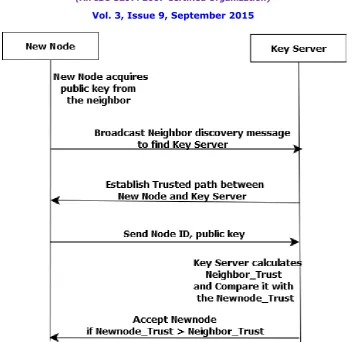
ABSTRACT: Mobile Ad Hoc Network (MANET) consists of set of independent mobile nodes communicate via radio waves. The nodes in the MANET are constantly moving and have no fixed topology. Due to these features the intermediate nodes take part in communication must trust each other. The proposed system calculates the global trust value of each node in the network using direct and indirect method. The malicious nodes in the network can be identified and eliminated. The communication between the nodes must take place only through the most trusted path in the network. It then monitor single node failure in the trusted path during data communication and finds most trusted next node of the failed node in the route through an alternate path. When a new node enters into the network the key server verifies the validity of the requesting node by checking for its trust value with the neighbors. If it is valid then authenticate it by the key server otherwise discard it from the network.
KEYWORDS: Direct Trust, Indirect Trust, MANET, PDR
I. INTRODUCTION
MANET is a collection of independent mobile nodes and its topology changes dynamically. When a source communicates with the destination, intermediate nodes route the packets. So the intermediate nodes must trust each other.
Trust
Trust can be defined as the degree of belief that nodes in the network correctly perform the task. The five basic properties of trust in MANET are subjectivity, dynamicity, nontransitivity, asymmetry and context dependence [1].
Subjectivity: The observer node in the network has a right to find out the trust value of an observed node. Dynamicity: Based on the behavior of each node, its trust value varies dynamically.
Nontransitivity: If node X trust node Y and node Y trust node Z then node X doesn’t trust node Z. Asymmetry: If node X trust node Y then node Y doesn’t trust node X.
Context dependence: Trust value of a node dependent on its behavior in the network.
The paper is organized as follows. Section I focus on Trust in MANET. Section II contains the background works related to the proposed system. Section III is devoted to detailed explanation of Proposed System. Section IV shows the simulation results. Conclusion and future work of the paper is included in section V.
II. RELATED WORK
Pallavi Khatri et al. [2] introduced a composite identity and trust based model which is a modified DSR routing protocol. The node in the network is authenticated using trust factor along with the key pair and identity of a node. After the authentication, a valid certificate is issued for authentic node to take part in communication.
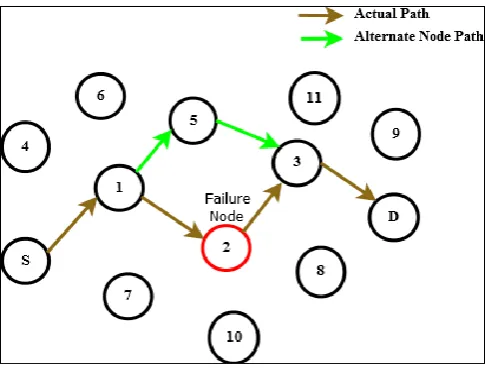
G.Rajkumar et al. [3] designed a short alternate path protocol. This protocol identifies link breaks or path failure during data communication and finds most trusted next node of the failed node in the route through an alternate path. This saves energy and catches the dropped packets at path failure.
III.PROPOSED SYSTEM
MANET has become the most commonly used communication technology in military environments. Trusting each node in the network increases the MANET security.
A. Block Diagram of Trust Based System
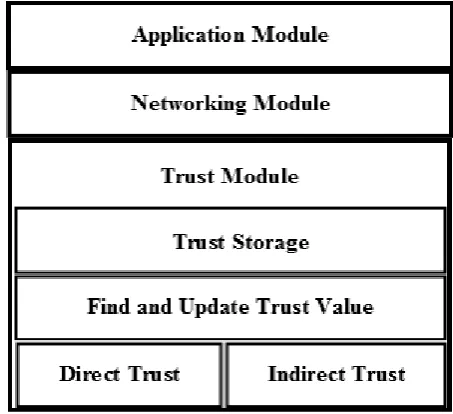
Figure 1: shows the block diagram of trust based system. The Trust module consists of Trust storage, Find and Update Trust, Direct Trust, Indirect Trust. Trust module calculates the trust value of each node using Direct and Indirect Trust value. The calculated trust value is stored in the Trust storage area. The Networking module establishes most secure trusted path between source and destination node. The Application module actually transfers data through the trusted path during communication.
Figure 1: Block Diagram of Trust Based System
B. Alternate Node Path Discovery
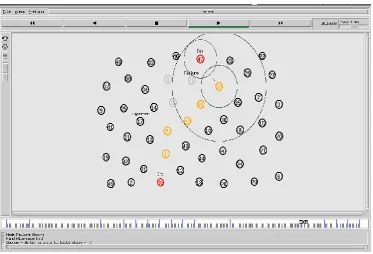
Figure 2: Node failure occurs during communication
Figure 3: Alternate Node Path Discovery
C. New Node Authentication
Figure 4: New Node Authentication
D. Proposed Algorithm
1. For every node in the network
1.1. Calculates PDR (Packet Delivery Ratio), mobility, previous trust value, number of neighbors to the node. 1.2. PDR = Number of packets received/ Number of packets forwarded.
1.3. If PDR > 1 then set PDR = 1. 1.4. Direct_trust = PDR.
1.5. Indirect_trust = mobility value + previous trust value + number of neighbors 1.6. Global_trust = Direct_trust + Indirect_trust
2. Assign high trust value node as Key Server.
3. Key Server generates the public key and broadcast it to all nodes in the network. 4. Find the most trusted path between Source and Destination node.
7.4.4.1.Discard new node and it is removed from the network.
IV. SIMULATION RESULTS
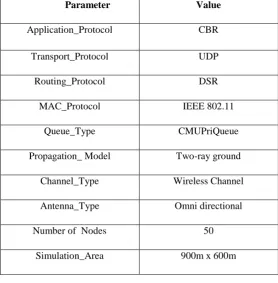
Network simulator 2.35 is used as the simulation tool for the evaluation of proposed system. The Table 1: show the simulation parameters and its value used in the NS 2.35 for the simulation of the proposed network.
A. Simulation Parameters
Parameter Value
Application_Protocol CBR
Transport_Protocol UDP
Routing_Protocol DSR
MAC_Protocol IEEE 802.11
Queue_Type CMUPriQueue
Propagation_ Model Two-ray ground
Channel_Type Wireless Channel
Antenna_Type Omni directional
Number of Nodes 50
Simulation_Area 900m x 600m
Table 1: Simulation Parameters
Initially all the nodes in the MANET are randomly placed in the defined area. Each scenario has a pair of source and destination nodes. The node with the high trust value is set as Key server.
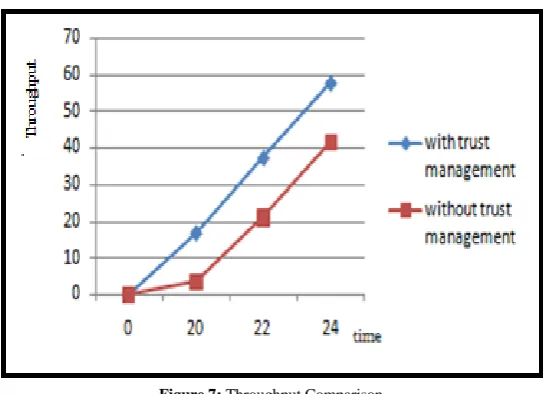
Figure 7: Throughput Comparison
The Figure 7: shows the comparison of throughput by including and excluding trust calculation into the given network. The graph obtained after introducing the trust management is higher that of one which is calculated without trust management.
V. CONCLUSION AND FUTURE WORK
In MANET, the nodes are constantly moving and have no fixed topology. The proposed trust management method improves the MANET security. Malicious nodes in the network are detected by calculating trust value of each node. It monitors single node failure and find the most trusted next node of the failed node in the route. Key server validates when a new node enters into the network.
The method is inefficient to detect multiple node failure. So future work extends to detecting multiple node failure in the routing path and establishes an alternate path.
REFERENCES
[1] Zhexiong Wei, Helen Tang, F. Richard Yu, Maoyu Wang, and Peter Mason, “Security Enhancements for Mobile Ad Hoc Networks with Trust
Management Using Uncertain Reasoning”, IEEE Transactions on Vehicular Technology, Vol. 63, No.9, November 2014.
[2] G.Rajkumar, K.Duraiswamy, “Streamlined Short Alternate Path Protocol for Mobile Ad hoc Networks”, 2013 IEEE International Conference
on Emerging Trends in Computing, Communication and Nanotechnology (ICECCN 2013).
[3] Pallavi Khatri, “Using Identity and Trust with Key Management for achieving security in Ad hoc Networks”, IEEE 2014.
[4] Aarti, Dr. S. S. Tyagi, “Study of MANET: Characteristics, Challenges, Application and Security Attacks”, International Journal of Advanced
Research in Computer Science and Software Engineering, Volume 3, Issue 5, May 2013.
[5] K.Seshadri Ramana “A Survey on Trust Management for MobileAd Hoc Networks”, International Journal of Network Security & Its