Fabrication and Testing of Composite
Materials for Relace Plastic Materials
Navinraj 1, Sivakumar 1, Naveenkumar 1, Pavithran 1 vairamani 2
U.G. Student, Department of Mechanical Engineering, Francis Xavier Engineering College, Vanarpettai, Tirunelveli,
Tamil Nadu, India 1
Associate Professor, Department of Mechanical Engineering, Francis Xavier Engineering College, Vanarpettai,
Tirunelveli, Tamil Nadu, India 2
ABSTRACT: The aim of this experimental study is to investigate the mechanical behavior of natural coconut coir and areca nut leaf reinforced polymer composite. The composite material is prepared using hand-layup technique and the mechanical properties are analyzed as per the ASTM standards. The effect of fiber loading influencing the mechanical properties like tensile strength, flexural strength, Impact strength and hardness of composites is studied. The moisture absorption ability of the material is also determined.
The mechanical behavior of the developed composite material shows that it can be used for various applications mainly for household furniture. The work proves that the waste coconut coir and areca nut leaf and can be transformed into a valuable product.
KEYWORDS: ASTM, hardness, composite materials, fibers
I. INTRODUCTION
1.1.COMPOSITE MATERIAL
II. LITERATURE SURVEY
The study on natural fiber based composite materials is increasing day by day. Mainly due to their advantages like light-weight, low cost. In particular coconut coir and areca nut leaf based polymer composite attracted the interest of many researchers, due to that several works weredone in this composites.
Sujeet Kumar [1] studied the mechanical behavior of coconut coir and areca nut leaf reinforced composite material based on epoxy resin. The specimen is prepared by means of hand lay-up process. It has been observed that fiber loading and length has major effect on the mechanical properties of composite like as hardness, impact, tensile and flexural strength. The composite with 10mm fiberlengthand 15% fiber contend. Show a better mechanical properties compare to the other composition involved in the study.
Alavudeen et al [2],studiedthe effect of weaving patterns and random orientation on the mechanical properties of coconut coir, kenaf and banana/kenaf fiber-reinforced hybrid polyester composites. Composites were prepared using hand lay-up method with two different weaving patterns, namely, plain and twill type. Of the two weaving patterns, the plain type showed improved tensile properties compared to the twill type in all the fabricated composites. Furthermore, the maximum increase in mechanical strength was observed in the plain woven hybrid composites rather than in randomly oriented composites. This indicates minimum stress development at the interface of composites due to the distribution of load transfer along the fiber direction. Moreover, alkali (NaOH) and sodium lauryl sulfate (SLS) treatments appear to provide an additional improvement in mechanical strength through enhanced interfacial bonding. Morphological studies of fractured mechanical testing samples were performed by scanning electron microscopy (SEM) to understand the de-bonding of fiber/matrix adhesion.
A.Baharin et al [3],produced laminated boards by laminating banana stem fiber boards with banana leaf tapes. Various laminated boards were created by changing the number of layers of leaf tapes. The tensile strength, elongation at break, flexural modulus and impact strength of the laminated boards increased with increasing number of layers of the leaf tapes. The elastic modulus of the laminated boards, however, showed the opposite trend. The orientation of fiber in the leaf tapes has little effect on impact strength but other properties studied show that the properties measured along the fiber orientation were higher than that in the perpendicular direction.
Madhukiran.J et al [5], carried out the investigation of the flexural properties of composites made by reinforcing banana and pineapple as the new natural fibers into epoxy resin matrix. The natural fibers were extracted by retting and manual process. The composites are fabricated using banana and pineapple fiber reinforcements. Hybrid composites were prepared using banana/pineapple fibers of 0/40, 15/25, 20/20, 25/15, and 40/0 weight fraction ratios, while overall fiber weight fraction (Wf) was fixed as 0.4. It has been observed that the flexural properties increase with the increase in the weight fraction of fibers to certain extent. The hybridization of the reinforcement in the composite shows greater flexural strength when compared to individual type of natural fibers reinforced composites. All the composites shows increase in flexural strength in longitudinal direction. Similar trends have been observed for flexural modulus, inter laminar shear strength and break load values.
III. EXPERIMENTAL SET UP AND PROCEDURE
PREPARATION OF MOLD AND MIXTURE
The raw materials used in this experimental work are
Natural fibers
Epoxy resin – LY556 and
Hardener–HY951.
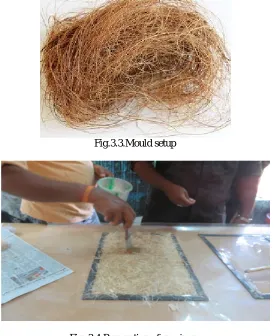
technique is done for various weight fraction. The mould setup and preparation of specimen is shown in Fig. 3.3 and 3.4.
Fig.3.3.Mould setup
Fig. 3.4 Preparation of specimen
IV RESULTS AND DISCUSSIONS
4.1. TENSILE TEST
From the above result it clearly show that the tensile strength increases with the fiber content and the highest value is obtained at N15. It has been observed that the tensile strength of composites increases with increase in fiber loading that was indicated in many studies[6].
4.2. FLEXURAL TEST
Fig. 4.2.Flexural strength for different composition of coconut coir and areca nut leaf epoxy composites study samples
It shows that when fiber loading increases the flexural strength of the fabricated composites decreases.The decrease in flexural strength is due to a poor interface bonding among the coconut coir and areca nut leaf and epoxy. As the vol. % of coconut coir and areca nut leaf increases, the vol.% of epoxy decreases which makes an ineffective stress transfer from the matrix to the fibers, thus not allowing a full exploitation of the reinforcement[6].
4.3. IMPACT TEST
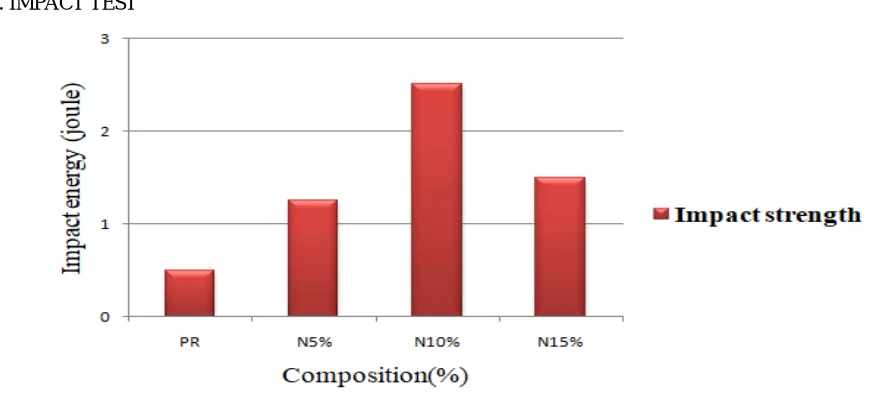
In case of impact strength, a higher value is given by 10% of fiberreinforcement.It has been observed that the impact strength of composites increases with increase in fiber loading to an extent of 10% fiber reinforcement. Impact properties are depends upon the cellulose content in the fibers
V. CONCLUSION
A composite based on natural fiber and polymer was fabricated by hand layup technique and its mechanical characteristic were tested according to ASTM standard. From the experimental study the following conclusions have been drawn.
The tensile strength of the composite increase with the fiber loading and the maximum fiber composition used in the study (15%) show the maximum tensile strength. The tensile strength show an increasing responses with the increase in fiber content in the composite.
The flexural strength behaves contrary to the tensile strength, in which the flexural strength decrease with the increase in fiber content. The maximum flexural strength is given by the pure resin.
The impact strengthIncreases up to 10% of fiber loading.But if the fiber content exceeds 10% of fiber loading, the fibers get contacted with themselves and due to this contact of fibers, the impact strength decreases.
REFERENCES
[1]Sujeet Kumar, Study on mechanical behavior of coconut coir and areca nut leaf reinforced epoxy composite, Department of mechanical engineering, National institute of technology, Rourkela 769008.
[2] A. Alavudeen et al, Centre for Composite Materials, Department of Mechanical Engineering, Kalasalingam University, Krishnankoil, Virudhunagar 626 126, Tamil Nadu, India.
[3] A.Baharin et al, School of Industrial Technology, UniversitiSains Malaysia.
[4] Nityanandakalia, synthesis and mechanical behavior of epoxy-fly ash material, Department of Ceramic Engineering National Institute of Technology Rourkela.