Manufacturing Process of Polymer Matrix
Composite with different description Process
Yogesh M 1, Hari Rao A N 2
Department of Mechanical Engineering, GSSS Institute of Engineering & Technology for Women, Mysore,
Karnataka, India1.
Department of Mechanical Engineering, Sri Jayachamarajendra College of Engineering, Mysore, Karnataka, India. 2
ABSTRACT: Polymer Matrix composite materials have been used to fabricate many structural parts in engineering applications. This is due to their many attractive characteristics such as light weight, high strength, high stiffness, good fatigue resistance and good corrosion resistance. Also, the ability to manufacture parts with complicated geometry using fewer components enables manufacturers to save cost as compared with the same parts made of conventional metallic materials. Before presenting the fundamental aspects of manufacturing and different techniques used for Polymer composites manufacturing, it is appropriate to present composite structural parts currently in use and the main techniques that have been used to fabricate them.
KEYWORDS:-Composite, Polymer Composite, Manufacturing Process, Thermoset and Thermoplastic
I. INTRODUCTION
Composites are classified according to their matrix phase. There are polymer matrix composites (PMCs), ceramic matrix composites (CMCs), and metal matrix composites (MMCs). Materials within these categories are often called "advanced" if they combine the properties of high strength and high stiffness, low weight, corrosion resistance, and in some cases special electrical properties. This combination of properties makes advanced composites very attractive for aircraft and aerospace structural parts.
This paper deals with a segment of the polymer composite industry known as advanced polymer matrix composites, or advanced composites. Since the reinforced plastics or polymer matrix composite industry is much larger than the subject of this chapter, the term "advanced composites" is used here to define this special segment of the industry. This sector of the composites industry is characterized by the use of expensive, high-performance resin systems and high-strength, high-stiffness fiber reinforcement. The aerospace industry, including military and commercial aircraft of all types, is the major customer for advanced composites. These materials have also been adopted for use by the sporting goods suppliers who sell high performance equipment to the golf, tennis, fishing, and archery markets. While aerospace is the predominant market for advanced composites today, the industrial and automotive markets will increasingly see the use of advanced composites toward the year 2000. At present, both manual and automated processes are employed in making advanced- composite parts. As automated processes become more predominant, the costs of advanced composites are expected to decline to the point at which these materials will be used widely in electronic, machinery, and surface transportation equipment.
II. THE MANUFACTURING PROCESS
A) Elements
The feature common to all composite processes is the combining of a resin, a curing agent, some type of reinforcing fiber, and in some cases a solvent. Typically, heat and pressure are used to shape and "cure" the mixture into a finished part.In composites, the resin acts to hold the fibers together and protect them, and to transfer the load to the fibers in the fabricated composite part. The curing agent, also known as hardener, acts as a catalyst and helps in curing the resin to a hard plastic. The reinforcing fiber imparts strength and other required properties to the composite [3]. Solvents may serve three purposes:
As part of the resin mixture,
As part of the process, and
As a cleaning agent for removing residue from the process equipment.
B) Major Processes
Diagrams of the major processes used in the advanced composites industry are provided in Section A. The processes vary widely in type of equipment and potential worker exposure. Several of the processes are automated; however, some are manual and require worker contact with the part during manufacture. The basic process types are described below.
Formulation: - is the process where the resin, curing agent, and any other component required are mixed together. This process may involve adding the components manually into a small mixing vessel or, in the case of larger processes, the components may be pumped into a mixing vessel. The potential hazards involve skin, eye, and respiratory contact with the ingredients or final formulation.
Prepregging: - is the process where the resin and curing- agent mixture are impregnated into the reinforcing fiber. These impregnated reinforcements (also known as prepregs) take three main forms: woven fabrics, roving, and unidirectional tape. Fabrics and tapes are provided as continuous rolls in widths up to 72 inches and lengths up to several hundred feet. The fabric or tape thickness constitutes one ply in the construction of a multi-ply layup. Impregnated roving is wound onto cores or bobbins and is used for filament winding. Once the resin mixture has been impregnated onto the fibers, the prepreg must be stored in a refrigerator or freezer until ready for use in the manufacturing process. This cold storage prevents the chemical reaction from occurring prematurely. Prepreg materials are used widely in the advanced composite industry, particularly in aircraft and aerospace. Potential exposure is generally from handling of the fiber or resin.
Open Molding: - processes are those where the part being manufactured is exposed to the atmosphere. The worker typically handles the part manually, and there is a higher potential for exposure. The resin mixture may be a liquid being formed onto a reinforcing material or it may be in the form of a prepreg material being formed for final cure.
Closed Molding: - processes are those in which all or part of the manufacture takes place in a closed vessel or chamber. The liquid resin mixture or prepreg material may be handled or formed manually into the container for the curing step. In the case of liquid resin mixtures, these may be pumped into the container, usually a mold of some type, for the curing step. These processes usually have less worker exposure potential, particularly if the entire process is closed.
Sequential: - or batch processes involve manufacture of a single part at a time, in sequence. This type of process is usually required where the part being made is small and complex in shape, when the curing phase is critical, when finishing work must be minimized, or where a small number of parts is involved.
III. POLYMER MATRIX COMPOSITE (PMC) RESIN SYSTEM
The advanced composite processes are discussed in more detail in description process. Seven manufacturing processes are covered, along with two preliminary processes and two finishing processes. The number and variety of processes should give some indication of the wide spectrum of workplaces likely to be encountered by field personnel. Potential worker exposure obviously will also vary widely, depending on the size and type of process being used. Since the advanced composite industry is relatively new and still developing, other processes may be developing or changing to meet new performance requirements. Advanced composites exhibit desirable physical and chemical properties that include light weight coupled with high stiffness and strength along the direction of the reinforcing fiber, dimensional stability, temperature and chemical resistance, flex performance, and relatively easy processing. Advanced composites are replacing metal components in many uses, particularly in the aerospace industry [4].
A) Resins
The resin systems used to manufacture advanced composites are of two basic types: thermosetting and thermoplastic. Thermosetting resins predominate today, while thermoplastics have only a minor role in advanced composites manufacture.
B) Thermosets
Thermoset resins require addition of a curing agent or hardener and impregnation onto a reinforcing material, followed by a curing step to produce a cured or finished part. Once cured, the part cannot be changed or reformed, except for finishing. Some of the more common thermoset include:
Epoxies,
Polyurethanes,
Phenolic and amino resins,
Bismaleimides (BMI, Polyimides), and
Polyamides.
Of these, epoxies are the most commonly used in today's PMC industry. Epoxy resins have been in use in U.S. industry for over 40 years. The basic epoxy compounds most commonly used in industry are the reaction product of epichlorohydrin and bisphenol-A. Epoxy compounds are also referred to as glycidyl compounds. There are several types of epoxy compounds including glycidyl ethers (or diglycidyl ethers), glycidyl esters, and glycidyl amines. Several of these compounds are reactive diluents and are sometimes added to the basic resin to modify performance characteristics. The epoxy molecule can also be expanded or cross-linked with other molecules to form a wide variety of resin products, each with distinct performance characteristics. These resins range from low-viscosity liquids to high-molecular weight solids. Typically they are high-viscosity liquids. Since epoxies are relatively high high-molecular-weight compounds, the potential for respiratory exposure is fairly low. The potential for respiratory exposure is increased when the resin mixture is applied by spraying or when curing temperatures are high enough to volatilize the resin mixture. The potential for dermal exposure is typically much greater than respiratory exposure when working with epoxies. Several advanced composite processes involve some worker contact with the resin mixture. These and the other processes are discussed in more detail in this study.
aliphatic and cycloaliphatic amines, polyaminoamides, amides, and anhydrides. Again, the choice of curing agent depends on the cure and performance characteristics desired for the finished part.
Polyurethanes are another group of resins used in advanced composite processes. These compounds are formed by reacting the polyol component with an isocyanate compound, typically toluene diisocyanate (TDI); methylene diisocyanate (MDI) and hexamethylene diisocyanate (HDI) are also widely used. While the polyols are relatively innocuous, the isocyanates can represent a significant respiratory hazard as well as a dermal hazard.
Phenolic and amino resins are another group of PMC resins. With respect to the phenol-formaldehyde resins, the well-known hazards of both phenol and formaldehyde must be protected against. In addition to traces of free formaldehyde, they may also contain free phenol, and contact with these resins in the uncured state is to be avoided. The urea- and melamine-formaldehyde resins present similar hazards. Free formaldehyde which is present in trace amounts and may be liberated when their resins are processed can irritate the mucous membranes.
The bismaleimides and polyamides are relative newcomers to the advanced composite industry and have not been studied to the extent of the other resins.
C. Thermoplastics
Thermoplastics currently represent a relatively small part of the PMC industry. They are typically supplied as nonreactive solids (no chemical reaction occurs during processing) and require only heat and pressure to form the finished part. Unlike the Thermosets, the thermoplastics can usually be reheated and reformed into another shape, if desired.
D. Fiber Reinforcements
Fiber reinforcement materials are added to the resin system to provide strength to the finished part. The selection of reinforcement material is based on the properties desired in the finished product. These materials do not react with the resin but are an integral part of the advanced composite system. Potential worker exposure is typically higher in facilities that manufacture the fibers or use them to produce prepreg material. Most of the fibers in use are considered to be in the non-respirable range. However, they do have the potential to cause eye, skin, and upper respiratory tract irritation as a result of the mechanical properties of the fibers.
The three basic types of fiber reinforcement materials in use in the advanced composite industry are:
carbon/graphite,
aramid, and
Glass fibers.
Fibers used in advanced composite manufacture come in various forms, including:
Yarns,
Rovings,
Chopped strands,
Woven fabric, and
Mats.
Each of these has its own special application. When prepreg materials are used in parts manufacture, woven fabric or mats are required. In processes such as filament wet winding or pultrusion, yarns and rovings are used. The most commonly used reinforcement materials are carbon/graphite fibers. (The terms graphite and carbon are often used interchangeably.) This is due to the fact that many of the desired performance characteristics require the use of carbon/graphite fibers. Currently, these fibers are produced from three types of materials known as precursor fibers:
Polyacrylonitrile (PAN),
Rayon, and
Petroleum pitch.
Carbon/graphite fibers: - are produced by the controlled burning off of the oxygen, nitrogen, and other non-carbon
are run through a furnace to produce either carbon or graphite fibers. Carbon fibers are produced at furnace temperatures of 1000-2000º C, while graphite fibers require temperatures of 2000-3000º C. At these temperatures the carbon atoms in the fibers are rearranged to impart the required characteristics to the finished fiber. The PAN-based fiber is the more commonly used precursor in the advanced composite industry today.
Aramid fibers: - are another man-made product. These fibers are produced by manufacturing the basic polymer, then
spinning it into either a paper-like configuration or into fiber. Aramid fibers have several useful characteristics:
High strength and modulus,
Temperature stability,
Flex performance,
Dimensional stability,
Chemical resistance, and
Textile Processibility.
Glass Fibers: - Textile (continuous filament) glass fibers are the type used in composite reinforcement. These fibers differ from the wool type in that they are die-drawn rather than spun.
Solvents: - A number of solvents are used in the advanced composites industry. These may be introduced into the workplace in three basic ways:
As part of the resin or curing agent,
during the manufacturing process, or
As part of the cleanup process.
Most of the solvents used may be introduced in any or all of the three ways above. For this reason it would be difficult, if not impossible, to separate the solvents into the categories of use.
The solvents discussed in this section are grouped by chemical class:
Ketones,
Alcohols,
Chlorinated hydrocarbons, or
Others.
Several solvents may be used in any one composite process. One or more may be introduced as part of the resin or curing agent, while another may be a part of the manufacturing process. Still another may be used for cleanup. Thus the hazard information for all products used in the process must be considered when evaluating potential exposures. The supplier's Safety Data Sheet (SDS) should be consulted for more specific hazard information.
Composite residues are often difficult to clean from operation equipment and molds. Various solvents have been used for cleaning, with varying degrees of success. Solvents in the workplace may be found in several areas:
In small containers near process equipment,
In larger containers (drums or vats) for soaking and cleaning, or
In process equipment containers (tanks, reactors, molds, etc.)
IV. DESCRIPTION OF PROCESSES
A brief description of each process is given, followed by a basic diagram. Details on Application and information about the Advantages provided in Sections V and VI.
A. Resin Formulation:- Resin formulation consists of mixing epoxy or other resins with other ingredients to achieve
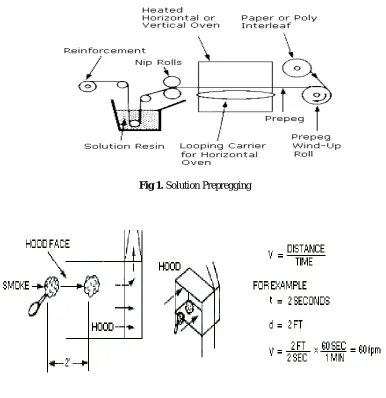
B. Prepregging:- Prepregging involves the application of formulated resin products, in solution or molten form, to reinforcement such as carbon, fiberglass or aramid fiber or cloth. The reinforcement is saturated by dipping through the liquid resin (solution form, see Fig 1.) or by being impregnated through heat and pressure (Hot melt form, see Fig 2.).
Fig 1. Solution Prepregging
Fig 2. Hot Melt Prepregging
C. Wet Filament Winding:- In the filament wet winding process, continuous fiber reinforcement materials are drawn
Fig 3. Wet Filament Winding
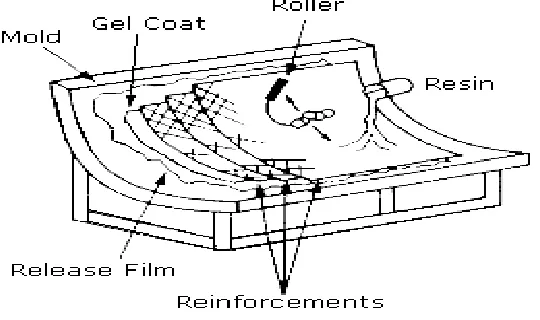
D. Hand Lay-up of Prepreg:- A prepreg product is laid down and formed to the desired shape (Fig 4.). Several layers may be required. After forming, the lay-up assembly is moved to an autoclave for cure under heat, vacuum and pressure.
Fig 4. Hand Layup of Prepreg
E. Automated Tape Lay-up:- In this process, the prepreg tape material is fed through an automated tape application
Fig 5. Automated Tape Lay-up
F. Resin Transfer Molding:- Resin transfer molding is used when parts with two smooth surfaces are required or when a low-pressure molding process is advantageous. Fiber reinforcement fabric or mat is laid by hand into a mold and resin mixture is poured or injected into the mold cavity. The part is then cured under heat and pressure (Fig 6.).
Fig 6. Resin Transfer Molding
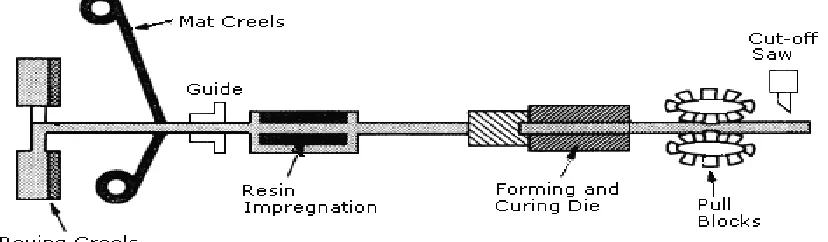
G. Pultrusion:- In the pultrusion process, continuous roving strands are pulled from a creel through a strand-tensioning device into a resin bath. The coated strands are then passed through a heated die where curing occurs. The continuous cured part, usually a rod or similar shape, is then cut to the desired length (Fig 7.).
H. Injection Molding:- One of the older plastics processes, injection molding is also the most closed process. It is not normally used in PMC processes due to fiber damage in the plasticating barrel. Thermoplastic granules are fed via a hopper into a screw-like plasticating barrel where melting occurs (Fig 8.). The melted plastic is injected into a heated mold where the part is formed. This process is often fully automated.
Fig 8. Injection Molding
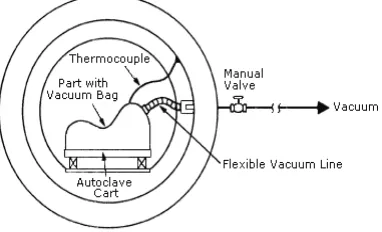
I. Vacuum Bagging & Autoclave Curing:- Most parts made by hand lay-up or automated tape lay-up must be cured
by a combination of heat, pressure, vacuum, and inert atmosphere. To achieve proper cure, the part is placed into a plastic bag inside an autoclave (Fig 9.). A vacuum is applied to the bag to remove air and volatile products. Heat and pressure are applied for curing. Usually an inert atmosphere is provided inside the autoclave through the introduction of nitrogen or carbon dioxide. Exo-therms may occur if the curing step is not done properly.
Fig 9. Vacuum Bagging & Autoclave Curing
J. Machine Finishing:- Many of the parts made in PMC processes require some machining and/or finishing work. This
may involve drilling, sanding, grinding, or other manual touch-up work. These processes vary widely, depending on the size of the finished part and the amount of finishing work required.
V. APPLICATIONS OF PMC’S
1. Just as with most new materials, the development of high performance polymer composites has driven by military
and later aero space, marine, automotive and many more. PMCs are used for manufacturing;
2. Aerospace structures: The military aircraft industry has mainly led the use of polymer composites. In commercial airlines, the use of composites is gradually increasing. Space shuttle and satellite systems use graphite/ epoxy for many structural parts.
3. Marine: Boat bodies, canoes, kayaks etc.
4. Automotive: Body panels, leaf springs, drive shaft, bumpers, doors, racing car bodies, and etc. 5. Sports goods: Golf clubs, skis, fishing rods, tennis rackets, and etc.
6. Bullet proof vests and other armor parts.
7. Chemical storage tanks, pressure vessels, piping, pump body, valves, and so on. 8. Biomedical applications: Medical implants, orthopedic devices, X-ray tables.
9. Bridges made of polymer composite materials are gaining wide acceptance due to their lower weight, corrosion
resistance, longer life cycle, and limited earthquake damage.
10. Electrical: Panels, housing, switchgear, insulators, and connectors and many more.
VI. CONCLUSION
The present study has dealt with the Manufacturing Processes of Polymer Matrix Composite with different description of Processes with this advantage.
1. Composites can be very strong and stiff, yet very light in weight, so ratios of strength-to-weight and stiffness-to-weight are several times greater than steel or aluminum.
2. Fatigue properties are generally better than for common engineering metals. 3. Toughness is often greater than most of the metals.
4. Composites can be designed that do not corrode like steel.
5. Possible to achieve combinations of properties not attainable with metals, ceramics, or polymers alone
6. The more efficient processing methods for manufacturing PMCs are important in order to obtain more
commercially viable products.
7. Further the researchers are introducing and investigating a hybrid processes (merging manufacturing technologies
into a single continuous process) as an efficient solution for shortening process chains and improving performance of processed materials
8. The merging manufacturing technologies to process composite materials will have to face a lot of changes within
the next decades and it certainly will remain as an interesting field of activity.
REFERENCES
[1] Advanced Composites Glossary. Blaise Technoire, San Marcos, Calif.
[2] Doyle, E. J. Suggested Strategies in Screening for Health Effects in Personnel who Work with Composites. Applied Industrial Hygiene Special Issue: December 1989. Pp 64-67.
[3] Engineered Materials Handbook, Vol. 1: Composites. ASM International, Metals Park, Ohio: 1987. [4] Lubin, G., Ed. Handbook of Composites. Van Nostrand Reinhold Co., New York: 1982.