"KHONSAR -TM'' A New, Replaceable, High Energy Dissipating, Beam-to-Column
Connection for Skeletal Structures
S.V. Khonsari ~), G.L. England 2) and S.M.H. Parvinnia 3)
1) Department of Civil Engineering, SharifUniversity of Technology, Tehran, Iran
2) Department of Civil and Environmental Engineering, Imperial College of Science, Technology & Medicine, London, UK 3) Department of Civil Engineering, International University, Ghazvin, Iran
ABSTRACT
A new semi-rigid structural connection has been devised to be used in various situations for connecting various structural members to each other, e.g. beams to columns, bracing systems to frames, bridge girders to piers/abutments, members of off- shore platforms to one another, etc. The connected elements can be of various, and even 'different' materials, steel, concrete, wood, etc. The geometry of the connection is so devised that it allows much higher rotations to develop before its failure, compared with its conventional counterparts. Due to the use of sacrificial high energy absorbing elements within this connection, it can absorb and dissipate high amounts of energy prior to its failure. Also, since it is fabricated independently of the beam and the column that it is designed to connect, it can be further housed in a heat-treating oven to be subjected to the desired thermal cycle, annealing, tempering, etc. Thus, restoring its ductility, lost/degraded as a result of manufacturing operations, in particular, welding and/or flame-cutting. Owing to the three afore-mentioned reasons, it has high energy- dissipation capacity. Moreover, since it is a separate entity with the ability to 'contain' the damage within itself, it can work in a 'sacrificial capacity,' 'replaceable' after dissipating a certain amount of energy, say during an earthquake or a blast, leaving the rest of the structure intact. By changing the geometric and/or material parameters of the comprising elements, the stiffness, the strength, and the energy absorption capacity of the connection can be so adjusted to the demand of the structure that while under service loads it supplies the expected rigidity and the required resisting moment, if the structure is overloaded, the connection fails after absorbing a certain amount of energy. Comprehensive experimental study of the comprising energy-dissipating elements showed the crucial role of annealing in eliminating the embrittlement effects of welding on the specimens, in particular the developed cracks. Also, limited number of tests, carried out on the connection, called KHONSAR, under 'monotonic' loading regime, proved all of the above claims. The extruded aluminium-alloy version of this type of connection is expected to reduce the cost of fabrication tremendously.
INTRODUCTION
The crucial role of connections in controlling the behaviour of structures, as well as in being at the forefront of receiving damage, established through experimental and theoretical studies, is indisputable. While under service loads and beyond, the behaviour of a structure is to a great extent controlled by the behaviour of its connections, if the loads are so increased to initiate damage, it is normally the connections which fail first rather than structural members, the beams and the columns. Therefore, it will not be wrong to claim, "the destiny of structures is determined by their connections."
Despite the long history of studying the behaviour of connections, in particular through experimental methods, which goes back to 1917, major activities in this field have been concentrated into the last three decades. However, this does not undermine the importance of the early work, especially, that of W.M. Wilson & H.F. Moore, of the University of Illinois, on riveted beam-to-column joints, published in 1917 [ 1 ]. Also, that of C. Batho and his co-workers, of Birmingham University, on various types of beam-to-column connections with various degrees of rigidity, published during the mid 1930s [2-3]. A summary of these can be found in the book by J.F. Baker [4]. A comprehensive report, written by D.A. Nethercot, reviewed most of the work carried out by the time of its publication, 1985 [5]. Also, Chen & Kishi reported on an electronic data bank, developed at Purdue University, called SCDB, under the Steel Connection Data Bank Program [6]. This data bank was claimed to have gathered digitized results of tests, carried out on structural connections in various parts of the world.
THE OBJECTIVES AND CHARACTERISTICS OF THE NEW CONNECTION
While any type of loading can push a structure to its limits of load-bearing capacity, these days it is normally violent, intractable, and disobedient loadings such as earthquake and blast, which still can cause severe damage to the structures, rather than dead or live loads. The cost of the damage incurred during the 1994 earthquake of Northridge, California, was
SMiRT 16, Washington DC, August 2001 Paper # 1300
estimated at $ 20 b [7]. And, in most of the cases it was the connections, which, in one way or another, were blamed for causing the major damage. Cracks developed as a result of welding performed on the connections, initiated at the weld area, and in some cases had even propagated through the flange and the web of the connected column.
Taking into account that connections are at the forefront of receiving damage in a severe loading, it will be beneficial, from the economical point of view, to devise a connection, which can be replaced after receiving severe damage. On the other hand, if such a goal can be achieved, why allowing other elements of the structure, i.e. beams and columns, whose replacement after construction is not easily viable, to be damaged to an extent which would require replacement. Thus, it means that the connection should be able to contain the damage within itself and prevent it from spreading through the rest of the structure. Also, it is the connection that should undergo permanent deformations, and thereby absorb and dissipate energy. Various structural connections, developed and used so far, have not shown much ability to absorb energy, even when reaching the extent of total destruction. This limited ability, as far as the authors are concerned, can be attributed to the fact that, almost in all of them, the energy absorption capacity of the connection is mostly supplied by the ductility of the material(s) of its comprising elements, including the connected beam and column. So far, the 'geometry' of these connections has been so restrictive that not much relative rotation of the engaging parts has been possible. Therefore it has not been exploited effectively in the energy absorption process of the connection hence in that of the structure. Moreover, in practice, this limited ability to absorb energy is further reduced by embrittlement effects of various fabricating operations such as welding and flame cutting- the natural cooling rate of the melted steel in the air normally turns it into a brittle phase called "martensite" [8-9]. The ductility of the resulted brittle connection would be restored if it could be housed in a heat treatment oven to be subjected to an annealing process. However, because in basically all of the conventional connections in which welding in some way is used, the connection becomes an integral part of the structure, the size of the created combination of beam, column and connection is so large that it cannot be housed in an annealing oven and performing such operation becomes almost impossible. Moreover, regardless of the amount of energy dissipated, the destruction of the connection has usually been accompanied by the destruction of the engaging beam and column, at least at the vicinity of the connection. In order to prevent the propagation of damage into the beam and column, the connection should be able to 'contain' the damage within itself. Thus, a desired connection should fulfill the following requirements. It should be able to:
1- deliver large rotations.
2- be subjected to the desired heat-treatment process. 3- absorb and dissipate large amounts of energy. 4- contain damage within itself.
5- be replaced.
With these objectives in mind, a new connection was developed by the first author at Sharif University of Technology, named KHONSAR, after the name of an Iranian city. During the recent one-year academic visit of the first author at Imperial College of Science, Technology and Medicine, it was patented by its technology transfer company, Imperial College Innovations Ltd. In order to include all of the above features in one single working package, the desired connection should be made independently of the beam and the column it is to connect. In other words it should be fabricated as a separate entity, say a box. This box should have a special type of geometry, which would allow it to deliver large rotations upon exertion of large moments. Also, some high energy absorbing devices (elements) should be incorporated in it. Now, because this separate entity is of a limited size, it can be housed in an annealing furnace and be subjected to the proper thermal cycle to restore its ductility. Thus its energy absorption capacity is improved due to three sources. First, because of its non-restrictive geometry and its ability to deliver large rotations. Second, because of the use of high energy absorbing elements. Third, because of its restored ductility. Later on, this box can be connected to the beam and the column through non-destructive or less-destructive fasteners such as bolts and nuts.
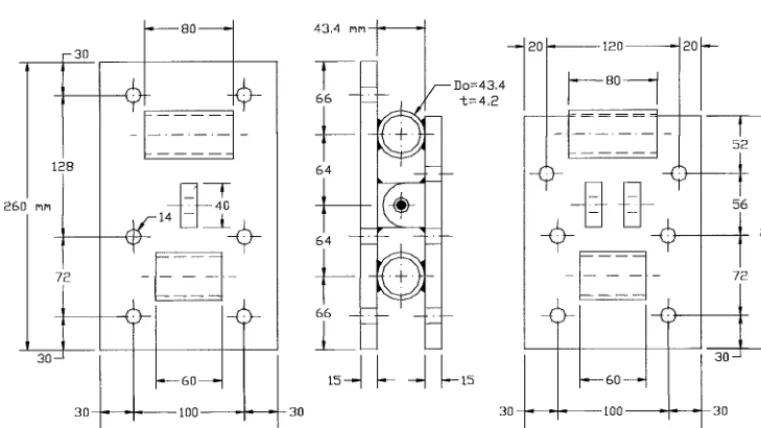
The connection comprises two parallel attachment plates of relatively high rigidity between which two high-energy absorbing elements are laid and w e l d e d - one in the area where the connection is under compression and the other in the tension zone. As high energy absorbing elements, circular cylindrical tubes under diametral tension and compression are used. Though other types of tubes such as square, rectangular, or hexagonal can be used equally. The relation of the two attachment plates can be further strengthened by adding a real hinge between them to work as the rotation axis of the connection and also to facilitate the transfer of high amounts of shear. The typical configuration of the connection together with the dimensions used in the experimental studies is shown in Fig. 1. Despite its fairly complicated shape, it can be prefabricated and annealed in mass in a workshop with a good degree of precision and at a reasonable cost.
CONDUCTED TESTS AND T H E I R RESULTS
vicinity of the welded areas, almost all of the annealed specimens showed no c r a c k i n g - only in rare cases, just 'surface cracks' developed in annealed specimens, whereas some unannealed specimens 'split' into two peaces as a result of development of two full-depth full-length parallel longitudinal cracks. Annealing is a process, which can be practised in a workshop without much increase in the cost, whereas field welding does not allow such practices. This potential, at least to the best of the authors' knowledge, has not been exploited by structural engineers. Measures such as pre-heating, post- heating, and/or using blankets to retard the cooling process of the welded areas and Heat-Affected Zones (HAZs) of the conventional connections, proposed by SAC [9], are believed not to be as effective as subjecting the connections to thermal cycles such as annealing, which take place in an annealing furnace in a controlled manner.
3O
260
~m
, ~ i4~--~40
I ::o_l
313 i = - - =
160 mm m 8O ~1
>
43,4 M ~ -
6 6 - - .
15JL
2 1 0 r~m
Fig. 1. The steel version of KHONSAR, with the dimensions as used in the tests.
Fig. 2 shows the photograph of the second T-shaped test assembly. In total, four almost-identical specimens were tested, using two T-shaped test assemblies, from which two 'average' moment-rotation curves were obtained. The maximum moments, maximum rotations, and the amount of absorbed energy of these two 'average' results are compared in Table 1 with those of two tests, carried out on end-plate connections, by W.M. Jenkins et al. [10]. Their 'test 3' specimen composed of an end-plate of 340x200x12 mm 3, connecting a 254x254UC132 column to a 305x165UB54 beam by 6 M20, grade 8.8 bolts, 4 in tension and 2 in compression. Their 'test 5' specimen, however, composed of an end-plate of 340x200x25 mm 3, connecting a beam and a column identical to those of 'test 3' through the same number of the same kind of bolts.
Table 1. Maximum moments and rotations together with total absorbed energy of the two (average) tested connections, KHONSAR1 & KHONSAR2, and two end-plate connections tested by Jenkins et ai., test3 and test5 [10].
Connection (Test) No. Max. (Final) Rotation Max. Moment Absorbed Energy
(radian) (kN.m) (N.m)
KHONSAR1 (C-l) 0.1489 14.0 1714
KHONSAR2 (C-2) 0.1532 13.7 1346
Test 3 (Jenkins et al.) 0.0249 93.5 1551
Fig. 2. Photograph of the second T-shaped test assembly [KHONSAR2 (C-2)], taken while the test was in progress.
As it is seen in Table 1, the amounts of absorbed energy are comparable, while the rotations of the devised connection are almost 6 times those of the end-plates. It is also five times the minimum inelastic rotation required by AISC [11], 0.03 radians. The maximum moments, however, are much lower for the two tested connections of the authors, compared with those of the two end-plate connections. The reason is that in the two new connections, it was the two tubes of 43.4 mm diameter and 4.2 mm thickness, one of 60 mm length and the other of 80 mm length, which took part in the energy absorption process and underwent permanent deformations - the two attachment plates, the bolts and the connected beam and column were so designed as to not deform plastically as such. Whereas in the end-plate connections quoted above, either of the constituting elements of the connection together with the beam and the column had contributed to the strength of the connection and the energy absorption process. The maximum resisting moment of the devised connection could be easily increased by increasing the length and the thickness of the tubes. To increase the diameter of the tubes while leaving other geometric parameters of the connection unchanged would lead to even higher rotational capacity. However, if this increase in the diameter were accompanied by the proper increase in the thickness and/or length of the tubes, the resulting connection would also have higher maximum resisting moment, which together with the increased rotational capacity would lead to much higher dissipated energy.
O T H E R VERSIONS O F T H E C O N N E C T I O N AND T H E I R A P P L I C A T I O N
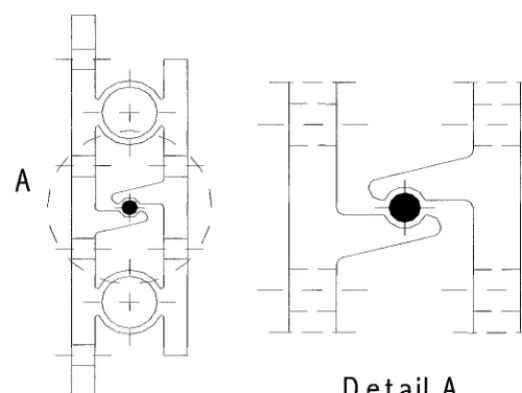
Fig. 3 illustrates an extruded aluminium version of the connection, which would significantly reduce the cost of fabrication. It also allows designers to have much more freedom in choosing the desired geometry. In this figure the middle hinge, removable in the absence of high shears, is part of the extrusion. The extra round bar acts as a hinge-pin, when tapped into the cavity created between the two arms, after extruding.
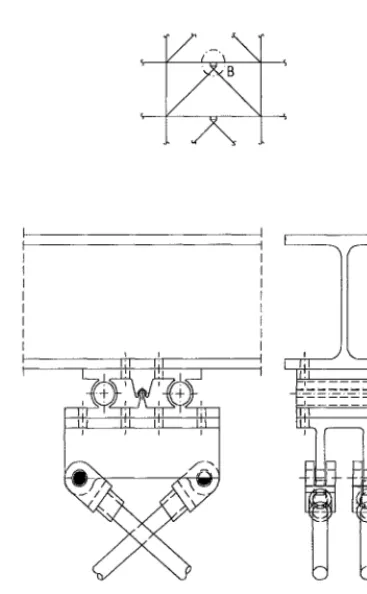
connecting the braces of a chevron type of bracing system to the beam of a concentrically braced frame (CBF), through an extruded double-T connecting block. CBFs are generally known for their extra high stiffness [7], and it is believed that this will introduce some degree of flexibility to their behaviour, making them more competent compared with EBFs.
m m
A
D etail A
Fig. 3. The extruded aluminium version with the integral continuous hinge arms at the middle and the separately- made hinge pin.
C O N C L U S I O N S
1. The use of this new 'unrestricted' configuration and geometry enables the devised connection to undergo very large rotations, much larger than those ever developed by any connection devised and used so f a r - the 0.15 radian observed during the conducted tests is a typical value, and even larger rotations are easily attainable.
2. The use of various kinds of cylindrical tubes, in particular circular ones, positioned so as to be loaded in lateral (diametral) tension and compression, as tensile and compressive elements of connections, enables structural engineers to design more efficient connections, as far as their energy absorption capacity is concerned.
3. As a separate entity, the devised connection can be mass-produced in a workshop to comply with the required precision, and at the same time to be more economical. Also, it can be subjected to the desired thermal cycle, such as annealing, in a heat-treating oven, to eliminate the adverse effects of welding, the embrittlement of the material, residual stresses, etc. 4. The ability of the devised connection to contain damage within itself without spreading it to the engaging parts it
connects, the beam and the column, is a characteristic which can be well exploited in structures located in earthquake- prone regions of the world. Also, in such structures as those of nuclear installations, which are liable to receive damage as a result of a shock or a blast. This will substantially reduce the cost of after-event repair of the structure.
5. Since the devised connection is a separate entity, bolted to the beam and the column it connects, with the ability to contain the damage, it can be replaced after being severely damaged. The location of the connections may be made accessible during the initial construction of the building to allow such replacements more viable and less costly.
6. The stiffness, the strength, as well as the energy dissipation capacity of the connection can be adjusted to the demand of the structure by using cylindrical tubes of various types (circular, square, hexagonal, irregular, etc.) and sizes.
7. The real hinge, placed at the middle of the connection, can be eliminated in the absence of large shears. This will make the connection simpler thus easier to be built. The other important implication is the reduction in the cost of manufacturing.
lateral force method," suggested by the UBC, is used. Values well above 12 for Rw are expected to be associated with such structures. However, in a dynamic analysis approach, such ductility would directly affect the dynamic response of the structure, again leading to attenuated earthquake-induced forces.
9. The cost of fabrication and annealing of the 'steel version' of the connection may be high. However, it is believed that its ability to contain damage, together with its replaceability, will reduce the cost of repair quite substantially, hence justifying the initial higher cost. Moreover, taking into account that mild steel has a high strength to weight ratio, and at the same time the ductility required for the crushing process to take place with high energy absorption efficiency, it can be regarded as a very good candidate for being used in this type of connection. This view is further strengthened by the current low prices of steel in the world.
10. The 'aluminium version' of the connection, due to the simplicity and high cost-effectiveness of 'extrusion,' as a producing technique, and due to the freedom that it provides for the designers in choosing the shape and the dimensions of the tubes, seems to be an excellent alternative to deal with the complexity and economy of the connection.
Fig. 4. The orthogonally-laid version, extruded in aluminium alloy.
ACKNOWLEDGEMENT
Financial and technical support of this project by Sharif University of Technology is gratefully acknowledged. Also, support provided by Imperial College of Science, Technology and Medicine for patenting the idea is much appreciated.
REFERENCES
2. Batho, C. and Rowan, H.C., "Investigations on Beam and Stanchion Connections," Second Report, Steel Structures Research Committee, H.M.S.O., London, 1934.
3. Batho, C. and Lash, S.D., "Further Investigations on Beam and Stanchion Connections," Final Report, Steel Structures Research Committee, H.M.S.O., London, 1936.
4. Baker, J.F., The Steel Skeleton, Vol. 1, Elastic Behaviour and Design, Cambridge University Press, Cambridge, UK,
1954.
5. Nethercot, D.A., "Steel Beam-to-Column Connections - - A Review of Test Data," CIRIA Project 338, London, 1985.
6. Chen, W.F. and Kishi, N., "Semirigid Steel Beam-to-Column Connections: Data Base and Modeling," Jr. Struct. Eng.,
ASCE, Vol. 115, 1989, No. 1, pp. 105-119.
7. Bruneau, M., Uang, C.M. and Whittaker, A., Ductile Design of Steel Structures, McGraw-Hill, N.Y., 1998.
8. Van Vlack, L.H., Elements of Materials Science and Engineering, Addison-Wesley, Reading, 1980.
9. SAC, "Interim Guidelines: Evaluation, Repair, Modification and Design of Steel Moment Frames," Chapter 8,
Metallurgy & Welding, Report No. SAC-95-02, SAC Joint Venture, Sacramento, California, 1995.
10. Jenkins, W.M., Tong, C.S. and Prescott, A.T., "Moment-Transmitting Endplate Connections in Steel Construction, and a
Proposed Basis for Flush Endplate Design," The Structural Engineer, Vol. 64A, No. 5, 1986, pp. 121-132.
11. AISC, "Seismic Provisions for Structural Steel Buildings," American Institute of Steel Construction, Chicago, Ill, 1997.
I~I lil
!
Detail B
i J
I II
!
![Fig. 2. Photograph of the second T-shaped test assembly [KHONSAR2 (C-2)], taken while the test was in progress](https://thumb-us.123doks.com/thumbv2/123dok_us/1539942.1188881/4.596.71.510.40.337/fig-photograph-second-shaped-assembly-khonsar-taken-progress.webp)