INVESTIGATION
Why Do More Divergent Sequences Produce Smaller
Nonsynonymous/Synonymous Rate Ratios in
Pairwise Sequence Comparisons?
Mario dos Reis and Ziheng Yang1
Department of Genetics, Evolution, and Environment, University College London, London, WC1E 6BT, United Kingdom
ABSTRACTSeveral studies have reported a negative correlation between estimates of the nonsynonymous to synonymous rate ratio (v=dN/dS) and the sequence distanced in pairwise comparisons of the same gene from different species. That is, more divergent sequences produce smaller estimates of v. Explanations for this negative correlation have included segregating nonsynonymous polymorphisms in closely related species and nonlinear dynamics of the ratio of two random variables. Here we study the statistical properties of the maximum-likelihood estimates of v andd in pairwise alignments and explore the possibility that the negative correlation can be entirely explained by those properties. We show that thevestimate is positively biased for smalldand that the bias decreases with the increase ofd. We also show that the estimates ofvanddare negatively correlated whenv,1 and positively correlated when v.1. However, the bias in estimates ofvand the correlation between estimates ofvanddare not enough to explain the much stronger correlation observed in real data sets. We then explore the behavior of the estimates when the model is misspecified and suggest that the observed correlation may be due to protein-level selection that causes very different amino acids to be favored in different domains of the protein. Widely used models fail to account for such among-site heterogeneity and cause underestimation of the nonsynonymous rate andv, with the bias being much stronger for distant sequences. We point out that tests of positive selection based on thevratio are invariant to the parameterization of the model and thus unaffected by bias in thev
estimates or the correlation between estimates ofvandd.
N
ATURAL selection acts differently on synonymous and nonsynonymous mutations in protein-coding genes (Ki-mura 1977). For almost all proteins, the nonsynonymous distance (dN, measured by the number of nonsynonymous substitutions per nonsynonymous site) is smaller than the corresponding synonymous distance (dS, measured by the number of synonymous substitutions per synonymous site), because the structure and function of a protein impose con-straints on the types of nonsynonymous (amino acid) substi-tutions that can take place, while synonymous substisubsti-tutions usually accumulate freely with little or no interference from selection. In contrast, a large nonsynonymous distance (dN.dS) is a strong indicator of positive (diversifying) selection acting on the protein (e.g., Messier and Stewart 1997). The nonsynonymous to synonymous rate ratio, v =dN/dS, in a
protein-coding gene is thus an important measure of the mode and strength of selection acting on the protein, and it is widely used in detecting positive Darwinian selection [indicated by v .1 (Yang and Bielawski 2000)] and also as a descriptive statistic calculated from pairwise sequence alignments.
A number of recent studies have reported a negative correlation between estimates of v and the evolutionary distance d(the total distance separating the sequences, in-cluding nonsynonymous and synonymous changes) in pair-wise comparisons of the sequences for the same gene from various organisms (Rocha et al. 2006; Peterson and Masel 2009; Wolf et al. 2009). For example, Rochaet al.(2006) found that pairwise estimates ofvare larger among closely related bacterial genomes. They proposed that deleterious nonsynonymous polymorphisms explain the larger estimates of v between closely related sequences. As the time of di-vergence between species increases, nonsynonymous poly-morphisms are lost due to purifying selection and thevratio decays as a function of time. Similarly, Wolf et al. (2009) reported a negative correlation between estimates ofvand
Copyright © 2013 by the Genetics Society of America doi: 10.1534/genetics.113.152025
Manuscript received April 5, 2013; accepted for publication June 17, 2013 1Corresponding author: Department of Genetics, Evolution, and Environment,
d in comparisons among several mammalian and avian genomes. They argued that this correlation is the result of
^
v being the ratio of two random variables (dNanddS) and suggested that current statistical tests based on v (for ex-ample, likelihood-ratio tests of positive selection comparing the null hypothesisv= 1 against the alternative hypothesis v .1) are inappropriate in light of the nonlinear behavior of the ratio of random variables.
The observed pattern of decay of v^ as a function of ^d
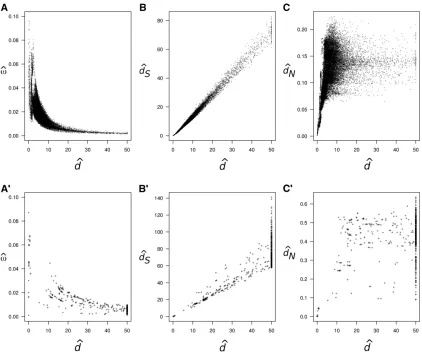
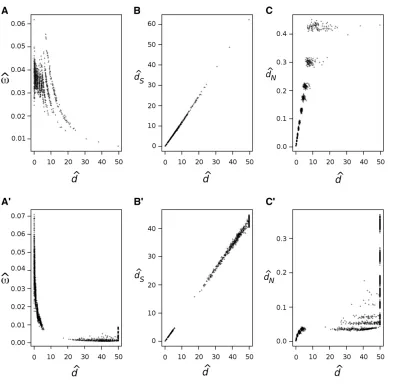
seems to be common (Rochaet al.2006; Peterson and Masel 2009; Wolfet al.2009). For example, Figure 1A shows pair-wise estimates ofvanddfor 12 mitochondrial protein-cod-ing genes from 244 mammal species and Figure 1A9shows a similar plot for 18 ribosomal protein-coding genes from 49 bacterial species. In both cases, estimates of v are clearly higher for closely related species, and the estimates decay as a function of the estimated distance. Figure 1, B and B9, shows the estimated synonymous distancedSvs.estimated
d and Figure 1, C and C9, shows the estimated nonsynon-ymous distancedNvs.estimatedd. Note that estimates ofdS anddare highly correlated in both cases, while estimates of
dNseem saturated for larged.
computer simulation. Our analysis suggests that the small-sample biases in estimates ofvas well as systematic biases investimates caused by model violation may be important factors to explain the correlation betweenv^ and^dobserved in empirical data sets.
Asymptotic Bias and Correlation in Estimates ofvandd
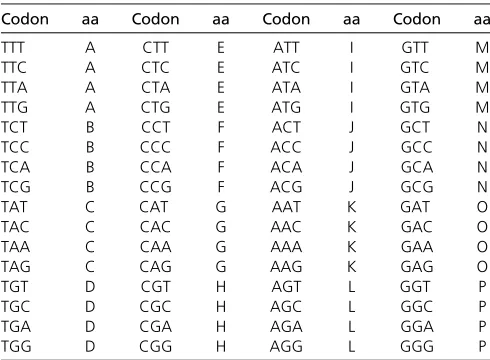
Wefirst consider a simple model of codon evolution that can be treated analytically. Consider a regularized genetic code with 16 amino acids and with every codon fourfold de-generate (Table 1). Substitutions atfirst and second codon positions are always nonsynonymous and those at the third positions are always synonymous. There are no stop codons. The substitution rate from codonitoj(i6¼j) is
qij¼ 8 < :
0; for more than one change; m; for a synonymous change; vm; for a nonsynonymous change:
(1)
The qijare the off-diagonal elements of a 64 ·64 rate
ma-trix, Q, with the diagonal elements,qii, set such that each
row of Q sums to one. Time is measured as the expected number of substitutions per codon site; in other wordsm= 1/(6v + 3) so that 2Pqii=64¼1. Because every codon
position is always either synonymous or nonsynonymous, evolution of codons can be treated as a mixture of two Jukes–Cantor (Jukes and Cantor 1969) models: the first two positions evolve with rate vm and the third position with rate m. Consider a pairwise sequence alignment with
n codons and with xS and xN observed synonymous and nonsynonymous differences. LetdSanddNbe the distances at synonymous and nonsynonymous sites, respectively. The total distance between the two sequences is thus d=dS+ 2dN. It follows thatv=dN/dS, andd= (1 + 2v)dS. The log-likelihood function is given by the fact that evolution at the
first two codon positions and at the third codon position is independent,
ℓ¼xSlogðpSÞ þ ðn2xSÞlogð12pSÞ
þ xNlogðpNÞ þ ð2n2xNÞlogð12pNÞ; (2)
where
pS¼ 3 42
3 4e
2ð4=3ÞdS¼3 42
3 4e
2ð4d=3ð1þ2vÞÞ; (3)
pN¼3 42
3 4e
2ð4=3ÞdN ¼3 42
3 4e
2ð4vd=3ð1þ2vÞÞ: (4)
The maximum-likelihood estimates (MLEs) of the distances at synonymous and nonsynonymous sites are, respectively,
^
dS¼2 3 4log
124
3^pS
; (5)
^
dN¼23 4log
124
3^pN
; (6)
where^pS ¼xS=nandp^N¼xN=ð2nÞare the observed propor-tions of synonymous and nonsynonymous differences, re-spectively. Note that Eð^pSÞ ¼pS and Eð^pNÞ ¼pN, where E denotes expectation. The MLEs ofdandvare
^
d¼^dSþ2^dN (7)
(in expected substitutions per codon) and
^ v¼^dN
^
dS
: (8)
There are only two parameters in the model, and we can work either withdandvor as a different parameterization with pSandpN.
Bothv^andd^are functions of the binomial proportions^pS and^pN that have variances
s2 ^
pN¼
pNð12pNÞ
ð2nÞ ; (9)
s2 ^
pS¼
pSð12pSÞ
n ; (10)
and Covð^pS;^pNÞ ¼0. Becausev^ and^dare functions of ran-dom variables with known variances, the delta method can be used to calculate the asymptotic expectations
E
^
d
dþ1
2s 2 ^
pN
@2^d @^p2N
þ1
2s 2 ^
pS
@2^d @^p2S
; (11)
Eðv^Þ vþ1
2s 2 ^
pN
@2v^ @^p2Nþ
1 2s
2 ^
pS
@2v^
@^p2S; (12)
Table 1 Thefictitious regularized genetic code
Codon aa Codon aa Codon aa Codon aa
TTT A CTT E ATT I GTT M
TTC A CTC E ATC I GTC M
TTA A CTA E ATA I GTA M
TTG A CTG E ATG I GTG M
TCT B CCT F ACT J GCT N
TCC B CCC F ACC J GCC N
TCA B CCA F ACA J GCA N
TCG B CCG F ACG J GCG N
TAT C CAT G AAT K GAT O
TAC C CAC G AAC K GAC O
TAA C CAA G AAA K GAA O
TAG C CAG G AAG K GAG O
TGT D CGT H AGT L GGT P
TGC D CGC H AGC L GGC P
TGA D CGA H AGA L GGA P
TGG D CGG H AGG L GGG P
and the asymptotic variance/covariance matrix
Var^d;v^
JVarð^pN;^pSÞ JT
¼ 0 B B B B B @ s2 ^ pN
@^d
@^pN !2
þs2
^
pS
@^d
@^pS !2
s2
^
pN
@^d
@^pN
@v^
@^pN
þs2
^
pS
@d^
@^pS
@v^
@^pS
s2
^
pN
@^b
@^pN
@v^
@^pNþs
2 ^
pS
@^b
@^pS
@v^
@^pS s
2 ^
pN @v^
@^pN
2
þs2
^
pS @v^
@^pS
2 1 C C C C C A; (13)
where J¼@ðd^;v^Þ=@ð^pN;^pSÞ is the Jacobian matrix of the transform (reparameterization). The Jacobian and the sec-ond derivatives of v^ and ^d with respect to ^pN and ^pS are given in theAppendix.
From Equations 11 and 12 the bias of the estimates can be approximated by Eðd^Þ2d and Eðv^Þ2v. Note that when
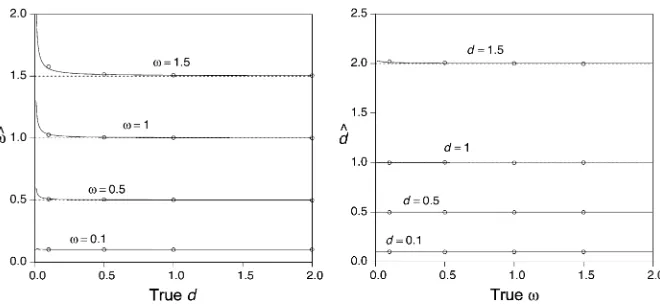
n/N, Eð^dÞ/d and Eð^vÞ/v, as expected according to standard theory. However, when nis small, the bias in the estimators may be substantial. Figure 2 shows the biases ofv^ and^dfor various cases. In particular, there is a positive bias in
^
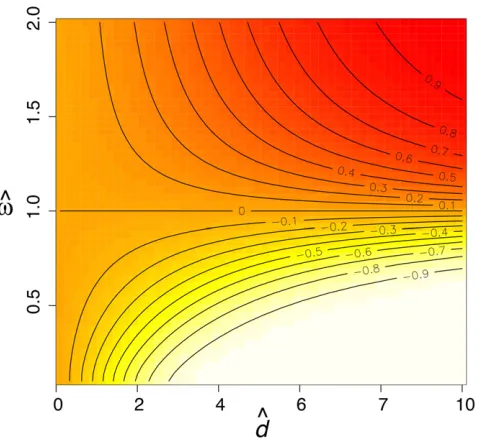
v for smalld (Figure 2A). On the other hand, there is very little bias in ^d (Figure 2B). Simulations confirm that the approximations (Equation 11 and Equation 12) are very good with$500 codons in the alignment (Figure 2, A and B). From Equation 13 the asymptotic correlation can be calcu-lated asrð^d;v^Þ ¼Covð^d;v^Þ=pffiffiffiffiffiffiffiffiffiffiffiffiffiffiffiffiffiffiffiVarð^dÞVarð^vÞ. Figure 3 shows the asymptotic correlation for various values ofv andd. Calcu-lations indicate that whenv ,1, the correlation is negative (r,0), and whenv.1, it is positive (r.1).
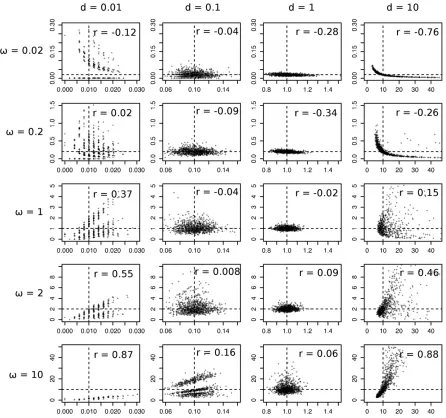
The codon substitution model based on the standard genetic code is not tractable. However, we can study the asymptotic properties of the model by simulation. We simulated pairwise sequence alignments of lengthn= 500 codons, with equal codon frequencies (1/61) and withk= 2. We simulated 1000 pairwise alignments for each combination ofd= 0.01, 0.1, 1, 10 andv= 0.02, 0.2, 1, 2, 10 (1000·4· 5 = 20,000 data sets). Estimates ofvanddfor each data set were then obtained by maximum likelihood (ML). The simu-lation shows the same pattern of corresimu-lation (Figure 4) as in the case of the regularized code.
To assess whether the bias and correlation of the MLEs of
d andv may be responsible for the strong correlation ob-served in real data sets, we simulated a 244-species se-quence alignment on the mammal phylogeny, using the mitochondrial genetic code. The values of n,v, andkand the branch lengths in the simulation werefixed to the MLEs obtained from the joint analysis of the original sequence data. The codon frequencies were fixed to those observed in the real data. Figure 5, A–C, shows the pairwise estimates for this simulation. Although there is a negative correlation between estimates of v and d, this correlation is much weaker than that observed for the real data (Figure 1A). Furthermore, when the simulated alignment is much longer (when we setn= 106codons), the correlation almost dis-appears and the MLE of vconverges to the true value (not shown). The simulation model assumes the same vfor all sites in the gene, which is not realistic for real genes. We also simulated with a different model wherevvaries among sites according to a mixture of three site classes [M3 discrete (Yanget al.2000)]. For the real mitochondrial data under this model, the MLEs are v^1¼0:00254,v^2¼0:0361, and
^
v3¼0:147, with the estimated frequencies of the site clas-ses being ^p1¼0:573, ^p2 ¼0:260, and ^p3¼0:167; and ^
k¼7:32. We then used those parameter values to simulate a 244-species alignment on the mammal phylogeny. Figure 5, A9–C9, shows the pairwise estimates ofvandd(obtained using a model of a singlevfor all sites) from this simulated data set. The correlation betweenv^and^dis stronger, but in general much weaker than for the real data (Figure 1A). Therefore, the asymptotic pattern of correlation and bias seems too weak to explain the pattern observed in real data (Figure 1A).
Variable Selection on Different Domains of the Protein
of a protein is composed mainly of hydrophobic amino acids, while the surface of the protein may be composed mainly of hydrophilic amino acids (Baud and Karlin 1999). The active site of an enzyme may tolerate only very few different amino acids that can stabilize a particular substrate and carry out an enzymatic reaction. Halpern and Bruno (1998; see also Tamuri et al. 2012) proposed a codon substitution model based on a population genetics model of site-specific amino acid frequencies. To avoid the use of too many parameters we consider a model of site classes. Suppose there areCsite classes. If the protein hasncodons, there aren/Ccodons for each site class. The substitution rate from codonitojin site classkis given by
qij;k¼ 8 < :
0; for more than one change; m; for a synonymous change; mvhFj;k2Fi;k
; for a nonsynonymous change; (14)
whereFi,kis thefitness of the amino acid encoded by codoni
in site classk, and
hFj;k2Fi;k
¼ Fj;k2Fi;k
12e2ðFj;k2Fi;kÞ
(15)
is the relative fixation probability of an i to j mutation relative to a neutral mutation (Kimura 1983, p. 45; see also Yang and Nielsen 2008), whereh(Fj,k2Fi,k).1, = 1,,1
forFj,k.Fi,k,Fj,k=Fi,k, andFj,k,Fi,k, respectively. In other
words, selection accelerates or slows down substitutions compared to the rate for a neutral mutation (i.e., when
Fj,k=Fi,k). The equilibrium frequency of a given amino acid
jin site classkis given by
pj;k¼
eFj;k
P
eFi;k: (16)
If Fj,k =2N, then pj,k = 0 and the amino acid is not
ob-served in site classk. The same value ofmis used to scale all rate matrices for the site classes, andmis set so that time is measured as the expected number of substitutions per site across the gene (i.e., so that 2PCk¼1
P
ipi;kqii;k=C¼1).
The Regularized Genetic Code
We examine whether heterogeneity among sites in amino acid preference may lead to strong correlation between estimates of v anddunder the model of Equation 1 when the data are generated by the process of Equation 14. First we study a simple case under the regularized genetic code (Table 1). There are four classes of sites in the protein, each class corresponding to a group of four amino acids whose codons differ only at the second position. For example, at sites of class I, we observe only amino acids A–D (Table 1); that is, A–D have the samefitness but the other 12 amino acids have fitness 2N. Similarly, class II is composed of amino acids E–H, class III of I–L, and class IV of M–P. The gene is composed of equal proportions of the four site clas-ses (that is, for a gene with 100 codons, 25 belong to class I, 25 to class II, and so on). Note that the substitution rate from codonitojat a site class can be written as
qij¼
8 > > < > > :
0; for more than one change;
0; if the codons differ at the first position;
m; for a nonsynonymous change at the second position; m; for a synonymous change at the third position;
(17)
wherem= 1/(3v+ 1).
We note the following about this substitution model:
1. thevratio at thefirst codon position isv1= 0 and it is v2= 1 at the second. Therefore, the averagevacross the protein isv= 0.5.
2. Gene-wide, the evolutionary rate is zero at thefirst codon position andmat the second and third positions. There-fore, the process can be described by a mixture of two independent Jukes–Cantor processes at the second and third positions.
Let xN and xS be the numbers of nonsynonymous and synonymous differences between two sequences of length
ncodons. The estimates of the nonsynonymous and synon-ymous distances are
^
d*N¼23
4log
124 3^p
* N
; (18)
^
dS¼23 4log
124
3^pS
; (19)
where^p*
N¼xN=n, instead of^pN¼xN=ð2nÞas in the model of Equation 1. Then
^
d*¼^d*Nþ^dS (20)
and
^ v* ¼ d^
* N 2^dS
: (21)
The factor1
2 in the calculation ofv^*is necessary to correct for the zero substitution rate at thefirst codon position. Let us now assume thatv,d,dN, anddSare estimated using the model of Equation 1. We note three points:
1. The synonymous distance dSis correctly estimated. 2. The nonsynonymous distance dNis underestimated and
the underestimation is greater for larger sequence diver-gence (Figure 6A). In fact, the estimate ofdNapproaches
23 4log
121
2
0:520, a constant, as d/N. The total distancedis also underestimated.
3. As a consequence,vis underestimated more seriously for longer distances (Figure 6B), and asd/N,v^/0. The correct value ofvis recovered only if the distance is close to zero:d/0,v^/0:5.
The Standard Genetic Code
We perform a simulation study, using the standard genetic code. We use two site classes: a class of buried sites in the hydrophobic core of the protein and a class of exposed sites on the protein’s surface. We perform two simulations. The
fitnesses for the 20 amino acids for the two site classes are calculated from the literature (Baud and Karlin 1999, Table 2). The substitution model is given by Equation 14, withv= 0.04 andn= 4000 sites with 2000 sites for each site class. We simulated pairwise sequence alignments for different values of d (= 0.1, 0.25, 0.5, 0.75, 1, 1.5, 2, 3, 4, 5, 7, and 10). The simulation code was written in R. The simu-lated alignments of two sequences were then analyzed using CODEML to estimate v and d. The results are shown in Figure 7, A–C. It is clear thatvis underestimated with pro-gressively long distances, causing a negative correlation be-tween estimates ofv andd.
The amino acid frequencies of Table 2 are averaged across different proteins (Baud and Karlin 1999) and may not be as extreme as in individual proteins. To mimic ex-treme amino acid frequencies in specific proteins, we con-ducted a second simulation in which the fitnesses for both site classes are multiplied by 10. The results are shown in
Figure 7, A9–C9. The underestimation ofvand the negative correlation between estimates of v and d are more pro-nounced in this case.
Discussion
have not been applied to estimation of v in pairwise alignments.
Rocha et al. (2006) considered the comparison of two sequences from the same species or from two closely related bacterial genomes and suggested that the decay of v with the time of divergence may be due to deleterious nonsynon-ymous mutations in the process of being removed by natural selection. Sequences that diverged a long time ago will have more nonsynonymous mutations removed than sequences that diverged a short time ago, thus generating a negative correlation between v and divergence time (or distance). However, their simulation model assumed that initially the population has no mutations, which seems biologically un-realistic. It should be preferable to analyze an equilibrium model, in which at any point in time, there is a distribution of nonsynonymous and synonymous mutations of different ages and frequencies, with the ratio of the two types of polymorphisms being stationary (Sawyer and Hartl 1992: Table 1). In contrast, the biases and correlations studied in this article apply to all levels of sequence divergence and should be considered even in comparisons of closely related sequences. The waiting time for the removal of non-synonymous mutations discussed by Rocha et al. (2006) may be important in comparisons of closely related species, but may not be important in comparisons of distantly related species, such as different mammal species (Figure 1). In any case, at this stage we cannot exclude the possibility that population-level processes may affect the behavior of v at small timescales, and further study is necessary.
It should be noted that the behavior of the MLEs ofvand
d can be understood using standard maximum-likelihood theory, and the likelihood-ratio test of positive selection based on the vratio is not affected either by the bias in v^ or by the correlation betweenv^ andd^. This is because the LRT is invariant to reparameterization whereas bias and correlation are properties that arise and disappear by trans-formation. For example, the false-positive rates for the test
of H0:v = 1 against H1:v6¼1 are 6.7%, 4.4%, 4.5%, and 6.1% ford= 0.01, 0.1, 1, and 10 in Figure 4, close to the 5% significance level expected according to standard ML theory. The suggestion by Wolf et al. (2009) that the LRT cannot control for the dependency between v^ and ^d is incorrect. The pattern of correlation observed in real data (e.g., Figure 1A) may not be fully explained by the statistical properties of v^ andd^, and some biological variables may play an im-portant role. Nonetheless, we suggest the statistical proper-ties of estimators must be studied carefully for each case of interest, before biological explanations for the observed pat-terns are offered.
Figure 6 Estimates ofdN(left) andv¼ dN/dS(right) when the model is misspe-cified and fails to account for the hetero-geneity among sites in amino acid frequencies. The data include infinitely many sites and the regularized genetic code is assumed.
Table 2 Fitnesses and equilibrium frequencies of amino acids in buried and exposed sites in proteins
Exposed Buried
Amino acid pJ,buried FJ,buried pJ,exposed FJ,exposed
D 0.0214 0 0.0871 0
E 0.0151 20.348 0.0931 0.067
R 0.0202 20.061 0.0646 20.299
K 0.0076 21.041 0.1021 0.159
H 0.0403 0.633 0.0480 20.595
L 0.0806 1.326 0.0180 21.576
M 0.0743 1.244 0.0225 21.352
I 0.0831 1.356 0.0165 21.663
V 0.0793 1.301 0.0225 21.352
F 0.0781 1.294 0.0180 21.576
W 0.0693 1.174 0.0150 21.758
Y 0.0567 0.973 0.0225 21.352
S 0.0416 0.663 0.0661 20.276
T 0.0441 0.722 0.0586 20.397
N 0.0264 0.211 0.0811 20.072
Q 0.0214 0 0.0811 20.071
C 0.0932 1.471 0.0091 22.269
G 0.0504 0.856 0.0661 20.276
Acknowledgment
Z.Y. is a Royal Society/Wolfson Merit Award holder.
Literature Cited
Bao, L., H. Gu, K. A. Dunn, and J. P. Bielawski, 2007 Methods for
selecting fixed-effect models for heterogeneous codon
evolu-tion, with comments on their application to gene and genome data. BMC Evol. Biol. 7(Suppl. 1): S5.
Bao, L., H. Gu, K. A. Dunn, and J. P. Bielawski, 2008
Likelihood-based clustering (LiBaC) for codon models, a method for group-ing sites accordgroup-ing to similarities in the underlygroup-ing process of evolution. Mol. Biol. Evol. 25: 1995–2007.
Baud, F., and S. Karlin, 1999 Measures of residue density
in protein structures. Proc. Natl. Acad. Sci. USA 96: 12494–
12499.
Halpern, A. L., and W. J. Bruno, 1998 Evolutionary distances for
protein-coding sequences: modeling site-specific residue
fre-quencies. Mol. Biol. Evol. 15: 910–917.
Jukes, T. H., and C. R. Cantor, 1969 Evolution of protein
mole-cules, pp. 21–123 inMammalian Protein Metabolism, edited by
H. N. Munro. Academic Press, New York.
Kimura, M., 1977 Preponderance of synonymous changes as evidence
for the neutral theory of molecular evolution. Nature 267: 275–276.
Kimura, M., 1983 The Neutral Theory of Molecular Evolution.
Cam-bridge University Press, CamCam-bridge, UK.
Messier, W., and C. B. Stewart, 1997 Episodic adaptive evolution
of primate lysozymes. Nature 385: 151–154.
Peterson, G. I., and J. Masel, 2009 Quantitative prediction of molecular clock and ka/ks at short timescales. Mol. Biol. Evol. 26: 2595–2603. Rocha, E. P., J. M. Smith, L. D. Hurst, M. T. Holden, J. E. Cooper
et al., 2006 Comparisons of dN/dS are time dependent for closely related bacterial genomes. J. Theor. Biol. 239: 226–235.
Sawyer, S. A., and D. L. Hartl, 1992 Population genetics of
poly-morphism and divergence. Genetics 132: 1161–1176.
Tamuri, A. U., M. dos Reis, and R. A. Goldstein, 2012 Estimating the distribution of selection coefficients from phylogenetic data using sitewise mutation-selection models. Genetics 190: 1101–1115. Wolf, J. B., A. Kunstner, K. Nam, M. Jakobsson, and H. Ellegren,
2009 Nonlinear dynamics of nonsynonymous (dN) and
synon-ymous (dS) substitution rates affects inference of selection. Genome Biol. Evol. 1: 308–319.
Yang, Z., 2007 PAML 4: phylogenetic analysis by maximum
likeli-hood. Mol. Biol. Evol. 24: 1586–1591.
Yang, Z., and J. P. Bielawski, 2000 Statistical methods for detect-ing molecular adaptation. Trends Ecol. Evol. 15: 496–503.
Yang, Z., and R. Nielsen, 2008 Mutation-selection models of
codon substitution and their use to estimate selective strengths on codon usage. Mol. Biol. Evol. 25: 568–579.
Yang, Z., R. Nielsen, N. Goldman, and A. M. Pedersen,
2000 Codon-substitution models for heterogeneous selection
pressure at amino acid sites. Genetics 155: 431–449.
Communicating editor: M. A. Beaumont
Figure 7 Pairwise estimates of v¼dN/dS,d,dS, anddNfor sim-ulated sequence alignments when the inference model is
Appendix
The Jacobian of Equation 13 is
J¼
2 6 6 6 6 4
@^d
@^pN @^d
@^pS @v^ @^pN
@v^ @^pS
3 7 7 7 7 5
¼ 2 6 6 6 6 4
2 12ð4=3Þ^pN
1 12ð4=3Þ^pS
2 4
3ð12ð4=3Þ^pNÞlogð12ð4=3Þ^pSÞ
4 logð12ð4=3Þ^pNÞ 3ð12ð4=3Þ^pSÞlog2ð12ð4=3Þ^pSÞ
3 7 7 7 7 5:
(A1)
The second derivatives of Equations 11 and 12 are
@2v^ @^p2N¼ 2
16
9ð12ð4=3Þ^pNÞ2logð12ð4=3Þ^pSÞ
; (A2)
@2v^ @^p2S
¼16 logð12ð4=3Þ^pNÞf2þlogð12ð4=3Þ^pSÞg
9ð12ð4=3Þ^pSÞ2log3ð12ð4=3Þ^pSÞ ; (A3)
@2^d @^p2N
¼ 8
3ð12ð4=3Þ^pNÞ2; (A4)
@2^d @^p2S
¼ 4
3ð12ð4=3Þ^pSÞ2: (A5)