Results and Performance Analysis of File Sharing
Between Peer-to-Peer Using Network Coding
Algorithm
Rathod Vijay U#1, Prof. Mrs. V. R. Chirchi*2 #MBES’s College of Engineering, Ambajogai,
Dr. Babasaheb Ambedkar Marathwada University, Aurangabad, India
Abstract
—
Network coding is a positive improvement of network routing to improve network throughput and provide high reliability. Network coding algorithm (i.e. Encoding algorithm) allows a node to generate output messages by encoding its received messages. Peer-to-peer networks are a perfect place to apply network coding algorithm due to two reasons: 1. in peer-to-peer network, the topology is not fixed. So, it is very much easier to create the topology which suits the network coding algorithm; 2. Peer-to-peer network every node is end hosts, so it is easier to perform the complex operation related to network coding like decoding and encoding rather than storing and forwarding the message. The motivation of this paper is to design an efficient and reliable file sharing service over peer-to-peer networks by taking advantages of the best feature of network coding algorithms (i.e. Encoding and decoding algorithm) and applying it to peer-to-peer networks in a proper way. Here to network coding algorithm (i.e. Encoding algorithm) encodes a file into multiple messages and divides peers into multiple groups with each group responsible for relaying one of the messages. The encoding algorithm is designed to satisfy the property that any subset of the messages can be used to decode (i.e. using a decoding algorithm) the original file as long as the size of the subset is sufficiently large. To meet this requirement, here first define an algorithm which satisfies the desired property, and then connect peers in the same group to flood the corresponding message, and connect peers in different groups to distribute messages for decoding. This paper has considered a number of theoretical and practical scenarios where network coding algorithm or its variant is applied on peer-to-peer file sharing based on Network coding with the aim to improve performance parameters like throughput and reliability. This paper has mainly focused on the comparative analysis of file sharing between peer-to-peer using network coding algorithms. Our simulation results show that the new network coding algorithms (i.e. Encoding and decoding algorithms) can achieve 15%-20% higher throughput than other peer-to-peer multicast system.Keywords— Network Coding Algorithm, Peer-to-Peer Networks, Web-based Applications, File Sharing, Multicast, Unstructured Overlay Network
I. INTRODUCTION
In the last various years, the internet has witnessed a massive increase of various types of web-based applications, ranging from web-based file sharing to video broadcasting or conferencing. Web-based applications have purchased more and more interests due to the flexibility and easy accessibility. Many such applications involve one source
(server) and multiple sinks (receivers). However, due to lack of multicast support over the internet, these applications usually suffer from the scalability problem, which limits the number of receivers involved. Peer-to-peer is an assuring technology that can implement multicast at the application layer, where sinks (peers) not only receive data, but also forward data. By integrating peer-to-peer technology into web-based applications, the scalability problem can be eliminated, i.e. the system performance (throughput, latency, etc.) will not be impaired when there are more users in the system.
In this paper, we consider applying peer-to-peer network to file sharing services, in which a web server or a file server holds a file that is requested by multiple clients (receivers) [1]. In most peer-to-peer networks, peers usually are end users personal computers which may have limited network resources (i.e. bandwidth, CPU time, etc). It is decisive for the file sharing system to be reliable and resilient while achieving good throughput at the same time.
Network coding breaks with the traditional paradigm in packet switched networks often referred to as store-and-forward. Network coding is potentially applicable to many forms of network communications. Up to now, the best understood scenario where network coding offers unique advantages is multicasting in a communication network. Multicasting refers to transmitting common information from one source node to a set of destination (sink) nodes. Multicasting finds many useful applications in practice. These include live broadcast such as Internet TV, content delivery such as content distribution networks and P2P (peer-to-peer) networks, and interactive communications such as online gaming, instant messaging and multimedia conferencing. Application layer multicast can be incorporated in peer-to-peer network. Scalability issue of web-based applications can be easily eliminated with the help of peer-to-peer networking. Throughput and reliability of a peer-to-peer network can be improved by using network coding algorithm. By using network coding algorithm for multicast can fully utilize the network capacity.
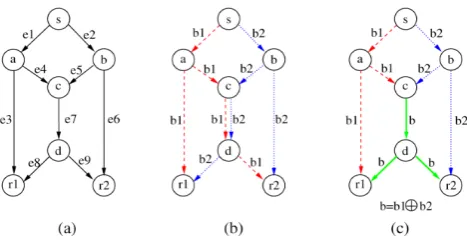
and forward messages. In network routing, intermediate node does not perform any processing operation other than store and forward messages. In fact, routing is not the only operation that can be performed on a node. Recently, network coding has collected as a good improvement of network routing to improve network throughput and provide high reliability. Network coding refers to a scheme where a node is allowed to generate output messages by encoding (i.e., computing certain functions of) it’s received messages. Thus, network coding algorithm (i.e. encoding algorithm) allows information to mix, in compare to the traditional routing approach where each node simply forwards received messages. Network coding has a wide range of applications for wireless networks [17], [28] to network tomography [18]. Network coding can greatly improve the throughput of a multicast network. Let’s first use the well-known butterfly network in Fig. 1 to demonstrate the advantage of network coding for multicast.
Fig 1: Illustration of the advantage of network coding for multicast. (a) The butterfly network represented by a DAG. (b) Multicast without
network coding. (c) Multicast with network coding [1].
In the figure, node s is the source, nodes r1 and r2 are two receivers, all edges have capacity 1, which means that the edge can only transmit 1 unit of data (bit) per unit time (second), and source s has two bits, b1 and b2 to multicast to both r1and r2. First, we use the traditional multicast without network coding as shown in Fig. 1(b). Without loss of generality, we use the dashed line (red) to represent bit b1, the dotted line (blue) to represent bit b2 and the bold line (green) to represent both bits b1 and b2. Bit b1 can reach r1 in two seconds, and bit b2 can reach r2 in two seconds. When node c receives both bits, it forwards them in sequence. Suppose it forwards bit b1 first. Then r1 receives both bits in 4 seconds and r2 receives both bits in 5 seconds. Now consider using network coding on link c–d as shown in Fig. 1(c). When node c receives both bits, it first mixes them by performing an exclusive OR (XOR) operation. Then it sends the mixed bit b to d node. When nodes r1 or r2 receive the mixed bit, it can recover the original bits b1 and b2 by XO-Ring the mixed bit and the other received bit. The entire transmission can be completed in 4 seconds. The definition of link c to d throughput (γ) from node c to d is given by
γ = Number of bits from node c to node d Observation duration
The aim of this paper is to design an efficient and reliable file sharing service over peer-to-peer networks by taking advantage of the good propertied of network coding algorithm and applying it to peer-to-peer networks in a proper way. Peer-to-peer (overlay) networks are a perfect place to apply network coding algorithm due to two reasons: 1. in peer-to-peer network, the topology is not fixed. So, it is very much easier to create the topology which suits the network coding algorithm; 2. Peer-to-peer network every node is end hosts, so it is easier to perform the complex operation related to network coding algorithm like decoding and encoding rather than storing and forwarding the message [1]. Network coding can be viewed as a generalized routing scheme and can be applied to any types of routing, i.e. unicast, multicast and broadcast, to enable a more efficient data transmission. There are two main streams of research in the field of network coding. 1. One stream investigates efficient encoding-and-decoding algorithms to increase the data transmission rate while reducing the computational cost and 2. The other emphasizes the applications of network coding.
For the first stream, regarding the encoding functions to combine the received information at intermediate nodes, there have been a number of encoding-and-decoding algorithms, e.g. linear network coding (Li et al, 2003), algebraic network coding (Koetter and Médard, 2003), convolution network coding (Li and Yeung, 2006) and so on. Among them, one of the most fundamental and widely used coding methods is a linear network coding, where packets are linearly combined at intermediate nodes. Introduced in 2003, linear network coding always suffices to achieve the theoretical maximum throughput for multicast sessions (Li et al, 2003).
This paper is organized as follows: In section II, Literature Review of paper. In section III, Explained Proposed System. In section IV, Advantages of Proposed Algorithm, in section V, Results and Discussion and in section VI and VII, future work and conclusion respectively.
II. LITERATURE REVIEW
Members of the network coding scheme have been proposed in past for multicast networks some are explained as follows:
Network coding (NC) is originally proposed by R.Ahlswede et al. [3] to improve the throughput utilization of a given network topology. The essence of network coding is to allow intermediate nodes between the source node and receivers to encode packets. In recent years, various network coding schemes [4-8] have been proposed to enhance the performance of P2P system.
2002: Another important performance parameter is the security of the network. CAI and Yeung considered the problem of using network coding to achieve perfect information security against a wire tapper who can eavesdrop on a limited number of network links, and presented the construction of a secure linear network code for this purpose [30].
2003: Important steps taken toward practical implementation. Li, Yeung and CAI showed network coding for multicast networks can rely on mathematical functions involving only addition and multiplication, which reduces the complexity of designing codes. And two of us (Koetter and Médard) introduced a powerful algebraic framework for analyzing coding approaches and simplifying code design [3] [4].
2005-2006: Valuable design algorithms published. Sidharth Jaggi, then at Caltech, with Peter Sanders of the University of Karlsruhe in Germany, one of us (Effros) and collaborators and, separately, Tracey Ho of Caltech, with the three of us and others, published low-complexity algorithms for designing the functions used by each node in a multicast network. The first paper gave a systematic approach for designing functions; the second showed that choosing functions randomly and independently for each node should work just as well [6] [7].
2005: One important performance parameter is the network cost incurred for a given set of connections, and the complexity associated with the computation of the sub graphs needed to provide the connections. While the minimum cost multicast problem in routed networks requires the finding of a directed Steiner tree, which is NP-hard, the same problem in coded networks can be solved by a linear program in polynomial time and also be implemented in a decentralized manner [15].
2006: Applications for wireless networks explored. D.M.Chiu, R. W. Yeung, J. Huang, and B. Fan, demonstrated the potential benefits of network coding for wireless applications and characterized scenarios in which the approach would be particularly helpful [13].
2014: It applies linear network coding to peer-to-peer file sharing and presents a high performance peer-to-peer file sharing system, PPFEED. Peer-to-Peer File Sharing Based on Network Coding (PPFEED) utilizes combination networks as its overlay topology prototype. Combined networks demonstrate great performance gain under linear network coding. It proposes a simple and efficient deterministic linear network coding scheme for combined networks and applies to PPFEED. As a result, PPFEED inherits its high performance when applied network coding and presents its superiority compared to other existing peer-to-peer file sharing systems. They showed that PPFEED can achieve 15%-20% higher throughput than Narada, which is an Application lifecycle management (ALM) system without network coding. Besides, it achieves higher reliability and resiliency [1].
III.PROPOSED SYSTEM
In past proposed scheme has some problem to remove these problems, in this paper a network coding algorithm (i.e. encoding and decoding) for multicast reduces the number of transmissions has been proposed. The main aim of this work is to reduce the total number of transmissions in multicast network and also to reduce the bandwidth consumption in multicast network using Bit Torrent file sharing protocol, by implementing network coding algorithm. Here abstract diagram of file sharing between peer-to-peer using network coding algorithms as shown in the fig 2 below.
Fig 2: Abstract Diagram of File Sharing Between Peer to Peer Using Network Coding Algorithm [1]
We propose a network coding algorithm (i.e. encoding and decoding algorithm) based file sharing system over unstructured P2P networks considering the overhead from the network coding. Our simulation results show that the proposed network coding algorithm based file sharing system is better than others such as network routing , when the network coding scheme and non-network coding scheme adopt the same network environment even though the network coding is executed under a limited network resource (bandwidth , CPU time).
A. Hypertext Transfer Protocol (HTTP)
Hypertext Transfer Protocol (HTTP) is a protocol used mainly to access data on World Wide Web (www). Hypertext Transfer Protocol (HTTP) function are a
Peer Request & Handshake (HTTP) Source (Peer)
Grouping the Peer (Peer Joining Algorithm)
Split/Encode (Network Coding Algorithm(X-OR
Operation))
File Transfers (TCP)
Join/Leave Group (Dynamic Process)
Calculating Best Path (Distributed Bellman-Ford
Algorithm)
Decoding at Destination (Network Coding Algorithm
combination of FTP and SMTP. HTTP is a stateless protocol. Remote peer registration data are store in database with help hypertext transfer protocol (http). There are two types of hypertext transfer protocol message are request and response.
B. Peer Joining
Here assume that the server is well-known, whose IP address is known to all the peers by some address translation service such as DNS (Domain Name System). When a peer wants to retrieve a file hosted by the server, it initiates a join process by sending a JOIN request to the server.
The server maintains various counters and lists. For each group Gi, the server maintains a counter gci to store
the number of peers in the group and a list gli to store the
list of clusters which include the peers in the group. For each cluster Ci, the server maintains a list cli to store the
groups which include peers in the cluster. Besides, the server maintains a list of existing peers and their respective residue upload bandwidths and IP addresses for each group. As more and more peers join the system, it is resource consuming to maintain a full list of peers for each group. The server will keep a partial list of peers with the largest residue upload bandwidths. Meanwhile, peers will report to the server their updated residue upload bandwidths periodically to update the partial list on the server. Although the server is responsible for bootstrapping the peers, it will not be the bottleneck of the system because once each peer receives the list, it communicates with other peers for topology construction and data dissemination. When the server receives a peer’s join request, it assigns the peer to a group. Then the server sends the list of peers of that group to the joining peer and updates the number of peers in that group.
The server will assign the new peer to a group based on following factors. First, the peer is assigned to a cluster based on its coordinate. If the number of groups which include peers in the cluster is less than, the new peer will be assigned to one of the groups which include no peers in the cluster. When there are multiple such groups, the group spans the least number of clusters is selected. The tie is broken by picking the group with less number of peers in the group. The rationale behind this is that here want to minimize the logical links between different clusters and ensure that peers can receive sufficient “innovative” messages, i.e., messages from different groups, within the cluster to perform the decoding.
After receiving the list of peers, the new peer will contact them and create overlays links with them. These peers are called intra-neighbours of the new pair because they are within the same group. In contrast, the neighbours which are in different groups are called inter-neighbours. The new peer asks one of its intra-neighbours to provide a list of its inter-neighbours. When picking the intra-neighbour, higher priority is given to the peer in the same cluster. The new peer then takes the list of peers as its inter-neighbours.
The topology of the peer-to-peer network can be considered as a combination of multiple unstructured peer-to-peer networks, each of which is composed of the peers
within the same group. The topology within one group is arbitrary as long as it is connected. The only constraint is on the edges between different groups. It is required that each peer is connected to at least k-1 peers in k-1 different groups respectively. Here k is multicast capacity of network. When more than k-1 peers are connected, the system reliability can be improved significantly.
The pseudo-code for peer joining is listed as Table I shows.
TABLE I PEER JOINING ALGORITHM [1]
INPUT : joining peer v OUTPUT : updated overlay network BEGIN
//Suppose the cluster corresponding to peer v is chi if |cli| <k
Si=the set of groups not in cli;
else
Si=the set of groups in cli;
Pick a group gi S such that gli is the smallest;
if multiple groups have the same smallest gl, pick a group gi
with less gci;
Peer v is assigned to group gi.
END
C. Peer Leaving
There are two types of peer leaving from groups I) Friendly
II) Abruptly (terminating or changing suddenly)
For the friendly living, the leaving peer will initiate a living process by sending LEAVE messages to both of its intra- neighbours and inter-neighbours. So that the system is aware of it’s leaving and can make the necessary updates accordingly. For the abruptly leaving, the leaving peer will initiate a living process do not send any notification messages to both of its intra-neighbours and inter-neighbours. This is mainly due to link crash or computer crash.
D. Transmission Control Protocol (TCP)
After performing encoding algorithm (i.e. encoding algorithm generates the encoded packets). These encoded packet transfer to sink peers (i.e. destination peers) by using transmission control protocol (TCP). The transmission control protocol (TCP) is called a connection oriented, reliable transport layer protocol. The encoded packets transfer to sink peer by using TCP datagram format (i.e. encoded packets, encoded packet length, destination peer IP address, and port). Each TCP message is called a TCP datagram (just like an IP datagram, since TCP is after all an extension of IP to provide communication between two applications). Each TCP datagram has two parts: a TCP header and a TCP data area.
E. Network Coding Algorithm
data transmission. Ratio of broadcasting peer is defined as the ratio of number packets received by the destination to the number of packets originated from the source. This ratio is calculated by a formula such as
Ratio of Broadcasting Peer= Number of Peers Broadcast the Packet/Total Number of Peers in Network In network coding, any intermediate node is allowed to not only forward but also combine (code) data packets received from different incoming links if necessary (Ahlswede et al, 2000; Li et al, 2003). The forwarding scheme in network coding is referred to as code-and-forward (Xing et al, 2010). Network coding has the potential to improve the data distribution among the users participating in the cooperative network. Network coding based on multicast or broadcast has been widely studied for non-P2P system. Yeung et al. give the first example to show how network coding could help to reduce the bandwidth by utilizing the wireless broadcast nature [12]. Katti et al. extend this idea beyond duplex flow and present the first implementation of practical network coding to the wireless environment [13]. There are two main streams of research in the field of network coding.
I) One stream investigates efficient encoding-and-decoding algorithms to increase the data transmission rate while reducing the computational cost.
II)
The other emphasizes the applications of network coding.The arithmetic operations used are defined within a branch of mathematics known as Finite Fields or Galois Fields. In network coding finite field arithmetic’s are used when performing the two core operations namely: 1. Encoding and 2.
Decoding. An efficient implementation of finite field arithmetic’s is therefore an important prerequisite for any network coding implementation. Finite field is also known as Galois Field and usually denoted by GF (2n) which contains 2n elements, where n is a positive integer. Finite
field has wide applications in many areas, such as coding theory, algebraic geometry and cryptography. The following briefly describes how network coding algorithm works, including the encoding (i.e. encoding algorithm) approach performed at coding nodes (i.e. Intermediate node) and decoding (i.e. decoding algorithm) approach performed at the receivers (i.e. destination node).
Assume each data packet in a communication network contains N binary bits. If we interpret every n consecutive bits of a packet as an element in the field GF (2n), the packet consists of a vector of N/n elements. In linear network coding, the outgoing packets of a coding node i.e. intermediate node are linear combinations of the incoming packets. Combining the packets requires two basic operations performed over the field GF (2n): addition and multiplication. Addition is the bitwise Exclusive-OR operation. For multiplication, every n consecutive bits, b0,
b1, bn−1 can be interpreted as the polynomial b0 + b1x + . . . +
bn−1 xn−1. Hence, multiplication is done by computing the
product of two polynomials.
I. Encoding
Network coding refers to an encoding algorithm where an intermediate node is allowed to generate output data by encoding (i.e., computing certain functions of) it’s received data. Thus, network coding allows information to be “mixed”, in comparison to the traditional routing approach where each node simply forwards received data. Network coding advocates that, in a multicast network where intermediate nodes perform simple linear operation on incoming packets.
TABLE II ENCODING ALGORITHM [1]
Input: k (Original Packets M1, M2,……, Mk)
Output: Anew (Encoded Packet)
1. Assume there are K original packets M1, M2…….
Mk to be delivered from the source to one or more
receivers.
2. Each packet contains encoding vector Ai= (α1i…
αki) and information vector Xi=∑kk=1αkiMk.
3. Assume there are m packets (A1, X1)... (Am, Xm)
that need to be linearly coded at intermediate nodes.
4. The node first picks a set of coefficients (β1… βm) in
GF (2n).
5. Than calculates the linear combination Xnew=∑ m i=1
βiXi. The new encoding vector Anew is obtained as
Anew= (∑mi=1βiαi1, ∑mi=1βiαi2…….. ∑mi=1βiαin).
The encoding and decoding algorithms we propose to make use of optimal (or low complexity) normal bases to improve their speed. The pseudo-code for encoding algorithm is listed as Table II shows.
II. Decoding
The job at the decoder side is to collect enough encoded packets to be able to reconstruct the original data. In general this is possible as long as the decoder receives k or more encoded packets. In order for a destination (sink) to successfully decode the original data packets, it must receive X linear independent coded packets and encoding vector. The receivers can then recover the original packets from the linearly combined packets, by solving a system of linear equations over a finite field. The pseudo-code for decoding algorithm is listed as Table III shows.
TABLE III DECODING ALGORITHM [1]
Input: Anew (Encoded Packet)
Output: k(Original Packets M1,M2,……,Mk)
1. Assume a receiver gets n packets: (A1, X1),..., (An,
Xn)
2. The node needs to solve the following n linear equations:
X1=∑kk=1α1kMk
X2=∑kk=1α2kMk
. . . Xn=∑kk=1αnkMk
F. Distributed Bellman-Ford Algorithm
Distributed Bellman-Ford Algorithm is also known as distance vector algorithm. It is simple and quick (i.e. Do not require much extra processing time). Distance vector algorithm can be used in calculating the best path (shortest path) in peer to peer network. The time complexity of distributed Bellman-Ford algorithm is O (V E) where V is the number of nodes and E is the number of links which is best complexity. Find the shortest paths, from a given source node to all other nodes [9] [1].
IV.ADVANTAGES OF PROPOSED ALGORITHM Applying network coding algorithms to peer to peer file sharing has some advantages.
A. Increase Throughput of Peer to Peer network
Peer-to-peer network throughput is the rate of successful message delivery over a communication channel. Throughput is defined as the service the peer-to-peer network provides in one time unit. Here as let different peer-to-peer network transmit the same file, thus throughput can be simply represented by the time consumed by the transmission. The shorter the time consumed, the higher the throughput.
B. Improving Reliability of Peer-to-Peer network
Network coding algorithm is a positive enhancement of network routing to improve peer-to-peer network throughput and provide high reliability. This performance metric is used to evaluate the ability of the peer-to-peer network to handle errors. A network with higher reliability will have a smaller number of retransmissions, and thus higher throughput. The repeated links can greatly improve the reliability of the system with little overhead.
C. Link Stress
Link stress is defined as the number of copies of the same message transmitted through the same link. It is a performance metric that only applies to an overlay network due to the mismatch between the overlay network and the physical network. Use it to evaluate the effectiveness of the topology awareness improvement and the efficiency of the peer-to-peer network.
D. Scalability
The files are distributed through a peer-to-peer system. With the increase of the network size, the total available bandwidth also increases. By using file sharing between peer-to-peer using network coding algorithms, scalability issue removes.
E. Efficiency
The network coding algorithm is deterministic and easy to implement. There is no requirement for peers to combine to construct the linear coding scheme on demand. All the peers need is the mapping between the group ID and the encoding function, and this mapping does not change with time. Compared to random network coding, the sinks (receivers) can always recover the original messages after receiving k different messages and the data dissemination is more efficient as data messages are transmitted through the same overlay link at most once.
F. Resilience
Churn is a common drawback in overlay networks. By adding redundant links, the negative effect of churn is eliminated.
V. RESULTS AND DISCUSSION
The proposed approach is implemented in Net Beans IDE 8.0.1 software.
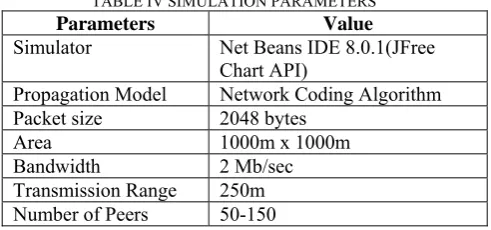
TABLE IV SIMULATION PARAMETERS
Parameters Value Simulator Net Beans IDE 8.0.1(JFree
Chart API)
Propagation Model Network Coding Algorithm Packet size 2048 bytes
Area 1000m x 1000m
Bandwidth 2 Mb/sec
Transmission Range 250m Number of Peers 50-150
The parameters used for comparison between with network coding algorithm and without network coding algorithm. Network coding gain is defined as the ratio of throughput with network coding algorithm (i.e. Encoding and decoding algorithm) for that without network coding algorithm. All these parameters are analysed with Net Beans IDE 8.0.1 and their performances are presented in figure 3 to figure 6 and the analysis of all these figures is summarized in table IV.
The simulation adopts following four performance metrics:
Throughput: Throughput or peer-to-peer network throughput is the rate of successful message delivery over a communication channel. Throughput is defined as the service the system provides in one time unit. Here we let different systems transmit the same file, thus throughput can be simply represented by the time consumed by the transmission. We send transmitting the file from time 0. Than the consumed time is the time when the peers finish receiving the file, denoted by finish time.
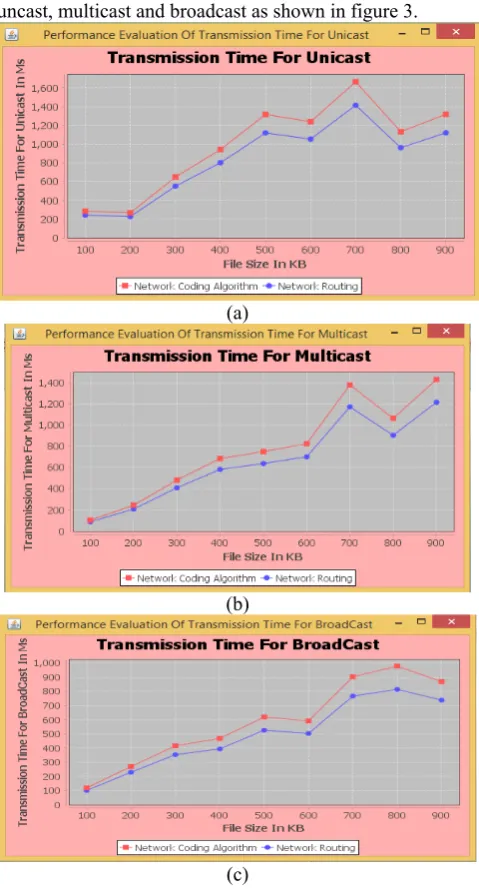
To calculate the throughput of peer to peer network, network is consistently dividing the peers in square area of size 1000m x1000m. Then we use any routing method such as unicast, multicast, and broadcast at each jfree chart. In Fig 3 show ratio of with network coding algorithm vs. without network coding algorithm. It is defined as the ratio of number of packets received by the destination (peer) to the number of packets originated by the source (peer).
The ratio is calculated by formula such as
γ = Number of bits from Source Peer to Destination Peer Observation duration
Where,
γ = throughput of peer to peer network.
Fig 3 shows ratio of with network coding algorithm vs. without network coding algorithm on X-axis and Y-axis. Performance evaluation of transmission time for uncast, multicast and broadcast as shown in figure 3.
(a)
(b)
(c)
Fig 3 Ratio of Throughput with Network Coding Algorithm versus without Network Coding Algorithm. (a) Performance Evaluation of Transmission
Time for Uncast. (b) Performance Evaluation of Transmission Time for Multicast. (c) Performance Evaluation of Transmission Time for Broadcast.
Scalability: Scalability is the capability of a peer to peer network, process to handle a growing amount of work or its potential to be enlarged in order to accommodate that growth. In fig 4, show set of transmission range 100 to 300m and numbers of peer are between 50 to 150. Transmission range means if there are three peers are presented at the same place, than transmission range based on the peer will be chosen. Transmission range is calculated by given formula such as
Transmission Range=Transmission Range/No. of Peer Unicast or Multicast or Broadcasts the packet
The ratio is increases in terms of with network coding algorithm and decreases in terms of without network
algorithm. Fig 4 shows ratio of throughput peers vs. transmission range on X-axis and Y-axis.
Fig 4 Performance Evaluation of Transmission Range
Reliability: A network coding algorithms (i.e. Encoding and decoding algorithms) is a smart enhancement of routing to improve network throughput and provide high reliability. By using this performance metric is used to measure the ability of the peer-to-peer network to handle errors.In fig. 5 shows, one more factor called average delay; this average delay is the average time it takes a data packet to reach the destination. This includes all possible delays caused by buffering during route discovery latency, queuing at the interface queue. This is the average overall delay for a packet to traverse from a source node to a destination node. Average delay is calculated by given formula such as
Avg. Delay =S/N
Where S is the sum of the time spent to deliver packets for each destination, and N is the number of packets received by the all destination peers. This ratio is increases in terms of without network coding algorithm and decreases in terms of with network coding algorithm. Fig 5 shows number of peers vs. end to end delay on X-axis is the number of peers and Y-axis is the end to end delay.
Fig 5 Performance Evaluation of Average Delay
Bandwidth consummation for peer to peer network is calculated by given formula such as
Bandwidth Consummation=Bandwidth consummation in Peer-to-Peer Network/Number of Unicast or Multicast or
Broadcast Peers
This ratio decreases in terms with peer joining algorithm and increases in terms without peer joining algorithm in peer to peer network. In fig 6 shows bandwidth consummation in with peer joining algorithm.
Fig 6 Performance Evaluation of Bandwidth Consummation
TABLE V PERFORMANCE ANALYSIS OF DIFFERENT PARAMETERS
Parameters Ratio of
Throughput Scalability Reliability Bandwidth Network
Routing Decreases Decreases Decreases Increases Network
Coding Algorithm
Increases Increases Increases Decreases
VI.FUTURE WORK
Issues in network coding algorithms include code construction when two or more sources are simultaneously multicast on the network. The issue becomes trickier when there is more than one source. For future research, the multi-user multi-sink issue is a demanding issue in front of the network coding algorithms.
VII. CONCLUSION
Network routing, messages are generally transferred by routing through intermediate nodes between the source and the destination, i.e. by having the intermediate nodes store and forward message. In network routing, intermediate node does not perform any processing operation on the message rather than store and forward messages. The traditional technique for multicasting in a computer network in general is not optimal. In network coding algorithm refers to as where a node is allowed to generate output messages by encoding (i.e. Computing certain functions of) it’s received messages. Thus, network coding allows information to mix, in comparison to the traditional routing approach where each node simply forwards received messages.Network coding algorithm can greatly improve the throughput, reliability, scalability and efficiency of a multicast network. Our simulation results show that the new network coding algorithms (i.e. Encoding and decoding algorithms) can achieve 15%-20% higher throughput than other peer-to-peer multicast system.
REFERENCES
[1] Rathod Vijay U and V.R.Chirchi,” File Sharing Between Peer-to-Peer Using Network Coding Algorithm”, IJCA, vol.129-No.9, November 2015.
[2] Min Yang and Yuanyuan Yang,” Applying network coding to peer-to-peer file sharing,” IEEE TRANSACTION ON COMPUTERS, vol.63, no.8, august 2014.
[3] R. Ahlswede, N. CAI, S.-Y. R. Li, and R. W. Yeung, “Network information flow,” IEEE Trans. Inf. Theory,vol. 46, no. 4,pp. 1204– 1216, Jul. 2000.
[4] S.-Y. R. Li, R. W. Yeung, and N. Cai, “Linear network coding,” IEEE Trans. Inf. Theory, vol. 49, no. 2, pp. 371–381, Feb. 2003.
[5] R. Koetter and M. Medard, “An algebraic approach to networkcoding,”IEEE/ACMTrans.Netw.,vol.11,no.5,pp.782–
795,Oct.2003.
[6] T. Ho, M. Medard, J. Shi, M. Effros, and D. R. Karger, “On randomized network coding,” in Proc. Annu. Allerton Conf. Commun. Control Comput. 2003, pp. 4413–4430.
[7] T. Ho, M. Medard, R. Koetter, D. Karger, M. Effros, J. Shi et al., “A random linear network coding approach to multicast,” IEEE Trans.Inf. Theory, vol. 52, no. 10, pp. 4413–4430, Oct. 2006.
[8] D. S. Lun, N. Ratnakar, R. Koetter, M. Medard, E. Ahmed, and H. Lee, “Achieving minimum-cost multicast: A decentralized approach based on network coding,” in Proc. IEEE INFOCOM’05 Mar. 2005, pp. 1607–1617.
[9] D. S. Lun, M.Medard, T. Ho, and R. Koetter, “Network coding with a cost criterion,” in Proc. Int. Symp. Inf. Theory Appl. (ISITA’04), Oct. 2004, pp. 1232–1237
[10]Y. Zhu, B. C. Li, and J. Guo, “Multicast with network coding in application-layer overlay networks,” IEEE J. Sel. Areas Commun.,vol. 22, no. 1, pp. 107–120, Sep. 2004.
[11]Bit Torrent. (2004) [Online]. Available: http://bittorrent.com.
[12]J. W. Byers, M. Luby, and M. Mitzenmacher, “A digital fountain approach to asynchronous reliable multicast,” IEEE J. Sel. Areas Commun., vol. 20, no. 3, pp. 1528–1540, Oct. 2002.
[13]A. G. Dimakis, P. B. Godfrey, M. J. Wainwright, and K. Ramchandran, “Network coding for distributed storage systems,” in Proc.IEEE INFOCOM’07, May. 2007, pp. 4359–4551.
[14]D. M. Chiu, R. W.Yeung, J. Huang, and B. Fan, “Can network coding help in P2P networks?” in Proc. Int. Symp. Model. Optimiz. Mobile Ad Hoc Wireless Netw. 2006, pp. 1–5.
[15]M. Kim, C. W. Ahn, M. Medard, and M. Effros, “On minimizing network coding resources: An evolutionary approach,” in Proc.NetCod, 2006.
[16]K. Bhattad, N. Ratnakar, R. Koetter, and K. R.Narayanan, “Minimal network coding for multicast,” in Proc. IEEE Int. Symp. Inf. Theory, Sep. 2005, pp. 1730–1734.
[17]C. K. Ngai and R. W. Yeung, “Network coding gain of combination networks,” in Proc. IEEE Inf. Theory Workshop, Oct. 2004, pp. 283– 287.
[18]C. Fragouli, J.Y.LeBoudec, and J.Widmer, “On the benefits of network coding for wireless applications,” in Proc. Net Cod, 2006, pp. 1–6.
[19]C. Wu and B. Li, “Echelon: Peer-to-peer network diagnosis with network coding,” in Proc. IEEE Int. Workshop Quality Service (IWQoS), Jun. 2006, pp. 20–29.
[20]Y. H. Chu, S. G. Rao, S. Seshan, and H. Zhang, “A case for end system multicast,” IEEE J. Sel. Areas Commun., Special Issue on Networking Support for Multicast, vol. 20, no. 8, pp. 1456–1471, Oct. 2002.
[21]S. Jaggi, P. Sanders, P. A. Chou, M. Effros, S. Egner, K. Jain et al., “Polynomial time algorithms for multicast network code construction,” IEEE Trans. Inf. Theory, vol. 51, no. 6, pp. 1973– 1982, Jun. 2005.
[22]C. Gkantsidis and P. R. Rodriguez, “Network coding for large scale content distribution,” IEEE INFOCOM 2005, Miami, FL, USA, Mar. 2005.
[24]S. Ratnasamy, M. Handley, R. Karp, and S. Shenker, “A scalable content-addressable network,” in Proc. ACM SIGCOMM, 2001, pp. 149–160.
[25](2003). Gnutella Protocol Development, the gnutella v0.6 protocol [Online]. Available: http://rfc-gnutella.sourceforge.net/developer/index.html.
[26]S.Ratnasamy, M.Handley, R.M.Karp, and S.Shenker, “Topologically aware overlay construction and server selection,” IEEEINFOCOM’02, New York, NY, USA, Jun. 2002.
[27]M. Yang and Y. Yang, “A hyper graph approach to linear network coding in multicast networks,” IEEE Trans. Parallel Distrib. Syst., vol.21, no. 7, pp. 968–982, Jul. 2010.
[28]Y. Yang, J. Wang, and M. Yang, “A service-centric multicast architecture and route protocol IEEE Trans. Parallel Distrib. Syst., vol.19, no. 1, pp. 35–51, Jan. 2008.
[29]X. Deng, Y. Yang, and S. Hong, “A flexible platform for hardware aware network experiments and a case study on wireless network coding,” IEEE/ACM Trans. Netw., vol. 21, no. 1, pp. 149–161,Feb. 2013.
[30]Y. Yang and J. Wang, “A new self-routing multicast network,” IEEE Trans. Parallel Distrib. Syst., vol. 10, no. 12, pp. 1299–1316, Dec. 1999.
![Fig 2: Abstract Diagram of File Sharing Between Peer to Peer Using Network Coding Algorithm [1]](https://thumb-us.123doks.com/thumbv2/123dok_us/7871698.1305753/3.595.307.555.215.557/abstract-diagram-file-sharing-using-network-coding-algorithm.webp)
![TABLE III DECODING ALGORITHM [1] Input:](https://thumb-us.123doks.com/thumbv2/123dok_us/7871698.1305753/5.595.299.549.567.754/table-iii-decoding-algorithm-input.webp)