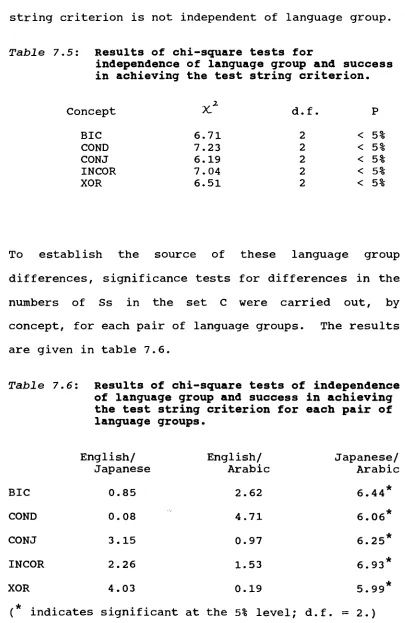
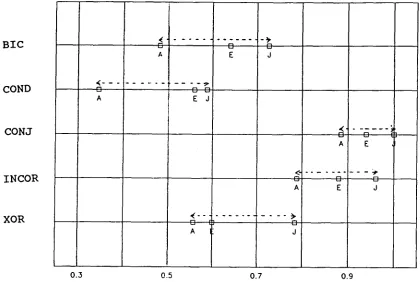
UNDERSTANDING LOGICAL CONNECTIVES: A COMPARATIVE STUDY OF LANGUAGE INFLUENCE.
Rowan Patricia Garnier
Thesis submitted for the degree of Doctor of Philosophy
University of London Institute of Education
ABSTRACT
Operators called 'logical connectives' convey in a precise way the logical relationships between truth functional propositions and hence determine what can be inferred from them. Mathematical reasoning therefore relies heavily on their use. Whilst the operators are free of ambiguity, this is not so for the linguistic items (called 'linguistic connectives') by which they are codified. In English, at least, there is a widely reported mismatch between the logical concepts and the 'meanings' of the linguistic connectives with which they are frequently identified.
This study compares the provision for expressing logical concepts in Japanese, Arabic and English and seeks to ascertain to what extent the problems reported for English are generalisable to the other two languages. It also aims to establish whether the concepts underlying certain logical connectives are 'more readily available' or 'better established' in the speakers of one or other of these languages and, if so, whether this can be attributed to differing provision in the lexicon.
Two experiments were carried out using as subjects adults who were native speakers of either English, Japanese or Arabic. One was designed to determine to what extent the appropriate linguistic connectives in each of the three languages convey the associated logical concepts. The second compared performance on five concept identification tasks where the concepts tested were conjunction, inclusive and exclusive disjunction, the conditional and biconditional.
ACKNOWLEDGMENTS
For a project which has taken as long as this one, there is a risk approaching certainty of failing to mention all those individuals to whom acknowledgment is due. Should this occur, I offer my apologies to those concerned and plead that a regrettable oversight rather than ingratitude be viewed as the cause.
I am grateful to the Faculty and Curriculum Development Committee at Richmond College for the award of finances which helped considerably with the payment of registration fees. For the granting of a semester's study leave which enabled completion of this thesis, I am indebted to the administration and trustees of Richmond College. I also acknowledge with thanks the receipt of a grant from the University of London Central Research Fund towards the cost of honoraria for data collection.
There are many from whose assistance this project has benefitted. I am indebted to Hania Dvorak and Stefan Sperl for their help in matters relating to the Arabic language and to Malcolm Simpson for similar assistance with Japanese. I am also grateful to Harvey Goldstein for his advice and help with the statistical data analysis. Without Fumiya Sawa, Elham Hassanain and Nahed AlShawa who acted as experimenters, there would have been no data to analyse and I therefore appreciate their many hours of hard work. The library staff at Richmond College dealt efficiently and cheerfully with my interminable requests for inter-library loans and I am grateful to them for their patience. Many friends and colleagues have shown an interest in this project and have been supportive in various ways. To attempt to list them would inevitably result in omissions but I would like to express my thanks to Nels Johnson, Amita Sen Gupta, Martin Winter and particularly to John Taylor whose ability to ferret out a flawed argument I have exploited mercilessly.
CONTENTS
Page
ABSTRACT 2
ACKNOWLEDGMENTS 3
Chapter 1: INTRODUCTION 10
Chapter 2: LANGUAGE AND MATHEMATICS 14 Chapter 3: LOGICAL AND LINGUISTIC CONNECTIVES 33
Conjunction 39
Disjunction 40
Conditional and Biconditional 42 Chapter 4: RELEVANT RESEARCH FINDINGS 56 Concept Identification Studies 58 Interpretation of linguistic connectives 71
Propositional reasoning 80
Cross-linguistic research 95 Chapter 5: LINGUISTIC CONNECTIVES IN JAPANESE
AND ARABIC 101
Japanese 101
Conjunctions 104
Disjunctions 108
Conditionals 110
Biconditionals 113
Arabic 113
Conjunctions 116
Disjunctions 117
Conditionals 118
Biconditionals 119
Chapter 6: EXPERIMENTAL METHOD 121
Subjects 124
Experiment 1 129
Test materials 129
Test procedure 131
Experiment 2 134
Test materials 134
Test procedure 136
Page Chapter 7: RESULTS OF EXPERIMENT 1 140
COMPARISON OF RESULTS BETWEEN LANGUAGE
GROUPS 148
Identification of concepts 148 Verbal descriptions of concepts 156 Results for individual concepts 162
Biconditional 162
Conditional 166
Conjunction 170
Disjunction 171
Inclusive disjunction 172 Exclusive disjunction 176 Complexity of verbal descriptions 182 Times to task completion 189 COMPARISON OF RESULTS WITHIN LANGUAGE
GROUPS 194
Identification of concepts 194 Times to task completion 196 SUMMARY OF RESULTS OF EXPERIMENT 1 199 Chapter 8: RESULTS OF EXPERIMENT 2 202 Results for individual connectives 209
Conjunction 209
Disjunction 210
Conditional 211
Biconditional 212
SUMMARY OF RESULTS OF EXPERIMENT 2 213 Chapter 9: DISCUSSION OF RESULTS 215 UNDERSTANDING OF LINGUISTIC CONNECTIVES 215 Comparison across language groups 215 Discussion of results for individual
connectives 218
Understanding of linguistic conjunction 219 Understanding of linguistic disjunction 219 Understanding of linguistic
conditionals and biconditionals 226 PERFORMANCE ON CONCEPT IDENTIFICATION TASKS 236 Relative difficulty of concepts 238 Times to task completion 240 Relative performance of language groups 241 Descriptions of concepts 241
GENERAL DISCUSSION 246
Chapter 10: CONCLUSIONS 254
Implications for learning mathematics 263
Appendices 269
Page
References 273
List of Tables
Table 3.1: Table 3.2: Table 6.1: Table 6.2: Table 7.1: Table 7.2: Table 7.3: Table 7.4: Table 7.5: Table 7.6: Table 7.7: Table 7.8: Table 7.9: Table 7.10: Table 7.11: Table 7.12: Table 7.13:
Definition of logical connective *i by truth value set of p *i q
(i = 1, ..., 16) 34
Definitions of logical connectives 35 Age and gender distribution of
subjects 126
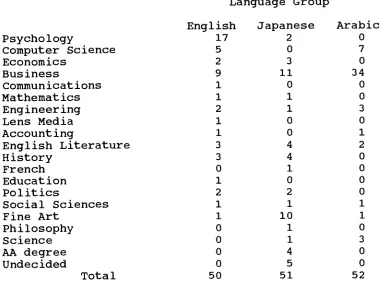
Distribution of major areas of study
of participating Ss 128
Results of experiment 1 classified
by language group and gender 144 Results of likelihood ratio tests
for gender differences in attaining criterion in identifying test
strings 144
Results of likelihood ratio tests for gender differences in correctly
describing the concept 145 Results of experiment 1 by language
group 147
Results of chi-square tests for independence of language group and success in achieving the test string
criterion 150
Results of chi-square tests of independence of language group and success in achieving the test string criterion for each pair of language
groups 150
Results of chi-square tests for independence of language group and success in describing the concept
for Ss in set C 154
Results of chi-square tests for independence of language group and success in identifying test strings
for Ss in set D 155
Breakdown of correct biconditional
descriptions 164
Breakdown of correct conditional
descriptions 168
Breakdown of correct conjunctive
descriptions 170
Breakdown of correct descriptions
of inclusive disjunction 175 Breakdown of correct descriptions
Table 7.14: Table 7.15: Table 7.16: Table 7.17: Table 7.18: Table 7.19: Table 7.20: Table 7.21: Table 7.22: Table 7.23: Table 7.24: Table 8.1: Table 8.2: Page Distribution of correct
descriptions of inclusive and
exclusive disjunction for those Ss who attained criterion on test
strings for both concepts 180 Numbers of elementary propositions
in correct verbal descriptions of concepts used by Ss attaining the
test string criterion 183 Results of one-way ANOVA for
equality of mean number of elementary propositions for Ss in cnD across language groups
(by concept) 184
Tukey's HSD for mean number of
elementary propositions 185 Mean and standard deviation of
times to task completion for Ss
in the sets C and C 189
Summary of two-way ANOVA for times
to task completion 190
Mean times to task completion 191 Results of two-sample t tests for
total times to complete all five
tasks 193
Results of tests of equality of proportions of Ss in set C by
language group 195
Results of ANOVA (repeated measures) for times to task completion within
language groups 197
Results of Newman-Keuls tests for significant differences in mean times to task completion within
language groups 198
Summary of results of experiment 2 205 Frequency distribution of truth
functional interpretations of
linguistic connectives 209
List of figures
Figure 6.1: Figures used in test 2 135
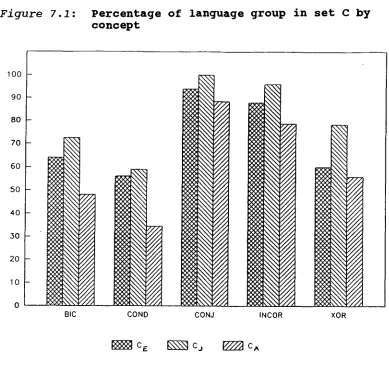
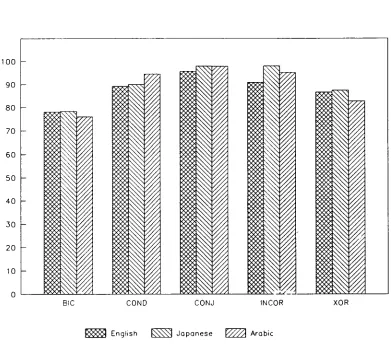
Figure 7.1: Percentage of language group in
set C by concept 149
Figure 7.2: Proportion of each language groups
in set C by concept 152
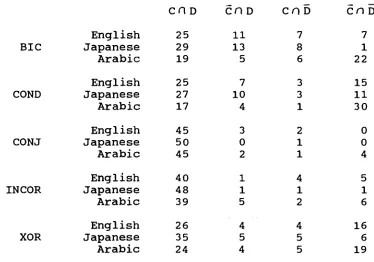
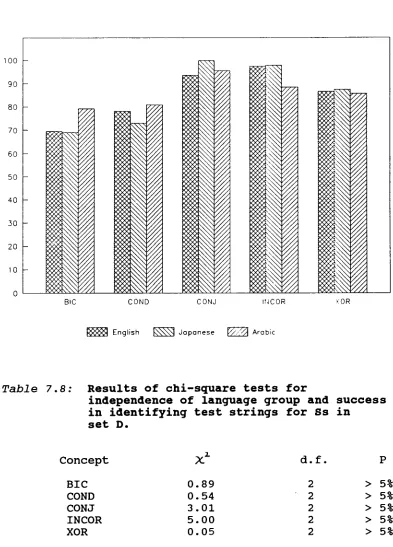
Figure 7.3: Ss in set Cn D as a percentage of
Page Figure 7.4: Ss in set cnD as a percentage of
those in set D 155
Figure 7.5: Mean number of elementary
propositions in descriptions of
concepts 186
Figure 7.6: Scatter diagram of mean number of elementary propositions in correct descriptions of concept (for Ss in set C) against proportion of
language group identifying the
concept 188
Figure 7.7: Mean times to task completion 192 Figure 7.8: Percentage of language group in
Chapter 1
INTRODUCTION
The context for this research project is the very broad question of whether mathematics might be easier to do and to learn in some languages rather than others. Human languages exhibit an extraordinary diversity; they differ in their phonology, in the categories for which they provide labels and in the grammatical rules which legislate how lexical units are combined. Could it be that the native speakers of certain languages have an advantage when it comes to learning mathematics because their language possesses structural features which in some way facilitate the formation of mathematical concepts?
there is ample evidence that, in English at least, a conditional statement such as 'If you clean the car, I'll give you £5' is not understood as conditional in the logical sense, i.e. false only when the addressee cleans the car and doesn't receive £5. In chapter 3 logical connectives are described together with the English language items which are commonly taken to express the logical relations which they define. Also described are the many ways in which these linguistic connectives fail to match up with the associated logical concepts.
Research published in English has dealt almost exclusively with the problems of expressing logical operations in that language. However, languages vary a great deal in the richness of their linguistic connective vocabulary and also in the grammatical structures which are used to convey logical concepts. It is by no means obvious that the problems reported for English language connectives should be universal features of all languages and yet this often seems to be the implicit (but unsupported) assumption.
language groups. More specifically, do these languages provide connectives which convey the associated logical concepts more precisely than English does? Or is there a mismatch between what are normally assumed to be linguistic expressions of logical forms similar to that reported for English? Also, are certain logical concepts 'more readily available' or 'better established' in the speakers of one or other of these languages and, if so, can this be attributed to differing provision in the lexicon?
There are two reasons why these particular languages were chosen. The first is that Japanese, English and Arabic belong to different 'language families'. Each is believed to stem from a different linguistic origin and hence we might expect significant structural differences between them. The second reason is pragmatic - the availability of a local source of native speakers to use as experimental subjects.
Chapter 2
LANGUAGE AND MATHEMATICS
The nature and extent of the relationship between language and thought has been, and remains, the subject of considerable controversy. At one extreme we have the view expressed in the so-called 'Whorfian hypothesis' (alternatively known as the 'Sapir-Whorf hypothesis'), formulated in the 1920s and 30s by the anthropologist Edward Sapir and his student Benjamin Lee Whorf. This proposes that the language we speak imposes upon us a particular way of viewing the world and hence the way in which we think about the world.
'We cut nature up, organize it into concepts, and ascribe significances as we do, largely because we are parties to an agreement to organize it in this way - an agreement that holds throughout our speech community and is codified in the patterns of our language. ... We are thus introduced to a new principle of relativity, which holds that all observers are not led by the same physical evidence to the same picture of the universe, unless their linguistic backgrounds are similar, or can be in some way calibrated.' (Whorf, 1956, pp 212 - 214)
Although there is considerable difference of opinion as to the validity of Whorf's theory, it is not now generally accepted in its 'strong' form - that language determines behaviour and thought. The view that a
be, at best, severely limited and the problems faced by the second language learner would be sufficiently daunting to discourage the attempt. Yet we are told that some ideas, easily expressible in one language, are difficult to translate into another and that bilinguals think differently depending upon the language they are using (see, for instance: Wierzbicka, 1985; Ervin-Tripp, 1964). It is evident that languages differ greatly in the aspects of the physical world which they label and also in the rules which they provide for stringing together basic semantic units. The notion that dissimilar languages influence the thought processes of their respective users in different ways is therefore intuitively appealing.
However, the constraints are not binding and they allow for encountering unusual values and also for correlating the value of a particular variable with those of others to which it is related. Schemata are not simply definitions. They are self-regulating and, when activated, are capable of assessing how well they fit the data currently being processed. It is proposed (Rumelhart, 1980) that schemata represent knowledge at every level of abstraction and that they play a central role in all reasoning and thinking processes. As such they are 'the building blocks of cognition'.
The foregoing account should not be taken to imply that schemata can be formed only for concepts which are labelled nor that language is necessary for concept formation. However, linguistic labels provide a means whereby concepts can be accessed from memory, manipulated at will and communicated to others. Although animals may be able to form certain low order concepts, they are unable to isolate them from the examples which gave rise to them in the first place (Skemp, 1987, p 15). Also, the possession of language greatly increases the range of concepts which can potentially be acquired because it provides for access to those which have been abstracted by other individuals. Without language, a concept must be formed by encountering exemplars and distinguishing them from non-exemplars. However, certain abstract concepts with no perceptible exemplars, such as 'infinity', could not be acquired other than through language.
purposes of communication, but also as a means of internal representation. His conclusion is that labelled schemata play an influential role in both the external and internal domains and also in the development of thought, leading each generation of speakers towards the specific schemata for which their culture has developed labels.
places fewer demands on expensive space in short-term memory. Although there is a concomitant additional burden on long-term memory, space there is virtually limitless and the net result is that 'a language user thinks most efficiently about those topics for which his or her lexicon has provided an efficient code'.
making the perceptual judgements necessary to select the word. They also propose a further correlation - that between the frequency of such perceptual discriminations and the 'accessibility' of the underlying concept. To summarise, shorter words tend to label more commonly encountered (and therefore more familiar) concepts so that '... more nameable concepts are nearer the top of the cognitive "deck"'.
Whilst the linguistic relativity hypothesis is compelling, experimental evidence in support of it is little more than flimsy. This is not surprising since we do not have direct access to the thoughts of the members of the linguistic groups we might wish to compare. All we can do is to look for differences in non-linguistic behaviour which might be attributable, in whole or in part, to language variation. This is clearly problematic. Whilst languages differ markedly and in ways that are amenable to analysis, the non-linguistic behaviour of their speakers can be attributed to the influence of a large number of inextricably inter-related variables.
1) The languages under investigation must exhibit differences in their lexicon with respect to the domain.
2) There must be some objective way of measuring the features of the domain which are reflected in lexical differences.
3) The cultures whose languages are being investigated must have much the same experience of the domain so that differences in non-linguistic behaviour cannot be attributable simply to dissimilar encounters with it.
4) Measures of non-linguistic behaviour associated with the domain must be independent of language and not deduced from it.
5) Differences in non-linguistic behaviour should be explainable in terms of an interaction between linguistic and cultural variables.
colours and, after these had been removed, were asked to pick them out on a chart consisting of 120 different colours. Their results led them to propose that highly codable colours were more likely to be remembered and recognised. A measure of codability was arrived at by considering the length of the word used to describe the colour, the amount of hesitation with which Ss responded to the colour with its name and the degree of agreement amongst Ss as to what was the appropriate name for the colour. Thus a colour to which Ss responded quickly with a short name agreed upon by all was said to be highly codable.
Brown and Lenneberg's conclusions have been criticised by, for instance, Rosch (1974). She points to the results of Berlin and Kay (1969) which suggest that certain colours have more perceptual salience than others and, as a direct result, are more codable. Thus memory for colours may derive from perceptual characteristics which are universal rather than culturally specific linguistic factors. This highlights the difficulty in separating the effects of linguistic categories from the effects of those factors which led to the formation of those categories in the first place. A phenomenon with perceptual salience will itself always be especially amenable to reference.
(1984). Their Ss were English speakers and speakers of Tarahumara, a language which does not distinguish green and blue. Ss were asked to indicate which of three coloured chips in the blue/green range was most different from the remaining two. It was found that English speakers' perceptual judgements were distorted when chips were on the blue/green boundary. This, it was proposed, was due to the fact that, given a difficult discrimination task, Ss had resorted to judgements based on lexical rather than perceptual characteristics. On identifying the central of the three chips, the one 'most different' was the one with a different name. There was no such trap available for the Tarahumara speakers who therefore had a greater tendency to make the correct perceptual judgements. Kay and Kempton concluded that '... there do appear to be incursions of linguistic categorisation into apparently nonlinguistic processes of thinking, even incursions that result in judgements that differ from those made on a purely perceptual basis'.
as in 'If I were rich, I would own a yacht'. Chinese speaking subjects showed a marked resistance to move into the counterfactual realm stating that it was an 'un-Chinese' (or even a 'Western') way of thinking. Bloom proposed that, because of this limitation of the Chinese language, a counterfactual interpretation would require considerably more cognitive effort for Chinese speakers than it would for their English counterparts. His experimental evidence seemed to support this contention.
Bloom's results provoked a flurry of criticism. Au (1984) found fault with his experimental procedure, claiming that the stories used to test counterfactual understanding were not idiomatic and were therefore difficult for the Chinese speakers to understand regardless of their counterfactual content. She repeated Bloom's experiments with more idiomatic stories and concluded that Chinese speakers have no particular problem in interpreting counterfactuals. Liu (1985) carried out experiments which also seemed to support this claim.
abstract realm that language is most likely to influence thought processes. Bloom is not alone in subscribing to this view. Lemon's (1981) research led him to suggest that, where concepts derive their meaning in verbal contexts rather than through direct sensory experience, language may affect categorisation. Cole and Scribner (1974, p 59) hold a similar opinion which they summarise thus:
'It may very well be that the "filtering effect" of language is greatest in respect to domains of phenomena that are definable, not in terms of physical properties, but in terms of attributes that are culturally specified. ... Or consider the area of ideology or theoretical work in general, where concepts largely acquire their meanings through their being embodied in explanatory verbal networks. It is here that language may play the greatest role in shaping the person's view of reality, in influencing his memory and thinking processes, and in contributing to his understanding or misunderstanding of other cultures.'
triangles do not share. In any case, many (perhaps most) mathematical concepts do not lend themselves to any obvious form of imagery. Whilst we may learn something about triangles by manipulating mental 'pictures' it is difficult to accept that such a process would be productive in learning something about 'groups', for instance.
Classification, generalisation and abstraction are essential features of mathematical activity. Whilst mathematical facts may be discovered by experimenting with concrete materials, it is the generalisation of these facts which is the ultimate goal. Such generalisation involves abstraction and the formation of concepts which are independent of any concrete situation. Also important to mathematical thinking is an appreciation of how mathematical objects are classified into categories whose members share common properties. Furthermore, these categories are inter-related. A square has certain properties by virtue of the particular relationship of its sides and angles. However, a square is a rhombus and therefore has properties which are shared by all rhombuses. Rhombuses are parallelograms which also have their own characteristics, and so on. This view of the nature of mathematical abstraction is summarised by Dienes:
already formed class and, therefore, it is more of a logical operation whereas abstraction is regarded as a constructive operation.' (quoted in Philp, 1973).
The most fundamental way in which a language may fail to make adequate provision for 'doing' mathematics is by not having a vocabulary which meets the subject's requirements, i.e. by having an insufficiently well-developed register of mathematical terms. (Indeed this has been reported as one of the reasons why many African countries have favoured English or French as the medium of instruction rather than native languages which lack the vocabulary necessary for technological subjects (Macnamara, 1967).) This can be solved by adding words to label the necessary concepts although the introduction of vocabulary for certain abstract concepts could prove problematic. For instance, certain African languages lack connectives and quantifiers such as 'all', 'some', 'only' and 'if' (CASME, 1975). The introduction of terms to convey these relational concepts is clearly more problematic than the introduction of nouns, even if the latter are abstract. However, languages are never static and the 'modernisation' of those which have had to accommodate a proliferation of technical terms has been engineered in an interesting variety of ways (see, for instance, Gallagher, 1969). The introduction of new vocabulary is a constant feature of any language and so there is no reason to believe that mathematical registers cannot be expanded using appropriate strategies.
mathematically is in its lack of provision for classification hierarchies. Philp (1973) argues that the way in which objects are classified depends, at least in part, on the language used. From the results of research by Kelly (unpublished) in New Guinea, Philp proposes that: 'These data ... support the earlier findings that it is as if the accessibility of inclusive words in a language in some way affects and restricts the inclusiveness of classifications which the child is able to make.' He draws attention to the number of languages which incorporate linguistic classifiers thereby encouraging their speakers to classify other than according to Western logical categories. The suggestion is that the logic of mathematics is the logic of the Indo-European languages and it must not be assumed that this is necessarily the logic inherent in other languages.
Watson (1988) also subscribes to this view:
'The words and operations of mathematics, as a field, are in the history of mathematics, a discipline which developed in Indo-European cultures, using and developing the language games of Indo-European cultures in specific ways. Mathematics is not just a set of concepts that anyone can learn as easily as anyone else. It is a specific Indo-European product. Learning mathematics will be easier for children whose language is Indo-European.'
'The development of mathematics may be seen as an attempt to overcome the weaknesses of natural languages for the purpose of exact and elegant statement. The terminology of science has been successful to the extent that it has been able to surmount the limitations imposed by natural language and produce an inter- and supralinguistic language.' (Haugen, 1977)
He goes on to say that accounts of scientific theories are expressed in the language of mathematics and are therefore translatable into any language regardless of its grammar, syntax or phonology. However, accounts which utilise natural language are necessarily only approximations because the ideas involved cannot be expressed precisely in any language. This seems to miss the point, however. Whilst the concepts which underlie mathematical symbols are, in the main, precise and unambiguous, those concepts may well be more alien to some cultural groups rather than others.
different from those attached to them in normal usage. For example, 'ring', 'function' and 'root' label concepts in mathematics which have little, if anything, in common with their more widely recognised referents. In so many cases, it is as though words used to label mathematical objects have been selected and assigned at random from the natural language lexicon. This cannot but create difficulties for the learner of mathematics who must assign a label, already laden with connotative and denotative meaning, to a new concept.
particularly acute for various African countries (Nairobi, 1974; Morris, 1978; Berry, 1985), but is by no means confined to Africa nor to developing countries. For instance, it has also been described for Aboriginal children in Australia (Crawford, 1988; Watson, 1988). Children learning mathematics in their native language may also suffer from the effects of a curriculum which is not in sympathy with their cultural and linguistic norms (see, for instance, Bernstein, 1971).
Chapter 3
LOGICAL AND LINGUISTIC CONNECTIVES
In symbolic logic, a set of operators called 'logical connectives' allow the formation of compound truth- functional propositions from simple ones. These operators are binary in the sense that each is used to conjoin two (simple or compound) propositions. The truth value of the resulting proposition is completely determined by two factors - the truth values of the two component propositions and the particular connective used to conjoin them. In addition to the binary connectives, negation acts as a unary operator reversing the truth value of a proposition to which it is applied. If the proposition p is true, then its negation
T
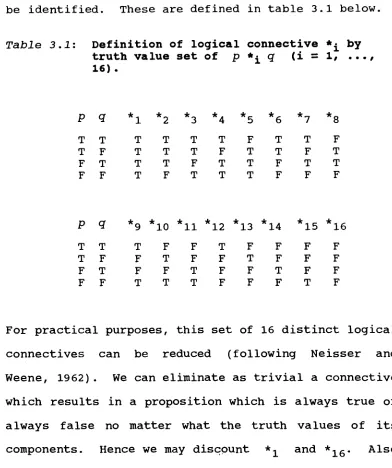
is false and vice versa.of 16 different logical connectives (*1, s *1, "'' *16) can be identified. These are defined in table 3.1 below.
Table 3.1: Definition of logical connective *i by truth value set of p *i q (i = 1, ..., 16).
P q *1 *2 *3 *4 *5 *6 *7 *8 T T T T T T F T T F T F T T T F T T F T F T T T F T T F T T F F T F T T T F F F
P q *9 *10 *11 *12 *13 *14 *15 *16 T T T F F T F F F F T F F T F F T F F F
F T F F T F F T F F
F F T T T F F F T F
For practical purposes, this set of 16 distinct logical connectives can be reduced (following Neisser and Weene, 1962). We can eliminate as trivial a connective which results in a proposition which is always true or always false no matter what the truth values of its components. Hence we may discount *1 and *16. Also p *3 q has exactly the same truth value set as q *4 p
.
Since either of the component propositions may be labelled p or q arbitrarily, one of these connectives is redundant. For the same reason, so is one connective in each of the pairs *6 and *7,*10 and *11, *13 and *14'
of the pair are the reverse of those defining the other. This is equivalent to saying that the compound proposition formed by using one member of the pair is simply the negation of that formed by using the other. Table 3.2 below shows, for each of these ten logical connectives, the defining truth value set, the usual symbolic representation of the compound proposition p * q and the term used to refer to that connective.
Table 3.2: Definitions of logical connectives.
p T T F F Symbolic representation q T F T F of p * q
*2 T T T F p v q Inclusive disjunction *15 F F F T p v q Joint denial
*4 T F T T p q Conditional *13 F T F F p q Exclusion
*12 T F F F p A q Conjunction
*5 F T T T p q Alternative denial *8 F T T F p q Exclusive disjunction *
9 T F F T P +- q Biconditional *6 T T F F Affirmation of p *
11 F F T T Denial of p
that for pAeq. In fact, all of the propositions above could be expressed in terms of negation and, for instance, conjunction. For example, we could replace the proposition denoted by py q by (p i% q)
A
(PA4)
which has exactly the same truth value set. In a similar way, a binary proposition containing any of the ten connectives defined above can be replaced by an equivalent one which uses only negation and conjunction. (By 'equivalent' we mean one having the identical set of truth values.) We can condense the set even further, dispense with negation and use only the single connective defined by the truth value set for alternative denial. This connective is sometimes known as the 'Scheffer stroke function' and is denoted by
1
. Conjunction, for example, would then be expressed as (pl q) 1 (p I q).The examples above demonstrate that any significant reduction in the connectives symbolised results in an increase in the symbolic complexity of compound propositions. So, despite the inherent redundancy in the set, negation together with the five connectives described above are conventionally used to symbolise compound propositions.
allow us to assess whether the conclusion drawn from stated premises is consistent with those premises or whether there is some faulty step in the deductive process which claims to support the validity of the conclusion. It is clearly necessary for such arguments to be expressible, not only in symbols, but also in natural language. Furthermore, logical problems frequently involve an assessment of the truth or falsity of a compound proposition when the truth values of its components are known. In order to carry out such an evaluation, it is necessary to identify the particular connectives used. If the argument is expressed in language, this information must be deduced from the linguistic content of the proposition.
can be formed by using negation or by combining p and q using each of the logical connectives V, A, ,
and H .
p: Tom is not American.
pvq: Tom is American or Max is a student or both. p Aq: Tom is American and Max is a student.
p-0.q: If Tom is American then Max is a student.
p3eq: Tom is American or Max is a student but not
both.
p-r*q: Tom is American if and only if Max is a
student.
logical operators with which they are frequently identified.
Conjunction
Although 'and' can be used to link two statements to form a compound statement whose truth or falsity can be deduced according to the rules of truth functional logic, there are other statements containing 'and' which cannot be so interpreted. It can be argued that a sentence like 'John and Mary are students' is simply an abbreviation of the conjunction of the two propositions 'John is a student' and 'Mary is a student'. However, no such argument can be sustained for 'John and Mary are colleagues'. Copi (1986) maintains that such propositions must be regarded as simple (i.e. making only a single statement) rather than as compound propositions with two components.
Logical conjunction is symmetric in the sense that it is commutative; /DA g is equivalent to qn p. However
non-linguistic knowledge about the two events and is not part of the semantic content of 'and'. Lakoff (1971) argues that, with the asymmetric 'and', the truth of the first member of the pair of propositions must be presupposed for the second to have any meaning. Denying the first assertion renders the compound proposition nonsensical and does not therefore invite an analysis based on logical rules.
Despite the fact that 'and' does not always have an interpretation which can be identified with logical conjunction, the divergence between the logical and linguistic forms is less than is the case for other connectives. It is for this reason that Strawson (1952) proposes that all connectives be defined in terms of negation and conjunction.
Disjunction
inclusively, this sense can be made explicit by adding 'or both'. Where it is to be given the exclusive interpretation, the phrase 'but not both' can be affixed. However, 'or' is frequently used without either of these qualifiers and, when this is the case, it is not clear which interpretation is intended, especially if no contextual cues are available.
In logic, 'or' is conventionally interpreted inclusively whereas, when 'or' is used in natural language, it is claimed that it is usually taken to represent exclusive disjunction (Lakoff, 1971; Sternberg, 1979; Newstead and Griggs, 1983). On the other hand, Pelletier (1977) is of the opinion that in English 'or' always represents inclusive disjunction and that the exclusive interpretation is the result of an individual's judgement that it is impossible or unlikely for both disjuncts to be true simultaneously. Gazdar (1979, p 78) is even more emphatic that the inclusive interpretation is basic and claims 'that there is no clear evidence to the effect that exclusive disjunction has ever been lexicalised in any language'.
it is debatable which of the two interpretations is basic and therefore how an ambiguous 'or' statement will be interpreted. Damarin (1977) found that the inclusive interpretation of 'or' was favoured amongst pre-service elementary teachers when interpreting statements about mathematical items. However, there was also a marked tendency for her Ss to interpret 'or' statements in this context as if they were conjunctions.
An additional ambiguity of the word 'or' in natural language is that it is sometimes used where the logical sense of 'and' is intended as in 'I eat meat or fish'.
Conditional and Biconditional
antecedent guarantees a false consequent. Furthermore, the biconditional is clearly the intended interpretation in many 'if ... then' statements. On hearing 'If you don't take an umbrella, then you'll get wet', the addressee will assume that if he does take an umbrella (and uses it appropriately) he won't get wet. On the other hand 'If we go in August, then the weather will be hot' does not seem to suggest that the weather is hot only in August and therefore invites an interpretation equivalent to the logical conditional.
There is no difficulty in interpreting a statement of the form 'if p then q' when the antecedent, p, is true. The statement would normally be regarded as true when q is true and false when q is false. It is the case of a false antecedent which is problematic. Wason and Johnson-Laird (1972) argue that the antecedent in an 'if ... then' statement is regarded as an indication of presupposition. The listener must assume the truth of the antecedent in order to interpret the sentence and will regard it as null and void if the antecedent turns out to be false. They therefore propose a 'defective' truth table for a conditional expressed in natural language, that is, one with an entry of 'irrelevant' for the two cases where the antecedent is not true.
between antecedent and consequent and which therefore dictates a symmetry between the two components. Although the FT case is true logically, it is not considered true causally. The failure of the logical conditional to account for comprehension of 'if • • •
then' statements is attributed to the fact that it does not take account of the semantic relationship between the two component propositions. As Comrie (1986) points out - there is a fundamental difference between conditionals in logic and in natural language. In logic there is no necessity for the antecedent and consequent to be related, causally or otherwise. A conditional proposition such as 'If Rome wasn't built in a day then London is north of the equator' is perfectly acceptable in logic but would evoke some surprise were it stated in normal conversation.
The biconditional, expressed linguistically using 'if and only if', has attracted less attention from researchers than have conjunctive, disjunctive and conditional language connectives. Lemmon (1965, p. 28) suggests that it is 'of rare occurrence in ordinary speech'. Since, as we have already seen, there is a tendency for conditional statements to interpreted as the logical biconditional, we might expect this tendency to be even more pronounced in interpreting statements containing 'if and only if'. If this is the case, a reasonable match might be expected between the linguistic and logical forms of this particular connective even though the language form is rarely used.
Gazdar (1979, chapter 4) claims that, of the 16 possible logical connectives, only two, conjunction and inclusive disjunction, are lexically encoded and that this is probably a universal feature of all languages. He suggests that there is some feature of the human mind which demands a convenient expression for these logical forms and that conjunction in particular is an unlearned innate human concept. He precludes 'if ... then' from having truth functional status because context affects its truth conditions.
and the sort of reasoning that takes place in day-to-day natural language exchanges. In the former nothing may be assumed other than the information contained within the propositions stated. In general conversation however, this is not the case. If A says to B 'If you don't take an umbrella, then you'll get wet', B will reason with a variety of inferences and assumptions not conveyed by the statement alone. For instance, he well almost certainly infer that it is raining (or that it is about to rain). Furthermore, A can reasonably assume that B will infer that it is raining (or about to rain) so that this information need not be stated explicitly. He will also assume that B knows that, in normal circumstances, he can avoid getting wet in the rain by using an umbrella appropriately. It may be that A really meant his statement to be a true conditional (rather than a biconditional) because, say, A knew that B's route would take him past some children throwing buckets of water at passers-by. If B subsequently got drenched because he had failed to use the umbrella at the appropriate time, he could not strictly accuse A of uttering a falsehood. However he could justifiably claim that he had been misled and intentionally so.
The potential ambiguity in 'On Monday I shall be attending a conference in Paris or visiting a friend in Birmingham' is resolved by the shared knowledge that the two constituent propositions are unlikely to be true simultaneously and that 'or' should therefore be interpreted exclusively.
Grice (1975) subsumes what he believes to be the conventions of normal language utterances under what he terms the 'cooperative principle'. Speakers try, as far as they can, to be truthful, relevant and informative, and listeners assume that speakers will be so. This allows much to be inferred that is not made explicit. He proposes 'conversational implicatures' - information not stated but understood by a listener by virtue of his assumption that the speaker is being co- operative. The discrepancy between linguistic and logical statements is viewed as a consequence of the fact that a natural language statement conveys more than its analytic meaning.
because they can be cancelled without apparent contradiction. For instance, 'If I study hard then I'll pass my exams and if I don't study hard I may or may not pass my exams' is a perfectly acceptable statement. Another invited inference proposed is 'but not both' in the expression
'p
orq'.
This can also be countermanded by adding 'or both' without producing a contradiction.The above makes clear the necessity to distinguish logical and linguistic connectives and yet this distinction is frequently neglected. Dik (1968, p 259) makes the point:
'Even in the context of the description of natural language, the co-ordinators are often classed as "logical connectives" and treated as if the "meanings" attached to such connectives in logic are directly relevant to the semantic description of natural language. ... It is no disparagement of logic (nor of natural language) when I stress the undeniable fundamental differences between the two. Again and again, students of natural language and of logical systems have rightly noted that the two are objects of fundamentally different natures, both in their aims and in their internal properties.'
In mathematics, the only acceptable form of reasoning is that which conforms to the laws of symbolic logic. Skemp (1987, pp 170 - 171) emphasises the importance of logical understanding for successful mathematical activity. This he considers is 'evidenced by the ability to demonstrate that what has been stated follows of logical necessity, by a chain of inferences, from (i) the given premises, together with (ii) suitably chosen items from what is accepted as established mathematical knowledge (axioms and theorems). This involves analysis, and the construction of chains of logical reasoning to produce what we call demonstrations or proofs.'
it is important to be able to distinguish conditional and biconditional propositions; given a mathematical statement of the form 'if p then q', the invited inference 'if not p then not q' will lead to errors of deduction. Furthermore mathematical objects are abstractions and therefore the contextual cues available in everyday language exchanges are not necessarily available to aid interpretation. Evans' (1982) assertion that '"If it is a dog then it is an animal" obviously does not entail the converse.' is true enough but it presupposes that the addressee is already familiar with the relationship between dogs and animals. In this case the statement is not informative and is therefore redundant. In mathematics, the interpreter of the statement 'If it is a rhombus then it is a parallelogram' may well be in the position of knowing nothing about the relationship between the two quadrilaterals other than that which the statement conveys. In particular, he may have no idea as to whether or not the statement may be taken to entail its converse, especially when his experience with natural language uses of 'if ... then' allows that it may or may not.
Politzer (1986) suggests that the lack of congruence between logical and linguistic connectives may go some way towards explaining poor performance in mathematics.
interpretation of the scientific language based on the pragmatic laws of language rather than on the logic conventions. Such a propensity to use pragmatic conventions would affect inferential activities but have little effect on algorithmic activities (such as calculating fractions, solving equations, etc.) hence the distinction that is well-known to Mathematics teachers between being good at Geometry (that requires the most use of hypothetico-deductive thought) and good at Algebra (that requires the most use of algorithms).'
Given that mathematical reasoning depends critically upon understanding logical relationships, it is not surprising that linguistic connectives are considered important devices for learning and doing mathematics. Imperfect as they are, it is they that must bear the burden of expressing logical relationships. Using children and adults as Ss, Johansson (1977) compared the level of mastery of the words 'and' and 'or' with performance in logical tests of conjunction and disjunction. He found a correlation between the level of understanding of the words and the quality of performance on the logical tests. Dawe (1982) investigated the ability of bilingual children to reason deductively in mathematics. He found that the single most important factor differentiating English children's performance on a test of mathematical reasoning- was a knowledge of linguistic connectives and that this factor also separated high from low achievers amongst bilinguals. His conclusion was that development of the ability to use linguistic connectives in their logical sense was important for success in mathematics.
vary enormously in the richness of their logical connectives vocabulary.' (Wilson, 1984). In the same paper, Wilson also points out the rather surprising fact that there are Commonwealth languages which lack such connectives (see also CASME, 1975). It is reported (Cohen, 1977, p. 94) that, in Chinese, there are no words equivalent to 'and' and 'or'. The conjunction of two statements p and q is expressed as 'there is p, there is q' and disjunction as 'if not p then q'. Moore (1982) reports that the Navajo language has no standard word for 'if', a fact which he associated with evidence that hypothetical thinking is not readily accepted by some Navajo speaking students. He also felt that this might go some way in explaining the poor performance of Navajo students on Piagetian conservation tasks.
for the antecedent to precede the consequent and in some languages this is obligatory. Although there appear to be some universal features of conditionals, it has been found that their expression can differ substantially from the English form 'if ... then' (Traugott et al, 1986, p. 5).
The ambiguity surrounding the word 'or' in English might be resolved, one would suppose, were the inclusive and exclusive forms to have distinct linguistic expressions. Attempts to identify languages which distinguish these forms have not been wholly successful. Copi (1986, p. 272) claims that Latin makes this distinction as does Quine (1974, p. 12). However, Dik (1968, p. 274) denies that the two forms in question parallel the logical distinction. The Kpelle in Liberia were also thought to have a separate linguistic expression for the two forms (Gay and Cole, 1967). Zepp (1989), having examined many world languages, has failed to find one which has an unambiguous word for exclusive as distinct from inclusive disjunction. He points out that this seems to indicate a fundamental difference between the foundations of mathematics and that of language development.
Chapter 4
RELEVANT RESEARCH FINDINGS
There are several areas of research pertinent to this study. Amongst these are investigations which have attempted to elucidate how linguistic connectives are understood and how this understanding (or lack of it) influences success in deductive reasoning. Of the various forms of reasoning, it is propositional reasoning which depends critically upon the logical relationships which the connectives define. Therefore we shall not review the extensive research on reasoning with categorical syllogisms where successful inference depends upon understanding quantifiers such as 'some' and 'all'.
concept. This view spawned a body of research which investigated the relative difficulty of learning different concepts using non-verbal stimulus materials. This type of investigation virtually ceased in the late 1970s when the classical view was replaced by theories based on schemata (see chapter 2) and prototypes (Rosch and Mervis, 1975). However, these 'concept identification' studies are of interest because they have shown that, given certain types of stimulus elements, some logical concepts are easier to identify than others.
Also of interest are attempts to establish whether the results obtained in the areas outlined above generalise to speakers of languages other than English,
particularly non-European languages.
studies which have examined developmental factors in the interpretation of linguistic connectives and in deductive reasoning. Should this project reveal differences in the performance of adults in different language groups, the burden of future research will be to elucidate the underlying developmental patterns.
Concept identification studies
A number of studies have focussed on concept learning behaviour. In these, typically the S is presented with a sequence of stimulus materials which vary along a number of dimensions, e.g. colour, form, size. The experimenter has in mind a subset defined by, say, one value (termed an 'attribute') of each of two dimensions and a rule for combining these values. Thus for any particular concept, not all dimensions are relevant.
both. The conditional concept 'if A then B' is exemplified by all stimuli except those which exhibit A but not B and the biconditional by those with both attributes or neither.
governing how these attributes are combined. In some investigations the S is told the relevant attributes and must determine the rule of combination. In others the rule is known and the relevant attributes must be identified. The former is often termed 'rule learning' and the latter 'attribute identification'. 'Complete learning' is used to describe concept identification tasks where neither the attributes nor the rule of combination is known.
A consistent finding of research into conceptual rule learning is that Ss find some rules easier than others. Neisser and Weene (1962) report that their adult Ss found conjunction, inclusive disjunction and the conditional easier than exclusive disjunction and the biconditional. Within the first group of concepts, the conditional was more difficult than the other two. A practice effect was noted - Ss' performance improved when the same concept was presented a second time.
expressed as combinations of two Level I concepts using the primitive connectives. Hence conjunction, inclusive disjunction and the conditional (interpreted as pvq) are Level II concepts. Level III concepts are combinations (using primitive connectives) of those at Level II and therefore include exclusive disjunction
((PA
q) v (p i\ 4)) and the biconditional (IDA q) v ( 5A -4)).In an attempt to explain why higher level concepts might be more elusive, it was suggested that a contributory factor might be the difficulty of formulating them verbally. These concepts could therefore be less familiar so that Ss might find them more difficult to keep in mind.
expressed as fciv q and assigned to Level II on this basis. However (p n q) V (15/1 q) v (5 A 4) is an alternative expression for this connective in terms of conjunction and inclusive disjunction. Were the conditional to be interpreted in this form, it would then be assigned to Level IV.
requires the TT cases (both attributes present) to be placed in the same response category as the FF cases (both attributes absent). The set of positive instances of the conditional concept is therefore large and non-homogeneous. An additional factor suggested as contributing to the relative difficulty in identifying the conditional concept is the fact that the non-commutativity of the rule requires Ss to distinguish FT and TF cases and assign them to different categories.
In a subsequent experiment, Haygood and Bourne (1965) tested Ss on four concept identification tasks where the concepts tested were the conditional, biconditional, conjunction and inclusive disjunction. Biconditional and conditional concepts were more difficult than conjunction and disjunction. Again the authors propose the assignment of TT and FF stimuli to the same class as contributing to the greater difficulty of the conditional and biconditional concepts.
implication is that Ss employ some kind of informal version of the truth table as a mediating device in the identification process. It is proposed that differences in the ease of identifying different concepts may be due to differing amounts of experience with the concepts or to unexpected assignments of certain truth table categories. However, with training, these differences tend to disappear so that Ss develop an appropriate strategy for identifying the concepts with equal facility.
With conjunction, errors were much the same for all the truth table categories. The assignment errors for disjunction, the conditional and biconditional are to a large extent those which would result from the identification of each concept as conjunction. Bourne therefore concludes that some of the differences in rule difficulty may be accounted for by a predilection for conjunctive concepts which must be suppressed when identifying other concepts. However, this seems a rather unsatisfactory explanation given that the biconditional differs from conjunction in the assignment of only one truth table category (FF) and yet it was the most difficult of the four concepts tested.
these concepts after at most one assignment error in each of the four categories.
table is given by the results of Dodd et al (1979). Truth table pretraining was found to improve performance in identifying concepts, presumably because it provided Ss with an appropriate strategy for all subsequent tasks.
rule difficulty would be less pronounced for young children. However, it has been shown that disjunctive concepts are more difficult to identify than conjunctive ones even for children as young as 5 or 6 years old (King, 1966; Snow and Rabinovitch, 1969).
inference model assumes that, should these lead the S to change the response category of FF stimuli, then he will similarly change the response categories for TF and FT instances. He will also attempt to maintain different response categories for the FF and TT categories; a change in one of these will cause a change in the other. Conjunction is therefore easy because it is consistent with the S's pre-experimental bias. Inclusive disjunction is more difficult because it requires the TF and FT categories to be assigned differently from FF stimulus elements. It is proposed that an increment in difficulty occurs when any of the inference operations are violated and that the magnitude of this increment is proportional to the number of different stimulus elements whose response category runs counter to a given inference. This is dependent on the proportion of stimulus elements in each truth table category and hence on the number of attributes on each relevant dimension.
integrate with any other dimension so that, for example, the attributes 'one' and 'circle' are likely to be viewed conjunctively. On the other hand, some combinations of attributes are more difficult to integrate and tend to be viewed separately thereby encouraging a disjunctive interpretation. Colour and form seem to fall into this category.
In a later paper (Ketchum and Bourne, 1980), it is proposed that 'the local integrality' hypothesis described above is too simple to explain rule bias. It is suggested that certain attributes such as colour are perceptually more salient. The S therefore tends to respond positively to an instance which is positive with regard to colour regardless of the presence/absence of the other relevant attribute. The tendency to respond to a highly salient attribute as positive results in a propensity for a disjunctive sorting. If no perceptually salient feature is relevant, Ss will tend to sort stimulus elements conjunctively.
conditional and biconditional. The reason for this differential rule difficulty is far from clear however, and none of the explanations offered seems entirely satisfactory.
Interpretation of linguistic connectives
A number of studies have attempted to elucidate how linguistic connectives are interpreted in a particular context and to compare this interpretation with the corresponding logical form. In general the experimental tasks involved are such that they elicit some or all of the truth table which a S associates with a particular linguistic connective. Usually this is achieved by providing the truth values of two simple propositions p and q and requesting Ss to assess the truth value of compound propositions such as 'if p then q'. Alternatively, the truth value of the compound statement is given and the S's task is to provide possible truth values for the simple components. Errors are taken to have occurred when the truth values elicited do not correspond to those which define the corresponding logical connective.
disjunction and the conditional. Ss were asked to assume the truth of just the first component and to evaluate the compound proposition as always true, always false or neither. Propositions containing negation were found to be more difficult than those which did not. Also conjunction was slightly easier than disjunction and the conditional was more difficult than either.
These results were replicated with another sample of pre-service teachers (Damarin, 1977b) when Ss were given compound propositions and asked to evaluate for which combinations of truth values of the simple components the proposition was true. The compound propositions consisted of two components. The first stated whether a number M was odd or even and the second made a similar statement about a number N. It was also reported that Ss were more likely to assign an inclusive interpretation to the word 'or', a finding which seems to conflict with the widely held view that, in natural language, disjunction is exclusive (see chapter 3).
constituted a different truth table category for each of the conditional propositions. For example, given the conditional 15-q, the truth of p and q renders the first component false and the second true so that the conditional is true. For however, these truth values give a false conditional statement. Evans found that the cases where the antecedent was false were less likely to be judged as irrelevant when these were the cases where p and q were true.
A similar investigation of the interpretation of disjunctive sentences (Evans and Newstead, 1980) showed that there were more errors of interpretation when just one of the components of the disjunctive proposition was negated. Also the majority of Ss interpreted disjunction inclusively, assessing TT cases as consistent with the disjunctive statement. No evidence of 'matching bias' was found, however.
confirming, TF cases as disconfirming and FT and FF cases as irrelevant was elicited by the first and last forms (p-*q and pA
4) .
'Not p if not q' was similarly treated as irrelevant when the antecedent (now4)
was false. In interpreting the disjunctive form1-5v
q, Ss did not classify stimuli as irrelevant but tended to favour the correct conditional interpretation.Airasian et al (1975) investigated the understanding of logical statements in adolescents presumed to have reached the stage of formal operations. The results led to the proposal of a hierarchy, the levels of which are conjunction, exclusive disjunction, inclusive disjunction, the conditional and biconditional. Understanding of each is a pre-requisite for the understanding of all subsequent connectives in the hierarchy. However, these findings are difficult to interpret since the linguistic form of the test statements used is not given.
connectives is reported as: conjunction, biconditional, inclusive disjunction, conditional.
Sternberg's (1979) results are somewhat at odds with those of Paris, described above. Interpretation of the biconditional was found to be the most susceptible to error and Sternberg's Ss (7 - 13 year olds and college students) favoured an exclusive interpretation of 'or'. However, his experimental method was rather different. Ss were given a compound proposition and required to assess the truth or falsity of all four truth table categories. Also reported is a preference by younger children for the inclusive interpretation of 'or', which diminished with increasing age in favour of the exclusive interpretation. Younger children also showed a preponderance for a biconditional reading for 'if ... then' which was replaced by a greater tendency for the conditional reading amongst older children. However the biconditional interpretation was not uncommon even amongst college students. The transition from a biconditional to a conditional reading seemed to occur earlier for a conditional statement expressed using 'only if'.
at all age levels whereas performance on disjunctive items improved steadily with age. The generality of their findings was investigated by Neimark and Slotnick (1970) who repeated some of their tests with American children in the same age range. Whilst the general results were similar, there was some indication that Japanese children perform better than American children of the same age. Beilin and Lust (1975) suggest that this developmental difference could be attributable to the greater ambiguity in the expression of logical connectives in English.
evidence does not seem to support such a view with any consistency.
It is interesting to note that the relative difficulty of interpreting linguistic connectives mirrors to a large extent the difficulty of identifying the underlying logical concepts in non-verbal concept identification tasks. As Lenneberg (1962) observes: in most instances of experimental concept formation, there is a correlation between ease of naming the concept and ease of attaining it.' A possible explanation of the relative difficulty of identifying logical concepts is that, for those with ambiguous labels, the underlying schemata are inadequately formed or infrequently invoked. In either case, the underlying concept is less familiar and therefore more difficult to access.
the concept'. However, the evidence suggests that such a verbal statement will be more difficult to formulate for certain logical concepts.
Propositional reasoning
to test the validity but must attempt to supply a valid conclusion himself. This type of task is similar to those used to investigate understanding of linguistic connectives (described in the last section). However it requires a scanning of the whole truth table rather than just the individual rows.
experience in computing'). When offered as further evidence that natural language disjunction is exclusive this is not really convincing since a number of the major premises used to cover other contexts are such that it is highly unlikely that both disjuncts could be true simultaneously. For instance, 'My wife will be either watching television or preparing a meal' and 'It [a poem] was written either by Ian Jennings or by Peter Lambert' do seem to invite an exclusive interpretation.
Roberge (1978) investigated reasoning with major premises in which the connectives were 'or ... but not both', 'or ... or both' and also conditional premises expressed using 'if ... then' and 'only if'. In each case the minor premise was the denial of the second component of the major premise. Reasoning with premises with abstract content (e.g. 'There is a J only if there is a W') was compared with those with concrete content ('If Joan is athletic then she is rich'). Also investigated was the effect of polarity (negation in either or both components) in the major premise. The following were the more relevant findings of this research.