Contractors Working Experience In Connection With
Understanding On Contract Construction Projects
Taufik Dwi Laksono
Department Civil Engineering, Wijayakusuma University, Purwokerto, Indonesia
Abstract
This research aimed to identify the correlation among contractors experiences and construction contract understanding. Method used in this research was survey method with a questionaire as instuments towards 30 respondents as researchs samples. Data collected were respondent’s experiences and construction contract understanding. The correlations were known by Coefficient Contigency correlation analysis. The result showed that respondent’s experiences had no correlation with the levael of construction contract understanding. Respondents who were not yet understand the contract content were caused by unperfect contract that needs some improvement.
Key-words: construction, delayed, factor, caused.
1. Introduction
Implementation of the project involves the construction of service providers (contractors and consultants) and the project owner (owner) are interlinked in a binding labor agreement is called a contract. The construction project is successful if the service provider to successfully implement the project according to the time, cost and quality stipulated in the contract documents [4] Henong (2016). The successful implementation of construction works is determined by the choice of technology, the definition of work tasks, estimate the resources required and the duration for individual tasks, as well as the identification of any interaction between the various work tasks [5] Ismael and Junaidi, (2014).
In construction, the contractual relationships that occur in the process of execution of work in the field is between project owners and contractors. Understand the contractual relationships will greatly assist in coordination and simultaneously prevent potential disputes unnecessary [2] Hansen (2015).
Breach of contract is a violation of one or more of the requirements contained in the contract, the consequences should be borne by the parties to the agreement. Depending on the level of violations that occurred as a result of the offense against the injured party can demand according to the rules [1] Ervianto (2003).
Problems will arise in the implementation of construction projects that do not comply with the contract construction projects, one of which is the delay. Delays in construction projects led to the loss of cost, time, the emergence of the dispute, the emergence of a lawsuit, the work becomes dormant, and the incidence of litigation [3] Haseeb et al (2011).
How to improve the quality, efficiency, productivity and cost-effective in construction projects by Bussiners Roundtable's Construction Industry Cost Effectiveness (Cicé) is through increased constructability. Constructability is the knowledge and experience optimum construction at the stage of planning, design, procurement and implementation of the field so that the building can be completed woke up with an effective, efficient and good quality [9] Sulistio and Magawati (2013).
Contractors need to conduct a review of the contract prior to the signing of a contract. Things that need to be reviewed, among others [7] PP (2003):
1. The administrative requirements, including the condition of the assignor, the presumed source of funds, the estimated value of the contract, method of payment, penalty for late completion of work, late payment penalties by the assignor, the articles of the contract incriminating contractors and bidders become a competitor.
2. Terms of techniques, including: the company's experience, especially for similar work, material specifications which must be held, construction equipment is needed, the time of the construction, according to the requirements for qualification of personnel, environmental conditions around the project site.
This study was conducted to determine the relationship of contracting experience in the implementation of the project of building the understanding of the construction work contract. Relationships implementation of the action in anticipation of delays in project implementation with an understanding of building construction work contract.
2. Methodology
suggestions on the sample size for the study is a decent sample size in the study were between 30 to 500.
Research conducted in the southern part of Central Java, Indonesia country of the 30 respondents who are contractors of construction services provider. Data were collected using a questionnaire to determine the length of contractors engaged in the construction world (years), the biggest contract (billion Rupiah), the project owner (a private company, government, or private), the project implementation time (days), project delays (never / ever), long delays in project implementation (days), things to do in the event of delays, things to consider when signing construction contracts, understanding the content of the contract (know / do not know), and understanding of the construction contract. Data penelitiaan obtained, then made changes into quantitative data by using a nominal scale [6] Mukhtar (2013). Variable experience contractor in dabbling in the world of construction, the value of the biggest contract, the project owner, the project implementation time, project delays, long delays in project implementation, things to do in the event of delays, and things to consider when signing a construction contract is then determined to do with an understanding of the content of the contract, and an understanding of the construction contracts using correlation analysis with contingency coefficient:
(1)
With :
= Nilai Chi-Square o = frequency of observation fe = Frequency expectations
The expected frequency value is obtained using the formula:
(2)
After the Chi-Square value is obtained, it is then transformed into a contingency coefficient formula:
(3)
With :
CC = Koefisien Kontigensi = Nilai Chi-Square N = Number of observations
Contingency coefficient value which has a significance value of <0.05 indicates a significant relationship between the two variables tested.
3. Result and Discussion
The results of the questionnaire respondent data to the understanding of the contents of the contract of construction projects can be seen in Table 1. Based on the results of the study, there were 15 respondents who expressed understanding of the content of the contract and 15 respondents did not understand the contents of the building project contracts.
Tabel 1. Variabel frequency distribution
Variable Category
Fill understanding Contract
Total Not
undestand understand
Length of contractors engaged
in the construction world
0 - 5 years 8 3 11
6 - 10 years 6 8 14
> 15 years 1 4 5
Total 15 15
Biggest contract 0.0 - 1.0 billion rupiah 2 2 4
1.1 - 10.0 billion rupiah 11 11 22
10.1 - 25.0 billion rupiah 1 0 1
25.1 - 50.0 billion rupiah 0 1 1
> 50 billion rupiah 1 1 2
Tabel 1. Variabel frequency distribution (continued)
Variable Category
Fill understanding Contract
Total Not
undestand understand
Project owner Private 5 6 11
Goverment 10 9 19
Total 15 15
Project
implementation time
0 - 100 days 4 1 5
101 - 200 days 8 12 20
201 - 300 days 1 2 3
> 301 days 2 0 2
Total 15 15
Project delays Never 7 8 15
No ever 8 7 15
Total 15 15
Long delays 0 - 15 days 10 14 24
16 - 30 days 3 1 4
31 - 45 days 1 0 1
> 45 days 1 0 1
Total 15 15
Things to do When It's Too Late
Not taking action 1 1 2
Extra time workforce 1 1 2
Making changes to working methods 1 1 2
Re-schedule 1 1 2
Adding manpower 2 2 4
extra labor time and make changes to
working methods 0 2 2
Extra time employment and increase
labor 1 4 5
Generating support tools and make
changes to working methods 1 0 1
Extra time employment, increase labor
and make changes to working methods 3 0 3
Extra time employment, re-schedule
and increase labor 1 0 1
Extra time employment, generating support tools, make changes to working methods and re-schedule
Extra time employment, generating support tools, make changes to working methods and increase labor
0 1 1
Tabel 1. Variabel frequency distribution (continued)
Variable Category
Fill understanding Contract
Total Not
undestand understand
Things to do When It's Too Late
Extra time employment, generating support tools, make changes to working methods, re-schedule and increase labor
1 2 3
Extra time employment, generating support tools, make changes to working methods, re-schedule, increase labor, fulfillment of material and maximize tool
1 0 1
Total 15 15
Things to consider when contract signature
No things 0 1 1
Time of project 1 0 1
The rights and obligations of each
party 1 1 2
Budget plan and working drawing 3 2 5
Time of project and contract value 2 0 2
The rights and obligations of each party, budget plan and working drawing
1 0 1
Time of project, the rights and obligations of each party, budget plan and working drawing
1 0 1
Time of project, the technical specifications required, budget plan and working drawing
0 4 4
Time of project, contract value, the rights and obligations of each party, and the technical specifications required
0 1 1
Time of project, contract value, the technical specifications required, budget plan and working drawing
2 2 4
Time of project, contract value, the rights and obligations of each party, the technical specifications required, budget plan and working drawing
Time of project, contract value, the technical specifications required, budget plan, working drawing and procedure of payment
1 0 1
Total 15 15
Results of correlation analysis with contingency coefficient shows that variables the length of contractors engaged in the construction world, the value of the biggest contract, the project owner, the project implementation time, project
delays, long delays in project implementation, things to do in the event of delays, and things note when signing a construction contract does not correlate significantly to the understanding of the contents of the contract (Table 2).
Table 2. Correlation Coefficient Contingency value variables of the study to the understanding of the contents of the contract
Variable Pearson Chi-Square
Asymp. Sig.
Contingency Coefficient
Approx.
Sig. Information
Length of contractors engaged
in the construction world 4.358 0.113 0.356 0.113
Not significant Biggest contract
2.000 0.736 0.250 0.736 Not significant Project owner
0.144 0.705 0.069 0.705 Not significant
Project implementation time 4.933 0.177 0.376 0.177 Not significant
Project delays 0.133 0.715 0.067 0.715 Not
significant
Long delays 3.667 0.300 0.330 0.300 Not
significant Things to do When It's Too
Late 12.133 0.517 0.537 0.517
Not significant Things to consider when
contract signature 12.343 0.388 0.540 0.388
Not significant
The duration of the respondents involved in the world of construction is not related to the level of understanding of the content of the construction contract means that the longer the respondents were in the construction world is not followed by a high understanding of the content of the construction contract (Table 2). This is indicated by the number of respondents with a long dive 0-5 years and> 15 years who understand the contract was not much different constructs. In addition, the number of respondents who have been in the world of construction for 6-10 years is almost the same. The contract value is also not related to the understanding of the contents of a construction contract. The higher the value of the contract is not followed by the pahamnya respondents to the contents of the contract. A total of 11 respondents stated that understand and do not understand the contents of the contract on the largest contract value by category 1.1 - 10.0 billion rupees. On the other hand, the highest value of the contract also has a frequency of respondents do not know and understand that balanced well (Table 1).
Respondents who do not understand and have understood the contents of the contract with the same dominant frequency in a category causes the variable correlation was not significant (Table 2). The level of understanding of the content of the contract and the project owner variable delay is balanced in each category, while at the time of execution, the respondents who do not understand and have understood dominant in the category of 101-200 days. Delays in the implementation of building projects at most that 0-15 day delay experienced by 24 respondents. Of these, 10 respondents stated not familiar with the contents of the contract and the remaining 14 are respondents who understand the content of the contract (Table 1). Thus, it means that the delay is not due to building projects or nothing to do whether a contractor was familiar with the contents of the contract or not (Table 2).
labor, but some are not taking any action when the construction project has been delayed, although the respondents were already familiar with the contents of the contract (Table 1). Things that concern while respondents signed a construction contract with the most nominations of respondents (7), which is the time of project implementation, the value of the contract, the rights and obligations of each party, the technical specifications required, as well as budget planning and working drawings ( table 1). The decision respondent to pay attention to these
aspects are not based on the level of their understanding of the content of the contract (Table 2).
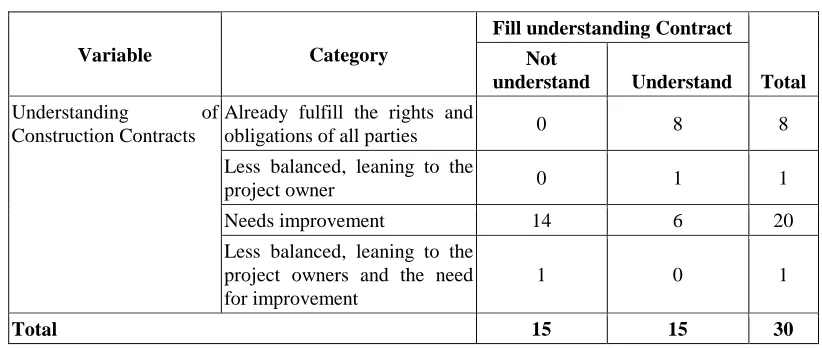
The identification results of respondents' understanding of construction contracts in Table 3 shows that 14 respondents who do not understand the content of the contract because the contract is not perfect and in need of repair. While one of the respondents who do not understand the contents of the contract states that the construction contract was less balanced, leaning to the project owners and the need for improvement.
Table 3. Understanding of Construction Contracts
Variable Category
Fill understanding Contract
Total Not
understand Understand
Understanding of Construction Contracts
Already fulfill the rights and
obligations of all parties 0 8 8
Less balanced, leaning to the
project owner 0 1 1
Needs improvement 14 6 20
Less balanced, leaning to the project owners and the need for improvement
1 0 1
Total 15 15 30
CONCLUSION
Experience the respondents including the old contractor in dabbling in the world of construction, the value of the biggest contract, the project owner, the project implementation time, project delays, long delays in project implementation, things to do in the event of delays, and things to consider when signing a contract construction did not correlate significantly to the understanding of the contents of the contract. Respondents who do not understand the content of the contract because the contract is not perfect and in need of repair. While one of the respondents who do not understand the contents of the contract states that the construction contract was less balanced, leaning to the project owners and the need for improvement.
ACKNOWLEDGMENTS
This research still needs to be refined. Researchers will conduct research related to the understanding of a construction contract can add variables to be reviewed so as to provide a clearer picture about the understanding of the construction contract fuller longer.
REFERENCES
[1] Ervianto, I. W, Manajemen Proyek Konstruksi, Yogyakarta : Andi, 2003.
[2] Hansen, S, Manajemen Kontrak Konstruksi, Jakarta: Gramedia Pustaka Utama, 2005
[3] Haseeb, M., Xinhai-Lu, A. Bibi, Maloof-ud-Dyian, & W. Rabbani. Problems of Projects and Effects of Delays in the Construction Industry of Pakistan.
Australian Journal of Business and Management Research. Volume 1, No. 5, 2015, Page 41 – 50. [4] Henong, Sebastinus Baki, Analisis Faktor-Faktor yang
Mempengaruhi Keterlambatan pada Proyek Pemerintahan di Kota Kupang. Prosiding Seminar Nasional Teknik Sipil, 2016. Hal 149 – 154.
[5] Ismael, Idzurnida., Junaidi, Identifikasi Faktor-faktor yang Mempengaruhi Keterlambatan Pelaksanaan Pekerjaan pada Proyek Pembangunan Gedung di Kota Bukittinggi.
Jurnal Momentum.
Volume16,
No.1, 2014, Page 25 – 36.
[6] Mukhtar, Metode Praktis Penelitian Deskriptif Kuantitatif, Jakarta: Referensi. 2013
[7] Pembangunan Perumahan, Buku Referensi untuk Kontraktor Bangunan Gedung dan Sipil. Jakarta: PT. Gramedia Pustaka Utama. 2003.
[9] Sulistio, H., Magawaty, Peran Kontraktor dalam Peningkatan Constructability pada Pembangunan Jalan Jembatan Wilayah Kalimantan Timur. Media
Komunikasi Teknik Sipil. Volume 19, No 1, 2013, Hal 27 – 39.
[10]Supardi, Aplikasi Statistika dalam Penelitian,
Jakarta:Change Publication, 2013.